DIC GMC YUKON 2004 Owner's Manual
[x] Cancel search | Manufacturer: GMC, Model Year: 2004, Model line: YUKON, Model: GMC YUKON 2004Pages: 554, PDF Size: 5.21 MB
Page 387 of 554

Only vehicles that have the 5.3L V8 engine (VIN
Code Z) may use 85% ethanol fuel (E-85). General
Motors encourages the use of E-85 in vehicles that are
designed to use it. The ethanol in E-85 is a “renewable”
fuel, meaning it is made from renewable sources
such as corn and other crops.
Many service stations will not have an 85% ethanol fuel
(E-85) pump available. The U. S. Department of
Energy has an alternative fuels website
(http://afdcmap.nrel.gov/nrel/) that can help you nd
E-85 fuel. Those stations that do have E-85 should have
a label indicating ethanol content. Do not use the fuel
if the ethanol content isgreaterthan 85%. Your vehicle
may not operate properly if the ethanol content is
greater than 85%.
At a minimum, E-85 should meet ASTM
Specication D 5798.
To insure quick starts in the wintertime, the E-85 fuel
must be formulated properly for your climate according
to ASTM specication D 5798. If you have trouble
starting on E-85, it may be because your E-85 fuel is
not properly formulated for your climate. If this happens,
switching to gasoline or adding gasoline to your fuel
tank may improve starting. Your vehicle is designed to
accommodate a mixture of gasoline and E-85 fuel.
For good starting and heater efficiency below 32°F
(0°C), the fuel mix in the fuel tank should contain no
more than 70% ethanol.E-85 has less energy per gallon than gasoline, so you
will need to rell your fuel tank more often when
using E-85 than when you are using gasoline. Regular
unleaded gasoline is recommended when pulling a
trailer. For payload capacity with ethanol fuel, see
Loading Your Vehicle on page 4-56.
Notice:Some additives are not compatible with
E-85 fuel and may harm your fuel system. Damage
caused by additives would not be covered by
your new vehicle warranty. Do not use additives
with E-85 fuel.
Notice:Your vehicle was not designed for fuel that
contains methanol. Do not use fuel containing
methanol. It can corrode metal parts in your fuel
system and also damage the plastic and rubber
parts. That damage would not be covered under
your warranty.
5-7
Page 389 of 554

{CAUTION:
If you spill fuel and then something ignites it,
you could be badly burned. Fuel can spray out
on you if you open the fuel cap too quickly. This
spray can happen if your tank is nearly full, and
is more likely in hot weather. Open the fuel cap
slowly and wait for any “hiss” noise to stop.
Then unscrew the cap all the way.
Be careful not to spill fuel. Don’t top off or overll your
tank and wait a few seconds after you’ve nished
pumping before you remove the nozzle. Clean any
spilled fuel from painted surfaces as soon as possible.
SeeCleaning the Outside of Your Vehicle on
page 5-107.
When you put the fuel cap back on, turn it to the
right (clockwise) until you hear a clicking sound. It will
require more effort to turn the fuel cap on the last turn as
you tighten it. Make sure you fully install the cap. The
diagnostic system can determine if the fuel cap has
been left off or improperly installed. this would allow fuel
to evaporate into the atmosphere. SeeMalfunction
Indicator Lamp on page 3-51.
{CAUTION:
If a re starts while you are refueling, do not
remove the nozzle. Shut off the ow of fuel by
shutting off the pump or by notifying the
station attendant. Leave the area immediately.
Notice:If you need a new fuel cap, be sure to get
the right type. Your dealer can get one for you.
If you get the wrong type, it may not t properly.
This may cause your malfunction indicator lamp to
light and may damage your fuel tank and emissions
system. SeeMalfunction Indicator Lamp on
page 3-51.
5-9
Page 393 of 554
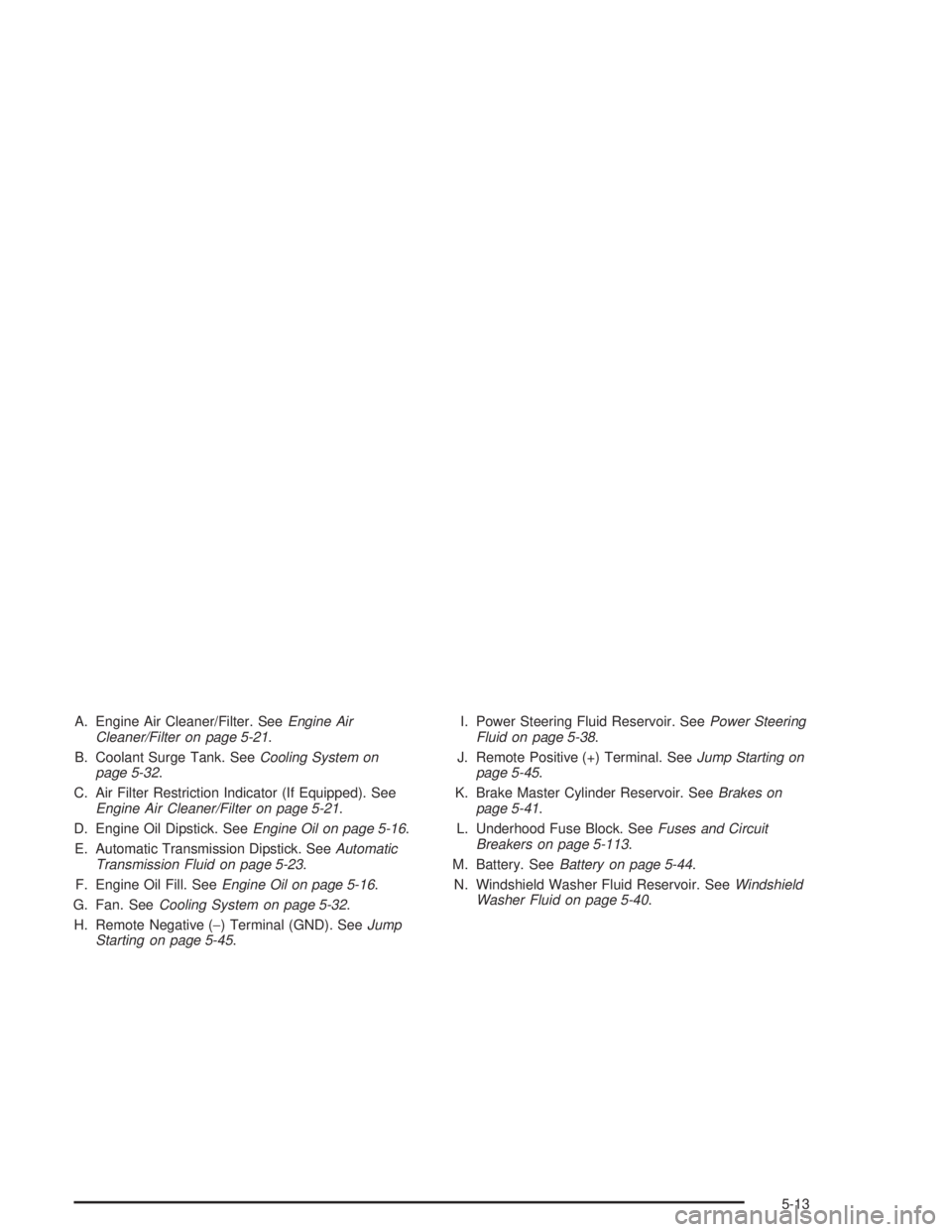
A. Engine Air Cleaner/Filter. SeeEngine Air
Cleaner/Filter on page 5-21.
B. Coolant Surge Tank. SeeCooling System on
page 5-32.
C. Air Filter Restriction Indicator (If Equipped). See
Engine Air Cleaner/Filter on page 5-21.
D. Engine Oil Dipstick. SeeEngine Oil on page 5-16.
E. Automatic Transmission Dipstick. SeeAutomatic
Transmission Fluid on page 5-23.
F. Engine Oil Fill. SeeEngine Oil on page 5-16.
G. Fan. SeeCooling System on page 5-32.
H. Remote Negative (−) Terminal (GND). SeeJump
Starting on page 5-45.I. Power Steering Fluid Reservoir. SeePower Steering
Fluid on page 5-38.
J. Remote Positive (+) Terminal. SeeJump Starting on
page 5-45.
K. Brake Master Cylinder Reservoir. SeeBrakes on
page 5-41.
L. Underhood Fuse Block. SeeFuses and Circuit
Breakers on page 5-113.
M. Battery. SeeBattery on page 5-44.
N. Windshield Washer Fluid Reservoir. SeeWindshield
Washer Fluid on page 5-40.
5-13
Page 395 of 554
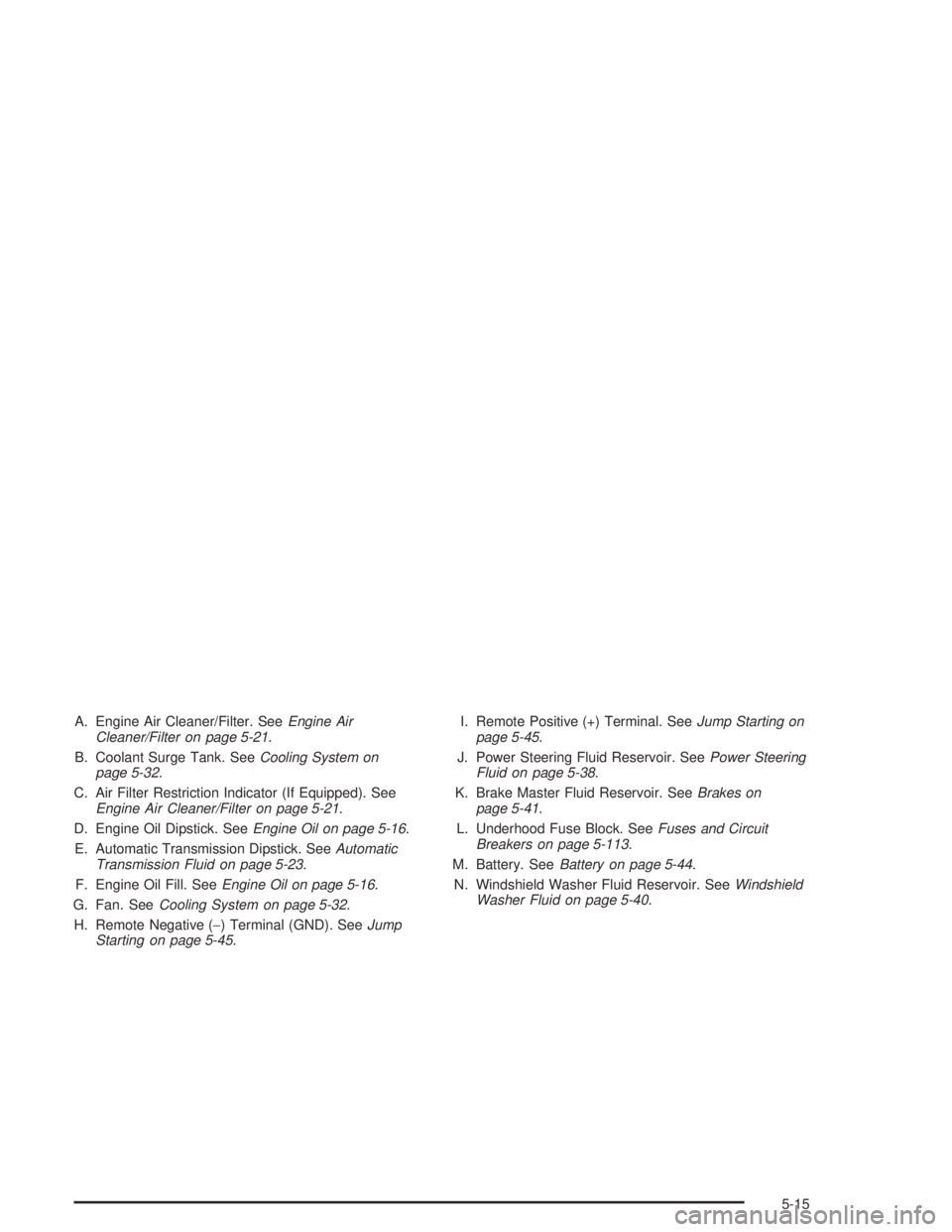
A. Engine Air Cleaner/Filter. SeeEngine Air
Cleaner/Filter on page 5-21.
B. Coolant Surge Tank. SeeCooling System on
page 5-32.
C. Air Filter Restriction Indicator (If Equipped). See
Engine Air Cleaner/Filter on page 5-21.
D. Engine Oil Dipstick. SeeEngine Oil on page 5-16.
E. Automatic Transmission Dipstick. SeeAutomatic
Transmission Fluid on page 5-23.
F. Engine Oil Fill. SeeEngine Oil on page 5-16.
G. Fan. SeeCooling System on page 5-32.
H. Remote Negative (−) Terminal (GND). SeeJump
Starting on page 5-45.I. Remote Positive (+) Terminal. SeeJump Starting on
page 5-45.
J. Power Steering Fluid Reservoir. SeePower Steering
Fluid on page 5-38.
K. Brake Master Fluid Reservoir. SeeBrakes on
page 5-41.
L. Underhood Fuse Block. SeeFuses and Circuit
Breakers on page 5-113.
M. Battery. SeeBattery on page 5-44.
N. Windshield Washer Fluid Reservoir. SeeWindshield
Washer Fluid on page 5-40.
5-15
Page 396 of 554
Engine Oil
If the CHECK OIL LEVEL message appears on the
instrument cluster, it means you need to check
your engine oil level right away.
For more information, see “CHECK OIL LEVEL” under
DIC Warnings and Messages on page 3-70.
You should check your engine oil level regularly; this is
an added reminder.
Checking Engine Oil
It is a good idea to check your engine oil every time you
get fuel. In order to get an accurate reading, the oil
must be warm and the vehicle must be on level ground.
The engine oil dipstick handle is a yellow loop. See
Engine Compartment Overview on page 5-12for
the location of the engine oil dipstick.
Turn off the engine and give the oil several minutes to
drain back into the oil pan. If you don’t, the oil
dipstick might not show the actual level.
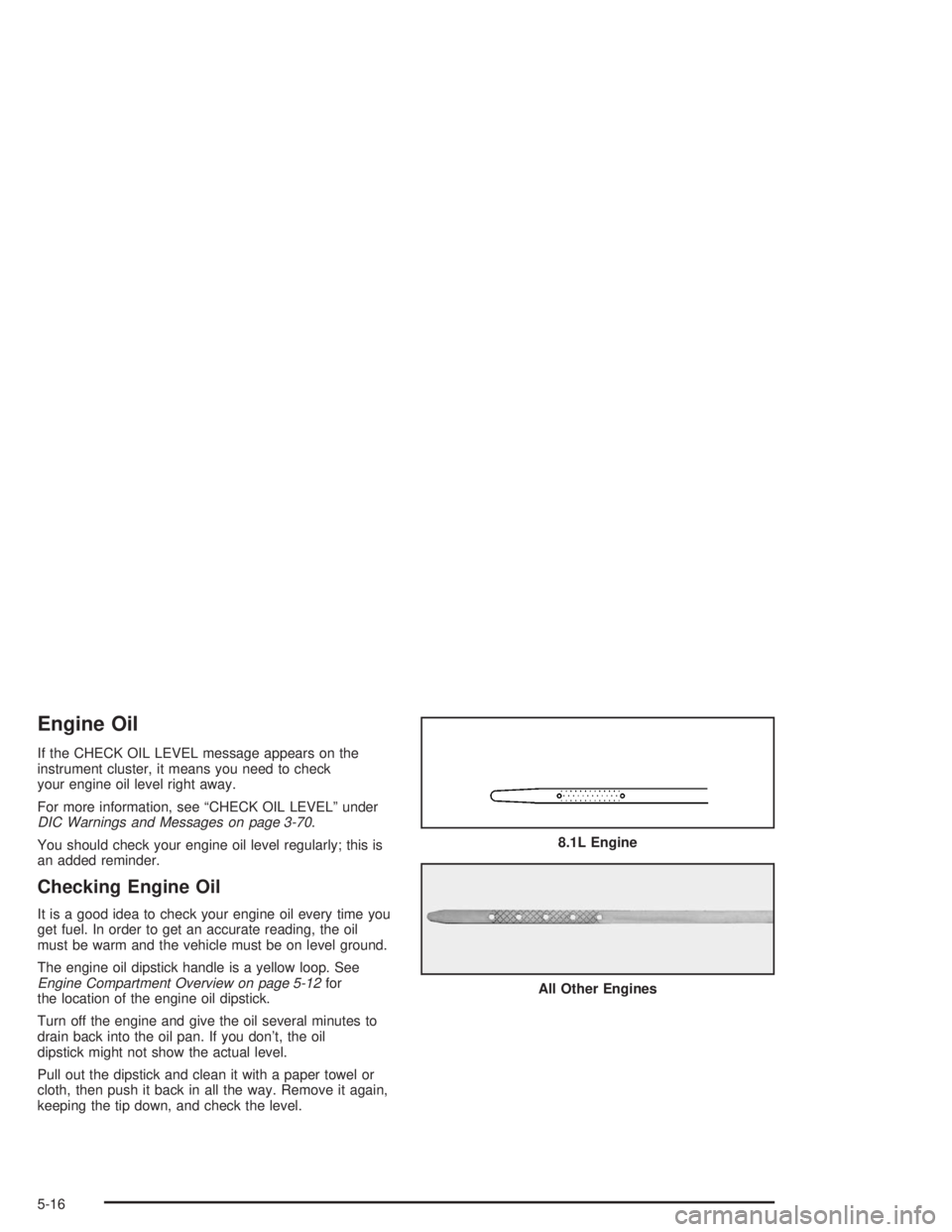
Pull out the dipstick and clean it with a paper towel or
cloth, then push it back in all the way. Remove it again,
keeping the tip down, and check the level.8.1L Engine
All Other Engines
5-16
Page 398 of 554
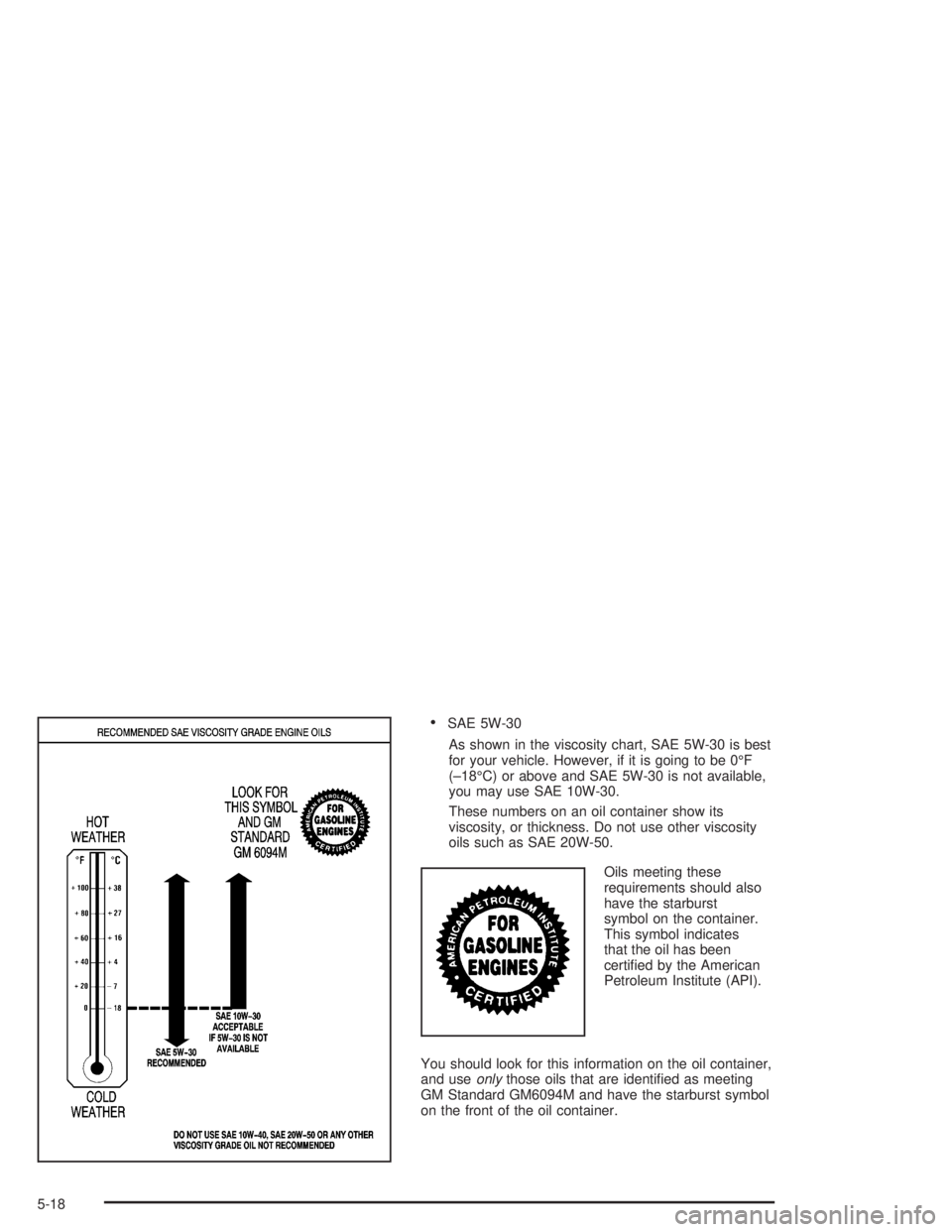
SAE 5W-30
As shown in the viscosity chart, SAE 5W-30 is best
for your vehicle. However, if it is going to be 0°F
(–18°C) or above and SAE 5W-30 is not available,
you may use SAE 10W-30.
These numbers on an oil container show its
viscosity, or thickness. Do not use other viscosity
oils such as SAE 20W-50.
Oils meeting these
requirements should also
have the starburst
symbol on the container.
This symbol indicates
that the oil has been
certied by the American
Petroleum Institute (API).
You should look for this information on the oil container,
and useonlythose oils that are identied as meeting
GM Standard GM6094M and have the starburst symbol
on the front of the oil container.
5-18
Page 399 of 554
Notice:Use only engine oil identied as meeting
GM Standard GM6094M and showing the American
Petroleum Institute Certied For Gasoline Engines
starburst symbol. Failure to use the recommended
oil can result in engine damage not covered by
your warranty.
GM Goodwrench
®oil meets all the requirements for
your vehicle.
If you are in an area of extreme cold, where the
temperature falls below−20°F (−29°C), it is
recommended that you use either an SAE 5W-30
synthetic oil or an SAE 0W-30 oil. Both will provide
easier cold starting and better protection for your engine
at extremely low temperatures.
Engine Oil Additives
Do not add anything to your oil. The recommended oils
with the starburst symbol that meet GM Standard
GM6094M are all you will need for good performance
and engine protection.
When to Change Engine Oil (GM Oil
Life System)
Your vehicle has a computer system that lets you know
when to change the engine oil and lter. This is based on
engine revolutions and engine temperature, and not on
mileage. Based on driving conditions, the mileage at
which an oil change will be indicated can vary
considerably. For the oil life system to work properly, you
must reset the system every time the oil is changed.
When the system has calculated that oil life has been
diminished, it will indicate that an oil change is necessary.
A CHANGE ENGINE OIL message will come on. Change
your oil as soon as possible within the next two times you
stop for fuel. It is possible that, if you are driving under the
best conditions, the oil life system may not indicate that
an oil change is necessary for over a year. However, your
engine oil and lter must be changed at least once a year
and at this time the system must be reset. Your dealer
has GM-trained service people who will perform this work
using genuine GM parts and reset the system. It is also
important to check your oil regularly and keep it at the
proper level.
If the system is ever reset accidentally, you must
change your oil at 3,000 miles (5 000 km) since your
last oil change. Remember to reset the oil life system
whenever the oil is changed.
5-19
Page 400 of 554
How to Reset the CHANGE ENGINE OIL
Message
The GM Oil Life System calculates when to change
your engine oil and lter based on vehicle use. Anytime
your oil is changed, reset the system so it can
calculate when the next oil change is required. If a
situation occurs where you change your oil prior to a
CHANGE ENGINE OIL message being turned on, reset
the system.
To reset the CHANGE ENGINE OIL message, see “GM
Oil Life System” underDIC Operation and Displays
on page 3-58for vehicles equipped with the DIC, or do
the following:
1. Turn the ignition key to RUN with the engine off.
2. Fully press and release the accelerator pedal slowly
three times within ve seconds.
If the OIL LIFE RESET message ashes for 10
seconds, the system is resetting.
3. Turn the key to LOCK.
If the CHANGE ENGINE OIL message comes back on
when you start your vehicle, the engine oil life system
has not reset. Repeat the procedure. If it still does
not reset, see your dealer for service.
What to Do with Used Oil
Used engine oil contains certain elements that may be
unhealthy for your skin and could even cause cancer.
Do not let used oil stay on your skin for very long. Clean
your skin and nails with soap and water, or a good
hand cleaner. Wash or properly dispose of clothing or
rags containing used engine oil. See the manufacturer’s
warnings about the use and disposal of oil products.
Used oil can be a threat to the environment. If you
change your own oil, be sure to drain all the oil from the
lter before disposal. Never dispose of oil by putting it in
the trash, pouring it on the ground, into sewers, or into
streams or bodies of water. Instead, recycle it by taking it
to a place that collects used oil. If you have a problem
properly disposing of your used oil, ask your dealer, a
service station or a local recycling center for help.
5-20
Page 401 of 554
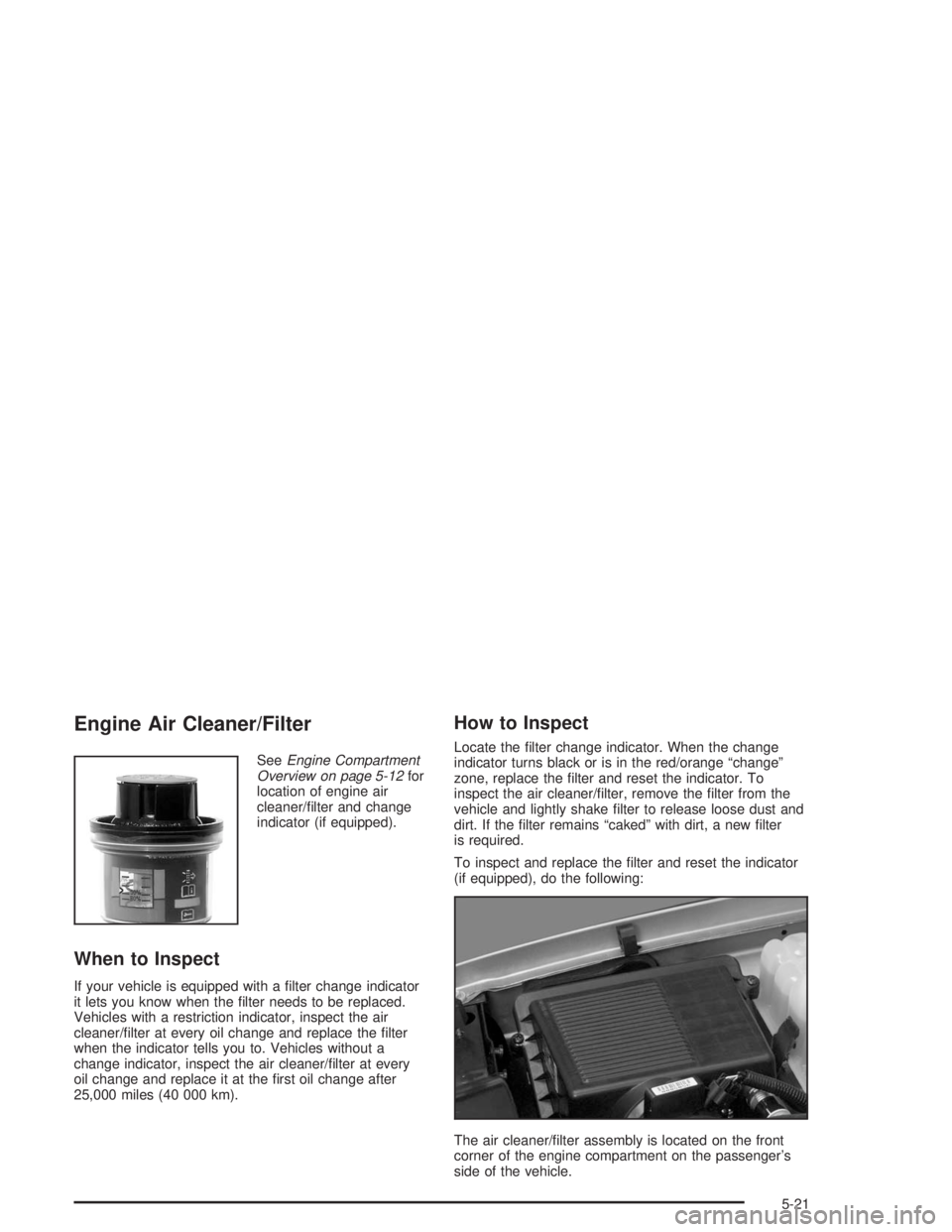
Engine Air Cleaner/Filter
SeeEngine Compartment
Overview on page 5-12for
location of engine air
cleaner/lter and change
indicator (if equipped).
When to Inspect
If your vehicle is equipped with a lter change indicator
it lets you know when the lter needs to be replaced.
Vehicles with a restriction indicator, inspect the air
cleaner/lter at every oil change and replace the lter
when the indicator tells you to. Vehicles without a
change indicator, inspect the air cleaner/lter at every
oil change and replace it at the rst oil change after
25,000 miles (40 000 km).
How to Inspect
Locate the lter change indicator. When the change
indicator turns black or is in the red/orange “change”
zone, replace the lter and reset the indicator. To
inspect the air cleaner/lter, remove the lter from the
vehicle and lightly shake lter to release loose dust and
dirt. If the lter remains “caked” with dirt, a new lter
is required.
To inspect and replace the lter and reset the indicator
(if equipped), do the following:
The air cleaner/lter assembly is located on the front
corner of the engine compartment on the passenger’s
side of the vehicle.
5-21
Page 402 of 554
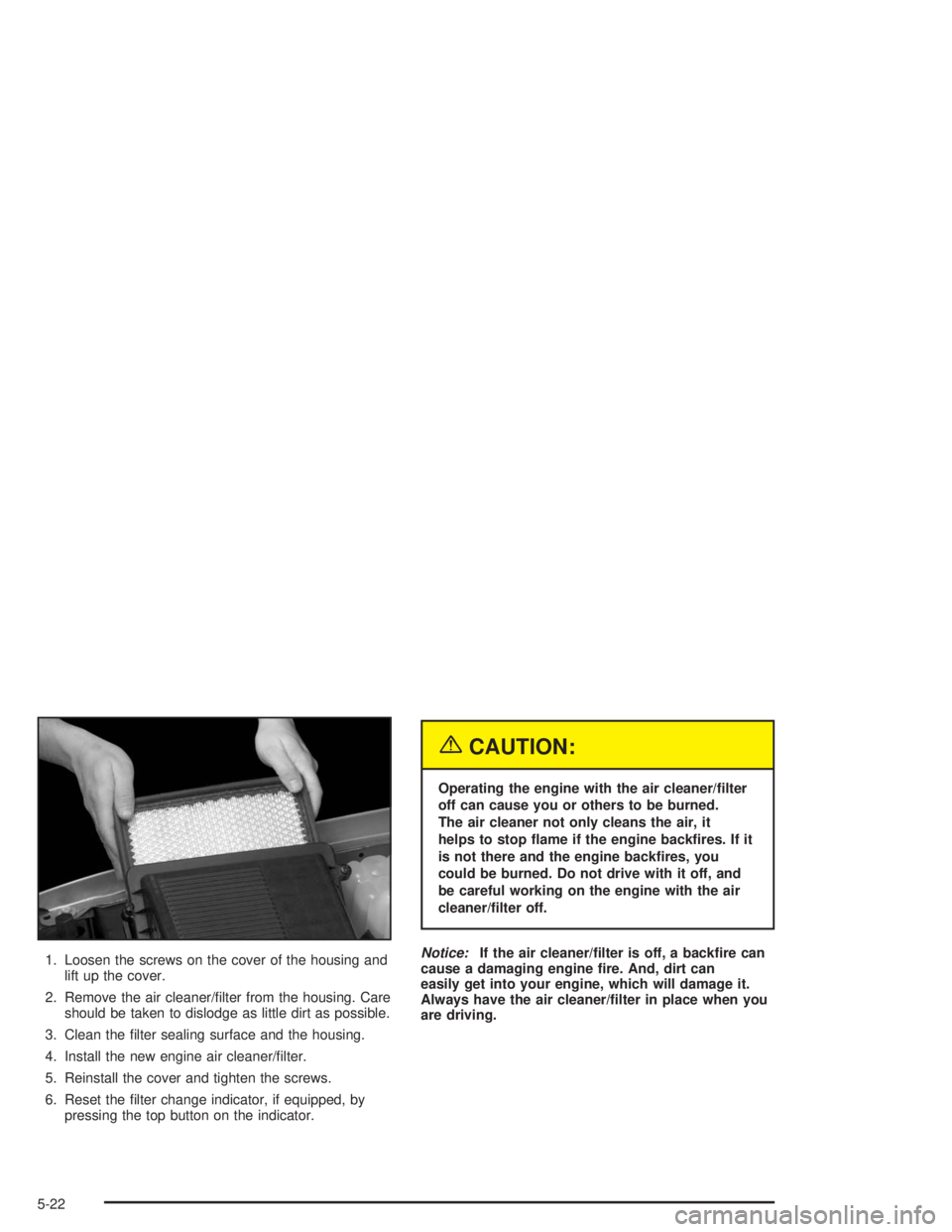
1. Loosen the screws on the cover of the housing and
lift up the cover.
2. Remove the air cleaner/lter from the housing. Care
should be taken to dislodge as little dirt as possible.
3. Clean the lter sealing surface and the housing.
4. Install the new engine air cleaner/lter.
5. Reinstall the cover and tighten the screws.
6. Reset the lter change indicator, if equipped, by
pressing the top button on the indicator.
{CAUTION:
Operating the engine with the air cleaner/lter
off can cause you or others to be burned.
The air cleaner not only cleans the air, it
helps to stop ame if the engine backres. If it
is not there and the engine backres, you
could be burned. Do not drive with it off, and
be careful working on the engine with the air
cleaner/lter off.
Notice:If the air cleaner/lter is off, a backre can
cause a damaging engine re. And, dirt can
easily get into your engine, which will damage it.
Always have the air cleaner/lter in place when you
are driving.
5-22