tires GMC YUKON DENALI 2003 Owners Manual
[x] Cancel search | Manufacturer: GMC, Model Year: 2003, Model line: YUKON DENALI, Model: GMC YUKON DENALI 2003Pages: 447, PDF Size: 21.97 MB
Page 2 of 447
The 2003 GMC Yukon DenaIiNukon XL Denali
Owner Manual
Seats and Restraint Systems ........................... 1-1
Front Seats
............................................... 1-3
Rear Seats
............................................... 1-7
Safety Belts
............................................. 1-25
Child Restraints
....................................... 1-48
Air Bag Systems
...................................... 1-72
Restraint System Check
............................ 1-86
Features and Controls ..................................... 2-1
Keys
........................................................ 2-3
Doors and Locks
....................................... 2-8
Windows
................................................. 2-14
Theft-Deterrent Systems
............................ 2-1 6
Starting and Operating Your Vehicle
....... 2-18
Mirrors
.................................................... 2-31
Onstar@
S stem ...................................... 2-36
HomeLink
J Transmitter ............................. 2-38
Storage Areas
......................................... 2-42
Sunroof
.................................................. 2-46
Vehicle Personalization
............................. 2-47
Instrument Panel ............................................. 3-1
Instrument Panel Overview
.......................... 3-4
Warning Lights, Gages and Indicators
......... 3-28
Driver Information Center (DIC)
.................. 3-43
Climate Controls
...................................... 3-1 9
Audio System(s)
....................................... 3-58
Driving Your Vehicle ....................................... 4-1
Your Driving, the Road, and Your Vehicle
..... 4-2
Towing
................................................... 4-44
Service
..................................................... 5-3
Fuel
......................................................... 5-5
Checking Things Under the Hood ............... 5-10
All-Wheel Drive
........................................ 5-46
Rear Axle ............................................... 5-48
Bulb Replacement
.................................... 5-49
Tires
...................................................... 5-55
Appearance Care ..................................... 5-78
Vehicle Identification
................................. 5-86
Electrical System
...................................... 5-87
Capacities and Specifications
..................... 5-96
Normal Maintenance Replacement Parts
...... 5-98
Maintenance Schedule
................................ 6-2
Customer Assistance Information .................... 7-1
Customer Assistance Information
.................. 7-2
Reporting Safety Defects
............................ 7-9
Index ................................................................ 1
Service and Appearance Care .......................... 5-1
Windshield Wiper Blade Replacement
......... 5-54
Maintenance Schedule ..................................... 6-1
Page 181 of 447
A temporary solution to hotter transmission operating
temperatures may be
to let the transmission cool down.
If the transmission is operated at higher temperatures
on a frequent basis, see
Scheduled Maintenance
on page
6-5 for the proper transmission maintenance
intervals.
Malfunction Indicator Lamp
Check Engine Light
Your vehicle is equipped
with
a computer which
monitors operation of the
fuel, ignition and emission
control systems.
This system is called OBD
II (On-Board
Diagnostics-Second Generation) and is intended to
assure that emissions are at acceptable levels for the
life of the vehicle, helping
to produce a cleaner
environment. The Check Engine light comes on
to
indicate that there is a problem and service is required.
Malfunctions often will be indicated by the system
before any problem is apparent. This may prevent more
serious damage
to your vehicle. This system is also
designed to
assist your service technician in correctly
diagnosing any malfunction.
Notice: If you keep driving your vehicle with this
light on, after a while, your emission controls
may not work as well, your fuel economy may not
be as good and your engine may not run as
smoothly. This could lead to costly repairs that may
not be covered by your warranty.
Notice: Modifications made to the engine,
transmission, exhaust, intake or fuel system of your
vehicle or the replacement of the original tires
with other than those of the same Tire Performance
Criteria (TPC) can affect your vehicle’s emission
controls and may cause this light to come on.
Modifications to these systems could lead to costly
repairs not covered by your warranty. This may
also result
in a failure to pass a required Emission
Inspection/Maintenance test.
This light should come on, as a check to show you it is
working, when the ignition is on and the engine is
not running. If the light doesn’t come on, have it
repaired. This light will also come on during
a
malfunction in one of two ways:
Light Flashing - A misfire condition has been
detected.
A misfire increases vehicle emissions
and may damage the emission control system on
your vehicle. Dealer or qualified service center
diagnosis and service may be required.
3-38
Page 238 of 447
There’s something else about drinking and driving that many people don’t know. Medical research shows
that alcohol in a person’s system can make crash
injuries worse, especially injuries to the brain, spinal
cord or heart. This means that when anyone who
has been drinking
- driver or passenger - is in a
crash, that person’s chance
of being killed or
permanently disabled is higher than
if the person had
not been drinking.
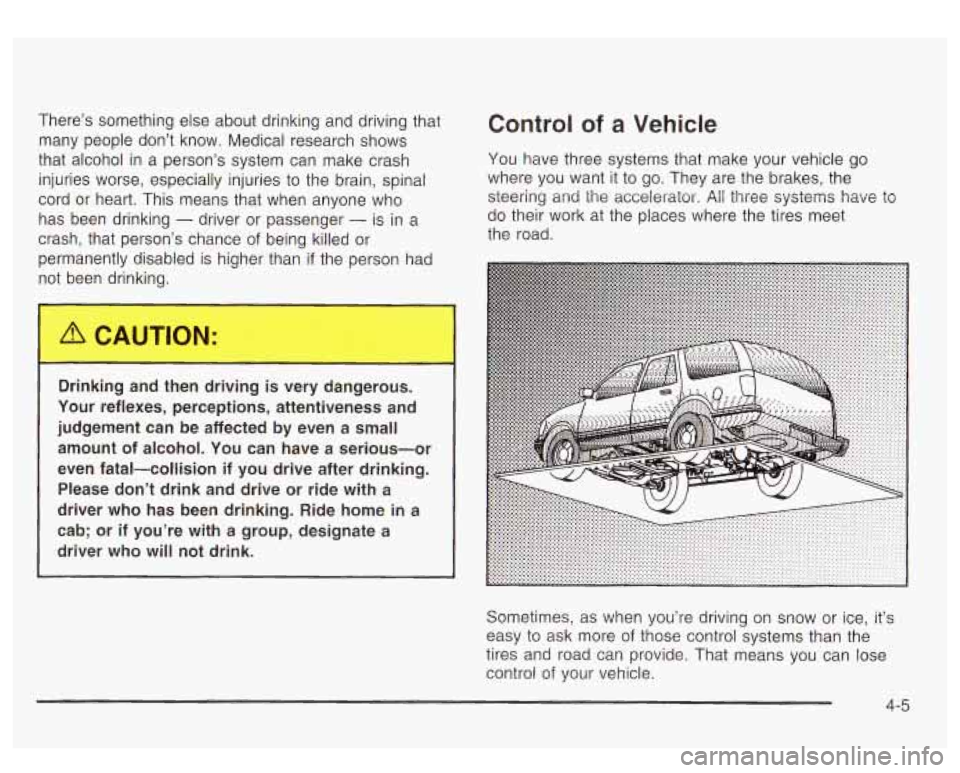
Control of a Vehicle
You have three systems that make your vehicle go
where you want it to go. They are the brakes, the
steering and
the accelerator. All three systems have to
do their work at the places where the tires meet
the road.
Drinking and
t n drivinc_ ; very -1ngerous.
Your reflexes, perceptions, attentiveness and
judgement can be affected by even a small amount of alcohol. You can have a serious-or
even fatal-collision if you drive after drinking. Please don’t drink and drive or ride with a
driver who has been drinking. Ride home in a
cab;
or if you’re with a group, designate a
driver who will not drink.
Sometimes, as when you’re driving
on snow or ice, it’s
easy
to ask more of those control systems than the
tires and road can provide. That means you can lose
control of your vehicle.
4-5
Page 244 of 447
The traction control system may activate on dry or
rough roads or under conditions such as heavy
acceleration while turning or abrupt upshifts/downshifts
of the transmission. When this happens you may
notice a reduction in acceleration, or may hear
a noise
or vibration. This is normal.
If your vehicle is in cruise control when the system
activates, the STABILITY SYS ACTIVE message will
appear on the Driver Information Center and the cruise
control will automatically disengage. When road
conditions allow you
to use cruise again, you may
re-engage the cruise control. See “Cruise Control” under
Turn SignaVMultifunction
Lever on page 3-7
Stabilitrak@may also turn off automatically if it
determines that a problem exists with the system. If the
problem does not clear itself after restarting the
vehicle, you should see your dealer for service.
Power Steering
If you lose power steering assist because the engine
stops or the system is not functioning, you can steer but
it will take much more effort.
Steering Tips
Driving on Curves
It’s important to take curves at a reasonable speed.
A
lot of the “driver lost control” accidents mentioned on
the news happen on curves. Here’s why:
Experienced driver or beginner, each of us is subject to
the same laws of physics when driving on curves.
The traction of the tires against the road surface makes
it possible for the vehicle
to change its path when
you turn the front wheels. If there’s no traction, inertia
will keep the vehicle going in the same direction.
If
you’ve ever tried to steer a vehicle on wet ice, you’ll
understand this.
The traction you can get
in a curve depends on the
condition of your tires and the road surface, the angle at
which the curve is banked, and your speed. While you’re
in a curve, speed is the one factor you can control.
Suppose you’re steering through a sharp curve. Then you
suddenly accelerate. Both control systems
- steering
and acceleration
- have to do their work where the tires
meet the road. Adding the sudden acceleration can
demand too much of those places. You can lose control.
What should you do
if this ever happens? Ease up on
the accelerator pedal, steer the vehicle the way
you want
it to go, and slow down.
4-1 1
Page 248 of 447
Loss of Control
Let’s review what driving experts say about what happens
when the three control systems (brakes, steering and
acceleration) don’t have enough friction where the tires
meet the road
to do what the driver has asked.
In any emergency, don’t give up. Keep trying
to steer
and constantly seek an escape route or area of
less danger.
In a skid, a driver can lose control of the vehicle.
Defensive drivers avoid most skids by taking reasonable
care suited to existing conditions, and by not
“overdriving” those conditions. But skids are always
possible.
The three types of skids correspond
to your vehicle’s
three control systems. In the braking skid, your wheels
aren’t rolling. In the steering or cornering skid,
too much
speed or steering in a curve causes tires to slip and lose
cornering force. And in the acceleration skid,
too much
throttle causes the driving wheels
to spin.
A cornering skid is best handled by easing your foot off
the accelerator pedal.
If your vehicle starts to slide, ease your foot off the
accelerator pedal and quickly steer the way you want
the vehicle
to go. If you start steering quickly enough,
your vehicle may straighten out. Always be ready
for
a second skid if it occurs.
Of course, traction is reduced when water, snow, ice,
gravel or other material is on the road. For safety, you’ll
want
to slow down and adjust your driving to these
conditions.
It is important to slow down on slippery
surfaces because stopping distance will be longer and
vehicle control more limited.
While driving on a surface with reduced traction, try
your best
to avoid sudden steering, acceleration
or braking (including engine braking by shifting
to a
lower gear). Any sudden changes could cause the tires
to slide. You may not realize the surface is slippery
until your vehicle is skidding. Learn
to recognize warning
clues
- such as enough water, ice or packed snow
on the road
to make a “mirrored surface” - and slow
down when you have any doubt.
Remember: Any anti-lock brake system (ABS) helps
avoid only the braking skid.
4-1 5
Page 250 of 447
Environmental Concerns
e
e
e
Cargo on the load floor piled higher than
the seatbacks can be thrown forward during a sudden stop. You or your
passengers could be injured. Keep cargo
below the top of the seatbacks.
Unsecured cargo on the load floor can be
tossed about when driving over rough
terrain. You or your passengers can be struck by flying objects. Secure the cargo properly.
Heavy loads on the roof raise the vehicle’s
center of gravity, making
it more likely to
roll over. You can be seriously or fatally
injured if the vehicle rolls over. Put heavy
loads inside the cargo area, not on the
roof. Keep cargo in the cargo area as far
forward and low as possible.
You’ll find other important information in this manual.
See Loading
Your Vehicle on page 4-44 and Tires
on page 5-55.
Off-road driving can provide wholesome and satisfying
recreation. However, it also raises environmental
concerns. we recognize these concerns and urge every
off-roader to follow these basic rules for protecting
the environment:
e
e
e
e
e
Always use established trails, roads and areas that
have been specially set aside for public off-road
recreational driving; obey all posted regulations.
Avoid any driving practice that could damage the
environment
- shrubs, flowers, trees, grasses - or
disturb wildlife (this includes wheel-spinning, breaking down trees or unnecessary driving through
streams or over soft ground).
Always carry a litter bag
... make sure all refuse is
removed from any campsite before leaving.
Take extreme care with open fires (where permitted), camp stoves and lanterns.
Never park your vehicle over dry grass or other
combustible materials that could catch fire from the heat of the vehicle’s exhaust system.
4-1 7
Page 257 of 447
Q: Am I likely to stall when going downhill?
A: It’s much more likely to happen going uphill. But if it
happens going downhill, here’s what
to do.
Stop your vehicle by applying the regular brakes.
Apply the parking brake.
Shift to PARK (P) and, while still braking, restart the
Shift back to a low gear, release the parking brake,
If the engine won’t start, get out and get help.
engine.
and
drive straight down.
Driving Across an Incline
Sooner or later, an off-road trail will probably go across
the incline
of a hill. If this happens, you have to
decide whether
to try to drive across the incline. Here
are some things
to consider:
A hill that can be driven straight up or down may be
too steep to drive across. When you go straight up
or down a
hill, the length of the wheel base (the
distance from the front wheels
to the rear wheels)
reduces the likelihood the vehicle will tumble end
over end. But when you drive across an incline,
the much more narrow track width (the distance
between the left and right wheels) may not prevent
the vehicle from tilting and rolling over.
Also,
driving across an incline puts more weight on the
downhill wheels. This could cause a downhill
slide or a rollover.
Surface conditions can be a problem when you
drive across a hill.
Loose gravel, muddy spots,
or even wet grass can cause your tires
to slip
sideways, downhill.
If the vehicle slips sideways,
it can hit something that will trip
it (a rock, a rut, etc.)
and roll over.
Hidden obstacles can make the steepness of the
incline even worse. If you drive across a rock
with the uphill wheels, or
if the downhill wheels
drop into a rut or depression, your vehicle can tilt
even more.
For reasons like these, you need to decide carefully
whether to try to drive across an incline. Just because
the trail goes across the incline doesn’t mean you
have to drive it. The last vehicle to try it might have
rolled over.
4-24
Page 260 of 447

Driving in Water
Heavy rain can mean flash flooding, and flood waters
demand extreme caution.
Find out how deep the water
is before you drive through
it. If it’s deep enough to cover your wheel hubs, axles
or exhaust pipe, don’t try
it - you probably won’t
get through. Also, water that deep can damage your
axle and other vehicle parts.
If the water isn’t too deep, drive slowly through it. At
faster speeds, water splashes on your ignition system
and your vehicle can stall. Stalling can also occur
if you
get your tailpipe under water. And, as long as your
tailpipe is under water, you’ll never be able to start your
engine. When you go through water, remember that
when your brakes get wet, it may take you longer
to stop.
I
- - - - -ng through rushing water can be
dangerous. Deep water can sweep your vehicle
downstream and you and your passengers
i could drown. If it’s only shallow water, it can
still wash away the ground from under your
tires, and you could lose traction and roll the
vehicle over. Don’t drive through rushing water.
I I
See Driving in Rain and on Wet Roads on page 4-29 for
more information on driving through water.
After Off-Road Driving
Remove any brush or debris that has collected on the
underbody, chassis or under the hood. These
accumulations can be a fire hazard.
After operation in mud or sand, have the brake linings
cleaned and checked. These substances can cause
glazing and uneven braking. Check the body structure,
steering, suspension, wheels, tires and exhaust
system for damage.
Also, check the fuel lines and
cooling system for any leakage.
Your vehicle will require more frequent service due to
off-road use. Refer
to the Maintenance Schedule
for additional information.
4-27
Page 262 of 447
You can be temporarily blinded by approaching
headlamps.
It can take a second or two, or even several
seconds, for your eyes
to readjust to the dark. When
you are faced with severe glare (as from a driver
who doesn’t lower the high beams, or a vehicle with
misaimed headlamps),
slow down a little. Avoid staring
directly into the approaching headlamps.
Keep your windshield and all the glass on your vehicle
clean
- inside and out. Glare at night is made much
worse by dirt on the glass. Even the inside of the glass
can build up a film caused by dust. Dirty glass makes
lights dazzle and flash more than clean glass would,
making the pupils of your eyes contract repeatedly.
Remember that your headlamps light up far less of a
roadway when you are in a turn or curve. Keep
your eyes moving; that way, it’s easier
to pick out dimly
lighted objects.
Just as your headlamps should be
checked regularly for proper aim,
so should your eyes
be examined regularly. Some drivers suffer from
night blindness
- the inability to see in dim light - and
aren’t even aware of it.
Driving in Rain and on Wet Roads
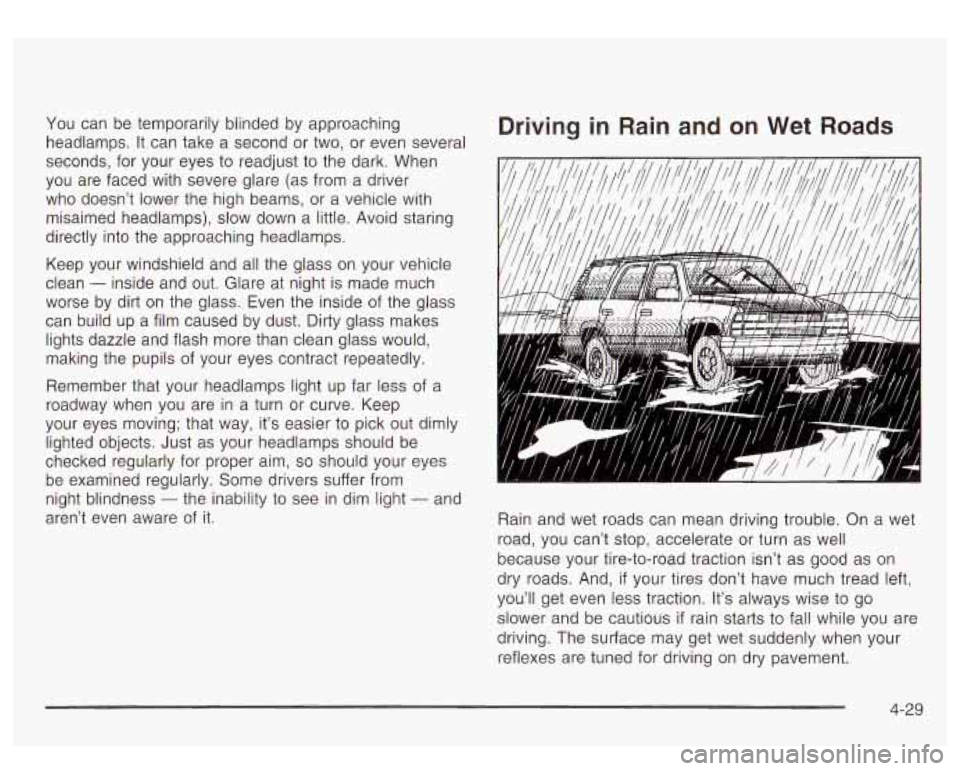
Rain and wet roads can mean driving trouble. On a wet
road, you can’t stop, accelerate or turn
as well
because your tire-to-road traction isn’t as good as on
dry roads. And,
if your tires don’t have much tread left,
you’ll get even less traction.
It’s always wise to go
slower and be cautious
if rain starts to fall while you are
driving. The surface may get wet suddenly when your
reflexes are tuned for driving on dry pavement.
4-29
Page 264 of 447
Hydroplaning
Hydroplaning is dangerous. So much water can build up
under your tires that they can actually ride on the
water. This can happen
if the road is wet enough and
you’re going fast enough. When your vehicle is
hydroplaning, it has little or no contact with the road.
Hydroplaning doesn’t happen often. But it can
if
your tires do not have much tread or if the pressure in
one or more is low. It can happen
if a lot of water is
standing on the road. If you can see reflections
from trees, telephone poles or other vehicles, and
raindrops “dimple” the water’s surface, there could be
hydroplaning.
Hydroplaning usually happens at higher speeds. There
just isn’t a hard and fast rule about hydroplaning.
The best advice is to slow down when
it is raining.
Driving Through Deep Standing Water
Notice: If you drive too quickly through deep
puddles or standing water, water can come
in
through your engine’s air intake and badly damage
your engine. Never drive through water that
is
slightly lower than the underbody of your vehicle. If
you can’t avoid deep puddles or standing water,
drive through them very slowly.
Drivhg Through Flowing Water
~~
I
Flowing or rushing water creates strong forces.
If you try to drive through flowing water, as you
might at a low water crossing, your vehicle can
be carried away.
As little as six inches of
flowing water can carry away a smaller vehicle.
If this happens, you and other vehicle
occupants could drown. Don’t ignore police
warning signs, and otherwise be very cautious
about trying to drive through flowing water.
Some Other Rainy Weather Tips
Turn on your low-beam headlamps - not just your
parking lamps
- to help make you more visible to
others.
* Besides slowing down, allow some extra following
distance. And be especially careful when you
pass another vehicle. Allow yourself more clear
room ahead, and be prepared to have your
view restricted by road spray.
* Have good tires with proper tread depth. See Tires
on page 5-55.
4-31