belt GREAT WALL FLORID 2008 User Guide
[x] Cancel search | Manufacturer: GREAT WALL, Model Year: 2008, Model line: FLORID, Model: GREAT WALL FLORID 2008Pages: 281, PDF Size: 43.97 MB
Page 161 of 281
Downloaded from www.Manualslib.com manuals search engine GWFLORID Maintenance Manual154
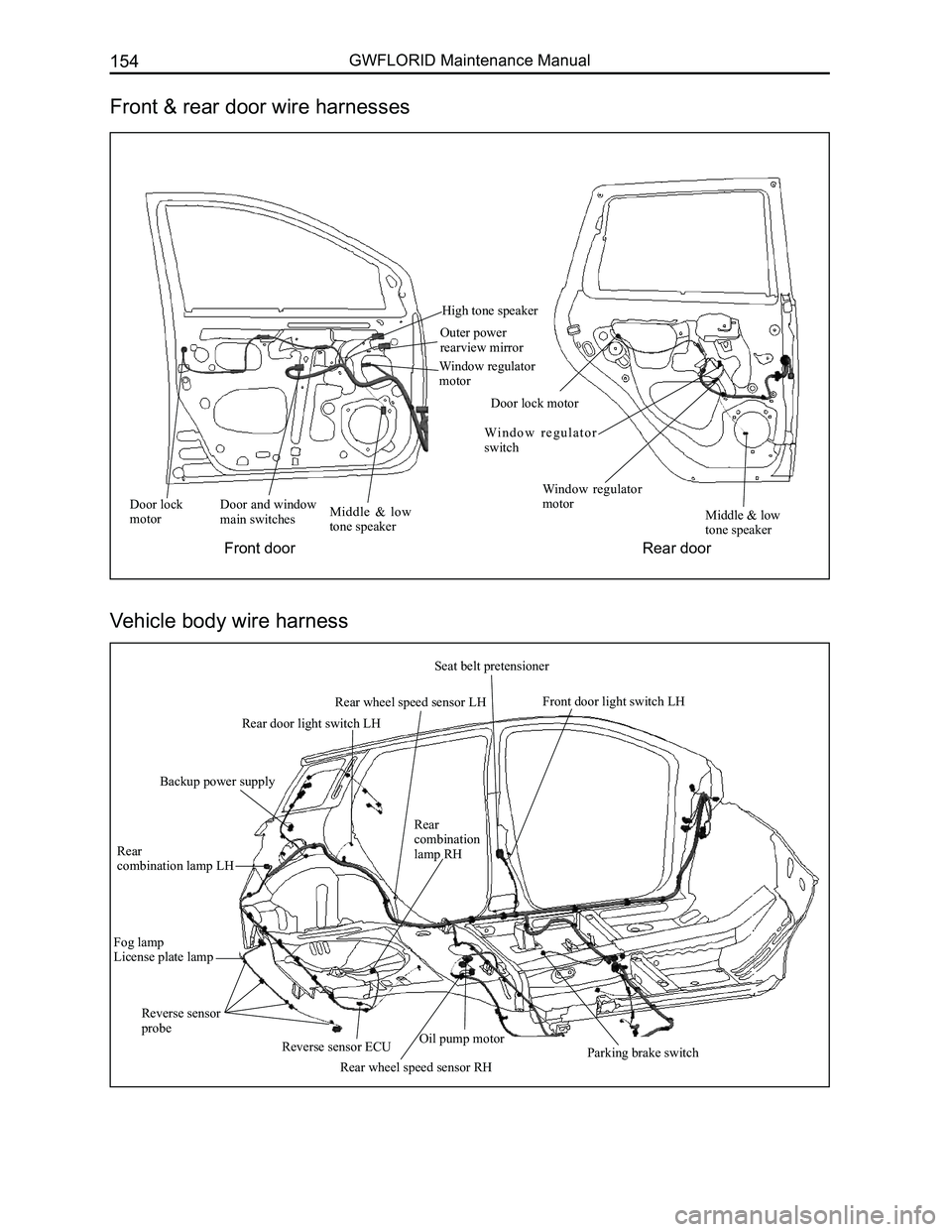
Door lock motorDoor and window main switchesMiddle & low tone speaker
High tone speaker
Outer power rearview mirror
Window regulator motor
Door lock motor
Wi n d o w r e g u l a t o r switch
Window regulator motorMiddle & low tone speaker
Fog lampLicense plate lamp
Rear
combination lamp LH
Rear combination lamp RH
Rear wheel speed sensor RHParking brake switch
Front door light switch LH
Seat belt pretensioner
Rear wheel speed sensor LH
Rear door light switch LH
Backup power supply
Front & rear door wire harnesses
Vehicle body wire harness
Front doorRear door
Reverse sensor ECU
Reverse sensor probeOil pump motor
Page 162 of 281
Downloaded from www.Manualslib.com manuals search engine 155Vehicle Body Electronic System
Condenser fan motor
Connected compressor
Oil pressure switch
Front oxygen sensor
Connected reverse switch
Connected engine speed sensor Connected
ignition coil
Connected speed sensor Connected coolant temp. sensor
Canister control valve
Connected combination meter A
Connected antenna
Diagnostic port
Connected AC switch Connected air conditioner temperature sensor
Front passenger side airbag
Connected speed adjustive resistance, blower
Front window regulator RH
Front window regulator switch RH
Front medium woofer RH
Front tweeter LH Right outer electric mirror
Front passenger side central door lock switch
Front door lamp switch RH
Front passenger seat belt pretensioner Front door lock motor RH
Ground
plate 3
Connected cigarette lighter (lighting)
Connected cigarette lighter
Front passenger seat belt switch
Connected parking brake switch Connected air conditioner governor & front
passenger seat belt unfastened indicator lamp
Connected CD player
Connected engine ECUConnected ground P1#
Connected ground P2#
Connected starter
Connected knock sensor
Connected starter field coil
Connected inlet
temperature pressure
sensor
connected
electronic throttle
Rear oxygen sensor
Connected 4th
cylinder injection
nozzle
Connected 3rd
cylinder injection
nozzle
Connected 2nd
cylinder injection
nozzle
Connected 1st
cylinder
injection nozzle
Connected generator
Connected engine armature Connected front combination lamp RH
Connected front fog lamp RH
Connected rear washer motor
Connected front washer motor
Connected front wheel speed sensor RH
Right ground
Connected A/C pressure switch
Connected phase sensor
Connected low
pitched horn
Connected front
combination lamp LH
Rediator fan motor
Connected front
fog lamp LH
Connected high pitched horn
Battery
negative
Body
ground
Battery
Left ground Connected
brake lamp
switch Connected brake fluid warning switch
Connected theft deterrent indicator Theft deterrent ECU 1Connected lock
cylinder lightConnected ignition
switch (white)
The key is inserted into the switch
Right combination switch (wiper) Connected airbag ECU (yellow)Ground
plate 2
Ground
plate 4
Connected accelerator pedal
Ground plate 1
Left outer electric mirror
Front medium woofer LH Front door lock motor LH
Rear medium woofer LH
Rear window regulator switch LH
Rear door lock motor LH Rear door lamp switch LH
Ground point ACapacitor
Vehicle power supply
Rear fog lamp LH Left license plate lamp
High mounted brake lamp
Ground point Trunk opener switch
Trunk motorRear wiper motor
Rear windshield defroster “-”
Trunk lamp switch Right license plate lamp
Rear fog lamp RH
Rear combination lamp RHRear wheel speed sensor RH
Rear window
regulator RH
Rear window
regulator switch RH
Rear door lock motor RH
Rear door lamp switch RH Rear medium woofer RH
Ground point B
Rear combination lamp LH
Rear windshield defroster “+”
Rear wheel speed
sensor LH
Rear window regulator LH
Fuel pump, fuel sensor
Rear interior dome lamp
Front door lamp
switch LH
Driver seat belt pretensioner Driver seat belt switch
Front tweeter LH
Connected light brightness regulator switch
Connected rearview mirror switch (white)
Connected glove box lamp
Front window regulator LH Left combination switch (light)
Connected main airbag, horn switch
Window regulator mainly
control switch, central door
lock mainly control switch Connected central door lock controller (white)
Connected front wiper motor
Connected clutch
switch
Connected ABS ECUBattery
positive
Connected front wheel
speed sensor LH Engine groud
Starter connect to
battery positive
Generator connect to
battery positive
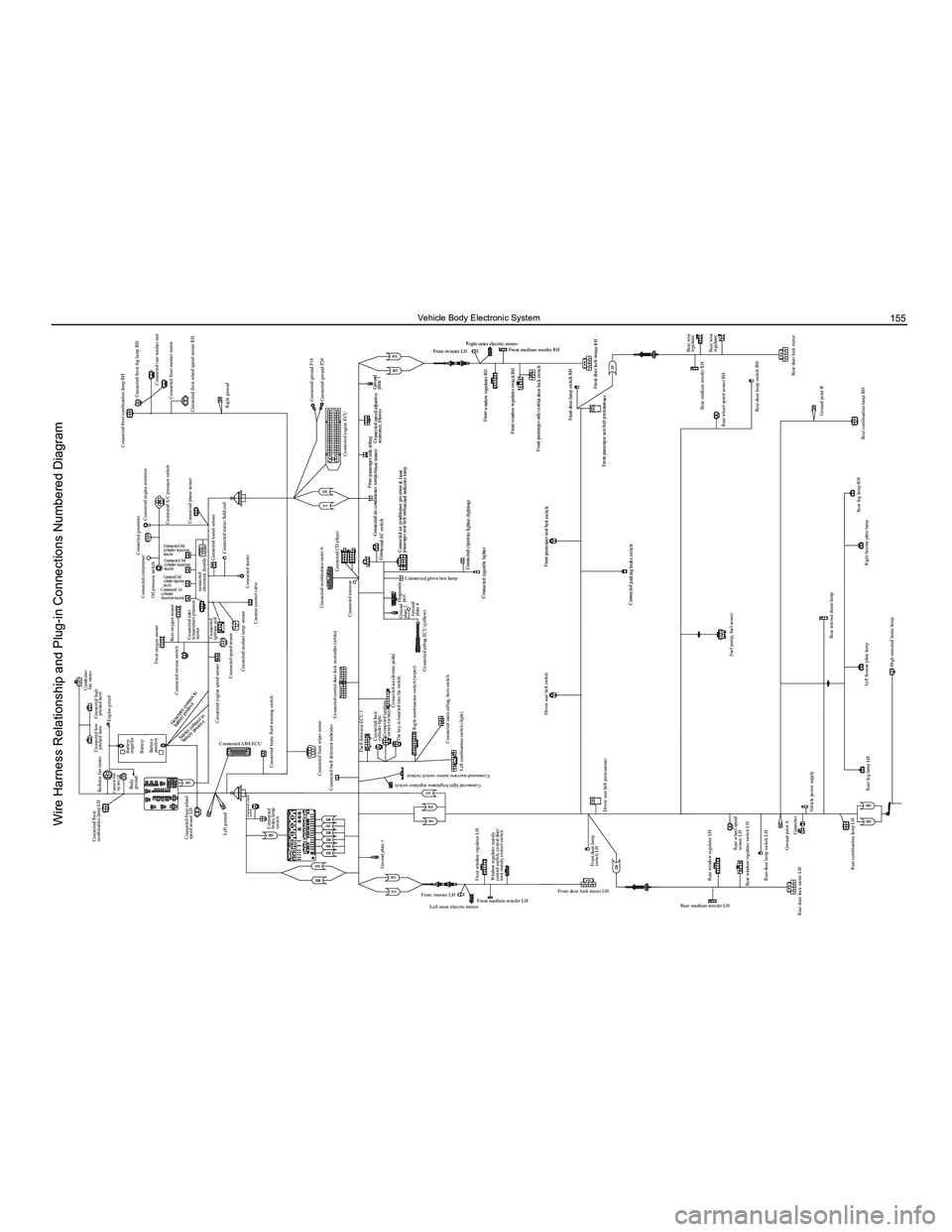
Wire Harness Relationship and Plug-in Connections Numbered Diagram
Page 175 of 281
Downloaded from www.Manualslib.com manuals search engine GWFLORID Maintenance Manual168
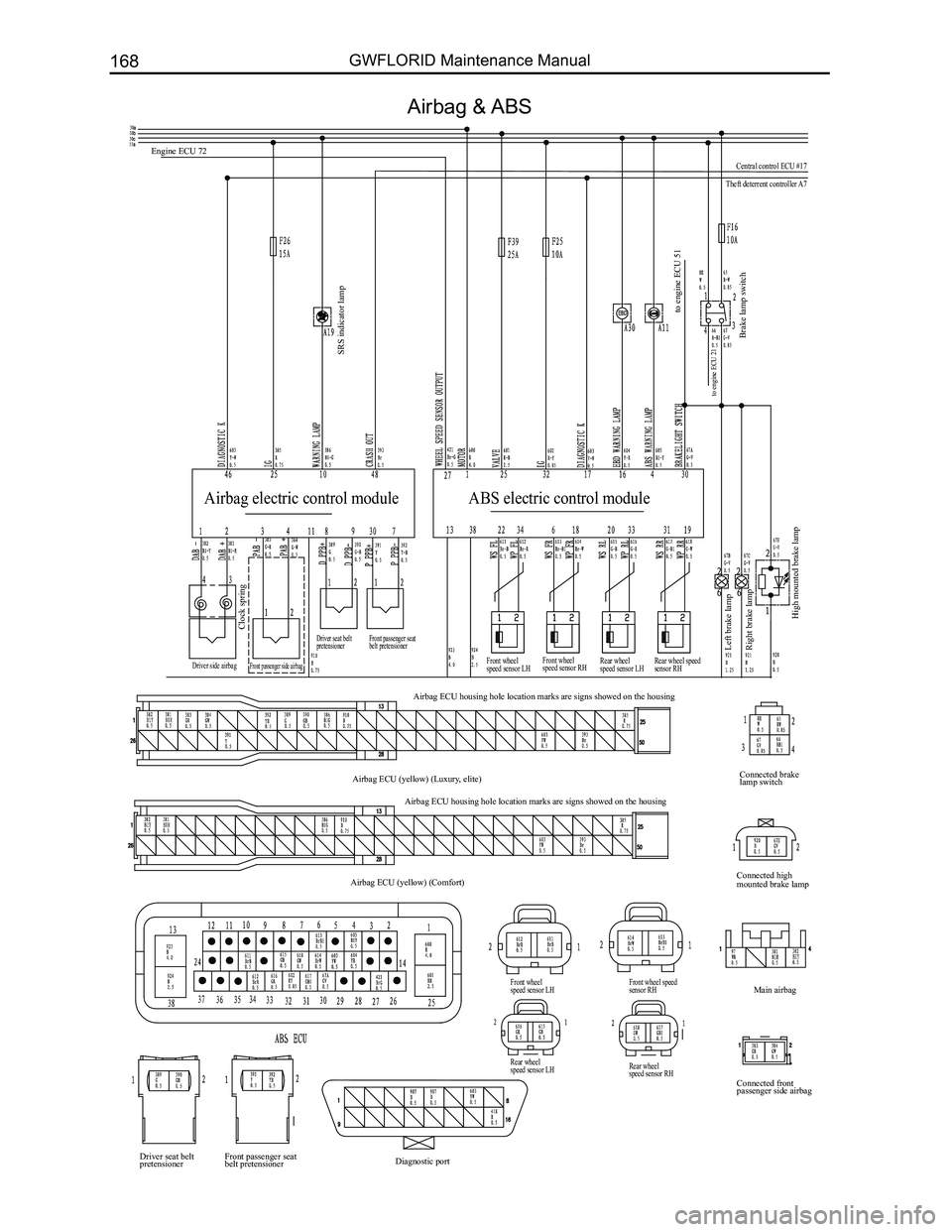
Airbag & ABS
SRS indicator lamp
Engine ECU 72
Central control ECU #17
Airbag ECU housing hole location marks are signs showed on the housing
Airbag ECU (yellow) (Luxury, elite)
Airbag ECU (yellow) (Comfort) Airbag ECU housing hole location marks are signs showed on the housing
Theft deterrent controller A7
Diagnostic port
Front passenger seat
belt pretensioner
Driver seat belt
pretensioner
Left brake lamp
Right brake lamp
High mounted brake lamp
Driver side airbagFront passenger side airbagFront wheel
speed sensor LH
Front wheel
speed sensor LH
Rear wheel
speed sensor LH Front wheel speed
sensor RH
Rear wheel
speed sensor RH
Front wheel
speed sensor RH
Rear wheel speed
sensor RH
Connected brake
lamp switch
Connected high
mounted brake lamp
Main airbag
Connected front
passenger side airbag
Rear wheel
speed sensor LH
Airbag electric control module ABS electric control module
Brake lamp switchto engine ECU 51
to engine ECU 21
Driver seat belt
pretensioner
Front passenger seat
belt pretensionerClock spring
Page 176 of 281
Downloaded from www.Manualslib.com manuals search engine 169Vehicle Body Electronic System
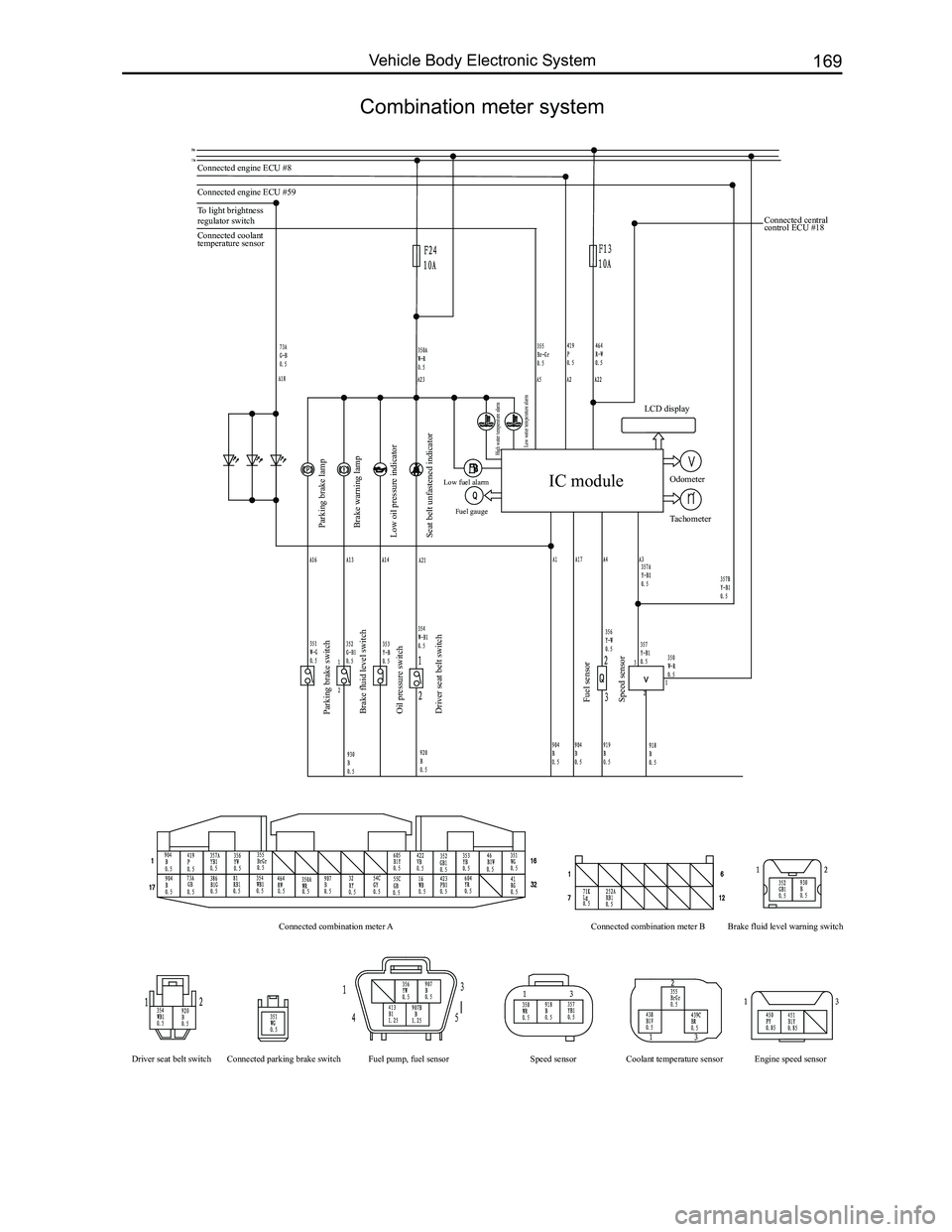
Combination meter system
Connected engine ECU #8
Connected engine ECU #59
To light brightness
regulator switch
Parking brake lamp
Parking brake switch
Brake fluid level switch
Oil pressure switch
Driver seat belt switch
Fuel sensor
Speed sensor
Connected combination meter A
Driver seat belt switch Connected parking brake switch Fuel pump, fuel sensor Coolant temperature sensor Engine speed sensor
Speed sensor Connected combination meter B
Brake fluid level warning switch
Brake warning lamp
Low oil pressure indicator
Seat belt unfastened indicator
Low fuel alarm Fuel gauge
High water temperature alarm
Low water temperature alarm
Connected coolant
temperature sensor Connected central
control ECU #18
IC module
LCD display
Odometer
Tachometer
Page 177 of 281
Downloaded from www.Manualslib.com manuals search engine GWFLORID Maintenance Manual170
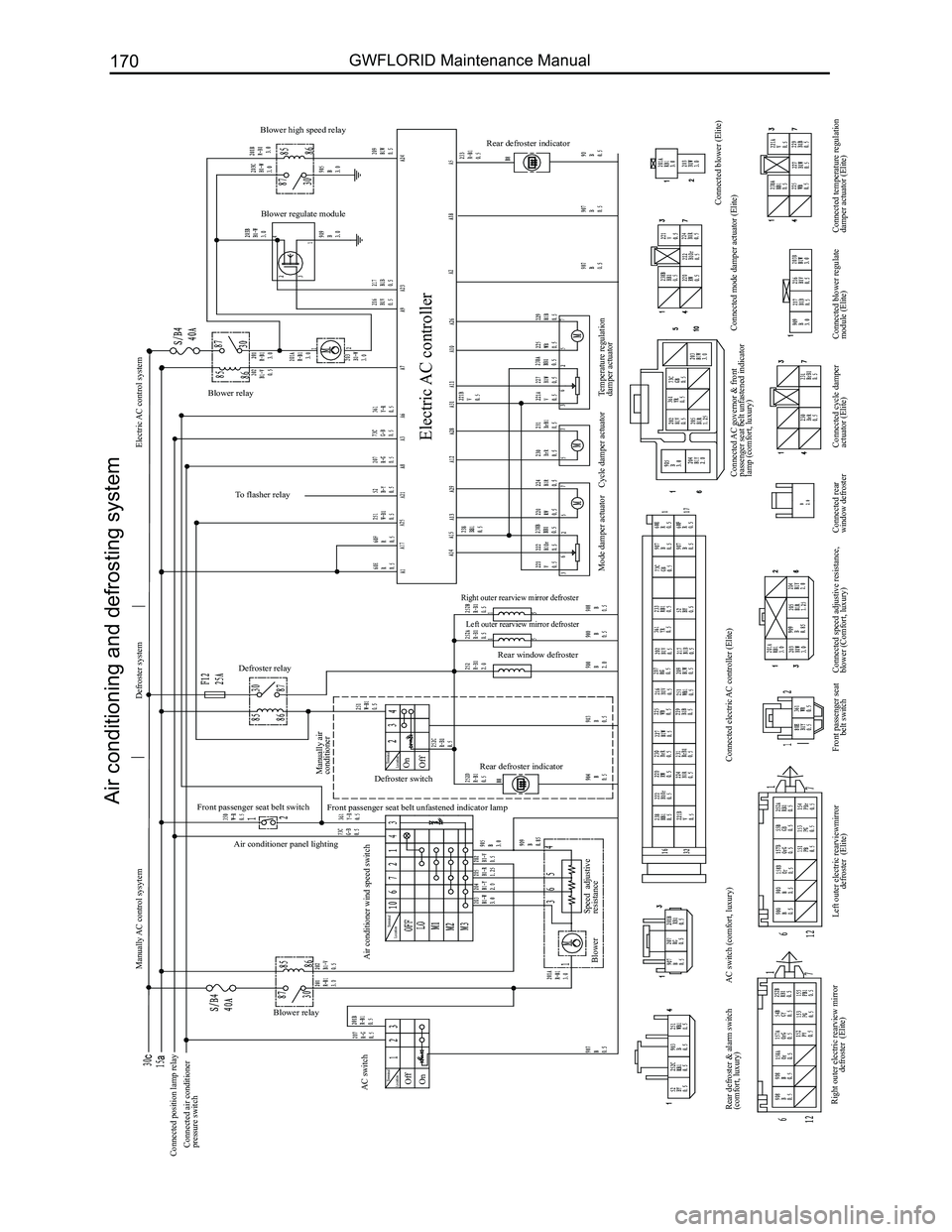
Air conditioning and defrosting system
Rear window defroster
Connected position lamp relay Manually AC control sysytem
Defroster system Electric AC control system
Connected air conditioner
pressure switch
Blower relay
Air conditioner
panel lighting Defroster switch
Rear defroster indicator
Left outer rearview mirror defroster
Right outer rearview mirror defroster
Front passenger seat belt switch Defroster relay
To flasher relay
Blower relay Blower regulate module
Blower high speed relay
Rear defroster indicator
Front passenger seat belt unfastened indicator lamp
Air conditioner wind speed switch
Blower Speed adjustive
resistance
Rear defroster & alarm switch
(comfort, luxury) Right outer electric rearview mirror defroster (Elite) Left outer electric rearviewmirror
defroster (Elite) Front passenger seat
belt switch Connected speed adjustive resistance,
blower (Comfort, luxury) Connected rear
window defroster Connected cycle damper
actuator (Elite) Connected blower regulate
module (Elite) Connected temperature regulation
damper actuator (Elite)
AC switch (comfort, luxury)
Connected electric AC controller (Elite)
Connected AC governor & front
passenger seat belt unfastened indicator
lamp (comfort, luxury) Connected mode damper actuator (Elite) Connected blower (Elite)
Mode damper actuator
Cycle damper actuator Temperature regulation
damper actuator
Manually
air
conditioner
Electric AC controller
AC switch
Off
On Off On Terminal
Terminal Terminal
Location Location
Location
Page 187 of 281
Downloaded from www.Manualslib.com manuals search engine GWFLORID Maintenance Manual180
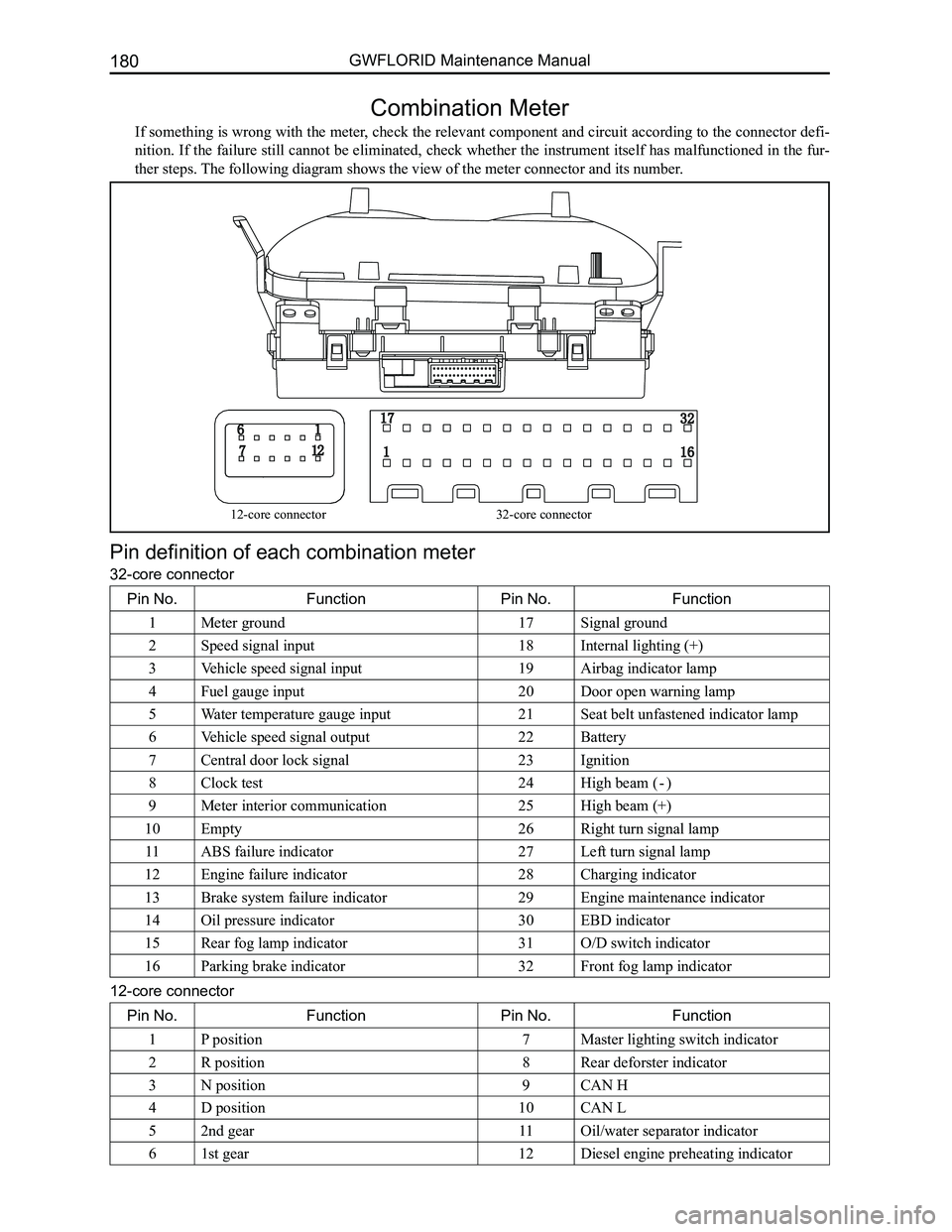
Combination Meter
If something is wrong with the meter, check the relevant component and circuit according to the connector defi-
nition. If the failure still cannot be eliminated, check whether the instrument itself has malfunctioned in the fur-
ther steps. The following diagram shows the view of the meter connector and its numb\
er.
Pin definition of each combination meter
32-core connector
Pin No.FunctionPin No.Function
1Meter ground17Signal ground
2Speed signal input18Internal lighting (+)
3Vehicle speed signal input19Airbag indicator lamp
4Fuel gauge input20Door open warning lamp
5Water temperature gauge input21Seat belt unfastened indicator lamp
6Vehicle speed signal output22Battery
7Central door lock signal23Ignition
8Clock test24High beam ( - )
9Meter interior communication25High beam (+)
10Empty26Right turn signal lamp
11ABS failure indicator27Left turn signal lamp
12Engine failure indicator28Charging indicator
13Brake system failure indicator29Engine maintenance indicator
14Oil pressure indicator30EBD indicator
15Rear fog lamp indicator31O/D switch indicator
16Parking brake indicator32Front fog lamp indicator
12-core connector
Pin No.FunctionPin No.Function
1P position7Master lighting switch indicator
2R position8Rear deforster indicator
3N position9CAN H
4D position10CAN L
52nd gear11Oil/water separator indicator
61st gear12Diesel engine preheating indicator
12-core connector32-core connector
Page 211 of 281
Downloaded from www.Manualslib.com manuals search engine GWFLORID Maintenance Manual204
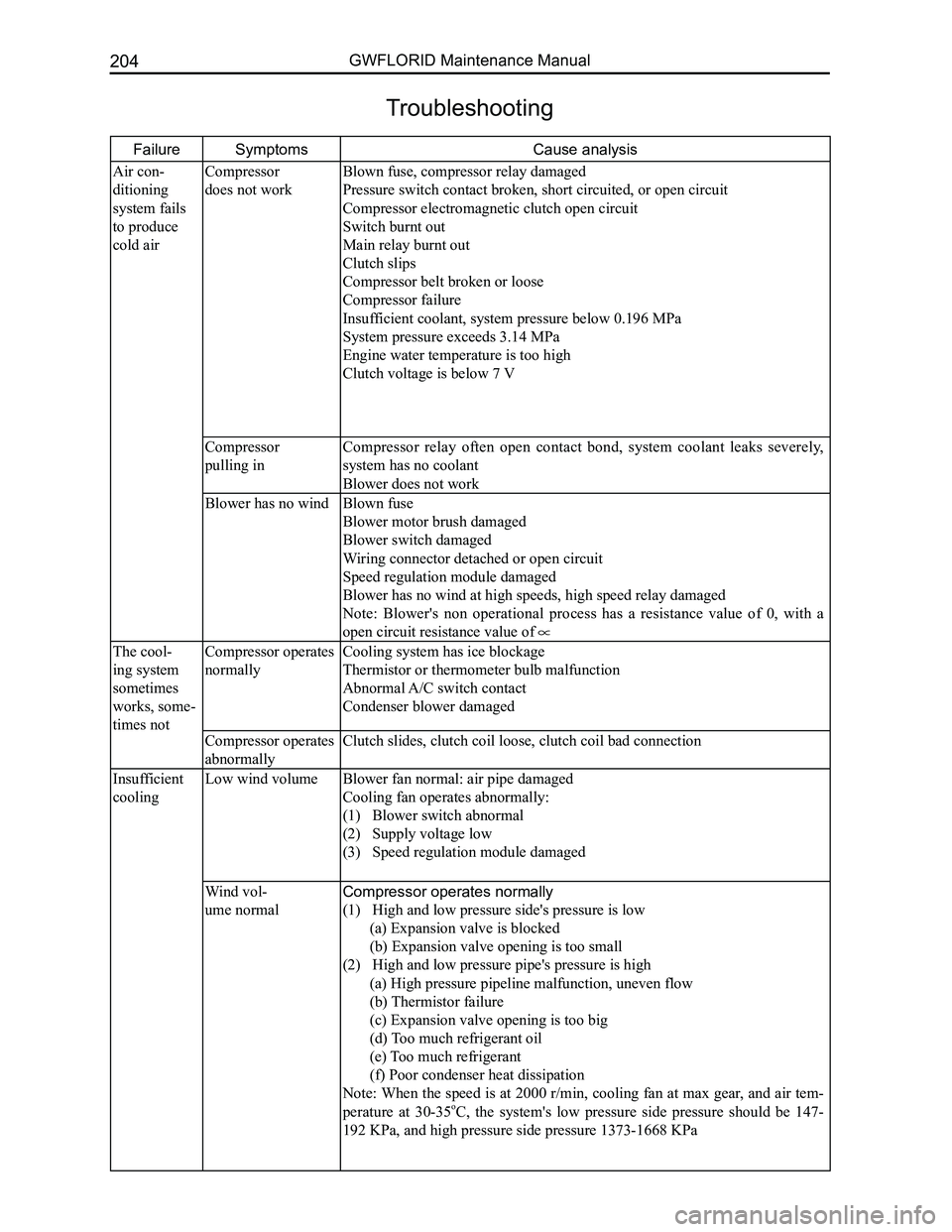
FailureSymptoms Cause analysis
Air con-
ditioning
system fails
to produce
cold air
Compressor
does not work
Blown fuse, compressor relay damaged
Pressure switch contact broken, short circuited, or open circuit
Compressor electromagnetic clutch open circuit
Switch burnt out
Main relay burnt out
Clutch slips
Compressor belt broken or loose
Compressor failure
Insufficient coolant, system pressure below 0.196 MPa
System pressure exceeds 3.14 MPa
Engine water temperature is too high
Clutch voltage is below 7 V
Compressor
pulling in
Compressor relay often open contact bond, system coolant leaks severely,
system has no coolant
Blower does not work
Blower has no windBlown fuse
Blower motor brush damaged
Blower switch damaged
Wiring connector detached or open circuit
Speed regulation module damaged
Blower has no wind at high speeds, high speed relay damaged
Note: Blower's non operational process has a resistance value of 0, with a
open circuit resistance value of
The cool-
ing system
sometimes
works, some-
times not
Compressor operates
normally
Cooling system has ice blockage
Thermistor or thermometer bulb malfunction
Abnormal A/C switch contact
Condenser blower damaged
Compressor operates
abnormally
Clutch slides, clutch coil loose, clutch coil bad connection
Insufficient
cooling
Low wind volume
Blower fan normal: air pipe damaged
Cooling fan operates abnormally:
(1) Blower switch abnormal
(2) Supply voltage low
(3) Speed regulation module damaged
Wind vol-
ume normal
Compressor operates normally
(1) High and low pressure side's pressure is low
(a) Expansion valve is blocked
(b) Expansion valve opening is too small
(2) High and low pressure pipe's pressure is high
(a) High pressure pipeline malfunction, uneven flow
(b) Thermistor failure
(c) Expansion valve opening is too big
(d) Too much refrigerant oil
(e) Too much refrigerant
(f) Poor condenser heat dissipation
Note: When the speed is at 2000 r/min, cooling fan at max gear, and air tem-
perature at 30-35oC, the system's low pressure side pressure should be 147-
192 KPa, and high pressure side pressure 1373-1668 KPa
Troubleshooting
Page 212 of 281
Downloaded from www.Manualslib.com manuals search engine 205Air Conditioning System
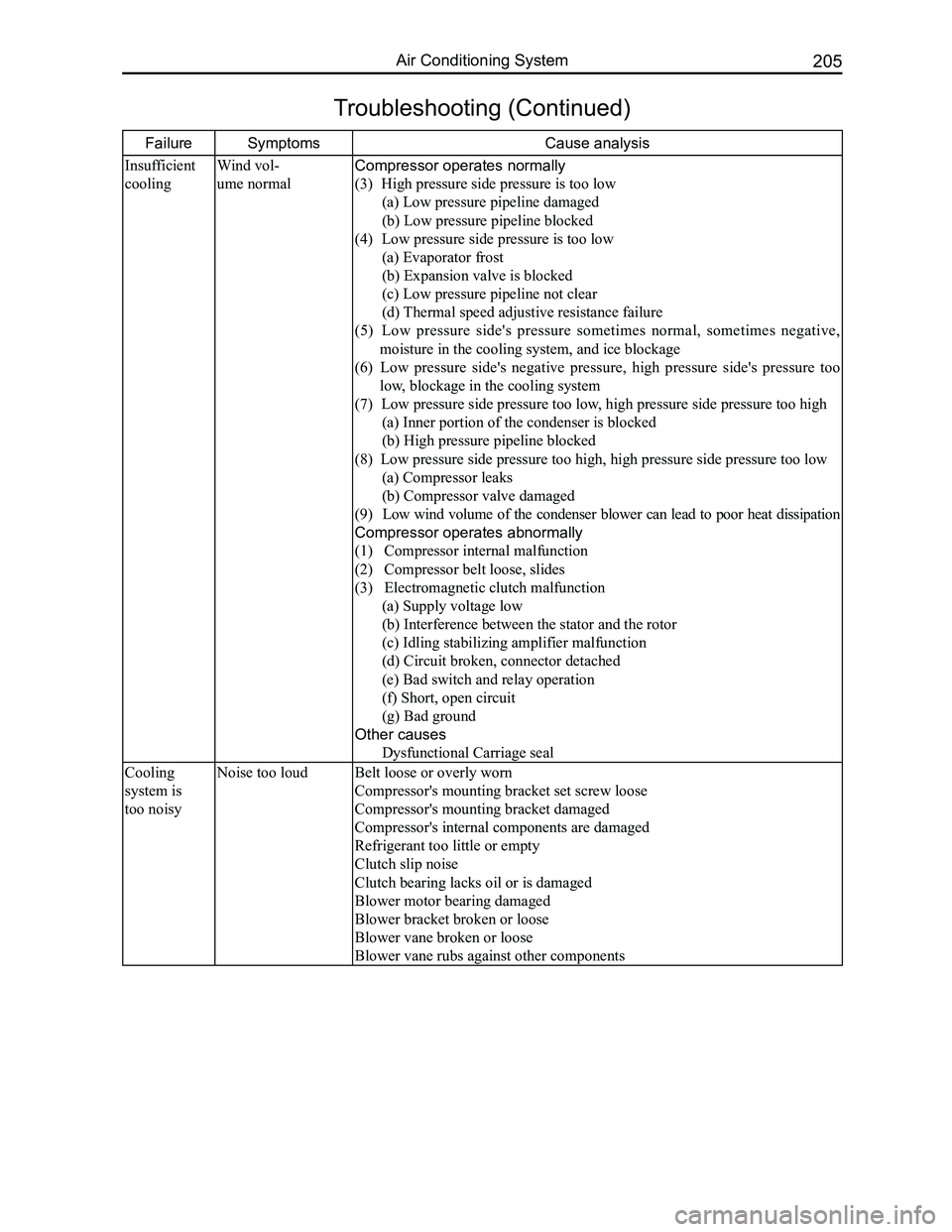
FailureSymptoms Cause analysis
Insufficient
cooling
Wind vol-
ume normal
Compressor operates normally
(3) High pressure side pressure is too low
(a) Low pressure pipeline damaged
(b) Low pressure pipeline blocked
(4) Low pressure side pressure is too low
(a) Evaporator frost
(b) Expansion valve is blocked
(c) Low pressure pipeline not clear
(d) Thermal speed adjustive resistance failure
(5) Low pressure side's pressure sometimes normal, sometimes negative,
moisture in the cooling system, and ice blockage
(6) Low pressure side's negative pressure, high pressure side's pressure too
low, blockage in the cooling system
(7) Low pressure side pressure too low, high pressure side pressure too high
(a) Inner portion of the condenser is blocked
(b) High pressure pipeline blocked
(8) Low pressure side pressure too high, high pressure side pressure \
too low
(a) Compressor leaks
(b) Compressor valve damaged
(9) Low wind volume of the condenser blower can lead to poor heat dissipation
Compressor operates abnormally
(1) Compressor internal malfunction
(2) Compressor belt loose, slides
(3) Electromagnetic clutch malfunction
(a) Supply voltage low
(b) Interference between the stator and the rotor
(c) Idling stabilizing amplifier malfunction
(d) Circuit broken, connector detached
(e) Bad switch and relay operation
(f) Short, open circuit
(g) Bad ground
Other causes
Dysfunctional Carriage seal
Cooling
system is
too noisy
Noise too loudBelt loose or overly worn
Compressor's mounting bracket set screw loose
Compressor's mounting bracket damaged
Compressor's internal components are damaged
Refrigerant too little or empty
Clutch slip noise
Clutch bearing lacks oil or is damaged
Blower motor bearing damaged
Blower bracket broken or loose
Blower vane broken or loose
Blower vane rubs against other components
Troubleshooting (Continued)
Page 216 of 281
Downloaded from www.Manualslib.com manuals search engine 209Air Conditioning System
Compressor Removal
1. Hoist the vehicle with a jack.
2. Remove the bottom mudguard.
3. Remove the compressor.
Compressor Installation
Before installing, manually rotate the compressor several
circles, allowing each component in the relative motion to be
covered with lubricant.
Clearance between the compressor's auricular branch and
bracket should be less than 0.1 mm. If the clearance is too
big, fill the clearance with a washer.
1. Loosen the engine's adjusting bolt firstly, take down the
engine belt, and then change the compressor belt.
2. Fix the compressor bracket onto the engine body with
the bolts. The bracket must be fastened tightly with suf-
ficient intensity. Fix the compressor bracket onto the
engine with four M10 ×1.25 (Q1461030 FD) bolts and
a tightening torque of 45±5 N·m, and then install the
compressor onto the bracket with a tightening torque of
22±3 N·m.
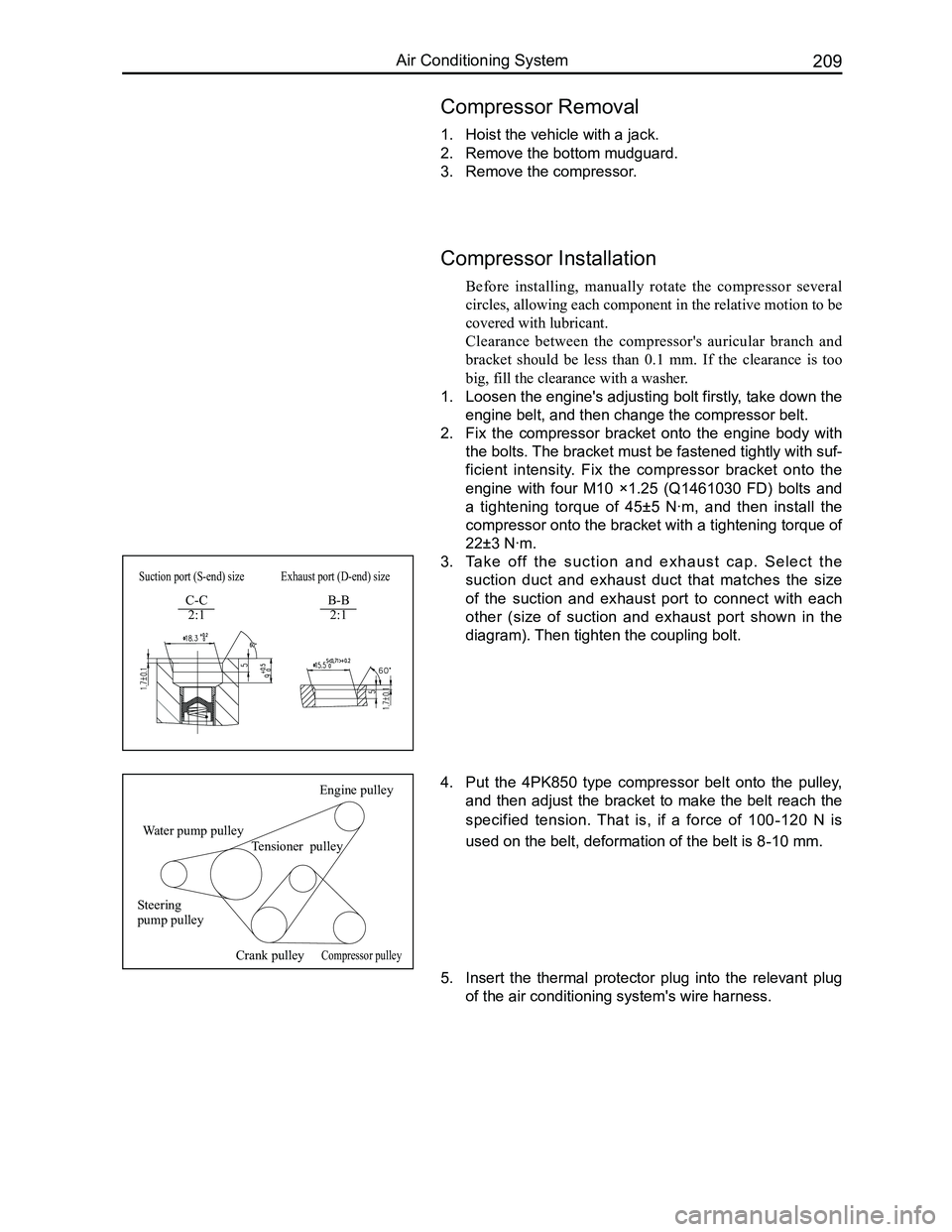
3. Ta k e o ff t h e s u c t i o n a n d e x h a u s t c a p . S e l e c t t h e
suction duct and exhaust duct that matches the size
of the suction and exhaust port to connect with each
other (size of suction and exhaust port shown in the
diagram). Then tighten the coupling bolt.
Water pump pulley
Engine pulley
Tensioner pulley
Steering pump pulley
Crank pulleyCompressor pulley
Suction port (S-end) sizeExhaust port (D-end) size
C-C 2:1B-B 2:1
4. Put the 4PK850 type compressor belt onto the pulley,
and then adjust the bracket to make the belt reach the
specified tension. That is, if a force of 100-120 N is
used on the belt, deformation of the belt is 8-10 mm.
5. Insert the thermal protector plug into the relevant plug
of the air conditioning system's wire harness.
Page 219 of 281
Downloaded from www.Manualslib.com manuals search engine GWFLORID Maintenance Manual212
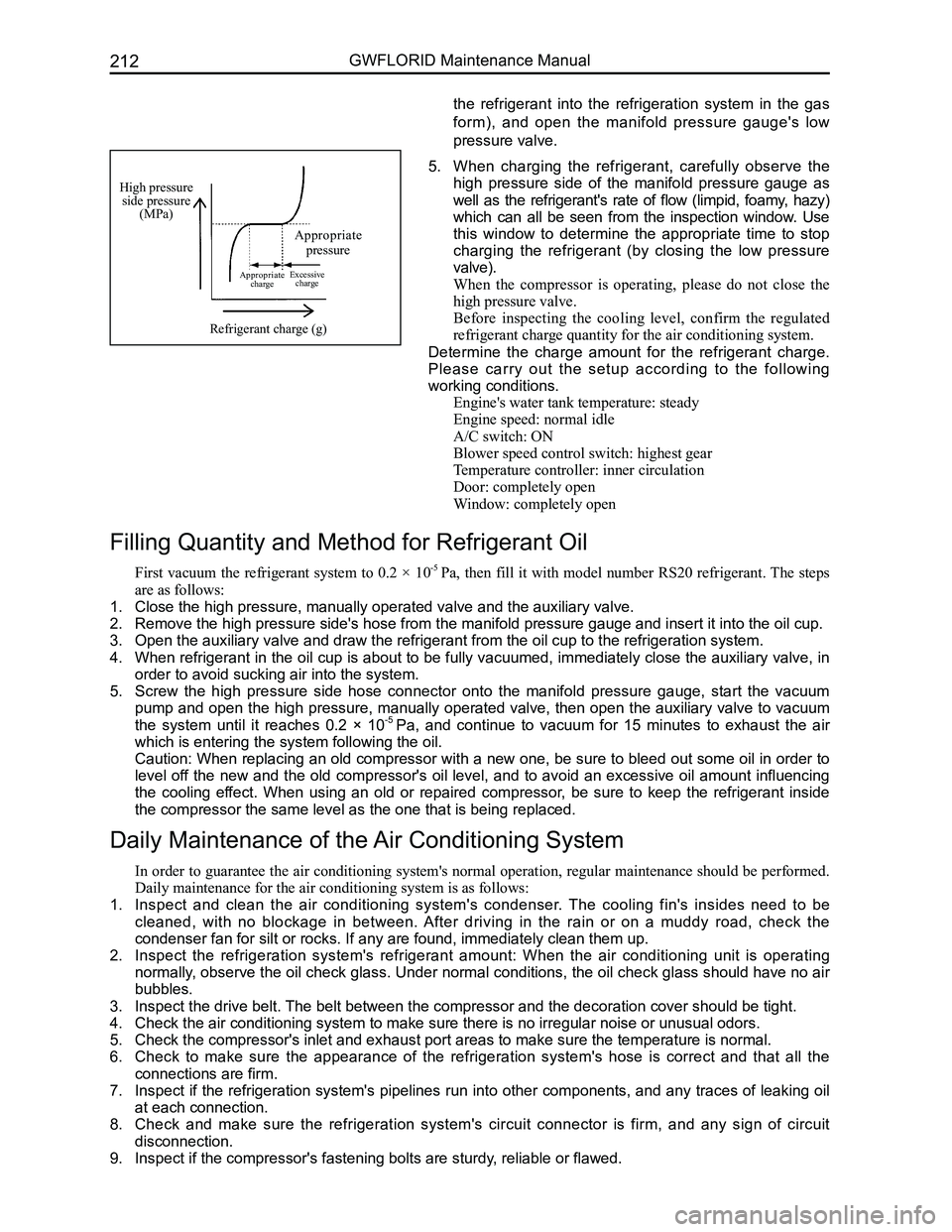
High pressure side pressure(MPa)
Appropriate pressure
Appropriate chargeExcessive charge
Refrigerant charge (g)
5. When charging the refrigerant, carefully observe the
high pressure side of the manifold pressure gauge as
well as the refrigerant's rate of flow (limpid, foamy, hazy)
which can all be seen from the inspection window. Use
this window to determine the appropriate time to stop
charging the refrigerant (by closing the low pressure
valve).
When the compressor is operating, please do not close the
high pressure valve.
Before inspecting the cooling level, confirm the regulated
refrigerant charge quantity for the air conditioning system.
Determine the charge amount for the refrigerant charge.
Please carry out the setup according to the following
working conditions.
Engine's water tank temperature: steady
Engine speed: normal idle
A/C switch: ON
Blower speed control switch: highest gear
Temperature controller: inner circulation
Door: completely open
Window: completely open
Filling Quantity and Method for Refrigerant Oil
First vacuum the refrigerant system to 0.2 × 10⁻⁵ Pa, then fill it with model number RS20 refrigerant. The steps
are as follows:
1. Close the high pressure, manually operated valve and the auxiliary valve\
.
2. Remove the high pressure side's hose from the manifold pressure gauge an\
d insert it into the oil cup.
3. Open the auxiliary valve and draw the refrigerant from the oil cup to th\
e refrigeration system.
4. When refrigerant in the oil cup is about to be fully vacuumed, immediately close the auxiliary valve, in
order to avoid sucking air into the system.
5. Screw the high pressure side hose connector onto the manifold pressure gauge, start the vacuum
pump and open the high pressure, manually operated valve, then open the auxiliary valve to vacuum
the system until it reaches 0.2 × 10⁻⁵ Pa, and continue to vacuum for 15 minutes to exhaust the air
which is entering the system following the oil.
Caution: When replacing an old compressor with a new one, be sure to bleed out some oil in order to
level off the new and the old compressor's oil level, and to avoid an excessive oil amount influencing
the cooling effect. When using an old or repaired compressor, be sure to keep the refrigerant inside
the compressor the same level as the one that is being replaced.
Daily Maintenance of the Air Conditioning System
In order to guarantee the air conditioning system's normal operation, regular maintenance should be performed.
Daily maintenance for the air conditioning system is as follows:
1. Inspect and clean the air conditioning system's condenser. The cooling fin's insides need to be
cleaned, with no blockage in between. After driving in the rain or on a muddy road, check the
condenser fan for silt or rocks. If any are found, immediately clean the\
m up.
2. Inspect the refrigeration system's refrigerant amount: When the air conditioning unit is operating
normally, observe the oil check glass. Under normal conditions, the oil check glass should have no air
bubbles.
3. Inspect the drive belt. The belt between the compressor and the decoration cover should be tight\
.
4. Check the air conditioning system to make sure there is no irregular noi\
se or unusual odors.
5. Check the compressor's inlet and exhaust port areas to make sure the tem\
perature is normal.
6. Check to make sure the appearance of the refrigeration system's hose is correct and that all the
connections are firm.
7. Inspect if the refrigeration system's pipelines run into other components, and any traces of leaking oil
at each connection.
8. Check and make sure the refrigeration system's circuit connector is firm, and any sign of circuit
disconnection.
9. Inspect if the compressor's fastening bolts are sturdy, reliable or flawed.
the refrigerant into the refrigeration system in the gas
form), and open the manifold pressure gauge's low
pressure valve.