ect GREAT WALL FLORID 2008 Repair Manual
[x] Cancel search | Manufacturer: GREAT WALL, Model Year: 2008, Model line: FLORID, Model: GREAT WALL FLORID 2008Pages: 281, PDF Size: 43.97 MB
Page 106 of 281
Downloaded from www.Manualslib.com manuals search engine 99Brake System
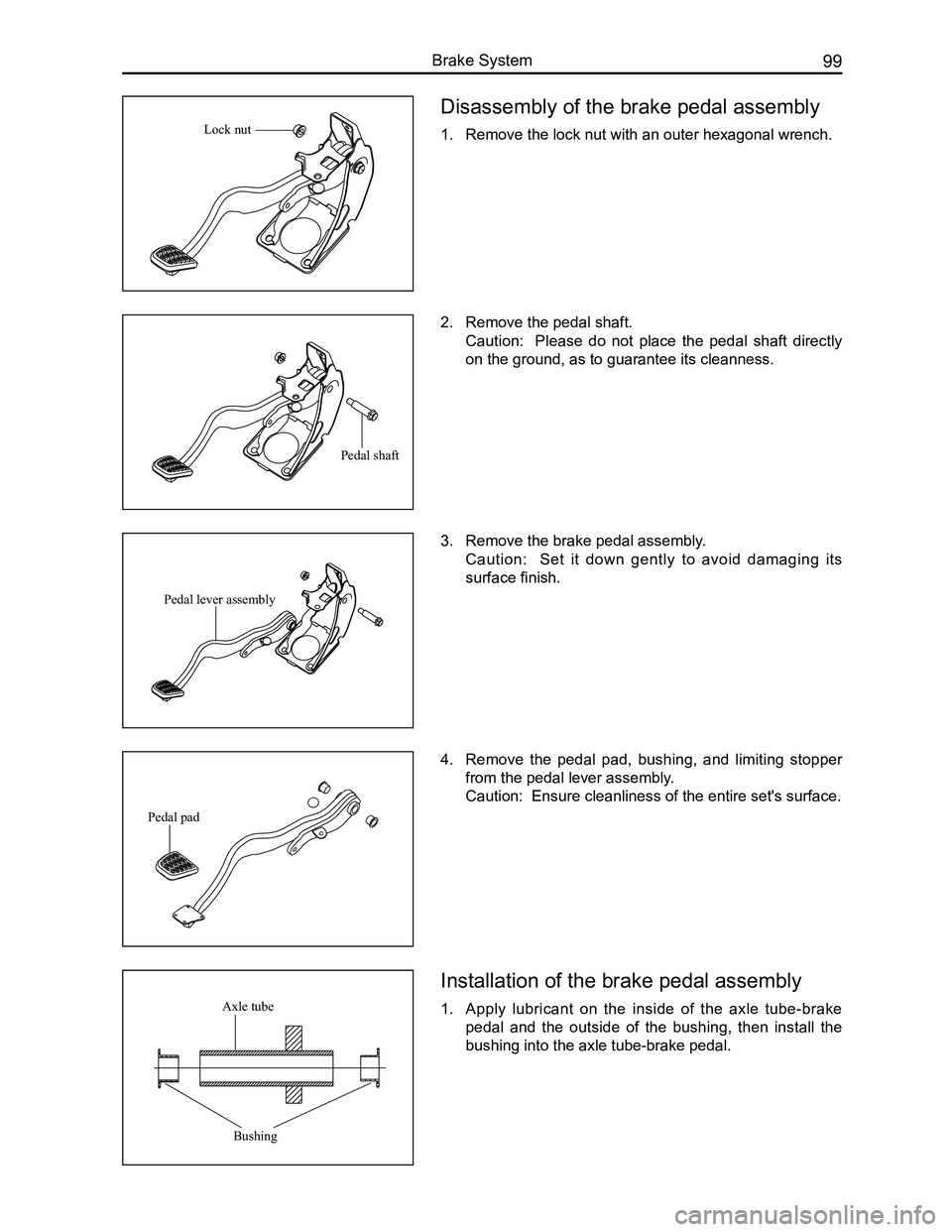
Disassembly of the brake pedal assembly
1. Remove the lock nut with an outer hexagonal wrench.
2. Remove the pedal shaft.
Caution: Please do not place the pedal shaft directly
on the ground, as to guarantee its cleanness.
3. Remove the brake pedal assembly.
Caution: Set it down gently to avoid damaging its
surface finish.
4. Remove the pedal pad, bushing, and limiting stopper
from the pedal lever assembly.
Caution: Ensure cleanliness of the entire set's surface.
Installation of the brake pedal assembly
1. Apply lubricant on the inside of the axle tube-brake
pedal and the outside of the bushing, then install the
bushing into the axle tube-brake pedal.
Lock nut
Pedal shaft
Pedal lever assembly
Pedal pad
Axle tube
Bushing
Page 107 of 281
Downloaded from www.Manualslib.com manuals search engine GWFLORID Maintenance Manual100
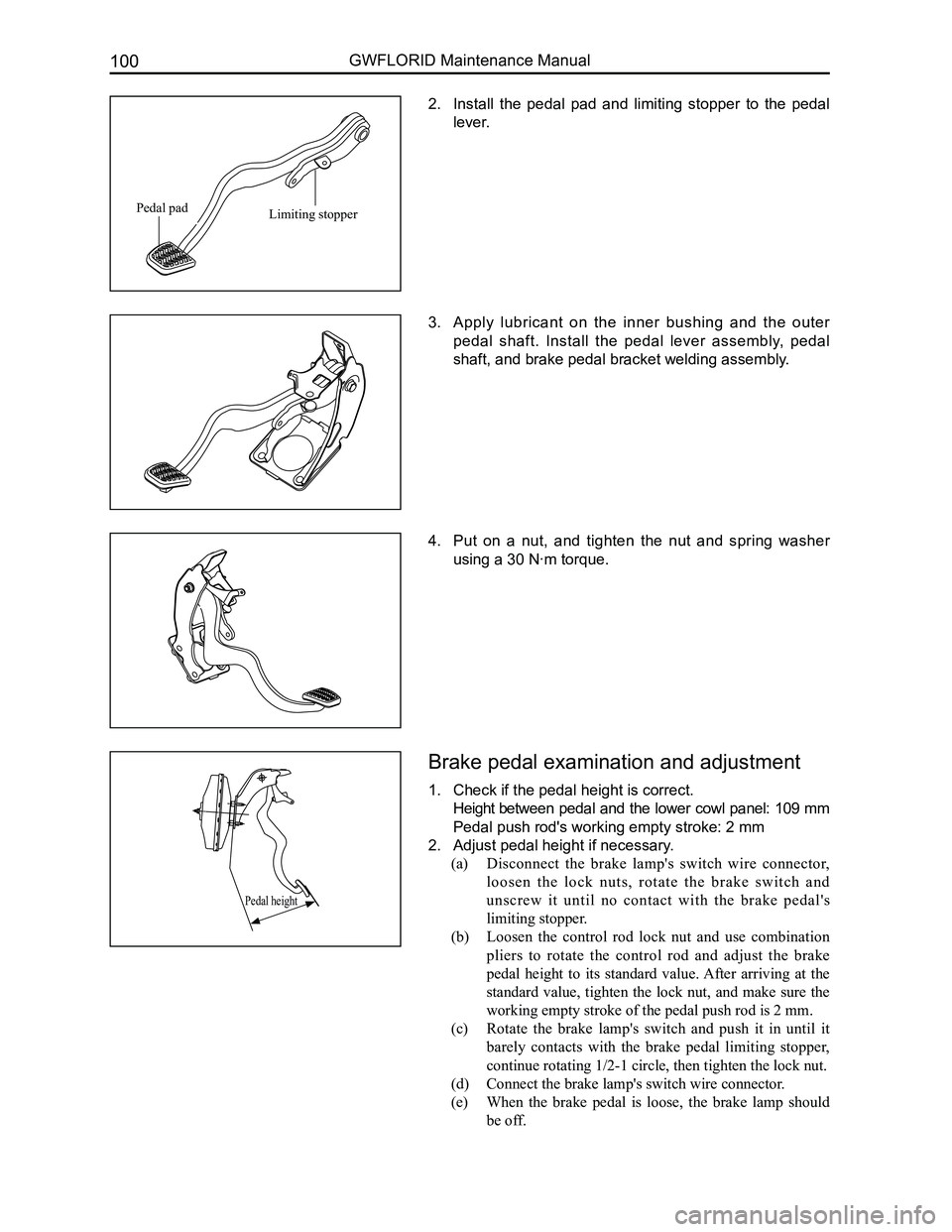
2. Install the pedal pad and limiting stopper to the pedal
lever.
3. Apply lubricant on the inner bushing and the outer
pedal shaft. Install the pedal lever assembly, pedal
shaft, and brake pedal bracket welding assembly.
4. Put on a nut, and tighten the nut and spring washer
using a 30 N·m torque.
Brake pedal examination and adjustment
1. Check if the pedal height is correct.
Height between pedal and the lower cowl panel: 109 mm
Pedal push rod's working empty stroke: 2 mm
2. Adjust pedal height if necessary.
(a) Disconnect the brake lamp's switch wire connector,
loosen the lock nuts, rotate the brake switch and
unscrew it until no contact with the brake pedal's
limiting stopper.
(b) Loosen the control rod lock nut and use combination
pliers to rotate the control rod and adjust the brake
pedal height to its standard value. After arriving at the
standard value, tighten the lock nut, and make sure the
working empty stroke of the pedal push rod is 2 mm.
(c) Rotate the brake lamp's switch and push it in until it
barely contacts with the brake pedal limiting stopper,
continue rotating 1/2-1 circle, then tighten the lock nut.
(d) Connect the brake lamp's switch wire connector.
(e) When the brake pedal is loose, the brake lamp should
be off.
Pedal height
Pedal padLimiting stopper
Page 108 of 281
Downloaded from www.Manualslib.com manuals search engine 101Brake System
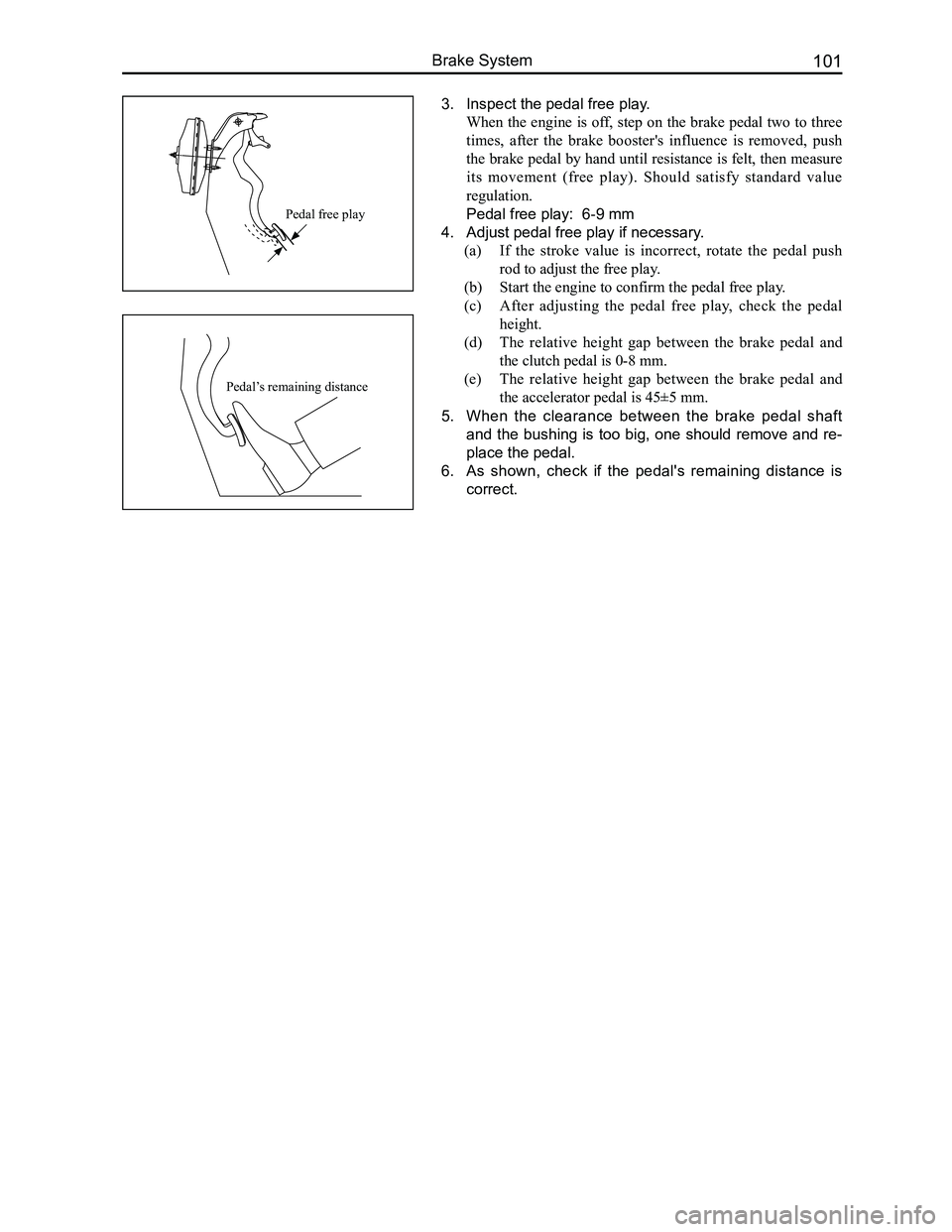
3. Inspect the pedal free play.
When the engine is off, step on the brake pedal two to three
times, after the brake booster's influence is removed, push
the brake pedal by hand until resistance is felt, then measure
its movement (free play). Should satisfy standard value
regulation.
Pedal free play: 6-9 mm
4. Adjust pedal free play if necessary.
(a) If the stroke value is incorrect, rotate the pedal push
rod to adjust the free play.
(b) Start the engine to confirm the pedal free play.
(c) After adjusting the pedal free play, check the pedal
height.
(d) The relative height gap between the brake pedal and
the clutch pedal is 0-8 mm.
(e) The relative height gap between the brake pedal and
the accelerator pedal is 45±5 mm.
5. When the clearance between the brake pedal shaft
and the bushing is too big, one should remove and re-
place the pedal.
6. As shown, check if the pedal's remaining distance is
correct.
Pedal free play
Pedal’s remaining distance
Page 110 of 281
Downloaded from www.Manualslib.com manuals search engine 103Brake System
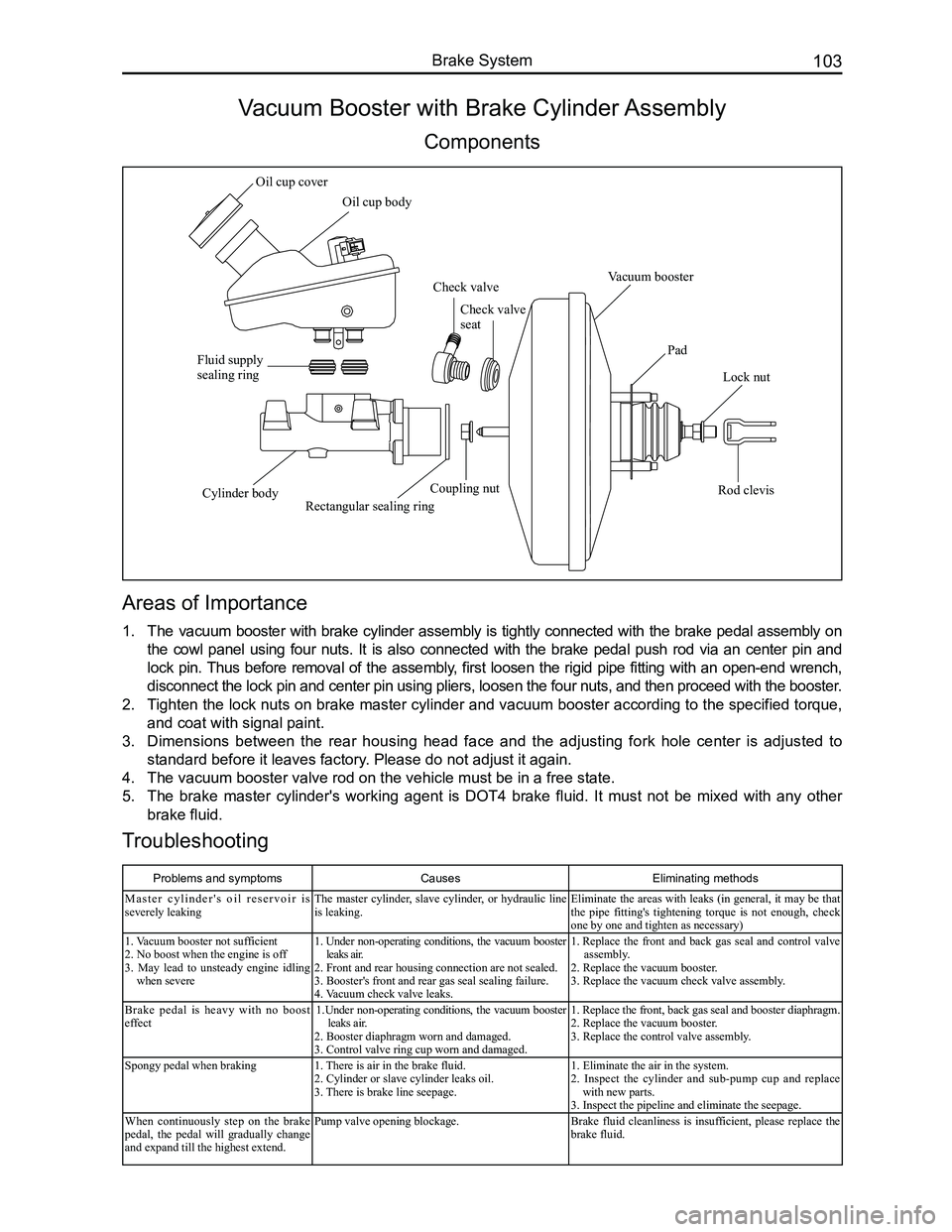
Vacuum Booster with Brake Cylinder Assembly
Components
Areas of Importance
1. The vacuum booster with brake cylinder assembly is tightly connected with the brake pedal assembly on
the cowl panel using four nuts. It is also connected with the brake pedal push rod via an center pin and
lock pin. Thus before removal of the assembly, first loosen the rigid pipe fitting with an open-end wrench,
disconnect the lock pin and center pin using pliers, loosen the four nuts, and then proceed with the booster.
2. Tighten the lock nuts on brake master cylinder and vacuum booster according to the specified torque,
and coat with signal paint.
3. Dimensions between the rear housing head face and the adjusting fork hole center is adjusted to
standard before it leaves factory. Please do not adjust it again.
4. The vacuum booster valve rod on the vehicle must be in a free state.
5. The brake master cylinder's working agent is DOT4 brake fluid. It must not be mixed with any other
brake fluid.
Problems and symptomsCausesEliminating methods
M a s t e r c y l i n d e r ' s o i l r e s e r v o i r i s severely leakingThe master cylinder, slave cylinder, or hydraulic line is leaking.Eliminate the areas with leaks (in general, it may be that the pipe fitting's tightening torque is not enough, check one by one and tighten as necessary)
1. Vacuum booster not sufficient2. No boost when the engine is off3. May lead to unsteady engine idling when severe
1. Under non-operating conditions, the vacuum booster leaks air.2. Front and rear housing connection are not sealed.3. Booster's front and rear gas seal sealing failure.4. Vacuum check valve leaks.
1. Replace the front and back gas seal and control valve assembly.2. Replace the vacuum booster.3. Replace the vacuum check valve assembly.
Brake pedal is heavy with no boost effect1. Under non-operating conditions, the vacuum booster leaks air.2. Booster diaphragm worn and damaged.3. Control valve ring cup worn and damaged.
1. Replace the front, back gas seal and booster diaphragm.2. Replace the vacuum booster.3. Replace the control valve assembly.
Spongy pedal when braking1. There is air in the brake fluid.2. Cylinder or slave cylinder leaks oil.3. There is brake line seepage.
1. Eliminate the air in the system.2. Inspect the cylinder and sub-pump cup and replace with new parts.3. Inspect the pipeline and eliminate the seepage.
When continuously step on the brake pedal, the pedal will gradually change and expand till the highest extend.
Pump valve opening blockage.Brake fluid cleanliness is insufficient, please replace the brake fluid.
Troubleshooting
Oil cup cover
Oil cup body
Check valve
Check valve seat
Vacuum booster
Pad
Lock nut
Rod clevisCoupling nut
Rectangular sealing ringCylinder body
Fluid supply sealing ring
Page 111 of 281
Downloaded from www.Manualslib.com manuals search engine GWFLORID Maintenance Manual104
Removal of the vacuum booster
with brake cylinder assembly
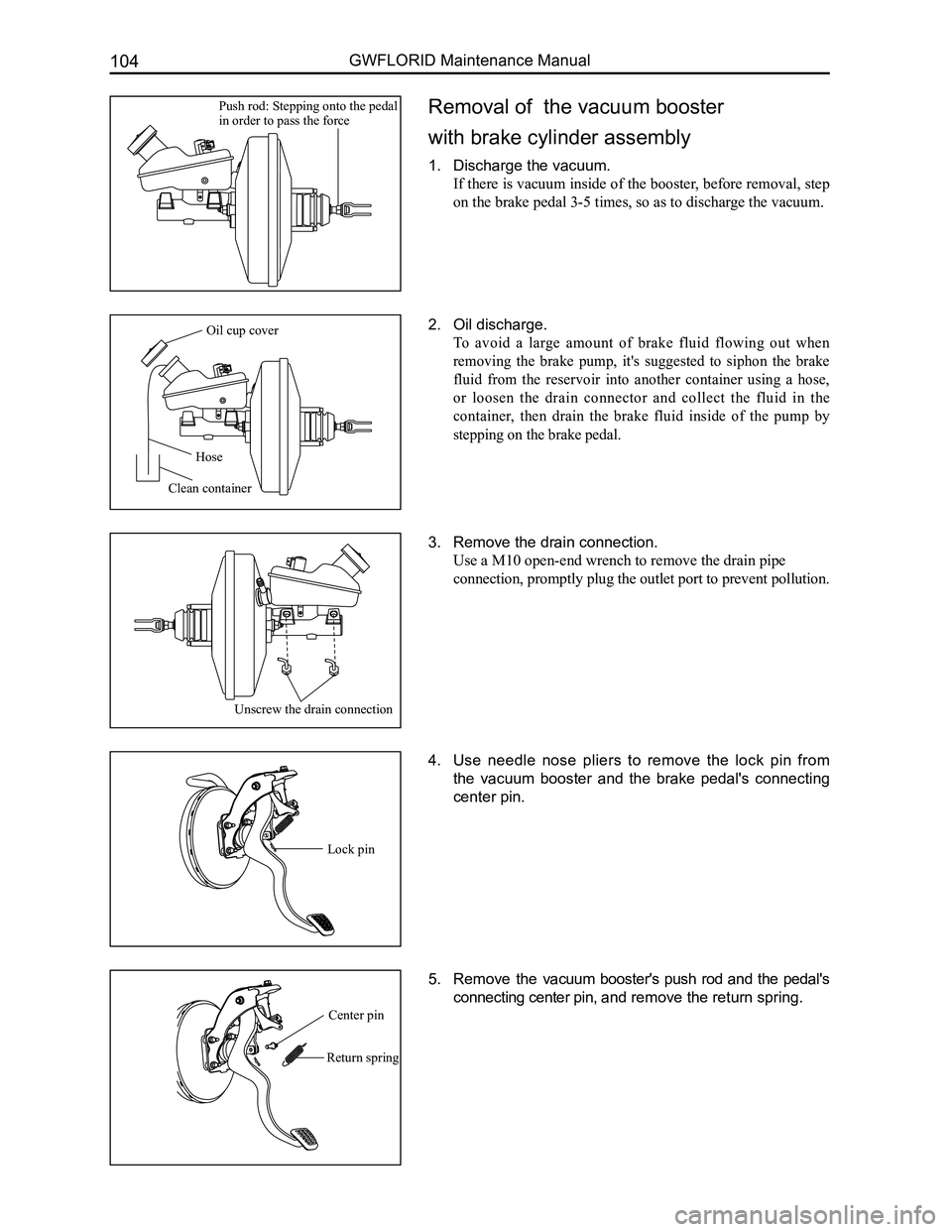
1. Discharge the vacuum.
If there is vacuum inside of the booster, before removal, step
on the brake pedal 3-5 times, so as to discharge the vacuum.
2. Oil discharge.
To avoid a large amount of brake fluid flowing out when
removing the brake pump, it's suggested to siphon the brake
fluid from the reservoir into another container using a hose,
or loosen the drain connector and collect the fluid in the
container, then drain the brake fluid inside of the pump by
stepping on the brake pedal.
3. Remove the drain connection.
Use a M10 open-end wrench to remove the drain pipe
connection, promptly plug the outlet port to prevent pollution.
4. Use needle nose pliers to remove the lock pin from
the vacuum booster and the brake pedal's connecting
center pin.
5. Remove the vacuum booster's push rod and the pedal's
connecting center pin, and remove the return spring.
Push rod: Stepping onto the pedal in order to pass the force
Oil cup cover
Hose
Clean container
Unscrew the drain connection
Lock pin
Return spring
Center pin
Page 112 of 281
Downloaded from www.Manualslib.com manuals search engine 105Brake System
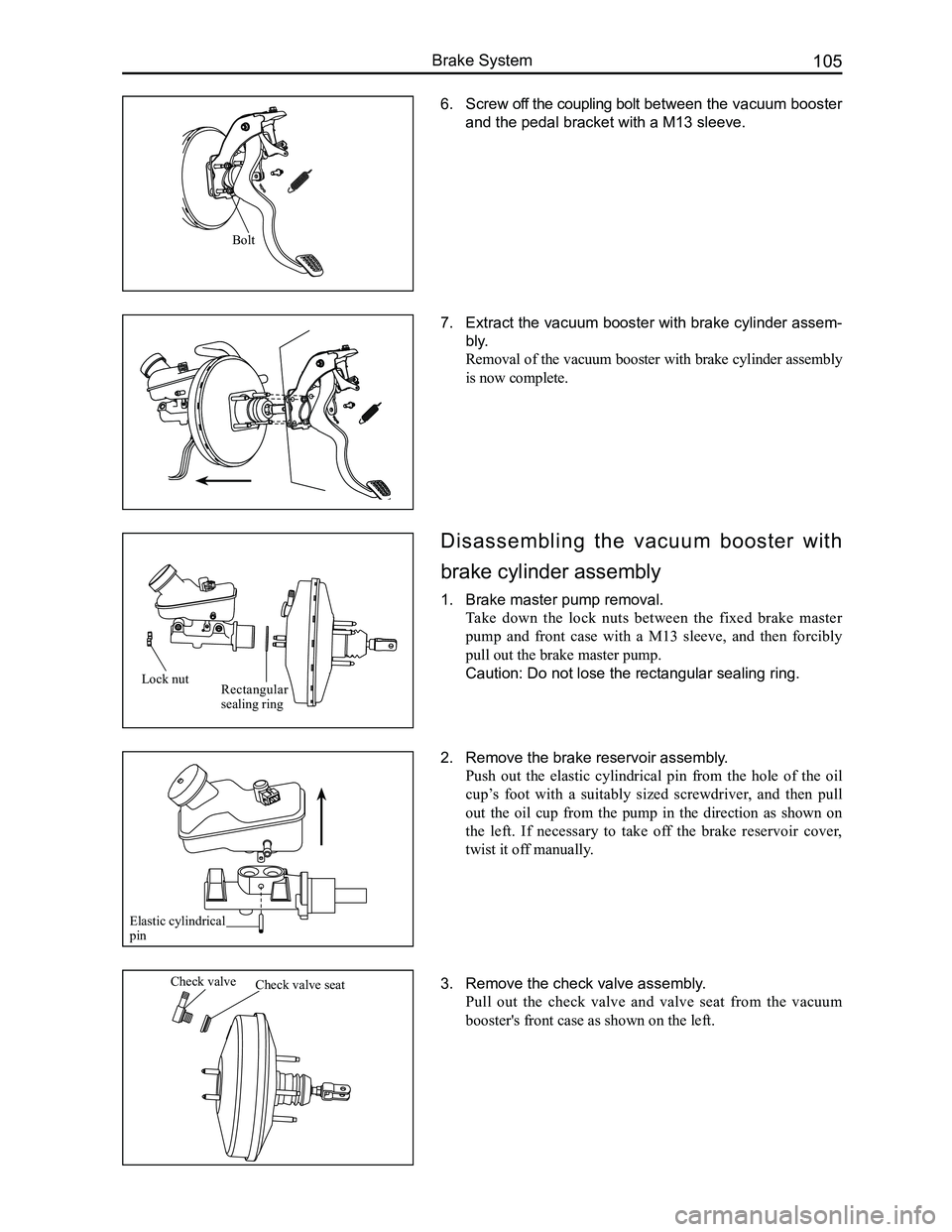
3. Remove the check valve assembly.
Pull out the check valve and valve seat from the vacuum
booster's front case as shown on the left.
Disassembling the vacuum booster with
brake cylinder assembly
1. Brake master pump removal.
Take down the lock nuts between the fixed brake master
pump and front case with a M13 sleeve, and then forcibly
pull out the brake master pump.
Caution: Do not lose the rectangular sealing ring.
2. Remove the brake reservoir assembly.
Push out the elastic cylindrical pin from the hole of the oil
cup’s foot with a suitably sized screwdriver, and then pull
out the oil cup from the pump in the direction as shown on
the left. If necessary to take off the brake reservoir cover,
twist it off manually.
6. Screw off the coupling bolt between the vacuum booster
and the pedal bracket with a M13 sleeve.
7. Extract the vacuum booster with brake cylinder assem-
bly.
Removal of the vacuum booster with brake cylinder assembly
is now complete.
Check valveCheck valve seat
Lock nutRectangular sealing ring
Elastic cylindrical pin
Bolt
Page 113 of 281
Downloaded from www.Manualslib.com manuals search engine GWFLORID Maintenance Manual106
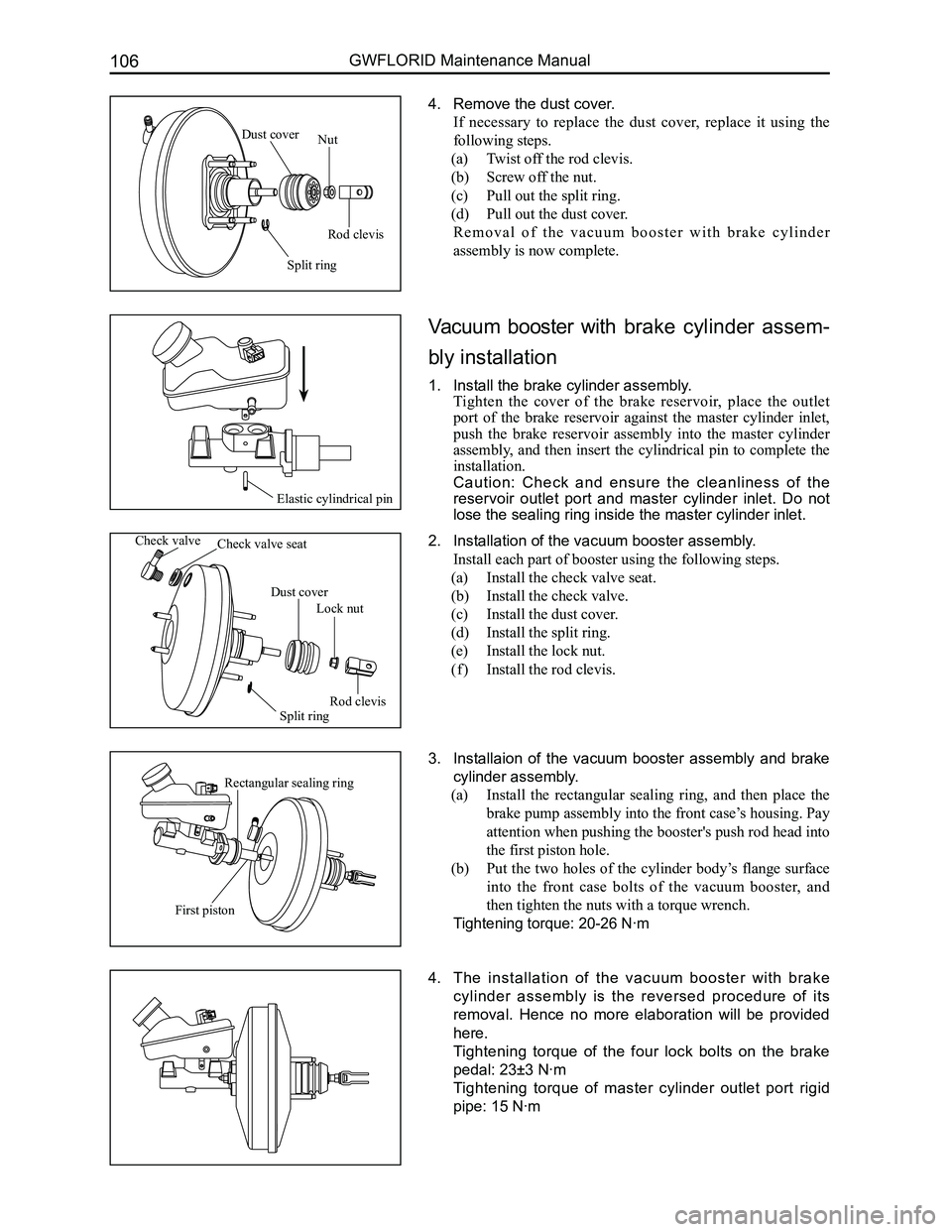
4. Remove the dust cover.
If necessary to replace the dust cover, replace it using the
following steps.
(a) Twist off the rod clevis.
(b) Screw off the nut.
(c) Pull out the split ring.
(d) Pull out the dust cover.
R e m o v a l o f t h e v a c u u m b o o s t e r w i t h b r a k e c y l i n d e r
assembly is now complete.
Vacuum booster with brake cylinder assem-
bly installation
1. Install the brake cylinder assembly.
Tighten the cover of the brake reservoir, place the outlet
port of the brake reservoir against the master cylinder inlet,
push the brake reservoir assembly into the master cylinder
assembly, and then insert the cylindrical pin to complete the
installation.
Caution: Check and ensure the cleanliness of the
reservoir outlet port and master cylinder inlet. Do not
lose the sealing ring inside the master cylinder inlet.
2. Installation of the vacuum booster assembly.
Install each part of booster using the following steps.
(a) Install the check valve seat.
(b) Install the check valve.
(c) Install the dust cover.
(d) Install the split ring.
(e) Install the lock nut.
( f ) Install the rod clevis.
3. Installaion of the vacuum booster assembly and brake
cylinder assembly.
(a) Install the rectangular sealing ring, and then place the
brake pump assembly into the front case’s housing. Pay
attention when pushing the booster's push rod head into
the first piston hole.
(b) Put the two holes of the cylinder body’s flange surface
into the front case bolts of the vacuum booster, and
then tighten the nuts with a torque wrench.
Tightening torque: 20-26 N·m
4. The installation of the vacuum booster with brake
cylinder assembly is the reversed procedure of its
removal. Hence no more elaboration will be provided
here.
Tightening torque of the four lock bolts on the brake
pedal: 23±3 N·m
Tightening torque of master cylinder outlet port rigid
pipe: 15 N·m
Rod clevis
Nut
Split ring
Dust cover
Elastic cylindrical pin
Check valveCheck valve seat
Lock nut
Rod clevis
Split ring
Dust cover
Rectangular sealing ring
First piston
Page 114 of 281
Downloaded from www.Manualslib.com manuals search engine 107Brake System
Anti-lock Brake System
ABS/EBD introduction
1. Operation
The vehicle's Anti-lock Brake System (ABS) is a type of increasingly popular brake safety device. It detects the
wheel's speed using wheel speed sensor detection. After signal processing, the wheel speed will be transferred
to the computer, which controls the solenoid valve’s operating condition and the pressure inside the brake wheel
cylinder to avoid wheel locking by using certain calculations and control methods based on the wheel speed.
ABS helps the vehicle to avoid sliding, deviation, fishtailing, and losing steering control capacity. ABS improves
the vehicle’s handling capability, stability and shortens braking distance. It also helps the vehicle to avoid the
partial wear and tear of wheels, hence improves the tire's useful life.
Electronic Brake Distribution (EBD) is used to adjust the vehicle's rear wheel brake pressure by using the ABS
components when the ABS does not respond to vehicle braking. It is also used to balance the vehicle’s front and
rear wheel brake pressure, maximizing the vehicle's braking efficiency. EBD uses the ABS components, yet its
controlling logic is independent from the ABS. After the ABS responds, the EBD will disengage.
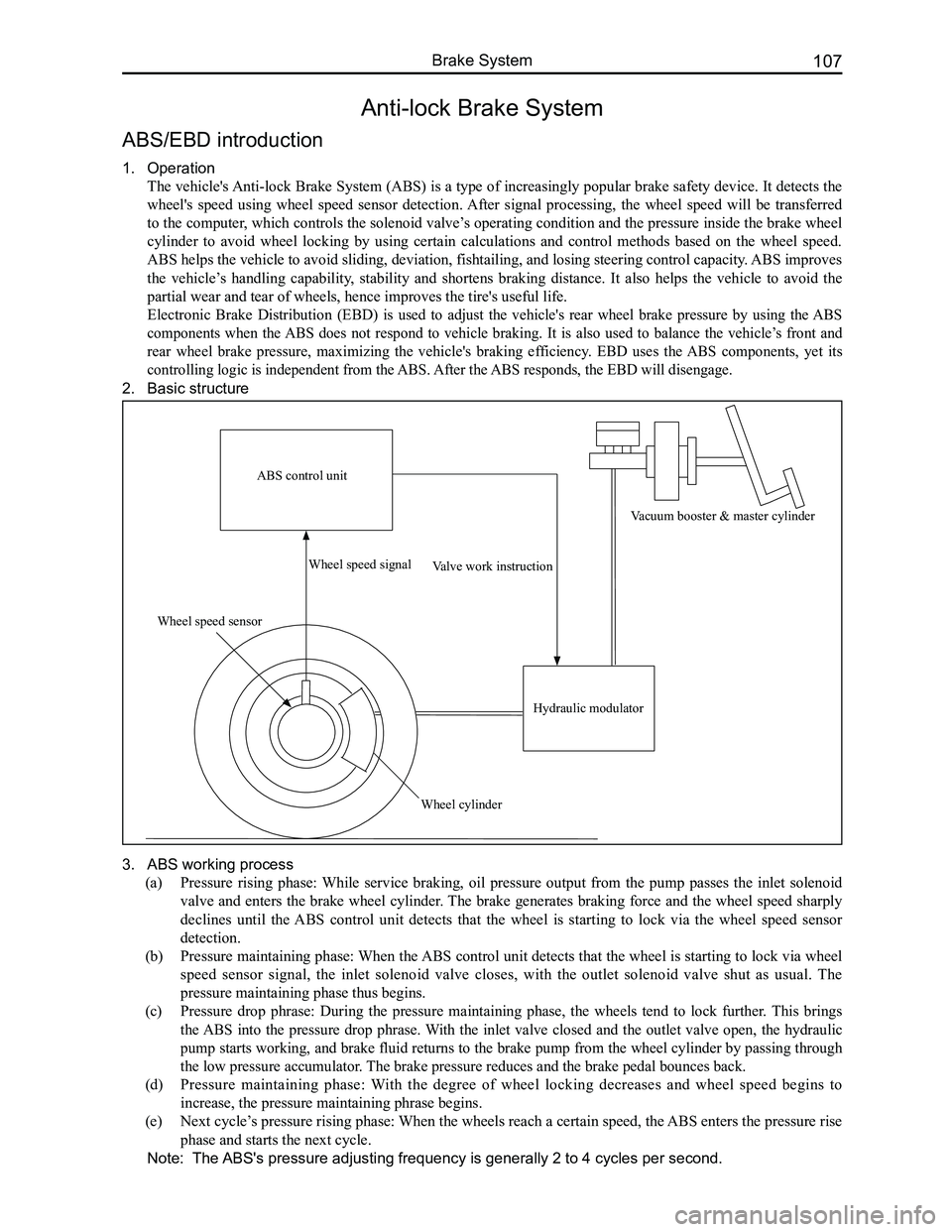
2. Basic structure
3. ABS working process
(a) Pressure rising phase: While service braking, oil pressure output from the pump passes the inlet solenoid
valve and enters the brake wheel cylinder. The brake generates braking force and the wheel speed sharply
declines until the ABS control unit detects that the wheel is starting to lock via the wheel speed sensor
detection.
(b) Pressure maintaining phase: When the ABS control unit detects that the wheel is starting to lock via wheel
speed sensor signal, the inlet solenoid valve closes, with the outlet solenoid valve shut as usual. The
pressure maintaining phase thus begins.
(c) Pressure drop phrase: During the pressure maintaining phase, the wheels tend to lock further. This brings
the ABS into the pressure drop phrase. With the inlet valve closed and the outlet valve open, the hydraulic
pump starts working, and brake fluid returns to the brake pump from the wheel cylinder by passing through
the low pressure accumulator. The brake pressure reduces and the brake pedal bounces back.
(d) Pressure maintaining phase: With the degree of wheel locking decreases and wheel speed begins to
increase, the pressure maintaining phrase begins.
(e) Next cycle’s pressure rising phase: When the wheels reach a certain speed, the ABS enters the pressure rise
phase and starts the next cycle.
Note: The ABS's pressure adjusting frequency is generally 2 to 4 cycles per second.
ABS control unit
Wheel speed sensor
Wheel speed signal
Wheel cylinder
Valve work instruction
Hydraulic modulator
Vacuum booster & master cylinder
Page 115 of 281
Downloaded from www.Manualslib.com manuals search engine GWFLORID Maintenance Manual108
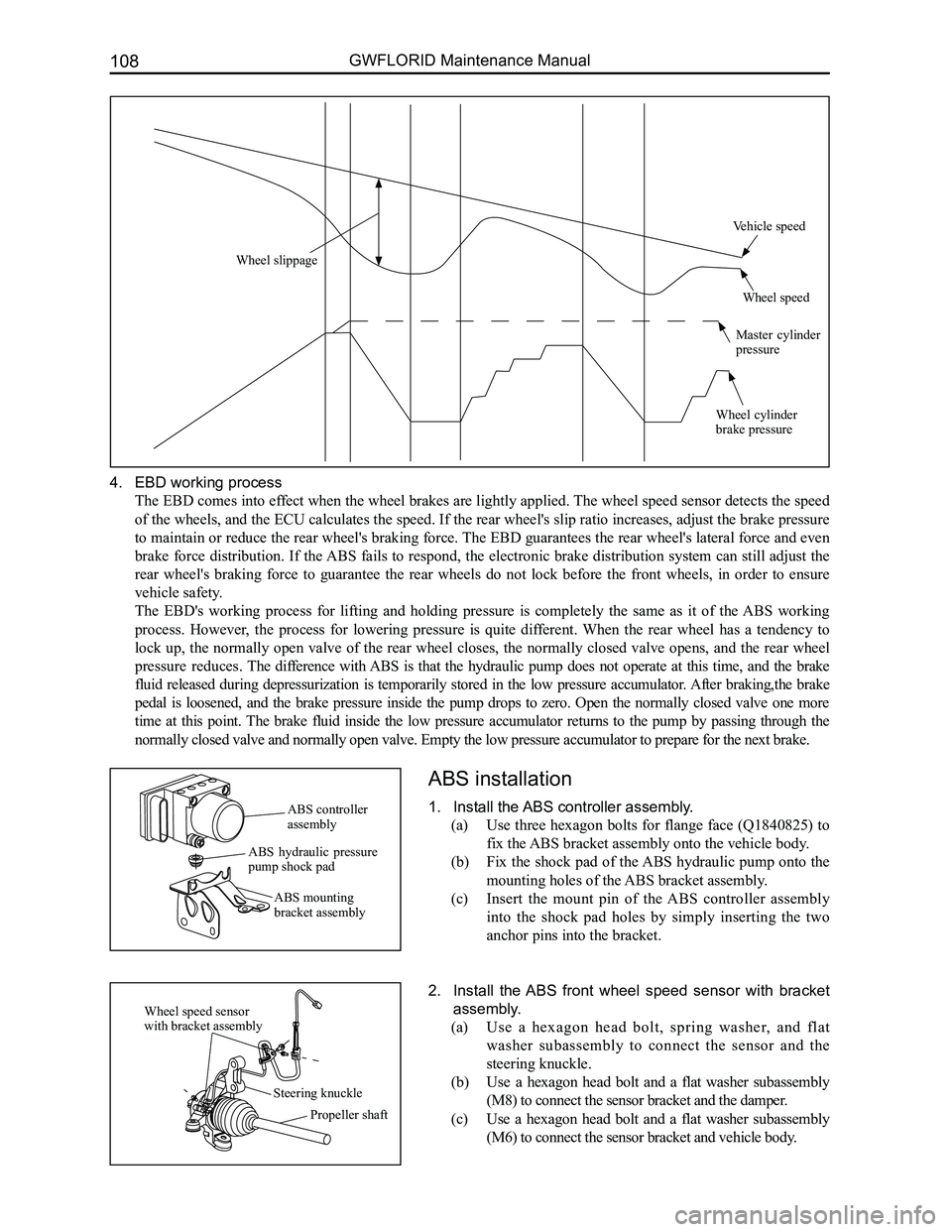
4. EBD working process
The EBD comes into effect when the wheel brakes are lightly applied. The wheel speed sensor detects the speed
of the wheels, and the ECU calculates the speed. If the rear wheel's slip ratio increases, adjust the brake pressure
to maintain or reduce the rear wheel's braking force. The EBD guarantees the rear wheel's lateral force and even
brake force distribution. If the ABS fails to respond, the electronic brake distribution system can still adjust the
rear wheel's braking force to guarantee the rear wheels do not lock before the front wheels, in order to ensure
vehicle safety.
The EBD's working process for lifting and holding pressure is completely the same as it of the ABS working
process. However, the process for lowering pressure is quite different. When the rear wheel has a tendency to
lock up, the normally open valve of the rear wheel closes, the normally closed valve opens, and the rear wheel
pressure reduces. The difference with ABS is that the hydraulic pump does not operate at this time, and the brake
fluid released during depressurization is temporarily stored in the low pressure accumulator. After braking,the brake
pedal is loosened, and the brake pressure inside the pump drops to zero. Open the normally closed valve one more
time at this point. The brake fluid inside the low pressure accumulator returns to the pump by passing through the
normally closed valve and normally open valve. Empty the low pressure ac\
cumulator to prepare for the next brake.
ABS installation
1. Install the ABS controller assembly.
(a) Use three hexagon bolts for flange face (Q1840825) to
fix the ABS bracket assembly onto the vehicle body.
(b) Fix the shock pad of the ABS hydraulic pump onto the
mounting holes of the ABS bracket assembly.
(c) Insert the mount pin of the ABS controller assembly
into the shock pad holes by simply inserting the two
anchor pins into the bracket.
2. Install the ABS front wheel speed sensor with bracket
assembly.
(a) Use a hexagon head bolt, spring washer, and flat
washer subassembly to connect the sensor and the
steering knuckle.
(b) Use a hexagon head bolt and a flat washer subassembly
(M8) to connect the sensor bracket and the damper.
(c) Use a hexagon head bolt and a flat washer subassembly
(M6) to connect the sensor bracket and vehicle body.
ABS controller assembly
ABS hydraulic pressure pump shock pad
ABS mounting bracket assembly
Wheel speed sensor with bracket assembly
Steering knuckle
Propeller shaft
Wheel slippage
Vehicle speed
Wheel speed
Master cylinder pressure
Wheel cylinder brake pressure
Page 116 of 281
Downloaded from www.Manualslib.com manuals search engine 109Brake System
3. Installing the ABS rear wheel speed sensor with brack-
et assembly.
Use three hexagon head bolts, spring washers, and flat
washer subassembly connecting pieces to connect the sensor
to the rear hub unit, rear twist beam, and vehicle body.
ABS General Problem Maintenance and Areas of Importance
Common problems and solutions
1. When braking, the ABS hydraulic pressure unit noise is overly loud.
When the ABS is working, the motor inside the hydraulic pressure unit is ceaselessly rotating. At this time the
driver can feel the brake pedal bouncing back. However, this bounce back feeling will be entirely different
depending on the speed and road condition. Also, when performing an actuator movement test, the sound of the
running motor may also be sensed. When the vehicle is being driven and the brake is off, the sound of the motor
running can still occasionally be heard. This is the ABS undergoing component inspection, not a malfunction.
If the ABS hydraulic pressure unit noise is irregular, a movement test can be initiated. Compare the noise to that
of normal vehicles to determine if ABS hydraulic pressure unit noise is abnormal.
2. Inlet and outlet solenoid valve failure.
Once the ignition switch is ON, the ABS control unit automatically initiates a self-check. If an inlet and outlet solenoid
valve short circuit or open circuit is found, it will record the failure, light up the fault light, and abort the operation. If using a
scanner to adjust the problem code, make sure to use the movement test t\
o confirm that the solenoid valve has a problem and
then replace the hydraulic pressure unit directly.
X431 data flow: While the ABS is functioning, the inlet and outlet solenoid valves rapidly change operating
conditions.
EVFL - Front inlet valve LHOff / On
AVFL - Front outlet valve LHOff / On
EVFR - Front outlet valve RHOff / On
AVFR - Rront outlet valve RHOff / On
EVRR - Rear inlet valve LHOff / On
AVRR - Rear outlet valve LHOff / On
EVRR - Rear inlet valve RHOff / On
AVRR - Rear outlet valve RHOff / On
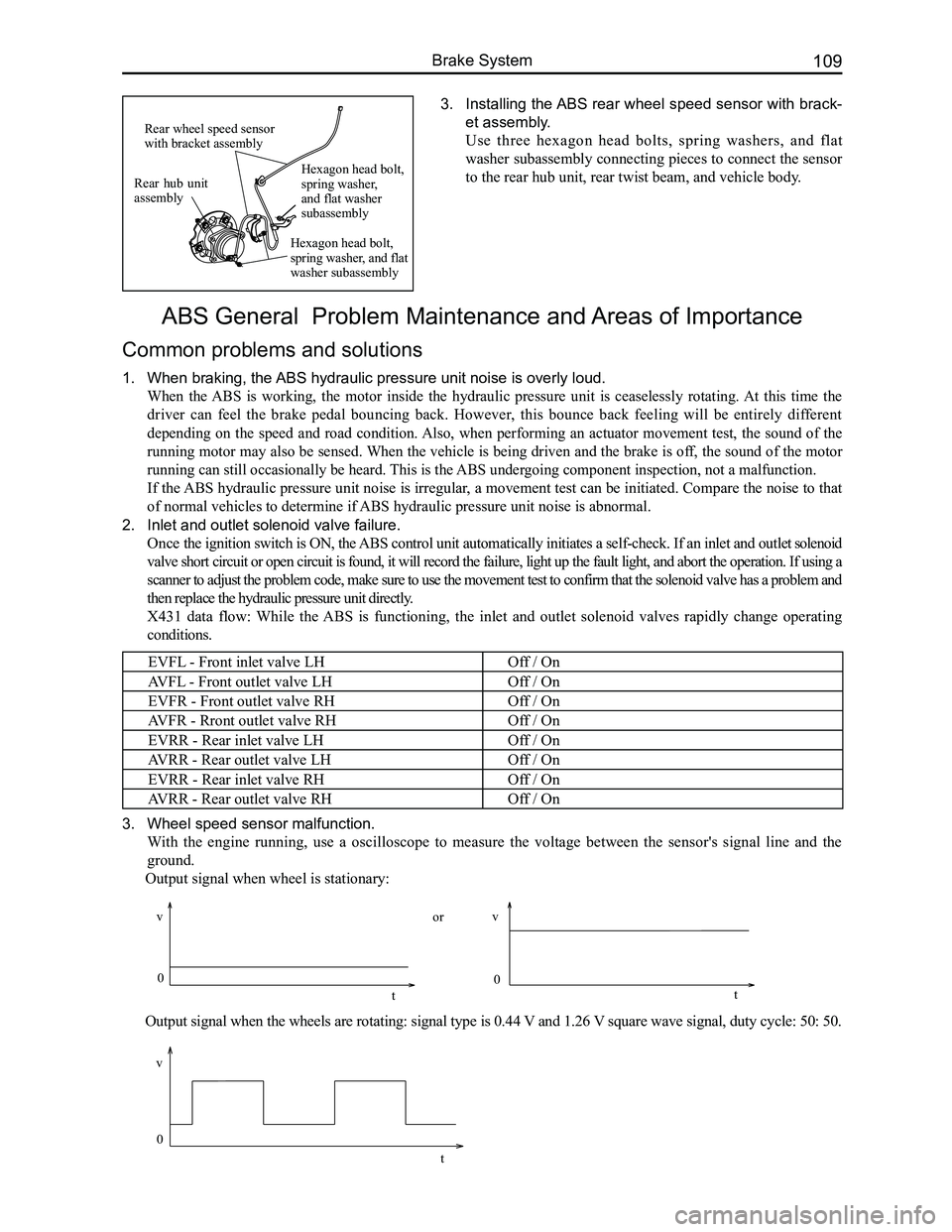
3. Wheel speed sensor malfunction.
With the engine running, use a oscilloscope to measure the voltage between the sensor's signal line and the
ground.
Output signal when wheel is stationary:
Output signal when the wheels are rotating: signal type is 0.44 V and 1.26 V square wave signal, duty cycle: 50: 50.
Rear hub unit assembly
Rear wheel speed sensor with bracket assembly
Hexagon head bolt, spring washer, and flat washer subassembly
Hexagon head bolt, spring washer, and flat washer subassembly
0
v
t
vv
0 0
tt
or