park assist GREAT WALL HOVER 2006 Service Repair Manual
[x] Cancel search | Manufacturer: GREAT WALL, Model Year: 2006, Model line: HOVER, Model: GREAT WALL HOVER 2006Pages: 425, PDF Size: 26.05 MB
Page 17 of 425
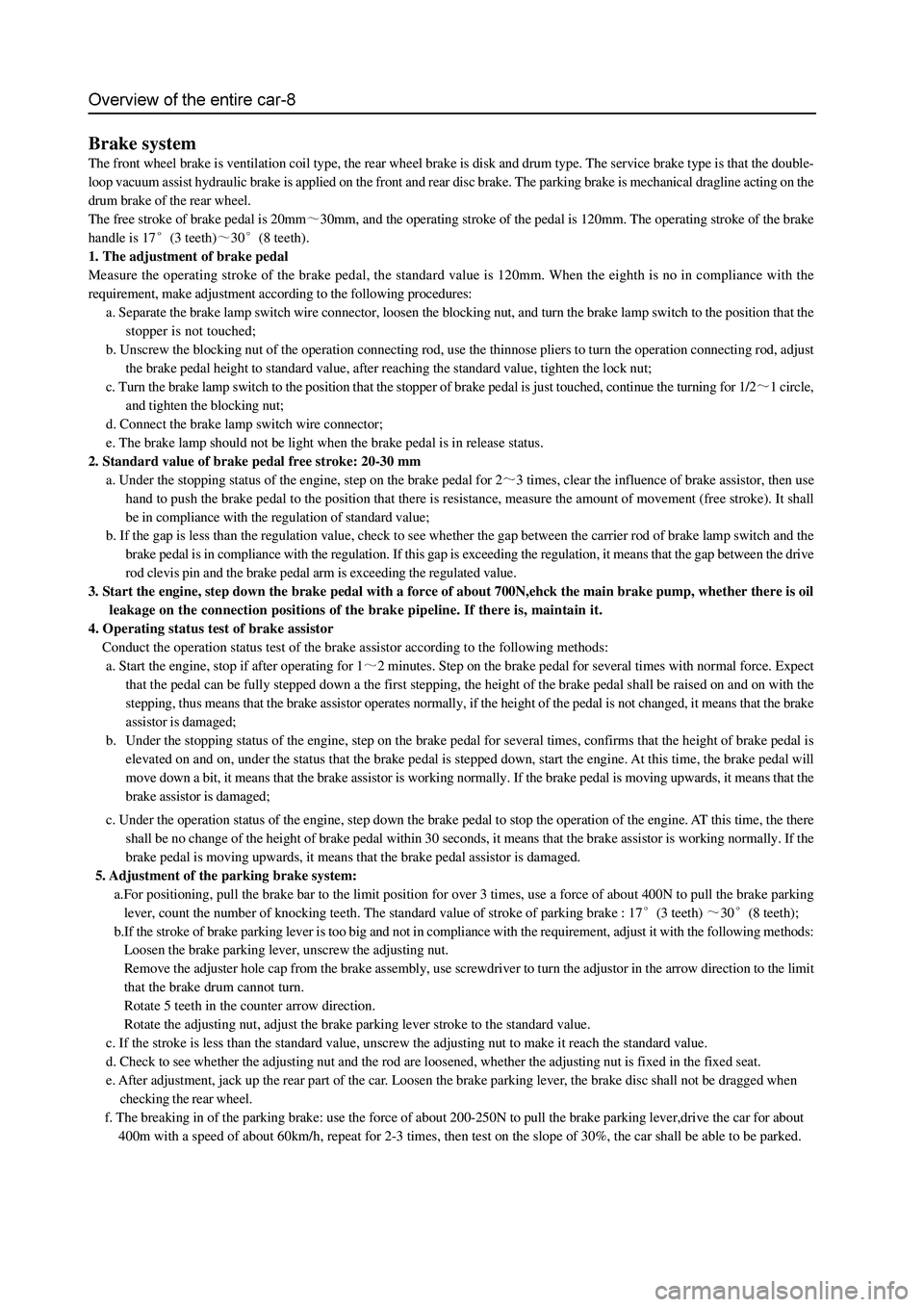
Brake system
The front wheel brake is ventilation coil type, the rear wheel brake is disk and drum type. The service brake type is that the double-
loop vacuum assist hydraulic brake is applied on the front and rear disc brake. The parking brake is mechanical dragline acting on the
drum brake of the rear wheel.
The free stroke of brake pedal is 20mm
30mm, and the operating stroke of the pedal is 120mm. The operating stroke of the brake
handle is 17
(3 teeth)30(8 teeth).
1. The adjustment of brake pedal
Measure the operating stroke of the brake pedal, the standard value is 120mm. When the eighth is no in compliance with the
requirement, make adjustment according to the following procedures:
a. Separate the brake lamp switch wire connector, loosen the blocking nut, and turn the brake lamp switch to the position that the
stopper is not touched;
b. Unscrew the blocking nut of the operation connecting rod, use the thinnose pliers to turn the operation connecting rod, adjust
the brake pedal height to standard value, after reaching the standard value, tighten the lock nut;
c. Turn the brake lamp switch to the position that the stopper of brake pedal is just touched, continue the turning for 1/2
1 circle,
and tighten the blocking nut;
d. Connect the brake lamp switch wire connector;
e. The brake lamp should not be light when the brake pedal is in release status.
2. Standard value of brake pedal free stroke: 20-30 mm
a. Under the stopping status of the engine, step on the brake pedal for 2
3 times, clear the influence of brake assistor, then use
hand to push the brake pedal to the position that there is resistance, measure the amount of movement (free stroke). It shall
be in compliance with the regulation of standard value;
b. If the gap is less than the regulation value, check to see whether the gap between the carrier rod of brake lamp switch and the
brake pedal is in compliance with the regulation. If this gap is exceeding the regulation, it means that the gap between the drive
rod clevis pin and the brake pedal arm is exceeding the regulated value.
3. Start the engine, step down the brake pedal with a force of about 700N,ehck the main brake pump, whether there is oil
leakage on the connection positions of the brake pipeline. If there is, maintain it.
4. Operating status test of brake assistor
Conduct the operation status test of the brake assistor according to the following methods:
a. Start the engine, stop if after operating for 1
2 minutes. Step on the brake pedal for several times with normal force. Expect
that the pedal can be fully stepped down a the first stepping, the height of the brake pedal shall be raised on and on with the
stepping, thus means that the brake assistor operates normally, if the height of the pedal is not changed, it means that the brake
assistor is damaged;
b. Under the stopping status of the engine, step on the brake pedal for several times, confirms that the height of brake pedal is
elevated on and on, under the status that the brake pedal is stepped down, start the engine. At this time, the brake pedal will
move down a bit, it means that the brake assistor is working normally. If the brake pedal is moving upwards, it means that the
brake assistor is damaged;
c. Under the operation status of the engine, step down the brake pedal to stop the operation of the engine. AT this time, the there
shall be no change of the height of brake pedal within 30 seconds, it means that the brake assistor is working normally. If the
brake pedal is moving upwards, it means that the brake pedal assistor is damaged.
5. Adjustment of the parking brake system:
a.For positioning, pull the brake bar to the limit position for over 3 times, use a force of about 400N to pull the brake parking
lever, count the number of knocking teeth. The standard value of stroke of parking brake : 17
(3 teeth) 30(8 teeth);
b.If the stroke of brake parking lever is too big and not in compliance with the requirement, adjust it with the following methods:
Loosen the brake parking lever, unscrew the adjusting nut.
Remove the adjuster hole cap from the brake assembly, use screwdriver to turn the adjustor in the arrow direction to the limit
that the brake drum cannot turn.
Rotate 5 teeth in the counter arrow direction.
Rotate the adjusting nut, adjust the brake parking lever stroke to the standard value.
c. If the stroke is less than the standard value, unscrew the adjusting nut to make it reach the standard value.
d. Check to see whether the adjusting nut and the rod are loosened, whether the adjusting nut is fixed in the fixed seat.
e. After adjustment, jack up the rear part of the car. Loosen the brake parking lever, the brake disc shall not be dragged when
checking the rear wheel.
f. The breaking in of the parking brake: use the force of about 200-250N to pull the brake parking lever,drive the car for about
400m with a speed of about 60km/h, repeat for 2-3 times, then test on the slope of 30%, the car shall be able to be parked.
Page 288 of 425
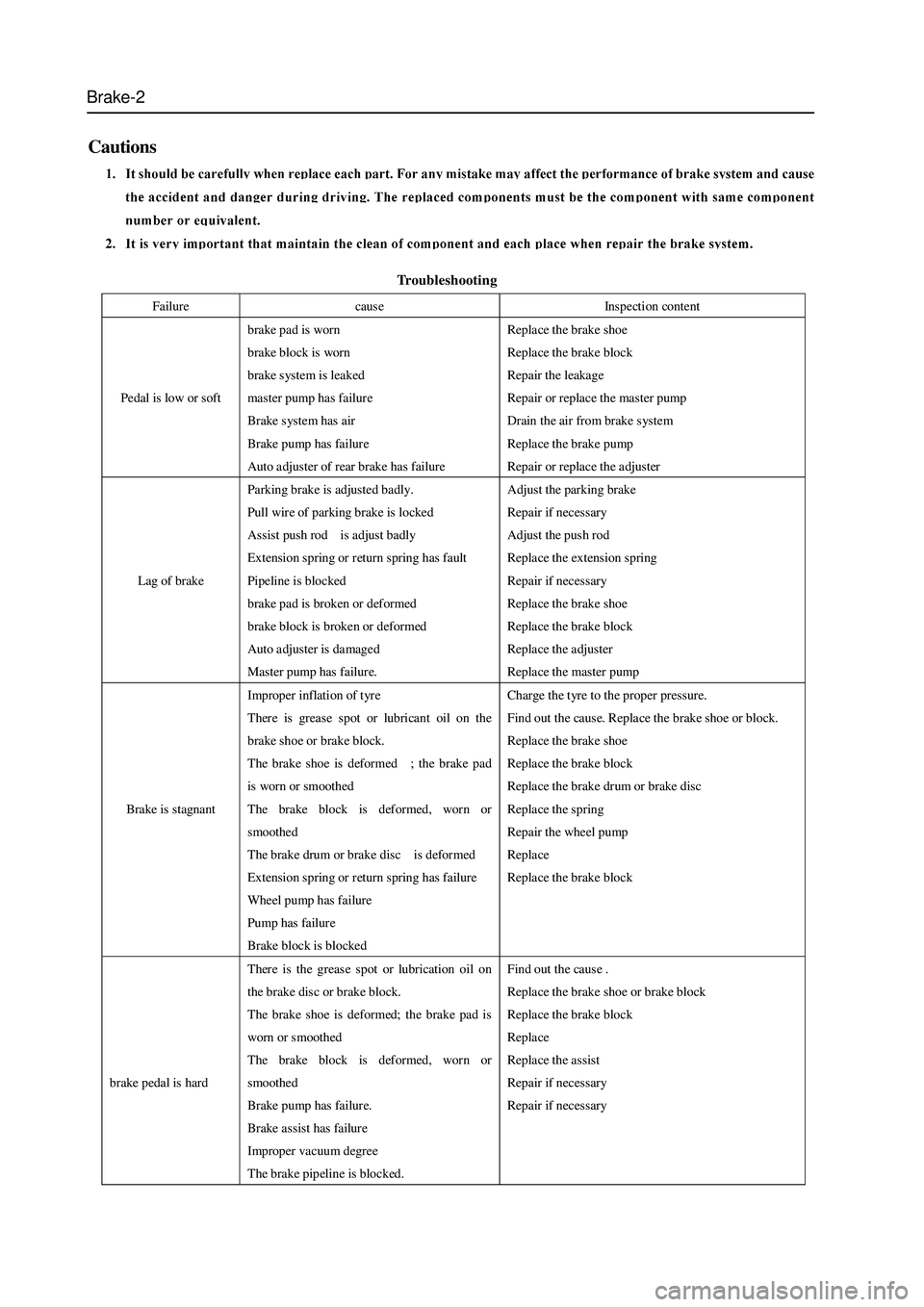
Brake-2
Troubleshooting
Cautions
Failure cause Inspection content
Pedal is low or soft brake pad is worn
brake block is worn
brake system is leaked
master pump has failure
Brake system has air
Brake pump has failure
Auto adjuster of rear brake has failure Replace the brake shoe
Replace the brake block
Repair the leakage
Repair or replace the master pump
Drain the air from brake system
Replace the brake pump
Repair or replace the adjuster
Lag of brake Parking brake is adjusted badly.
Pull wire of parking brake is locked
Assist push rod is adjust badly
Extension spring or return spring has fault
Pipeline is blocked
brake pad is broken or deformed
brake block is broken or deformed
Auto adjuster is damaged
Master pump has failure. Adjust the parking brake
Repair if necessary
Adjust the push rod
Repla ce the extension spring
Repair if necessary
Replace the brake shoe
Replace the brake block
Repla ce the a djuster
Repla ce the master pump
Brake is stagnant Improper inflation of tyre
There is grease spot or lubricant oil on the
brake shoe or brake block.
The brake shoe is deformed ; the brake pad
is worn or smoothed
The brake block is deformed, worn or
smoothed
The brake drum or brake disc is deformed
Extension spring or return spring has failure
Wheel pump has failure
Pump has failure
Brake block is blocked Charge the tyre to the proper pressure.
Find out the cause. Replace the brake shoe or block.
Replace the brake shoe
Replace the brake block
Replace the brake drum or brake disc
Repla ce the spring
Repair the wheel pump
Replace
Replace the brake block
brake pedal is hard There is the grease spot or lubrication oil on
the brake disc or brake block.
The brake shoe is deformed; the brake pad is
worn or s moothed
The brake block is deformed, worn or
smoothed
Brake pump has failure.
Brake assist has failure
Improper vacuum degree
The brake pipeline is blocked. Find out the caus e .
Replace the brake shoe or brake block
Replace the brake block
Replace
Replace the assist
Repair if necessary
Repair if necessary
Page 291 of 425
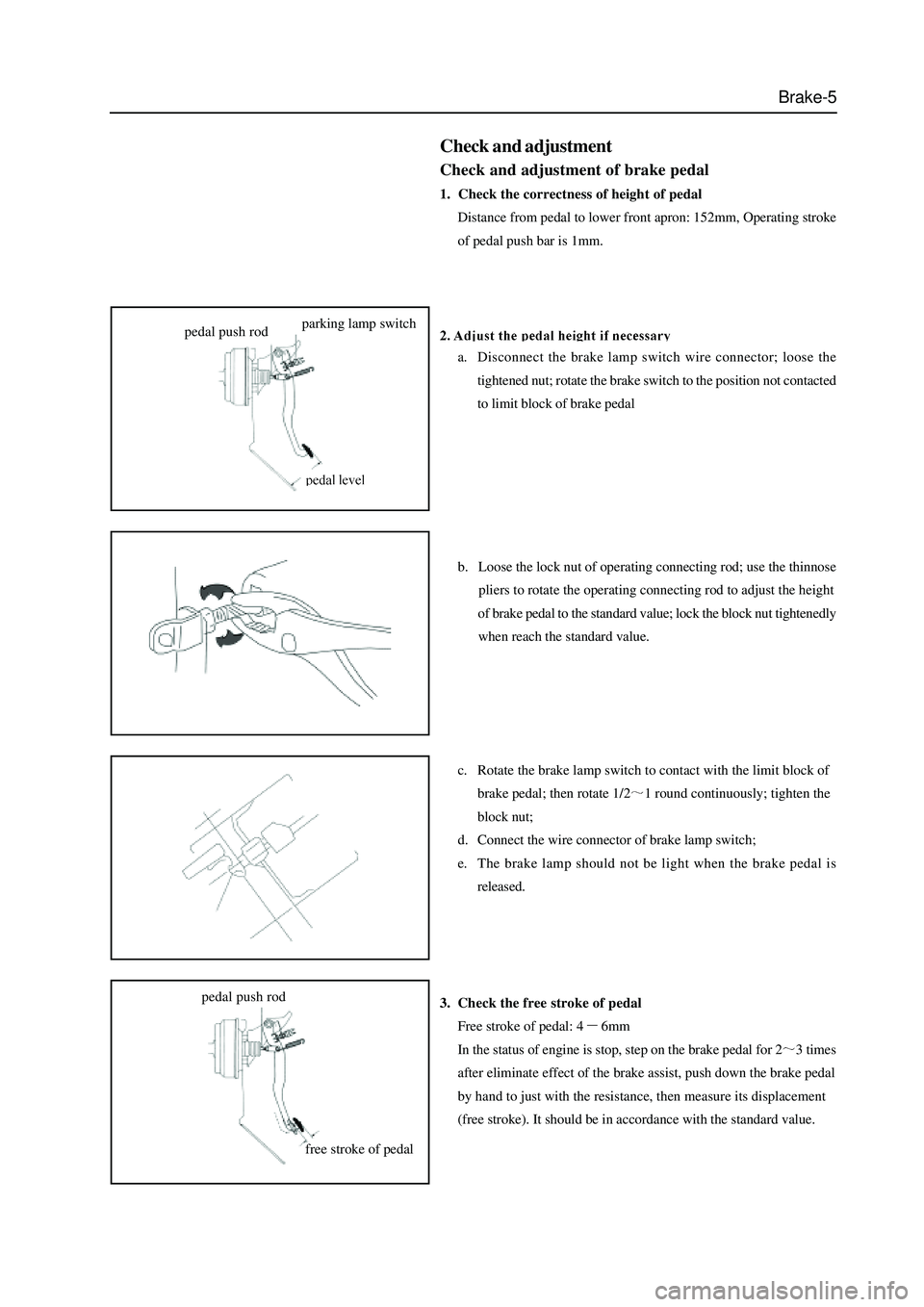
Brake-5
Check and adjustment
Check and adjustment of brake pedal
1. Check the correctness of height of pedal
Distance from pedal to lower front apron: 152mm, Operating stroke
of pedal push bar is 1mm.
a. Disconnect the brake lamp switch wire connector; loose the
tightened nut; rotate the brake switch to the position not contacted
to limit block of brake pedal
b. Loose the lock nut of operating connecting rod; use the thinnose
pliers to rotate the operating connecting rod to adjust the height
of brake pedal to the standard value; lock the block nut tightenedly
when reach the standard value.
c. Rotate the brake lamp switch to contact with the limit block of
brake pedal; then rotate 1/2
1 round continuously; tighten the
block nut;
d. Connect the wire connector of brake lamp switch;
e. The brake lamp should not be light when the brake pedal is
released.
3. Check the free stroke of pedal
Free stroke of pedal: 4
6mm
In the status of engine is stop, step on the brake pedal for 2
3 times
after eliminate effect of the brake assist, push down the brake pedal
by hand to just with the resistance, then measure its displacement
(free stroke). It should be in accordance with the standard value.
pedal push rodparking lamp switch
free stroke of pedal pedal push rod
Page 319 of 425
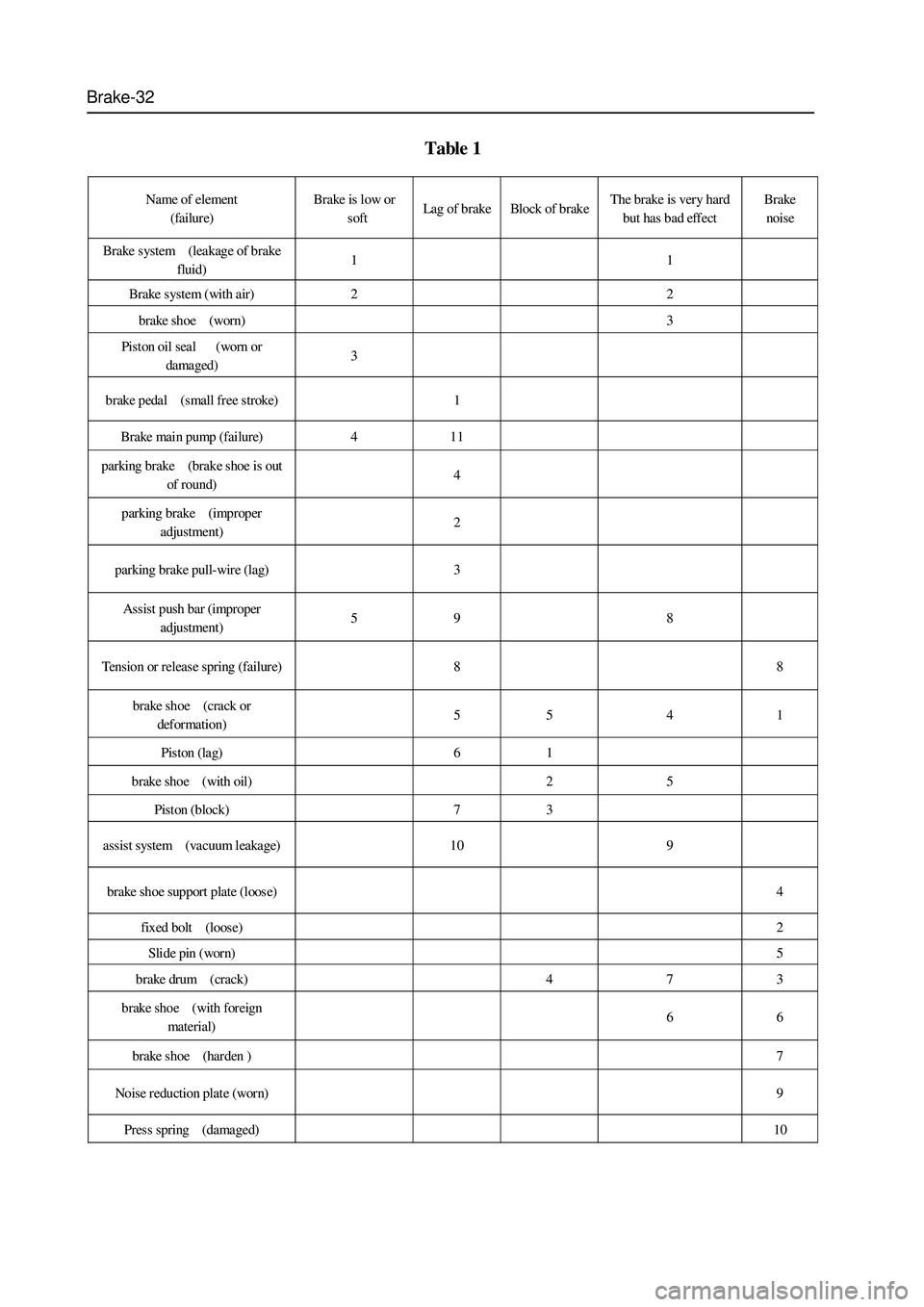
Brake-32
Table 1
Name of element
(failure) Brake is low or
soft Lag of brake Block of brake The brake is very hard
but has bad eff ect Brake
noise
Brake system (leakage of brake
fluid) 1 1
Brake system (with air) 2 2
brake shoe (worn) 3
Piston oil seal (worn or
damaged) 3
brake pedal (small free stroke) 1
Brake mai n p ump (fai lur e) 4 1 1
parking brake (brake shoe is out
of round) 4
parking brake (improper
adjustment) 2
parking brake pull-wire (lag) 3
Assist push bar (improper
adjustment) 5 9 8
Tension or release spring (failure) 8 8
brake shoe (crack or
deformation) 5 5 4 1
Piston (lag) 6 1
brake shoe (with oil) 2 5
Piston (block) 7 3
assist system (vacuum leakage) 10 9
brake shoe support plate (loose) 4
fixed bolt (loose) 2
Slide pin (worn) 5
brake drum (crack) 4 7 3
brake shoe (with foreign
mater ial) 6 6
brake shoe (harden ) 7
Noise reduction plate (worn) 9
Press spring (damaged) 10