ECO mode HONDA ACCORD COUPE 2001 CF / 6.G Owner's Guide
[x] Cancel search | Manufacturer: HONDA, Model Year: 2001, Model line: ACCORD COUPE, Model: HONDA ACCORD COUPE 2001 CF / 6.GPages: 372, PDF Size: 6.1 MB
Page 181 of 372
Break-in Period, Gasoline, Service Station Procedures
Break-in Period
Help assure your car's future
reliability and performance by paying
extra attention to how you drive
during the first 600 miles (1,000 km).
During this period: Avoid full-throttle starts and rapid
acceleration.
Avoid hard braking. New brakes
need to be broken-in by moderate
use for the first 200 miles (300
km).
Do not change the oil until the
recommended time or mileage
interval shown in the maintenance
schedule.
You should follow these same re-
commendations with an overhauled
or exchanged engine, or when the
brakes are relined.
Gasoline
Your Honda is designed to operate on unleaded gasoline with a pump
octane number of 86 or higher. Useof a lower octane gasoline can cause
a persistent, heavy metallic rapping
noise in the engine that can lead to
mechanical damage.
We recommend gasolines containing detergent additives that help prevent
fuel system and engine deposits. Using gasoline containing lead willdamage your car's emissions
controls. This contributes to air
pollution.
In Canada, some gasolines contain
an octane-enhancing additive called
MMT. If you use such gasolines,
your emission control system performance may deteriorate and
the Malfunction Indicator Lamp on
your instrument panel may turn on.If this happens, contact your
authorized Honda dealer for service. Filling the Fuel Tank
1. Because the fuel fill cap is on the driver's side of the car, park with
that side closest to the service
station pumps.
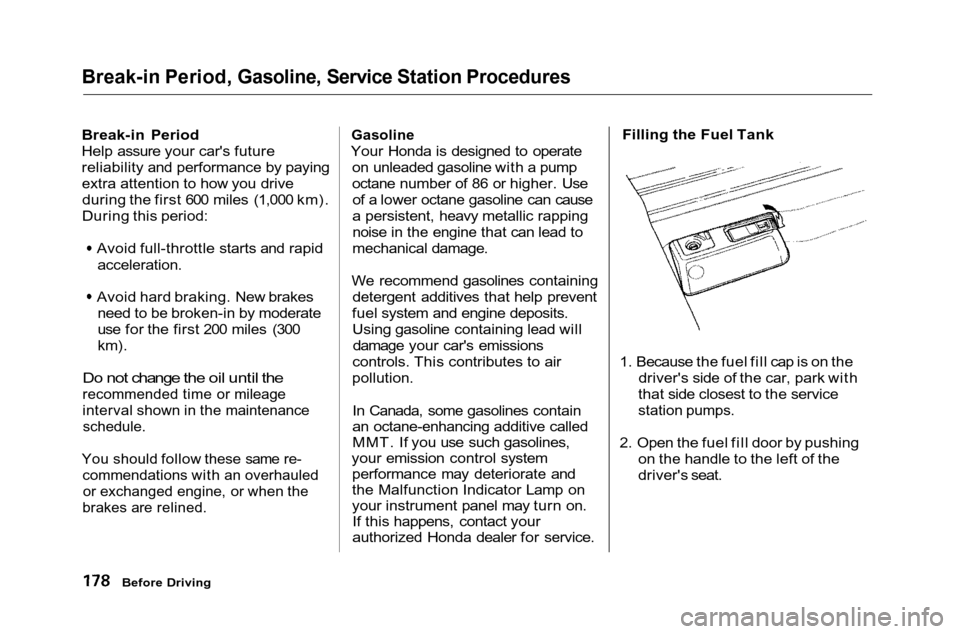
2. Open the fuel fill door by pushing on the handle to the left of the
driver's seat.
Before Driving
Page 188 of 372
Fuel Economy
The condition of your car and your driving habits are the two most
important things that affect the fuel
mileage you get.
Vehicle Condition Always maintain your car according to the maintenance schedule. This
will keep it in top operating condition.
An important part of that mainte- nance is the Owner Maintenance
Checks (see page 231). For
example, an underinflated tire
causes more "rolling resistance,"
which uses fuel. It also wears out faster, so check the tire pressure at
least monthly.
In winter, the build-up of snow on
your car's underside adds weight and rolling resistance. Frequent cleaning
helps your fuel mileage and reduces
the chance of corrosion. Driving Habits
You can improve fuel economy by driving moderately. Rapid acceler-
ation, abrupt cornering, and hard
braking use more fuel.
Always drive in the highest gear that allows the engine to run and acceler-ate smoothly.
Depending on traffic conditions, try
to maintain a constant speed. Every
time you slow down and speed up,
your car uses extra fuel. Use the cruise control, when appropriate, to
increase fuel economy. A cold engine uses more fuel than a
warm engine. It is not necessary to
"warm-up" a cold engine by letting it
idle for a long time. You can drive
away in about a minute, no matter
how cold it is outside. The engine
will warm up faster, and you get better fuel economy. To cut down on
the number of "cold starts," try tocombine several short trips into one.
The air conditioning puts an extra load on the engine which makes ituse more fuel. Turn off the A/C to
cut down on air conditioning use.
Use the flow-through ventilation
when the outside air temperature is moderate.
Before Driving
Page 241 of 372
Engine Oil
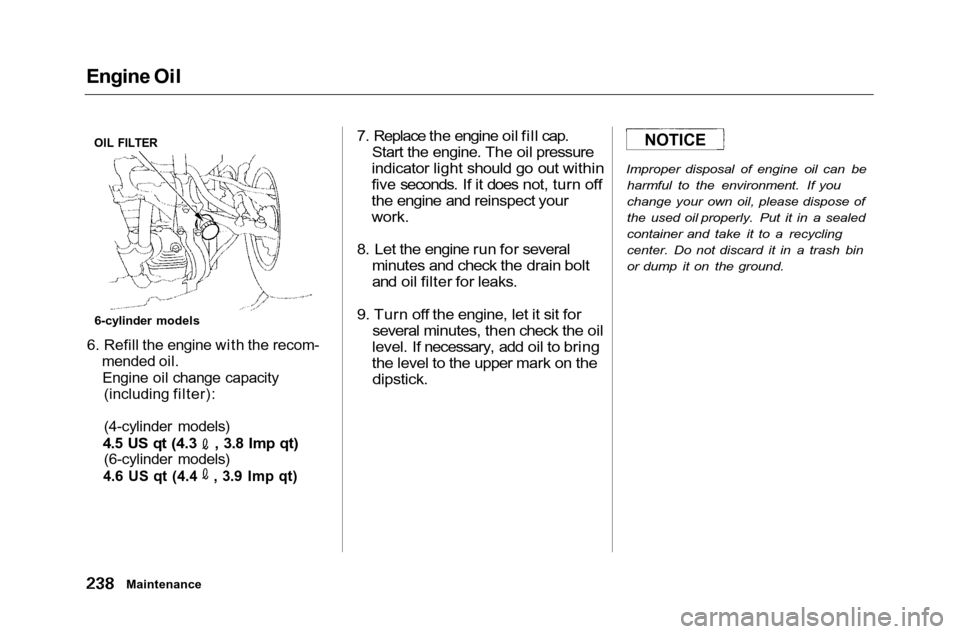
6. Refill the engine with the recom- mended oil.
Engine oil change capacity (including filter):
(4-cylinder models)
4.5 US qt (4.3 , 3.8 Imp qt)
(6-cylinder models)
4.6 US qt (4.4 , 3.9 Imp qt)
7. Replace the engine oil fill cap.
Start the engine. The oil pressure
indicator light should go out within
five seconds. If it does not, turn off
the engine and reinspect your
work.
8. Let the engine run for several minutes and check the drain bolt
and oil filter for leaks.
9. Turn off the engine, let it sit for several minutes, then check the oil
level. If necessary, add oil to bring
the level to the upper mark on the
dipstick.
Improper disposal of engine oil can be
harmful to the environment. If you
change your own oil, please dispose of
the used oil properly. Put it in a sealed
container and take it to a recycling
center. Do not discard it in a trash bin
or dump it on the ground.
Maintenance
NOTICE
OIL FILTER
6-cylinder models
Page 242 of 372

Cooling System
Adding Engine Coolant
If the coolant level in the reserve
tank is at or below the MIN line, add
coolant to bring it up to the MAX line.
Inspect the cooling system for leaks.
This coolant should always be a mixture of 50 percent antifreeze and50 percent water. Never add straight
antifreeze or plain water. Always use Genuine Honda All
Season Antifreeze/Coolant Type 2.
This coolant is pre-mixed with 50 percent antifreeze and 50 percent
water. It does not require anyadditional mixing. If it is not available,
you may use another major-brand non-silicate coolant as a temporary
replacement. Make sure it is a high-quality coolant recommended for
aluminum engines. However,
continued use of any non-Honda coolant can result in corrosion,
causing the cooling system to malfunction or fail. Have the cooling
system flushed and refilled with
Honda antifreeze/coolant as soon as
possible.
If the reserve tank is completely
empty, you should also check the
coolant level in the radiator.
CONTINUED
Maintenance
4-cylinder models
RESERVE TANK
RESERVE TANK
6-cylinder models
Page 244 of 372
Cooling System
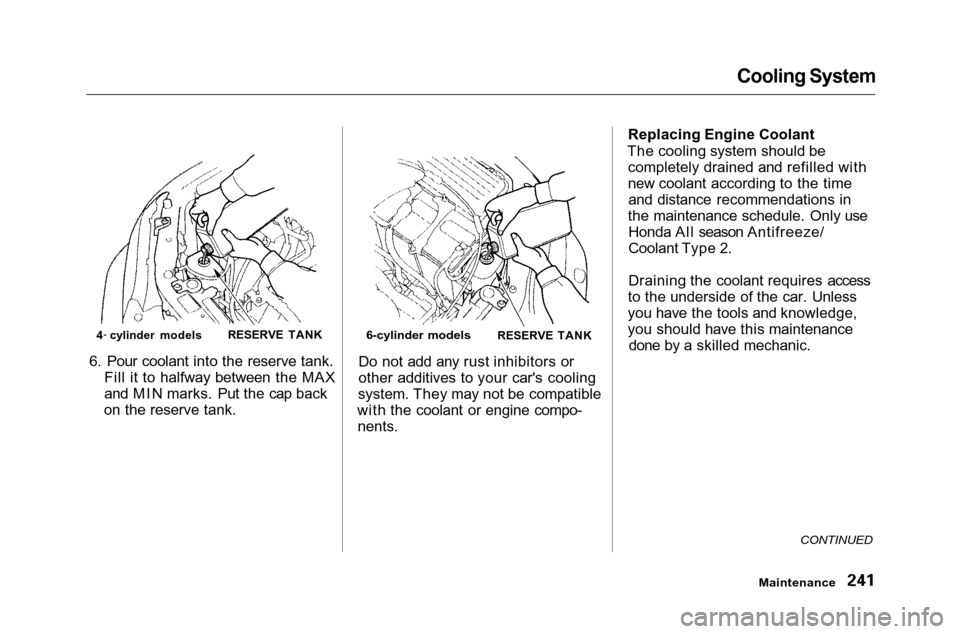
6. Pour coolant into the reserve tank. Fill it to halfway between the MAX
and MIN marks. Put the cap back
on the reserve tank. Do not add any rust inhibitors or
other additives to your car's cooling
system. They may not be compatible
with the coolant or engine compo- nents. Replacing Engine Coolant
The cooling system should be completely drained and refilled with
new coolant according to the timeand distance recommendations in
the maintenance schedule. Only use Honda All season Antifreeze/
Coolant Type 2.
Draining the coolant requires access
to the underside of the car. Unless
you have the tools and knowledge,
you should have this maintenance done by a skilled mechanic.
CONTINUED
Maintenance
4 cylinder models
RESERVE TANK
6-cylinder models
RESERVE TANK
Page 245 of 372
Cooling System
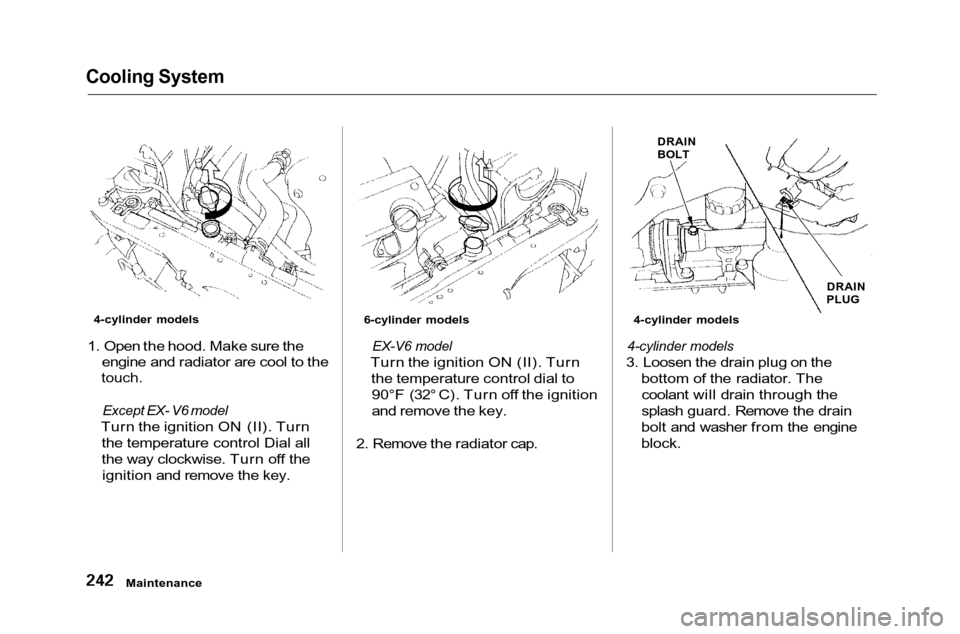
1. Open the hood. Make sure the engine and radiator are cool to the
touch.
Except EX- V6 model
Turn the ignition ON (II). Turn the temperature control Dial all
the way clockwise. Turn off theignition and remove the key.
EX-V6 model
Turn the ignition ON (II). Turn the temperature control dial to90°F (32° C). Turn off the ignition
and remove the key.
2. Remove the radiator cap.
4-cylinder models
3. Loosen the drain plug on the bottom of the radiator. Thecoolant will drain through the
splash guard. Remove the drain
bolt and washer from the engine
block.
Maintenance
DRAIN
BOLT
DRAIN
PLUG
6-cylinder models
4-cylinder models
4-cylinder models
Page 248 of 372
Cooling System
6-cylinder models
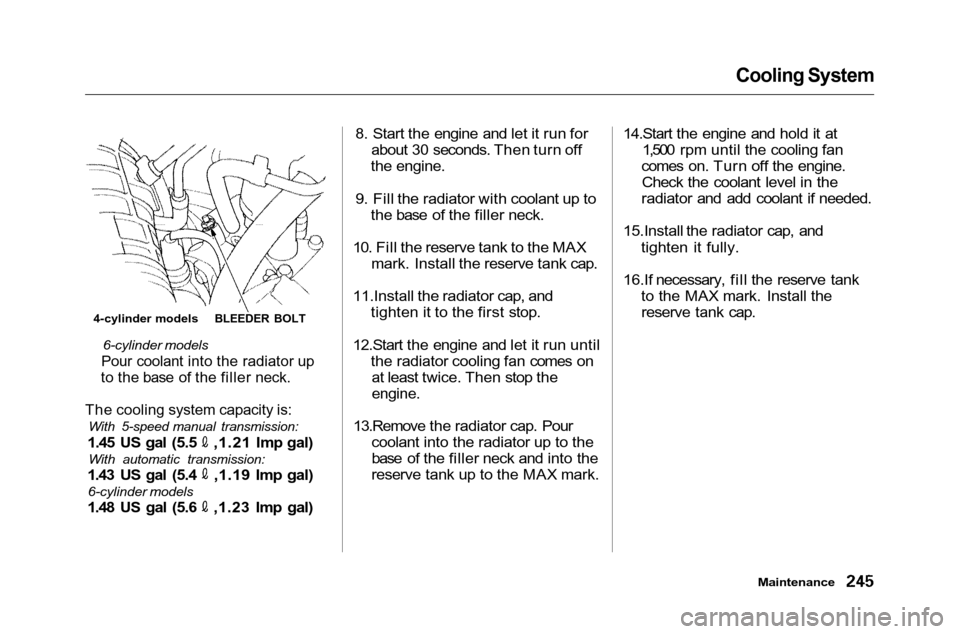
Pour coolant into the radiator up
to the base of the filler neck.
The cooling system capacity is:
With 5-speed manual transmission:
1.45 US gal (5.5 ,1.21 Imp gal)
With automatic transmission:
1.43 US gal (5.4 ,1.19 Imp gal)
6-cylinder models 1.48 US gal (5.6 ,1.23 Imp gal) 8. Start the engine and let it run for
about 30 seconds. Then turn off
the engine.
9. Fill the radiator with coolant up to the base of the filler neck.
10. Fill the reserve tank to the MAX mark. Install the reserve tank cap.
11.Install the radiator cap, and tighten it to the first stop.
12.Start the engine and let it run until the radiator cooling fan comes onat least twice. Then stop the
engine.
13.Remove the radiator cap. Pour coolant into the radiator up to the
base of the filler neck and into the
reserve tank up to the MAX mark. 14.Start the engine and hold it at
1,500 rpm until the cooling fan
comes on. Turn off the engine. Check the coolant level in the
radiator and add coolant if needed.
15.Install the radiator cap, and tighten it fully.
16.If necessary, fill the reserve tank to the MAX mark. Install thereserve tank cap.
Maintenance
4-cylinder models
BLEEDER BOLT
Page 251 of 372
Transmission Fluid
6. Insert the dipstick all the way back into the transmission securely asshown in the illustration.
The transmission should be drained and refilled with new fluid according
to the time and distance recommen- dations in the maintenance schedule.
Automatic Transmission
6-cylinder models
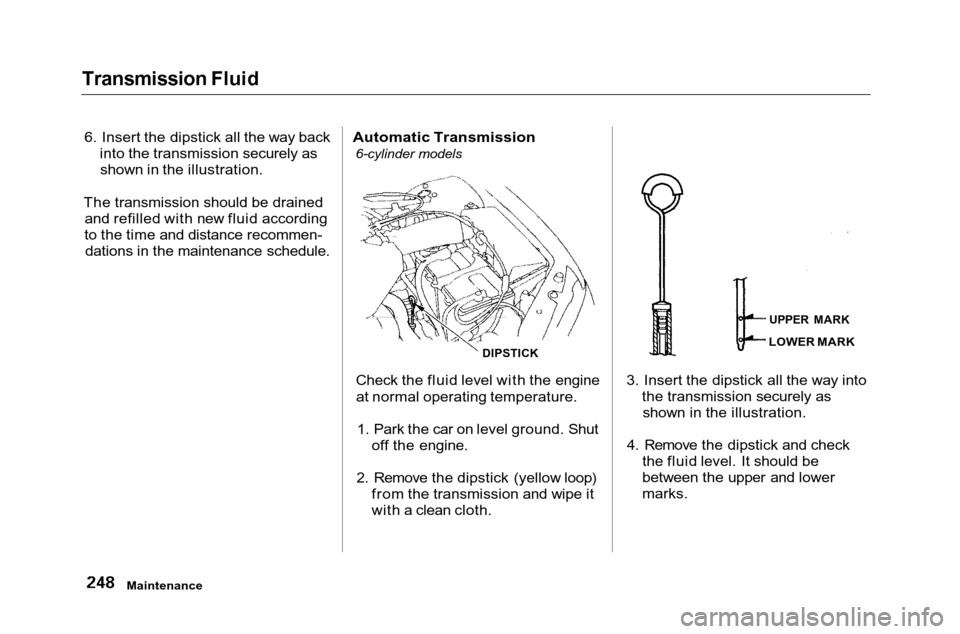
Check the fluid level with the engineat normal operating temperature.
1. Park the car on level ground. Shut off the engine.
2. Remove the dipstick (yellow loop) from the transmission and wipe it
with a clean cloth. 3. Insert the dipstick all the way into
the transmission securely asshown in the illustration.
4. Remove the dipstick and check the fluid level. It should be
between the upper and lower
marks.
Maintenance
DIPSTICK
UPPER MARK
LOWER MARK
Page 254 of 372
Brake and Clutch Fluid
Check the fluid level in the reser-
voirs monthly. There are up to two reservoirs, depending on the model.
They are:
Brake fluid reservoir (all models)
Clutch fluid reservoir(manual transmission only)
The brake fluid should be replaced according to the time and distance
recommendations in the mainte- nance schedule. Always use Honda DOT 3 brake
fluid. If it is not available, you should use only DOT 3 or DOT 4
fluid, from a sealed container, as a temporary replacement. However,
the use of any non-Honda brake fluid
can cause corrosion and decrease
the life of the system. Have the
brake system flushed and refilled
with Honda DOT 3 brake fluid as soon as possible.
Brake fluid marked DOT 5 is not
compatible with your car's braking system and can cause extensive
damage.
Brake System
4-cylinder models
MIN
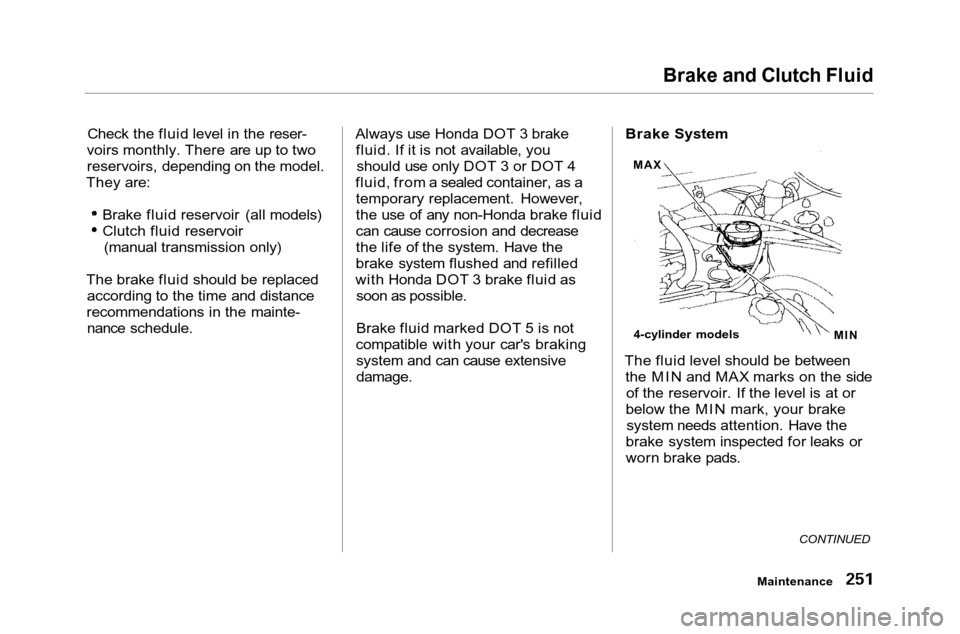
The fluid level should be between the MIN and MAX marks on the sideof the reservoir. If the level is at or
below the MIN mark, your brake system needs attention. Have the
brake system inspected for leaks or
worn brake pads.
CONTINUED
Maintenance
MAX
Page 256 of 372
Power Steering, Air Cleaner Element
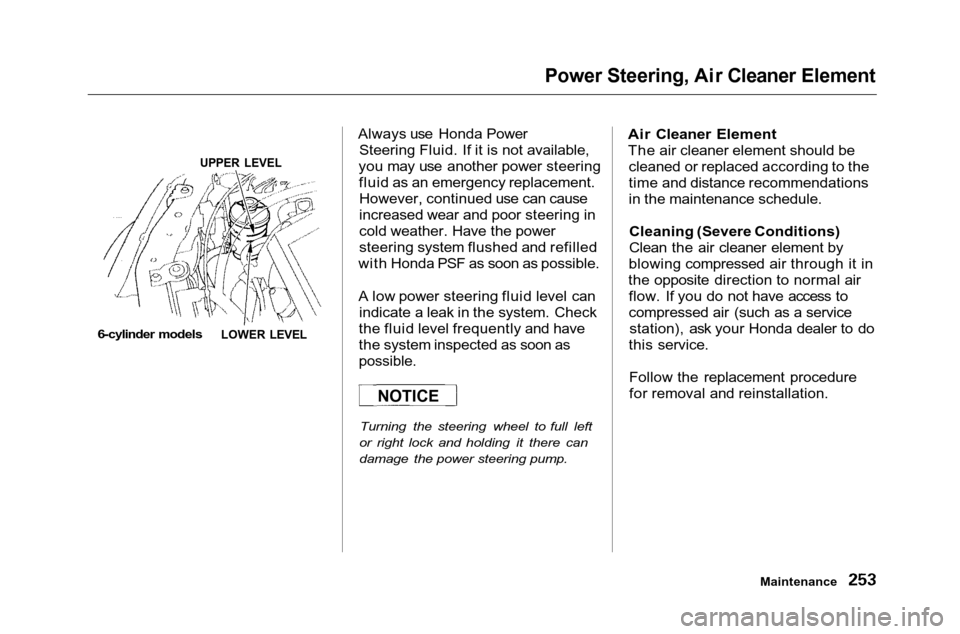
UPPER LEVEL
6-cylinder models
Always use Honda Power
Steering Fluid. If it is not available,
you may use another power steering fluid as an emergency replacement.However, continued use can cause
increased wear and poor steering in
cold weather. Have the power
steering system flushed and refilled
with Honda PSF as soon as possible.
A low power steering fluid level can indicate a leak in the system. Check
the fluid level frequently and have
the system inspected as soon as
possible.
Turning the steering wheel to full left
or right lock and holding it there can
damage the power steering pump.
Air Cleaner Element
The air cleaner element should be
cleaned or replaced according to the
time and distance recommendations
in the maintenance schedule.
Cleaning (Severe Conditions)
Clean the air cleaner element by
blowing compressed air through it in
the opposite direction to normal air flow. If you do not have access to
compressed air (such as a service station), ask your Honda dealer to do
this service.
Follow the replacement procedure
for removal and reinstallation.
Maintenance
NOTICE
LOWER LEVEL