steering HONDA ACCORD COUPE 2001 CF / 6.G Owner's Guide
[x] Cancel search | Manufacturer: HONDA, Model Year: 2001, Model line: ACCORD COUPE, Model: HONDA ACCORD COUPE 2001 CF / 6.GPages: 372, PDF Size: 6.1 MB
Page 212 of 372
Driving in Bad Weather
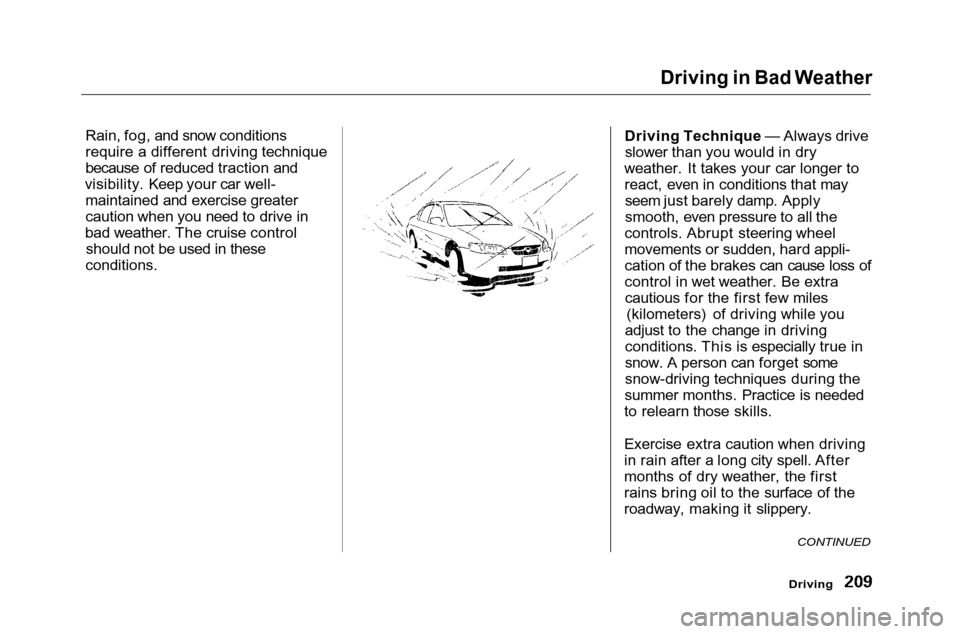
Rain, fog, and snow conditions
require a different driving technique
because of reduced traction and
visibility. Keep your car well- maintained and exercise greater
caution when you need to drive in
bad weather. The cruise control should not be used in these
conditions. Driving Technique — Always drive
slower than you would in dry
weather. It takes your car longer to react, even in conditions that mayseem just barely damp. Apply
smooth, even pressure to all the
controls. Abrupt steering wheel
movements or sudden, hard appli-
cation of the brakes can cause loss of
control in wet weather. Be extra cautious for the first few miles (kilometers) of driving while you
adjust to the change in driving
conditions. This is especially true in
snow. A person can forget some
snow-driving techniques during the
summer months. Practice is needed
to relearn those skills.
Exercise extra caution when driving
in rain after a long city spell. After
months of dry weather, the first
rains bring oil to the surface of the
roadway, making it slippery.
Driving
CONTINUED
Page 214 of 372
Towing a Trailer
Your Honda has been designed primarily to carry passengers and
their cargo. You can use it to tow a
trailer if you carefully observe the
load limits, use the proper equipment, and follow the guidelines in this
section.
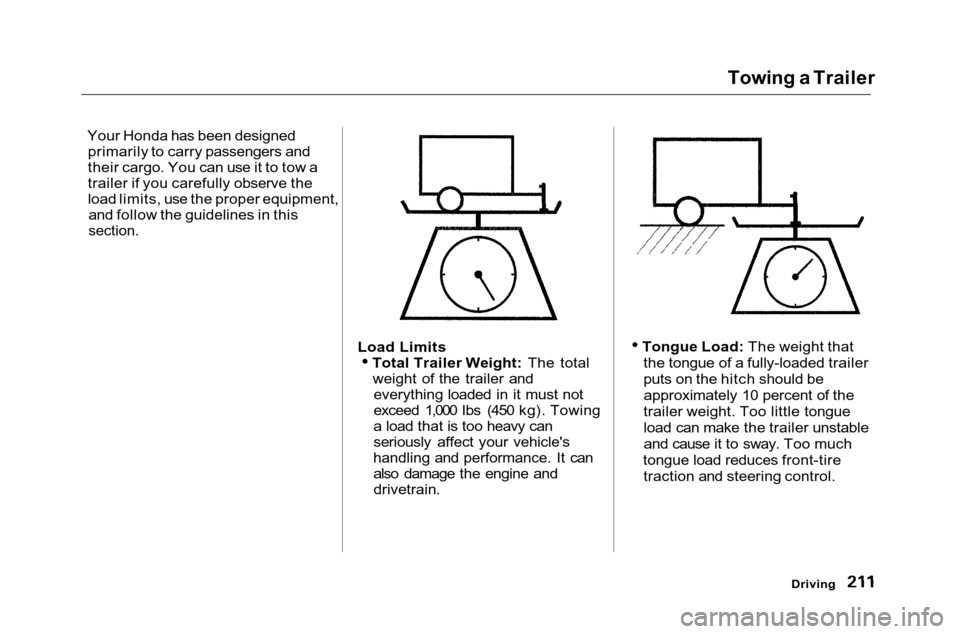
Load Limits Total Trailer Weight: The total
weight of the trailer and everything loaded in it must not
exceed 1,000 Ibs (450 kg). Towing
a load that is too heavy can
seriously affect your vehicle's
handling and performance. It can also damage the engine and
drivetrain. Tongue Load: The weight that
the tongue of a fully-loaded trailer
puts on the hitch should beapproximately 10 percent of the
trailer weight. Too little tongue
load can make the trailer unstable and cause it to sway. Too much
tongue load reduces front-tire traction and steering control.
Driving
Page 220 of 372
Towing a Trailer
Handling Crosswinds and Buffeting
Crosswinds and air turbulence
caused by passing trucks can disrupt
your steering and cause trailer swaying. When being passed by a
large vehicle, keep a constant speed and steer straight ahead. Do not try
to make quick steering or braking
corrections.
Backing Up
Always drive slowly and have someone guide you when backing up.Grip the bottom of the steering
wheel; then turn the wheel to the left
to get the trailer to move to the left, and turn the wheel right to move the
trailer to the right.
Parking
Follow all normal precautions when
parking, including firmly setting the
parking brake and putting the
transmission in Park (automatic) or in 1st or Reverse (manual). Also,
place wheel chocks at each of the
trailer's tires.
Driving
Page 222 of 372
Maintenance
This section explains why it is important to keep your car well
maintained and to follow basic
maintenance safety precautions.
This section also includes Maintenance Schedules for normaldriving and severe driving conditions,
a Maintenance Record, and instruc-
tions for simple maintenance tasks
you may want to take care of
yourself.
If you have the skills and tools to per-
form more complex maintenance
tasks on your Honda, you may want
to purchase the Service Manual. See page 345 for information on how toobtain a copy, or see your Honda
dealer.
Maintenance Safety....................... 220
Important Safety Precautions ..221
Maintenance Schedule.................. 222
Maintenance Record..................... 229
Owner Maintenance Checks........ 231
Fluid Locations............................... 232
Engine Oil....................................... 234
Adding Oil................................... 234Recommended Oil..................... 235
Synthetic Oil............................... 235
Additives..................................... 235
Changing the Oil and Filter...... 236
Cooling System.............................. 239
Adding Engine Coolant............. 239Replacing Engine Coolant........ 241
Windshield Washers..................... 246
Transmission Fluid........................ 247
Automatic
Transmission.......................... 247
5-speed Manual
Transmission.......................... 249
Brake and Clutch Fluid................. 251
Brake System............................. 251
Clutch System............................ 252
Power Steering............................... 252
Air Cleaner Element...................... 253
Hood Latch..................................... 256
Spark Plugs..................................... 256
Replacement............................... 256
Specifications............................. 257
Battery............................................ 260
Wiper Blades.................................. 263
Air Conditioning System............... 265
Air Conditioning Filter.................. 266 Drive Belts...................................... 266
Timing Belt..................................... 267
Tires................................................ 267
Inflation...................................... 268
Inspection................................... 270
Maintenance............................... 270
Tire Rotation.............................. 271 Replacing Tires and Wheels .... 271
Wheels and Tires....................... 272 Winter Driving........................... 273
Snow Tires.............................. 273
Tire Chains............................. 273
Lights.............................................. 274 Replacing Bulbs......................... 276
Storing Your Car............................ 285
Maintenance
Page 235 of 372
Fluid Locations
Maintenance
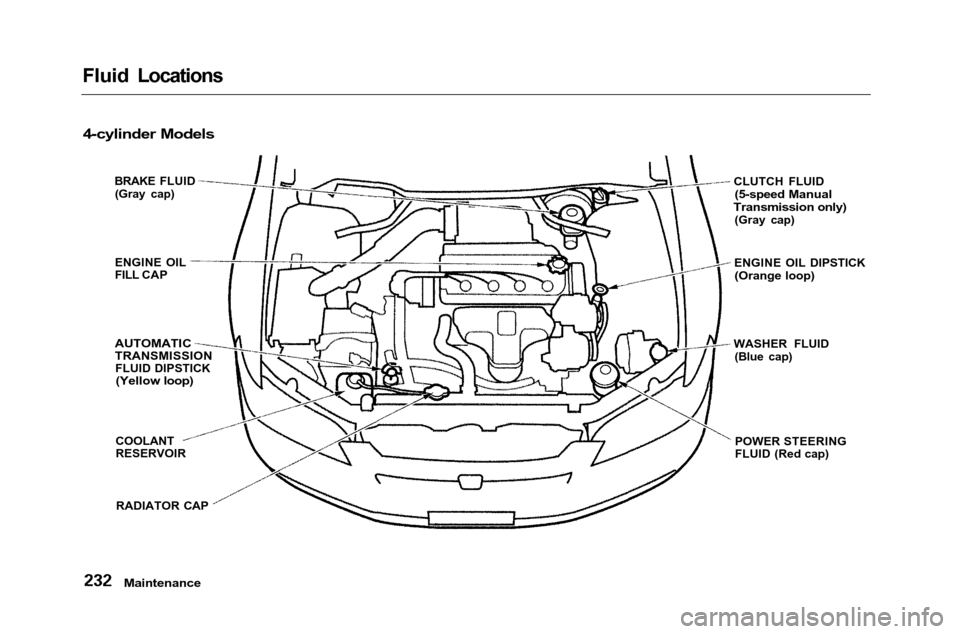
4-cylinder Models
BRAKE FLUID(Gray cap)
ENGINE OIL
FILL CAP
AUTOMATIC
TRANSMISSION
FLUID DIPSTICK
(Yellow loop)
COOLANT
RESERVOIR
CLUTCH FLUID
(5-speed Manual
Transmission only)
(Gray cap)
ENGINE OIL DIPSTICK
(Orange loop)
WASHER FLUID (Blue cap)
POWER STEERING
FLUID (Red cap)
RADIATOR CAP
Page 236 of 372
Fluid Locations
Maintenance
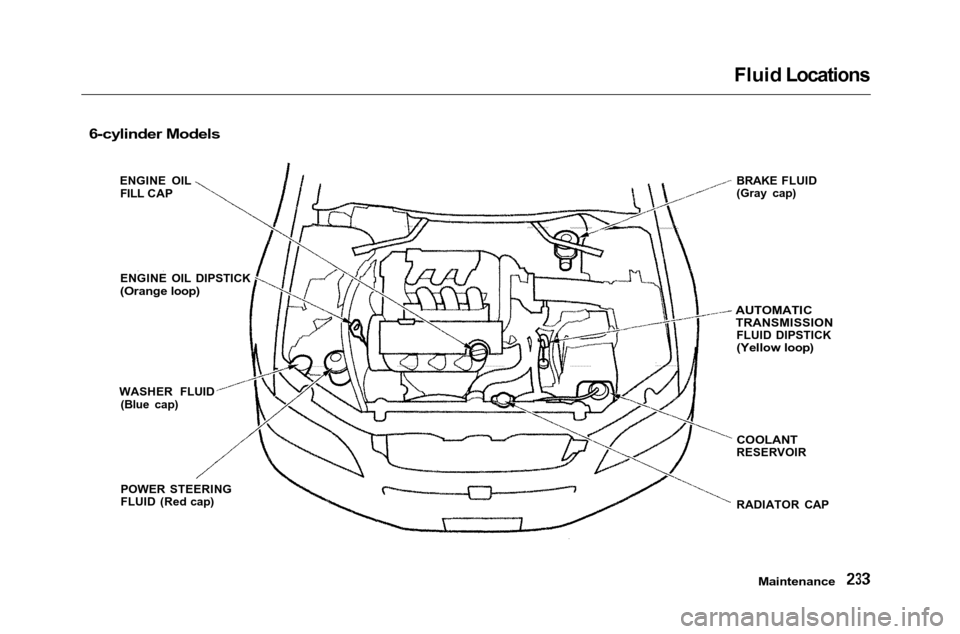
RADIATOR CAP
COOLANT
RESERVOIR
AUTOMATIC
TRANSMISSION
FLUID DIPSTICK
(Yellow loop)
6-cylinder Models
ENGINE OILFILL CAP
ENGINE OIL DIPSTICK
(Orange loop)
WASHER FLUID (Blue cap) BRAKE FLUID
(Gray cap)
POWER STEERING
FLUID (Red cap)
Page 255 of 372
Brake and Clutch Fluid, Power Steering
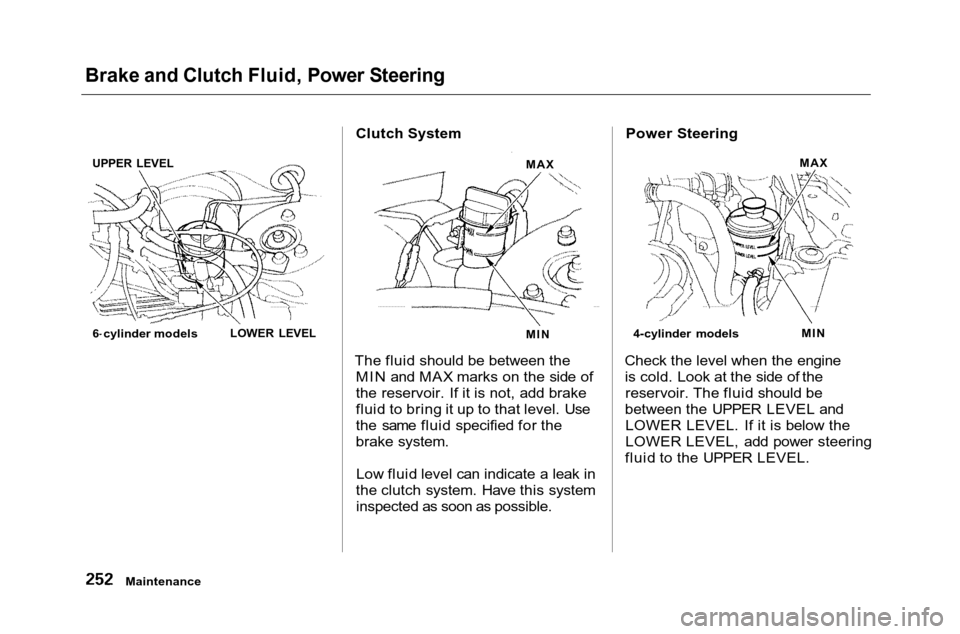
Clutch System
The fluid should be between the MIN and MAX marks on the side of
the reservoir. If it is not, add brake
fluid to bring it up to that level. Use
the same fluid specified for the
brake system.
Low fluid level can indicate a leak in
the clutch system. Have this system inspected as soon as possible. Power Steering
Check the level when the engine is cold. Look at the side of thereservoir. The fluid should be
between the UPPER LEVEL and LOWER LEVEL. If it is below the
LOWER LEVEL, add power steering
fluid to the UPPER LEVEL.
Maintenance
UPPER LEVEL
6 cylinder models
LOWER LEVEL
MIN MAX
4-cylinder models
MIN
MAX
Page 256 of 372
Power Steering, Air Cleaner Element
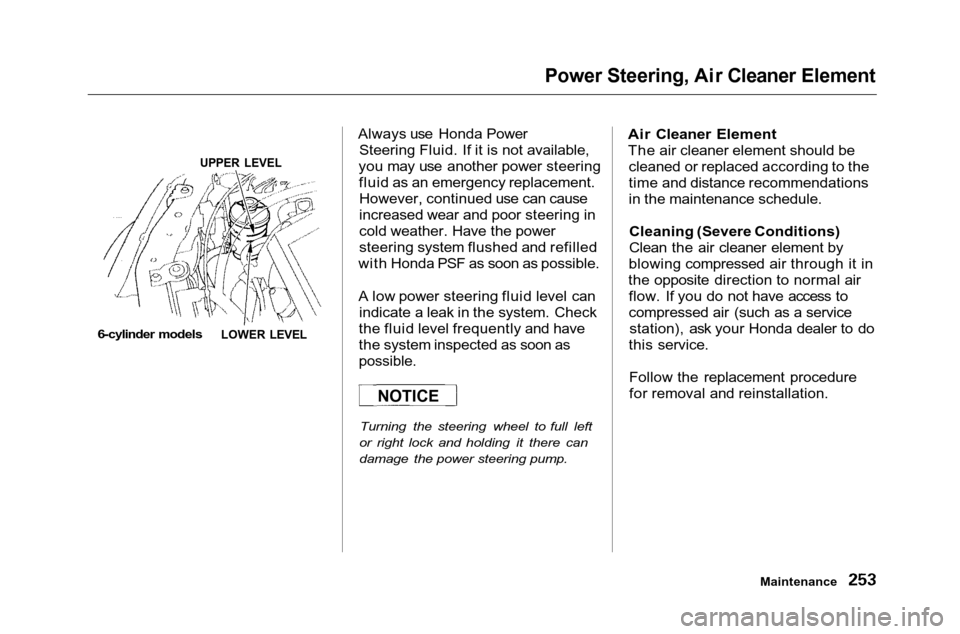
UPPER LEVEL
6-cylinder models
Always use Honda Power
Steering Fluid. If it is not available,
you may use another power steering fluid as an emergency replacement.However, continued use can cause
increased wear and poor steering in
cold weather. Have the power
steering system flushed and refilled
with Honda PSF as soon as possible.
A low power steering fluid level can indicate a leak in the system. Check
the fluid level frequently and have
the system inspected as soon as
possible.
Turning the steering wheel to full left
or right lock and holding it there can
damage the power steering pump.
Air Cleaner Element
The air cleaner element should be
cleaned or replaced according to the
time and distance recommendations
in the maintenance schedule.
Cleaning (Severe Conditions)
Clean the air cleaner element by
blowing compressed air through it in
the opposite direction to normal air flow. If you do not have access to
compressed air (such as a service station), ask your Honda dealer to do
this service.
Follow the replacement procedure
for removal and reinstallation.
Maintenance
NOTICE
LOWER LEVEL
Page 269 of 372
Air Conditioning Filter, Drive Belts
Air Conditioning FilterThe air conditioning filter removes pollen and dust that is brought in
from the outside through the heatingand cooling system.
This filter should be replaced every 30,000 miles (48,000 km) under
normal conditions. It should be replaced every 15,000 miles (24,000
km) if you drive primarily in urban areas that have high concentrationsof soot in the air from industry and
diesel-powered vehicles. Replace it
more often if air flow from the
climate control system becomes less
than usual. Have the air conditioning
filter replaced by your Honda dealer. Drive Belts
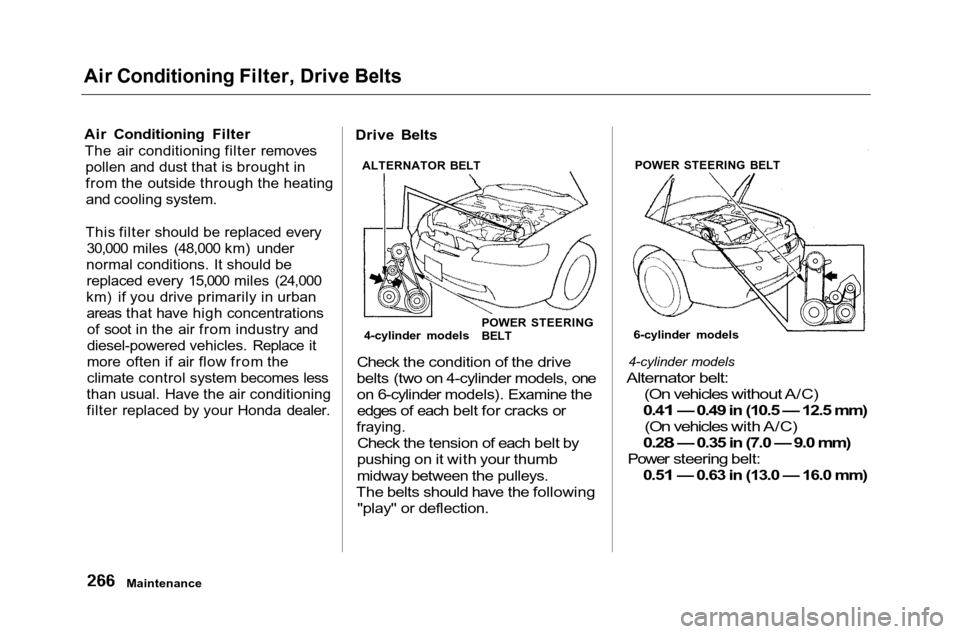
Check the condition of the drive
belts (two on 4-cylinder models, one
on 6-cylinder models). Examine the
edges of each belt for cracks or
fraying.
Check the tension of each belt by
pushing on it with your thumb
midway between the pulleys.
The belts should have the following
"play" or deflection.
4-cylinder models
Alternator belt: (On vehicles without A/C)
0.41 — 0.49 in (10.5 — 12.5 mm)
(On vehicles with A/C)
0.28 — 0.35 in (7.0 — 9.0 mm)
Power steering belt:
0.51 — 0.63 in (13.0 — 16.0 mm)
Maintenance
ALTERNATOR BELT
4-cylinder models
POWER STEERING
BELT
6-cylinder models
POWER STEERING BELT
Page 270 of 372
Drive Belts, Timing Belt, Tires
6-cylinder models
Power steering belt:
0.51 — 0.65 in (13.0 — 16.5 mm)
If you see signs of wear or looseness,
have your dealer adjust or replace
the belts.
Timing Belt
The timing belt and balancer belt
should normally be replaced at the
intervals shown in the maintenance
schedule.
Replace these belts at 60,000 miles
(U.S.) or 100,000 km (Canada) if you
regularly drive your car in one or
more of these conditions:
In very high temperatures
(over 110° F,43°C).
In very low temperatures
(under — 20°F, — 29°C).
Tires
To safely operate your car, your tires
must be the proper type and size, in
good condition with adequate tread,
and correctly inflated. The following
pages give more detailed information
on how and when to check air
pressure, how to inspect your tires
for damage and wear, and what to do
when your tires need to be replaced.
Maintenance
Using tires that are excessively
worn or improperly inflated can
cause a crash in which you can
be seriously hurt or killed.
Follow all instructions in this
owner's manual regarding tire
inflation and maintenance.