load capacity HONDA CIVIC 1991 Owners Manual
[x] Cancel search | Manufacturer: HONDA, Model Year: 1991, Model line: CIVIC, Model: HONDA CIVIC 1991Pages: 136, PDF Size: 1.33 MB
Page 91 of 136
Checking the fuses:
1 .Turn off the ignition and all other switches.
2. If you find a blown or possibly faulty fuse, use the fuse remover, stored beside the spare fuse to pull the blown fuse out of its clips.
3. Check all other fuses as well as the one you suspect.
4. Push in a new fuse of the same rating, and make sure it fits tightly in the clips. If it fits loosely, have your dealer fix it.If you don't have a spare, take a fuse of the same rating (or lower)
out of a circuit you may not need, like the radio or cigarette lighter.
Remember to replace the borrowed fuse and the missing spares.
CAUTION:
A blown fuse may be just a symptom of some other problem. If a new fuse blows right away, the cause should be diagnosed and
corrected by a qualified Honda technician. Never replace a fuse with anything but another fuse of the same or lower rating. A
higher capacity fuse could cause damage and even start a fire.
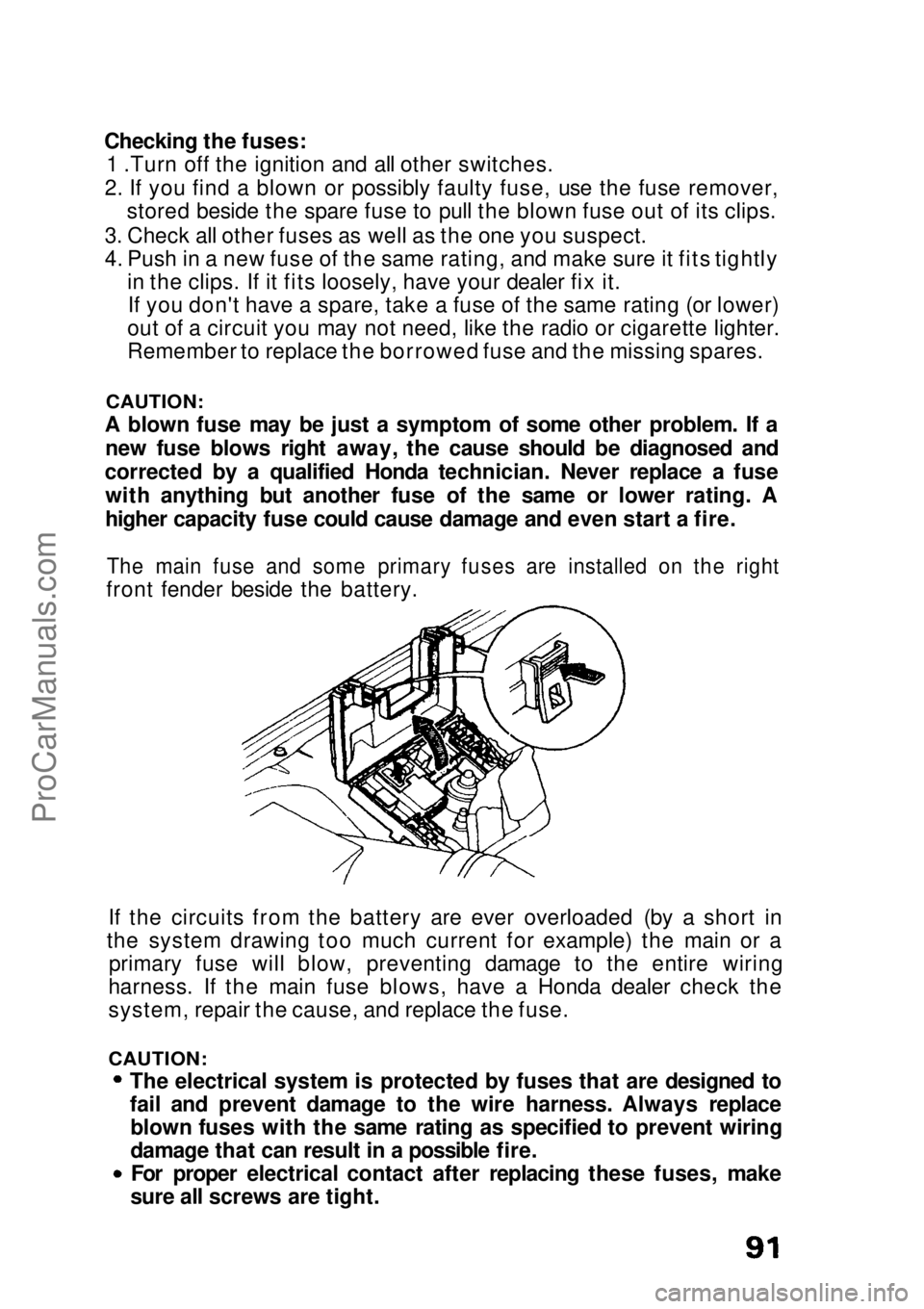
The main fuse and some primary fuses are installed on the right
front fender beside the battery.
If the circuits from the battery are ever overloaded (by a short in
the system drawing too much current for example) the main or a primary fuse will blow, preventing damage to the entire wiring
harness. If the main fuse blows, have a Honda dealer check the
system, repair the cause, and replace the fuse.
CAUTION:
The electrical system is protected by fuses that are designed to
fail and prevent damage to the wire harness. Always replaceblown fuses with the same rating as specified to prevent wiring
damage that can result in a possible fire.For proper electrical contact after replacing these fuses, make
sure all screws are tight.ProCarManuals.comMain Menu s t
Page 94 of 136
The factory installed tires on your car were selected to match the
car's performance capabilities and to provide the best combination
of handling, ride comfort and tread wear.
We recommend that you get the same size, type, and grade of tires when replacement is necessary. If your tires have an all-season
tread design, the model name will be followed by the marking: "M + S" (mud and snow) or "all-season".
If you decide not to get the same brand of tires as those originally
installed, you should make sure that the replacements are the radial
type, of the same size, load range and speed rating as the original
tires.
If you have any questions about your car's tires, please contact
your Honda dealer.
Inflation Pressures
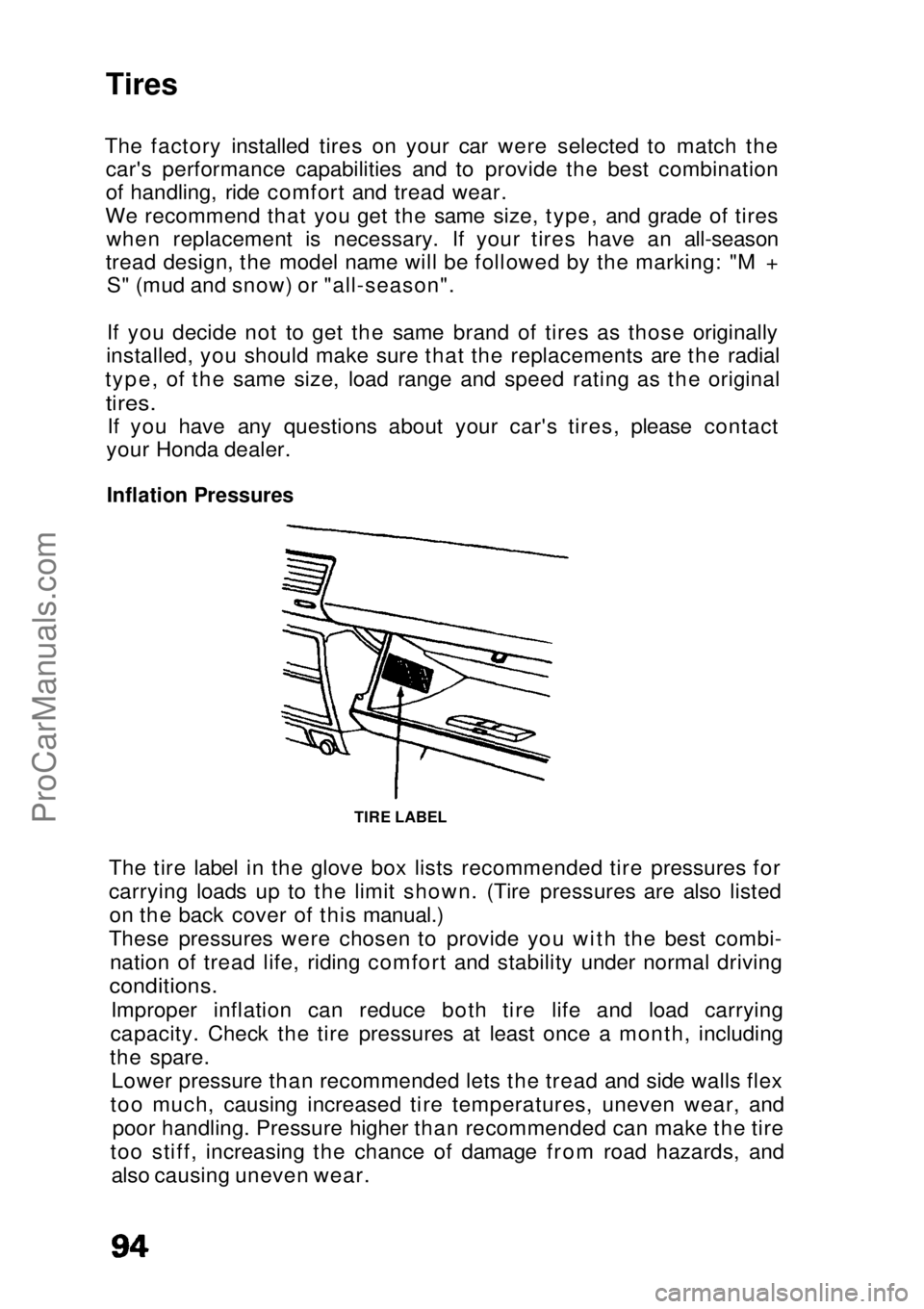
The tire label in the glove box lists recommended tire pressures for
carrying loads up to the limit shown. (Tire pressures are also listedon the back cover of this manual.)
These pressures were chosen to provide you with the best combi- nation of tread life, riding comfort and stability under normal driving
conditions.
Improper inflation can reduce both tire life and load carrying
capacity. Check the tire pressures at least once a month, including
the spare. Lower pressure than recommended lets the tread and side walls flex
too much, causing increased tire temperatures, uneven wear, and poor handling. Pressure higher than recommended can make the tire
too stiff, increasing the chance of damage from road hazards, and also causing uneven wear.
Tires
TIRE LABELProCarManuals.comMain Menu s t
Page 95 of 136

CAUTION:
Check tire pressure when the tires are cold.(After the car has been parked for more than 3 hours or driven
less than 1 mile/1.6 km.)
Tire pressure may increase as much as 41 kPa (6 psi) when the
tire is hot, so NEVER ADJUST tire pressure when the tires are hot.
Never inflate load range B tires to more than 220 kPa (32 psi)
cold.
Cars with luggage racks or cartop carriers DO NOT have greater
load limits than those on the label.
Winter Driving Tires marked "M + S" or "all season" have an all-weather treaddesign and should be suitable for most driving conditions. However,
snow tires and tire chains may be required under some conditions. Ifyour tires do not have these markings, they may not be suitable forwinter driving conditions. We recommend snow tires or tire chainsfor snow and icy conditions.
Snow TiresIf you use snow tires, they should be of the same size, construction
and load capacity as the original tires on your car. Snow tires must
be installed in sets of four, or they may cause poor handling. Driving
with snow tires on dry roads can reduce your car's performance
during acceleration, turning and stopping.
If you need further information on snow tires, please contact your
Honda dealer.
Tire Chains
Use chains only when you have to. Check with local authorities or
Provinces for requirements prior to installing tire chains. Make sure
the chains are the right size for your tires. Install them only on the
drive wheels of your car, and do so as tightly as possible, following
the manufacturer's instructions. If metal chains are used, they must
be SAE Class "S." Cable type traction devices can also be used.
Drive slowly with chains installed. If you hear the chains contacting
your car's body or chassis, stop and tighten them.
(cont'd)ProCarManuals.comMain Menu s t