fuel cap HONDA CIVIC 2003 7.G User Guide
[x] Cancel search | Manufacturer: HONDA, Model Year: 2003, Model line: CIVIC, Model: HONDA CIVIC 2003 7.GPages: 1139, PDF Size: 28.19 MB
Page 360 of 1139
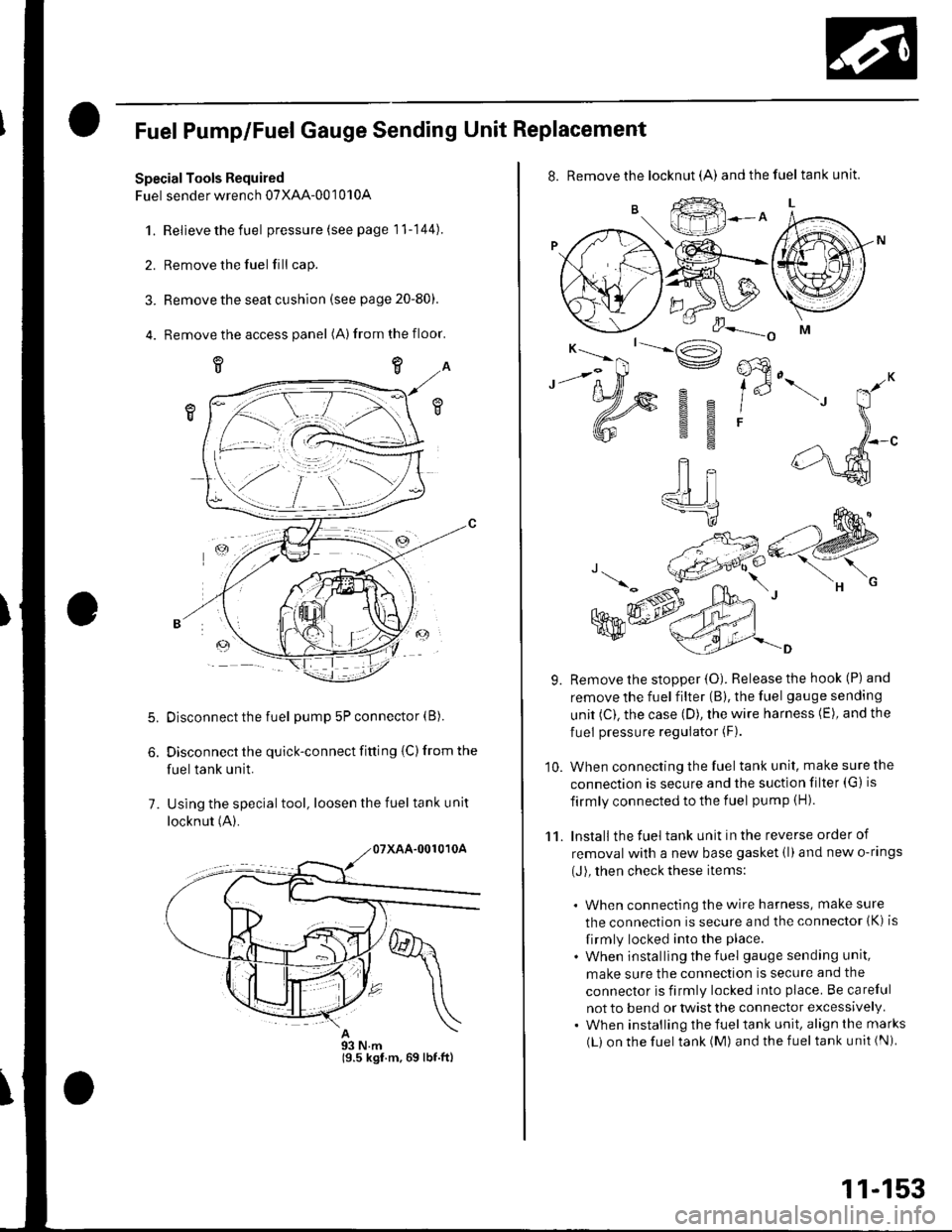
Fuel Pump/Fuel Gauge Sending Unit Replacement
SpecialTools Required
Fuel sender wrench 07XAA-001010A
1.Relieve the fuel pressure (see page 11-144).
Remove the fuel fill cap.
Remove the seat cushion (see page 20-80).
Remove the access panel (A)from the floor.
5.
7.
Disconnect the fuel pump 5P connector (B).
Disconnect the quick-connect fitting {C) from the
fuel tank unit.
Using the special tool, loosen the fuel tank unit
locknut (A).
93 N.m19.5 kgf.m,69 lbf.ftl
11-153
8. Remove the locknut (A) andthefuel tankunit.
9. Remove the stopper {O). Release the hook (P) and
remove the fuel filter (B), the fuel gauge sending
unit (C). the case (D), the wire harness (E), and the
fuel pressure regulator (F).
10. When connecting the fuel tank unit, make sure the
connection is secure and the suction filter (G) is
firmly connected to the f uel pump (H).
11. Install the fuel tank unit in the reverse order of
removal with a new base gasket (l)and new o-rings
(J), then check these items:
. When connecting the wire harness, make sure
the connection is secure and the connector (K) is
firmly locked into the place.
. When installing the f uel gauge sending unit,
make sure the connection is secure and the
connector is firmly locked into place. Be careful
not to bend or twist the connector excessively.. When installing the fueltank unit, align the marks
(L) on the fuel tank (M) and the fuel tank unit (Ni
Page 364 of 1139
10. Checkthatthe pointerof thefuel gauge indicates"F".
. lf the pointer does not indicate "F", replace the
ga uge.. lf the pointer indicates "F", inspect the fuel
gauge sending unit.
NOTE: The pointer of the fuel gauge retu rns to the
bottom of the gauge dial when the ignition switch
is OFF, regardless of the fuel level. -
11. Relieve the fuel pressure (see page 11-144\.
12. Remove the fuelfill cap.
13. Disconnect the quick-connect fittings from the fuel
pump.
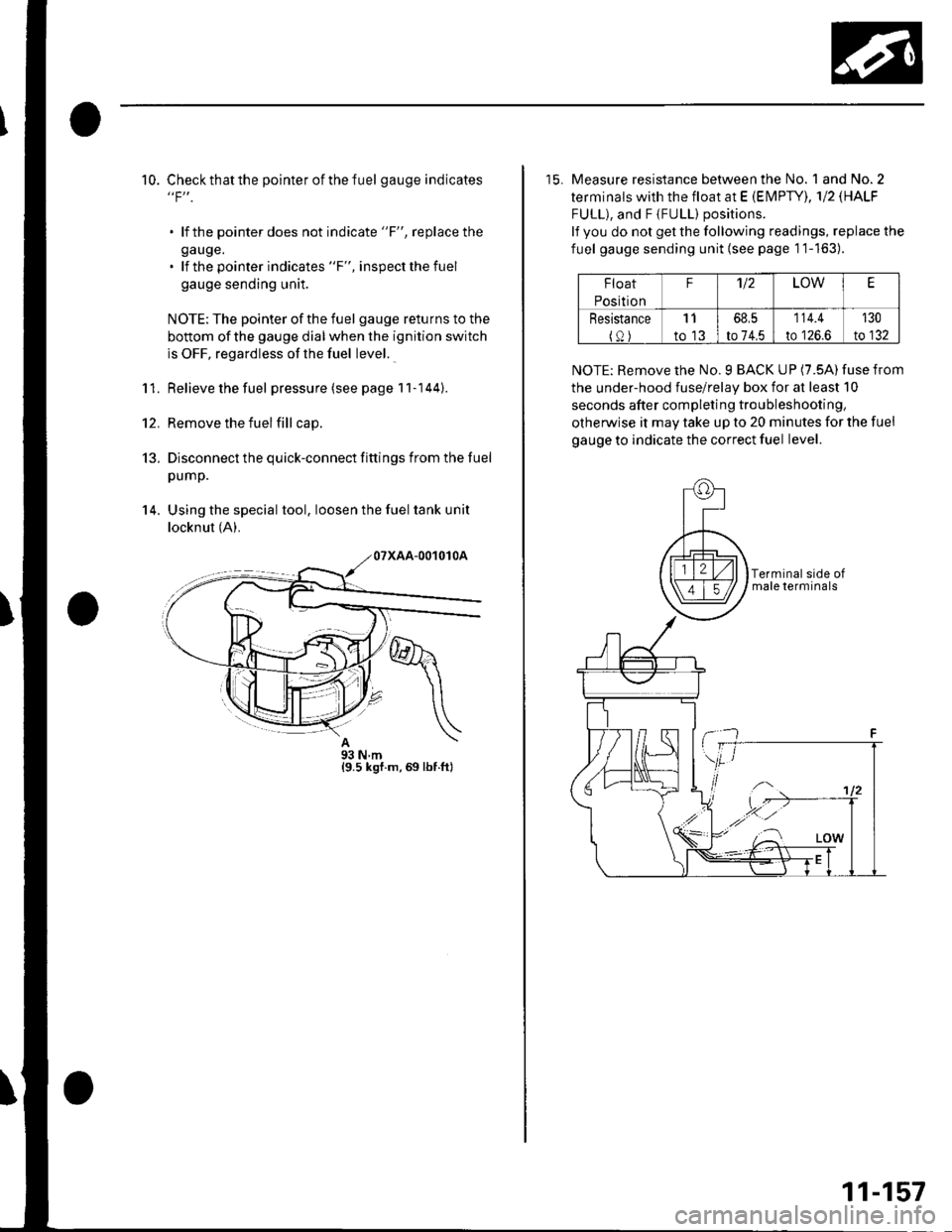
14. Using the special tool, loosen the fuel tank unit
locknut (A).
A93Nm{9.5 ksf.m,69 lbf.ft}
15. Measure resistance between the No. 1 and No.2
terminals with the float at E (EN4PTY), 'l12 \HALF
FULL), and F {FULL) positions.
lf you do not get the following readings, replace the
fuel gauge sending unit {see page 1'1-163).
Float
Position
F'U2LOWE
Resistance
{0)
11
to 13
68,5
to 74.5
114.4
to 126.6
130
to 132
NOTE: Remove the No. 9 BACK UP (7.5A) fuse from
the under-hood fuse/relay box for at least 10
seconds after completing troubleshooting,
otherwise it may take up to 20 minutes for the fuel
gauge to indicate the correct fuel level.
11-157
Page 378 of 1139
DTC Troubleshooting
DTC P0451: FTP Sensor Range/Performa nce
Problem
Special Tools Required
Vacuum Pump/Gauge, 0-30 in. Hg A973X-041-XXXXX
1. Remove the fuel fill cap.
2. Turn the ignition switch ON (ll)
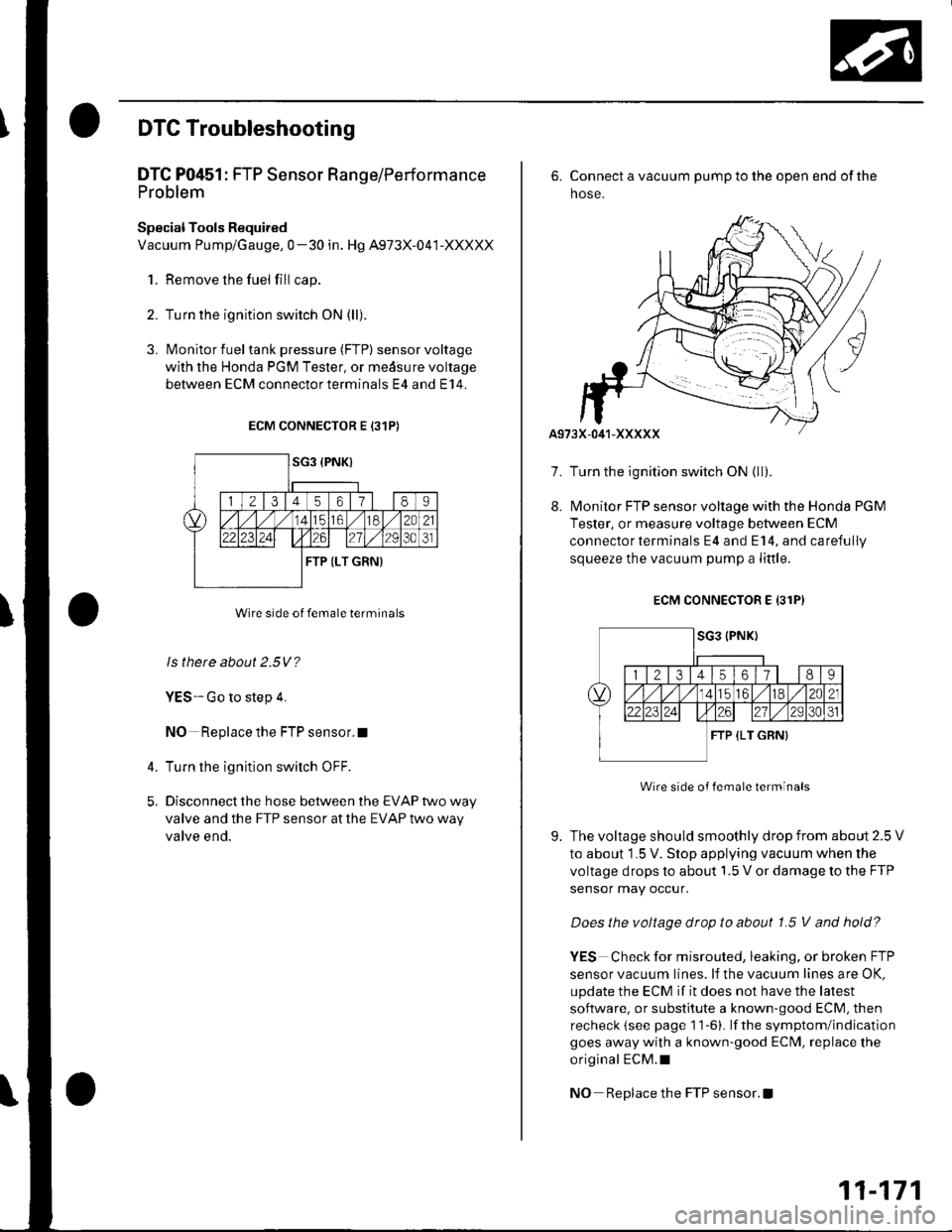
3. l\4onitor fuel tank pressure (FTP) sensorvoltage
with the Honda PGM Tester, or medsure voltage
between ECM connectorterminals E4 and E14.
ECM CONNECTOR E 131P)
Wire side of female terminals
ls there about 2.5V?
YES-Go to step 4.
NO Replace the FTP sensor.I
Turn the ignition switch OFF.
Disconnect the hose between the EVAP two way
valve and the FTP sensor at the EVAP two way
valve end.
4.
5.
7.
8.
6. Connect a vacuum pump to the open end of the
hose.
Turn the ignition switch ON {ll).
l\4onitor FTP sensor voltage with the Honds PGM
Tester, or measure voltage between ECM
connector terminals E4 and E14, and carefully
squeeze the vacuum pump a little.
ECM CONNECTOR E 13lPI
Wire side of lemale terminals
The voltage should smoothly drop from about 2.5 V
to about 1.5 V. Stop applying vacuum when the
voltage drops to about 1.5 V or damage to the FTP
sensor may occur.
Does the voltage drop to about 1.5 V and hold?
YES Check for misrouted, leaking, or broken FTP
sensor vacuum lines. lf the vacuum lines are OK,
update the ECM if it does not have the latest
software. or substitute a known-good ECM, then
recheck (see page 1 1-6). lf the symptom/indication
goes away with a known-good ECM, replace the
original ECM.I
NO Replace the FTP sensor. !
9.
11-171
Page 379 of 1139
EVAP System
DTC Troubleshooting (cont'd)
DTC P0452: FTP Sensor Circuit Low Voltage
1. Check the vacuum lines at the FTP sensor for
misrouting, leakage. breakage, or clogging.
Are the vacuum lines OK?
YES Go to step 2.
NO Repair or replace vacuum lines as
necessary. I
2. Reset the ECM (see page 11-4).
3. Remove the fuelfill cap.
4. Turn the ignition switch ON (ll)
5. Monitor FTP sensor voltage with the Honda PGM
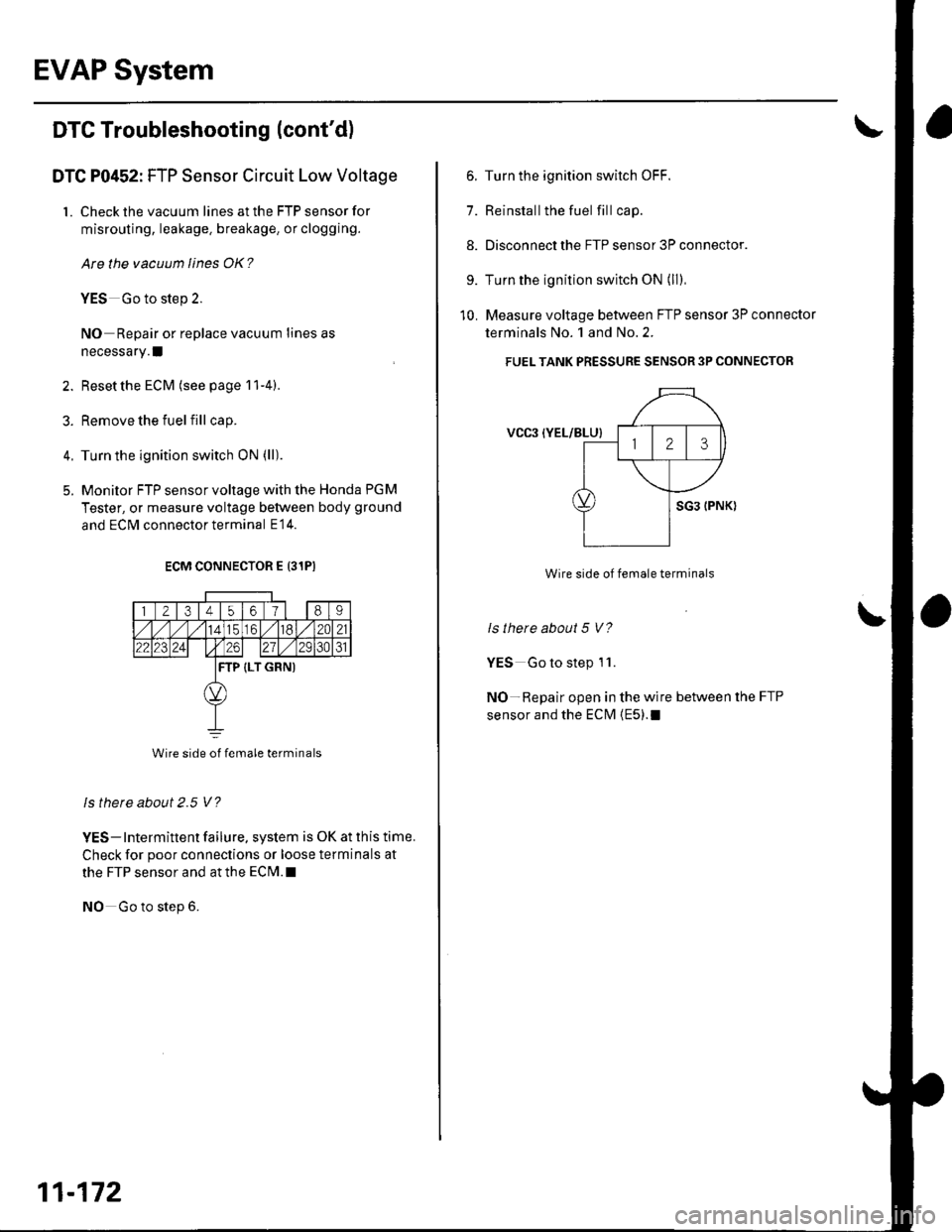
Tester, or measure voltage between body ground
and ECM connector terminal E14.
ECM CONNECTOR E 131PI
1 2t3t45o/89
././114tc61./182C21
22123241 t26271/ 2931
TP (LT GRN)
Wire side of female terminals
ls thete about 2.5 V?
YES- Intermittent failure, system is OK at this time.
Check for poor connections or loose terminals at
the FTP sensor and at the ECrM.l
NO Go to step 6.
11-172
6. Turn the ignition switch OFF.
7. Reinstallthe fuel fill cap.
8. Disconnect the FTP sensor 3P connector.
9. Turn the ignition switch ON (ll)
10. Measure voltage between FTP sensor 3P connector
terminals No. 1 and No.2.
FUEL TANK PRESSURE SENSOR 3P CONNECTOR
VCgl {YEL/BLU}
Wire side of female terminals
ls there about 5 V?
YES Go to step 1 '1.
NO-Repair open in the wire between the FTP
sensor and the ECM {E5).1
Page 380 of 1139
't2.
13.
14.
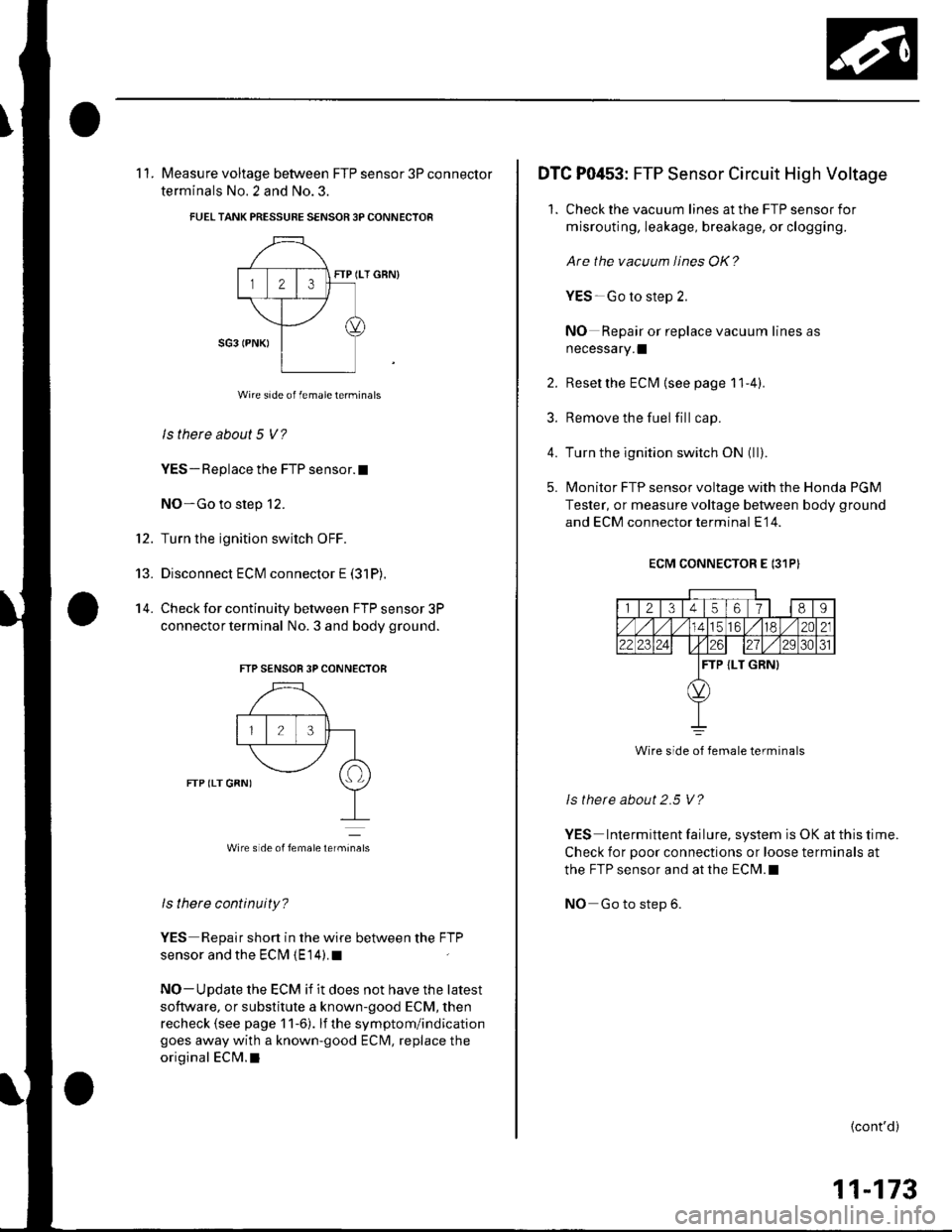
11. Measure voltage between FTP sensor 3P connector
terminals No. 2 and No.3.
FUELTANK PRESSUBE SENSOR 3P CONNECTOR
FTP (LT GBN)
Wire side of femaleterminals
ls there about 5 V?
YES - Replace the FTP sensor. t
NO-Go to step 12.
Turn the ignition switch OFF.
Disconnect ECM connector E (31P),
Check for continuity between FTP sensor 3P
connector terminal No. 3 and body ground.
FTP SENSOR 3P CONNECTOB
FTP (LT GRNI
Wire side of femalelerminats
ls there continuity?
YES Repair short in the wire between the FTP
sensor and the ECI\4 {E14).I
NO-Update the ECM if it does not have the latest
software, or substitute a known-good ECM, then
recheck (see page 1 1-6). lf the symptom/indicationgoes away with a known-good EClvl, replace the
original ECM.I
DTC P0453: FTP Sensor Circuit High Voltage
1. Check the vacuum lines at the FTP sensor for
misrouting, leakage, breakage, or clogging.
Are the vacuum lines OK?
YES-Go to step 2.
NO Repair or replace vacuum lines as
necessary.I
2. Reset the ECM {see page 11'4).
3. Remove the fuel fill cap.
4. Turn the ignition switch ON (ll).
5. lvlonitor FTP sensor voltage with the Honda PGM
Tester, or measure voltage between body ground
and ECM connector terminal E'14.
ECM CONNECTOR E 131PI
112134567I9
56/ t182C21
242il./29 3031
TP {LT GRN}
Wire side of female terminals
Is there about 2.5 V?
YES Intermittent failure, system is OK at this time.
Check for poor connections or loose terminals at
the FTP sensor and at the ECM.I
NO Go to step 6.
{cont'd)
11-173
Page 381 of 1139
EVAP System
DTC Troubleshooting (cont'dl
6. Turn the ignition switch OFF.
7. Reinstall lhe fuel fill cap.
8. Disconnect the FTP sensor 3P connector.
9. Turn the ignition switch ON (ll).
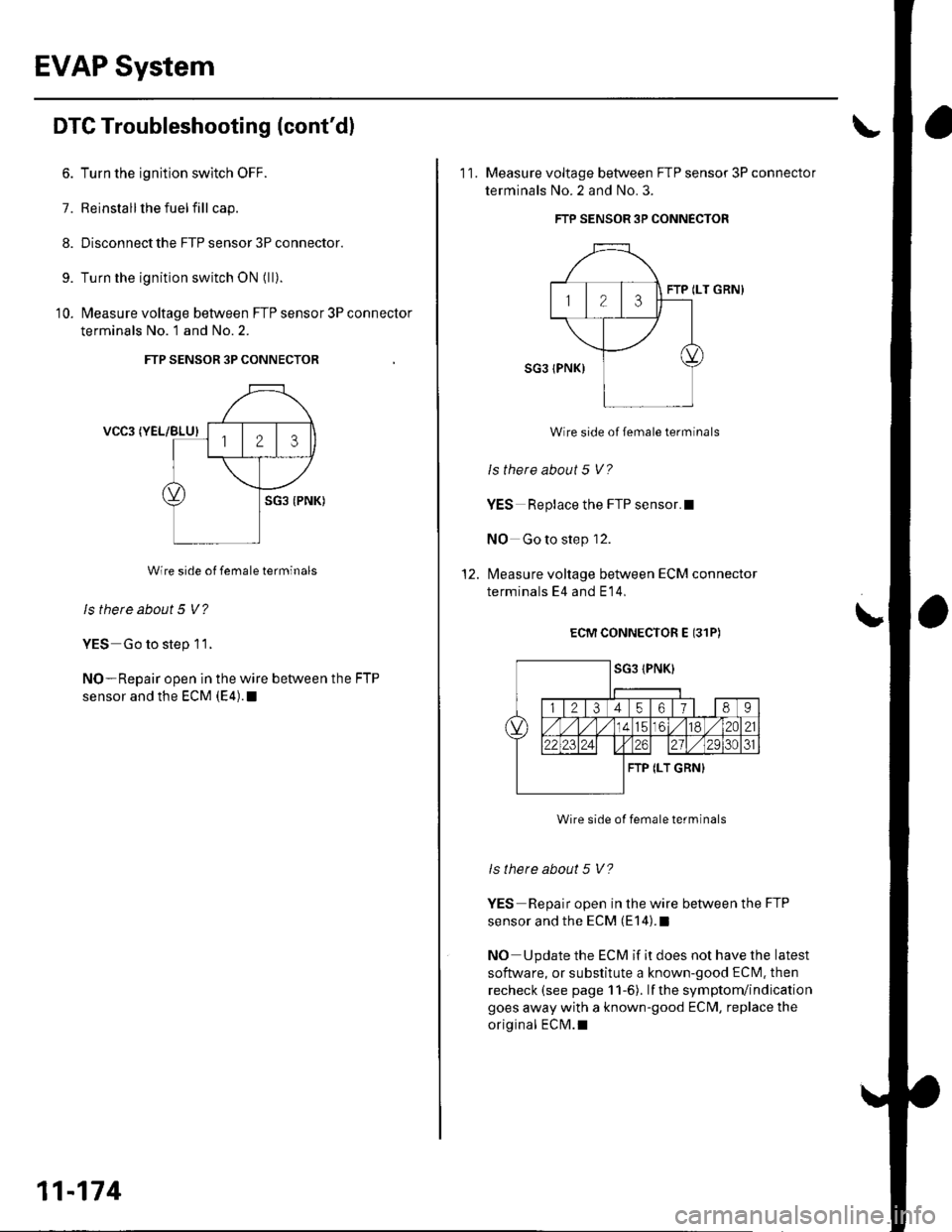
'10. l\4easure voltage between FTP sensor 3P connector
terminals No. 1 and No.2.
FTP SENSOR 3P CONNECTOR
VCC3 (YEL/BLU)
Wire side of female terminals
ls there about 5 V?
YES Go to step 11.
NO-Repair open in the wire between the FTP
sensor and the ECM (E4). !
11-174
11, Measure voltage between FTP sensor 3P connector
terminals No.2 and No.3.
FTP SENSOR 3P CONNECTOR
FTP ILT GRN}
Wire side of female terminals
ls there about 5 V?
YES Replace the FTP sensor.l
NO Go to step 12.
l\4easure voltage between ECM connector
terminals E4 and E 14,
ECM CONNECTOR E (31P)
Wire side of female terminals
ls there about 5 V?
YES Repair open in the wire between the FTP
sensor and the ECM (E14).I
NO Update the ECM if it does not have the latest
software, or substitute a known-good ECN4. then
recheck (see page 11-6). lf the symptom/indication
goes away with a known-good ECM, replace the
original ECM.I
\
Page 382 of 1139
DTC Pl456: EVAP Control(Fuel Tank Svstem)
System Leakage
The fuel system is designed to allow specified
maximum vacuum and pressure conditions. Do not
deviate from the vacuum and pressure tests as
indicated in these procedures. Excessive pressure/
vacuum would damage the EVAP components or cause
eventual fuel tank failure.
Special Tools Required
Vacuum Pump/Gauge, 0-30 in. Hg A973X-041-XXXXX
This is a two-trip code. Once cleared, it cannot be
reproduced in one trip. Also, cenain specific driving
and ambient conditions must occur before the ECM will
complete the system checks. Additional test drives may
still not meet the specific conditions needed to
reproduce the code.
Follow these troubleshooting procedures carefully to
ensure the integrity of the system and to confirm the
cause of the problem or code.
NOTE: Fresh fuel has a higher volatility that createsgreater pressure/vacuum. The optimum condltlon for
testing is fresh fuel, and must be less than a full tank. lf
possible, to assist in leak detection, add 1 gallon of
fresh fuel to the tank (as long as it will not fill the tank).just before starting these procedures.
Fuel Fill Cap Check
1. Check the fuel fill cap (the cap must say "lf not
tightened 3 clicks check engine light may come
on" ).
ls the proper luel till cap installed and properly
tightened?
YES Go to step 2.
NO- Replace or tighten the cap.I
2. Check the fuel fill cap seal.
ls the tuel fill cap seal missing or damaged?
YES- Replace the fuel fill cap.I
NO The fuelfill cap is OK. Go to step 3.
EVAP Canister Purge Valve Test
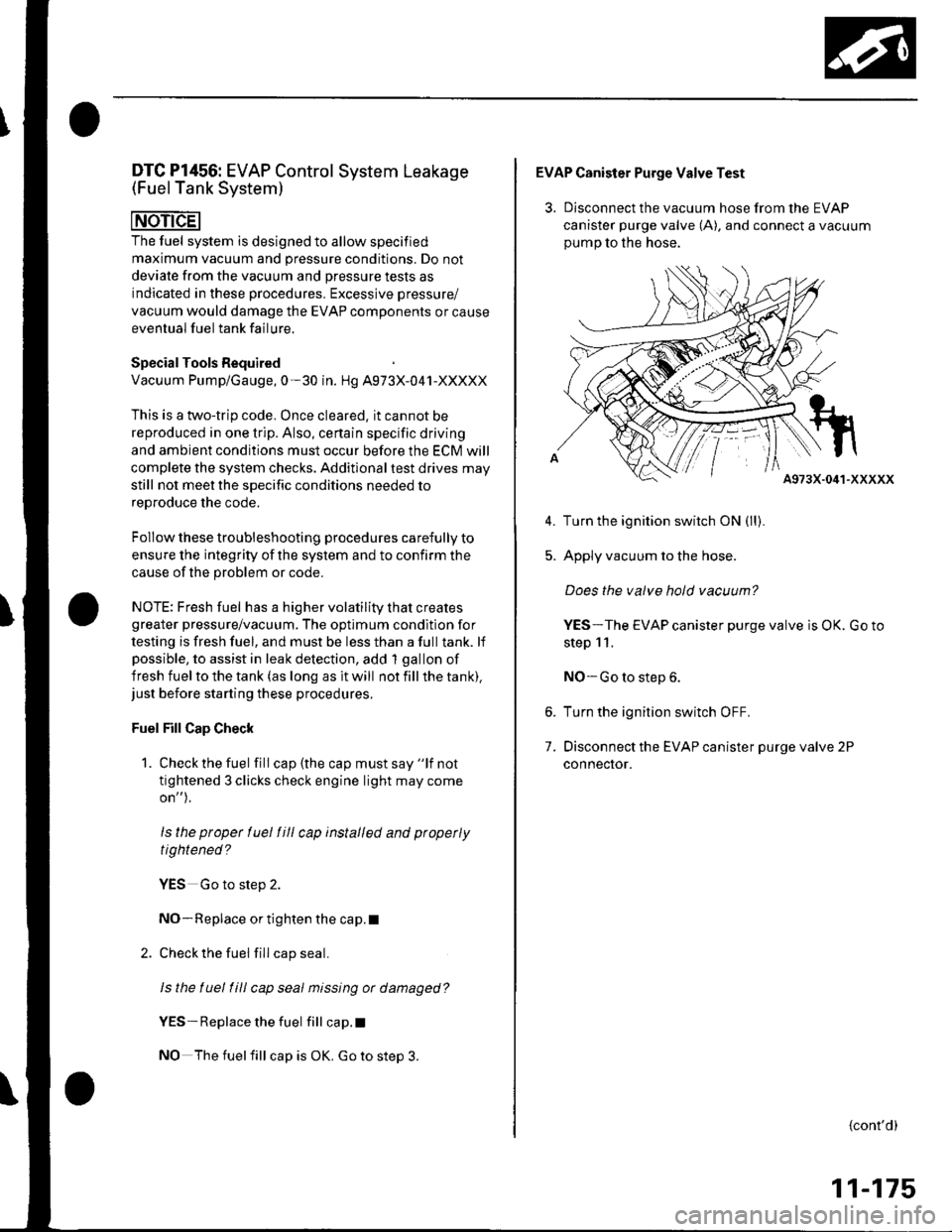
3. Disconnect the vacuum hose from the EVAP
canister purge valve (A), and connect a vacuum
oumo to the hose.
A973X-041-XXXXX
Turn the ignition switch ON (ll).
Apply vacuum to the hose.
Does the valve hold vacuum?
YES-The EVAP canister purge valve is OK. Go to
step 11.
NO-Go to step 6.
Turn the ignition switch OFF.
Disconnect the EVAP canister purge valve 2P
connecror.
5.
7.
{cont'd)
11-175
Page 386 of 1139
28.
29.
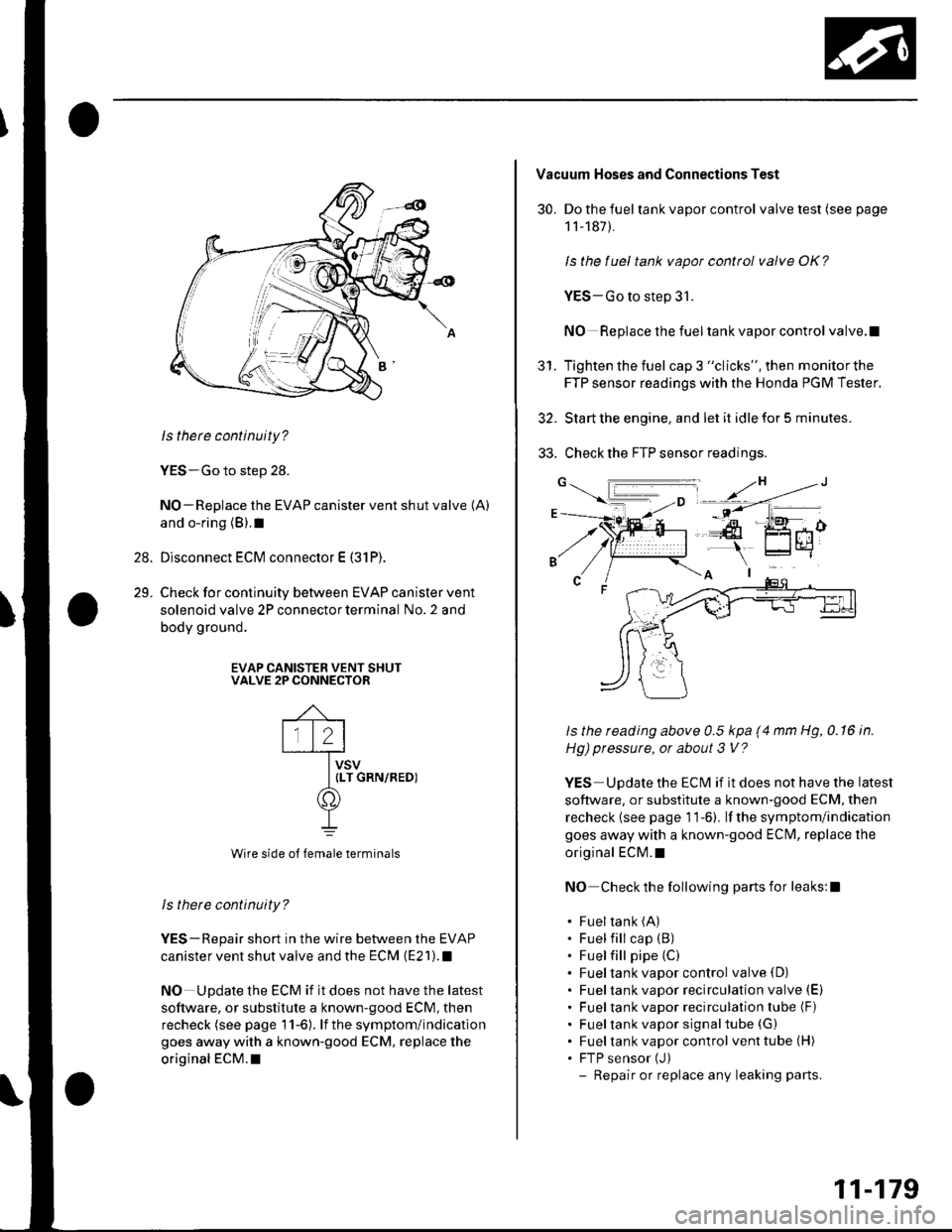
ls thete continuity?
YES-Go to step 28.
NO-Replace the EVAP canister vent shut valve (A)
and o-ring (B).1
Disconnect ECM connector E (31P).
Check for continuity between EVAP canister vent
solenoid valve 2P connector terminal No. 2 and
body ground.
EVAP CANISTER VENT SHUTVALVE 2P CONNECTOR
Wire side o{ female terminals
ls there continuity?
YES-Repair short in the wire between the EVAP
canister vent shut valve and the ECM (E21).1
NO Update the ECM if it does not have the latest
soflware, or substitute a known-good ECM, then
recheck (see page 11-6). lf the symptom/indication
goes away with a known-good ECM, replace the
original ECM.I
30.
Vacuum Hoses and Connections Test
Do the fuel tank vapor control valve test (see page
1 1-187).
ls the fuel tank vapot control valve OK?
YES-Go to step 31.
NO Replace the fueltank vapor control valve.l
Tighten the fuel cap 3 "clicks", then monitorthe
FTP sensor readings with the Honda PGM Tester.
Start the engine. and let it idle for 5 minutes.
Check the FTP sensor readings.
ls the reading above 0.5 kpa (4 mm Hg, 0.16 in.
Hg) pressure, or about 3 V?
YES Update the ECM if it does not have the latest
software, or substitute a known-good ECM, then
recheck {see page 1 1-6). lf the symptom/indication
goes away with a known-good ECfvl, replace the
original ECM.t
NO Check the following parts for leaks:l
. Fueltank (A)
. Fuel fill cap (B)
. Fuel fill pipe (C)
. Fueltank vapor control valve(D). Fueltank vapor recirculation valve (E)
. Fueltank vapor recirculation tube (F)
. Fueltank vapor signaltube (G)
. Fueltank vapor control venttube(H). FTP sensor (J)
- Repair or replace any leaking parts.
5t.
11-179
Page 393 of 1139
EVAP System
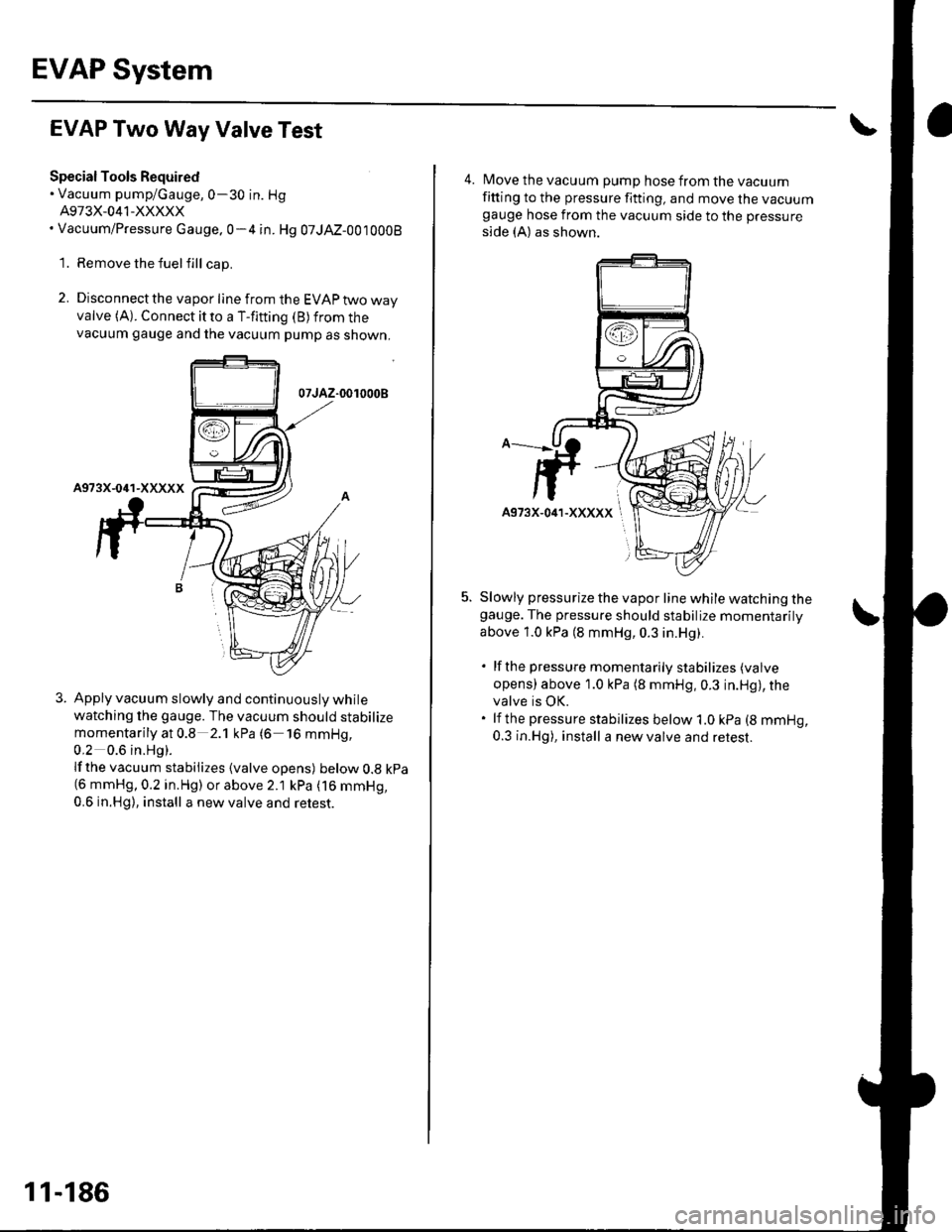
EVAP Two Way Valve Test
Special Tools Required. Vacuum pump/Gauge,0-30 in. Hg
A973X-041-XXXXX. Vacuum/Pressure cauge.0-4 in. Hg 07JAZ-0010008
1. Remove the fuelfill cap.
2. Disconnect the vapor line from the EVAP two wayvalve (A). Connect it to a T-fitting (B) from thevacuum gauge and the vacuum pump as shown,
07JAZ-0010008
Apply vacuum slowly and continuously while
watching the gauge. The vacuum should stabilize
momentarily at 0.8 2.1 kPa (6 16 mmHg,
0,2 0.6 in.Hg).
lf the vacuum stabilizes {valve opens) below 0.8 kpa(6 mmHg,0.2 in.Hg) or above 2.1 kPa (16 mmHg,
0.6 in.Hg), install a new valve and retest.
11-186
4. Move the vacuum pump hose from the vacuumfitting to the pressure fitting, and move the vacuumgauge hose from the vacuum side to the pressure
side (A) as shown.
Slowly pressurize the vapor line while watching thegauge. The pressure should stabilize momentarilV
above 1.0 kPa (8 mmHg, 0.3 in.Hg).
. lfthe pressure momentarily stabilizes (valve
opens) above 1.0 kPa (8 mmHg,0.3 in.Hg), thevalve is OK.. lf the pressure stabilizes below 1.0 kPa (8 mmHg,
0.3 in.Hg), install a new valve and retest.
Page 394 of 1139
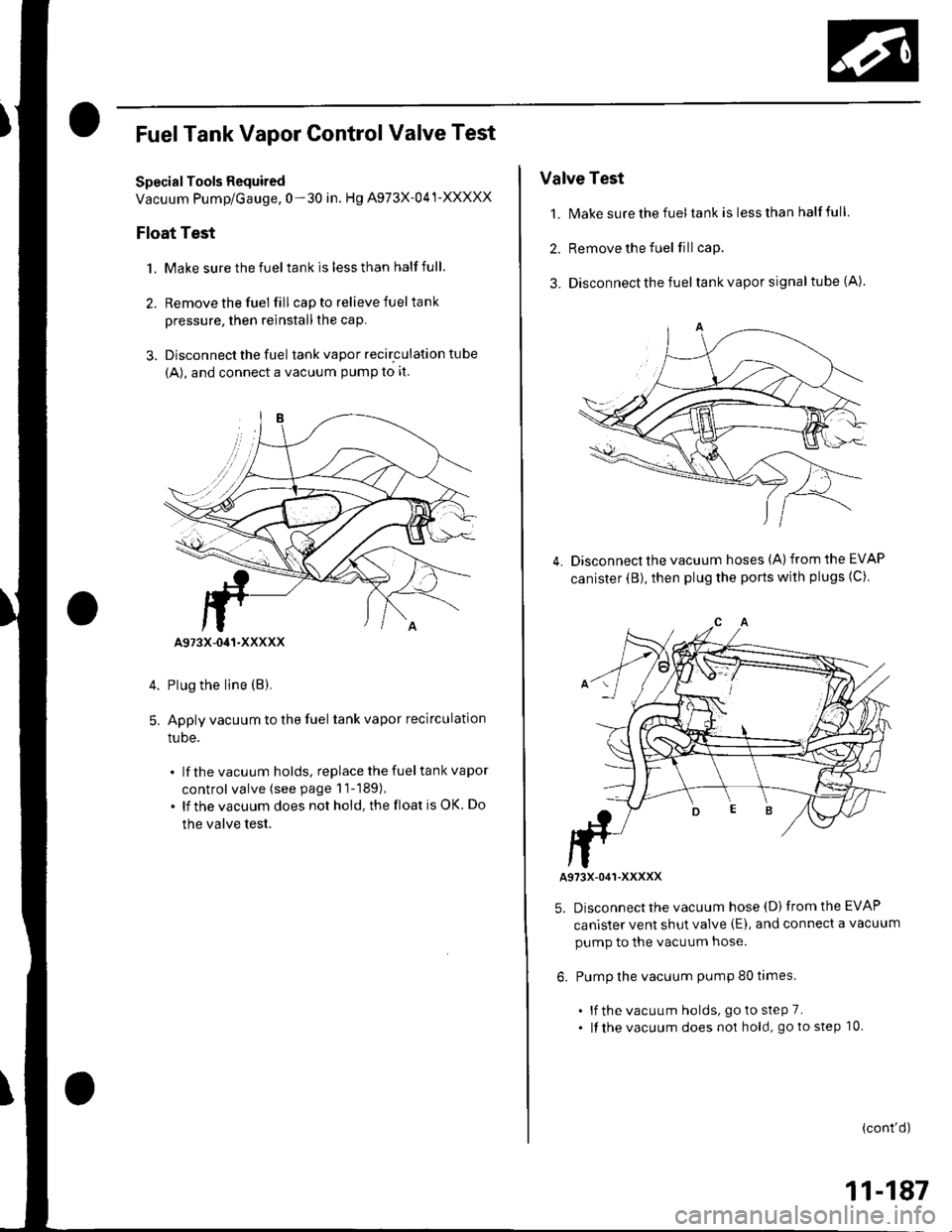
FuelTank Vapor Control Valve Test
Special Tools Required
Vacuum Pump/Gauge, 0-30 in. Hg A973X-041-XXXXX
Float Test
1. Make sure the fuel tank is less than half full.
2. Remove the fuel fill cap to relieve fuel tank
pressure, then reinstall the cap.
3. Disconnect the fuel tank vapor recirculation tube
{A), and connect a vacuum PumP to it.
Plug the line (B).
Apply vacuum to the fuel tank vapor recirculation
tuDe.
lf the vacuum holds, replace the fuel tank vapor
control valve (see page 11-189).
lf the vacuum does not hold, the float is OK. Do
the valve test.
5.
A973X-041-XXXXX
Valve Test
1. N4ake sure the fuel tank is less than half full
2. Remove the fuel fill cap.
3. Disconnect the fuel tank vapor signal tube (A).
Disconnect the vacuum hoses (A) from the EVAP
canister (B), then plug the ports with plugs (C)4.
A973X-O41-XXXXX
5. Disconnect the vacuum hose (D) from the EVAP
canister vent shut valve (E), and connect a vacuum
pump to the vacuum hose.
6. Pump the vacuum pump 80 times.
. lf the vacuum holds, goto steP 7.. lf the vacuum does no1 hold, go to step 10.
(cont'd)
11-187