coolant temperature HONDA CIVIC COUPE 1999 Owners Manual
[x] Cancel search | Manufacturer: HONDA, Model Year: 1999, Model line: CIVIC COUPE, Model: HONDA CIVIC COUPE 1999Pages: 269, PDF Size: 2.42 MB
Page 59 of 269
Gauges
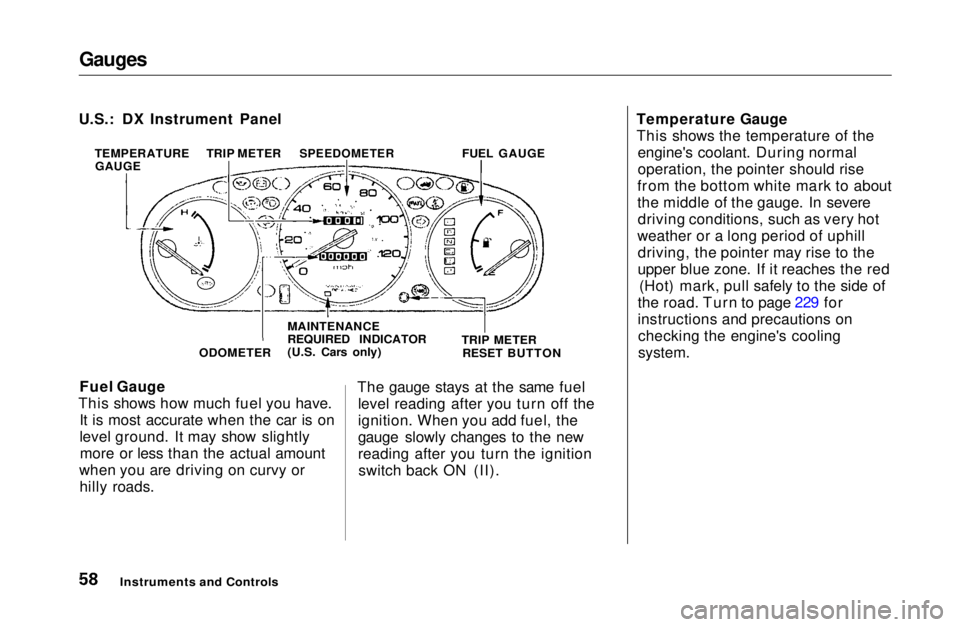
Fuel Gauge
This shows how much fuel you have. It is most accurate when the car is on
level ground. It may show slightlymore or less than the actual amount
when you are driving on curvy or hilly roads. The gauge stays at the same fuel
level reading after you turn off the
ignition. When you add fuel, the
gauge slowly changes to the new
reading after you turn the ignitionswitch back ON (II). Temperature Gauge
This shows the temperature of the
engine's coolant. During normal
operation, the pointer should rise
from the bottom white mark to about
the middle of the gauge. In severe driving conditions, such as very hot
weather or a long period of uphill driving, the pointer may rise to the
upper blue zone. If it reaches the red (Hot) mark, pull safely to the side of
the road. Turn to page 229 for
instructions and precautions on checking the engine's cooling
system.
Instruments and Controls
U.S.: DX Instrument Panel
TEMPERATUREGAUGE TRIP METER
SPEEDOMETER
FUEL GAUGE
ODOMETER MAINTENANCE
REQUIRED INDICATOR
(U.S. Cars only)
TRIP METER
RESET BUTTONMain Menu Table of Contents s t
Page 91 of 269
Heating and Cooling
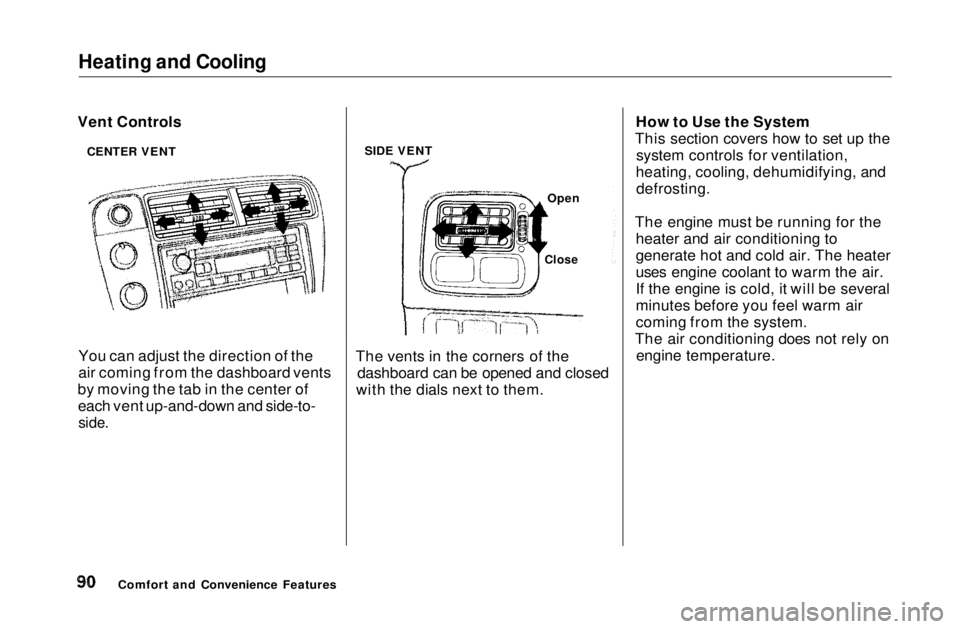
Vent Controls
You can adjust the direction of the
air coming from the dashboard vents
by moving the tab in the center of each vent up-and-down and side-to-
side.
The vents in the corners of the
dashboard can be opened and closed
with the dials next to them. How to Use the System
This section covers how to set up the system controls for ventilation,
heating, cooling, dehumidifying, and defrosting.
The engine must be running for the heater and air conditioning to
generate hot and cold air. The heater
uses engine coolant to warm the air.
If the engine is cold, it will be several
minutes before you feel warm air
coming from the system.
The air conditioning does not rely on engine temperature.
Comfort and Convenience Features
CENTER VENT
SIDE VENT
Open
CloseMain Menu Table of Contents s t
Page 93 of 269
Heating and Cooling
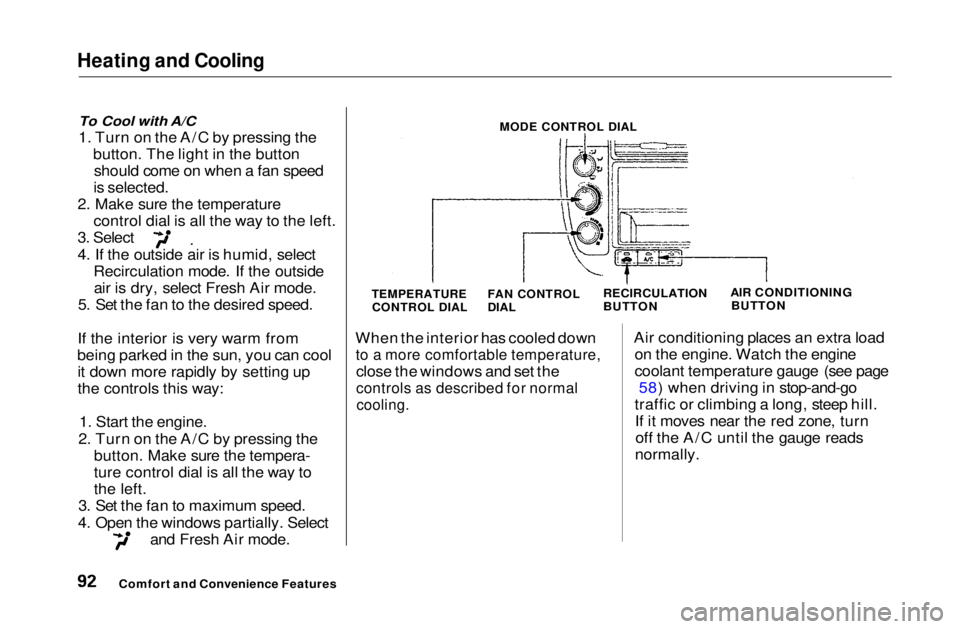
To Cool with A/C
1. Turn on the A/C by pressing the button. The light in the buttonshould come on when a fan speed
is selected.
2. Make sure the temperature control dial is all the way to the left. 3. Select
4. If the outside air is humid, select
Recirculation mode. If the outsideair is dry, select Fresh Air mode.
5. Set the fan to the desired speed.
If the interior is very warm from
being parked in the sun, you can cool it down more rapidly by setting up
the controls this way:
1. Start the engine.
2. Turn on the A/C by pressing the button. Make sure the tempera-
ture control dial is all the way to
the left.
3. Set the fan to maximum speed.
4. Open the windows partially. Select and Fresh Air mode.
MODE CONTROL DIAL
TEMPERATURE
CONTROL DIAL
FAN CONTROL
DIAL
RECIRCULATION
BUTTON AIR CONDITIONING
BUTTON
When the interior has cooled down
to a more comfortable temperature,
close the windows and set the
controls as described for normal
cooling.
Air conditioning places an extra load
on the engine. Watch the engine
coolant temperature gauge (see page 58) when driving in stop-and-go
traffic or climbing a long, steep hill. If it moves near the red zone, turnoff the A/C until the gauge reads
normally.
Comfort and Convenience FeaturesMain Menu Table of Contents s t
Page 96 of 269

Heating and Cooling
These settings direct all the air flow to the defroster vents at the base of
the windshield and the side windowdefroster vents. The air flow will get
warmer and clear the windows faster as the engine warms up. You can
close the side vents with the dial
beside each vent. This will send
more warm air to the windshield defroster vents.
For safety, make sure you have a
clear view through all the windows
before driving away. To Turn Everything Off
To shut off the system temporarily,
turn the fan speed and temperature
control dials all the way to the left.
You should shut the system completely off only for the first few
minutes of driving in cold weather,
until the engine coolant warms up enough to operate the heater. Keep
the fan on at all other times so stale air does not build up in the interior.
Comfort and Convenience FeaturesMain Menu Table of Contents s t
Page 176 of 269
Cooling System
Replacing Engine Coolant
The cooling system should be completely drained and refilled with
new coolant according to the timeand distance recommendations in
the maintenance schedule. Only use Genuine Honda Antifreeze/Coolant.
Draining the coolant requires access
to the underside of the car. Unless
you have the tools and knowledge,
you should have this maintenance done by a skilled mechanic. 1. Turn the ignition ON (II). Turnthe temperature control dial to
maximum heat. Turn off the
ignition and remove the key. Open
the hood. Make sure the engineand radiator are cool to the touch.
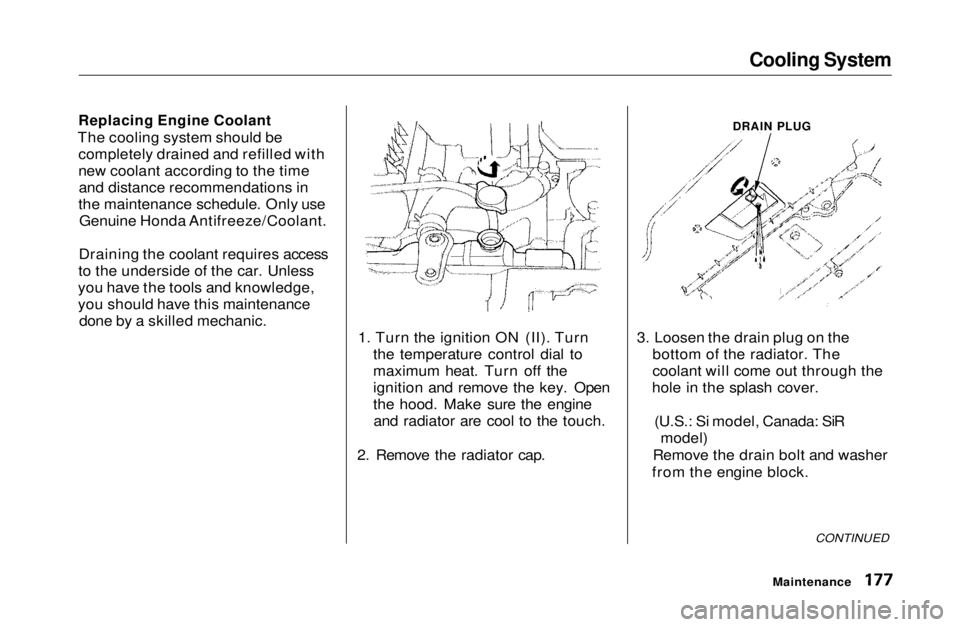
2. Remove the radiator cap. 3. Loosen the drain plug on the
bottom of the radiator. The
coolant will come out through the
hole in the splash cover.
(U.S.: Si model, Canada: SiR model)
Remove the drain bolt and washer
from the engine block.
CONTINUED
Maintenance
DRAIN PLUGMain Menu Table of Contents s t
Page 228 of 269
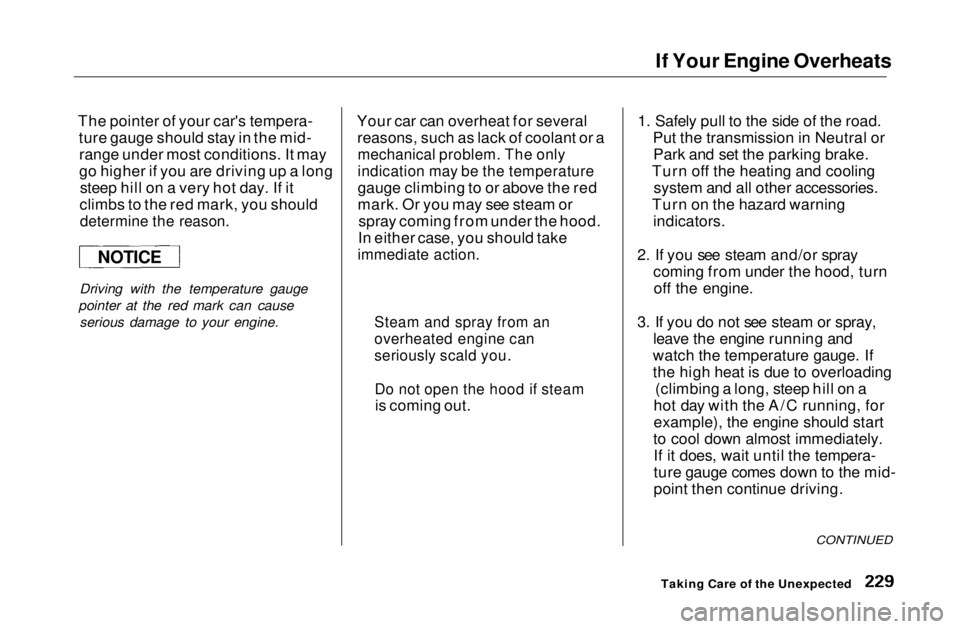
If Your Engine Overheats
The pointer of your car's tempera- ture gauge should stay in the mid-range under most conditions. It may
go higher if you are driving up a long steep hill on a very hot day. If it
climbs to the red mark, you should
determine the reason.
Driving with the temperature gauge
pointer at the red mark can cause serious damage to your engine. Your car can overheat for several
reasons, such as lack of coolant or a
mechanical problem. The only
indication may be the temperature
gauge climbing to or above the red
mark. Or you may see steam or spray coming from under the hood.
In either case, you should take
immediate action.
1. Safely pull to the side of the road.
Put the transmission in Neutral orPark and set the parking brake.
Turn off the heating and cooling system and all other accessories.
Turn on the hazard warning indicators.
2. If you see steam and/or spray coming from under the hood, turnoff the engine.
3. If you do not see steam or spray, leave the engine running and
watch the temperature gauge. If
the high heat is due to overloading (climbing a long, steep hill on a
hot day with the A/C running, for
example), the engine should start
to cool down almost immediately. If it does, wait until the tempera-
ture gauge comes down to the mid-
point then continue driving.
CONTINUED
Taking Care of the Unexpected
NOTICE
Steam and spray from an
overheated engine can
seriously scald you.
Do not open the hood if steam
is coming out.Main Menu Table of Contents s t
Page 229 of 269
If Your Engine Overheats
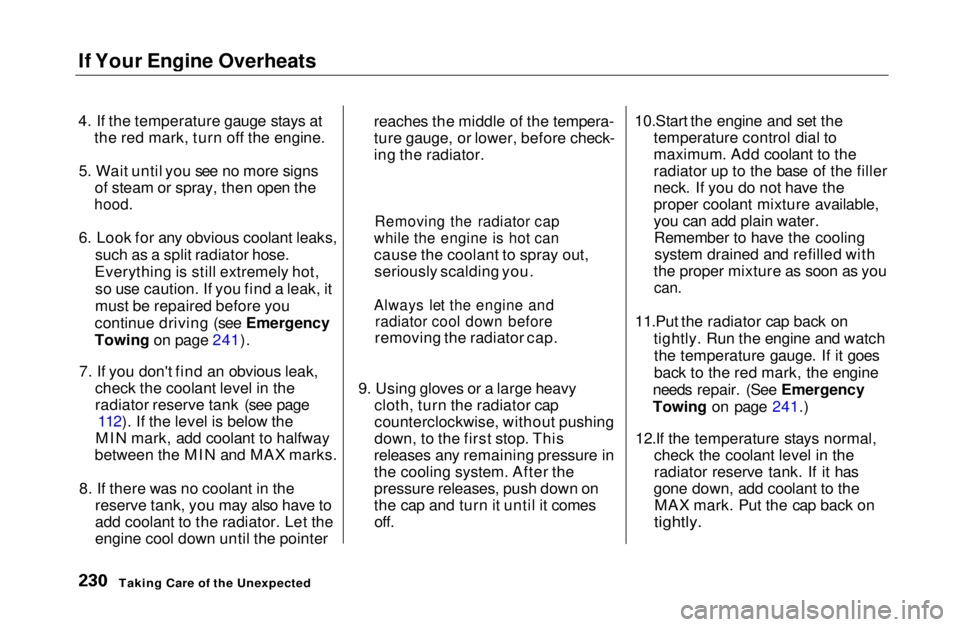
4. If the temperature gauge stays at
the red mark, turn off the engine.
5. Wait until you see no more signs of steam or spray, then open the
hood.
6. Look for any obvious coolant leaks, such as a split radiator hose.
Everything is still extremely hot, so use caution. If you find a leak, it
must be repaired before you
continue driving (see Emergency
Towing on page 241).
7. If you don't find an obvious leak, check the coolant level in the
radiator reserve tank (see page112). If the level is below the
MIN mark, add coolant to halfway
between the MIN and MAX marks.
8. If there was no coolant in the reserve tank, you may also have to
add coolant to the radiator. Let the
engine cool down until the pointer reaches the middle of the tempera-
ture gauge, or lower, before check-
ing the radiator.
9. Using gloves or a large heavy cloth, turn the radiator cap
counterclockwise, without pushing
down, to the first stop. This
releases any remaining pressure in
the cooling system. After the
pressure releases, push down on
the cap and turn it until it comes off. 10.Start the engine and set the
temperature control dial to
maximum. Add coolant to the
radiator up to the base of the filler
neck. If you do not have the
proper coolant mixture available,
you can add plain water.Remember to have the coolingsystem drained and refilled with
the proper mixture as soon as you
can.
11.Put the radiator cap back on tightly. Run the engine and watchthe temperature gauge. If it goes
back to the red mark, the engine
needs repair. (See Emergency
Towing on page 241.)
12.If the temperature stays normal, check the coolant level in the
radiator reserve tank. If it has
gone down, add coolant to the MAX mark. Put the cap back on
tightly.
Taking Care of the Unexpected
Removing the radiator cap
while the engine is hot can
cause the coolant to spray out, seriously scalding you.
Always let the engine and radiator cool down before
removing the radiator cap.Main Menu Table of Contents s t
Page 262 of 269
Index
Consumer Information*................ 258
Controls, Instruments and.............. 51
Coolant
Adding.........................................171
Checking..................................... 128
Proper Solution.......................... 175
Replacing.................................... 177
Temperature Gauge.................... 58
Corrosion Protection..................... 217
Crankcase Emissions Control
System......................................... 254
Cruise Control Operation............... 66
Customer Relations Office........... 258
DANGER, Explanation of................. ii
Dashboard........................................ 52
Daytime Running Lights................. 61
Dead Battery, What to Do............ 227
Defects, Reporting Safety............. 262 Defog and Defrost........................... 93
Defogger, Rear Window................. 64
Defrosting the Windows................. 93
DEXRON® III Automatic
Transmission Fluid.................... 181
Dimensions..................................... 246
Dimming the Headlights................ 61
Dipstick
Automatic Transmission........... 181
Engine Oil................................... 128
Directional Signals........................... 62
Disabled, Towing Your Car If...... 241
Disc Brake Wear Indicators......... 150
Disposal of Used Oil...................... 174
Doors Locking and Unlocking............... 70Power Door Locks....................... 71
DOT Tire Quality Grading........... 250
Downshifting, 5-speed Manual Transmission.............................. 138
Driver and Passenger Safety............ 5
Drive Belts...................................... 194
Driving............................................ 135
Economy..................................... 129
In Bad Weather.......................... 154
In Foreign Countries................. 253
Economy, Fuel............................... 129
Emergencies on the Road............. 219
Battery, Jump Starting.............. 227
Brake System Indicator............ 234 Changing a Flat Tire................. 221
Charging System Indicator...... 232
Checking the Fuses................... 237
Low Oil Pressure Indicator...... 231 Malfunction Indicator Lamp.... 233
Manually Closing Moonroof.... 235
Overheated Engine................... 229
Emergency Brake............................ 82 Emergency Flashers....................... 64
Emergency Towing ........................ 241
Emissions Controls........................ 254Engine Coolant Temperature Gauge ..... 58
Malfunction Indicator Lamp................................. 55, 233
Oil Pressure Indicator......... 55, 231
Oil, What Kind to Use............... 171
Overheating................................ 229
Specifications............................. 246
Engine Speed Limiter............139, 144
CONTINUEDMain Menu s t
Page 263 of 269
Index
Ethanol in Gasoline ....................... 252
Evaporative Emissions Controls.. 254
Exhaust Fumes................................ 49
Expectant Mothers, Use of Seat Belts by......................................... 19
Exterior, Cleaning the................... 214
Fabric, Cleaning............................. 216
Fan, Interior...................................... 88
Features, Comfort and Convenience................................. 87
Filling the Fuel Tank..................... 125
Filters Air................................................ 185
Oil................................................ 173
5-speed Manual Transmission
Checking Fluid Level................ 182
Shifting the................................. 138
Flashers, Hazard Warning.............. 64
Flat Tire, Changing a.................... 221
Fluids Automatic Transmission........... 180Brake........................................... 183Clutch.......................................... 183 Manual Transmission............... 182
Power Steering........................... 184
Windshield Washer................... 180
FM Stereo Radio Reception.................................... 120
Folding Rear Seat............................ 78
Foreign Countries, Driving in...... 253
Four-way Flashers........................... 64
Front End, Towing by Emergency Wrecker................. 241
Fuel.................................................. 124
Fill Door and Cap....................... 125Gauge............................................ 58
Octane Requirement................. 124
Oxygenated................................ 252
Reserve Indicator......................... 58
Tank, Filling the......................... 125
Fuses, Checking the...................... 236
Gas Mileage, Improving................ 129
Gasohol........................................... 252
Gasoline.......................................... 124
Fuel Reserve Indicator................ 58
Gauge............................................ 58
Octane Requirement................. 124
Tank, Filling the......................... 125
Gas Station Procedures................. 125
Gauges
Engine Coolant Temperature .... 58
Fuel................................................58
Gearshift Lever Positions
Automatic Transmission........... 140
5-speed Manual
Transmission.......................... 138
Glass Cleaning............................... 217
Glove Box......................................... 83
Halogen Headlight Bulbs.............. 204
Hazard Warning Flashers............... 64
Headlights
Daytime Running Lights............. 61
High Beam Indicator................... 55
High Beams, Turning on............ 61
Low Beams, Turning on............. 61
Reminder Beeper......................... 61
Replacing Halogen Bulbs ......... 204
Turning on.................................... 61
Head Restraints............................... 77Main Menu s t