tire size HONDA PASSPORT 2002 2.G Owners Manual
[x] Cancel search | Manufacturer: HONDA, Model Year: 2002, Model line: PASSPORT, Model: HONDA PASSPORT 2002 2.GPages: 294, PDF Size: 3.97 MB
Page 166 of 294

163Driving Tips
distances will be longer and
vehicle control more limited.
While driving on a surface with
reduced traction, avoid maneuvers
involving sudden steering,
acceleration, or braking (including
engine braking due to shifting to
lower gear), that could cause the
tires to skid.
Drivers may not realize the
surface is slippery until the
vehicle is skidding.
Learn to recognize warning
clues—such as enough water or
ice on the road to make a
“mirrored surface”—and slow
down when there is any doubt.
Also see “Traction” under “Tires”
in this section.
Rapid slowing down or
speeding-up can cause loss
of control on slippery
surfaces. If you crash, you
can be injured.
Use extra care when driving
on slippery surfaces.
To safely operate your vehicle,
your tires must be the proper type
and size, in good condition with
adequate tread, and correctly
inflated. The following pages give
more detailed information on how
and when to check air pressure,
how to inspect your tires for
damage and wear, and what to do
when your tires need to be
replaced.
Using tires that are excessively
worn or improperly inflated can
cause a crash in which you
can be seriously hurt or killed.
Follow all instructions in this
owner’s manual regarding tire
inflation and maintenance.
Tires
Page 167 of 294

164Driving Tips
Inflation
Keeping the tires properly inflated
provides the best combination of
handling, tread life, and riding
comfort. Underinflated tires wear
unevenly, adversely affect handling
and fuel economy, and are more
likely to fail from being overheated.
Overinflated tires can make your
vehicle ride more harshly, are
more prone to damage from road
hazards, and wear unevenly.
We recommend that you visually
check your tires every day. If you
think a tire might be low, check it
immediately with a tire gauge.
Use a gauge to measure the air
pressure at least once a month.
Even tires that are in good
condition may lose one to two psi
per month. Remember to check
the spare tire at the same time you
check all the other tires.Check the pressure in the tires
when they are cold. This means
the vehicle has been parked for at
least three hours. If you have to
drive the vehicle before checking
the tire pressure, the tires can still
be considered “cold” if you drive
less than 1 mile (1.6 km).
If you check the pressure when
the tires are hot (the vehicle has
been driven several miles), you
will see readings 4 to 6 psi (28 to
41 kPa, 0.3 to 0.4 kg/cm
2) higher
than the cold reading. This is
normal. Do not let air out to
match the specified cold pressure.
The tire will be underinflated.
You should get your own tire
pressure gauge and use it at all
times. That makes it easier for
you to tell if a pressure loss is
caused by a tire problem and not a
variation between gauges. Recommended Tire Pressures for
Normal Driving
The following chart shows the
recommended cold tire pressures
for most normal driving
conditions and speeds.
Tire SizeCold Tire Pressure for
Normal Driving
225/75R1629psi (200 kPa)225/75R1629 psi (200 kPa)
245/70R1626 psi (180 kPa)
Page 169 of 294

166Driving Tips
indicator in three or more places
around the tire.
Maintenance
In addition to proper inflation,
correct wheel alignment helps to
decrease tire wear. You should get
your vehicle’
s suspension parts
inspected often, and aligned when
needed.
The tires were properly balanced
at the factory. They may need to
be rebalanced at some time before
they are worn out. Have your
dealer check the tires if you feel a
consistent vibration while driving.
A tire should always be
rebalanced if it is removed from
the wheel for repair.
Make sure the installer balances
the wheels when you have new
tires installed. This increases riding comfort and tire life. Your
vehicle’
s original tires were
dynamic or “spin” balanced at the
factory. For best results, have the
installer perform a dynamic
balance.
Tire Rotation
To help increase tire life and
distribute wear more evenly, you
should have the tires rotated every
7,500 miles (12,000 km).
FRONT
4 WHEEL 5 WHEEL
Move the tires to the positions
shown in the diagram each time
they are rotated.
Replacing Tires and Wheels
The tires that came with your
vehicle were selected to match its
performance capabilities while
providing the best combination of
handling, ride comfort, and long
life. You should replace them with
radial tires of the same size, load
range, speed rating, and maximum
cold tire pressure rating (as shown
on the tire’ s sidewall). Mixing
radial and bias-ply tires on your
vehicle can reduce its braking
ability, traction, and steering
accuracy.
Page 170 of 294

167Driving Tips
We urge you not to install
oversize tires and wheels that
would change your vehicle’s
ride height and possibly affect
handling and stability.
Installing improper tires on
your vehicle can affect
handling and stability. This
can cause a crash in which
you can be seriously hurt or
killed.
Always use the size and type
of tires recommended in this
owner’s manual.
It is best to replace all four tires at
the same time. If that is not
possible
or necessary, then replace
the two front tires or the two rear
tires as a pair. Replacing just one
tire can seriously affect your
vehicle’s handling.
The
ABS works by comparing the
speed of the wheels. When
replacing tires, use the same size
originally supplied with the
vehicle. Tire size and construction
can affect wheel speed and may
cause the system to work
inconsistently.
If you ever need to replace a
wheel, make sure the
replacement’s specifications
match the wheels that originally
came on your Honda. Replacement wheels are available
at your Honda dealer.
Wheels and Tires
Wheels:
16 x 7 JJ
Tires:
Standard on
LX 2WD
225/75R16
Standard on all other models
245/70R16
See page 250 for information
about DOT Tire Quality Grading.
Page 171 of 294

168Driving Tips
Traction
A decrease in driving, cornering,
and braking traction occurs when
water, snow, ice, gravel, or other
materials are on the road. Vehicle
speed should be adjusted to the
road conditions.
When driving on wet or slushy
roads, a wedge of water can build
up between the tire and road. This
is known as hydroplaning and
may cause partial or complete loss
of traction, vehicle control, and
stopping ability. To reduce the
chance of traction loss, follow
these tips:
1. Slow down during rainstormsor when roads are slushy.
2. Slow down if the road has standing water or puddles. 3. Replace tires when they are
worn to a point where 1/16
inch (1.6 mm) or less tread
remains, or cord or fabric
can be seen.
4. Keep the tires properly inflated.
If your vehicle has snow tires, be
sure they are the same size, load
range and construction type as your
other tires. Vehicle speed should be
limited to a maximum of 75 mph
(120 km/h) when equipped with
either passenger vehicle-type or
truck-type snow tires.
Tire Chains
To prevent tire chains from
damaging your vehicle:
•Install the chains on the rear
tires as tightly as possible. Tighten them again after
driving 1/4 to 1/2 mile (0.4 to
0.8 kilometer). Using chains on
the front tires is not
recommended. They may
contact the body and possibly
damage the vehicle. If you
intend to use chains on the
front tires, be sure there is
enough clearance.
•Do not exceed 45 mph
(70 km/h) or the chain
manufacturer ’
s suggested speed
limit if it is lower.
•Drive in a restrained manner
and avoid large bumps,
potholes, severe turns or other
maneuvers that could cause the
vehicle to bounce up and down.
•Follow the chain
manufacturer ’ s instructions.
Page 172 of 294

169Driving Tips
Wheel Replacement
Considerations
Damaged wheels must be
replaced. For example, replace
wheels if they are bent, cracked or
heavily rusted, or if wheel nuts
often become loose. Also replace
wheels that leak air (except some
aluminum wheels that can be
repaired). See your Honda dealer.
Do not use bent wheels that have
been straightened, and do not use
tubes in leaking wheels designed
for tubeless tires. Such wheels
may have structural damage and
could fail without warning.
Maximum loads, maximum
inflation pressures, wheel
identification codes, and wheel
sizes are stamped on each wheel.
Service-tested and approvedwheels are available from your
Honda dealer.
When obtaining wheels for any
reason from any other source, the
replacement wheels should be
equal in load capacity, inflation
pressure capacity, diameter, width,
offset and mounting configuration
to those originally installed on
your vehicle. A wheel of the
wrong size or type may adversely
affect load carrying capacity,
wheel and bearing life, brake
cooling, speedometer/odometer
calibration, stopping ability,
headlight aim, bumper height,
vehicle ground clearance, and tire
or tire chain clearance to the body
and chassis. Replacement with
used wheels is not advised: They
may have been subjected to harsh
treatment or very high mileage and
could fail without warning.
Installing wheels and/or tires that
have a higher load carrying limit
than those that originally came on
your vehicle does not increase the
GAWR or GVWR of the vehicle.
Page 184 of 294

181Driving Tips
Safety Chain
Always use suitable safety chains
between your vehicle and the
trailer.
Check with your trailer
manufacturer for the required
equipment. Cross the safety
chains under the hitch and attach
them to the trailer hitch hardware.
This will prevent the trailer from
dropping to the ground in the
event the hitch disengages. For
proper use and installation,
consult your trailer manufacturer.
Trailer Lights
Trailer lights and equipment must
comply with federal, state and
local regulations. Check with your
local recreational vehicle dealer
for the requirements in your area.Use only equipment designed for
your vehicle.
Improper equipment or
installation can cause damage to
your vehicle’
s electrical system
and affect your vehicle warranty.
Consult your Honda dealer for
installation.
Tires
Always check the condition of
your vehicle’ s tires and trailer ’s
tires before operation. Replace
worn or damaged tires before
operation.
Inflate tire pressure to the
recommended cold tire pressure
indicated in the tire
manufacturer ’ s warranty booklet
in the glove box packet. Check the tire manufacturer
’s
requirements when replacement
tires are installed on your vehicle.
Trailer tire condition, size, load
rating, and proper inflation
pressure should be in accordance
with the tire manufacturer ’s
specifications. Improper tire size
and inflation can cause tire
failure, possibly resulting in
vehicle damage and personal
injury.
Trailer Brakes
Trailers with a total weight of
1,000 pounds or more require
trailer brakes. If your trailer is
equipped with a braking system,
make sure it conforms to federal,
state, and local equipment
regulations.
Page 242 of 294

Technical Data239
Rear Axle
Models2WD4WDModels2WD4WD
Gear ratio4 3004 300Gear ratio4.3004.300
Lubricant capacity1.87 U.S. quarts(1.77 liters)
Front Axle (4WD Model)
Gear ratio4.300
Lubricant capacity1.6 U.S. quarts (1.5 liters)
Shift-on-the-Fly System
Lubricant capacity0.13 U.S. quarts (0.12 liters)
Wheels and Tires
Tire size225/75R16245/70R16
Wheel size16 x 7 JJ16 x 7 JJ
Tire pressure29 psi (200 kPa)26 psi (180 kPa)
Wheel nut
tightening torque87 lb.ft (118 N.m )
Page 273 of 294
Off-Road Precautions
For your safety and the safety of your passengers, please follow
these precautions:
Don't
Modify Your Vehicle
We urge you not to install aftermarket
"lift kits," oversize
wheels and tires, or alter your
vehicle
in any other way that
would
change the vehicle's
suspension
or ride height. Such
modifications can make handling
difficult and unpredictable, and
they could cause you to lose
control, roll over and be seriously hurt
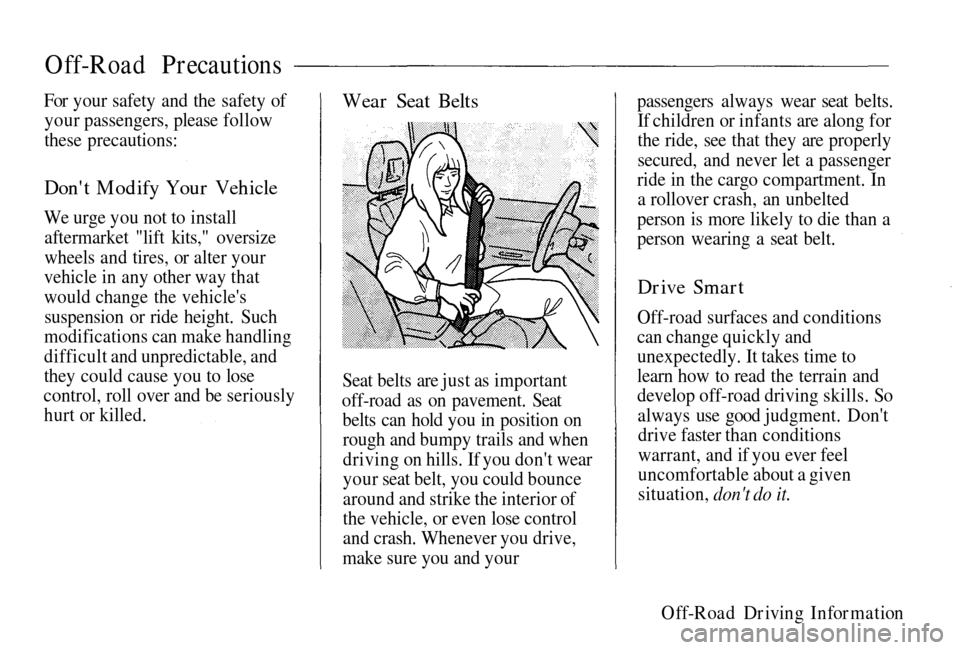
or killed. Wear Seat Belts
Seat belts are just as important
off-road as on pavement. Seat belts can hold you in position onrough
and bumpy trails and when
driving on hills. If you don't wear
your seat belt, you could bounce
around
and strike the interior of
the
vehicle, or even lose control
and crash. Whenever you drive,
make
sure you and your passengers always wear seat belts.
If
children or infants are along for
th
e ride, see that they are properly
secured,
and never let a passenger
ride in the cargo compartment. In a rollover crash, an unbelted
person
is more likely to die than a
person
wearing a seat belt.
Drive
Smart
Off-road surfaces and conditions
can change quickly and
unexpectedly.
It takes time to
learn
how to read the terrain and
develo
p off-road driving skills. So
always use good judgment. Don't drive faster than conditions
warrant,
and if you ever feel
uncomfortable about a given
situation,
don't do it. Off-Road Driving Information