mirror HUMMER H3 2007 User Guide
[x] Cancel search | Manufacturer: HUMMER, Model Year: 2007, Model line: H3, Model: HUMMER H3 2007Pages: 480, PDF Size: 2.73 MB
Page 248 of 480

Watch for traffic signs, pavement markings,
and lines. If you can see a sign up ahead
that might indicate a turn or an intersection,
delay your pass. A broken center line
usually indicates it is all right to pass, providing
the road ahead is clear. Never cross a solid
line on your side of the lane or a double solid
line, even if the road seems empty of
approaching traffic.
Do not get too close to the vehicle you want to
pass while you are awaiting an opportunity. For
one thing, following too closely reduces your
area of vision, especially if you are following a
larger vehicle. Also, you will not have adequate
space if the vehicle ahead suddenly slows or
stops. Keep back a reasonable distance.
When it looks like a chance to pass is coming
up, start to accelerate but stay in the right lane
and do not get too close. Time your move so
you will be increasing speed as the time comes
to move into the other lane. If the way is clear to
pass, you will have a running start that more
than makes up for the distance you would lose
by dropping back. And if something happens to
cause you to cancel your pass, you need only
slow down and drop back again and wait for
another opportunity.
If other vehicles are lined up to pass a slow
vehicle, wait your turn. But take care that
someone is not trying to pass you as you pull
out to pass the slow vehicle. Remember to
glance over your shoulder and check the
blind spot.
Check your vehicle’s mirrors, glance over your
shoulder, and start your left lane change signal
before moving out of the right lane to pass.
When you are far enough ahead of the passed
vehicle to see its front in your vehicle’s inside
mirror, activate the right lane change signal and
move back into the right lane. Remember that,
if your vehicle’s passenger side outside mirror is
convex, the vehicle you just passed may seem
to be farther away from you than it really is.
Try not to pass more than one vehicle at a time
on two-lane roads. Reconsider before passing
the next vehicle.
Do not overtake a slowly moving vehicle too
rapidly. Even though the brake lamps are not
ashing, it may be slowing down or starting
to turn.
If you are being passed, make it easy for the
following driver to get ahead of you. Perhaps
you can ease a little to the right.
248
Page 250 of 480
While driving on a surface with reduced traction,
try your best to avoid sudden steering, acceleration,
or braking, including reducing vehicle speed by
shifting to a lower gear. Any sudden changes could
cause the tires to slide. You may not realize the
surface is slippery until your vehicle is skidding.
Learn to recognize warning clues — such as
enough water, ice, or packed snow on the road to
make a mirrored surface — and slow down when
you have any doubt.
Remember: Any Anti-Lock Brake System (ABS)
helps avoid only the braking skid.
Off-Road Driving
This off-road guide is meant to provide advice
for when you drive your vehicle off paved roads.
Also, seeBraking on page 238.
Off-road driving can be great fun. But it does have
some denite hazards. The greatest of these is
the terrain itself.
“Off-roading” means you have left the great
North American road system behind. Traffic
lanes are not marked. Curves are not banked.There are no road signs. Surfaces can be slippery,
rough, uphill or downhill. In short, you have
gone right back to nature.
Off-road driving involves some new skills. And
that is why it is very important that you read
this guide. You will nd many driving tips and
suggestions. These will help make your off-road
driving safer and more enjoyable.
Before You Go Off-Roading
There are some things to do before you go out.
For example, be sure to have all necessary
maintenance and service work done. Check to
make sure all underbody shields are properly
attached. Make sure any equipment you
may need — rst aid kit, cell phone, ashlight,
etc. — is securely stored in the vehicle.
Be sure you read all the information about your
four-wheel-drive vehicle in this manual. Is
there enough fuel? Is the spare tire fully inated?
Are the uid levels up where they should be?
What are the local laws that apply to off-roading
where you will be driving? If you do not know, you
should check with law enforcement people in
the area. Will you be on someone’s private land?
If so, be sure to get the necessary permission.
250
Page 272 of 480

Driving at Night
Night driving is more dangerous than day driving.
One reason is that some drivers are likely to
be impaired — by alcohol or drugs, with night
vision problems, or by fatigue.
Here are some tips on night driving.
Drive defensively.
Do not drink and drive.
Adjust the inside rearview mirror to reduce
the glare from headlamps behind you.
Since you cannot see as well, you may need
to slow down and keep more space between
you and other vehicles.
Slow down, especially on higher speed roads.
Your vehicle’s headlamps can light up only
so much road ahead.
In remote areas, watch for animals.
If you are tired, pull off the road in a safe
place and rest.No one can see as well at night as in the daytime.
But as we get older these differences increase.
A 50-year-old driver may require at least twice as
much light to see the same thing at night as a
20-year-old.
What you do in the daytime can also affect your
night vision. For example, if you spend the
day in bright sunshine you are wise to wear
sunglasses. Your eyes will have less trouble
adjusting to night. But if you are driving, do not
wear sunglasses at night. They may cut down on
glare from headlamps, but they also make a
lot of things invisible.
You can be temporarily blinded by approaching
headlamps. It can take a second or two, or
even several seconds, for your eyes to re-adjust
to the dark. When you are faced with severe glare,
as from a driver who does not lower the high
beams, or a vehicle with misaimed headlamps,
slow down a little. Avoid staring directly into
the approaching headlamps.
272
Page 277 of 480
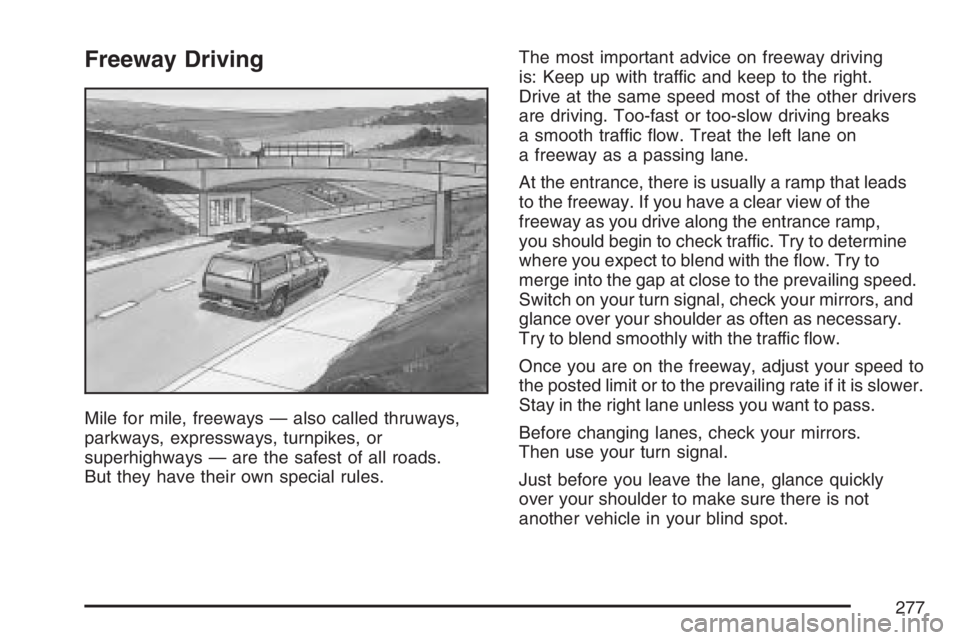
Freeway Driving
Mile for mile, freeways — also called thruways,
parkways, expressways, turnpikes, or
superhighways — are the safest of all roads.
But they have their own special rules.The most important advice on freeway driving
is: Keep up with traffic and keep to the right.
Drive at the same speed most of the other drivers
are driving. Too-fast or too-slow driving breaks
a smooth traffic ow. Treat the left lane on
a freeway as a passing lane.
At the entrance, there is usually a ramp that leads
to the freeway. If you have a clear view of the
freeway as you drive along the entrance ramp,
you should begin to check traffic. Try to determine
where you expect to blend with the ow. Try to
merge into the gap at close to the prevailing speed.
Switch on your turn signal, check your mirrors, and
glance over your shoulder as often as necessary.
Try to blend smoothly with the traffic ow.
Once you are on the freeway, adjust your speed to
the posted limit or to the prevailing rate if it is slower.
Stay in the right lane unless you want to pass.
Before changing lanes, check your mirrors.
Then use your turn signal.
Just before you leave the lane, glance quickly
over your shoulder to make sure there is not
another vehicle in your blind spot.
277
Page 279 of 480
Highway Hypnosis
Is there actually such a condition as highway
hypnosis? Or is it just plain falling asleep at the
wheel? Call it highway hypnosis, lack of
awareness, or whatever.
There is something about an easy stretch of road
with the same scenery, along with the hum of the
tires on the road, the drone of the engine, and the
rush of the wind against the vehicle that can make
you sleepy. Do not let it happen to you! If it does,
your vehicle can leave the road in less than a
second, and you could crash and be injured.
What can you do about highway hypnosis?
First, be aware that it can happen.
Then here are some tips:
Make sure your vehicle is well ventilated,
with a comfortably cool interior.
Keep your eyes moving. Scan the road
ahead and to the sides. Check your mirrors
and your instruments frequently.
If you get sleepy, pull off the road into a rest,
service, or parking area and take a nap, get
some exercise, or both. For safety, treat
drowsiness on the highway as an emergency.
Hill and Mountain Roads
Driving on steep hills or mountains is different
from driving in at or rolling terrain.
279
Page 304 of 480
Driving with a Trailer
Towing a trailer requires a certain amount of
experience. Before setting out for the open road,
you’ll want to get to know your rig. Acquaint
yourself with the feel of handling and braking with
the added weight of the trailer. And always
keep in mind that the vehicle you are driving is
now a good deal longer and not nearly as
responsive as your vehicle is by itself.
Before you start, check all trailer hitch parts and
attachments, safety chains, electrical connector,
lamps, tires and mirror adjustment. If the trailer has
electric brakes, start your vehicle and trailer moving
and then apply the trailer brake controller by hand
to be sure the brakes are working. This lets you
check your electrical connection at the same time.
During your trip, check occasionally to be sure
that the load is secure, and that the lamps and
any trailer brakes are still working.
Following Distance
Stay at least twice as far behind the vehicle ahead
as you would when driving your vehicle without
a trailer. This can help you avoid situations
that require heavy braking and sudden turns.
Passing
You’ll need more passing distance up ahead when
you’re towing a trailer. Because you’re a good
deal longer, you’ll need to go much farther beyond
the passed vehicle before you can return to
your lane.
Backing Up
Hold the bottom of the steering wheel with one
hand. Then, to move the trailer to the left, just move
that hand to the left. To move the trailer to the right,
move your hand to the right. Always back up slowly
and, if possible, have someone guide you.
Making Turns
Notice:Making very sharp turns while
trailering could cause the trailer to come in
contact with the vehicle. Your vehicle could
be damaged. Avoid making very sharp
turns while trailering.
When you’re turning with a trailer, make wider
turns than normal. Do this so your trailer
won’t strike soft shoulders, curbs, road signs,
trees or other objects. Avoid jerky or sudden
maneuvers. Signal well in advance.
304
Page 420 of 480

Fuse Usage
9 Sunroof, Front Washer Pump
10 Accessories (SPO)
11 Air Compressor
12 Transfer Case Control Module
13Radio, Heating, Ventilation,
Air Conditioning Display
14 Body Control Module
15 Rear Wiper Motor
16 Rear Wiper Pump Switch
17 Air Injection Reactor (AIR) Solenoid
18 Spare 6
19 Cluster
20 Rear Turn Signal, Hazard Signal
21 Powertrain Control Module 1
22Mass Air Flow Sensor,
Purge Solenoid
23 Injector
24 Fog Lamp
25 Powertrain Control Module B
26 Spare 4
27 Airbags
28 Back-up Lamps
29 Anti-lock Brakes, StabiliTrak
®
30 Rear Window Defogger
Fuse Usage
31 Canister Vent
32 Regulated Voltage Control VSense+
33 Ignition 1
34 Transmission
35 Cruise, Inside Rearview Mirror
36 Horn
37 Driver’s Side Rear Park Lamp
38 Amplier
39Reduced Intensity Low-Beam
Daytime Running Lamps
40 Passenger’s Side Headlamp
41 Driver’s Side Headlamp
42 Trailer Back-Up Lamp
43 Front Park Lamps
44 Air Injection Reactor (AIR) Solenoid
45 Auxiliary Power 2
46 Electronic Throttle Control
47 Oxygen Sensor
48 Air Conditioning Clutch
49 Passenger’s Side Rear Park Lamp
50 XM™ Satellite Radio
51 Auxiliary Power 1
52 StabiliTrak
®, Anti-lock Brakes
53 Power Heater Switch
420
Page 474 of 480

Light (cont.)
Security................................................... 190
StabiliTrak
®Not Ready............................. 184
Tire Pressure........................................... 185
Traction Off.............................................. 184
Up-Shift................................................... 181
Lighting
Exit.......................................................... 168
Loading Your Vehicle................................... 289
Locking Rear Axle....................................... 243
Lockout Protection......................................... 94
Locks
Door.......................................................... 92
Lockout Protection..................................... 94
Power Door............................................... 93
Programmable Automatic Door Locks......... 94
Loss of Control........................................... 249
Luggage Carrier.......................................... 144
Lumbar
Power Controls............................................ 9
M
Maintenance Schedule
Additional Required Services.................... 432
At Each Fuel Fill...................................... 436
At Least Once a Month............................ 436
At Least Once a Year.............................. 437Maintenance Schedule (cont.)
Introduction.............................................. 426
Maintenance Footnotes............................ 433
Maintenance Record................................ 444
Maintenance Requirements...................... 426
Normal Maintenance Replacement Parts.... 442
Owner Checks and Services.................... 435
Recommended Fluids and Lubricants....... 440
Scheduled Maintenance........................... 429
Using....................................................... 427
Your Vehicle and the Environment............ 427
Malfunction Indicator Light........................... 186
Manual Seats.................................................. 8
Manual Transmission
Fluid........................................................ 332
Operation................................................. 109
Message
DIC Warnings and Messages................... 196
Mirrors
Automatic Dimming Rearview with
Compass and Temperature Display....... 125
Automatic Dimming Rearview
with OnStar
®, Compass and
Temperature Display............................. 122
Outside Convex Mirror............................. 128
Outside Power Mirrors............................. 128
474
Page 475 of 480

MP3 ............................................................ 222
MyGMLink.com............................................ 451
N
Navigation/Radio System,
see Navigation Manual............................. 230
New Vehicle Break-In.................................. 101
Normal Maintenance Replacement Parts....... 442
O
Odometer.................................................... 176
Odometer, Trip............................................ 176
Off-Road Driving.......................................... 250
Off-Road Lamps.......................................... 166
Off-Road Recovery...................................... 247
Oil
Engine..................................................... 323
Pressure Light.......................................... 189
Oil, Engine Oil Life System......................... 326
Older Children, Restraints............................. 39
Online Owner Center................................... 451
OnStar
®System, see OnStar®Manual........ 129
Other Warning Devices................................ 154
Outlet Adjustment........................................ 173
Outlet(s), Accessory Power.......................... 169Outside
Convex Mirror.......................................... 128
Power Mirrors.......................................... 128
Owner Checks and Services....................... 435
Owners, Canadian.......................................... 3
P
Paint, Damage............................................ 413
Park (P)
Shifting Into............................................. 117
Shifting Out of......................................... 119
Parking
Brake....................................................... 116
Over Things That Burn............................ 119
Parking Your Vehicle................................... 119
Passenger Airbag Status Indicator............... 179
Passenger Sensing System........................... 75
Passing....................................................... 247
Passlock
®.................................................... 100
Power
Accessory Outlet(s).................................. 169
Door Locks................................................ 93
Electrical System..................................... 417
Lumbar Controls.......................................... 9
Retained Accessory (RAP)....................... 103
Seat............................................................ 9
475
Page 476 of 480

Power (cont.)
Steering Fluid.......................................... 345
Windows.................................................... 97
Pretensioners, Safety Belt............................. 38
Programmable Automatic Door Locks............ 94
Q
Questions and Answers About
Safety Belts............................................... 21
R
Radiator Pressure Cap................................ 338
Radios........................................................ 201
Care of Your CD Player........................... 232
Care of Your CDs.................................... 231
Navigation/Radio System,
see Navigation Manual......................... 230
Radio with CD......................................... 203
Radio with Six-Disc CD............................ 211
Setting the Time...................................... 202
Theft-Deterrent......................................... 230
Understanding Reception......................... 230
Reading Lamps........................................... 168Rear Axle.................................................... 357
Locking.................................................... 243
Rear Safety Belt Comfort Guides.................. 35
Rear Seat Passengers, Safety Belts.............. 32
Rear Storage Area...................................... 146
Rear Windshield Washer/Wiper.................... 159
Rearview Mirror, Automatic Dimming with
Compass and Temperature Display.......... 125
Rearview Mirror, Automatic Dimming
with OnStar
®, Compass and
Temperature Display................................ 122
Reclining Seatbacks...................................... 10
Recommended Fluids and Lubricants.......... 440
Recovery Loops.......................................... 287
Recreational Vehicle Towing........................ 295
Remote Keyless Entry (RKE) System............ 88
Remote Keyless Entry (RKE)
System, Operation..................................... 89
Removing the Flat Tire and Installing
the Spare Tire.......................................... 396
Removing the Spare Tire and Tools............ 393
Replacement Bulbs..................................... 365
Reporting Safety Defects
Canadian Government............................. 464
General Motors........................................ 464
United States Government....................... 464
476