lock HUMMER H3 2009 Manual Online
[x] Cancel search | Manufacturer: HUMMER, Model Year: 2009, Model line: H3, Model: HUMMER H3 2009Pages: 382, PDF Size: 1.99 MB
Page 200 of 382
For mounds, washouts, loose
up-hill slopes, ditches, etc.
When wheel spin occurs as the
vehicle is moving, the driver may
notice a slight shaking or shuddering
of the vehicle. This should be
stopped as soon as possible to
prevent damage to vehicle
components. This is the indication
that a loss of traction is occurring on
this terrain. The operator should:
1. Reduce speed and apply
the brakes.
2. Assess the terrain properly and
adjust vehicle speed and gear
ranges accordingly: Four-Wheel
High position for higher speeds
and Four-Wheel-Low Lock
for more torque and lower
speeds. Transmission 1 (First)
gear is generally recommended.3. Apply slight pressure to the
brake when the shaking or
shuddering sensation is felt,
keeping the vehicle moving in a
controlled manner.
4. Be prepared to alternate between
braking and accelerating through
the adverse terrain.
Getting Familiar with Off-Road
Driving
It is a good idea to practice in an
area that is safe and close to home
before you go into the wilderness.
Off-roading requires some new
and different skills.
Tune your senses to different
kinds of signals. Your eyes need
to constantly sweep the terrain
for unexpected obstacles. Your ears
need to listen for unusual tire or
engine sounds. Use your arms,
hands, feet, and body to respond to
vibrations and vehicle bounce.Controlling the vehicle is the key to
successful off-road driving. One of
the best ways to control the
vehicle is to control the speed.
At higher speeds:
You approach things faster and
have less time to react.
There is less time to scan the
terrain for obstacles.
The vehicle has more bounce
when driving over obstacles.
More braking distance is needed,
especially on an unpaved surface.
{CAUTION
When you are driving off-road,
bouncing and quick changes in
direction can easily throw you
out of position. This could cause
you to lose control and crash.
So, whether you are driving
on or off the road, you and
your passengers should wear
safety belts.
4-18 Driving Your Vehicle
Page 202 of 382
For very large dips, ditches or
small washes, coast in, using the
engine as a brake (transmission
and transfer case lowest gears).
Then, use the low ranges in
the transmission and transfer case
to power out.
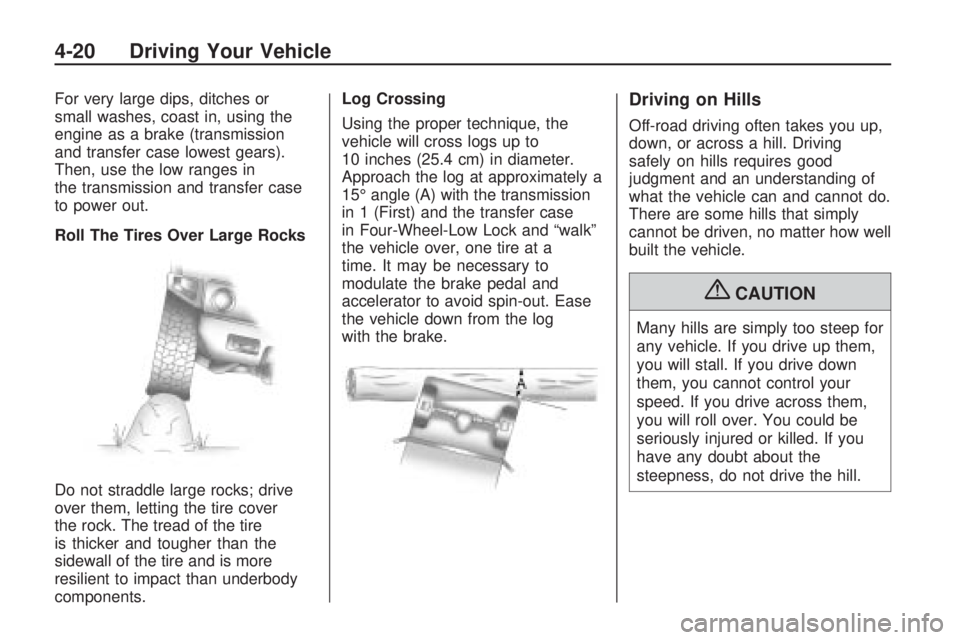
Roll The Tires Over Large Rocks
Do not straddle large rocks; drive
over them, letting the tire cover
the rock. The tread of the tire
is thicker and tougher than the
sidewall of the tire and is more
resilient to impact than underbody
components.Log Crossing
Using the proper technique, the
vehicle will cross logs up to
10 inches (25.4 cm) in diameter.
Approach the log at approximately a
15° angle (A) with the transmission
in 1 (First) and the transfer case
in Four-Wheel-Low Lock and “walk”
the vehicle over, one tire at a
time. It may be necessary to
modulate the brake pedal and
accelerator to avoid spin-out. Ease
the vehicle down from the log
with the brake.Driving on Hills
Off-road driving often takes you up,
down, or across a hill. Driving
safely on hills requires good
judgment and an understanding of
what the vehicle can and cannot do.
There are some hills that simply
cannot be driven, no matter how well
built the vehicle.
{CAUTION
Many hills are simply too steep for
any vehicle. If you drive up them,
you will stall. If you drive down
them, you cannot control your
speed. If you drive across them,
you will roll over. You could be
seriously injured or killed. If you
have any doubt about the
steepness, do not drive the hill.
4-20 Driving Your Vehicle
Page 203 of 382
Approaching a Hill
When you approach a hill, decide
if it is too steep to climb, descend, or
cross. Steepness can be hard to
judge. On a very small hill, for
example, there may be a smooth,
constant incline with only a
small change in elevation where
you can easily see all the way to the
top. On a large hill, the incline
may get steeper as you near the
top, but you might not see this
because the crest of the hill
is hidden by bushes, grass, or
shrubs.
Consider this as you approach
a hill:
Is there a constant incline, or
does the hill get sharply
steeper in places?
Is there good traction on the
hillside, or will the surface
cause tire slipping?
Is there a straight path up or
down the hill so you will not have
to make turning maneuvers?
Are there obstructions on the hill
that can block your path, such
as boulders, trees, logs, or ruts?
What is beyond the hill? Is there
a cliff, an embankment, a
drop-off, a fence? Get out and
walk the hill if you do not know. It
is the smart way to nd out.
Is the hill simply too rough?
Steep hills often have ruts,
gullies, troughs, and exposed
rocks because they are
more susceptible to the effects
of erosion.
See “Hill Start Assist” underBraking
on page 4-3for information on
vehicles stopped on a grade.
Driving Uphill
Once you decide it is safe to drive
up the hill:
Use transmission and transfer
case low gear and get a rm
grip on the steering wheel.
Get a smooth start up the hill
and try to maintain speed.
Not using more power than
needed can avoid spinning the
wheels or sliding.
Let the traction system work to
control any wheel slippage.
The traction control system
allows for moderate wheel spin
with some capability to dig in and
power up the hill.
Driving Your Vehicle 4-21
Page 205 of 382
While backing down the hill, put
your left hand on the steering
wheel at the 12 o’clock position
so you can tell if the wheels
are straight and can maneuver
as you back down. It is best
to back down the hill with
the wheels straight rather than
in the left or right direction.
Turning the wheel too far to the
left or right will increase the
possibility of a rollover.
Things not to do if the vehicle stalls,
or is about to stall, when going
up a hill:
Never attempt to prevent a stall
by shifting into N (Neutral) to
rev-up the engine and regain
forward momentum. This will
not work. The vehicle can
roll backward very quickly and
could go out of control.
Never try to turn around if about
to stall when going up a hill. If
the hill is steep enough to
stall the vehicle, it is steep
enough to cause it to roll over. If
you cannot make it up the hill,
back straight down the hill.
If, after stalling, you try to back
down the hill and decide you just
cannot do it, set the parking brake.
If the vehicle has an automatic
transmission, shift to P (Park). Turn
off the engine. Leave the vehicle
and go get some help. Exit on
the uphill side and stay clear of the
path the vehicle would take if it
rolled downhill. Do not shift
the transfer case to Neutral when
you leave the vehicle. Leave it
in some gear.{CAUTION
Shifting the transfer case to
Neutral can cause your vehicle to
roll even if the transmission is in
P (Park). This is because the
Neutral position on the transfer
case overrides the transmission.
You or someone else could be
injured. If you are going to leave
your vehicle, set the parking
brake and shift the transmission
to P (Park). But do not shift the
transfer case to Neutral.
Driving Your Vehicle 4-23
Page 213 of 382
{CAUTION
Coasting downhill in N (Neutral)
or with the ignition off is
dangerous. The brakes will have
to do all the work of slowing down
and they could get so hot that
they would not work well. You
would then have poor braking or
even none going down a hill. You
could crash. Always have the
engine running and the vehicle in
gear when going downhill.
Stay in your own lane. Do not
swing wide or cut across the
center of the road. Drive at
speeds that let you stay in your
own lane.
Top of hills: Be alert — something
could be in your lane (stalled car,
accident).
Pay attention to special road
signs (falling rocks area, winding
roads, long grades, passing or
no-passing zones) and take
appropriate action.
SeeOff-Road Driving on page 4-13
for information about driving
off-road.
Winter Driving
Driving on Snow or Ice
Drive carefully when there is snow
or ice between the tires and the
road, creating less traction or grip.
Wet ice can occur at about 32°F
(0°C) when freezing rain begins to
fall, resulting in even less traction.
Avoid driving on wet ice or in
freezing rain until roads can be
treated with salt or sand.
Drive with caution, whatever the
condition. Accelerate gently
so traction is not lost. Accelerating
too quickly causes the wheelsto spin and makes the surface
under the tires slick, so there is even
less traction.
Try not to break the fragile traction. If
you accelerate too fast, the drive
wheels will spin and polish the
surface under the tires even more.
TheTraction Control System (TCS)
on page 4-7improves the ability
to accelerate on slippery roads, but
slow down and adjust your driving
to the road conditions. When driving
through deep snow, turn off the
traction control system to help
maintain vehicle motion at lower
speeds.
TheAntilock Brake System (ABS)
on page 4-5improves vehicle
stability during hard stops on a
slippery roads, but apply the brakes
sooner than when on dry pavement.
Driving Your Vehicle 4-31
Page 214 of 382
Allow greater following distance on
any slippery road and watch for
slippery spots. Icy patches
can occur on otherwise clear roads
in shaded areas. The surface of
a curve or an overpass can remain
icy when the surrounding roads
are clear. Avoid sudden steering
maneuvers and braking while on ice.
Turn off cruise control, if equipped,
on slippery surfaces.
Blizzard Conditions
Being stuck in snow can be in a
serious situation. Stay with the
vehicle unless there is help nearby.
If possible, use theRoadside
Service on page 7-6. To get help
and keep everyone in the vehicle
safe:
Turn on theHazard Warning
Flashers on page 3-5.
Tie a red cloth to an outside
mirror.
{CAUTION
Snow can trap engine exhaust
under the vehicle. This may cause
exhaust gases to get inside.
Engine exhaust contains carbon
monoxide (CO) which cannot be
seen or smelled. It can cause
unconsciousness and even death.
If the vehicle is stuck in the snow:
Clear away snow from
around the base of your
vehicle, especially any that is
blocking the exhaust pipe.
Check again from time to
time to be sure snow does
not collect there.
Open a window about two
inches (5 cm) on the side of
the vehicle that is away from
the wind to bring in fresh air.
Fully open the air outlets on
or under the instrument
panel.
(Continued)
CAUTION (Continued)
Adjust the Climate Control
system to a setting that
circulates the air inside the
vehicle and set the fan speed
to the highest setting. See
Climate Control System in the
Index.
For more information about
carbon monoxide, seeEngine
Exhaust on page 2-31.
Snow can trap exhaust gases
under your vehicle. This can
cause deadly CO (carbon
monoxide) gas to get inside. CO
could overcome you and kill you.
You cannot see it or smell it, so
you might not know it is in your
vehicle. Clear away snow from
around the base of your vehicle,
especially any that is blocking the
exhaust.
4-32 Driving Your Vehicle
Page 234 of 382
The trailer towing harness contains
the following seven trailer circuits:
Yellow: Left Stop/Turn Signal
Dark Green: Right Stop/Turn
Signal
Brown: Taillamps
White: Ground
Light Green: Back-up Lamps
Red: Battery Feed
Dark Blue: Trailer Brake
If charging a remote (non-vehicle)
battery, turn on the headlamps
to boost the vehicle system voltage
to properly charge the battery.Four-Wire Harness Adapter
If towing a light-duty trailer with a
standard four-way, at pin
connector, an adapter is available
from your dealer/retailer.
Hold the adapter with the tab
pointing up.Connect the adapter to the
seven-pin universal heavy-duty
trailer connector attached to
the bracket on the hitch platform.
The ip cap on the vehicle’s harness
locks onto the tab and helps hold
the adapter in place. Plug the
four-way pin connector onto the
adapter.
4-52 Driving Your Vehicle
Page 239 of 382
Electrical System
Add-On Electrical
Equipment.......................5-91
Windshield Wiper Fuses. . . .5-91
Power Windows and
Other Power Options.......5-91
Fuses and Circuit
Breakers.........................5-91
Engine Compartment
Fuse Block......................5-92
Capacities and
Specications
Capacities and
Specications..................5-96
Service
For service and parts needs, visit
your dealer/retailer. You will receive
genuine GM parts and GM-trained
and supported service people.
Genuine GM parts have one
of these marks:
Accessories and
Modications
When non-dealer/non-retailer
accessories are added to the
vehicle, they can affect vehicle
performance and safety, including
such things as airbags, braking,
stability, ride and handling,
emissions systems, aerodynamics,
durability, and electronic systems
like antilock brakes, traction control,
and stability control. Some of
these accessories could even cause
malfunction or damage not
covered by the vehicle warranty.
Damage to vehicle components
resulting from the installation or use
of non-GM certied parts, including
control module modications,
are not covered under the terms of
the vehicle warranty and may
affect remaining warranty coverage
for affected parts.
Service and Appearance Care 5-3
Page 243 of 382
of the emission control system could
be affected. The malfunction
indicator lamp might turn on. If this
occurs, return to your dealer/retailer
for service.
Fuels in Foreign
Countries
If you plan on driving in another
country outside the United States or
Canada, the proper fuel might be
hard to nd. Never use leaded
gasoline or any other fuel not
recommended in the previous text
on fuel. Costly repairs caused
by use of improper fuel would not
be covered by the vehicle warranty.
To check the fuel availability, ask an
auto club, or contact a major oil
company that does business in the
country where you will be driving.
Filling the Tank
{CAUTION
Fuel vapor burns violently and a
fuel re can cause bad injuries.
To help avoid injuries to you and
others, read and follow all the
instructions on the pump island.
Turn off the engine when you are
refueling. Do not smoke if you are
near fuel or refueling the vehicle.
Do not use cellular phones. Keep
sparks, ames, and smoking
materials away from fuel. Do not
leave the fuel pump unattended
when refueling the vehicle. This is
against the law in some places.
Do not re-enter the vehicle while
pumping fuel. Keep children away
from the fuel pump; never let
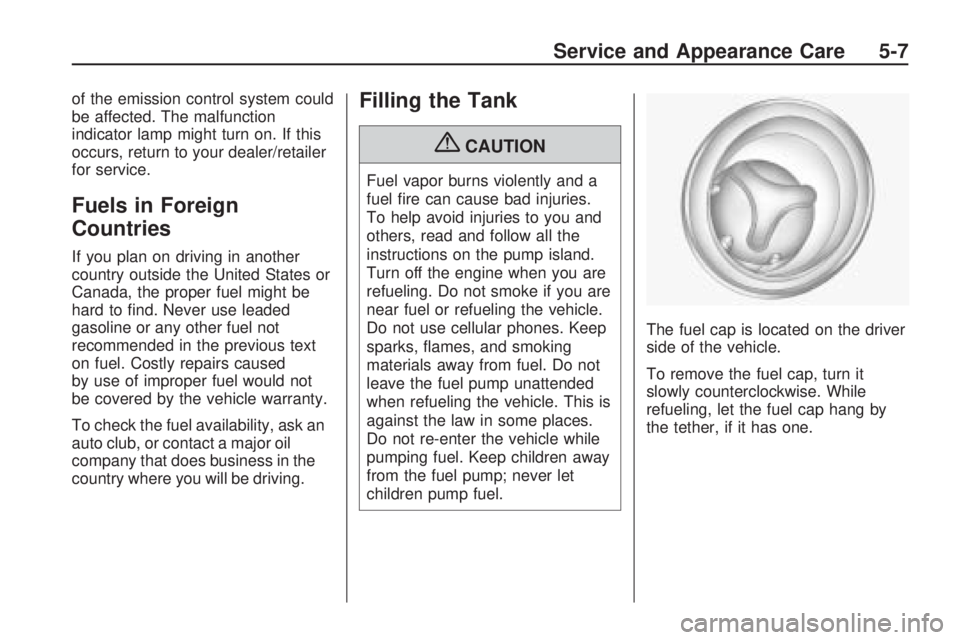
children pump fuel.The fuel cap is located on the driver
side of the vehicle.
To remove the fuel cap, turn it
slowly counterclockwise. While
refueling, let the fuel cap hang by
the tether, if it has one.
Service and Appearance Care 5-7
Page 244 of 382
{CAUTION
Fuel can spray out on you if you
open the fuel cap too quickly.
If you spill fuel and then
something ignites it, you could
be badly burned. This spray can
happen if the tank is nearly full,
and is more likely in hot weather.
Open the fuel cap slowly and wait
for any hiss noise to stop. Then
unscrew the cap all the way.
Be careful not to spill fuel. Do not
top off or overll the tank and wait
a few seconds after you have
nished pumping before removing
the nozzle. Clean fuel from
painted surfaces as soon as
possible. SeeWashing Your
Vehicle on page 5-86.When replacing the fuel cap,
turn it clockwise until it clicks.
Make sure the cap is fully
installed. The diagnostic system
can determine if the fuel cap
has been left off or improperly
installed. This would allow fuel to
evaporate into the atmosphere.
SeeMalfunction Indicator Lamp
on page 3-30.
The FUEL CAP message displays
on the Driver Information Center
(DIC) if the fuel cap is not properly
installed. SeeDIC Warnings
and Messages on page 3-37for
more information.
{CAUTION
If a re starts while you are
refueling, do not remove the
nozzle. Shut off the ow of fuel
by shutting off the pump or by
notifying the station attendant.
Leave the area immediately.Notice:If you need a new fuel
cap, be sure to get the right type.
Your dealer/retailer can get one
for you. If you get the wrong type,
it may not t properly. This may
cause the malfunction indicator
lamp to light and may damage the
fuel tank and emissions system.
SeeMalfunction Indicator
Lamp on page 3-30.
Filling a Portable Fuel
Container
{CAUTION
Never ll a portable fuel container
while it is in the vehicle. Static
electricity discharge from the
container can ignite the fuel
(Continued)
5-8 Service and Appearance Care