parking brake Hyundai Azera 2017 User Guide
[x] Cancel search | Manufacturer: HYUNDAI, Model Year: 2017, Model line: Azera, Model: Hyundai Azera 2017Pages: 520, PDF Size: 16.33 MB
Page 315 of 520
511
Driving your vehicle
For smooth operation, depress thebrake pedal when shifting from N(Neutral) to a forward or reverse gear.
When stopped on an upgrade, do not
hold the vehicle with engine power.
Use the service brake or the parking
brake.
Transaxle ranges
The indicator in the instrument clus-
ter displays the shift lever position
when the ignition switch is in the ON
position.
P (Park)
Always come to a complete stop
before shifting into P (Park). This
position locks the transaxle and pre-
vents the drive wheels from rotating.
WARNING- Automatic
transaxle
Before leaving the driver’s seat,
always make sure the shift lever
is in the P (Park) position; then
set the parking brake fully and
shut the engine off. Always
make sure the shift lever is
latched in the P (Park) position
and set the parking brake fully.
Unexpected and sudden vehicle
movement can occur if these
precautions are not followed,
which could result in serious
injury or death.
CAUTION - Transaxle
To avoid damage to your transaxle, do not acceleratethe engine in R (Reverse) orany forward gear position withthe brakes on.
The transaxle may be dam- aged if you shift into P (Park)while the vehicle is in motion.
WARNING
Shifting into P (Park) while the vehicle is in motion will cause
the drive wheels to lock which
will cause you to lose control
of the vehicle.
Do not use the P (Park) posi- tion in place of the parking
brake. Always make sure the
shift lever is latched in the P
(Park) position and set the
parking brake fully.
Never leave a child unattend- ed in a vehicle.
Page 316 of 520
Driving your vehicle
12
5
R (Reverse)
Use this position to drive the vehicle
backward. N (Neutral)
The wheels and transaxle are not
engaged. The vehicle will roll freely
even on the slightest incline unless
the parking brake or service brakes
are applied.
D (Drive)
This is the normal forward driving
position. The transaxle will automati-
cally shift through a 6-gear
sequence, providing the best fuel
economy and power.
For extra power when passing anoth-
er vehicle or climbing grades,
depress the accelerator pedal fully
(more than 80%) until the kick down
switch operates with a clicking noise,
at which time the transaxle will auto-
matically downshift to the next lower
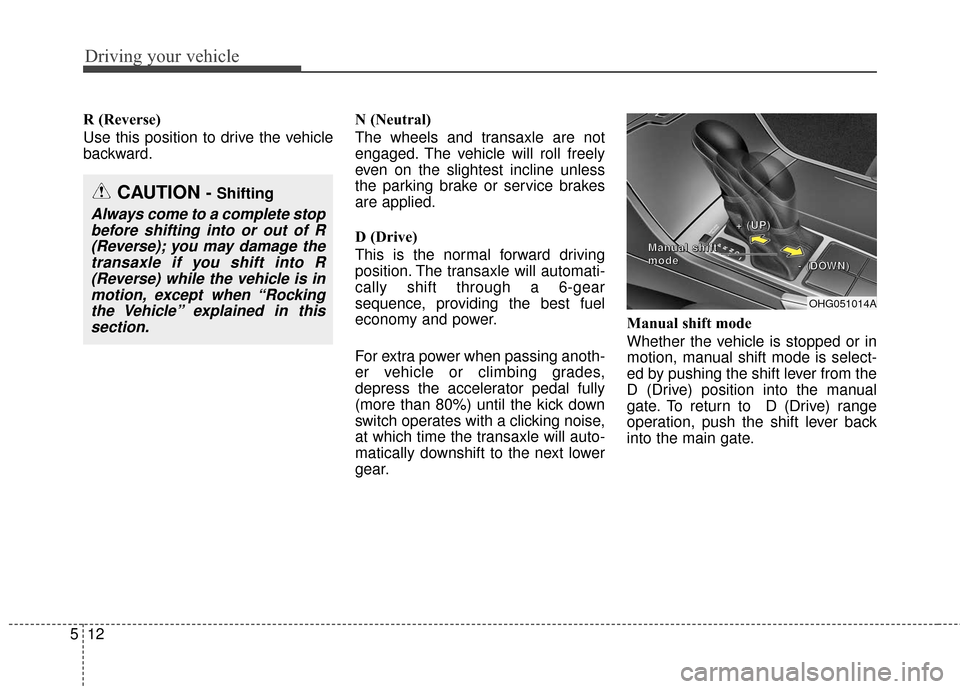
gear.Manual shift mode
Whether the vehicle is stopped or in
motion, manual shift mode is select-
ed by pushing the shift lever from the
D (Drive) position into the manual
gate. To return to D (Drive) range
operation, push the shift lever back
into the main gate.
OHG051014A
+
+
+
+
(
(
(
(
U
U
U
U
P
P
P
P
)
)
)
)
-
-
-
-
(
(
(
(
D
D
D
D
O
O
O
O
W
W
W
W
N
N
N
N
)
)
)
)
M
M
M
M
a
a
a
a
n
n
n
n
u
u
u
u
a
a
a
a
l
l
l
l
s
s
s
s
h
h
h
h
i
i
i
i
f
f
f
f
t
t
t
t
m
m
m
m
o
o
o
o
d
d
d
d
e
e
e
e
CAUTION - Shifting
Always come to a complete stop
before shifting into or out of R(Reverse); you may damage thetransaxle if you shift into R(Reverse) while the vehicle is inmotion, except when “Rockingthe Vehicle” explained in thissection.
Page 318 of 520
Driving your vehicle
14
5
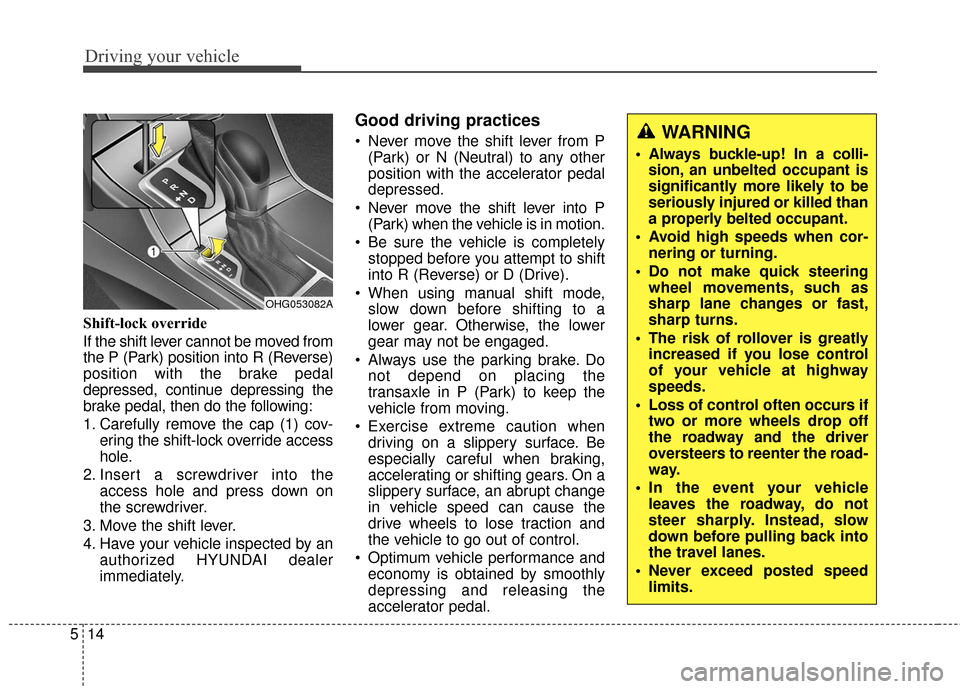
Shift-lock override
If the shift lever cannot be moved from
the P (Park) position into R (Reverse)
position with the brake pedal
depressed, continue depressing the
brake pedal, then do the following:
1. Carefully remove the cap (1) cov-
ering the shift-lock override access
hole.
2. Insert a screwdriver into the access hole and press down on
the screwdriver.
3. Move the shift lever.
4. Have your vehicle inspected by an authorized HYUNDAI dealer
immediately.
Good driving practices
Never move the shift lever from P(Park) or N (Neutral) to any other
position with the accelerator pedal
depressed.
Never move the shift lever into P (Park) when the vehicle is in motion.
Be sure the vehicle is completely stopped before you attempt to shift
into R (Reverse) or D (Drive).
When using manual shift mode, slow down before shifting to a
lower gear. Otherwise, the lower
gear may not be engaged.
Always use the parking brake. Do not depend on placing the
transaxle in P (Park) to keep the
vehicle from moving.
Exercise extreme caution when driving on a slippery surface. Be
especially careful when braking,
accelerating or shifting gears. On a
slippery surface, an abrupt change
in vehicle speed can cause the
drive wheels to lose traction and
the vehicle to go out of control.
Optimum vehicle performance and economy is obtained by smoothly
depressing and releasing the
accelerator pedal.
OHG053082A
WARNING
Always buckle-up! In a colli-sion, an unbelted occupant is
significantly more likely to be
seriously injured or killed than
a properly belted occupant.
Avoid high speeds when cor- nering or turning.
Do not make quick steering wheel movements, such as
sharp lane changes or fast,
sharp turns.
The risk of rollover is greatly increased if you lose control
of your vehicle at highway
speeds.
Loss of control often occurs if two or more wheels drop off
the roadway and the driver
oversteers to reenter the road-
way.
In the event your vehicle leaves the roadway, do not
steer sharply. Instead, slow
down before pulling back into
the travel lanes.
Never exceed posted speed limits.
Page 319 of 520
515
Driving your vehicle
Moving up a steep grade from astanding start
To move up a steep grade from a
standing start, depress the brake
pedal, move the shift lever to D
(Drive) and release the parking
brake. Depress the accelerator pedal
gradually while releasing the service
brakes.
WARNING
If your vehicle becomes stuck in
snow, mud, sand, etc., then you
may attempt to rock the vehicle
free by moving it forward and
backward. Do not attempt this
procedure if people or objects
are anywhere near the vehicle.
During the rocking operation
the vehicle may suddenly move
forward or backward as it
becomes unstuck, causing
injury or damage to nearby peo-
ple or objects.
Page 321 of 520
517
Driving your vehicle
In the event of brake failure
If service brakes fail to operate while
the vehicle is in motion, you can
make an emergency stop with the
parking brake. The stopping dis-
tance, however, will be much greater
than normal.
Disc brakes wear indicator
When your brake pads are worn and
new pads are required, you may hear
a high-pitched warning sound from
your front brakes or rear brakes. You
may hear this sound come and go or
it may occur whenever you depress
the brake pedal.
Please remember that some driving
conditions or climates may cause a
brake squeal when you first apply (or
lightly apply) the brakes. This is nor-
mal and does not indicate a problem
with your brakes.
Always replace the front or rear
brake pads as pairs.
WARNING - Parking brake
Avoid applying the parking
brake to stop the vehicle while it
is moving except in an emer-
gency situation. Applying the
parking brake while the vehicle
is moving at normal speeds can
cause a sudden loss of control
of the vehicle. If you must use
the parking brake to stop the
vehicle, use great caution in
applying the brake.
CAUTION - Replace brake
pads
Do not continue to drive with worn brake pads. Continuing todrive with worn brake pads candamage the braking system andresult in costly brake repairs.
WARNING - Brake wear
Do not ignore high pitch wear
sounds from your brakes. If you
ignore this audible warning, you
will eventually lose braking per-
formance, which could lead to a
serious accident.
Page 322 of 520
Driving your vehicle
18
5
Parking brake
Applying the parking brake
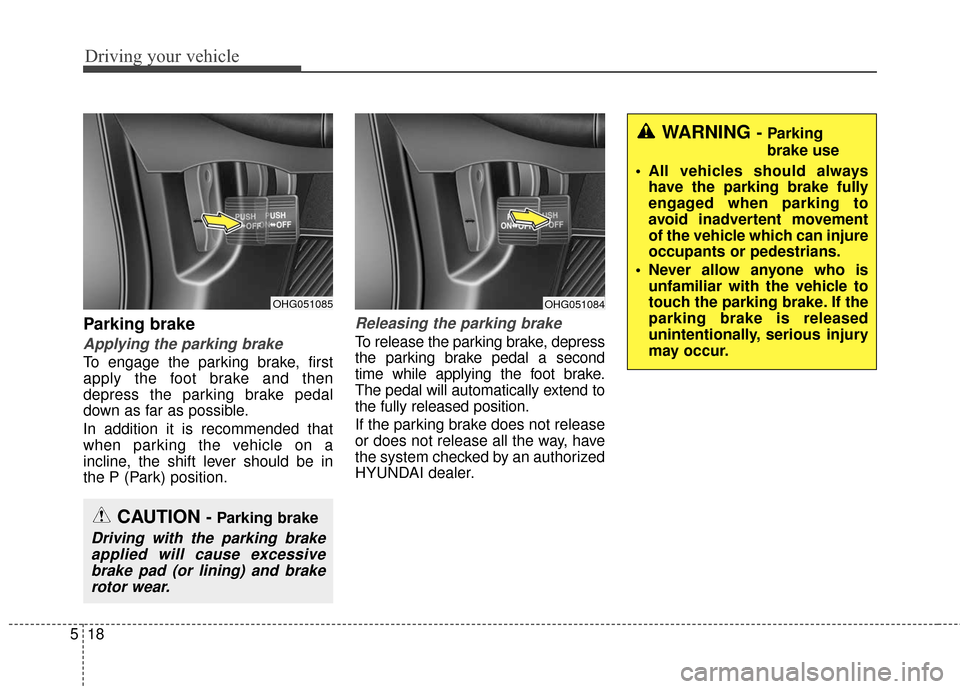
To engage the parking brake, first
apply the foot brake and then
depress the parking brake pedal
down as far as possible.
In addition it is recommended that
when parking the vehicle on a
incline, the shift lever should be in
the P (Park) position.
Releasing the parking brake
To release the parking brake, depress
the parking brake pedal a second
time while applying the foot brake.
The pedal will automatically extend to
the fully released position.
If the parking brake does not release
or does not release all the way, have
the system checked by an authorized
HYUNDAI dealer.
OHG051085
CAUTION - Parking brake
Driving with the parking brake
applied will cause excessivebrake pad (or lining) and brakerotor wear.
OHG051084
WARNING - Parking
brake use
All vehicles should always have the parking brake fully
engaged when parking to
avoid inadvertent movement
of the vehicle which can injure
occupants or pedestrians.
Never allow anyone who is unfamiliar with the vehicle to
touch the parking brake. If the
parking brake is released
unintentionally, serious injury
may occur.
Page 323 of 520
519
Driving your vehicle
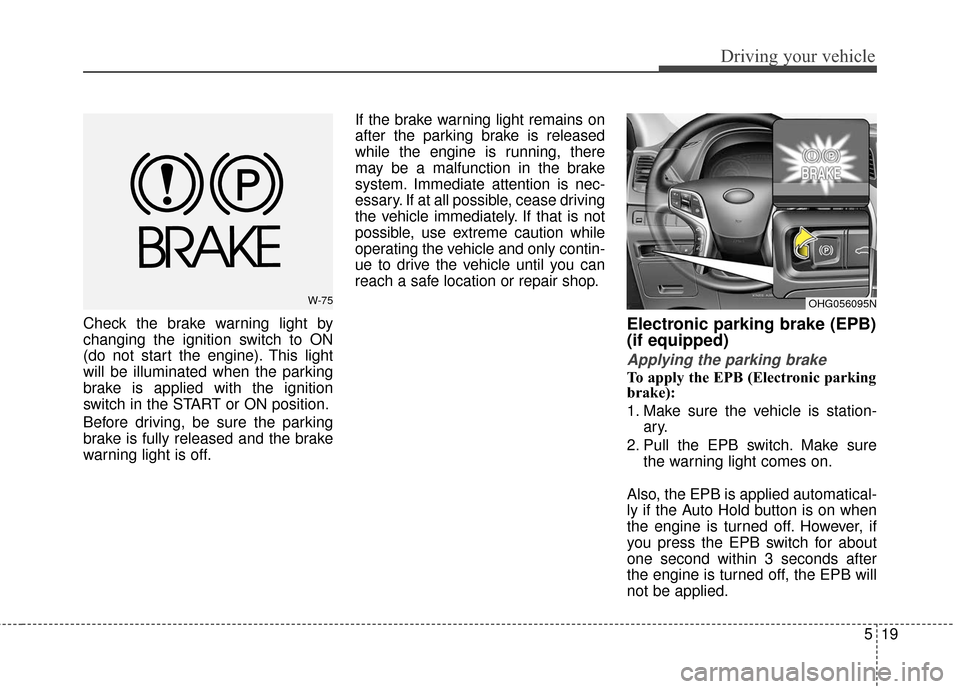
Check the brake warning light by
changing the ignition switch to ON
(do not start the engine). This light
will be illuminated when the parking
brake is applied with the ignition
switch in the START or ON position.
Before driving, be sure the parking
brake is fully released and the brake
warning light is off.If the brake warning light remains on
after the parking brake is released
while the engine is running, there
may be a malfunction in the brake
system. Immediate attention is nec-
essary. If at all possible, cease driving
the vehicle immediately. If that is not
possible, use extreme caution while
operating the vehicle and only contin-
ue to drive the vehicle until you can
reach a safe location or repair shop.Electronic parking brake (EPB)
(if equipped)
Applying the parking brake
To apply the EPB (Electronic parking
brake):
1. Make sure the vehicle is station-
ary.
2. Pull the EPB switch. Make sure the warning light comes on.
Also, the EPB is applied automatical-
ly if the Auto Hold button is on when
the engine is turned off. However, if
you press the EPB switch for about
one second within 3 seconds after
the engine is turned off, the EPB will
not be applied.
W-75OHG056095N
Page 324 of 520
Driving your vehicle
20
5
Releasing the parking brake
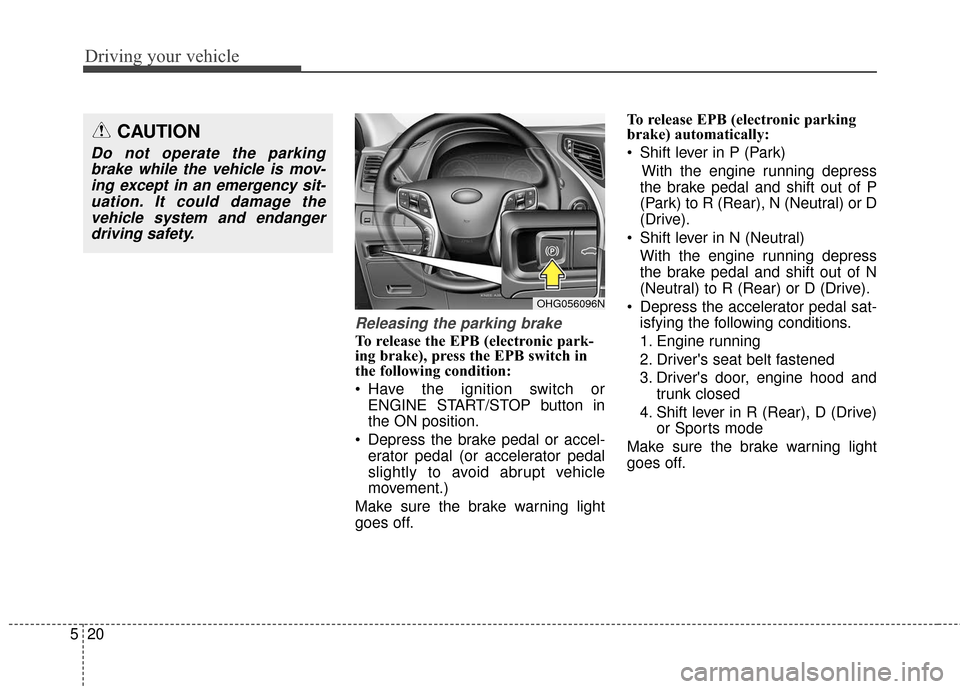
To release the EPB (electronic park-
ing brake), press the EPB switch in
the following condition:
Have the ignition switch or
ENGINE START/STOP button in
the ON position.
Depress the brake pedal or accel- erator pedal (or accelerator pedal
slightly to avoid abrupt vehicle
movement.)
Make sure the brake warning light
goes off. To release EPB (electronic parking
brake) automatically:
Shift lever in P (Park)
With the engine running depress
the brake pedal and shift out of P
(Park) to R (Rear), N (Neutral) or D
(Drive).
Shift lever in N (Neutral) With the engine running depress
the brake pedal and shift out of N
(Neutral) to R (Rear) or D (Drive).
Depress the accelerator pedal sat- isfying the following conditions.
1. Engine running
2. Driver's seat belt fastened
3. Driver's door, engine hood and trunk closed
4. Shift lever in R (Rear), D (Drive) or Sports mode
Make sure the brake warning light
goes off.
CAUTION
Do not operate the parking brake while the vehicle is mov-ing except in an emergency sit-uation. It could damage thevehicle system and endangerdriving safety.
OHG056096N
Page 325 of 520
521
Driving your vehicle
✽
✽NOTICE
• For your safety, you can engage
the EPB even though the ignition
switch or ENGINE STOP/START
button is in the OFF position, but
you cannot release it.
• For your safety, depress the brake pedal and release the parking
brake manually with the EPB
switch when you drive downhill or
when backing up the vehicle.
When the EPB (Electronic Parking
Brake) does not release:
We recommend that you contact an
authorized HYUNDAI dealer by load-
ing the vehicle on a flatbed tow truck
and have the system checked.
EPB (Electronic Parking Brake) may
be automatically applied when:
The rear brake is overheated
Requested by other systems
The engine is turned off with the
EPB applied
✽ ✽ NOTICE
If the driver turns the engine off
while Auto Hold is operating, EPB
will be automatically applied.
However, if you press the EPB
switch for about one second within 3
seconds after the engine is turned
off, the EPB will not be applied.
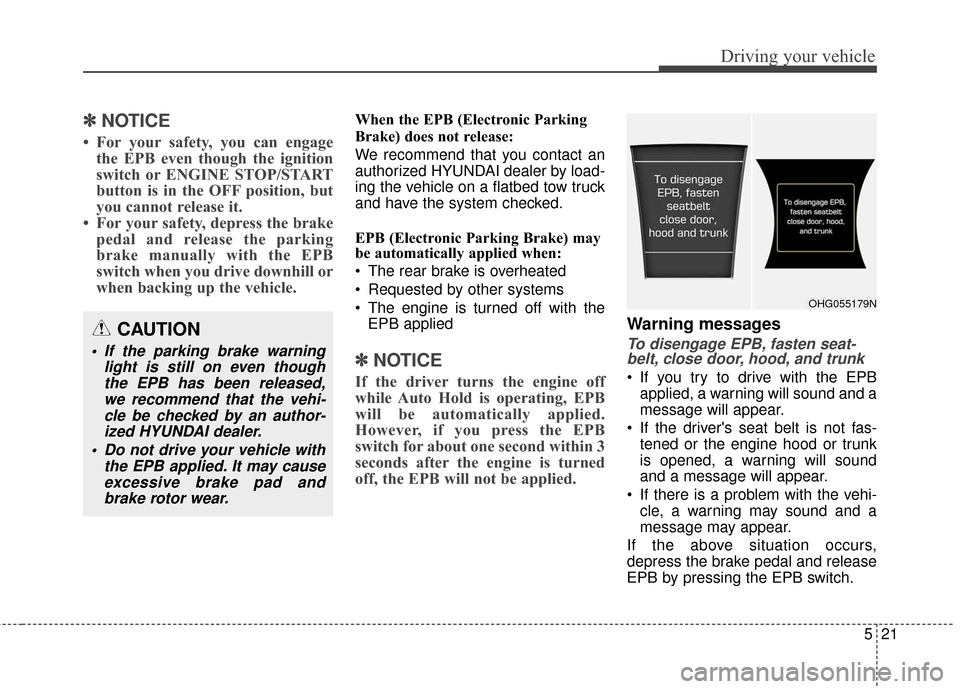
Warning messages
To disengage EPB, fasten seat-
belt, close door, hood, and trunk
If you try to drive with the EPB
applied, a warning will sound and a
message will appear.
If the driver's seat belt is not fas- tened or the engine hood or trunk
is opened, a warning will sound
and a message will appear.
If there is a problem with the vehi- cle, a warning may sound and a
message may appear.
If the above situation occurs,
depress the brake pedal and release
EPB by pressing the EPB switch.
CAUTION
If the parking brake warning light is still on even thoughthe EPB has been released,we recommend that the vehi-cle be checked by an author-ized HYUNDAI dealer.
Do not drive your vehicle with the EPB applied. It may causeexcessive brake pad andbrake rotor wear.
OHG055179N
Page 326 of 520
Driving your vehicle
22
5
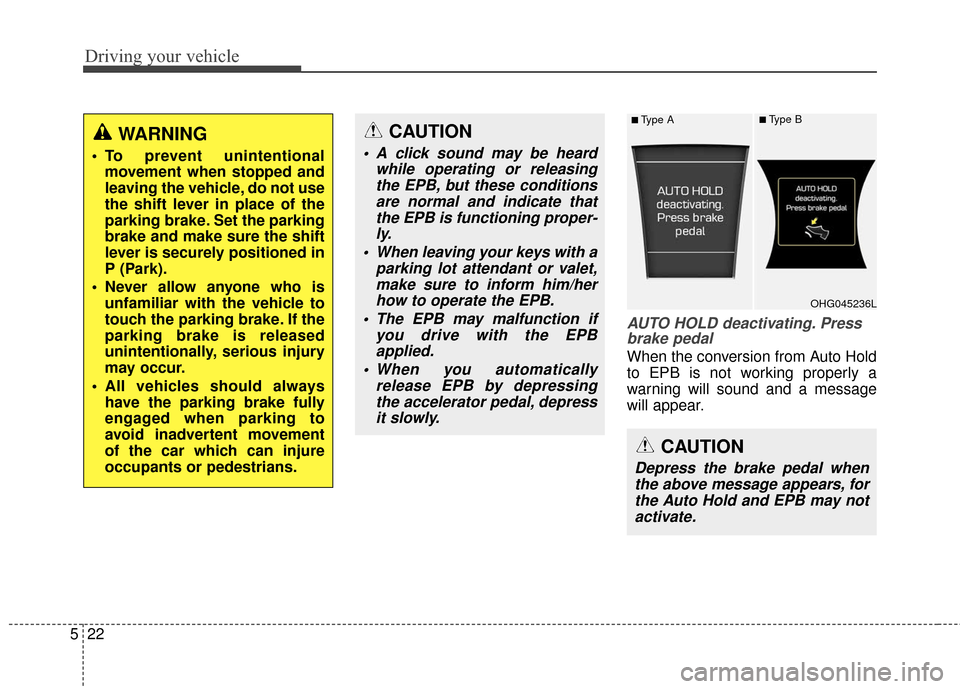
AUTO HOLD deactivating. Press
brake pedal
When the conversion from Auto Hold
to EPB is not working properly a
warning will sound and a message
will appear.
WARNING
To prevent unintentional
movement when stopped and
leaving the vehicle, do not use
the shift lever in place of the
parking brake. Set the parking
brake and make sure the shift
lever is securely positioned in
P (Park).
Never allow anyone who is unfamiliar with the vehicle to
touch the parking brake. If the
parking brake is released
unintentionally, serious injury
may occur.
All vehicles should always have the parking brake fully
engaged when parking to
avoid inadvertent movement
of the car which can injure
occupants or pedestrians.
CAUTION
Depress the brake pedal whenthe above message appears, forthe Auto Hold and EPB may notactivate.
CAUTION
A click sound may be heard while operating or releasingthe EPB, but these conditionsare normal and indicate thatthe EPB is functioning proper-ly.
When leaving your keys with a parking lot attendant or valet,make sure to inform him/herhow to operate the EPB.
The EPB may malfunction if you drive with the EPBapplied.
When you automatically release EPB by depressingthe accelerator pedal, depressit slowly.
OHG045236L
■Type A■Type B