check engine Hyundai Elantra 2018 Owner's Guide
[x] Cancel search | Manufacturer: HYUNDAI, Model Year: 2018, Model line: Elantra, Model: Hyundai Elantra 2018Pages: 526, PDF Size: 17.2 MB
Page 302 of 526
5-19
Driving your vehicle
5
A
AU
U T
TO
O M
M A
AT
TI
IC
C
T
T R
R A
A N
N S
SM
M I
IS
S S
SI
IO
O N
N
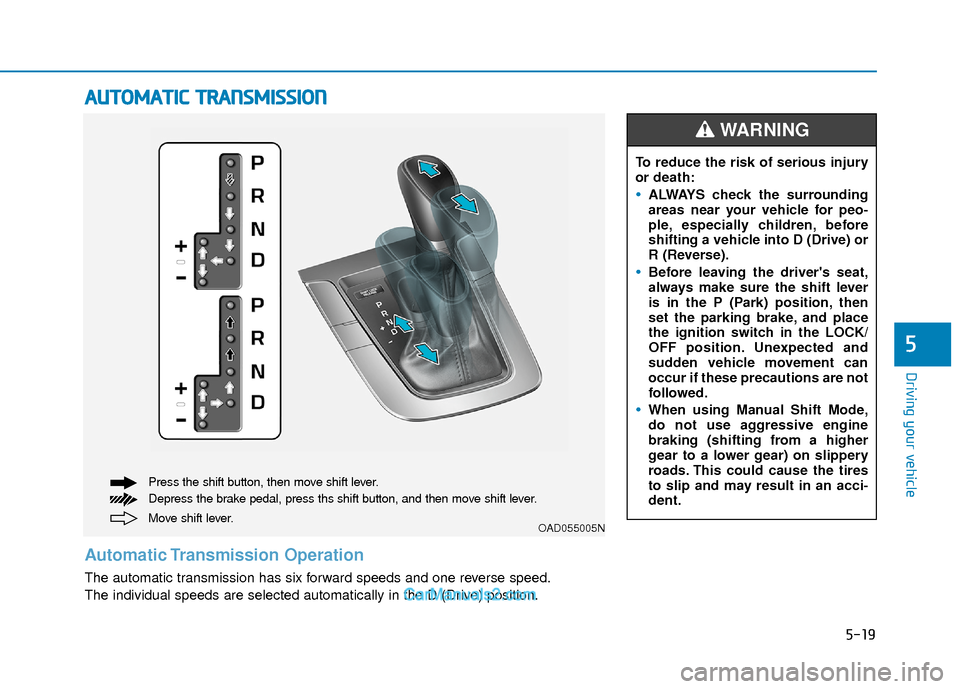
Move shift lever. Press the shift button, then move shift lever.
Depress the brake pedal, press ths shift button, and then move shift lever.OAD055005N
Automatic Transmission Operation
The automatic transmission has six forward speeds and one reverse speed.
The individual speeds are selected automatically in the D (Drive) position. To reduce the risk of serious injury
or death:
ALWAYS check the surrounding
areas near your vehicle for peo-
ple, especially children, before
shifting a vehicle into D (Drive) or
R (Reverse).
Before leaving the driver's seat,
always make sure the shift lever
is in the P (Park) position, then
set the parking brake, and place
the ignition switch in the LOCK/
OFF position. Unexpected and
sudden vehicle movement can
occur if these precautions are not
followed.
When using Manual Shift Mode,
do not use aggressive engine
braking (shifting from a higher
gear to a lower gear) on slippery
roads. This could cause the tires
to slip and may result in an acci-
dent.
WARNING
Page 308 of 526
5-25
Driving your vehicle
5
The dry-type clutch transfers torquemore directly and provides a direct-
drive feeling which may feel different
from a conventional automatic trans-
mission. This may be more noticeable
when launching the vehicle from a stop
or when traveling at low, stop-and-go
vehicle speeds.
When rapidly accelerating from a lower vehicle speed, the engine rpm may
increase dramatically as a result of
clutch slip as the dual clutch transmis-
sion selects the correct gear. This is a
normal condition.
When accelerating from a stop on an incline, press the accelerator smoothly
and gradually to avoid any shudder
feeling or jerkiness.
When traveling at a lower vehicle speed, if you release the accelerator
pedal quickly, you may feel engine
braking before the transmission
changes gears. This engine braking
feeling is similar to operating a manual
transmission at low speed.
When driving downhill, you may wish to move the gear shift lever to Manual
Shift mode and downshift to a lower
gear in order to control your speed
without using the brake pedal exces-
sively. When you turn the engine on and off,
you may hear clicking sounds as the
system goes through a self-test. This is
a normal sound for the dual clutch
transmission.
During the first 1000 miles, you may feel that the vehicle may not be smooth
when accelerating at low speed.
During this break-in period, the shift
quality and performance of your new
vehicle is continuously optimized. Always come to a complete stop
before shifting into D (Drive) or R
(Reverse).
Do not put the shift lever in N (Neutral) while driving.
NOTICE
To reduce the risk of serious injury
or death:
ALWAYS check the surrounding
areas near your vehicle for peo-
ple, especially children, before
shifting a vehicle into D (Drive) or
R (Reverse).
Before leaving the driver's seat,
always make sure the shift lever
is in the P (Park) position, then
set the parking brake, and place
the ignition switch in the
LOCK/OFF position. Unexpected
and sudden vehicle movement
can occur if these precautions
are not followed.
(Continued)
WARNING
(Continued)
Do not use aggressive engine
braking (shifting from a higher
gear to a lower gear) on slippery
roads. This could cause the tires
to slip and may result in an acci-
dent.
Due to transmission failure, you
may not continue to drive and the
position indicator (D, R) on the
cluster will blink. Contact an
authorized hyundai dealer and have
the system checked.
WARNING
Page 310 of 526
5-27
Driving your vehicle
5
If this occurs, pull over to a safe loca-tion, stop the vehicle with the engine
running, apply the brakes and shift the
vehicle to P (Park) with engine on, and
allow the transmission to cool.
If you ignore this warning, the driving condition may become worse. You may
experience abrupt shifts, frequent
shifts, or jerkiness.
When the warning message goes away you can continue to drive your
vehicle.
When possible, drive the vehicle smoothly.
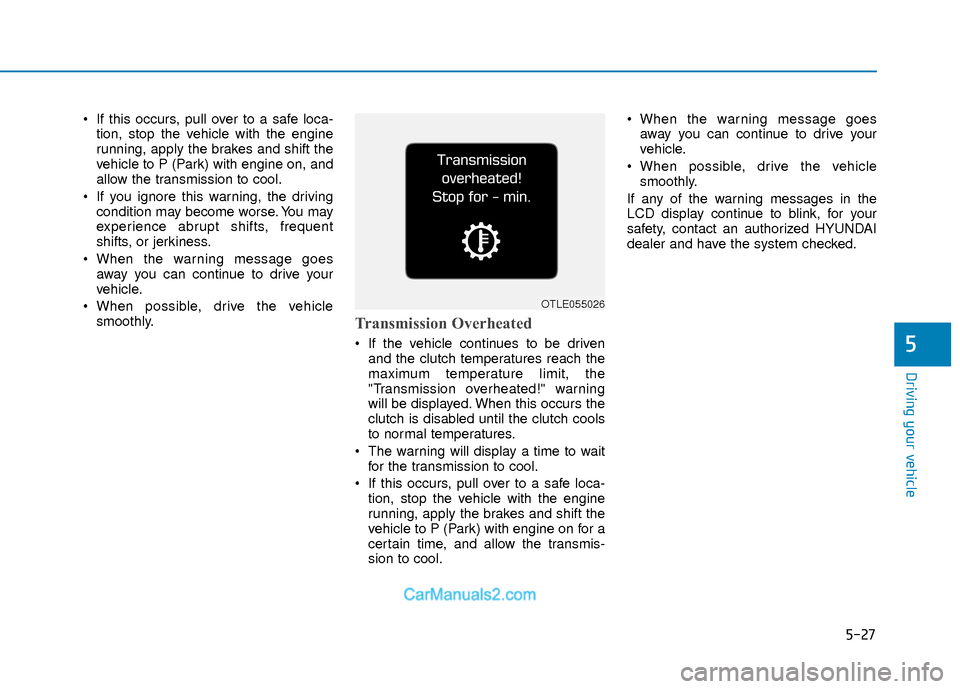
Transmission Overheated
If the vehicle continues to be drivenand the clutch temperatures reach the
maximum temperature limit, the
"Transmission overheated!" warning
will be displayed. When this occurs the
clutch is disabled until the clutch cools
to normal temperatures.
The warning will display a time to wait for the transmission to cool.
If this occurs, pull over to a safe loca- tion, stop the vehicle with the engine
running, apply the brakes and shift the
vehicle to P (Park) with engine on for a
certain time, and allow the transmis-
sion to cool. When the warning message goes
away you can continue to drive your
vehicle.
When possible, drive the vehicle smoothly.
If any of the warning messages in the
LCD display continue to blink, for your
safety, contact an authorized HYUNDAI
dealer and have the system checked.
OTLE055026
Page 319 of 526
5-36
Driving your vehicle
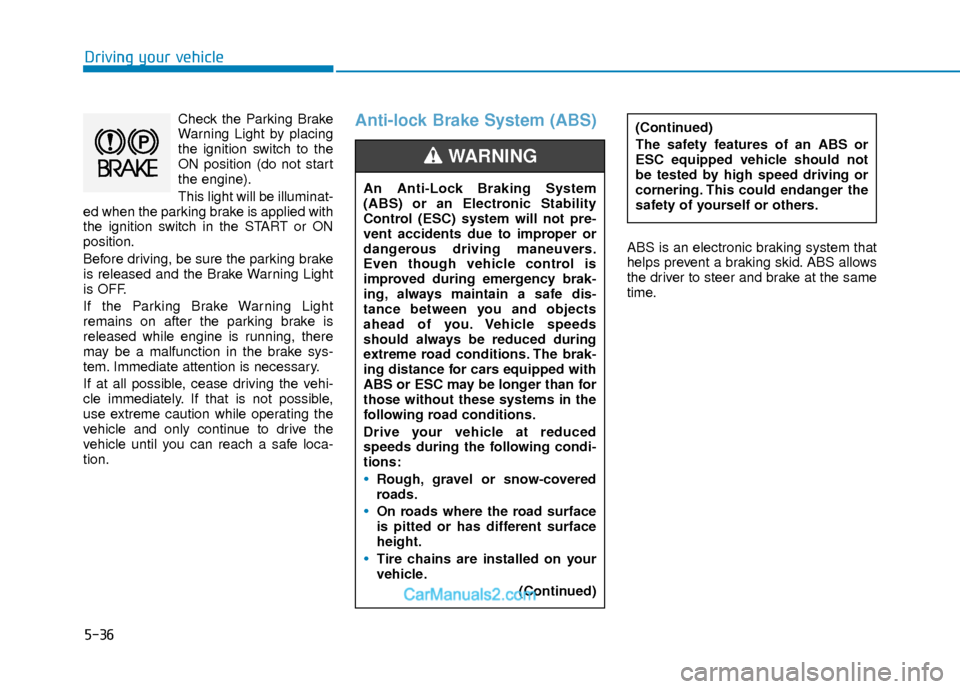
Check the Parking Brake
Warning Light by placing
the ignition switch to the
ON position (do not start
the engine).
This light will be illuminat-
ed when the parking brake is applied with
the ignition switch in the START or ON
position.
Before driving, be sure the parking brake
is released and the Brake Warning Light
is OFF.
If the Parking Brake Warning Light
remains on after the parking brake is
released while engine is running, there
may be a malfunction in the brake sys-
tem. Immediate attention is necessary.
If at all possible, cease driving the vehi-
cle immediately. If that is not possible,
use extreme caution while operating the
vehicle and only continue to drive the
vehicle until you can reach a safe loca-
tion.Anti-lock Brake System (ABS)
ABS is an electronic braking system that
helps prevent a braking skid. ABS allows
the driver to steer and brake at the same
time.
An Anti-Lock Braking System
(ABS) or an Electronic Stability
Control (ESC) system will not pre-
vent accidents due to improper or
dangerous driving maneuvers.
Even though vehicle control is
improved during emergency brak-
ing, always maintain a safe dis-
tance between you and objects
ahead of you. Vehicle speeds
should always be reduced during
extreme road conditions. The brak-
ing distance for cars equipped with
ABS or ESC may be longer than for
those without these systems in the
following road conditions.
Drive your vehicle at reduced
speeds during the following condi-
tions:
Rough, gravel or snow-covered
roads.
On roads where the road surface
is pitted or has different surface
height.
Tire chains are installed on your
vehicle.
(Continued)
WARNING
(Continued)
The safety features of an ABS or
ESC equipped vehicle should not
be tested by high speed driving or
cornering. This could endanger the
safety of yourself or others.
Page 321 of 526
5-38
Driving your vehicle
Electronic Stability Control
(ESC)
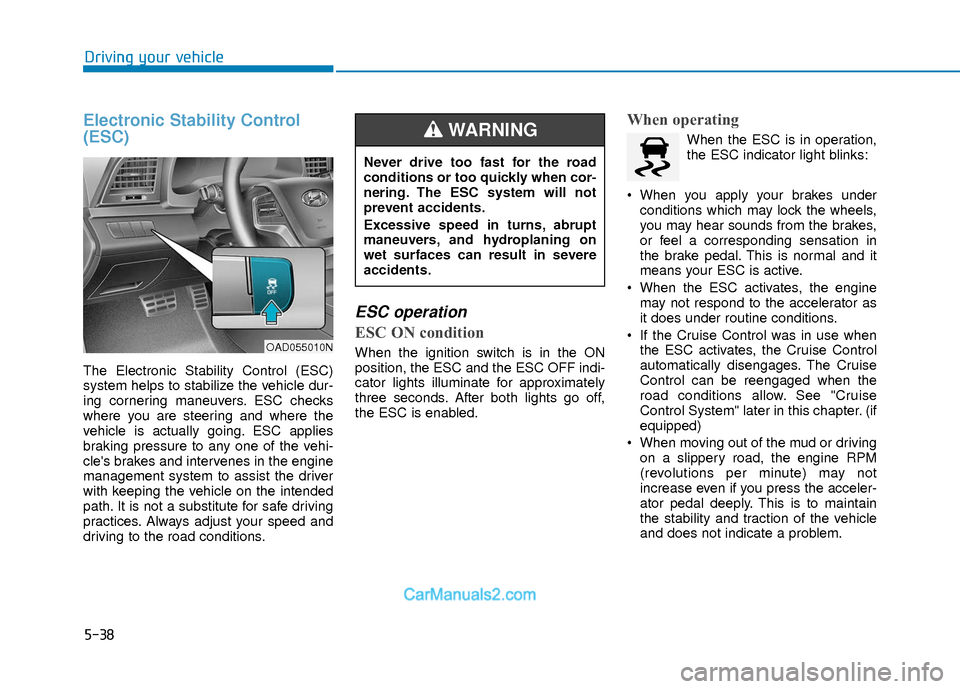
The Electronic Stability Control (ESC)
system helps to stabilize the vehicle dur-
ing cornering maneuvers. ESC checks
where you are steering and where the
vehicle is actually going. ESC applies
braking pressure to any one of the vehi-
cle's brakes and intervenes in the engine
management system to assist the driver
with keeping the vehicle on the intended
path. It is not a substitute for safe driving
practices. Always adjust your speed and
driving to the road conditions.
ESC operation
ESC ON condition
When the ignition switch is in the ON
position, the ESC and the ESC OFF indi-
cator lights illuminate for approximately
three seconds. After both lights go off,
the ESC is enabled.
When operating
When the ESC is in operation,
the ESC indicator light blinks:
When you apply your brakes under conditions which may lock the wheels,
you may hear sounds from the brakes,
or feel a corresponding sensation in
the brake pedal. This is normal and it
means your ESC is active.
When the ESC activates, the engine may not respond to the accelerator as
it does under routine conditions.
If the Cruise Control was in use when the ESC activates, the Cruise Control
automatically disengages. The Cruise
Control can be reengaged when the
road conditions allow. See "Cruise
Control System" later in this chapter. (if
equipped)
When moving out of the mud or driving on a slippery road, the engine RPM
(revolutions per minute) may not
increase even if you press the acceler-
ator pedal deeply. This is to maintain
the stability and traction of the vehicle
and does not indicate a problem.
OAD055010N
Never drive too fast for the road
conditions or too quickly when cor-
nering. The ESC system will not
prevent accidents.
Excessive speed in turns, abrupt
maneuvers, and hydroplaning on
wet surfaces can result in severe
accidents.
WARNING
Page 322 of 526
5-39
Driving your vehicle
5
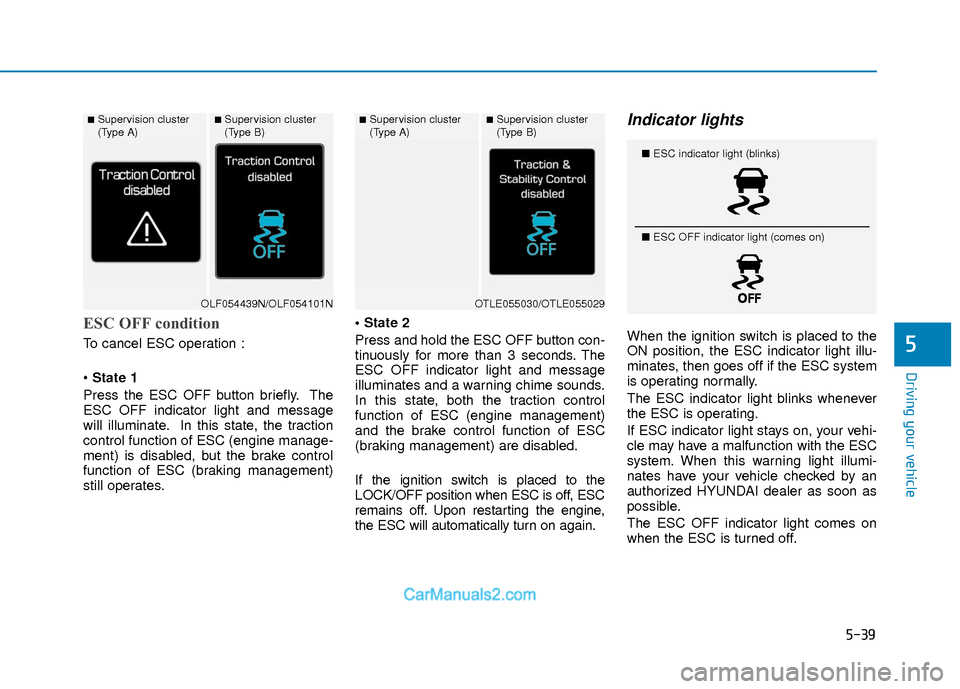
ESC OFF condition
To cancel ESC operation :
State 1
Press the ESC OFF button briefly. The
ESC OFF indicator light and message
will illuminate. In this state, the traction
control function of ESC (engine manage-
ment) is disabled, but the brake control
function of ESC (braking management)
still operates.
Press and hold the ESC OFF button con-
tinuously for more than 3 seconds. The
ESC OFF indicator light and message
illuminates and a warning chime sounds.
In this state, both the traction control
function of ESC (engine management)
and the brake control function of ESC
(braking management) are disabled.
If the ignition switch is placed to the
LOCK/OFF position when ESC is off, ESC
remains off. Upon restarting the engine,
the ESC will automatically turn on again.
Indicator lights
When the ignition switch is placed to the
ON position, the ESC indicator light illu-
minates, then goes off if the ESC system
is operating normally.
The ESC indicator light blinks whenever
the ESC is operating.
If ESC indicator light stays on, your vehi-
cle may have a malfunction with the ESC
system. When this warning light illumi-
nates have your vehicle checked by an
authorized HYUNDAI dealer as soon as
possible.
The ESC OFF indicator light comes on
when the ESC is turned off.
■Supervision cluster
(Type A)■Supervision cluster
(Type B)
OLF054439N/OLF054101N
■Supervision cluster
(Type A)■Supervision cluster
(Type B)
OTLE055030/OTLE055029
■
ESC indicator light (blinks)
■ ESC OFF indicator light (comes on)
Page 350 of 526
5-67
Driving your vehicle
5
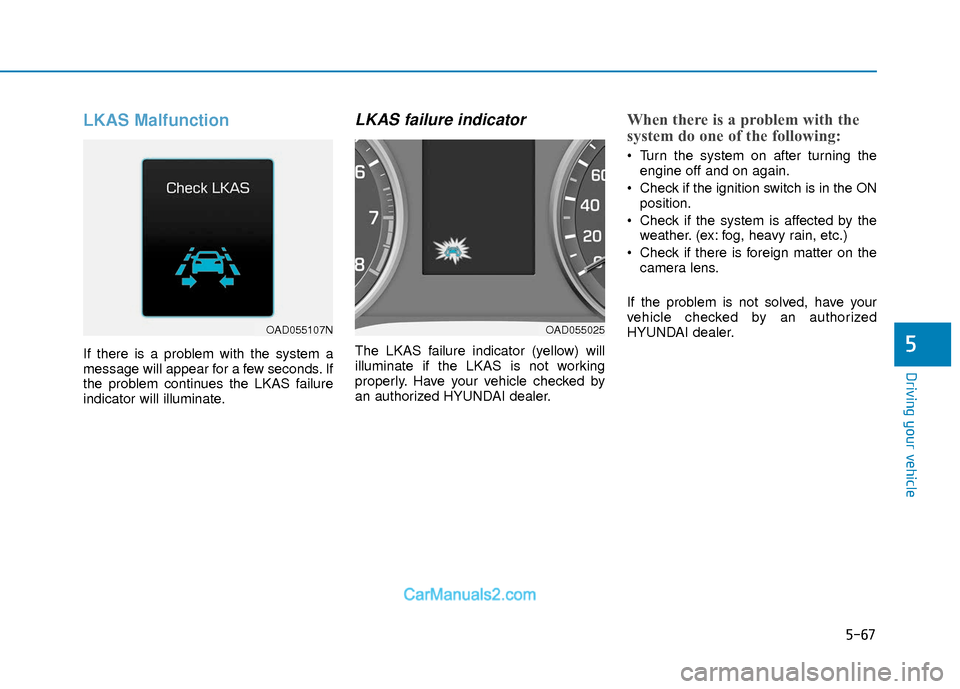
LKAS Malfunction
If there is a problem with the system a
message will appear for a few seconds. If
the problem continues the LKAS failure
indicator will illuminate.
LKAS failure indicator
The LKAS failure indicator (yellow) will
illuminate if the LKAS is not working
properly. Have your vehicle checked by
an authorized HYUNDAI dealer.
When there is a problem with the
system do one of the following:
Turn the system on after turning theengine off and on again.
Check if the ignition switch is in the ON position.
Check if the system is affected by the weather. (ex: fog, heavy rain, etc.)
Check if there is foreign matter on the camera lens.
If the problem is not solved, have your
vehicle checked by an authorized
HYUNDAI dealer.
OAD055107NOAD055025
Page 352 of 526
5-69
Driving your vehicle
5
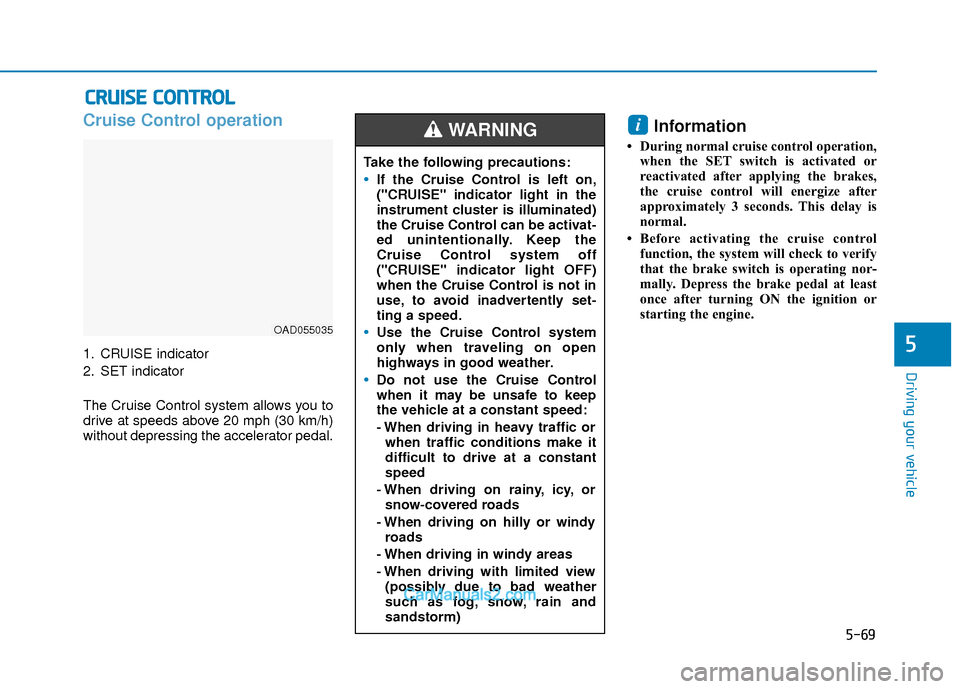
Cruise Control operation
1. CRUISE indicator
2. SET indicator
The Cruise Control system allows you to
drive at speeds above 20 mph (30 km/h)
without depressing the accelerator pedal.
Information
• During normal cruise control operation,when the SET switch is activated or
reactivated after applying the brakes,
the cruise control will energize after
approximately 3 seconds. This delay is
normal.
• Before activating the cruise control function, the system will check to verify
that the brake switch is operating nor-
mally. Depress the brake pedal at least
once after turning ON the ignition or
starting the engine.
i
C CR
R U
U I
IS
S E
E
C
C O
O N
NT
TR
R O
O L
L
OAD055035
Take the following precautions:
If the Cruise Control is left on,
("CRUISE" indicator light in the
instrument cluster is illuminated)
the Cruise Control can be activat-
ed unintentionally. Keep the
Cruise Control system off
("CRUISE" indicator light OFF)
when the Cruise Control is not in
use, to avoid inadvertently set-
ting a speed.
Use the Cruise Control system
only when traveling on open
highways in good weather.
Do not use the Cruise Control
when it may be unsafe to keep
the vehicle at a constant speed:
- When driving in heavy traffic or
when traffic conditions make it
difficult to drive at a constant
speed
- When driving on rainy, icy, or snow-covered roads
- When driving on hilly or windy roads
- When driving in windy areas
- When driving with limited view (possibly due to bad weather
such as fog, snow, rain and
sandstorm)
WARNING
Page 361 of 526
5-78
Driving your vehicle
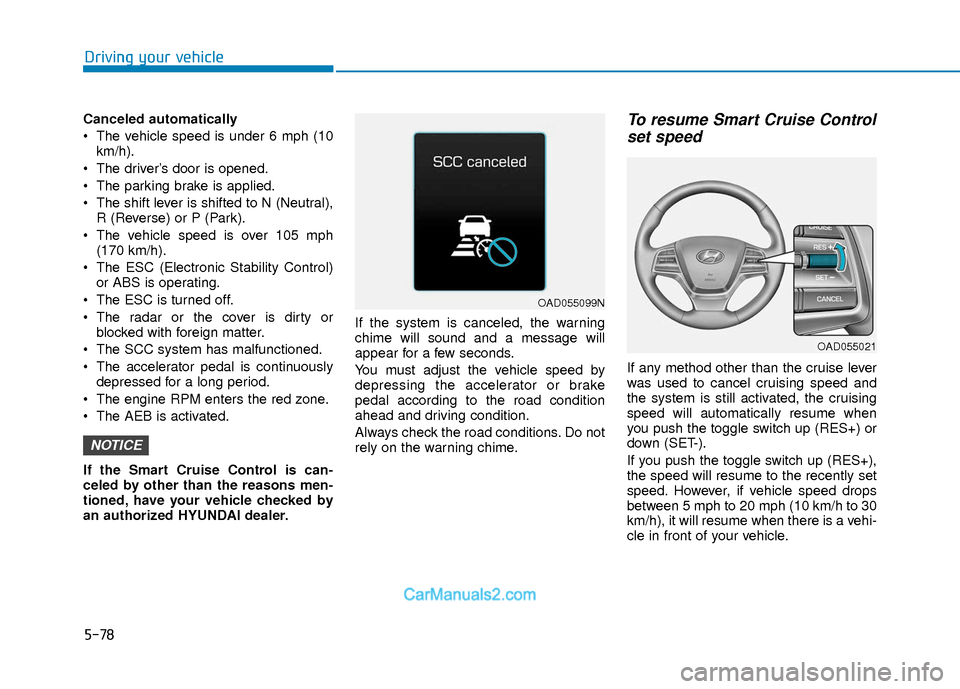
Canceled automatically
The vehicle speed is under 6 mph (10km/h).
The driver’s door is opened.
The parking brake is applied.
The shift lever is shifted to N (Neutral), R (Reverse) or P (Park).
The vehicle speed is over 105 mph (170 km/h).
The ESC (Electronic Stability Control) or ABS is operating.
The ESC is turned off.
The radar or the cover is dirty or blocked with foreign matter.
The SCC system has malfunctioned.
The accelerator pedal is continuously depressed for a long period.
The engine RPM enters the red zone.
The AEB is activated.
If the Smart Cruise Control is can-
celed by other than the reasons men-
tioned, have your vehicle checked by
an authorized HYUNDAI dealer. If the system is canceled, the warning
chime will sound and a message will
appear for a few seconds.
You must adjust the vehicle speed by
depressing the accelerator or brake
pedal according to the road condition
ahead and driving condition.
Always check the road conditions. Do not
rely on the warning chime.To resume Smart Cruise Control
set speed
If any method other than the cruise lever
was used to cancel cruising speed and
the system is still activated, the cruising
speed will automatically resume when
you push the toggle switch up (RES+) or
down (SET-).
If you push the toggle switch up (RES+),
the speed will resume to the recently set
speed. However, if vehicle speed drops
between 5 mph to 20 mph (10 km/h to 30
km/h), it will resume when there is a vehi-
cle in front of your vehicle.
NOTICE
OAD055021
OAD055099N
Page 362 of 526
5-79
Driving your vehicle
5
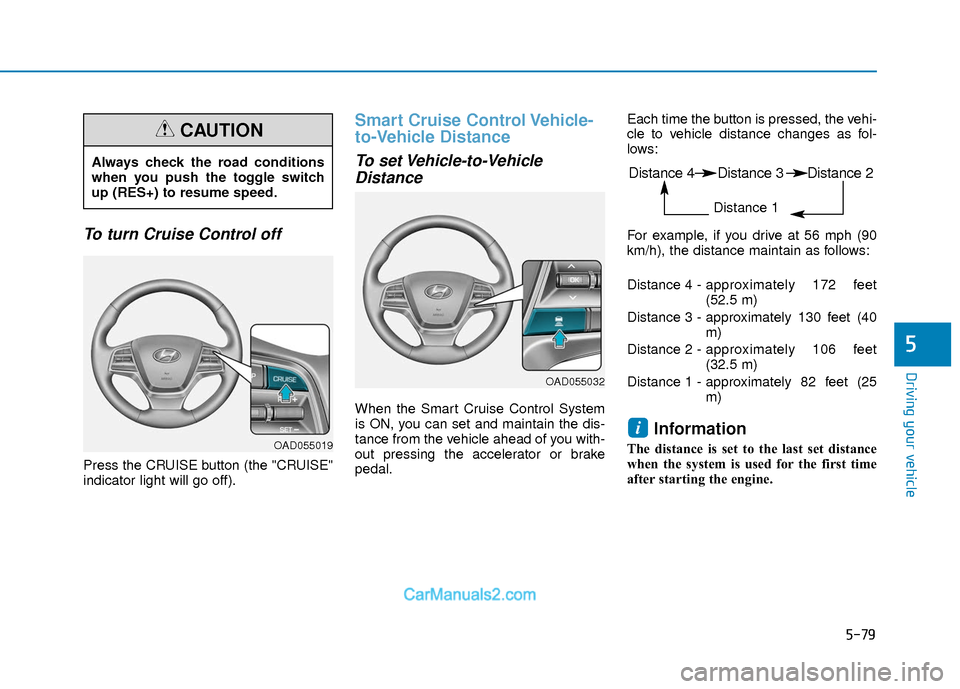
To turn Cruise Control off
Press the CRUISE button (the "CRUISE"
indicator light will go off).
Smart Cruise Control Vehicle-
to-Vehicle Distance
To set Vehicle-to-VehicleDistance
When the Smart Cruise Control System
is ON, you can set and maintain the dis-
tance from the vehicle ahead of you with-
out pressing the accelerator or brake
pedal. Each time the button is pressed, the vehi-
cle to vehicle distance changes as fol-
lows:
For example, if you drive at 56 mph (90
km/h), the distance maintain as follows:
Distance 4 -
approximately 172 feet
(52.5 m)
Distance 3 - approximately 130 feet (40 m)
Distance 2 - approximately 106 feet
(32.5 m)
Distance 1 - approximately 82 feet (25 m)
Information
The distance is set to the last set distance
when the system is used for the first time
after starting the engine.
i
Always check the road conditions
when you push the toggle switch
up (RES+) to resume speed.
CAUTION
OAD055019
OAD055032
Distance 4 Distance 3 Distance 2
Distance 1