child restraint HYUNDAI GENESIS G90 2020 Owner's Manual
[x] Cancel search | Manufacturer: HYUNDAI, Model Year: 2020, Model line: GENESIS G90, Model: HYUNDAI GENESIS G90 2020Pages: 538, PDF Size: 13.02 MB
Page 86 of 538
2-66
Safety system of your vehicle
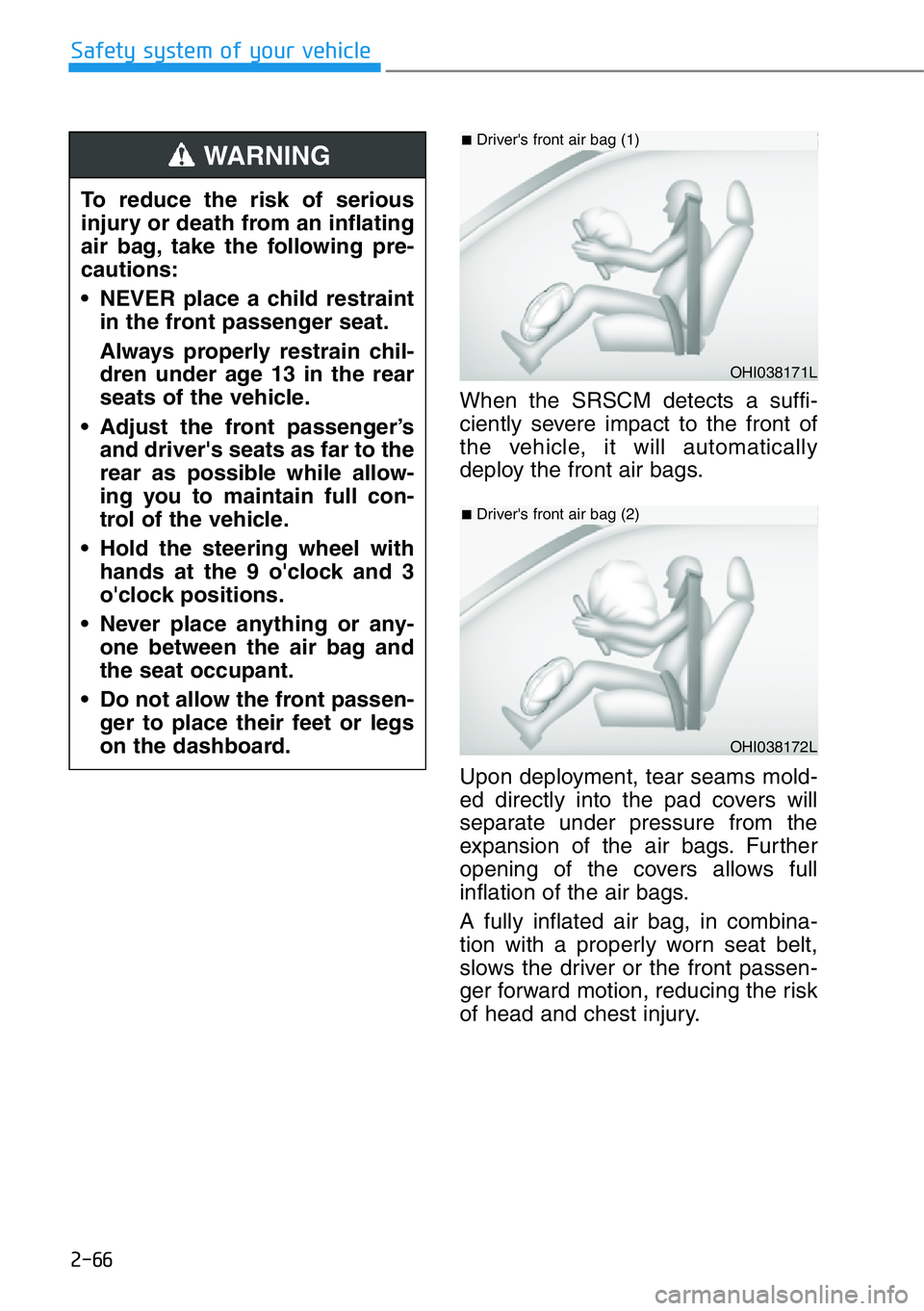
When the SRSCM detects a suffi-
ciently severe impact to the front of
the vehicle, it will automatically
deploy the front air bags.
Upon deployment, tear seams mold-
ed directly into the pad covers will
separate under pressure from the
expansion of the air bags. Further
opening of the covers allows full
inflation of the air bags.
A fully inflated air bag, in combina-
tion with a properly worn seat belt,
slows the driver or the front passen-
ger forward motion, reducing the risk
of head and chest injury. To reduce the risk of serious
injury or death from an inflating
air bag, take the following pre-
cautions:
• NEVER place a child restraint
in the front passenger seat.
Always properly restrain chil-
dren under age 13 in the rear
seats of the vehicle.
• Adjust the front passenger’s
and driver's seats as far to the
rear as possible while allow-
ing you to maintain full con-
trol of the vehicle.
• Hold the steering wheel with
hands at the 9 o'clock and 3
o'clock positions.
• Never place anything or any-
one between the air bag and
the seat occupant.
• Do not allow the front passen-
ger to place their feet or legs
on the dashboard.
WARNING
OHI038171L
■Driver's front air bag (1)
OHI038172L
■Driver's front air bag (2)
Page 89 of 538

2-69
02
Main components of the
Occupant Classification System
The OCS is designed to help detect
the presence of a properly-seated
front passenger and determine if the
passenger's front air bag should be
enabled (may inflate) or not.
The purpose is to help reduce the
risk of injury or death from an inflat-
ing air bag to certain front passenger
seat occupants, such as children, by
requiring the air bag to be automati-
cally turned OFF.
For example, if a child restraint of the
type specified in the regulations is on
the seat, the occupant classification
sensor can detect it and cause the
air bag to turn OFF.
Front passenger seat adult occu-
pants who are properly seated and
wearing the seat belt properly,
should not cause the passenger air
bag to be automatically turned OFF.
For small adults it may be turned
OFF, however, if the occupant does
not sit in the seat properly (for exam-
ple, by not sitting upright, by sitting
on the edge of the seat, or by other-
wise being out of position), this could
cause the sensor to turn the air bag
OFF.
You will find the "PASSENGER AIR
BAG OFF" indicator on the overhead
console. This system detects the
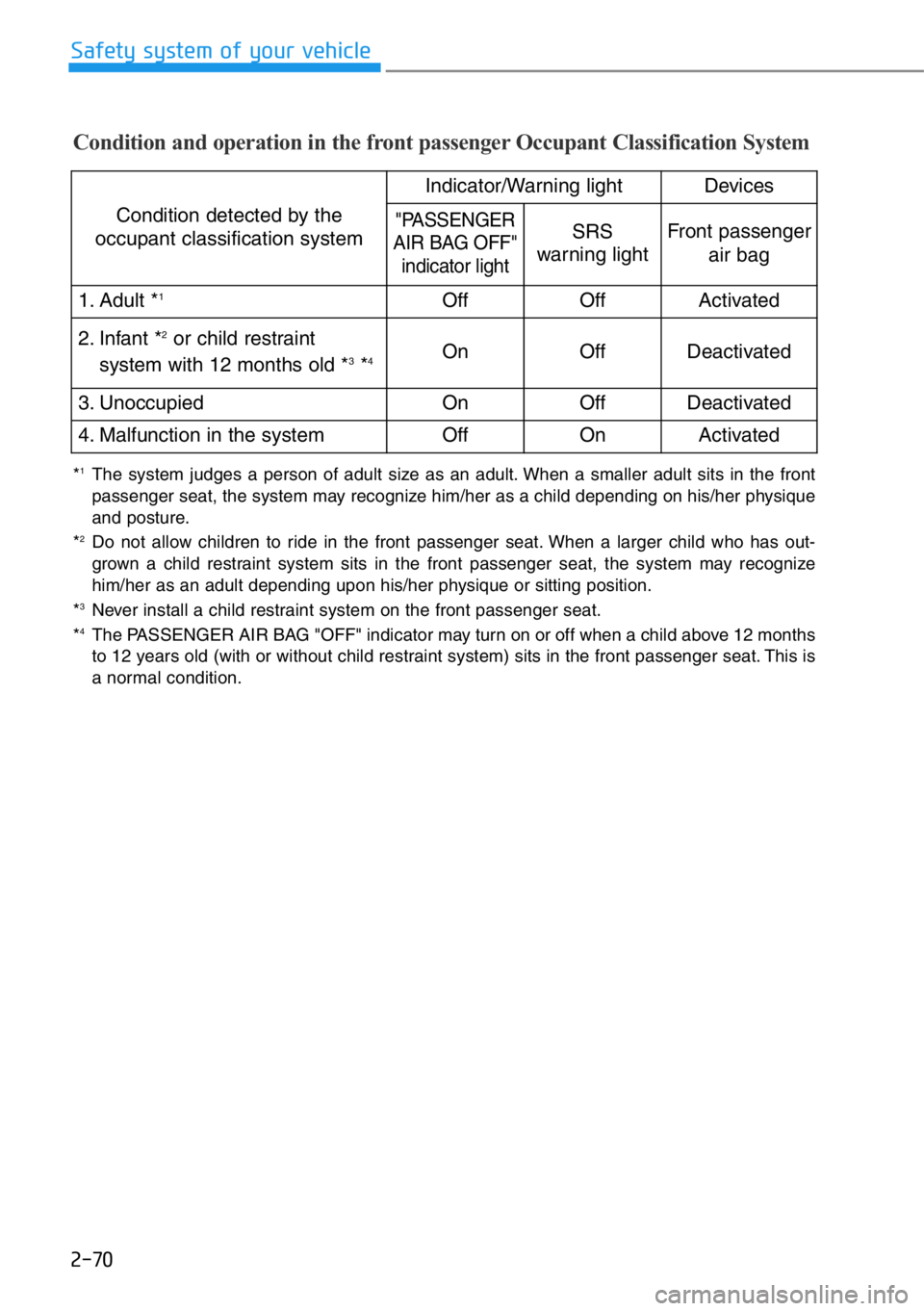
conditions 1-4 in the following table
and activates or deactivates the front
passenger air bag based on these
conditions.Always be sure that you and all vehi-
cle occupants are seated properly
and wearing the seat belt properly for
the most effective protection by the
air bag and the seat belt.
The OCS may not function properly if
the passenger takes actions which
can affect the classification system.
These include:
• Failing to sit in an upright position.
• Leaning against the door or center
console.
• Sitting towards the sides of the
front of the seat.
• Putting their legs on the dashboard
or resting them on other locations
which reduce the passenger
weight on the front seat.
• Wearing the seat belt improperly.
• Reclining the seatback.
• Wearing a thick cloth like ski wear
or hip protection wear.
• Putting an additional thick cushion
on the seat.
• Putting electrical devices (e.g.
notebook, satellite radio) on the
seat with inverter charging.
Page 90 of 538
2-70
Safety system of your vehicle
Condition and operation in the front passenger Occupant Classification System
Condition detected by the
occupant classification system
Indicator/Warning lightDevices
"PASSENGER
AIR BAG OFF"
indicator lightSRS
warning lightFront passenger
air bag
1. Adult *1OffOffActivated
2. Infant *2or child restraint
system with 12 months old *3*4 OnOffDeactivated
3. Unoccupied OnOffDeactivated
4. Malfunction in the systemOffOnActivated
*1The system judges a person of adult size as an adult. When a smaller adult sits in the front
passenger seat, the system may recognize him/her as a child depending on his/her physique
and posture.
*
2Do not allow children to ride in the front passenger seat. When a larger child who has out-
grown a child restraint system sits in the front passenger seat, the system may recognize
him/her as an adult depending upon his/her physique or sitting position.
*
3Never install a child restraint system on the front passenger seat.
*4The PASSENGER AIR BAG "OFF" indicator may turn on or off when a child above 12 months
to 12 years old (with or without child restraint system) sits in the front passenger seat. This is
a normal condition.
Page 94 of 538

2-74
Safety system of your vehicle
Do Not Install a Child Restraint
in the Front Passenger's Seat
Even though your vehicle is
equipped with the OCS, never install
a child restraint in the front passen-
ger’s seat. An inflating air bag can
forcefully strike a child or child
restraint resulting in serious or fatal
injury.
Why Didn't My Air Bag Go Off
in a Collision?
Air bags are not designed to inflate in
every collision. There are certain
types of accidents in which the air
bag would not be expected to pro-
vide additional protection. These
include rear impacts, second or third
collisions in multiple impact acci-
dents, as well as low speed impacts.
Damage to the vehicle indicates a
collision energy absorption, and is
not an indicator of whether or not an
air bag should have inflated.
• NEVER place a rearward-fac-
ing or forward-facing child
restraint in the front passen-
ger's seat of the vehicle.
• An inflating frontal air bag
could forcefully strike a child
resulting in serious injury or
death.
• Always properly restrain chil-
dren in an appropriate child
restraint in the rear seat of the
vehicle.
WARNING
OHI039193N
To reduce the risk of an air bag
deploying unexpectedly and
causing serious injury or death:
• Do not hit or allow any objects
to impact the locations where
air bags or sensors are
installed.
• Do not perform maintenance
on or around the air bag sen-
sors. If the location or angle of
the sensors is altered, the air
bags may deploy when they
should not or may not deploy
when they should.
• Do not install bumper guards
or replace the bumper with a
non-Genuine Genesis Part.
This may adversely affect the
collision and air bag deploy-
ment performance.
• Press the Engine Start/Stop
button to the OFF or ACC
position when the vehicle is
being towed to prevent inad-
vertent air bag deployment.
• Have all air bag repairs con-
ducted by an authorized
retailer of Genesis Branded
products.
WARNING
Page 414 of 538
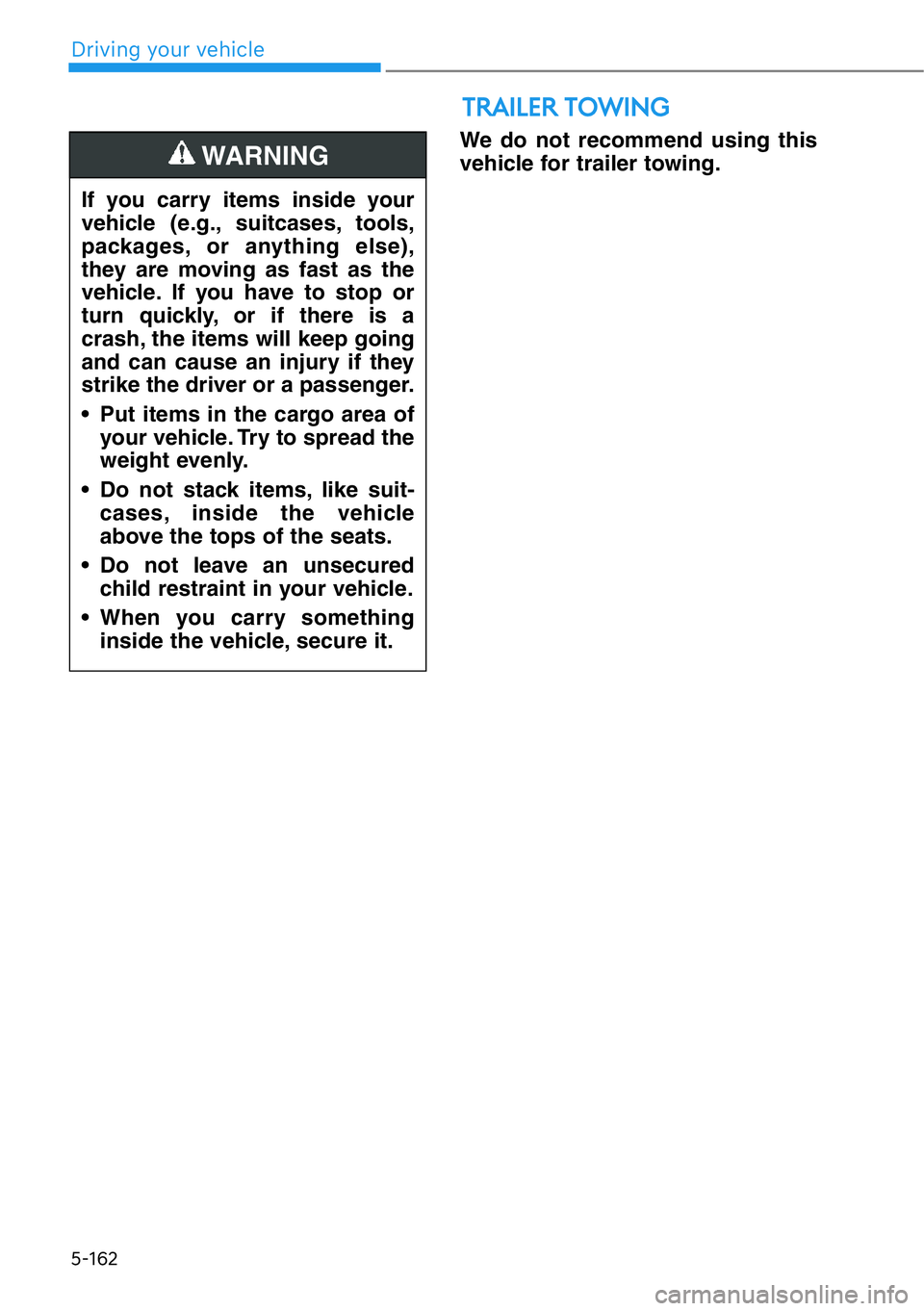
We do not recommend using this
vehicle for trailer towing.
If you carry items inside your
vehicle (e.g., suitcases, tools,
packages, or anything else),
they are moving as fast as the
vehicle. If you have to stop or
turn quickly, or if there is a
crash, the items will keep going
and can cause an injury if they
strike the driver or a passenger.
• Put items in the cargo area of
your vehicle. Try to spread the
weight evenly.
• Do not stack items, like suit-
cases, inside the vehicle
above the tops of the seats.
• Do not leave an unsecured
child restraint in your vehicle.
• When you carry something
inside the vehicle, secure it.WARNING
TRAILER TOWING
Driving your vehicle
5-162