parking brake Hyundai Getz 2002 User Guide
[x] Cancel search | Manufacturer: HYUNDAI, Model Year: 2002, Model line: Getz, Model: Hyundai Getz 2002Pages: 428, PDF Size: 6.13 MB
Page 124 of 428

DRIVING YOUR HYUNDAI 2- 3
C020A01O-GAT BEFORE STARTING THE EN- GINE Before you start the engine, you should always:
1. Look around the vehicle to be sure
there are no flat tires, puddles of oil, water or other indications of pos-sible trouble.
2. After entering the car, check to be
sure the parking brake is engaged.
3. Check that all windows, and lights are clean.
4. Check that the interior and exterior mirrors are clean and in position.
5. Check your seat, seatback and
headrest to be sure they are in theirproper positions.
6. Lock all the doors.
7. Fasten your seat belt and be sure
that all other occupants have fas- tened theirs.
8. Turn off all lights and accessories that are not needed.
9. When you turn the ignition switch to
"ON", check that all appropriate warning lights are operating and that you have sufficient fuel. 10.Check the operation of warning
lights and all bulbs when key is in the "ON" position.
!WARNING: (DIESEL ENGINE)
To ensure that sufficient vacuum exists within the brake system dur-ing cold weather start-up condi- tions, it is necessary to run the engine at idle for several secondsafter starting the engine. C030A01A-GAT COMBINATION IGNITION SWITCHTo Start the Engine
o If your Hyundai is equipped with a
manual transaxle, place the shift lever in neutral and depress theclutch pedal fully.
o If your Hyundai has an automatic
transaxle, place the shift lever in "P"(park).
o To start the engine, insert the igni-
tion key and turn it to the "START"position. Release it as soon as the engine starts. Do not hold the key in the "START" position for more than15 seconds.
NOTE: For safety, the engine will not start if the shift lever is not in "P" or "N"Position (Automatic transaxle).
Page 128 of 428
DRIVING YOUR HYUNDAI 2- 7
HTB206 NOTE:
o To shift into reverse, rest the le-
ver in neutral for at least 3 sec- onds after your car is completelystopped. Then move the lever into the reverse position.
o During cold weather, shifting may
be difficult until the transaxle lu-bricant has warmed up. This is normal and not harmful to thetransaxle.
o If you 've come to a complete
stop and it's hard to shift into 1 st
or R(Reverse), put the shift lever in N(Neutral) position and release the clutch. Press the clutch pedalback down, and then shift into 1 st
or R(Reverse) gear position.
o Do not use the shift lever as a
handrest during driving, as this can result in premature wear of the transaxle shift forks.
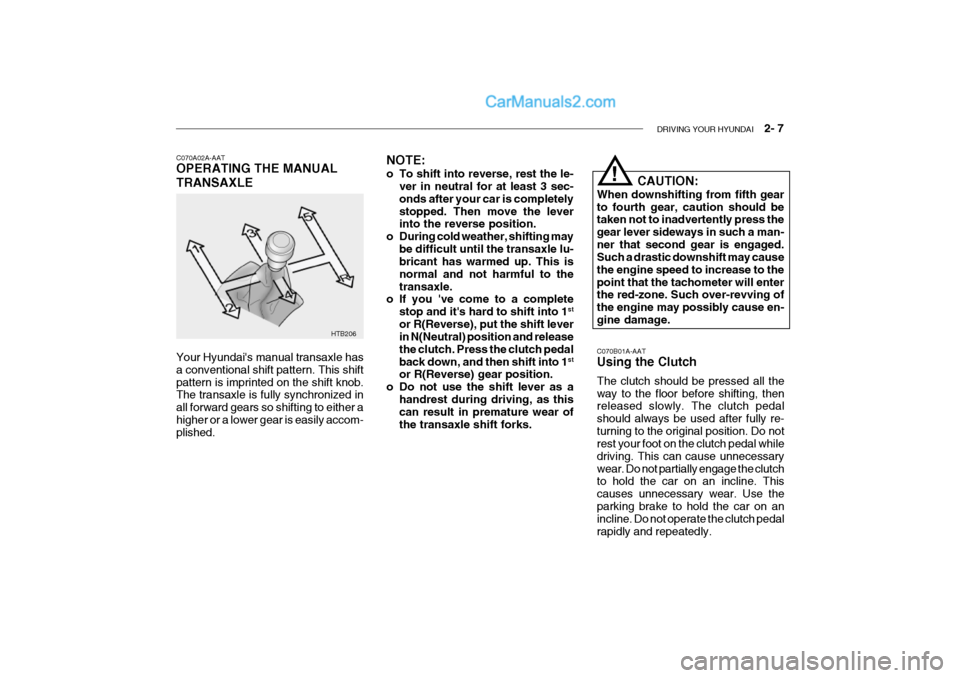
C070A02A-AAT OPERATING THE MANUAL TRANSAXLE Your Hyundai's manual transaxle has a conventional shift pattern. This shiftpattern is imprinted on the shift knob. The transaxle is fully synchronized in all forward gears so shifting to either ahigher or a lower gear is easily accom- plished.
CAUTION:
When downshifting from fifth gear to fourth gear, caution should be taken not to inadvertently press the gear lever sideways in such a man-ner that second gear is engaged. Such a drastic downshift may cause the engine speed to increase to thepoint that the tachometer will enter the red-zone. Such over-revving of the engine may possibly cause en-gine damage.
!
C070B01A-AAT Using the Clutch The clutch should be pressed all the way to the floor before shifting, then released slowly. The clutch pedal should always be used after fully re-turning to the original position. Do not rest your foot on the clutch pedal while driving. This can cause unnecessarywear. Do not partially engage the clutch to hold the car on an incline. This causes unnecessary wear. Use theparking brake to hold the car on an incline. Do not operate the clutch pedal rapidly and repeatedly.
Page 130 of 428

DRIVING YOUR HYUNDAI 2- 9
HTB185
C090A01A-GAT AUTOMATIC TRANSAXLE
The highly efficient Hyundai automatic transaxle has four forward speeds andone reverse speed. It has a conven- tional shift pattern as shown in the illustration. At night, with the first posi-tion of the multi-function switch, the appropriate symbol on the shift pattern indicator will be illuminated accordingto the range selected. CAUTION:
Never shift into "R" or "P" positionwhile the vehicle is moving. NOTE:
Depress the brake pedal and push the button when shift- ing. Push the button when shift- ing. The selector lever can be shifted freely.
For optimum fuel economy, acceler-ate gradually. The transaxle will auto-matically shift to the second, third and overdrive gears. C090B01A-AAT The Function of Each Position Is As Follows: o P (Park): Use to hold the vehicle in place when parking or while starting the engine; shift the selector lever to the "P" (Park) position. Whenever parking the car,apply the parking brake and shift the selector lever to the "P" (Park) posi- tion.
CAUTION:
Never place the selector lever in the"P" (Park) position unless the ve-hicle is fully stopped. Failure to observe this caution will cause se- vere damage to the transaxle.
!
!
Page 132 of 428

DRIVING YOUR HYUNDAI 2- 11
C090I02A-AAT
CAUTION:
o Shift into "R" and "P" position only when the vehicle has com- pletely stopped.
o Do not accelerate the engine in reverse or any of the forwardpositions with the brakes applied.
o Always apply the footbrake when shifting from "P" or "N", to "R",
"D", "2" or "L" position.
o Do not use the "P" (Park) posi- tion in place of the parking brake.Always set the parking brake, shift the transaxle into "P" (Park)position and turn off the ignition when you leave the vehicle, even momentarily. Never leave the ve-hicle unattended while the en- gine is running.
o Check the automatic transaxle fluid level regularly, and add fluidas necessary. See the maintenance schedulefor the proper fluid recommen- dation. C090N02A-AAT Good Driving Practices
o Never move the gear selector lever
from "P" or "N" to any other position with the accelerator pedal de- pressed.
o Never move the gear selector lever
into "P" when the vehicle is in mo-tion.
o Be sure the car is completely stopped before you attempt to shift into "R".
o Never take the car out of gear and
coast down a hill. This may be ex- tremely hazardous. Always leave the car in gear when moving.
o Do not "ride" the brakes. This can cause them to overheat and mal-function. Instead, when you are driv- ing down a long hill, slow down andshift to a lower gear. When you do this, engine braking will help slow the car.
o Slow down before shifting to a lower gear. Otherwise, the lower gear maynot be engaged.
o Always use the parking brake. Do not depend on placing the transaxlein "P" to keep the car from moving.
! o Exercise extreme caution when driv-
ing on a slippery surface. Be espe- cially careful when braking, acceler-ating or shifting gears. On a slippery surface, an abrupt change in ve- hicle speed can cause the drivewheels to lose traction and the ve- hicle to go out of control.
o Turn the overdrive switch on for good fuel economy and smooth driv-ing. If engine braking is needed in the "D" range or if repeated upshift-ing and downshifting between 3rd and 4th gear is needed when climb- ing a gentle slope, it is recommendedthat the overdrive switch be turned off. Turn the overdrive switch back on immediately afterward.
Page 133 of 428
2- 12 DRIVING YOUR HYUNDAI
C130A01A-AAT GOOD BRAKING PRACTICES
WARNING:
Nothing should be carried on top of the shelf panel behind the rear seat. If there were an accident or a sud-den stop, such objects could move forward and cause damage to the vehicle or injure the occupants.
o After being parked, check to be sure the parking brake is not engaged and that the parking brake indicator light is out before driving away.
o Driving through water may get the brakes wet. They can also get wet
when the car is washed. Wet brakes can be dangerous! Your car will not
stop as quickly if the brakes are wet. Wet brakes may cause the car to pull to one side. To dry the brakes,apply the brakes lightly until the braking action returns to normal, taking care to keep the car undercontrol at all times. If the braking
action does not return to normal, stop as soon as it is safe to do soand call your Hyundai dealer for assistance.
!
HTB217
C090P01A-GAT Overdrive Switch
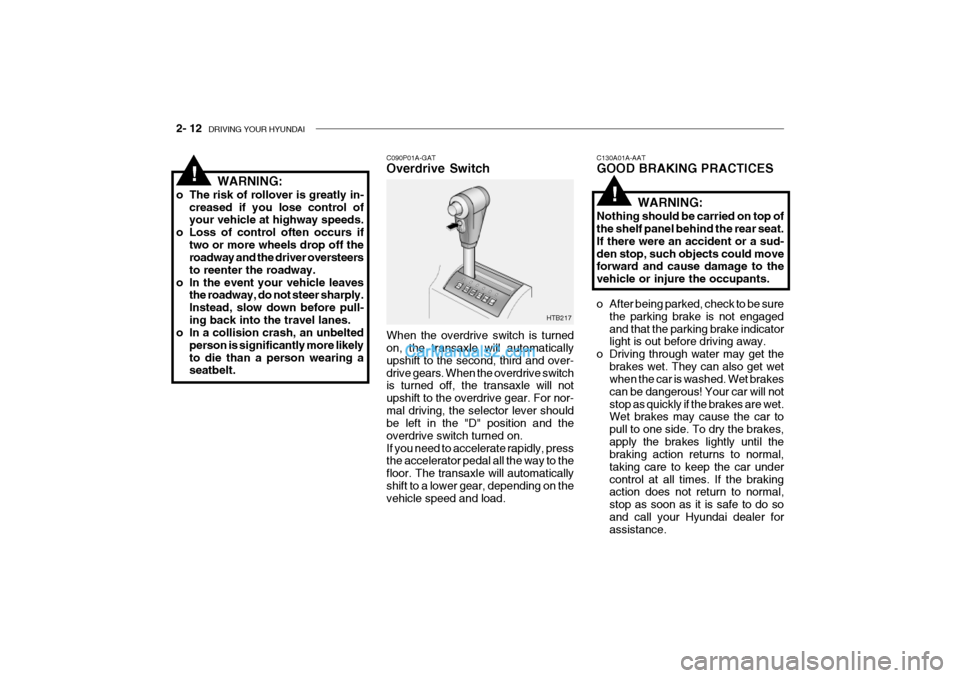
When the overdrive switch is turned on, the transaxle will automatically upshift to the second, third and over-drive gears. When the overdrive switch is turned off, the transaxle will not upshift to the overdrive gear. For nor-mal driving, the selector lever should be left in the "D" position and the overdrive switch turned on.If you need to accelerate rapidly, press the accelerator pedal all the way to the floor. The transaxle will automaticallyshift to a lower gear, depending on the vehicle speed and load.
!WARNING:
o The risk of rollover is greatly in- creased if you lose control of your vehicle at highway speeds.
o Loss of control often occurs if
two or more wheels drop off theroadway and the driver oversteers to reenter the roadway.
o In the event your vehicle leaves the roadway, do not steer sharply.Instead, slow down before pull-ing back into the travel lanes.
o In a collision crash, an unbelted
person is significantly more likelyto die than a person wearing a seatbelt.
Page 134 of 428
DRIVING YOUR HYUNDAI 2- 13
o Don't coast down hills with the car
out of gear. This is extremely haz-
ardous. Keep the car in gear at alltimes, use the brakes to slow down,
then shift to a lower gear so that engine braking will help you main-tain a safe speed.
o Don't "ride" the brake pedal. Rest-
ing your foot on the brake pedal
while driving can be dangerous be- cause it can result in the brakes overheating and losing their effec-tiveness. It also increases the wear of the brake components.
o If a tire goes flat while you are driving, apply the brakes gently andkeep the car pointed straight ahead while you slow down. When you are
moving slowly enough for it to be safe to do so, pull off the road and stop in a safe place.
o If your car is equipped with an auto- matic transaxle, don't let your carcreep forward. To avoid creepingforward, keep your foot on the brake
pedal when the car is stopped.
o Use caution when parking on a hill. Engage the parking brake and place
the gear selector lever in "P" (auto- matic transaxle) or in first or reverse gear (manual transaxle). If your car is facing downhill, turn the front wheels into the curb to help keep thecar from rolling. If your car is facing
uphill, turn the front wheels away from the curb to help keep the carfrom rolling. If there is no curb or if it is required by other conditions to keep the carfrom rolling, block the wheels.
o Under some conditions your park-
ing brake can freeze in the engagedposition. This is most likely to hap- pen when there is an accumulation of snow or ice around or near therear brakes or if the brakes are wet. If there is a risk that the parking brake may freeze, apply it only tem-porarily while you put the gear se- lector lever in "P" (automatic) or in first or reverse gear (manualtransaxle) and block the rear wheels so the car cannot roll. Then release the parking brake.
o Do not hold the vehicle on the up- grade with the accelerator pedal.This can cause the transmission tooverheat. Always use the brake pedal or parking brake. C120A02A-AAT ANTI-LOCK BRAKE SYSTEM (If Installed) The Anti-Lock Brake System (ABS) is designed to prevent wheel lock-up during sudden braking or on hazard-ous road surfaces. The ABS control module monitors the wheel speed and controls the pressure applied to eachbrake. Thus, in emergency situations or on slick roads, ABS will increase vehicle control during braking. NOTE: During ABS operation, a slight pul- sation may be felt in the brake pedalwhen the brakes are applied. Also, a noise may be heard in the engine compartment while braking. Theseconditions are normal and indicate that the anti-lock brake system is functioning properly.
Page 138 of 428
DRIVING YOUR HYUNDAI 2- 17
C160K01A-AAT Carry Emergency Equipment Depending on the severity of the weather where you drive your car, you should carry appropriate emergencyequipment. Some of the items you may want to carry include tire chains, tow straps or chains, flashlight, emer-gency flares, sand, a shovel, jumper cables, a window scraper, gloves, ground cloth, coveralls, a blanket, etc.
C160H01A-AAT Use Approved Anti-Freeze in
Window Washer System To keep the water in the window washer system from freezing, add an approved anti-freeze solution in accordance withinstructions on the container. Window washer anti-freeze is available from Hyundai dealers and most auto partsoutlets. Do not use engine coolant or other types of anti-freeze as these may damage the finish. C160I01A-AAT Don't Let Your Parking Brake Freeze Under some conditions your parking brake can freeze in the engaged posi- tion. This is most likely to happenwhen there is an accumulation of snow or ice around or near the rear brakes or if the brakes are wet. If there is a riskthe parking brake may freeze, apply it only temporarily while you put the gear selector lever in "P" (automatic) or infirst or reverse gear (manual transaxle) and block the rear wheels so the car cannot roll. Then release the parkingbrake. C160J01A-AAT Don't Let Ice and Snow Accumu- late Underneath Under some conditions, snow and ice can build up under the fenders and interfere with the steering. When driv-ing in severe winter conditions where this may happen, you should periodi- cally check underneath the car to besure the movement of the front wheels and the steering components is not obstructed.
C170A01A-AAT HIGHER SPEED MOTORING Pre-Trip Inspections 1. Tires: Adjust the tire inflation pressures to specification. Low tire inflation pres- sures will result in overheating andpossible failure of the tires. Avoid using worn or damaged tires which may result in reduced traction ortire failure. NOTE: Never exceed the maximum tire in- flation pressure shown on the tires. 2. Fuel, engine coolant and en- gine oil: High speed travel consumes 1.5 times more fuel than urban motoring. Do not forget to check both engine coolantand engine oil. 3. Drive belt: A loose or damaged drive belt may result in overheating of the engine.
Page 142 of 428

DRIVING YOUR HYUNDAI 2- 21
6. Check the condition and air pres-
sure of all tires on the trailer and your car. Low tire pressure canseriously affect the handling. Also check the spare tire.
7. The vehicle/trailer combination is more affected by crosswind andbuffeting. When being passed by a largevehicle, keep a constant speed and steer straight ahead. If there is too much wind buffeting slow downto get out of the other vehicle's air turbulence.
8. When parking your car and trailer, especially on a hill, be sure to fol-low all the normal precautions. Turn your front wheel into the curb, setthe parking brake firmly, and put the transaxle in 1st or Reverse (manual) or Park (automatic). Inaddition, place wheel chocks at each of the trailer's tires.
9. If the trailer has electric brakes, start your vehicle and trailer mov-ing, and then apply the trailer brake controller by hand to be sure thebrakes are working. This lets you check your electrical connection at the same time. 10. During your trip, check occasion-
ally to be sure that the load issecure, and that the lights andany trailer brakes are still working.
11. Avoid jerky starts, sudden accel-
eration or sudden stops.
12. Avoid sharp turns and rapid lane changes.
13. Avoid holding the brake pedal down
too long or too frequently. This could cause the brakes to over- heat, resulting in reduced brakingefficiency.
14. When going down a hill, shift into a
lower gear and use the engine brak-ing effect. When ascending a long grade, downshift the transaxle to a lowergear and reduce speed to reduce chances of engine overloading and/ or overheating.
15. If you have to stop while going uphill, do not hold the vehicle inplace by pressing on the accelera-tor. This can cause the automatic transaxle to overheat. Use the park- ing brake or footbrake.
NOTE: When towing check transaxle fluid more frequently. CAUTION:
If overheating should occur whentowing, (temperature gauge readsnear red zone), taking the following action may reduce or eliminate the problem.
1. Turn off the air conditioner.
2. Reduce highway speed.
3. Select a lower gear when going uphill.
4. While in stop and go traffic, place the gear selection in park or neutral and idle the engine at a higher speed.
!
Page 146 of 428
3- 4 WHAT TO DO IN AN EMERGENCY
D030A01TB-AAT IF THE ENGINE OVERHEATS If your temperature gauge indicates overheating, you experience a loss of power, or hear loud pinging or knock- ing, the engine is probably too hot. Ifthis happens to you, you should:
1. Pull off the road and stop as soon as
it is safe to do so.
2. Place the gear selector lever in "P"
(automatic), or neutral (manual transaxle) and set the parking brake. If the air conditioning is on, turn it off.
6. Carefully remove the jumper cables
in the reverse order of attachment.
If you do not know why your battery became discharged (because the lights were left on, etc.), have the chargingsystem checked by your Hyundai dealer. 3. If engine coolant is running out un-
der the car or steam is coming out from the hood, stop the engine. Donot open the hood until the engine coolant has stopped running or the steaming has stopped. If there is novisible loss of engine coolant and no steam, leave the engine running and check to be sure the enginecooling fan is operating. If the fan is not running, turn the engine off.
4. Check to see if the water pump drive belt is missing. If it is not missing,check to see that it is tight. If the drive belt seems to be satisfactory,check for coolant leaking from the radiator, hoses or under the car. (If the air conditioning had been in use,it is normal for cold water to be draining from it when you stop). WARNING (Diesel only):
Never work on injection system with engine running or within 30 sec- onds after shutting off engine. High pressure pump, rail, injectors andhigh pressure pipes are subject to high pressure even after the engine stopped. The fuel jet produced byfuel leaks may cause serious in- jury, if it touch the body. People using pacemakers should not movethan 30cm closer to the ECU or wiring harness within the engine room while engine is running, sincethe high currents in the Common Rail system produce considerable magnetic fields.
WARNING:
While the engine is running, keep hair, hands, and clothing away from moving parts such as the fan anddrive belts to prevent injury.
!
!
5. If the water pump drive belt is bro- ken or coolant is leaking out, stop the engine immediately and call the nearest Hyundai dealer for assis-tance.
Page 148 of 428
3- 6 WHAT TO DO IN AN EMERGENCY
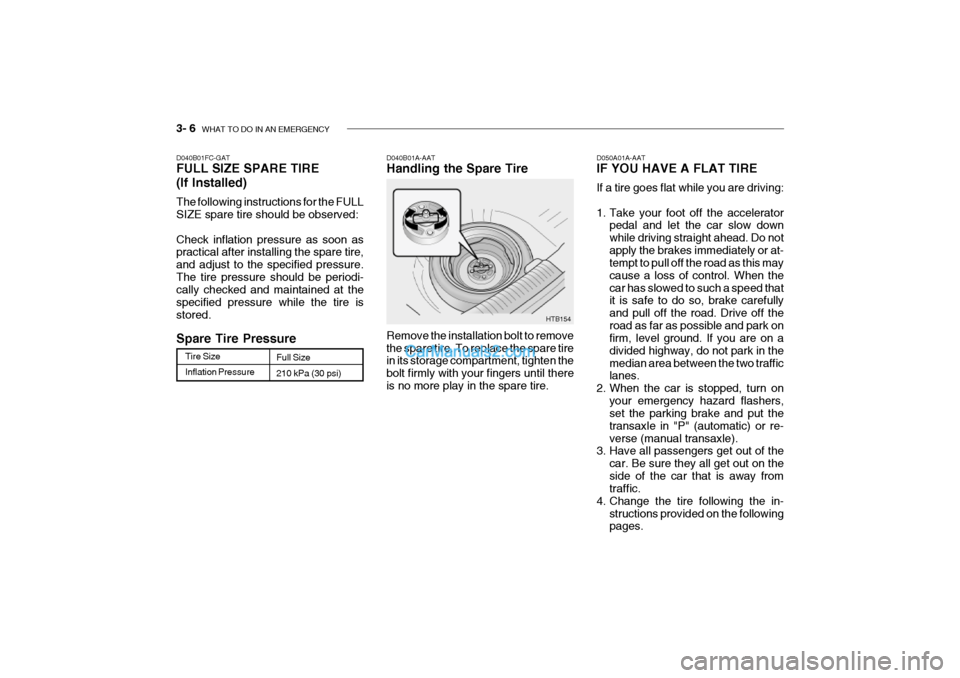
HTB154
D040B01A-AAT Handling the Spare Tire Remove the installation bolt to remove the spare tire. To replace the spare tire in its storage compartment, tighten the bolt firmly with your fingers until thereis no more play in the spare tire. D050A01A-AAT IF YOU HAVE A FLAT TIRE If a tire goes flat while you are driving:
1. Take your foot off the accelerator
pedal and let the car slow down while driving straight ahead. Do notapply the brakes immediately or at- tempt to pull off the road as this may cause a loss of control. When thecar has slowed to such a speed that it is safe to do so, brake carefully and pull off the road. Drive off theroad as far as possible and park on firm, level ground. If you are on a divided highway, do not park in themedian area between the two traffic lanes.
2. When the car is stopped, turn on your emergency hazard flashers,set the parking brake and put the transaxle in "P" (automatic) or re-verse (manual transaxle).
3. Have all passengers get out of the
car. Be sure they all get out on theside of the car that is away from traffic.
4. Change the tire following the in- structions provided on the followingpages.
Inflation Pressure
Tire Size
D040B01FC-GAT FULL SIZE SPARE TIRE (If Installed) The following instructions for the FULL SIZE spare tire should be observed: Check inflation pressure as soon as practical after installing the spare tire, and adjust to the specified pressure.The tire pressure should be periodi- cally checked and maintained at the specified pressure while the tire isstored. Spare Tire Pressure
Full Size 210 kPa (30 psi)