stop start Hyundai H-100 Truck 2011 Owner's Manual
[x] Cancel search | Manufacturer: HYUNDAI, Model Year: 2011, Model line: H-100 Truck, Model: Hyundai H-100 Truck 2011Pages: 211, PDF Size: 8.37 MB
Page 14 of 211
1FEATURES OF YOUR HYUNDAI
2
!
FUEL RECOMMENDATIONS
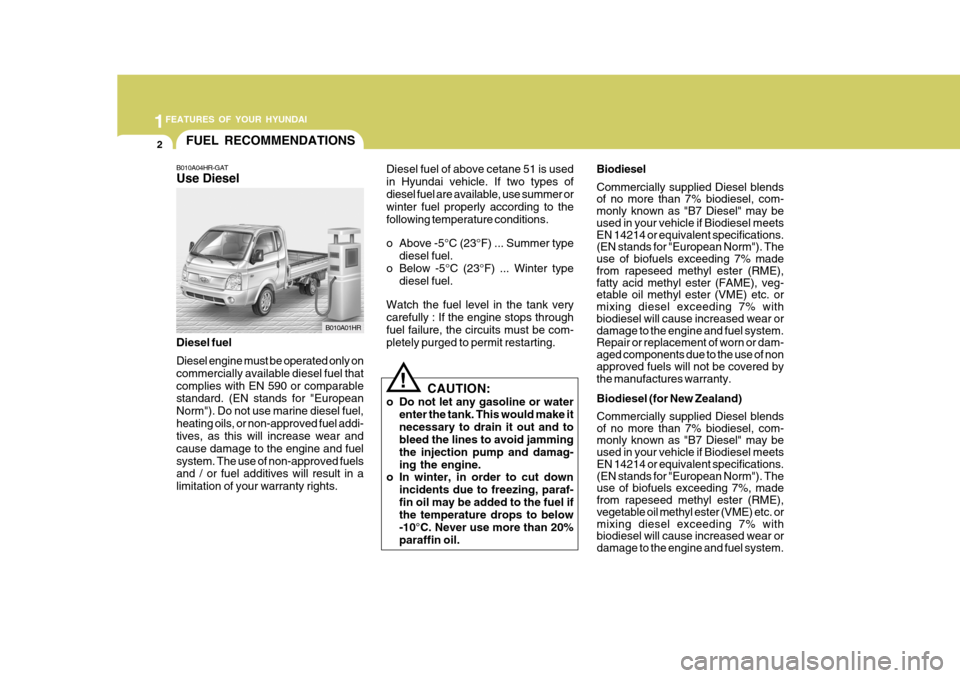
B010A04HR-GAT Use Diesel
CAUTION:
o Do not let any gasoline or water enter the tank. This would make it necessary to drain it out and to bleed the lines to avoid jamming the injection pump and damag-ing the engine.
o In winter, in order to cut down
incidents due to freezing, paraf-fin oil may be added to the fuel if the temperature drops to below -10°C. Never use more than 20%paraffin oil.
Diesel fuel Diesel engine must be operated only on commercially available diesel fuel thatcomplies with EN 590 or comparable standard. (EN stands for "European Norm"). Do not use marine diesel fuel,heating oils, or non-approved fuel addi- tives, as this will increase wear and cause damage to the engine and fuelsystem. The use of non-approved fuels and / or fuel additives will result in a limitation of your warranty rights.
B010A01HR
Diesel fuel of above cetane 51 is usedin Hyundai vehicle. If two types ofdiesel fuel are available, use summer or winter fuel properly according to the following temperature conditions.
o Above -5°C (23°F) ... Summer type
diesel fuel.
o Below -5°C (23°F) ... Winter type
diesel fuel.
Watch the fuel level in the tank very carefully : If the engine stops through fuel failure, the circuits must be com- pletely purged to permit restarting. Biodiesel Commercially supplied Diesel blends of no more than 7% biodiesel, com- monly known as "B7 Diesel" may be used in your vehicle if Biodiesel meets EN 14214 or equivalent specifications. (EN stands for "European Norm"). The use of biofuels exceeding 7% made from rapeseed methyl ester (RME), fatty acid methyl ester (FAME), veg- etable oil methyl ester (VME) etc. or mixing diesel exceeding 7% with biodiesel will cause increased wear or damage to the engine and fuel system. Repair or replacement of worn or dam- aged components due to the use of non approved fuels will not be covered by the manufactures warranty.
Biodiesel (for New Zealand) Commercially supplied Diesel blends of no more than 7% biodiesel, com- monly known as "B7 Diesel" may be used in your vehicle if Biodiesel meets EN 14214 or equivalent specifications. (EN stands for "European Norm"). The use of biofuels exceeding 7%, made from rapeseed methyl ester (RME), vegetable oil methyl ester (VME) etc. or mixing diesel exceeding 7% with biodiesel will cause increased wear or damage to the engine and fuel system.
Page 15 of 211
1
FEATURES OF YOUR HYUNDAI
3BREAKING IN YOUR NEW HYUNDAI
B010F01A-AAT Operation in Foreign Countries If you are going to drive your Hyundai in another country, be sure to:
o Observe all regulations regarding registration and insurance.
o Determine that acceptable fuel is available. B020B01HR-GAT During the First 1,000 Km (600 Miles) No formal "break-in" procedure is re- quired with your new Hyundai. How-ever, you can contribute to the eco- nomical operation and durability of your Hyundai by observing the followingrecommendations during the first 1,000 km (600 miles).
o While driving, keep your engine
speed (rpm, or revolutions per minute) between 2,000 rpm and 4,000rpm.
o While driving, keep under three quar-
ters of maximum speed.
o Use moderate acceleration. Don't start, depress the accelerator pedalfully.
o For the first 300 km (200 miles), try to avoid hard stops.
o Don't lug the engine (in other words, don't drive so slowly in too-high a gear that the engine "bucks": shift to a lower gear).
CAUTION:
o Never use any fuel, whether diesel or B7 biodiesel or otherwise, thatfails to meet the latest petroleumindustry specification.
o Never use any fuel additives or
treatments that are not recom-mended or approved by the ve- hicle manufacturer.
! o Whether going fast or slow, vary your
speed from time to time.
o Don't let the engine idle longer than 3 minutes at one time.
o Don't tow a trailer during the first
1,000 km (600 miles) of operation.
o Do not exceed loading limits. B030A01P-GAT Before Operation Precautions for New Vehicle The performance and life of a vehicle depend largely on how the vehicle is handled when new.To maintain the parts smoothly and sustain high performance for a long time to come, be sure to observe thefollowing points. Make sure that your vehicle does not miss the first 5,000 km inspections. After the first 5,000 km of driving, take your vehicle to your nearest service shop for inspection.
Repair or replacement of worn or dam- aged components due to the use of non approved fuels will not be covered by the manufactures warranty.
Page 38 of 211
1FEATURES OF YOUR HYUNDAI
26WARNING AND INDICATOR LIGHTS
!
B260F01A-AAT
High Beam Indicator Light
The high beam indicator light comes on whenever the headlights are switched to the high beam or flash position. B260H02O-GAT
Parking Brake/Low Brake Fluid Level Warning Light
B260G01A-AAT
Low Oil PressureWarning Light
!CAUTION:
If the oil pressure warning light stays on while the engine is running, seri- ous engine damage may result. Theoil pressure warning light comes on whenever there is insufficient oil pres- sure. In normal operation, it shouldcome on when the ignition switch is turned on, then go out when the en- gine is started. If the oil pressurewarning light stays on while the en- gine is running, there may be a seri- ous malfunction.If this happens, stop the car as soon as it is safe to do so, turn off the
engine and check the oil level. If the oil level is low, fill the engine oil to the proper level and start the engine again. If the light stays on with theengine running, turn the engine off immediately. In any instance where the oil light stays on when the engineis running, the engine should be checked by an authorized Hyundai dealer before the car is driven again. WARNING:
If you suspect brake trouble, haveyour brakes checked by a Hyundaidealer as soon as possible. Driving your car with a problem in either the brake electrical system or brake hy-draulic system is dangerous, and could result in a serious injury or death.
B260D01A-AAT
Turn Signal Indicator Lights
The blinking green arrows on the in- strument panel show the direction indi- cated by the turn signals. If the arrowcomes on but does not blink, blinks more rapidly than normal, or does not illuminate at all, a malfunction in theturn signal system is indicated. Your dealer should be consulted for repairs.
Warning Light Operation The parking brake/low brake fluid level warning light should come on when the parking brake is applied and the ignitionswitch is turned to "ON" or "START". After the engine is started, the light should go out when the parking brake isreleased. If the parking brake is not applied, the warning light should come on when theignition switch is turned to "ON" or "START", then go out when the engine starts. If the light comes on at any other
Page 39 of 211
1
FEATURES OF YOUR HYUNDAI
27
! B260J01S-GAT
Charging System Warning Light
The charging system warning light should come on when the ignition isturned on, then go out when the engine is running. If the light stays on while the engine is running, there is a malfunc-tion in the electrical charging system. If the light comes on while you are driv- ing, stop, turn off the engine and checkunder the hood. First, make certain the generator drive belt is in place. If it is, check the tension of the belt.And then, have the system checked by your Hyundai dealer.
CAUTION:
If the drive belt (generator belt) is loosen, broken, or mission while the vehicle is driving, there may be a serious malfunction, engine couldoverheat because this belt also drives the water pump.!
time, you should slow the vehicle and bring it to a complete stop in a safelocation off the roadway. The brake fluid level warning light indi- cates that the brake fluid level in thebrake master cylinder is low and hy- draulic brake fluid conforming to DOT 3 or DOT 4 specifications should be added.After adding fluid, if no other trouble is found, the car should be immediately and carefully driven to a Hyundai dealerfor inspection. If further trouble is expe- rienced, the vehicle should not be driven at all but taken to a dealer by a profes-sional towing service or some other safe method. Your Hyundai is equipped with dual-diagonal braking systems. This means you still have braking on two wheels even if one of the dual systems shouldfail. With only one of the dual systems working, more than normal pedal travel and greater pedal pressure are requiredto stop the car. Also, the car will not stop in as short a distance with only half of the brake system working. If thebrakes fail while you are driving, shift to a lower gear for additional engine brak- ing and stop the car as soon as it is safeto do so. CAUTION:
The parking brake/low brake fluid warning light should also come on when the vacuum level in brakebooster descends to about 275 mmHg or below. The brake system is de- signed to stop the vehicle with re-serve assist if brake pedal is held down. This reserve is greatly reduced each time you release the brake.Without vacuum assist your vehicle can still be stopped by pushing much harder on brake pedal, however thestopping distance may be much longer. If the light comes on at any other time, you should slow the ve-hicle and bring it to a complete stop in a safe location off the roadway. After starting the engine, do not drivethe vehicle until the vacuum level is above 275 mmHg below atmosphere and warning light has turned off. Iffurther trouble is experienced, the vehicle should not be driven at all but taken to a dealer by a profes-sional towing service.
Page 50 of 211
1FEATURES OF YOUR HYUNDAI
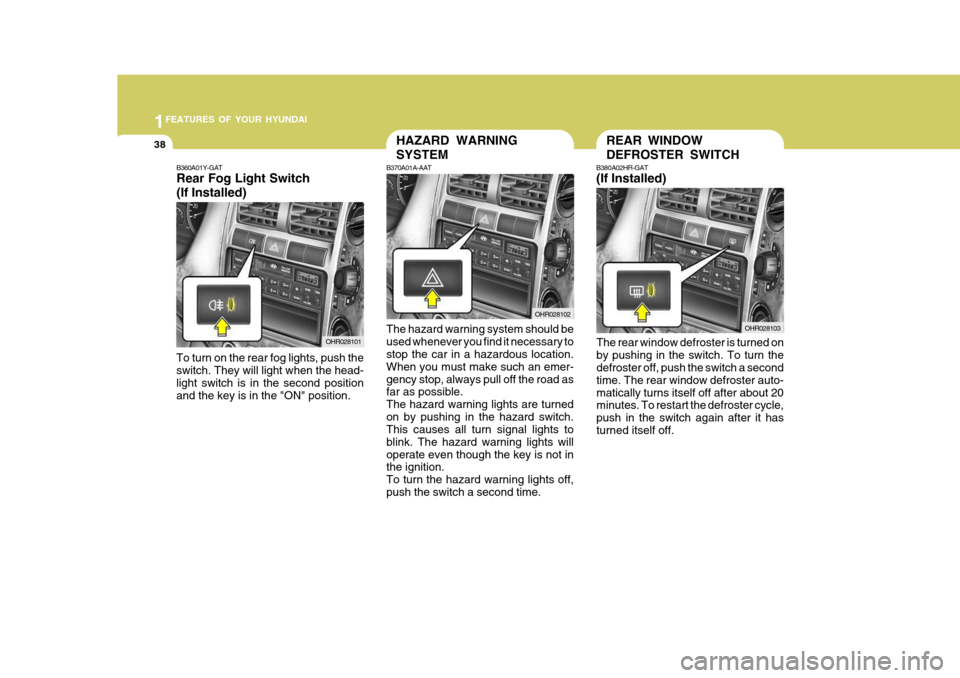
38REAR WINDOW DEFROSTER SWITCH
B380A02HR-GAT (If Installed)
The rear window defroster is turned on by pushing in the switch. To turn the defroster off, push the switch a second time. The rear window defroster auto-matically turns itself off after about 20 minutes. To restart the defroster cycle, push in the switch again after it hasturned itself off. OHR028103HAZARD WARNING SYSTEM
B370A01A-AAT The hazard warning system should be used whenever you find it necessary to stop the car in a hazardous location. When you must make such an emer-gency stop, always pull off the road as far as possible. The hazard warning lights are turnedon by pushing in the hazard switch. This causes all turn signal lights to blink. The hazard warning lights willoperate even though the key is not in the ignition. To turn the hazard warning lights off,push the switch a second time. OHR028102
B360A01Y-GAT Rear Fog Light Switch (If Installed)
To turn on the rear fog lights, push the switch. They will light when the head- light switch is in the second position and the key is in the "ON" position. OHR028101
Page 60 of 211
1FEATURES OF YOUR HYUNDAI
48
!WARNING:
o Make sure to refuel your vehicle according to the "Fuel require- ments" suggested in section 1.
o Fuel vapors are dangerous. Be-
fore refueling, always stop theengine and never allow sparks or open flames near the tank area. If you need to replace the tank cap,use a genuine Hyundai replace- ment part. If you open the fuel tank cap dur-ing high ambient temperatures, a slight "pressure sound" may be heard. This is normal and not acause for concern. Whenever you open the fuel tank cap, turn it slowly.
o Automotive fuels are flammable/ explosive materials. When refuel-ing, please note the followingguidelines carefully.
- Before touching the fuel nozzle or
fuel tank cap, have one's hands incontact with metal parts away from the tank neck to discharge static electricity.
FUEL TANK CAP
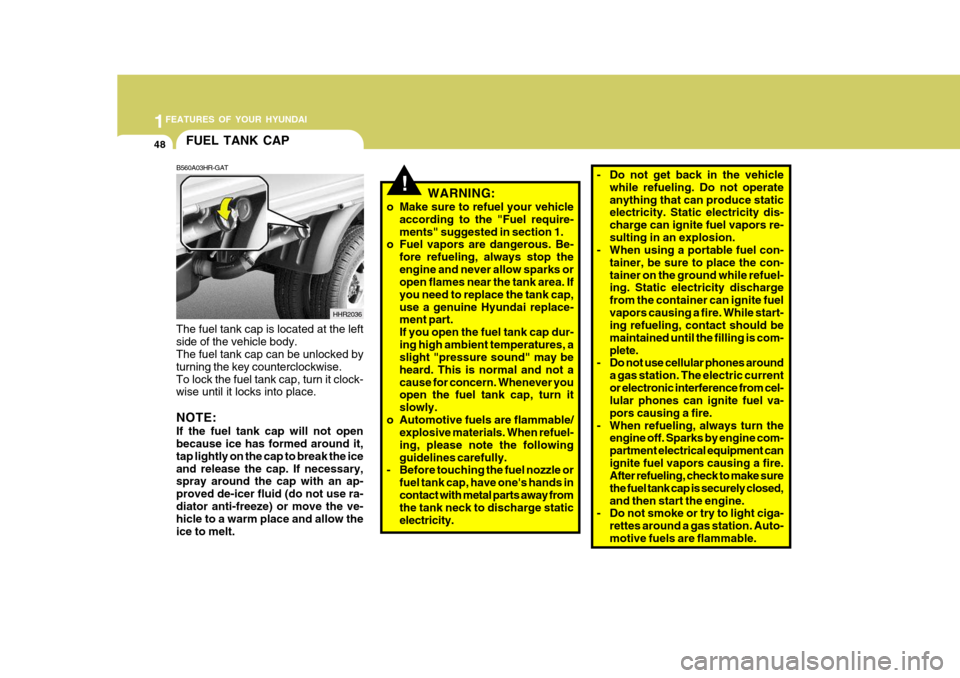
B560A03HR-GAT
The fuel tank cap is located at the left side of the vehicle body. The fuel tank cap can be unlocked by turning the key counterclockwise.To lock the fuel tank cap, turn it clock- wise until it locks into place. NOTE: If the fuel tank cap will not open because ice has formed around it, tap lightly on the cap to break the iceand release the cap. If necessary, spray around the cap with an ap- proved de-icer fluid (do not use ra-diator anti-freeze) or move the ve- hicle to a warm place and allow the ice to melt. HHR2036
- Do not get back in the vehicle
while refueling. Do not operateanything that can produce static electricity. Static electricity dis- charge can ignite fuel vapors re-sulting in an explosion.
- When using a portable fuel con-
tainer, be sure to place the con-tainer on the ground while refuel- ing. Static electricity discharge from the container can ignite fuelvapors causing a fire. While start- ing refueling, contact should be maintained until the filling is com-plete.
- Do not use cellular phones around
a gas station. The electric currentor electronic interference from cel- lular phones can ignite fuel va- pors causing a fire.
- When refueling, always turn the engine off. Sparks by engine com-partment electrical equipment canignite fuel vapors causing a fire. After refueling, check to make sure the fuel tank cap is securely closed,and then start the engine.
- Do not smoke or try to light ciga-
rettes around a gas station. Auto-motive fuels are flammable.
Page 89 of 211
1
FEATURES OF YOUR HYUNDAI
77
K220D01HR-GAT
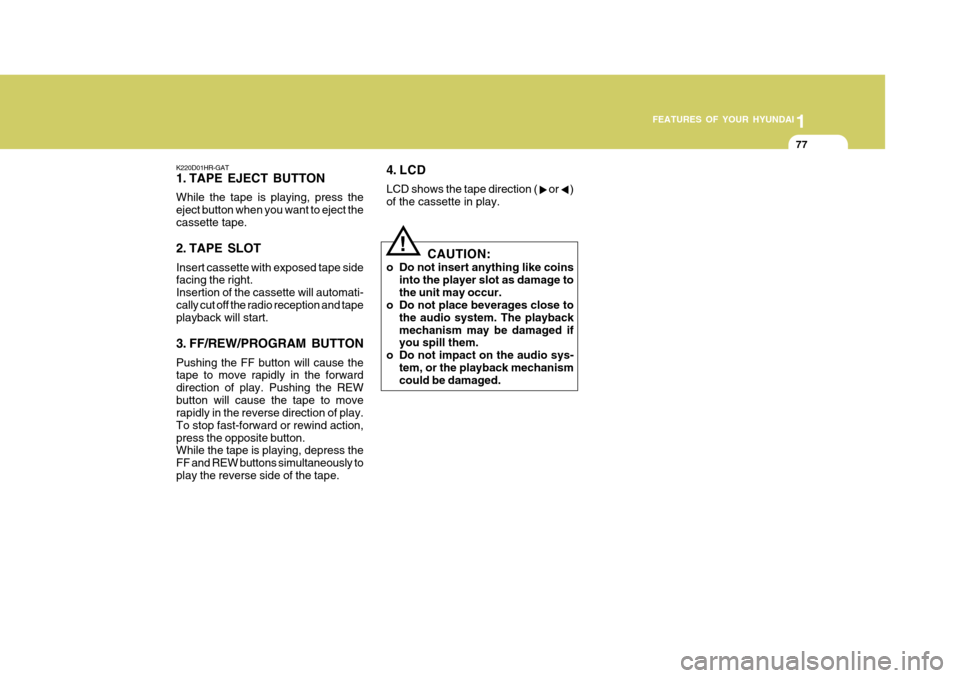
1. TAPE EJECT BUTTON While the tape is playing, press the eject button when you want to eject thecassette tape.
2. TAPE SLOT Insert cassette with exposed tape side facing the right. Insertion of the cassette will automati-cally cut off the radio reception and tape playback will start.
3. FF/REW/PROGRAM BUTTON Pushing the FF button will cause the tape to move rapidly in the forward direction of play. Pushing the REWbutton will cause the tape to move rapidly in the reverse direction of play. To stop fast-forward or rewind action,press the opposite button. While the tape is playing, depress the FF and REW buttons simultaneously toplay the reverse side of the tape.
!
4. LCD LCD shows the tape direction ( or ) of the cassette in play.CAUTION:
o Do not insert anything like coins into the player slot as damage to the unit may occur.
o Do not place beverages close to
the audio system. The playbackmechanism may be damaged if you spill them.
o Do not impact on the audio sys-
tem, or the playback mechanismcould be damaged.
Page 99 of 211
2
DRIVING YOUR HYUNDAI
3
!
TO START THE ENGINEBEFORE STARTING THE EN- GINE
C020A02A-AAT Before you start the engine, you should always:
1. Look around the vehicle to be sure
there are no flat tires, puddles of oil, water or other indications of pos- sible trouble.
2. After entering the car, check to be sure the parking brake is engaged.
3. Check that all windows, and lights are clean.
4. Check that the interior and exterior
mirrors are clean and in position.
5. Check your seat, seatback and headrest to be sure they are in theirproper positions.
6. Lock all the doors.
7. Fasten your seat belt and be sure
that all other occupants have fas- tened theirs.
8. Turn off all lights and accessories
that are not needed.
9. When you turn the ignition switch to "ON", check that all appropriatewarning lights are operating andthat you have sufficient fuel.
10.Check the operation of warning
lights and all bulbs when key is inthe "ON" position. C030A03HR-GAT COMBINATION IGNITION SWITCH
o Place the shift lever in neutral and
depress the clutch pedal fully.
o To start the engine, insert the igni- tion key and turn it to the "START" position. Release it as soon as theengine starts. Do not hold the key in the "START" position for more than 15 seconds.
!WARNING:
To ensure that sufficient vacuum exists within the brake system dur-ing cold weather start-up condi- tions, it is necessary to run the engine at idle for several secondsafter starting the engine.
WARNING:
Always wear appropriate shoes when operating your vehicle. Unsuitable shoes (high heels, ski boots,etc.)may interfere with your ability to use the brake and accelerator pedal, and the clutch (if installed).
!WARNING:
When you intend to park or stop the vehicle with the engine on, be care- ful not to depress the acceleratorpedal for a long period of time. It may overheat the engine or exhaust sys- tem and cause fire.
Page 102 of 211
2 DRIVING YOUR HYUNDAI
6
!
!
C055B01HR-GAT STARTING AND STOPPING THE ENGINE FOR TURBO CHARGERINTERCOOLER (Diesel Engine)
(1) Do not race, accelerate suddenly,
or accelerate immediately the en- gine after starting it. If the engine iscold, allow the engine to idle for several seconds before it is driven to ensure sufficient lubrication ofthe turbo charger unit. WARNING:
Be sure that the clutch is fully de- pressed when starting a manual transmission vehicle. Otherwisethere is the potential to cause dam- age to the vehicle or injury to some- one inside or outside the vehicle asa result of the forward or backward movement of the vehicle that will occur if the clutch is not depressedwhen the vehicle is started.
5. Turn the ignition key to the "START" position and release it when the engine starts.
WARNING:
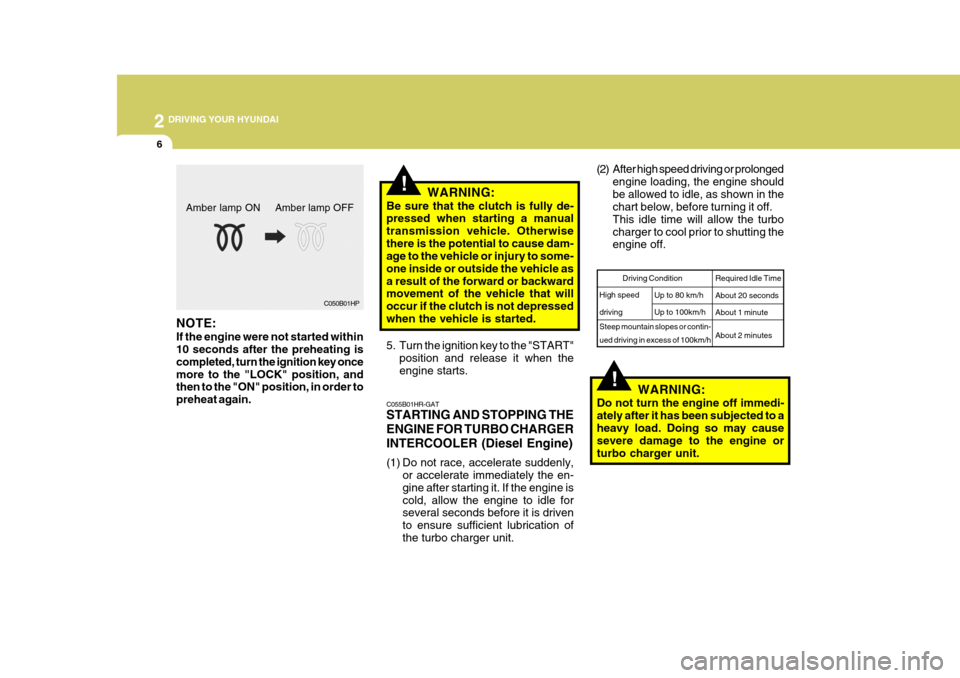
Do not turn the engine off immedi-ately after it has been subjected to aheavy load. Doing so may cause severe damage to the engine or turbo charger unit. High speed driving
Up to 80 km/hUp to 100km/h
Driving Condition
Required Idle Time About 20 secondsAbout 1 minute About 2 minutes
Steep mountain slopes or contin- ued driving in excess of 100km/h
(2) After high speed driving or prolonged
engine loading, the engine should be allowed to idle, as shown in the chart below, before turning it off. This idle time will allow the turbocharger to cool prior to shutting the engine off.
C050B01HP
NOTE: If the engine were not started within 10 seconds after the preheating is completed, turn the ignition key oncemore to the "LOCK" position, and then to the "ON" position, in order to preheat again. Amber lamp ON Amber lamp OFF
Page 103 of 211
2
DRIVING YOUR HYUNDAI
7
CAUTION:
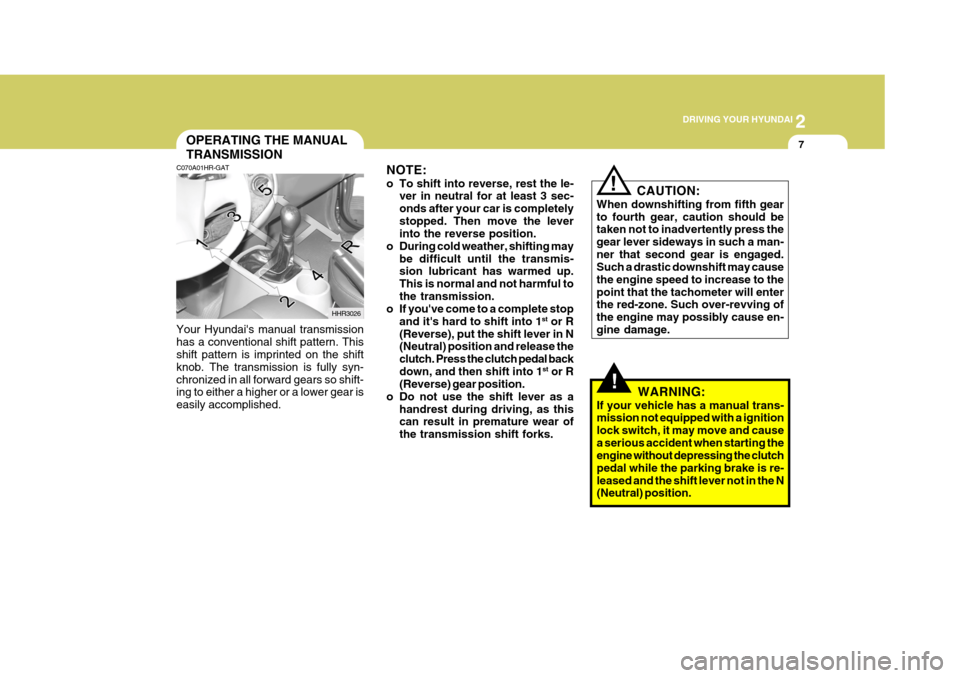
When downshifting from fifth gear to fourth gear, caution should be taken not to inadvertently press the gear lever sideways in such a man-ner that second gear is engaged. Such a drastic downshift may cause the engine speed to increase to thepoint that the tachometer will enter the red-zone. Such over-revving of the engine may possibly cause en-gine damage.!
OPERATING THE MANUAL TRANSMISSION
HHR3026NOTE:
o To shift into reverse, rest the le-
ver in neutral for at least 3 sec- onds after your car is completelystopped. Then move the lever into the reverse position.
o During cold weather, shifting may be difficult until the transmis-sion lubricant has warmed up. This is normal and not harmful tothe transmission.
o If you've come to a complete stop
and it's hard to shift into 1 st
or R
(Reverse), put the shift lever in N (Neutral) position and release the clutch. Press the clutch pedal backdown, and then shift into 1 st
or R
(Reverse) gear position.
o Do not use the shift lever as a handrest during driving, as this can result in premature wear of the transmission shift forks.
C070A01HR-GAT Your Hyundai's manual transmission has a conventional shift pattern. This shift pattern is imprinted on the shift knob. The transmission is fully syn-chronized in all forward gears so shift- ing to either a higher or a lower gear is easily accomplished.
!WARNING:
If your vehicle has a manual trans- mission not equipped with a ignition lock switch, it may move and causea serious accident when starting the engine without depressing the clutch pedal while the parking brake is re-leased and the shift lever not in the N (Neutral) position.