ESP HYUNDAI IX35 2016 Repair Manual
[x] Cancel search | Manufacturer: HYUNDAI, Model Year: 2016, Model line: IX35, Model: HYUNDAI IX35 2016Pages: 550, PDF Size: 9.92 MB
Page 412 of 550
Driving your vehicle64
5To keep locks from freezingTo keep the locks from freezing, squirt an
approved de-icer fluid or glycerine into
the key opening. If a lock is covered with
ice, squirt it with an approved de-icing
fluid to remove the ice. If the lock is
frozen internally, you may be able to thaw
it out by using a heated key. Handle the
heated key with care to avoid injury.Use approved window washer
anti-freeze in systemTo keep the water in the window washer
system from freezing, add an approved
window washer anti-freeze solution in
accordance with instructions on the con-
tainer. Window washer anti-freeze is
available from a HYUNDAI authorised
repairer and most auto parts outlets. Do
not use engine coolant or other types of
anti-freeze as these may damage the
paint finish.
Don't let your parking brake
freezeUnder some conditions your parking
brake can freeze in the engaged position.
This is most likely to happen when there
is an accumulation of snow or ice around
or near the rear brakes or if the brakes
are wet. If there is a risk the parking
brake may freeze, apply it only temporar-
ily whilst you put the shift lever in P (auto-
matic transaxle) or in first or reverse gear
(manual transaxle) and block the rear
wheels so the vehicle cannot roll. Then
release the parking brake.
Do not park a vehicle on a public road
without the parking brake applied.Don't let ice and snow accumu-
late underneathUnder some conditions, snow and ice
can build up under the fenders and inter-
fere with the steering. When driving in
severe winter conditions where this may
happen, you should periodically check
underneath the vehicle to be sure the
movement of the front wheels and the
steering components is not obstructed.
Carry emergency equipmentDepending on the severity of the weath-
er, you should carry appropriate emer-
gency equipment. Some of the items you
may want to carry include tyre chains,
tow straps or chains, flashlight, emer-
gency flares, sand, a shovel, jumper
cables, a window scraper, gloves, ground
cloth, coveralls, a blanket, etc.Don’t place foreign objects or
materials in the engine compart-
mentPlacement of foreign object or materials
which prevent cooling of the engine, in
the engine compartment, may cause a
failure or combustion. The manufacturer
is not responsible for the damage caused
by such placement.
EL(FL) UK 5.QXP 12/16/2014 8:10 PM Page 64
Page 415 of 550
567
Driving your vehicle
Safety cablesYou should always attach cables
between your vehicle and your trailer.
Cross the safety cables under the nose
of the trailer so that the nose will not drop
to the road if it becomes separated from
the towbar.
Instructions about safety cables may be
provided by the towbar manufacturer or
by the trailer manufacturer. Follow the
manufacturer’s recommendation for
attaching safety cables. Always leave just
enough slack so you can turn with your
trailer. And, never allow safety cables to
drag on the ground.
Trailer brakes If your trailer is equipped with a braking
system, make sure it conforms to local
regulations and that it is properly
installed and operating correctly.
If your trailer weight exceeds the maxi-
mum allowed weight without trailer
brakes, then the trailer will also require its
own brakes as well. Be sure to read and
follow the instructions for the trailer
brakes so you’ll be able to install, adjust
and maintain them properly.
Don’t tap into or modify your vehicle'sbrake system.
Driving with a trailer Towing a trailer requires a certain
amount of experience. Before setting out
for the open road, you must get to know
your trailer. Acquaint yourself with the
feel of handling and braking with the
added weight of the trailer. And always
keep in mind that the vehicle you are
driving is now a good deal longer and not
nearly so responsive as your vehicle is
by itself.
Before you start, check the trailer towbar
and platform, safety cables, electrical
connector(s), lights, tyres and mirror
adjustment. If the trailer has electric
brakes, start your vehicle and trailer mov-
ing and then apply the trailer brake con-
troller by hand to be sure the brakes are
working. This lets you check your electri-
cal connection at the same time.
During your trip, check occasionally to be
sure that the load is secure, and that the
lights and any trailer brakes are still work-
ing.
WARNING
- Trailer brakes
Do not use a trailer with its own
brakes unless you are absolutely
certain that you have properly set
up the brake system. This is not a
task for amateurs. Use an experi-
enced, competent trailer shop for
this work.
EL(FL) UK 5.QXP 12/16/2014 8:10 PM Page 67
Page 430 of 550
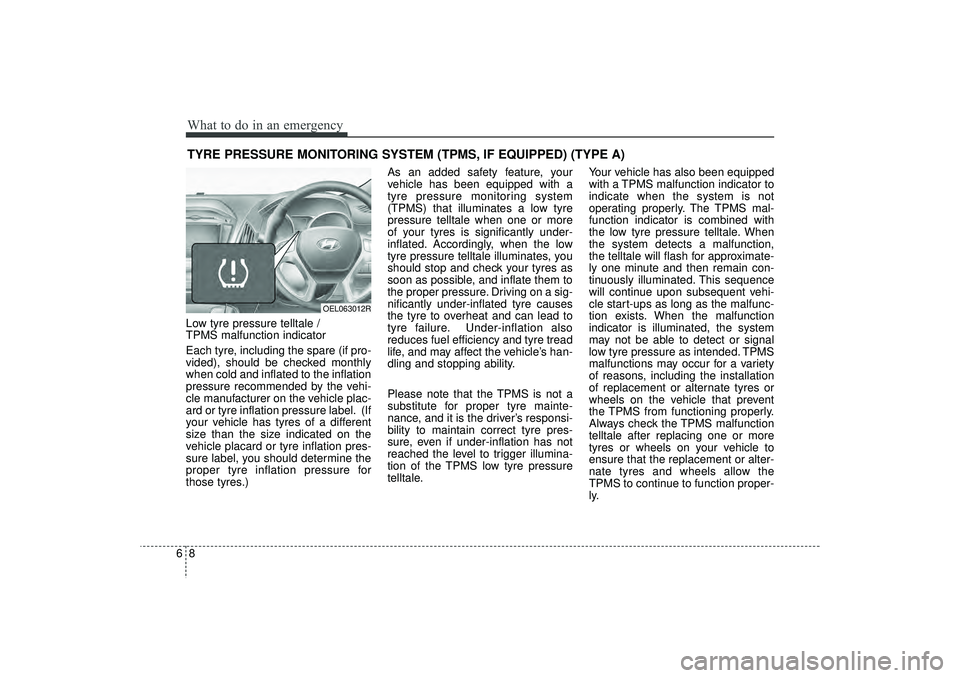
What to do in an emergency86TYRE PRESSURE MONITORING SYSTEM (TPMS, IF EQUIPPED) (TYPE A)Low tyre pressure telltale /
TPMS malfunction indicator
Each tyre, including the spare (if pro-
vided), should be checked monthly
when cold and inflated to the inflation
pressure recommended by the vehi-
cle manufacturer on the vehicle plac-
ard or tyre inflation pressure label. (If
your vehicle has tyres of a different
size than the size indicated on the
vehicle placard or tyre inflation pres-
sure label, you should determine the
proper tyre inflation pressure for
those tyres.)As an added safety feature, your
vehicle has been equipped with a
tyre pressure monitoring system
(TPMS) that illuminates a low tyre
pressure telltale when one or more
of your tyres is significantly under-
inflated. Accordingly, when the low
tyre pressure telltale illuminates, you
should stop and check your tyres as
soon as possible, and inflate them to
the proper pressure. Driving on a sig-
nificantly under-inflated tyre causes
the tyre to overheat and can lead to
tyre failure. Under-inflation also
reduces fuel efficiency and tyre tread
life, and may affect the vehicle’s han-
dling and stopping ability.
Please note that the TPMS is not a
substitute for proper tyre mainte-
nance, and it is the driver’s responsi-
bility to maintain correct tyre pres-
sure, even if under-inflation has not
reached the level to trigger illumina-
tion of the TPMS low tyre pressure
telltale.
Your vehicle has also been equipped
with a TPMS malfunction indicator to
indicate when the system is not
operating properly. The TPMS mal-
function indicator is combined with
the low tyre pressure telltale. When
the system detects a malfunction,
the telltale will flash for approximate-
ly one minute and then remain con-
tinuously illuminated. This sequence
will continue upon subsequent vehi-
cle start-ups as long as the malfunc-
tion exists. When the malfunction
indicator is illuminated, the system
may not be able to detect or signal
low tyre pressure as intended. TPMS
malfunctions may occur for a variety
of reasons, including the installation
of replacement or alternate tyres or
wheels on the vehicle that prevent
the TPMS from functioning properly.
Always check the TPMS malfunction
telltale after replacing one or more
tyres or wheels on your vehicle to
ensure that the replacement or alter-
nate tyres and wheels allow the
TPMS to continue to function proper-
ly.
OEL063012R
EL(FL) UK 6.QXP 12/16/2014 8:12 PM Page 8
Page 433 of 550
611
What to do in an emergency
Changing a tyre with TPMS
If you have a flat tyre, the Low Tyre
Pressure will come on. We recom-
mend that the flat tyre be checked by
a HYUNDAI authorised repairer.Each wheel is equipped with a tyre
pressure sensor mounted inside the
tyre behind the valve stem. You must
use TPMS specific wheels. It is rec-
ommended that you have your tyres
serviced by a HYUNDAI authorised
repairer.
Even if you replace the low pressure
tyre with the spare tyre, the Low Tyre
Pressure Telltale will blink or remain
on until the low pressure tyre is
repaired and placed on the vehicle.
After you replace the low pressure
tyre with the spare tyre, the Low Tyre
Pressure Telltale may blink or illumi-
nate after a few minutes because the
TPMS sensor mounted on the spare
wheel is not initiated.
Once the low pressure tyre is rein-
flated to the recommended pressure
and installed on the vehicle or we
recommend that the TPMS sensor
mounted on the replaced spare
wheel be initiated by a HYUNDAI
authorised repairer, the TPMS mal-
function indicator and the low tyre
pressure telltale will extinguish within
a few minutes of driving.If the indicator is not extinguished
after a few minutes of driving, We
recommend that the system be
checked by a HYUNDAI authorised
repairer.
CAUTION
If original mounted tyre is
replaced with the spare tyre, theTPMS sensor on the replacedspare wheel should be initiatedand we recommend that theTPMS sensor on the originalmounted wheel be deactivatedby a HYUNDAI dealer. If theTPMS sensor on the originalmounted wheel located in thespare tyre carrier still activates,the tyre pressure monitoringsystem may not operate proper-ly. We recommend that the sys-tem be serviced by a HYUNDAIauthorised repairer.
CAUTION
We recommend that you use apuncture-repairing agentapproved by HYUNDAI.
The sealant on the tyre pressuresensor and wheel shall be elim-inated when you replace thetyre with a new one.
EL(FL) UK 6.QXP 12/16/2014 8:12 PM Page 11
Page 435 of 550
613
What to do in an emergency
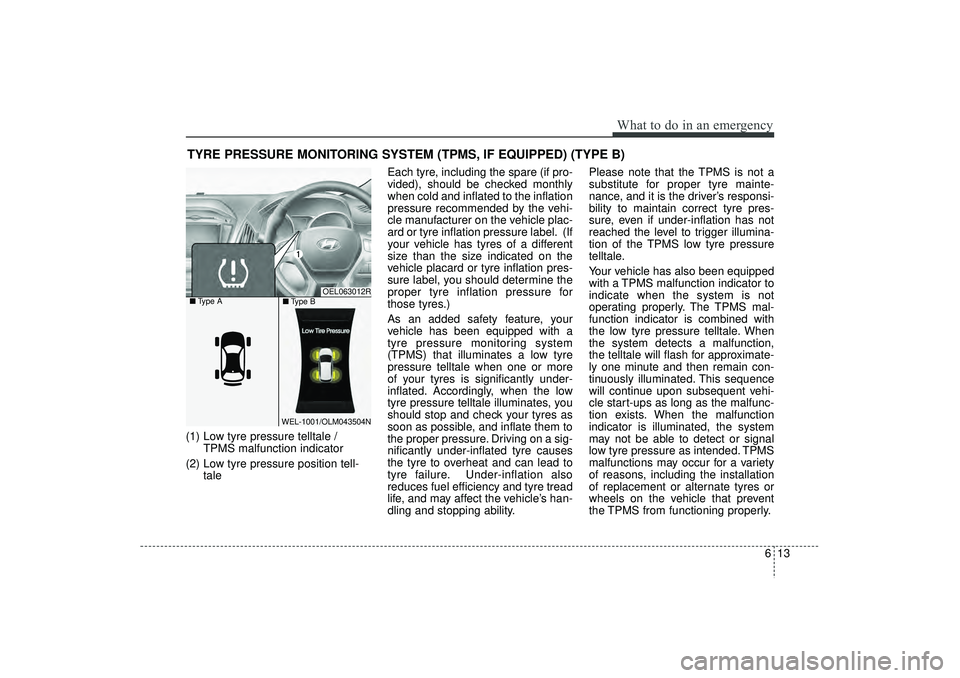
TYRE PRESSURE MONITORING SYSTEM (TPMS, IF EQUIPPED) (TYPE B)(1) Low tyre pressure telltale / TPMS malfunction indicator
(2) Low tyre pressure position tell- tale Each tyre, including the spare (if pro-
vided), should be checked monthly
when cold and inflated to the inflation
pressure recommended by the vehi-
cle manufacturer on the vehicle plac-
ard or tyre inflation pressure label. (If
your vehicle has tyres of a different
size than the size indicated on the
vehicle placard or tyre inflation pres-
sure label, you should determine the
proper tyre inflation pressure for
those tyres.)
As an added safety feature, your
vehicle has been equipped with a
tyre pressure monitoring system
(TPMS) that illuminates a low tyre
pressure telltale when one or more
of your tyres is significantly under-
inflated. Accordingly, when the low
tyre pressure telltale illuminates, you
should stop and check your tyres as
soon as possible, and inflate them to
the proper pressure. Driving on a sig-
nificantly under-inflated tyre causes
the tyre to overheat and can lead to
tyre failure. Under-inflation also
reduces fuel efficiency and tyre tread
life, and may affect the vehicle’s han-
dling and stopping ability. Please note that the TPMS is not a
substitute for proper tyre mainte-
nance, and it is the driver’s responsi-
bility to maintain correct tyre pres-
sure, even if under-inflation has not
reached the level to trigger illumina-
tion of the TPMS low tyre pressure
telltale.
Your vehicle has also been equipped
with a TPMS malfunction indicator to
indicate when the system is not
operating properly. The TPMS mal-
function indicator is combined with
the low tyre pressure telltale. When
the system detects a malfunction,
the telltale will flash for approximate-
ly one minute and then remain con-
tinuously illuminated. This sequence
will continue upon subsequent vehi-
cle start-ups as long as the malfunc-
tion exists. When the malfunction
indicator is illuminated, the system
may not be able to detect or signal
low tyre pressure as intended. TPMS
malfunctions may occur for a variety
of reasons, including the installation
of replacement or alternate tyres or
wheels on the vehicle that prevent
the TPMS from functioning properly.
OEL063012R
WEL-1001/OLM043504N
■
Type A
■Type B
EL(FL) UK 6.QXP 12/16/2014 8:12 PM Page 13
Page 436 of 550
What to do in an emergency14
6Always check the TPMS malfunction
telltale after replacing one or more
tyres or wheels on your vehicle to
ensure that the replacement or alter-
nate tyres and wheels allow the
TPMS to continue to function proper-
ly.✽ ✽
NOTICEIf the TPMS, Low Tyre Pressure and
Position indicators do not illuminate
for 3 seconds when the ignition
switch is turned to the ON position
or engine is running, or if they
remain illuminated after coming on
for approximately 3 seconds, we rec-
ommend that the system be checked
by a HYUNDAI authorised repairer.
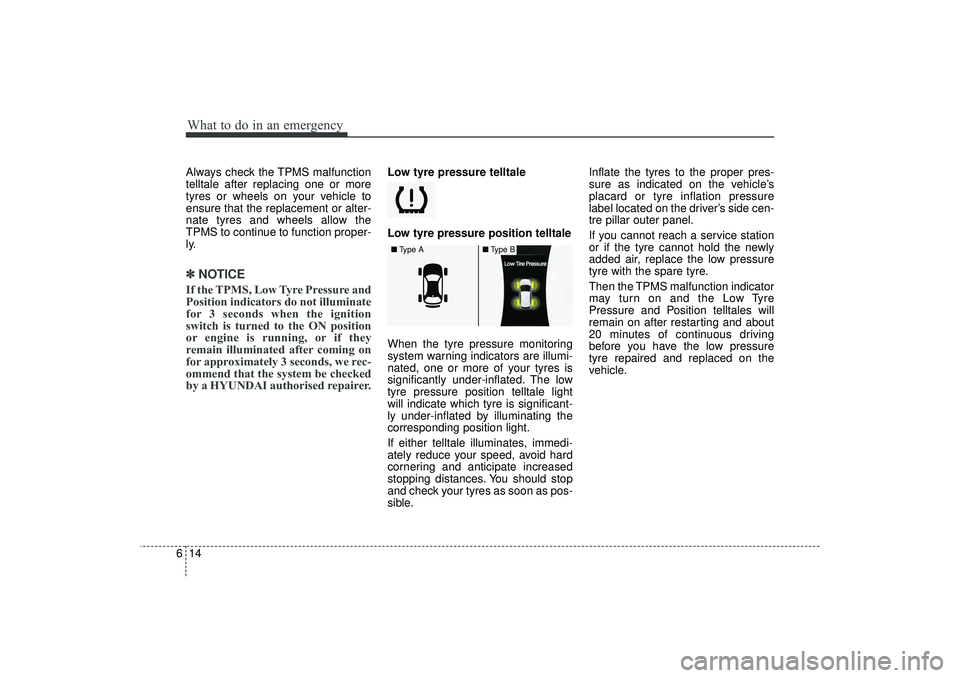
Low tyre pressure telltale
Low tyre pressure position telltale
When the tyre pressure monitoring
system warning indicators are illumi-
nated, one or more of your tyres is
significantly under-inflated. The low
tyre pressure position telltale light
will indicate which tyre is significant-
ly under-inflated by illuminating the
corresponding position light.
If either telltale illuminates, immedi-
ately reduce your speed, avoid hard
cornering and anticipate increased
stopping distances. You should stop
and check your tyres as soon as pos-
sible. Inflate the tyres to the proper pres-
sure as indicated on the vehicle’s
placard or tyre inflation pressure
label located on the driver’s side cen-
tre pillar outer panel.
If you cannot reach a service station
or if the tyre cannot hold the newly
added air, replace the low pressure
tyre with the spare tyre.
Then the TPMS malfunction indicator
may turn on and the Low Tyre
Pressure and Position telltales will
remain on after restarting and about
20 minutes of continuous driving
before you have the low pressure
tyre repaired and replaced on the
vehicle.■
Type A
■Type B
EL(FL) UK 6.QXP 12/16/2014 8:12 PM Page 14
Page 439 of 550
617
What to do in an emergency
You may not be able identify a low
tyre by simply looking at it. Always
use a good quality tyre pressure
gauge to measure the tyre's inflation
pressure. Please note that a tyre that
is hot (from being driven) will have a
higher pressure measurement than a
tyre that is cold (from sitting station-
ary for at least 3 hours and driven
less than 1 mile (1.6 km) during that
3 hour period).
Allow the tyre to cool before measur-
ing the inflation pressure. Always be
sure the tyre is cold before inflating
to the recommended pressure.
A cold tyre means the vehicle has
been sitting for 3 hours and driven for
less than 1 mile (1.6 km) in that 3
hour period.
CAUTION
If original mounted tyre isreplaced with the spare tyre, theTPMS sensor on the replacedspare wheel should be initiatedand we recommend that theTPMS sensor on the originalmounted wheel be deactivatedby a HYUNDAI dealer. If theTPMS sensor on the originalmounted wheel located in thespare tyre carrier still activates,the tyre pressure monitoringsystem may not operate proper-ly. We recommend that the sys-tem be serviced by a HYUNDAIauthorised repairer.
CAUTION
We recommend that you do notuse any tyre sealant except theTyre Mobility Kit approved byHYUNDAI if your vehicle isequipped with a Tyre PressureMonitoring System. The liquidsealant can damage the tyrepressure sensors.
WARNING
- TPMS
The TPMS cannot alert you to severe and sudden tyre dam-
age caused by external fac-
tors such as nails or road
debris.
If you feel any vehicle instabil- ity, immediately take your foot
off the accelerator, apply the
brakes gradually and with
light force, and slowly move to
a safe position off the road.
EL(FL) UK 6.QXP 12/16/2014 8:12 PM Page 17
Page 450 of 550
What to do in an emergency28
6It is possible that some tyres, espe-
cially with larger punctures or dam-
age to the sidewall, cannot be sealed
completely.Air pressure loss in the tyre may
adversely affect tyre performance.
For this reason, you should avoid
abrupt steering or other driving
manoeuvres, especially if the vehicle
is heavily loaded or if a trailer is in
use.
The TyreMobilityKit is not designed
or intended as a permanent tyre
repair method and is to be used for
one tyre only. This instruction shows
you step by step how to temporarily
seal the puncture simply and reliably.
Read the section "Notes on the safe
use of the TyreMobilityKit". Notes on the safe use of the
TyreMobilityKit
Park your car at the side of the
road so that you can work with the
TyreMobilityKit away from moving
traffic.
To be sure your vehicle won't move, even when you're on fairly
level ground, always set your park-
ing brake.
Only use the TyreMobilityKit for sealing/inflation passenger car
tyres. Only punctured areas locat-
ed within the tread region of the
tyre can be sealed using the tyre
mobility kit.
Do not use on motorcycles, bicy- cles or any other type of tyres.
When the tyre and wheel are dam- aged, do not use Tyre Mobility Kit
for your safety.
Use of the Tyre Mobility Kit may not be effective for tyre damage larger
than approximately 0.24 in (6 mm).
If the tyre cannot be made road-
worthy with the Tyre Mobility Kit,
we recommend that you contact a
HYUNDAI authorised repairer. Do not use the Tyre Mobility Kit if a
tyre is severely damaged by driving
run flat or with insufficient air pres-
sure.
Do not remove any foreign objects- such as nails or screws that have
penetrated the tyre.
Provided the car is outdoors, leave the engine running. Otherwise
operating the compressor may
eventually drain the car battery.
Never leave the TyreMobilityKit unattended whilst it is being used.
Do not leave the compressor run- ning for more than 10 min. at a time
or it may overheat.
Do not use the TyreMobilityKit if the ambient temperature is below
-30°C (-22°F).
WARNING
Do not use the TMK if a tyre is
severely damaged by driving
run flat or with insufficient air
pressure.
Only punctured areas located
within the tread region of the
tyre can be sealed using the
TMK.
EL(FL) UK 6.QXP 12/16/2014 8:13 PM Page 28
Page 461 of 550
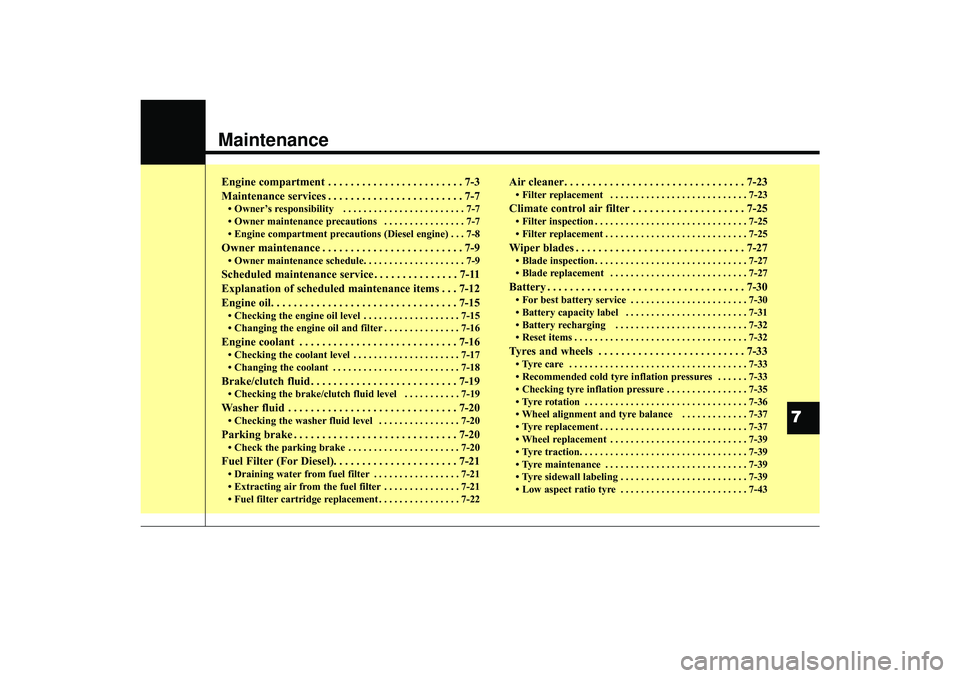
Maintenance
7
Engine compartment . . . . . . . . . . . . . . . . . . . . . . . . 7-3
Maintenance services . . . . . . . . . . . . . . . . . . . . . . . . 7-7• Owner’s responsibility . . . . . . . . . . . . . . . . . . . . . . . . 7-7
• Owner maintenance precautions . . . . . . . . . . . . . . . . 7-7
• Engine compartment precautions (Diesel engine) . . . 7-8Owner maintenance . . . . . . . . . . . . . . . . . . . . . . . . . 7-9• Owner maintenance schedule. . . . . . . . . . . . . . . . . . . . 7-9Scheduled maintenance service . . . . . . . . . . . . . . . 7-11
Explanation of scheduled maintenance items . . . 7-12
Engine oil. . . . . . . . . . . . . . . . . . . . . . . . . . . . . . . . . 7-15• Checking the engine oil level . . . . . . . . . . . . . . . . . . . 7-15
• Changing the engine oil and filter . . . . . . . . . . . . . . . 7-16Engine coolant . . . . . . . . . . . . . . . . . . . . . . . . . . . . 7-16• Checking the coolant level . . . . . . . . . . . . . . . . . . . . . 7-17
• Changing the coolant . . . . . . . . . . . . . . . . . . . . . . . . . 7-18Brake/clutch fluid . . . . . . . . . . . . . . . . . . . . . . . . . . 7-19• Checking the brake/clutch fluid level . . . . . . . . . . . 7-19Washer fluid . . . . . . . . . . . . . . . . . . . . . . . . . . . . . . 7-20• Checking the washer fluid level . . . . . . . . . . . . . . . . 7-20Parking brake . . . . . . . . . . . . . . . . . . . . . . . . . . . . . 7-20• Check the parking brake . . . . . . . . . . . . . . . . . . . . . . 7-20Fuel Filter (For Diesel). . . . . . . . . . . . . . . . . . . . . . 7-21• Draining water from fuel filter . . . . . . . . . . . . . . . . . 7-21
• Extracting air from the fuel filter . . . . . . . . . . . . . . . 7-21
• Fuel filter cartridge replacement . . . . . . . . . . . . . . . . 7-22
Air cleaner. . . . . . . . . . . . . . . . . . . . . . . . . . . . . . . . 7-23• Filter replacement . . . . . . . . . . . . . . . . . . . . . . . . . . . 7-23Climate control air filter . . . . . . . . . . . . . . . . . . . . 7-25• Filter inspection . . . . . . . . . . . . . . . . . . . . . . . . . . . . . . 7-25
• Filter replacement . . . . . . . . . . . . . . . . . . . . . . . . . . . . 7-25Wiper blades . . . . . . . . . . . . . . . . . . . . . . . . . . . . . . 7-27• Blade inspection . . . . . . . . . . . . . . . . . . . . . . . . . . . . . . 7-27
• Blade replacement . . . . . . . . . . . . . . . . . . . . . . . . . . . 7-27Battery . . . . . . . . . . . . . . . . . . . . . . . . . . . . . . . . . . . 7-\
30• For best battery service . . . . . . . . . . . . . . . . . . . . . . . 7-30
• Battery capacity label . . . . . . . . . . . . . . . . . . . . . . . . 7-31
• Battery recharging . . . . . . . . . . . . . . . . . . . . . . . . . . 7-32
• Reset items . . . . . . . . . . . . . . . . . . . . . . . . . . . . . . . . . . 7-32\
Tyres and wheels . . . . . . . . . . . . . . . . . . . . . . . . . . 7-33• Tyre care . . . . . . . . . . . . . . . . . . . . . . . . . . . . . . . . . . . 7-\
33
• Recommended cold tyre inflation pressures . . . . . . 7-33
• Checking tyre inflation pressure . . . . . . . . . . . . . . . . 7-35
• Tyre rotation . . . . . . . . . . . . . . . . . . . . . . . . . . . . . . . . 7-36
• Wheel alignment and tyre balance . . . . . . . . . . . . . 7-37
• Tyre replacement . . . . . . . . . . . . . . . . . . . . . . . . . . . . . 7-37
• Wheel replacement . . . . . . . . . . . . . . . . . . . . . . . . . . . 7-39
• Tyre traction. . . . . . . . . . . . . . . . . . . . . . . . . . . . . . . . \
. 7-39
• Tyre maintenance . . . . . . . . . . . . . . . . . . . . . . . . . . . . 7-39
• Tyre sidewall labeling . . . . . . . . . . . . . . . . . . . . . . . . . 7-39
• Low aspect ratio tyre . . . . . . . . . . . . . . . . . . . . . . . . . 7-43
EL(FL) UK 7.QXP 3/4/2015 9:04 PM Page 1
Page 467 of 550
77
Maintenance
MAINTENANCE SERVICESYou should exercise the utmost care to
prevent damage to your vehicle and
injury to yourself whenever performing
any maintenance or inspection proce-
dures.
Inadequate, incomplete or insufficient
servicing may result in operational prob-
lems with your vehicle that could lead to
vehicle damage, an accident, or person-
al injury.
Owner’s responsibility ✽ ✽NOTICEMaintenance Service and Record
Retention are the owner's responsibility. We recommend in general that you have
your vehicle serviced by a HYUNDAI
authorised repairer. You should retain
documents that show proper mainte-
nance has been performed on your vehi-
cle in accordance with the scheduled
maintenance service charts shown on
the following pages. You need this infor-
mation to establish your compliance with
the servicing and maintenance require-
ments of your vehicle warranties.
Detailed warranty information is provided
in your Service Passport. Repairs and
adjustments required as a result of
improper maintenance or a lack of
required maintenance are not covered
when your vehicle is covered by warran-
ty.
Owner maintenance precautions Improper or incomplete service may
result in problems. This section gives
instructions only for the maintenance
items that are easy to perform.✽ ✽NOTICEImproper owner maintenance during
the warranty period may affect warran-
ty coverage. For details, read the sepa-
rate Service Passport provided with the
vehicle. If you're unsure about any serv-
icing or maintenance procedure, we rec-
ommend that the system be serviced by
a HYUNDAI authorised repairer.
EL(FL) UK 7.QXP 3/4/2015 9:04 PM Page 7