air condition Hyundai Matrix 2003 Owner's Manual
[x] Cancel search | Manufacturer: HYUNDAI, Model Year: 2003, Model line: Matrix, Model: Hyundai Matrix 2003Pages: 312, PDF Size: 4.1 MB
Page 9 of 312
FEATURES OF YOUR HYUNDAI 1- 1
1. FEATURES OF
YOUR HYUNDAI
B010A01FC-1
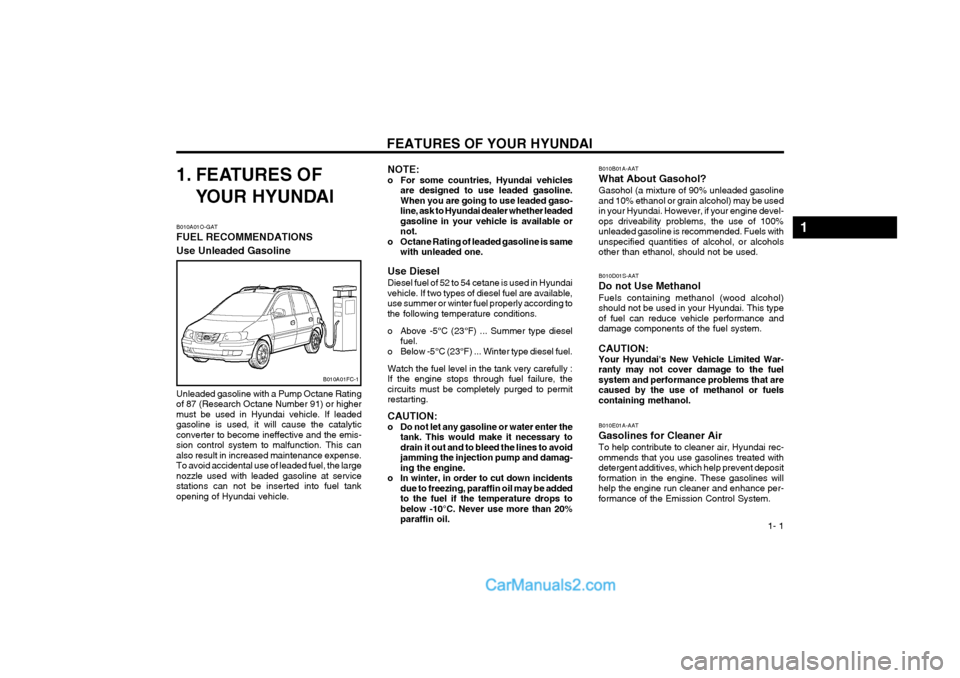
B010A01O-GAT FUEL RECOMMENDATIONS Use Unleaded Gasoline Unleaded gasoline with a Pump Octane Rating of 87 (Research Octane Number 91) or highermust be used in Hyundai vehicle. If leadedgasoline is used, it will cause the catalyticconverter to become ineffective and the emis-sion control system to malfunction. This canalso result in increased maintenance expense.To avoid accidental use of leaded fuel, the largenozzle used with leaded gasoline at servicestations can not be inserted into fuel tankopening of Hyundai vehicle. NOTE:
o For some countries, Hyundai vehicles
are designed to use leaded gasoline.When you are going to use leaded gaso-line, ask to Hyundai dealer whether leadedgasoline in your vehicle is available ornot.
o Octane Rating of leaded gasoline is same with unleaded one.
Use Diesel Diesel fuel of 52 to 54 cetane is used in Hyundai vehicle. If two types of diesel fuel are available,
use summer or winter fuel properly according tothe following temperature conditions.
o Above -5°C (23°F) ... Summer type diesel fuel.
o Below -5°C (23°F) ... Winter type diesel fuel.Watch the fuel level in the tank very carefully : If the engine stops through fuel failure, thecircuits must be completely purged to permitrestarting. CAUTION:
o Do not let any gasoline or water enter the tank. This would make it necessary todrain it out and to bleed the lines to avoidjamming the injection pump and damag-ing the engine.
o In winter, in order to cut down incidents due to freezing, paraffin oil may be addedto the fuel if the temperature drops tobelow -10°C. Never use more than 20%paraffin oil. B010B01A-AAT What About Gasohol?Gasohol (a mixture of 90% unleaded gasoline and 10% ethanol or grain alcohol) may be usedin your Hyundai. However, if your engine devel-ops driveability problems, the use of 100%unleaded gasoline is recommended. Fuels withunspecified quantities of alcohol, or alcoholsother than ethanol, should not be used. B010E01A-AAT Gasolines for Cleaner Air To help contribute to cleaner air, Hyundai rec- ommends that you use gasolines treated withdetergent additives, which help prevent depositformation in the engine. These gasolines willhelp the engine run cleaner and enhance per-formance of the Emission Control System.
B010D01S-AAT Do not Use Methanol Fuels containing methanol (wood alcohol) should not be used in your Hyundai. This typeof fuel can reduce vehicle performance anddamage components of the fuel system. CAUTION: Your Hyundai's New Vehicle Limited War-
ranty may not cover damage to the fuelsystem and performance problems that are
caused by the use of methanol or fuelscontaining methanol.
1
Page 27 of 312
FEATURES OF YOUR HYUNDAI 1- 19
YR10400B
On outboard rear seats
B230G01A-GAT
Installation on the Outboard Rear Seats
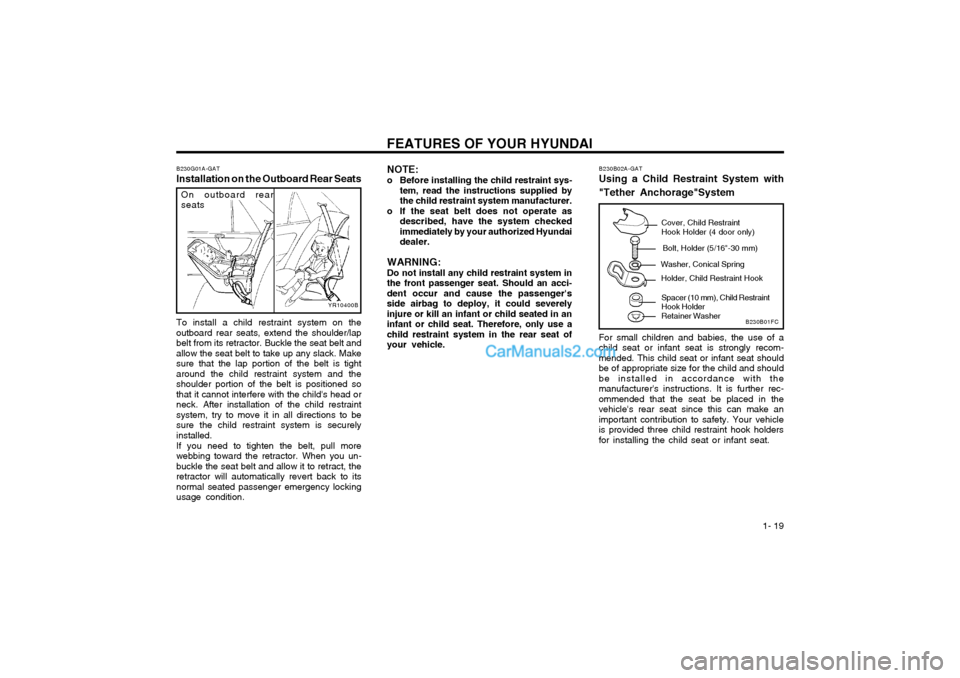
To install a child restraint system on the outboard rear seats, extend the shoulder/lapbelt from its retractor. Buckle the seat belt andallow the seat belt to take up any slack. Makesure that the lap portion of the belt is tightaround the child restraint system and theshoulder portion of the belt is positioned sothat it cannot interfere with the child's head orneck. After installation of the child restraintsystem, try to move it in all directions to besure the child restraint system is securelyinstalled. If you need to tighten the belt, pull more webbing toward the retractor. When you un-buckle the seat belt and allow it to retract, theretractor will automatically revert back to itsnormal seated passenger emergency lockingusage condition. NOTE:
o Before installing the child restraint sys- tem, read the instructions supplied bythe child restraint system manufacturer.
o If the seat belt does not operate as described, have the system checkedimmediately by your authorized Hyundaidealer.
WARNING: Do not install any child restraint system in
the front passenger seat. Should an acci- dent occur and cause the passenger'sside airbag to deploy, it could severelyinjure or kill an infant or child seated in aninfant or child seat. Therefore, only use achild restraint system in the rear seat ofyour vehicle. B230B02A-GAT
Using a Child Restraint System with "Tether Anchorage"System For small children and babies, the use of a child seat or infant seat is strongly recom-mended. This child seat or infant seat shouldbe of appropriate size for the child and shouldbe installed in accordance with themanufacturer's instructions. It is further rec-ommended that the seat be placed in thevehicle's rear seat since this can make animportant contribution to safety. Your vehicleis provided three child restraint hook holdersfor installing the child seat or infant seat.
Cover, Child Restraint Hook Holder (4 door only)
Bolt, Holder (5/16"-30 mm)
Washer, Conical Spring Holder, Child Restraint Hook
Spacer (10 mm), Child Restraint
Hook Holder
Retainer Washer
B230B01FC
Page 31 of 312
FEATURES OF YOUR HYUNDAI 1- 23
CAUTION:
o Because the sensor that activates the
SRS airbag is connected with the pre-tensioner seat belt, the SRS airbag warn-ing light on the instrument panel willblink for approximately 6 seconds afterthe ignition key has been turned to the"ON" position, and then it should turnoff.
o If the pre-tensioner seat belt is not work- ing properly, this warning light will illu-minate even if there is no malfunction ofthe SRS airbag system . If the SRS airbagwarning light does not illuminate whenthe ignition key is turned to "ON", or if itremains illuminated after blinking forapproximately 6 seconds, or if it illumi-nates while the vehicle is being driven,please have an authorized Hyundai deal-er inspect the pre-tensioner seat belt orSRS airbag system as soon as possible. WARNING:
o Pre-tensioners are designed to operate
only one time. After activation, pre-tensioner seat belts must be replaced.All seat belts, of any type, should alwaysbe replaced after they have been wornduring a collision.
o The pre-tensioner seat belt assembly mechanisms become hot during activa-tion. Do not touch the pre-tensioner seatbelt assemblies for several minutes afterthey have been activated.
o Do not attempt to inspect or replace the pre-tensioner seat belts yourself. Thismust be done by an authorized Hyundaidealer.
o Do not strike the pre-tensioner seat belt assemblies.
o Do not attempt to service or repair the pre-tensioner seat belt system in anymanner.
o Improper handling of the pre-tensioner seat belt assemblies, and failure to heedthe warnings to not strike, modify, in-spect, replace, service or repair the pre-tensioner seat belt assemblies may leadto improper operation or inadvertent ac-tivation and serious injury.
o Always wear the seat belts when driving or riding in a motor vehicle.
NOTE:
o Both the driver's and front passenger's pre-tensioner seat belts will be activatedin certain frontal collisions. The pre-tensioner seat belts can be activatedwith the airbags. The pre-tensioners willbe activated under these conditions evenif the seat belts are not being worn at thetime of the collision.
o When the pre-tensioner seat belts are activated, a loud noise may be heard andfine dust, which may appear to be smoke,may be visible in the passenger compart-ment. These are normal operating condi-tions and are not hazardous.
o Although it is harmless, the fine dust may cause skin irritation and should notbe breathed for prolonged periods. Washyour hands and face thoroughly after anaccident in which the pre-tensioner seatbelts were activated.
Page 32 of 312
FEATURES OF YOUR HYUNDAI
1- 24
B240C01FC
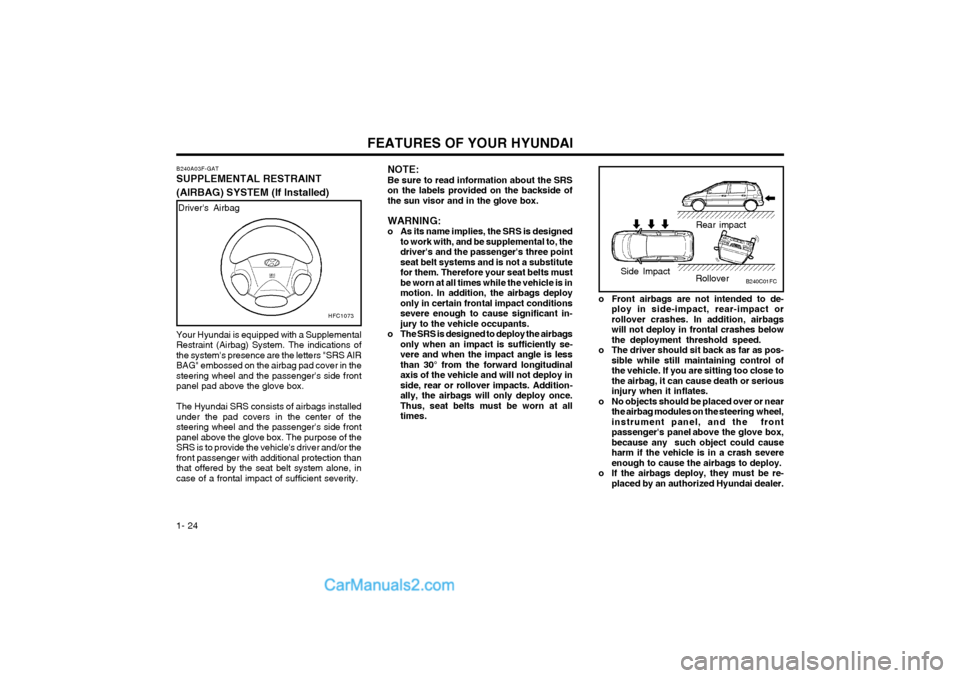
Rear impact
Side Impact Rollover
o Front airbags are not intended to de- ploy in side-impact, rear-impact or rollover crashes. In addition, airbagswill not deploy in frontal crashes belowthe deployment threshold speed.
o The driver should sit back as far as pos- sible while still maintaining control ofthe vehicle. If you are sitting too close tothe airbag, it can cause death or seriousinjury when it inflates.
o No objects should be placed over or near the airbag modules on the steering wheel,instrument panel, and the frontpassenger's panel above the glove box,because any such object could causeharm if the vehicle is in a crash severeenough to cause the airbags to deploy.
o If the airbags deploy, they must be re- placed by an authorized Hyundai dealer.
NOTE: Be sure to read information about the SRSon the labels provided on the backside ofthe sun visor and in the glove box. WARNING:
o As its name implies, the SRS is designedto work with, and be supplemental to, thedriver's and the passenger's three pointseat belt systems and is not a substitutefor them. Therefore your seat belts mustbe worn at all times while the vehicle is inmotion. In addition, the airbags deployonly in certain frontal impact conditionssevere enough to cause significant in-jury to the vehicle occupants.
o The SRS is designed to deploy the airbags only when an impact is sufficiently se-vere and when the impact angle is lessthan 30° from the forward longitudinalaxis of the vehicle and will not deploy inside, rear or rollover impacts. Addition-ally, the airbags will only deploy once.Thus, seat belts must be worn at alltimes.
Your Hyundai is equipped with a SupplementalRestraint (Airbag) System. The indications ofthe system's presence are the letters "SRS AIRBAG" embossed on the airbag pad cover in thesteering wheel and the passenger's side frontpanel pad above the glove box. The Hyundai SRS consists of airbags installed
under the pad covers in the center of thesteering wheel and the passenger's side frontpanel above the glove box. The purpose of theSRS is to provide the vehicle's driver and/or thefront passenger with additional protection thanthat offered by the seat belt system alone, incase of a frontal impact of sufficient severity.
Driver's Airbag
B240A03F-GAT SUPPLEMENTAL RESTRAINT (AIRBAG) SYSTEM (If Installed)
HFC1073
Page 37 of 312
FEATURES OF YOUR HYUNDAI 1- 29
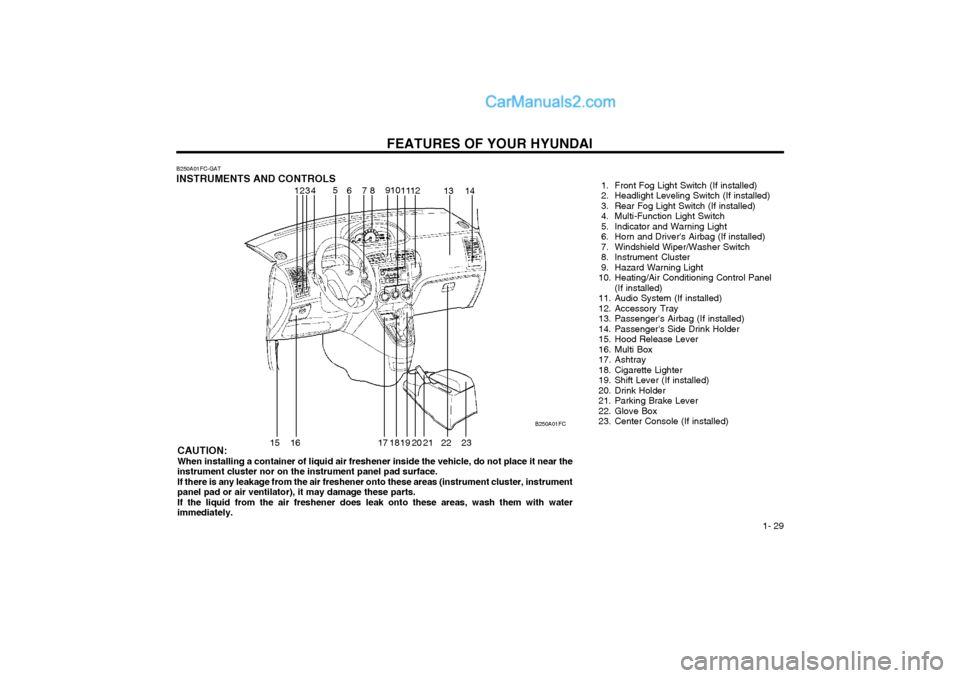
B250A01FC-GAT INSTRUMENTS AND CONTROLS
1. Front Fog Light Switch (If installed)
2. Headlight Leveling Switch (If installed)
3. Rear Fog Light Switch (If installed)
4. Multi-Function Light Switch
5. Indicator and Warning Light
6. Horn and Driver's Airbag (If installed)
7. Windshield Wiper/Washer Switch
8. Instrument Cluster
9. Hazard Warning Light
10. Heating/Air Conditioning Control Panel
(If installed)
11. Audio System (If installed)
12. Accessory Tray
13. Passenger's Airbag (If installed)
14. Passenger's Side Drink Holder
15. Hood Release Lever
16. Multi Box
17. Ashtray
18. Cigarette Lighter
19. Shift Lever (If installed)
20. Drink Holder
21. Parking Brake Lever
22. Glove Box
23. Center Console (If installed)
CAUTION:When installing a container of liquid air freshener inside the vehicle, do not place it near theinstrument cluster nor on the instrument panel pad surface.If there is any leakage from the air freshener onto these areas (instrument cluster, instrumentpanel pad or air ventilator), it may damage these parts.If the liquid from the air freshener does leak onto these areas, wash them with waterimmediately. B250A01FC
12
3
4 5
678 910
1112
13 14
15 16 17 18 19 20 21 22 23
Page 42 of 312
FEATURES OF YOUR HYUNDAI
1- 34
B260N02FC-GAT
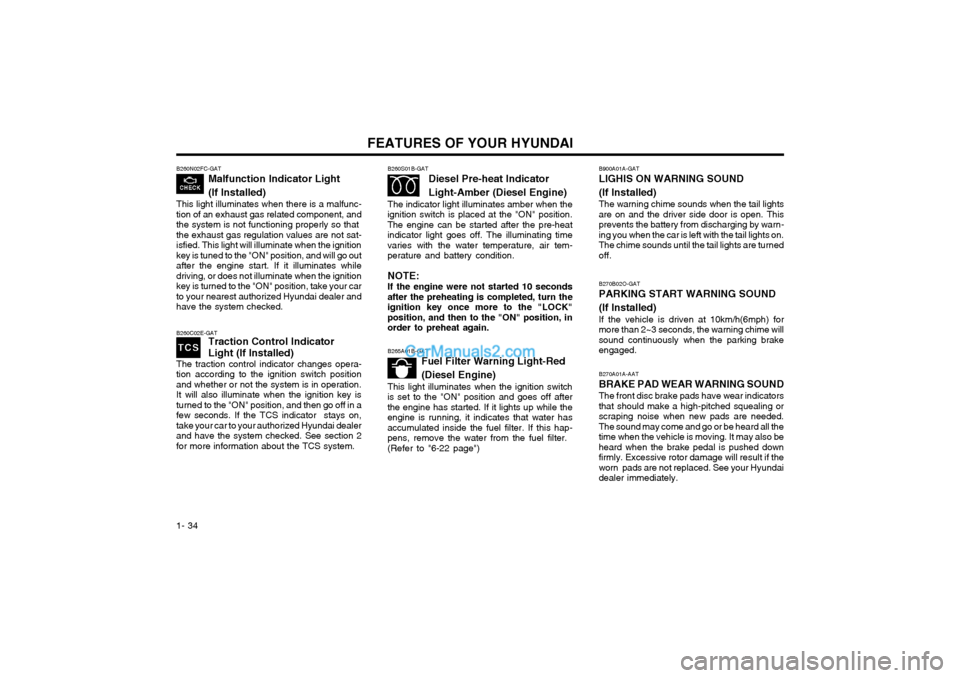
Malfunction Indicator Light (If Installed)
This light illuminates when there is a malfunc- tion of an exhaust gas related component, andthe system is not functioning properly so thatthe exhaust gas regulation values are not sat-isfied. This light will illuminate when the ignitionkey is tuned to the "ON" position, and will go outafter the engine start. If it illuminates whiledriving, or does not illuminate when the ignitionkey is turned to the "ON" position, take your carto your nearest authorized Hyundai dealer andhave the system checked.
B260C02E-GAT Traction Control Indicator Light (If Installed)
The traction control indicator changes opera- tion according to the ignition switch positionand whether or not the system is in operation.It will also illuminate when the ignition key isturned to the "ON" position, and then go off in afew seconds. If the TCS indicator stays on,take your car to your authorized Hyundai dealerand have the system checked. See section 2for more information about the TCS system.
B270A01A-AAT BRAKE PAD WEAR WARNING SOUND The front disc brake pads have wear indicators
that should make a high-pitched squealing orscraping noise when new pads are needed.
The sound may come and go or be heard all thetime when the vehicle is moving. It may also beheard when the brake pedal is pushed down
firmly. Excessive rotor damage will result if theworn pads are not replaced. See your Hyundaidealer immediately.
B260S01B-GAT
Diesel Pre-heat Indicator Light-Amber (Diesel Engine)
The indicator light illuminates amber when the
ignition switch is placed at the "ON" position. The engine can be started after the pre-heatindicator light goes off. The illuminating timevaries with the water temperature, air tem-perature and battery condition.
NOTE: If the engine were not started 10 seconds
after the preheating is completed, turn the ignition key once more to the "LOCK"position, and then to the "ON" position, inorder to preheat again.
B265A01B-GAT
Fuel Filter Warning Light-Red (Diesel Engine)
This light illuminates when the ignition switch
is set to the "ON" position and goes off after the engine has started. If it lights up while theengine is running, it indicates that water hasaccumulated inside the fuel filter. If this hap-pens, remove the water from the fuel filter.
(Refer to "6-22 page")
B270B02O-GAT PARKING START WARNING SOUND
(If Installed) If the vehicle is driven at 10km/h(6mph) for more than 2~3 seconds, the warning chime willsound continuously when the parking brakeengaged.
B900A01A-GAT LIGHIS ON WARNING SOUND (If Installed) The warning chime sounds when the tail lights are on and the driver side door is open. Thisprevents the battery from discharging by warn-ing you when the car is left with the tail lights on.The chime sounds until the tail lights are turnedoff.
Page 65 of 312

FEATURES OF YOUR HYUNDAI 1- 57
Face-Level
Selecting the "Face" mode will cause air to be discharged through the face level vents.
NOTE:
o It should be noted that prolonged opera- tion of the heating in "Recirculation"mode will increase to fogging of thewindshield and side windows and the airwithin the passenger compartment willbecome stale. In addition, prolonged useof the air conditioning with the "Recircu-lation" mode selected may result in theair within the passenger compartmentbecoming excessively dry.
o When the ignition switch is turned "ON" the air intake control will change to " "mode (regardless of switch position).This is normal operation. B670D05A-AAT Air Flow Control
HFC2068
This is used to direct the flow of air. Air can be directed to the floor, dashboard outlets, orwindshield. Five symbols are used to representFace, Bi-Level, Floor, Floor-Defrost and De-frost air position.
B670D01FC
B670D02FC
Bi-Level
Air is discharged through the face vents and the floor vents. This makes it possible to havecooler air from the dashboard vents and warmerair from the floor outlets at the same time.
Page 68 of 312
FEATURES OF YOUR HYUNDAI
1- 60 B740C01FC-GAT Dehumidified Heating
B740C01FC
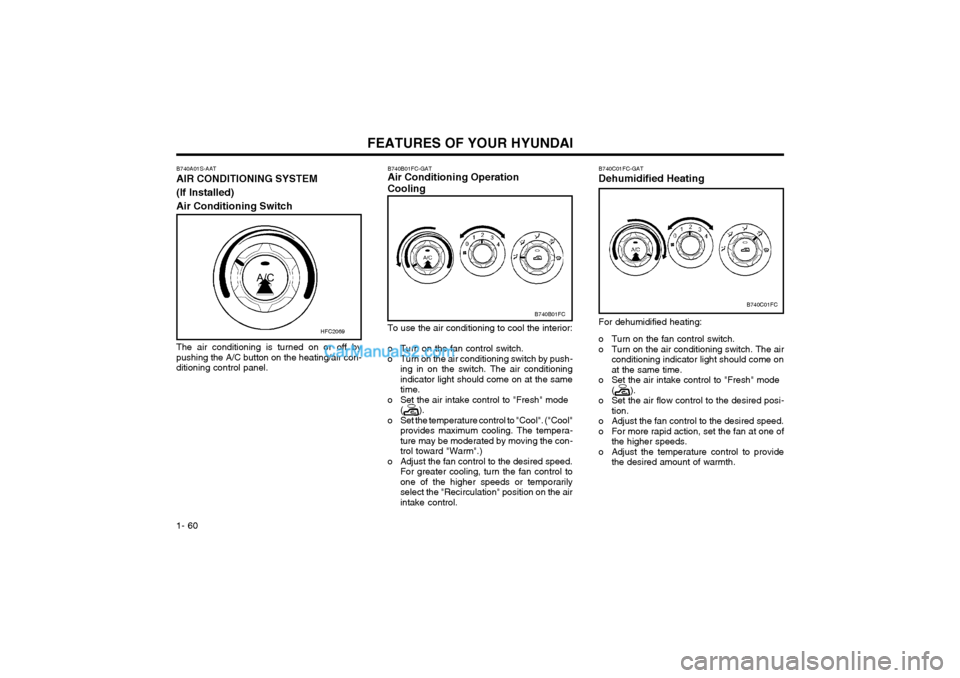
For dehumidified heating:
o Turn on the fan control switch.
o Turn on the air conditioning switch. The air conditioning indicator light should come onat the same time.
o Set the air intake control to "Fresh" mode (
).
o Set the air flow control to the desired posi- tion.
o Adjust the fan control to the desired speed.
o For more rapid action, set the fan at one of the higher speeds.
o Adjust the temperature control to provide the desired amount of warmth.
B740B01FC-GAT Air Conditioning Operation Cooling
B740B01FC
To use the air conditioning to cool the interior:
o Turn on the fan control switch.
o Turn on the air conditioning switch by push- ing in on the switch. The air conditioningindicator light should come on at the sametime.
o Set the air intake control to "Fresh" mode (
).
o Set the temperature control to "Cool". ("Cool" provides maximum cooling. The tempera- ture may be moderated by moving the con-trol toward "Warm".)
o Adjust the fan control to the desired speed. For greater cooling, turn the fan control toone of the higher speeds or temporarilyselect the "Recirculation" position on the airintake control.
B740A01S-AAT AIR CONDITIONING SYSTEM (If Installed)Air Conditioning Switch
The air conditioning is turned on or off by pushing the A/C button on the heating/air con-ditioning control panel. HFC2069
Page 69 of 312

FEATURES OF YOUR HYUNDAI 1- 61
B760A01E
The air filter is located in front of the blower unit behind the glove box.It operates to decrease pollutants from enteringthe car and to filter the air. Replacement instructions:
1. Remove the adjusting pins on both sides ofthe glove box.
2. Remove the filter cover and replace the filler.
3. Installation is the reverse order of disas- sembly.
Evaporator coreBlower fan
Heater core
B760A01FC-GAT AIR FILTER (IN FRONT OF BLOWER UNIT) (If Installed)
Outside air
Filter
Inside air
Inside air CAUTION:
o Replace the filter every 20,000 km (12,000
miles) or once a year. If the car is beingdriven in severe conditions such as dusty,rough roads, more frequent air filter in-spections and changes are required.
o When the air flow rate is suddenly de- creased, it must be checked at an autho-rized dealer.
B740D01A-AAT Operation Tips
o If the interior of the car is hot when you first get in, open the windows for a few minutes to expel the hot air.
o When you are using the air conditioning system, keep all windows closed to keep hotair out.
o When moving slowly, as in heavy traffic, shift to a lower gear. This increases enginespeed, which in turn increases the speed ofthe air conditioning compressor.
o On steep grades, turn the air conditioning off to avoid the possibility of the engine over-heating.
o During winter months or in periods when the air conditioning is not used regularly, run theair conditioning once every month for a fewminutes. This will help circulate the lubri-cants and keep your system in peak operat-ing condition.
Page 82 of 312
FEATURES OF YOUR HYUNDAI
1- 74
B260D02O-AAT
1. Playing CD
o Insert the CD with the label facing upward.
o Insert the CD to start CD playback, during
radio operation.
o When a disc is in the CD deck, if you press the CD button, the CD player will beginplaying even if the radio is being used.
o The CD player can be used when the igni- tion switch is in either the "ON" or "ACC"position.
2. FF/REW ( / ) If you want to fast forward or reverse through the compact disc track, push and hold in the FF( ) or REW ( ) button.When you release the button, the compact discplayer will resume playing.
3. TRACK UP/DOWN
o The desired track on the disc currently being played can be selected using the track number.
o Press once to skip forward to the beginn- ing of the next track. Press once to skipback to the beginning of the track.
4. SCAN Button
o Press the SCAN button to playback the first 10 seconds of each track.
o Press the SCAN button again within 10 sec. When you have reached the desired track. 5. REPEAT Button
o To repeat the track you are currently listen-
ing to, press the RPT button. To cancel , press again.
o If you do not release RPT operation when the track ends, it will automatically be re-played.This process will be continued until youpush the button again.
6. EJECT Button When the EJECT button is pressed with a CD loaded, the CD will eject. NOTE:
o To assure proper operation of the unit, keep the vehicle interior temperaturewithin a normal range by using thevehicle's air conditioning or heating sys-tem.
o When replacing the fuse, replace it with a fuse having the correct capacity.
o The preset station frequencies are all erased when the car battery is discon-nected. Therefore, all data will have to beset again if this should occur.
o Do not add any oil to the rotating parts. Keep magnets, screwdrivers and othermetallic objects away from the tapemechanism and head.
o This equipment is designed to be used only in a 12 volt DC battery system withnegative ground.
o This unit is made of precision parts. Donot attempt to disassemble or adjust any parts.
o When driving your vehicle, be sure to keep the volume of the unit set low enoughto allow you to hear sounds coming fromthe outside.
o Do not expose this equipment (including the speakers) to water or excessive mois-ture.