Panel Hyundai Matrix 2004 User Guide
[x] Cancel search | Manufacturer: HYUNDAI, Model Year: 2004, Model line: Matrix, Model: Hyundai Matrix 2004Pages: 317, PDF Size: 5.12 MB
Page 106 of 317
DRIVING YOUR HYUNDAI
2- 8 o Do not hold the vehicle on the upgrade with
the accelerator pedal. This can cause the transmission to overheat. Always use the brake pedal or parking brake.
C120A02A-AAT ANTI-LOCK BRAKE SYSTEM (If Installed) The Anti-Lock Brake System (ABS) is designed to prevent wheel lock-up during sudden braking or on hazardous road surfaces. The ABS control module monitors the wheel speed and controls the pressure applied to each brake. Thus, in emergency situations or on slick roads, ABS will increase vehicle control during braking. NOTE: During ABS operation, a slight pulsation may be felt in the brake pedal when the brakes are applied. Also, a noise may be heard in the engine compartment while braking. These conditions are normal and indicate that the anti-lock brake system is functioning proper- ly. WARNING: ABS will not prevent accidents due to im- proper or dangerous driving maneuvers. Even though vehicle control is improved during emergency braking, always maintain a safe distance between you and objects ahead. Vehicle speeds should always be reduced during extreme road conditions. The braking distance for cars equipped with
also increases the wear of the brake compo-nents.
o If a tire goes flat while you are driving, apply
the brakes gently and keep the car pointed straight ahead while you slow down. When
you are moving slowly enough for it to be safe to do so, pull off the road and stop in a safe place.
o If your car is equipped with an automatic
transaxle, don't let your car creep forward. To avoid creeping forward, keep your foot on the brake pedal when the car is stopped.
o Use caution when parking on a hill. Engage
the parking brake and place the gear selector lever in "P" (automatic transaxle) or in first or
reverse gear (manual transaxle). If your car is
facing downhill, turn the front wheels into the curb to help keep the car from rolling. If your car is facing uphill, turn the front wheels away from the curb to help keep the car from rolling. If there is no curb or if it is required by other conditions to keep the car from rolling, block the wheels.
o Under some conditions your parking brake can freeze in the engaged position. This is most likely to happen when there is an accu- mulation of snow or ice around or near the rear brakes or if the brakes are wet. If there is a risk that the parking brake may freeze, apply it only temporarily while you put the gear selector lever in "P" (automatic) or in first or reverse gear (manual transaxle) and block the rear wheels so the car cannot roll. Then release the parking brake.
C130A01A-AAT GOOD BRAKING PRACTICES WARNING: Nothing should be carried on top of the shelf panel behind the rear seat. If there were an accident or a sudden stop, such objects could move forward and cause damage to the ve- hicle or injure the occupants.
o After being parked, check to be sure the
parking brake is not engaged and that the parking brake indicator light is out before driving away.
o Driving through water may get the brakes
wet. They can also get wet when the car is washed. Wet brakes can be dangerous! Your
car will not stop as quickly if the brakes are wet. Wet brakes may cause the car to pull to one side. To dry the brakes, apply the brakes lightly until the braking action returns to nor-
mal, taking care to keep the car under control at all times. If the braking action does not return to normal, stop as soon as it is safe to do so and call your Hyundai dealer for assis- tance.
o Don't coast down hills with the car out of gear.
This is extremely hazardous. Keep the car in gear at all times, use the brakes to slow down, then shift to a lower gear so that engine braking will help you maintain a safe speed.
o Don't "ride" the brake pedal. Resting your foot on the brake pedal while driving can be dan- gerous because it can result in the brakes overheating and losing their effectiveness. It
Page 123 of 317
CORROSION PREVENTION AND APPEARANCE CARE 4-1
4. CORROSIONPREVENTION AND
APPEARANCE CAREE020B01A-AAT Keep Your Car Clean The best way to prevent corrosion is to keep your car clean and free of corrosive materials. Atten- tion to the underside of the car is particularly important.
o If you live in a high-corrosion area — whereroad salts are used, near the ocean, areas with industrial pollution, acid rain, etc.—, you should take extra care to prevent corrosion. In winter, hose off the underside of your car at least once a month and be sure to clean the underside thoroughly when winter is over.
o When cleaning underneath the car, give par- ticular attention to the components under the fenders and other areas that are hidden from view. Do a thorough job; just dampening the accumulated mud rather than washing it away will accelerate corrosion rather than prevent it. Water under high pressure and steam are particularly effective in removing accumulat- ed mud and corrosive materials.
o When cleaning lower door panels, rocker
panels and frame members, be sure that drain holes are kept open so that moisture can escape and not be trapped inside to ac- celerate corrosion.
E010A01A-AAT CORROSION PROTECTION Protecting Your Hyundai from Corro- sion By using the most advanced design and con- struction practices to combat corrosion, Hyundai produces cars of the highest quality, however, this is only part of the job. To achieve the long- term corrosion resistance your Hyundai can de- liver, the owner’s cooperation and assistance is also required.
E010C01A-AAT High-Corrosion Areas If you live in an area where your car is regularly exposed to corrosive materials, corrosion pro- tection is particularly important. Some of the common causes of accelerated corrosion are road salts, dust control chemicals, ocean air and industrial pollution.
E010B01A-AAT Common Causes of Corrosion The most common causes of corrosion on your car are:
o Road salt, dirt and moisture that is allowed to accumulate underneath the car.
o Removal of paint or protective coatings by stones, gravel, abrasion or minor scrapes and dents which leave unprotected metal exposed to corrosion. E010D01A-AAT Moisture Breeds CorrosionMoisture creates the conditions in which corro- sion is most likely to occur. For example, corro- sion is accelerated by high humidity, particularly when temperatures are just above freezing. In such conditions, the corrosive material is kept in contact with the car surfaces by moisture that isslow to evaporate. Mud is particulary corrosive because it is slow to dry and holds moisture in contact with the ve- hicle. Although the mud appears to be dry, it can still retain the moisture and promote corrosion. High temperatures can also accelerate corro- sion of parts that are not properly ventilated so the moisture can be dispersed. For all these reasons, it is particularly important to keep your car clean and free of mud or accumulations of other materials. This applies not only to the visible surfaces but particularly to the underside of the car. E020A01A-AAT TO HELP PREVENT CORROSION You can help prevent corrosion from getting started by observing the following:
4
Page 154 of 317
DO-IT-YOURSELF MAINTENANCE
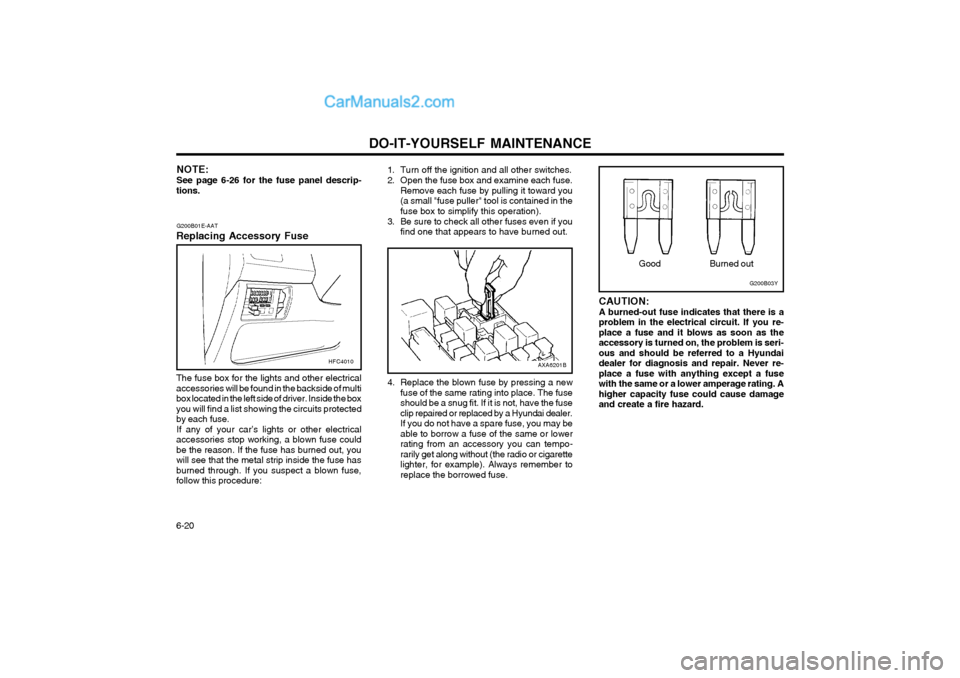
6-20 CAUTION: A burned-out fuse indicates that there is aproblem in the electrical circuit. If you re-place a fuse and it blows as soon as theaccessory is turned on, the problem is seri-ous and should be referred to a Hyundaidealer for diagnosis and repair. Never re-place a fuse with anything except a fusewith the same or a lower amperage rating. Ahigher capacity fuse could cause damageand create a fire hazard.
Burned out
G200B03YGood
4. Replace the blown fuse by pressing a new fuse of the same rating into place. The fuse should be a snug fit. If it is not, have the fuseclip repaired or replaced by a Hyundai dealer.If you do not have a spare fuse, you may beable to borrow a fuse of the same or lowerrating from an accessory you can tempo-rarily get along without (the radio or cigarettelighter, for example). Always remember toreplace the borrowed fuse.
AXA6201B
G200B01E-AAT
Replacing Accessory Fuse The fuse box for the lights and other electrical accessories will be found in the backside of multibox located in the left side of driver. Inside the boxyou will find a list showing the circuits protectedby each fuse. If any of your car’s lights or other electrical
accessories stop working, a blown fuse couldbe the reason. If the fuse has burned out, youwill see that the metal strip inside the fuse hasburned through. If you suspect a blown fuse,follow this procedure:
HFC4010
NOTE: See page 6-26 for the fuse panel descrip-
tions. 1. Turn off the ignition and all other switches.
2. Open the fuse box and examine each fuse.
Remove each fuse by pulling it toward you (a small "fuse puller" tool is contained in thefuse box to simplify this operation).
3. Be sure to check all other fuses even if you find one that appears to have burned out.
Page 160 of 317
DO-IT-YOURSELF MAINTENANCE
6-26
G200C02FC-GAT
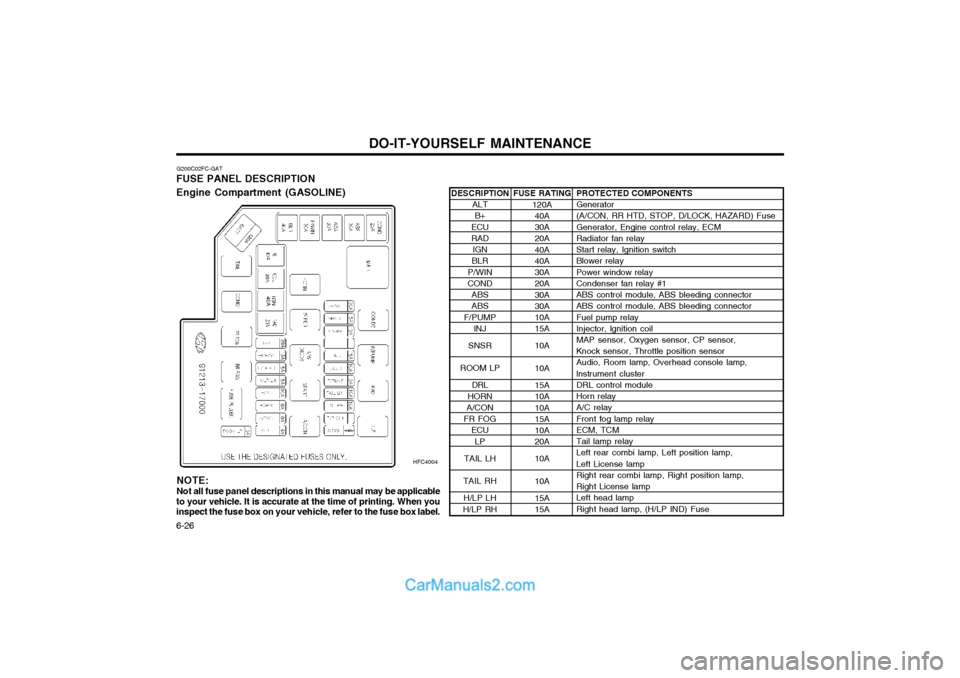
FUSE PANEL DESCRIPTION Engine Compartment (GASOLINE)
HFC4004
PROTECTED COMPONENTS Generator (A/CON, RR HTD, STOP, D/LOCK, HAZARD) Fuse Generator, Engine control relay, ECM Radiator fan relay Start relay, Ignition switch Blower relay Power window relay Condenser fan relay #1 ABS control module, ABS bleeding connector ABS control module, ABS bleeding connector Fuel pump relay Injector, lgnition coilMAP sensor, Oxygen sensor, CP sensor, Knock sensor, Throttle position sensor Audio, Room lamp, Overhead console lamp, lnstrument cluster DRL control module Horn relay A/C relay Front fog lamp relay ECM, TCM Tail lamp relay Left rear combi lamp, Left position lamp, Left License lamp Right rear combi lamp, Right position lamp, Right License lamp Left head lamp Right head lamp, (H/LP IND) Fuse
FUSE RATING
120A40A30A 20A 40A 40A 30A 20A 30A 30A 10A 15A 10A 10A 15A 10A 10A 15A 10A 20A 10A 10A 15A 15A
DESCRIPTION
ALTB+
ECU RAD IGN
BLR
P/WINCOND ABSABS
F/PUMP INJ
SNSR
ROOM LP DRL
HORN
A/CON
FR FOG ECU
LP
TAIL LH
TAIL RH H/LP LH
H/LP RH
NOTE:
Not all fuse panel descriptions in this manual may be applicable
to your vehicle. It is accurate at the time of printing. When you inspect the fuse box on your vehicle, refer to the fuse box label.
Page 161 of 317
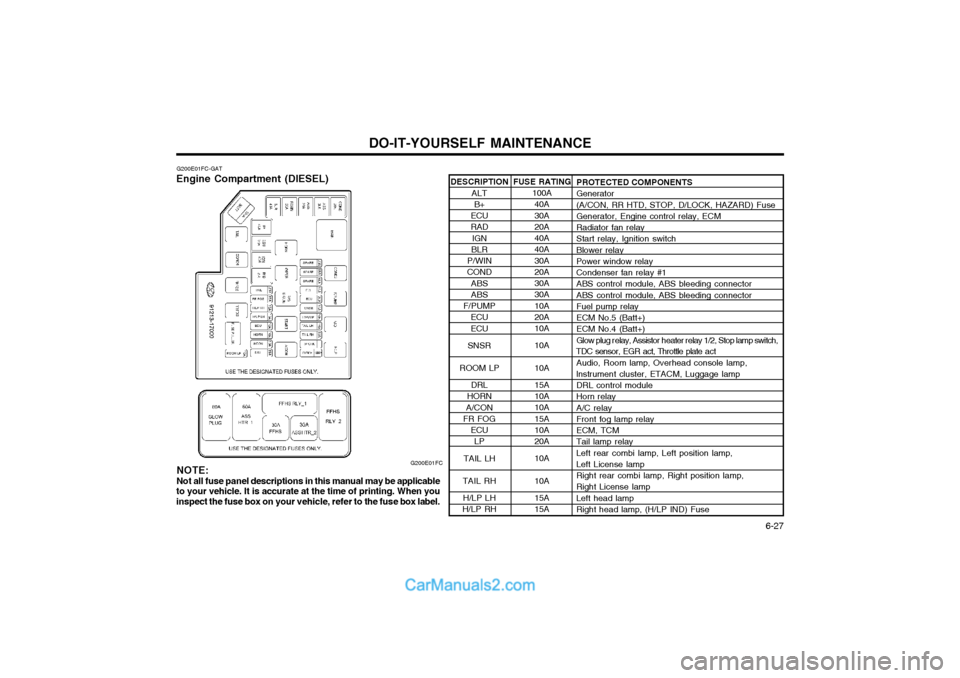
DO-IT-YOURSELF MAINTENANCE 6-27
DESCRIPTION
ALTB+
ECU RAD IGN
BLR
P/WINCOND ABSABS
F/PUMP ECU ECU
SNSR
ROOM LP DRL
HORN
A/CON
FR FOG
ECULP
TAIL LH
TAIL RH H/LP LH
H/LP RH
G200E01FC-GAT
Engine Compartment (DIESEL)
G200E01FCPROTECTED COMPONENTS Generator (A/CON, RR HTD, STOP, D/LOCK, HAZARD) Fuse Generator, Engine control relay, ECM Radiator fan relay Start relay, Ignition switch Blower relay Power window relay Condenser fan relay #1 ABS control module, ABS bleeding connector ABS control module, ABS bleeding connector Fuel pump relay ECM No.5 (Batt+) ECM No.4 (Batt+)
Glow plug r elay, Assistor h eater relay 1/2, Stop lamp switch,
TDC sensor, EGR act, Throttle plate a ct
Audio, Room lamp, Overhead console lamp, lnstrument cluster, ETACM, Luggage lamp DRL control module Horn relay A/C relay Front fog lamp relay ECM, TCM Tail lamp relay Left rear combi lamp, Left position lamp, Left License lamp Right rear combi lamp, Right position lamp, Right License lamp Left head lamp Right head lamp, (H/LP IND) Fuse
FUSE RATING
100A40A 30A 20A 40A 40A 30A 20A 30A 30A 10A 20A 10A 10A 10A 15A 10A 10A 15A 10A 20A 10A 10A 15A 15A
NOTE:
Not all fuse panel descriptions in this manual may be applicable
to your vehicle. It is accurate at the time of printing. When you inspect the fuse box on your vehicle, refer to the fuse box label.
Page 162 of 317
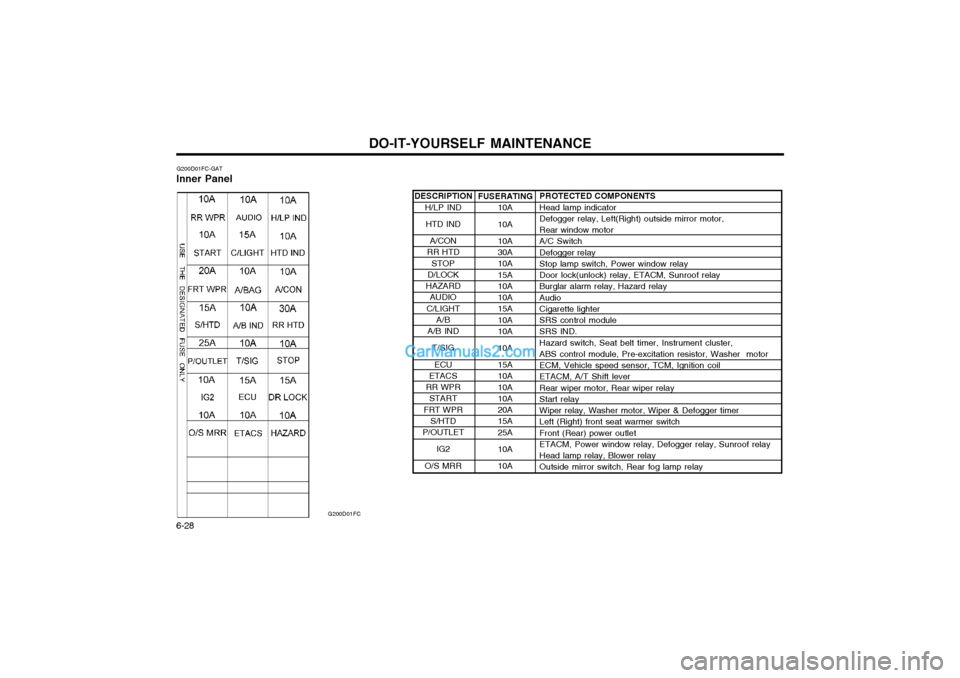
DO-IT-YOURSELF MAINTENANCE
6-28 DESCRIPTION
H/LP IND
HTD IND
A/CON
RR HTD
STOP
D/LOCK
HAZARD AUDIO
C/LIGHT A/B
A/B IND
T/SIG
ECU
ETACS
RR WPR START
FRT WPR S/HTD
P/OUTLET
IG2
O/S MRR
G200D01FC-GAT
Inner Panel
G200D01FC
PROTECTED COMPONENTS Head lamp indicator Defogger relay, Left(Right) outside mirror motor, Rear window motor A/C Switch Defogger relay Stop lamp switch, Power window relay Door lock(unlock) relay, ETACM, Sunroof relay Burglar alarm relay, Hazard relay Audio Cigarette lighter SRS control module SRS IND. Hazard switch, Seat belt timer, Instrument cluster, ABS control module, Pre-excitation resistor, Washer motor ECM, Vehicle speed sensor, TCM, Ignition coil ETACM, A/T Shift lever Rear wiper motor, Rear wiper relay Start relay Wiper relay, Washer motor, Wiper & Defogger timer Left (Right) front seat warmer switch Front (Rear) power outlet ETACM, Power window relay, Defogger relay, Sunroof relay Head lamp relay, Blower relay Outside mirror switch, Rear fog lamp relay
FUSERATING
10A 10A 10A 30A 10A 15A 10A 10A 15A 10A 10A 10A 15A 10A 10A 10A 20A 15A 25A 10A 10A
Page 165 of 317
CONSUMER INFORMATION 8-1
8. CONSUMER
INFORMATION
I010A01FC-GAT
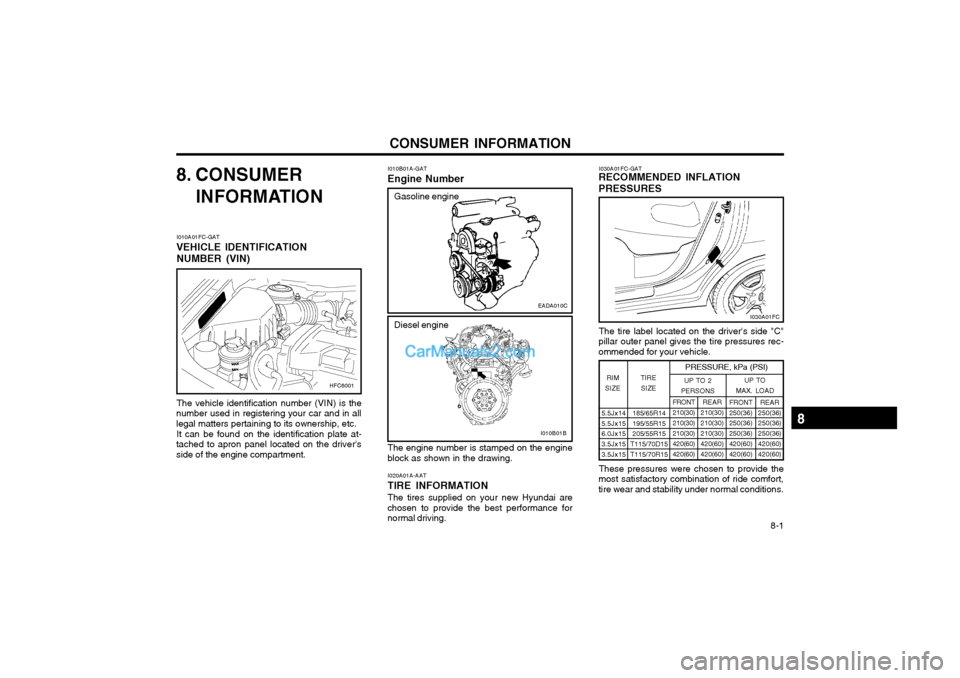
VEHICLE IDENTIFICATION NUMBER (VIN) The vehicle identification number (VIN) is the
number used in registering your car and in all legal matters pertaining to its ownership, etc.
It can be found on the identification plate at-
tached to apron panel located on the driver'sside of the engine compartment.
HFC6001
I010B01A-GAT
Engine Number
EADA010C
The engine number is stamped on the engine
block as shown in the drawing.
I020A01A-AAT TIRE INFORMATIONThe tires supplied on your new Hyundai are
chosen to provide the best performance for normal driving. I030A01FC-GAT
RECOMMENDED INFLATION PRESSURES
The tire label located on the driver's side "C"
pillar outer panel gives the tire pressures rec- ommended for your vehicle.I030A01FC
I010B01B
Gasoline engine Diesel engine
5.5Jx14 5.5Jx15 6.0Jx15 3.5Jx153.5Jx15 TIRE
SIZE
RIM
SIZE PRESSURE, kPa (PSI)
185/65R14195/55R15 205/55R15
T115/70D15 T115/70R15 REAR
210(30)210(30)210(30)420(60)420(60) FRONT
250(36) 250(36) 250(36)420(60)420(60)
UP TO 2
PERSONS UP TO
MAX. LOAD
REAR
250(36) 250(36) 250(36)420(60)420(60)
FRONT210(30)210(30) 210(30) 420(60)420(60)
These pressures were chosen to provide the
most satisfactory combination of ride comfort, tire wear and stability under normal conditions.
8
Page 172 of 317
INDEX
10-2 Driving
Economical dr iving ........................................................................ 2-10
Smooth cornering .......................................................................... 2-10
Winter driving ................................................................................ 2-10
E Emissions Control Systems ................................................................ 7-1
Engine Before starting the engine ............................................................... 2-2Compartment .......................................................................... 6-1 ~ 6-3
Coolant ................................................................................. 6-8 ~ 6-10
Coolant temperature gauge ........................................................... 1-36
If the engine overheats ................................................................... 3-2
Number ............................................................................................ 8-1
Oil ........................................................................................... 6-4 ~ 6-5Starting ............................................................................................ 2-3
Engine Exhaust Can Be Dangerous ................................................... 2-1
FFold-up Tray ...................................................................................... 1-50
Front Fog Light Sw itch ...................................................................... 1-42
Front Seats Adjustable front seats ..................................................................... 1-9
Lumbar support control ................................................................. 1-10
Seat cushion height adjustment .................................................... 1-10
Fuel Capacity .......................................................................................... 9-1
Gauge ............................................................................................ 1-36
Recommendations ........................................................................... 1-1
Fuel Filler Lid
Remote release ............................................................................. 1-52
Fuse Panel Description .......................................................... 6-26 ~ 6-28
Fuses ...................................................................................... 6-19 ~6-20 GGeneral Checks
.................................................................................. 6-4
Glove box .......................................................................................... 1-47
H Hazard Warning System ................................................................... 1-41
Headlight Aiming Adjustment ........................................................... 6-24
Headlight Bulb ................................................................................... 6-23
Headlight Leveling Device System ........................................ 1-44 ~ 1-45
Heating and Ventilation
Air flow control .............................................................................. 1-58
Air intake control ........................................................................... 1-57
Bi-level heating .............................................................................. 1-59
Fan speed control ......................................................................... 1-57
Heating controls ............................................................................ 1-59
Temperature control ...................................................................... 1-59
High-mounted Rear Stoplight ............................................................ 1-50
Hood Release ................................................................................... 1-51
Horn .................................................................................................. 1-55
IIgnition Switch ..................................................................................... 2-2
Immobilizer System ............................................................................. 1-3
Instrument Cluster and Indicator ............................................ 1-31 ~ 1-35
Instruments and Controls .................................................................. 1-30
Interior Light Interior light ................................................................................... 1-47
Map light ........................................................................................ 1-46
Intermittent Wiper .............................................................................. 1-41
JJump Starting ...................................................................................... 3-1
Page 201 of 317
1- 19
CONTROLS AND EQUIPMENT
B230E01FC
Back panel
Front of Vehicle
Tether straphook
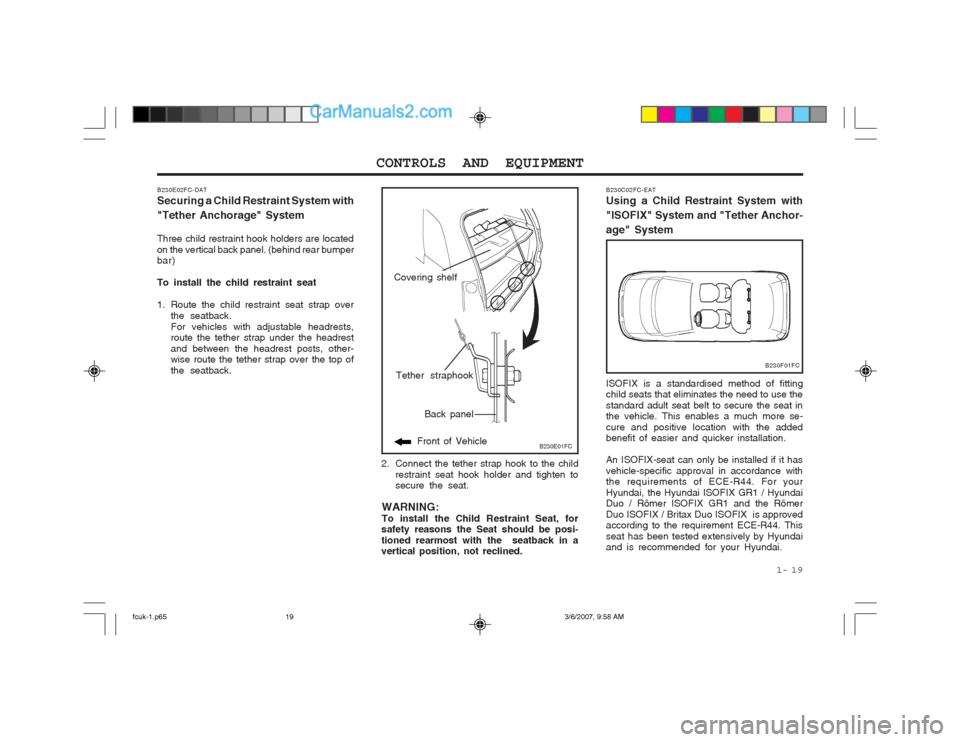
B230E02FC-DAT Securing a Child Restraint System with "Tether Anchorage" System Three child restraint hook holders are located on the vertical back panel. (behind rear bumper bar) To install the child restraint seat
1. Route the child restraint seat strap over the seatback. For vehicles with adjustable headrests, route the tether strap under the headrest and between the headrest posts, other- wise route the tether strap over the top of the seatback.
2. Connect the tether strap hook to the childrestraint seat hook holder and tighten to secure the seat.
WARNING:
To install the Child Restraint Seat, for
safety reasons the Seat should be posi-tioned rearmost with the seatback in a vertical position, not reclined.
Covering shelf
B230F01FC
B230C02FC-EAT Using a Child Restraint System with "ISOFIX" System and "Tether Anchor-age" System ISOFIX is a standardised method of fitting child seats that eliminates the need to use the standard adult seat belt to secure the seat in the vehicle. This enables a much more se- cure and positive location with the added benefit of easier and quicker installation. An ISOFIX-seat can only be installed if it has vehicle-specific approval in accordance with the requirements of ECE-R44. For your Hyundai, the Hyundai ISOFIX GR1 / Hyundai Duo / Römer ISOFIX GR1 and the Römer Duo ISOFIX / Britax Duo ISOFIX is approved according to the requirement ECE-R44. This seat has been tested extensively by Hyundai and is recommended for your Hyundai.
fcuk-1.p65 3/6/2007, 9:58 AM
19
Page 203 of 317
1- 21
CONTROLS AND EQUIPMENT
authorized Hyundai dealer inspect the pre-tensioner seat belt or SRS airbag system as soon as possible.
WARNING:
o Pre-tensioners are designed to operate only one time. After activation, pre- tensioner seat belts must be replaced. All seat belts, of any type, should al- ways be replaced after they have been worn during a collision.
o The pre-tensioner seat belt assembly mechanisms become hot during activa-tion. Do not touch the pre-tensioner seat belt assemblies for several min- utes after they have been activated.
o Do not attempt to inspect or replace the pre-tensioner seat belts yourself. Thismust be done by an authorized Hyundai dealer.
o Do not strike the pre-tensioner seat belt assemblies.
o Do not attempt to service or repair the pre-tensioner seat belt system in any manner.
o Improper handling of the pre-tensioner
seat belt assemblies, and failure to heed the warnings to not strike, modify, in- spect, replace, service or repair the pre- tensioner seat belt assemblies may lead to improper operation or inadvertent activation and serious injury.
o Always wear the seat belts when driving or travelling in a motor vehicle.
Driver's airbag conditions even if the seat belts are not being worn at the time of the collision.
o When the pre-tensioner seat belts are
activated, a loud noise may be heardand fine dust, which may appear to be smoke, may be visible in the passenger compartment. These are normal operat- ing conditions and are not hazardous.
o Although it is harmless, the fine dust
may cause skin irritation and should not be breathed for prolonged periods. Wash your hands and face thoroughly after an accident in which the pre- tensioner seat belts were activated.
CAUTION:
o Because the sensor that activates the SRS airbag is connected with the pre- tensioner seat belt, the SRS airbag warn- ing light on the instrument panel will blink for approximately 6 seconds after the ignition key has been turned to the "ON" position and then it should turn off.
o If the pre-tensioner seat belt is not work- ing properly, this warning light will illu-minate even if there is no malfunction of the SRS airbag system.If the SRS airbag warning light does not illuminate when the ignition key is turned to "ON", or if it remains illuminated after blinking for approximately 6 sec- onds, or if it illuminates while the ve- hicle is being driven, please have an
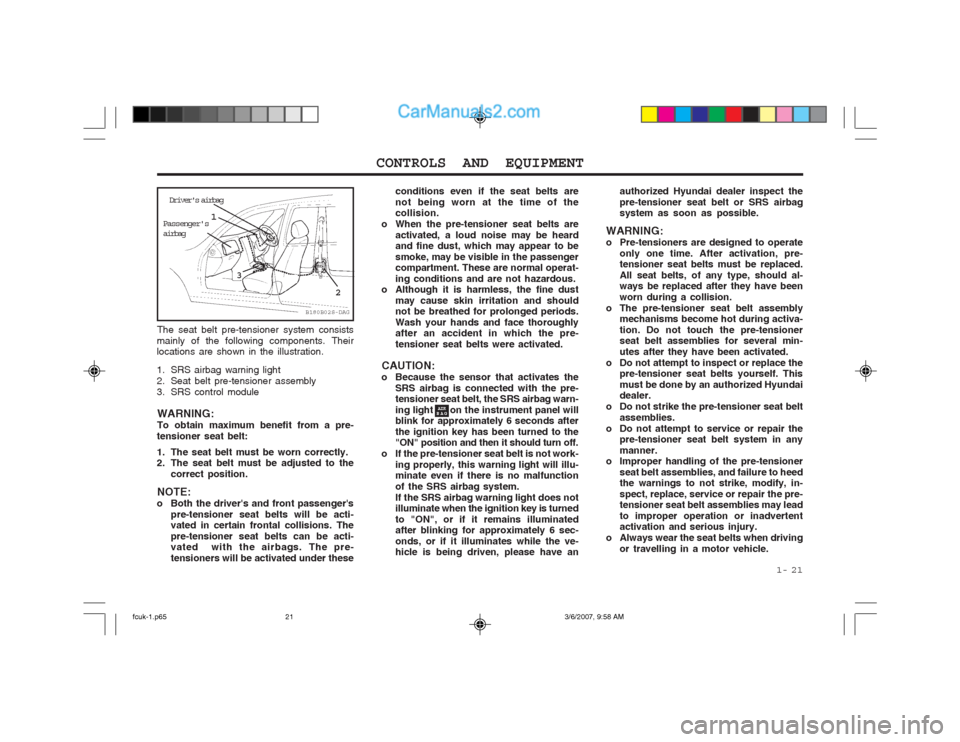
The seat belt pre-tensioner system consists
mainly of the following components. Theirlocations are shown in the illustration.
1. SRS airbag warning light
2. Seat belt pre-tensioner assembly
3. SRS control module
WARNING:To obtain maximum benefit from a pre-
tensioner seat belt:
1. The seat belt must be worn correctly.
2. The seat belt must be adjusted to the correct position.
NOTE:
o Both the driver's and front passenger's
pre-tensioner seat belts will be acti-vated in certain frontal collisions. The pre-tensioner seat belts can be acti- vated with the airbags. The pre- tensioners will be activated under these
1
2
3
B180B02S-DAG
Passenger's airbag
AIR
BAG
fcuk-1.p65 3/6/2007, 9:58 AM
21