Brake caliper HYUNDAI SONATA 2021 Owners Manual
[x] Cancel search | Manufacturer: HYUNDAI, Model Year: 2021, Model line: SONATA, Model: HYUNDAI SONATA 2021Pages: 546, PDF Size: 51.21 MB
Page 465 of 546
08
8-11
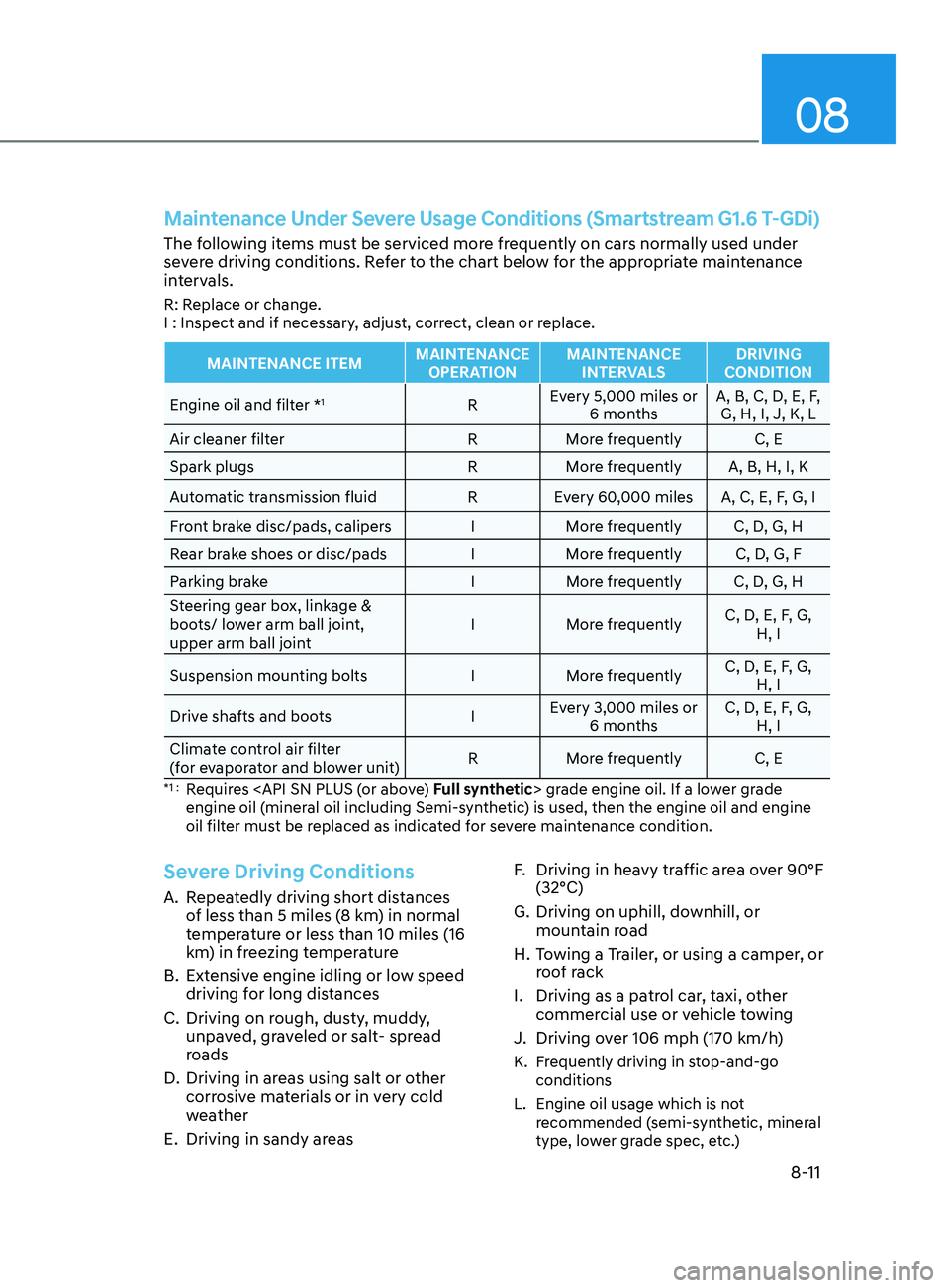
Maintenance Under Severe Usage Conditions (Smartstream G1.6 T-GDi)
The following items must be serviced more frequently on cars normally used under
severe driving conditions. Refer to the chart below for the appropriate maintenance
intervals.
R: Replace or change.
I : Inspect and if necessary, adjust, correct, clean or replace.
MAINTENANCE ITEMMAINTENANCE
OPERATION MAINTENANCE
INTERVALS DRIVING
CONDITION
Engine oil and filter *
1R Every 5,000 miles or
6 months A, B, C, D, E, F,
G, H, I, J, K, L
Air cleaner filter RMore frequently C, E
Spark plugs RMore frequently A, B, H, I, K
Automatic transmission fluid R Every 60,000 miles A, C, E, F, G, I
Front brake disc/pads, calipers I More frequently C, D, G, H
Rear brake shoes or disc/pads IMore frequently C, D, G, F
Parking brake IMore frequently C, D, G, H
Steering gear box, linkage &
boots/ lower arm ball joint,
upper arm ball joint I
More frequently C, D, E, F, G,
H, I
Suspension mounting bolts IMore frequently C, D, E, F, G,
H, I
Drive shafts and boots IEvery 3,000 miles or
6 months C, D, E, F, G,
H, I
Climate control air filter
(for evaporator and blower unit) R
More frequently C, E
*1 : Requires
engine oil (mineral oil including Semi-synthetic) is used, then the engine oil and engine
oil filter must be replaced as indicated for severe maintenance condition.
Severe Driving Conditions
A. Repeatedly driving short distances
of less than 5 miles (8 km) in normal
temperature or less than 10 miles (16
km) in freezing temperature
B.
Ext
ensive engine idling or low speed
driving for long distances
C.
Driving on r
ough, dusty, muddy,
unpaved, graveled or salt- spread
roads
D.
Driving in ar
eas using salt or other
corrosive materials or in very cold
weather
E.
Driving in sandy ar
eas F.
Driving in hea
vy traffic area over 90°F
(32°C)
G. Driving on uphill, do wnhill, or
mountain road
H.
T
owing a Trailer, or using a camper, or
roof rack
I.
Driving as a pa
trol car, taxi, other
commercial use or vehicle towing
J.
Driving o
ver 106 mph (170 km/h)
K. Frequently driving in stop-and-go conditions
L.
E
ngine oil usage which is not
recommended (semi-synthetic, mineral
type, lower grade spec, etc.)
Page 469 of 546
08
8-15
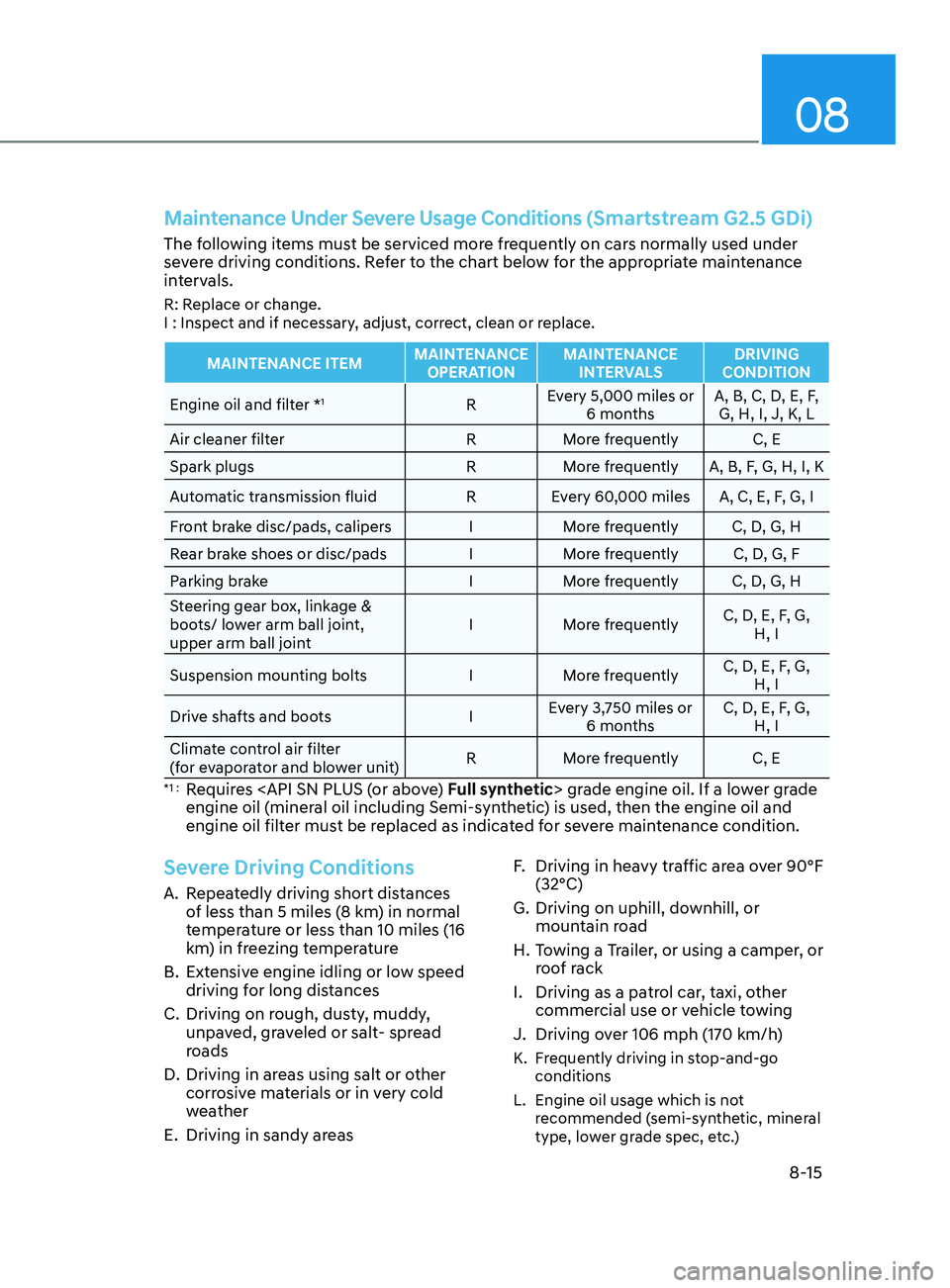
Maintenance Under Severe Usage Conditions (Smartstream G2.5 GDi)
The following items must be serviced more frequently on cars normally used under
severe driving conditions. Refer to the chart below for the appropriate maintenance
intervals.
R: Replace or change.
I : Inspect and if necessary, adjust, correct, clean or replace.
MAINTENANCE ITEMMAINTENANCE
OPERATION MAINTENANCE
INTERVALS DRIVING
CONDITION
Engine oil and filter *
1R Every 5,000 miles or
6 months A, B, C, D, E, F,
G, H, I, J, K, L
Air cleaner filter RMore frequently C, E
Spark plugs RMore frequently A, B, F, G, H, I, K
Automatic transmission fluid R Every 60,000 miles A, C, E, F, G, I
Front brake disc/pads, calipers I More frequently C, D, G, H
Rear brake shoes or disc/pads I More frequently C, D, G, F
Parking brake IMore frequently C, D, G, H
Steering gear box, linkage &
boots/ lower arm ball joint,
upper arm ball joint I
More frequently C, D, E, F, G,
H, I
Suspension mounting bolts IMore frequently C, D, E, F, G,
H, I
Drive shafts and boots IEvery 3,750 miles or
6 months C, D, E, F, G,
H, I
Climate control air filter
(for evaporator and blower unit) R
More frequently C, E
*1 : Requires
engine oil (mineral oil including Semi-synthetic) is used, then the engine oil and
engine oil filter must be replaced as indicated for severe maintenance condition.
Severe Driving Conditions
A. Repeatedly driving short distances
of less than 5 miles (8 km) in normal
temperature or less than 10 miles (16
km) in freezing temperature
B.
Ext
ensive engine idling or low speed
driving for long distances
C.
Driving on r
ough, dusty, muddy,
unpaved, graveled or salt- spread
roads
D.
Driving in ar
eas using salt or other
corrosive materials or in very cold
weather
E.
Driving in sandy ar
eas F.
Driving in hea
vy traffic area over 90°F
(32°C)
G. Driving on uphill, do wnhill, or
mountain road
H.
T
owing a Trailer, or using a camper, or
roof rack
I.
Driving as a pa
trol car, taxi, other
commercial use or vehicle towing
J.
Driving o
ver 106 mph (170 km/h)
K. Frequently driving in stop-and-go conditions
L.
E
ngine oil usage which is not
recommended (semi-synthetic, mineral
type, lower grade spec, etc.)
Page 471 of 546
08
8-17
Engine Coolant
The coolant should be changed at the
intervals specified in the maintenance
schedule.
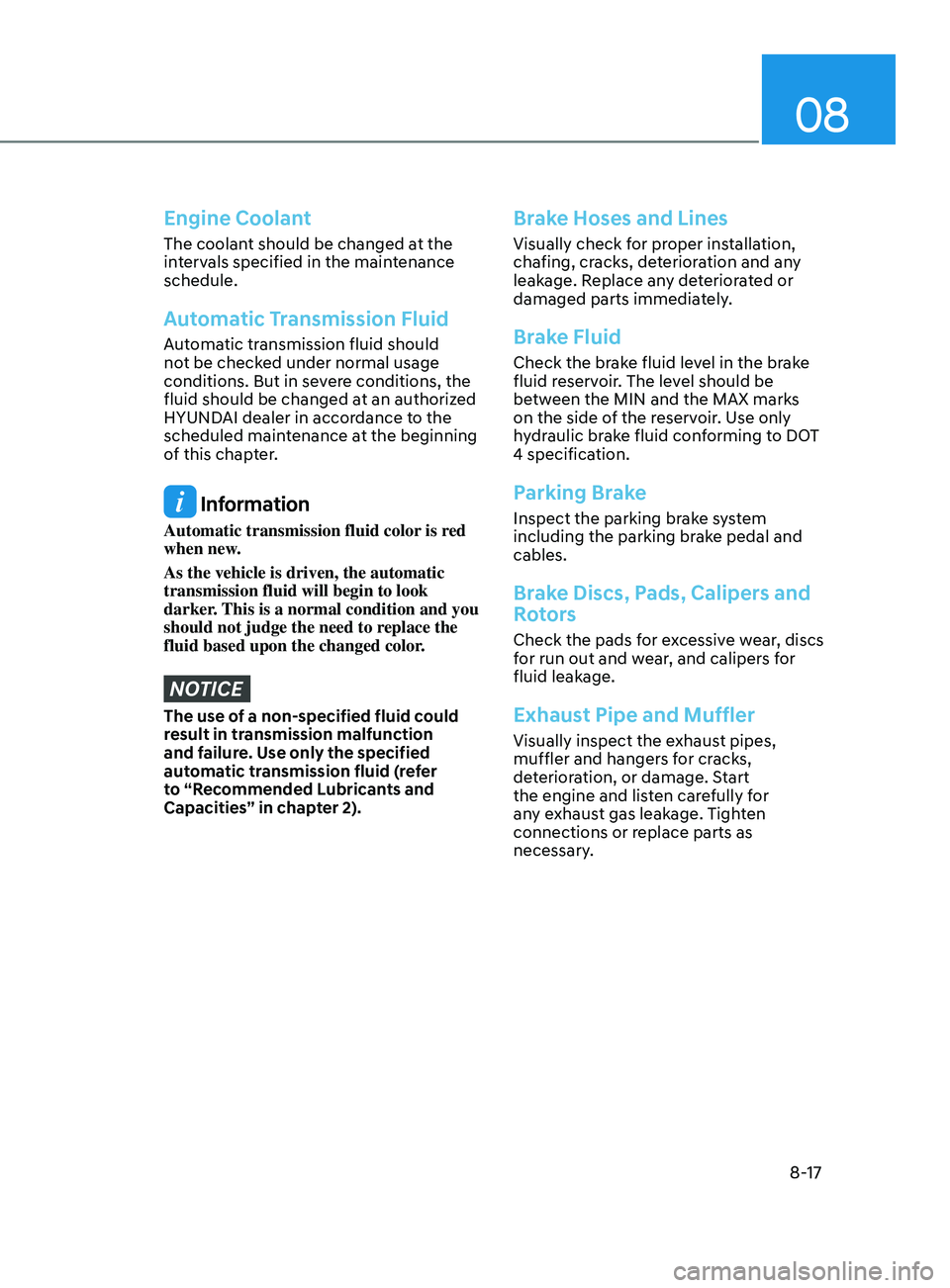
Automatic Transmission Fluid
Automatic transmission fluid should
not be checked under normal usage
conditions. But in severe conditions, the
fluid should be changed at an authorized
HYUNDAI dealer in accordance to the
scheduled maintenance at the beginning
of this chapter.
Information
Automatic transmission fluid color is red
when new.
As the vehicle is driven, the automatic
transmission fluid will begin to look
darker. This is a normal condition and you
should not judge the need to replace the
fluid based upon the changed color.
NOTICE
The use of a non-specified fluid could
result in transmission malfunction
and failure. Use only the specified
automatic transmission fluid (refer
to “Recommended Lubricants and
Capacities” in chapter 2).
Brake Hoses and Lines
Visually check for proper installation,
chafing, cracks, deterioration and any
leakage. Replace any deteriorated or
damaged parts immediately.
Brake Fluid
Check the brake fluid level in the brake
fluid reservoir. The level should be
between the MIN and the MAX marks
on the side of the reservoir. Use only
hydraulic brake fluid conforming to DOT
4 specification.
Parking Brake
Inspect the parking brake system
including the parking brake pedal and
cables.
Brake Discs, Pads, Calipers and
Rotors
Check the pads for excessive wear, discs
for run out and wear, and calipers for
fluid leakage.
Exhaust Pipe and Muffler
Visually inspect the exhaust pipes,
muffler and hangers for cracks,
deterioration, or damage. Start
the engine and listen carefully for
any exhaust gas leakage. Tighten
connections or replace parts as
necessary.