trunk Hyundai Tiburon 2005 Owner's Manual
[x] Cancel search | Manufacturer: HYUNDAI, Model Year: 2005, Model line: Tiburon, Model: Hyundai Tiburon 2005Pages: 262, PDF Size: 11.12 MB
Page 31 of 262
1FEATURES OF YOUR HYUNDAI20
!
o Always make sure that the shoulder belt
portion of the lap/shoulder belt is posi-
tioned midway over the shoulder, never
across the neck or behind the back.
Moving the child closer toward the seat
belt buckle may help provide a good
shoulder belt fit. The lap belt portion of
the lap/shoulder belt or the center seat
lap belt must always be positioned as
low as possible on the child's hips and
as snug as possible.
o If the seat belt will not properly fit the
child, Hyundai recommends the use of
an approved booster seat in the rear seat
in order to raise the child's seating height
so that the seat belt will properly fit the
child. Before purchasing a booster seat,
make sure that it meets applicable Fed-
eral Motor Vehicle Safety Standards
(FMVSS) and that it is satisfactory for
use with this vehicle.
o Never allow a child to stand up or kneel
on the seat.
o Never use an infant carrier or child safety
seat that "hooks" over a seatback; it may
not provide adequate security in an ac-
cident.
WARNING:
!
WARNING:
o A child restraint system must be placed
in the rear seat. Never install a child or
infant seat on the front passenger's seat.
Should an accident occur and cause the
passenger side airbag to deploy, it could
severely injure or kill an infant or child
seated in an infant or child seat. Thus,
only use a child restraint in the rear seat
of your vehicle.
o A safety belt or child restraint system
can become very hot if it is left in a closed
vehicle on a sunny day, even if the out-
side temperature does not feel hot. Be
sure to check the seat cover and buckles
before placing a child there.
o When the child restraint system is not in
use, store it in the trunk or fasten it with
a safety belt so that it will not be thrown
forward in the case of a sudden stop or
an accident.
o Children who are too large to be in a child
restraint should still sit in the rear seat
and be restrained with the available lap/
shoulder belts. Never allow children to
ride in the front passenger seat.
CHILD RESTRAINT SYSTEMB230A03A-AATChildren riding in the car should sit in the rear
seat and must always be properly restrained to
minimize the risk of injury in an accident, sudden
stop or sudden maneuver. According to acci-
dent statistics provided by the National High-
way Traffic Safety Administration (NHTSA),
children are safer when properly restrained in
the rear seats than in the front seat. Larger
children not in a child restraint should use one
of the seat belts provided.
All 50 states have child restraint laws. You
should be aware of the specific requirements in
your state. Child and/or infant safety seats must
be properly placed and installed in the rear seat.
You must use a commercially available child
restraint system that meets the requirements of
the Federal Motor Vehicle Safety Standards
(FMVSS).
Children could be injured or killed in a crash if
their restraints are not properly secured. For
small children and babies, a child seat or infant
seat must be used. Before buying a particular
child restraint system, make sure it fits your car
and seat belts, and fits your child. Follow all the
instructions provided by the manufacturer when
installing the child restraint system.
Page 43 of 262

1FEATURES OF YOUR HYUNDAI32
!
o If you sell your vehicle, make certain that
this manual is transferred to the new
owner.
o If your car was flooded and has soaked
carpeting or water on the floor, you
shouldn't try to start the engine; have
the car towed to an authorized Hyundai
dealer.
WARNING:
B240D01JM-AATAdditional Safety PrecautionsoNever let passengers ride in the cargo
area (trunk) or on top of a folded-down
back seat. All occupants should sit upright,
fully back in their seats with their seat belts
on and their feet on the floor.
oPassengers should not move out of or
change seats while the vehicle is mov-
ing. A passenger who is not wearing a seat
belt during a crash or emergency stop can
be thrown against the inside of the vehicle,
against other occupants, or out of the ve-
hicle.
oEach seat belt is designed to restrain one
occupant. If more than one person uses the
same seat belt, they could be seriously
injured or killed in a collision.
oDo not use any accessories on seat
belts. Devices claiming to improve occu-
pant comfort or reposition the seat belt can
reduce the protection provided by the seat
belt and increase the chance of serious
injury in a crash.
oPassengers should not place hard or
sharp objects between themselves and
the airbags. Carrying hard or sharp objects
on your lap or in your mouth can result in
injuries if an airbag inflates.oKeep occupants away from the airbag
covers. All occupants should sit upright, fully
back in their seats with their seat belts on and
their feet on the floor. If occupants are too
close to the airbag covers, they could be
injured if the airbags inflate.
oDo not attach or place objects on or near
the airbag covers. Any object attached to
or placed on the front or side impact airbag
covers could interfere with the proper opera-
tion of the airbags.
oDo not modify the front seats. Modifica-
tion of the front seats could interfere with the
operation of the supplemental restraint sys-
tem sensing components or side impact
airbags.
oDo not place items under the front seats.
Placing items under the front seats could
interfere with the operation of the supple-
mental restraint system sensing compo-
nents and wiring harnesses.
oNever hold an infant or child on your lap.
The infant or child could be seriously injured
or killed in the event of a crash. All infants and
children should be properly restrained in
appropriate child safety seats or seat belts
in the rear seat.
Page 65 of 262
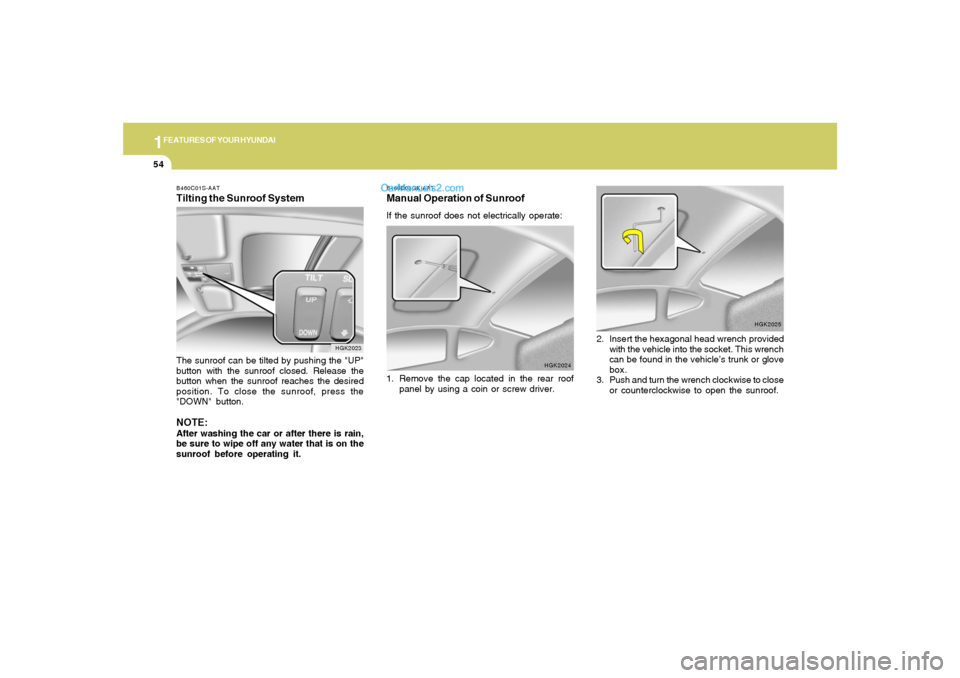
1FEATURES OF YOUR HYUNDAI54
2. Insert the hexagonal head wrench provided
with the vehicle into the socket. This wrench
can be found in the vehicle’s trunk or glove
box.
3. Push and turn the wrench clockwise to close
or counterclockwise to open the sunroof.
HGK2025 B460C01S-AAT
Tilting the Sunroof SystemThe sunroof can be tilted by pushing the "UP"
button with the sunroof closed. Release the
button when the sunroof reaches the desired
position. To close the sunroof, press the
"DOWN" button.NOTE:After washing the car or after there is rain,
be sure to wipe off any water that is on the
sunroof before operating it.
HGK2023
B460D03GK-AATManual Operation of SunroofIf the sunroof does not electrically operate:
1. Remove the cap located in the rear roof
panel by using a coin or screw driver.
HGK2024
Page 155 of 262
2
DRIVING YOUR HYUNDAI
19
C190D01S-AATSafety ChainsShould the hitch connection between your
vechile and the trailer or vehicle you are towing
fail, the trailer or vehicle could wander danger-
ously across other lanes of traffic and ultimately
leave the roadway. To eliminate this potentially
dangerous situation, safety chains, attached
between your car and the trailer or towed
vehicle, are required in most states.
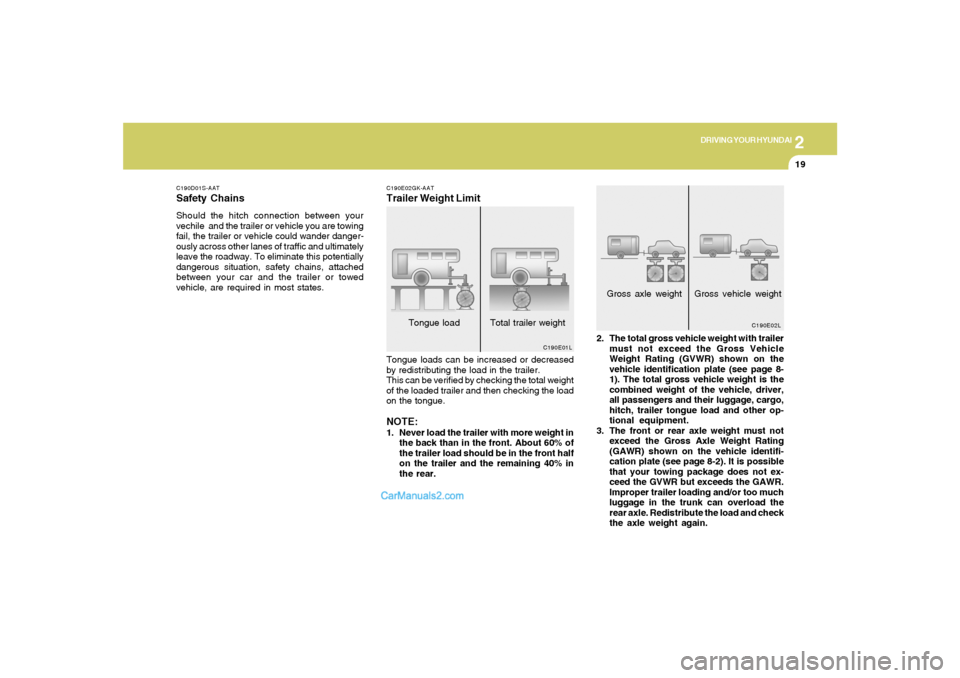
C190E02GK-AATTrailer Weight Limit
C190E01L
Tongue load Total trailer weight
Tongue loads can be increased or decreased
by redistributing the load in the trailer.
This can be verified by checking the total weight
of the loaded trailer and then checking the load
on the tongue.
NOTE:1. Never load the trailer with more weight in
the back than in the front. About 60% of
the trailer load should be in the front half
on the trailer and the remaining 40% in
the rear.
2. The total gross vehicle weight with trailer
must not exceed the Gross Vehicle
Weight Rating (GVWR) shown on the
vehicle identification plate (see page 8-
1). The total gross vehicle weight is the
combined weight of the vehicle, driver,
all passengers and their luggage, cargo,
hitch, trailer tongue load and other op-
tional equipment.
3. The front or rear axle weight must not
exceed the Gross Axle Weight Rating
(GAWR) shown on the vehicle identifi-
cation plate (see page 8-2). It is possible
that your towing package does not ex-
ceed the GVWR but exceeds the GAWR.
Improper trailer loading and/or too much
luggage in the trunk can overload the
rear axle. Redistribute the load and check
the axle weight again.
C190E02L
Gross axle weight Gross vehicle weight
Page 167 of 262
3
WHAT TO DO IN AN EMERGENCY
7
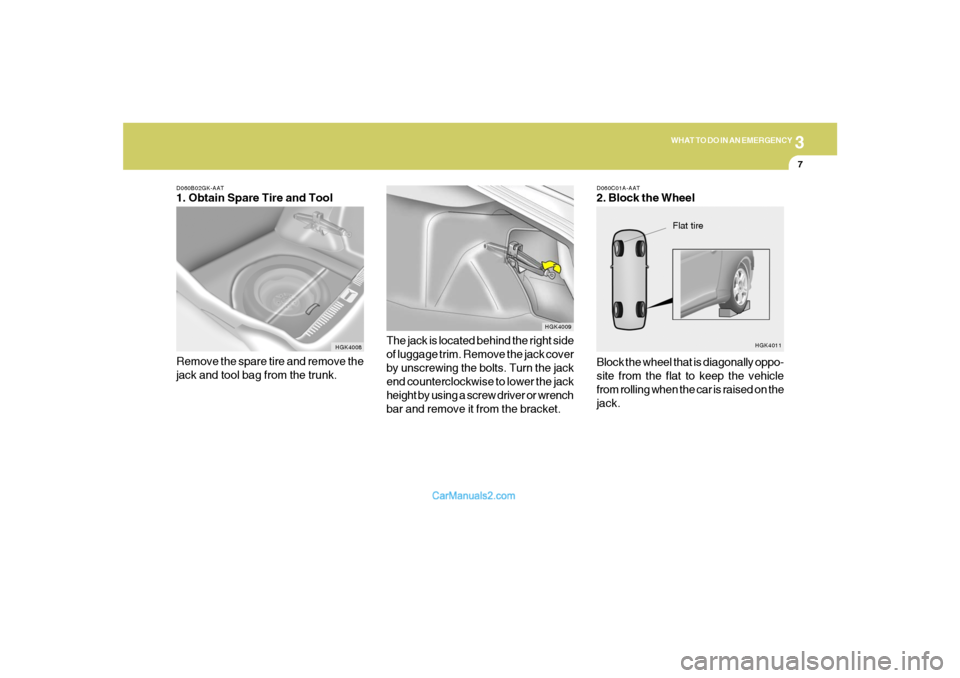
D060B02GK-AAT1. Obtain Spare Tire and Tool
Remove the spare tire and remove the
jack and tool bag from the trunk.
HGK4008
The jack is located behind the right side
of luggage trim. Remove the jack cover
by unscrewing the bolts. Turn the jack
end counterclockwise to lower the jack
height by using a screw driver or wrench
bar and remove it from the bracket.
HGK4009
D060C01A-AAT2. Block the Wheel
Block the wheel that is diagonally oppo-
site from the flat to keep the vehicle
from rolling when the car is raised on the
jack.
HGK4011
Flat tire
Page 232 of 262
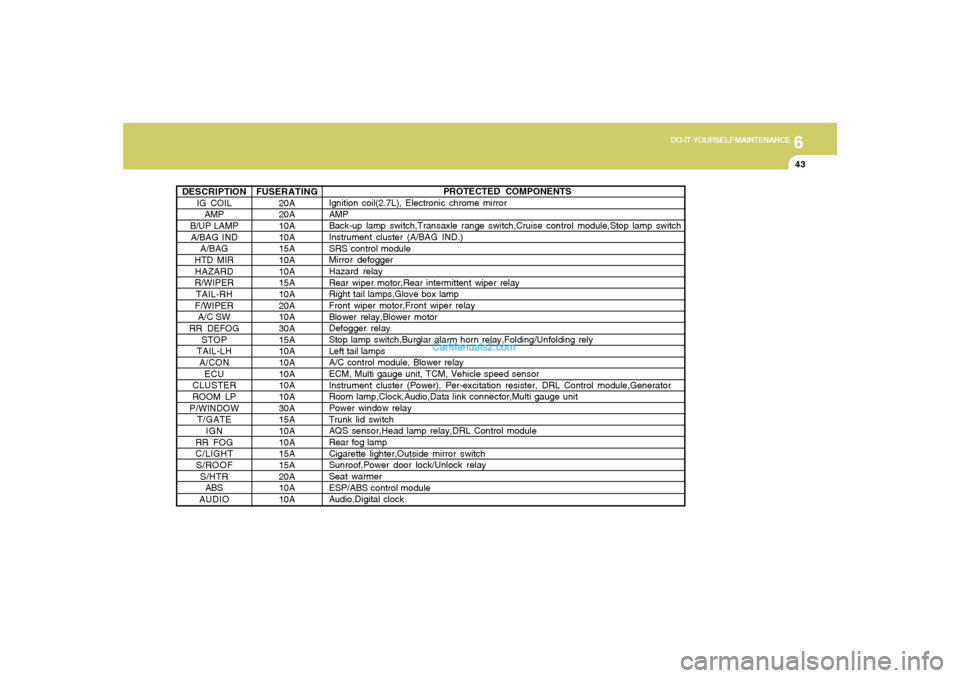
6
DO-IT-YOURSELF MAINTENANCE
43
DESCRIPTION
IG COIL
AMP
B/UP LAMP
A/BAG IND
A/BAG
HTD MIR
HAZARD
R/WIPER
TAIL-RH
F/WIPER
A/C SW
RR DEFOG
STOP
TAIL-LH
A/CON
ECU
CLUSTER
ROOM LP
P/WINDOW
T/GATE
IGN
RR FOG
C/LIGHT
S/ROOF
S/HTR
ABS
AUDIO
PROTECTED COMPONENTS
Ignition coil(2.7L), Electronic chrome mirror
AMP
Back-up lamp switch,Transaxle range switch,Cruise control module,Stop lamp switch
Instrument cluster (A/BAG IND.)
SRS control module
Mirror defogger
Hazard relay
Rear wiper motor,Rear intermittent wiper relay
Right tail lamps,Glove box lamp
Front wiper motor,Front wiper relay
Blower relay,Blower motor
Defogger relay
Stop lamp switch,Burglar alarm horn relay,Folding/Unfolding rely
Left tail lamps
A/C control module, Blower relay
ECM, Multi gauge unit, TCM, Vehicle speed sensor
Instrument cluster (Power), Per-excitation resister, DRL Control module,Generator
Room lamp,Clock,Audio,Data link connector,Multi gauge unit
Power window relay
Trunk lid switch
AQS sensor,Head lamp relay,DRL Control module
Rear fog lamp
Cigarette lighter,Outside mirror switch
Sunroof,Power door lock/Unlock relay
Seat warmer
ESP/ABS control module
Audio,Digital clock FUSERATING
20A
20A
10A
10A
15A
10A
10A
15A
10A
20A
10A
30A
15A
10A
10A
10A
10A
10A
30A
15A
10A
10A
15A
15A
20A
10A
10A