start stop button HYUNDAI VELOSTER 2013 User Guide
[x] Cancel search | Manufacturer: HYUNDAI, Model Year: 2013, Model line: VELOSTER, Model: HYUNDAI VELOSTER 2013Pages: 372, PDF Size: 22.04 MB
Page 191 of 372
Driving your vehicle
10 5
Starting the engine
1. Carry the smart key or leave it inside
the vehicle.
2. Make sure the parking brake is firmly
applied.
3.Manual Transaxle- Depress the
clutch pedal fully and shift the
transaxle into Neutral. Depress the
brake and clutch pedal fully.
Automatic transaxle / EcoShift dual
clutch transmission- Place the
transaxle shift lever in P (Park).
Depress the brake pedal fully.
You can also start the engine when the
shift lever is in the N (Neutral) position.
4. Press the engine start/stop button.
WARNING
Never press the engine start/stop
button while the vehicle is in
motion. This would result in loss
of directional control and braking
function, which could cause an
accident.
Before leaving the driver’s seat,
always make sure the shift lever is
engaged in 1st gear for the manual
transaxle or P (Park) for the
EcoShift dual clutch transmission,
set the parking brake fully and shut
the engine off. Unexpected and
sudden vehicle movement may
occur if these precautions are not
taken.
Never reach for the engine
start/stop button, or any other con-
trols through the steering wheel
while the vehicle is in motion. The
presence of your hand or arm in
this area could cause a loss of
vehicle control, an accident and
serious bodily injury or death.
(Continued)
(Continued)
Do not place any movable objects
around the driver’s seat as they
may move while driving, interfere
with the driver and lead to an
accident.
While driving, if you push the
ENGINE START/ STOP button, the
warning buzzer sounds for 1 sec-
ond.
WARNING
Always wear appropriate shoes
when operating your vehicle.
Unsuitable shoes (high heels, ski
boots, etc.) may interfere with your
ability to use the brake, accelerator
and clutch pedal (if equipped).
Page 192 of 372
511
Driving your vehicle
5. In extremely cold weather (below -
18°C / 0°F) or after the vehicle has not
been operated for several days, let the
engine warm up without depressing
the accelerator.
Whether the engine is cold or warm, it
should be started without depressing
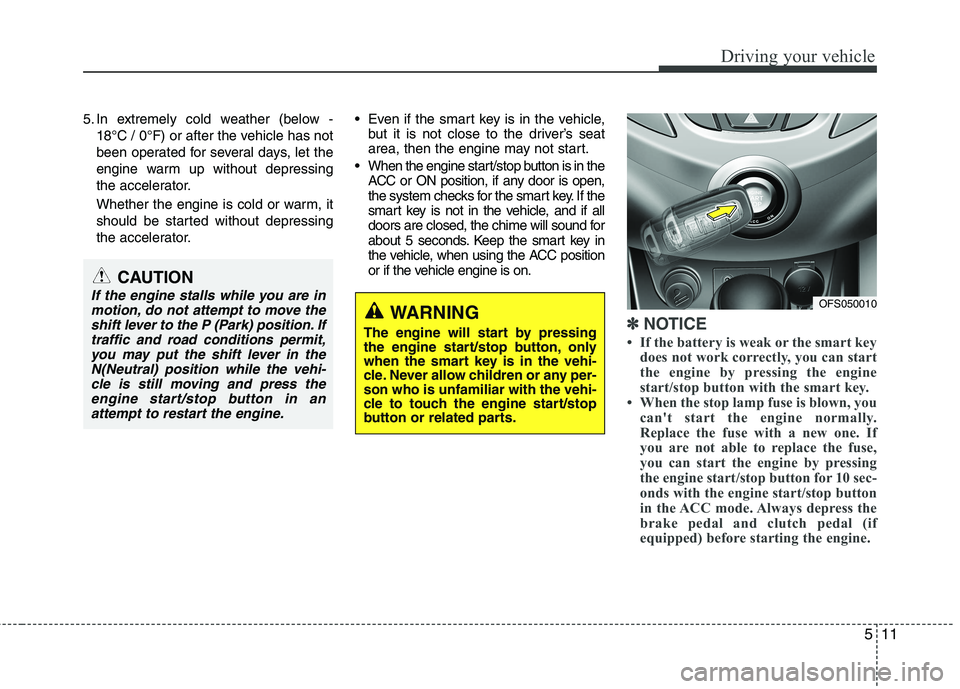
the accelerator. Even if the smart key is in the vehicle,
but it is not close to the driver’s seat
area, then the engine may not start.
When the engine start/stop button is in the
ACC or ON position, if any door is open,
the system checks for the smart key. If the
smart key is not in the vehicle, and if all
doors are closed, the chime will sound for
about 5 seconds. Keep the smart key in
the vehicle, when using the ACC position
or if the vehicle engine is on.
✽ ✽
NOTICE
• If the battery is weak or the smart key
does not work correctly, you can start
the engine by pressing the engine
start/stop button with the smart key.
• When the stop lamp fuse is blown, you
can't start the engine normally.
Replace the fuse with a new one. If
you are not able to replace the fuse,
you can start the engine by pressing
the engine start/stop button for 10 sec-
onds with the engine start/stop button
in the ACC mode. Always depress the
brake pedal and clutch pedal (if
equipped) before starting the engine.
WARNING
The engine will start by pressing
the engine start/stop button, only
when the smart key is in the vehi-
cle. Never allow children or any per-
son who is unfamiliar with the vehi-
cle to touch the engine start/stop
button or related parts.
CAUTION
If the engine stalls while you are in
motion, do not attempt to move the
shift lever to the P (Park) position. If
traffic and road conditions permit,
you may put the shift lever in the
N(Neutral) position while the vehi-
cle is still moving and press the
engine start/stop button in an
attempt to restart the engine.OFS050010
Page 193 of 372
Driving your vehicle
12 5
CAUTION
Do not press the engine start/stop
button for more than 5 seconds
except when the stop lamp fuse is
disconnected.
Page 194 of 372
513
Driving your vehicle
Manual transaxle operation
The manual transaxle has 6 forward
gears.
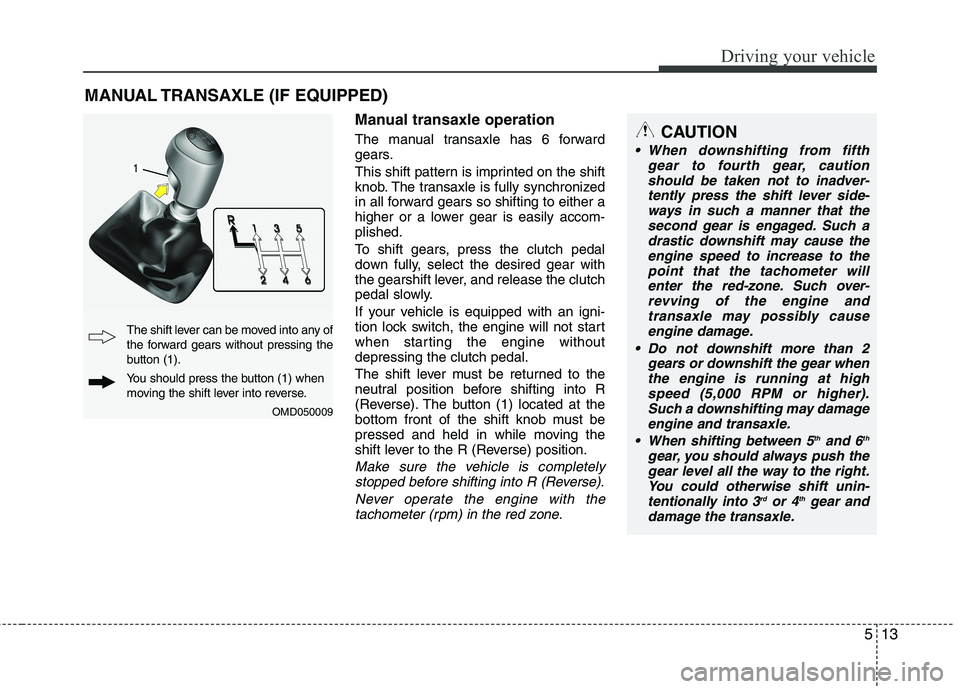
This shift pattern is imprinted on the shift
knob. The transaxle is fully synchronized
in all forward gears so shifting to either a
higher or a lower gear is easily accom-
plished.
To shift gears, press the clutch pedal
down fully, select the desired gear with
the gearshift lever, and release the clutch
pedal slowly.
If your vehicle is equipped with an igni-
tion lock switch, the engine will not start
when starting the engine without
depressing the clutch pedal.
The shift lever must be returned to the
neutral position before shifting into R
(Reverse). The button (1) located at the
bottom front of the shift knob must be
pressed and held in while moving the
shift lever to the R (Reverse) position.
Make sure the vehicle is completely
stopped before shifting into R (Reverse).
Never operate the engine with the
tachometer (rpm) in the red zone.
MANUAL TRANSAXLE (IF EQUIPPED)
OMD050009
The shift lever can be moved into any of
the forward gears without pressing the
button (1).
You should press the button (1) when
moving the shift lever into reverse.
CAUTION
When downshifting from fifth
gear to fourth gear, caution
should be taken not to inadver-
tently press the shift lever side-
ways in such a manner that the
second gear is engaged. Such a
drastic downshift may cause the
engine speed to increase to the
point that the tachometer will
enter the red-zone. Such over-
revving of the engine and
transaxle may possibly cause
engine damage.
Do not downshift more than 2
gears or downshift the gear when
the engine is running at high
speed (5,000 RPM or higher).
Such a downshifting may damage
engine and transaxle.
When shifting between 5
thand 6th
gear, you should always push the
gear level all the way to the right.
You could otherwise shift unin-
tentionally into 3
rdor 4thgear and
damage the transaxle.
Page 214 of 372
533
Driving your vehicle
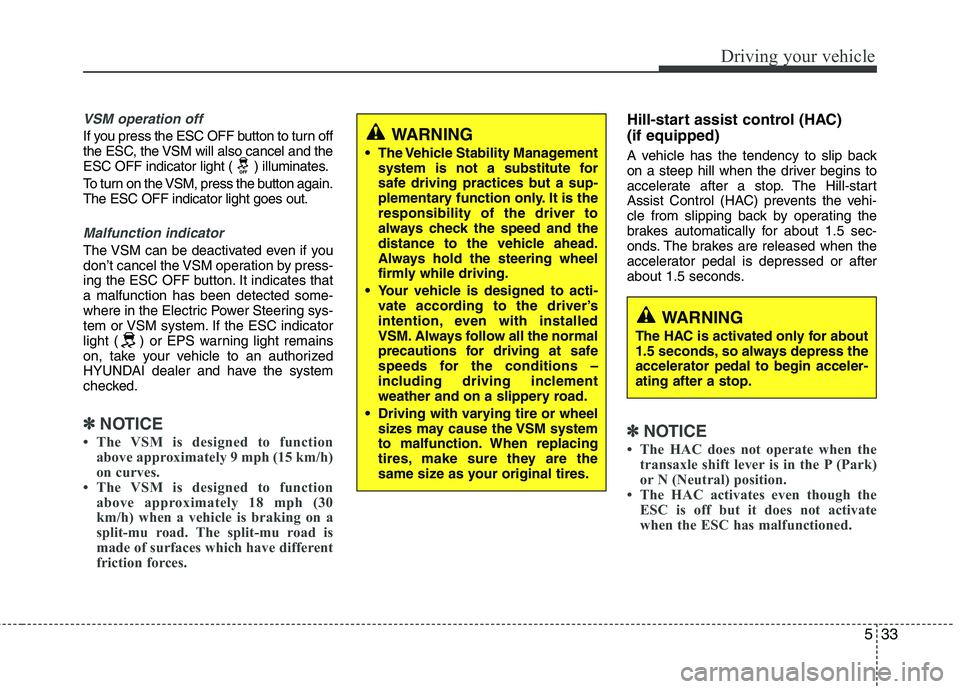
VSM operation off
If you press the ESC OFF button to turn off
the ESC, the VSM will also cancel and the
ESC OFF indicator light ( ) illuminates.
To turn on the VSM, press the button again.
The ESC OFF indicator light goes out.
Malfunction indicator
The VSM can be deactivated even if you
don’t cancel the VSM operation by press-
ing the ESC OFF button. It indicates that
a malfunction has been detected some-
where in the Electric Power Steering sys-
tem or VSM system. If the ESC indicator
light ( ) or EPS warning light remains
on, take your vehicle to an authorized
HYUNDAI dealer and have the system
checked.
✽ ✽
NOTICE
• The VSM is designed to function
above approximately 9 mph (15 km/h)
on curves.
• The VSM is designed to function
above approximately 18 mph (30
km/h) when a vehicle is braking on a
split-mu road. The split-mu road is
made of surfaces which have different
friction forces.
Hill-start assist control (HAC)
(if equipped)
A vehicle has the tendency to slip back
on a steep hill when the driver begins to
accelerate after a stop. The Hill-start
Assist Control (HAC) prevents the vehi-
cle from slipping back by operating the
brakes automatically for about 1.5 sec-
onds. The brakes are released when the
accelerator pedal is depressed or after
about 1.5 seconds.
✽ ✽
NOTICE
• The HAC does not operate when the
transaxle shift lever is in the P (Park)
or N (Neutral) position.
• The HAC activates even though the
ESC is off but it does not activate
when the ESC has malfunctioned.
WARNING
The Vehicle Stability Management
system is not a substitute for
safe driving practices but a sup-
plementary function only. It is the
responsibility of the driver to
always check the speed and the
distance to the vehicle ahead.
Always hold the steering wheel
firmly while driving.
Your vehicle is designed to acti-
vate according to the driver’s
intention, even with installed
VSM. Always follow all the normal
precautions for driving at safe
speeds for the conditions –
including driving inclement
weather and on a slippery road.
Driving with varying tire or wheel
sizes may cause the VSM system
to malfunction. When replacing
tires, make sure they are the
same size as your original tires.
WARNING
The HAC is activated only for about
1.5 seconds, so always depress the
accelerator pedal to begin acceler-
ating after a stop.
Page 259 of 372
623
What to do in an emergency
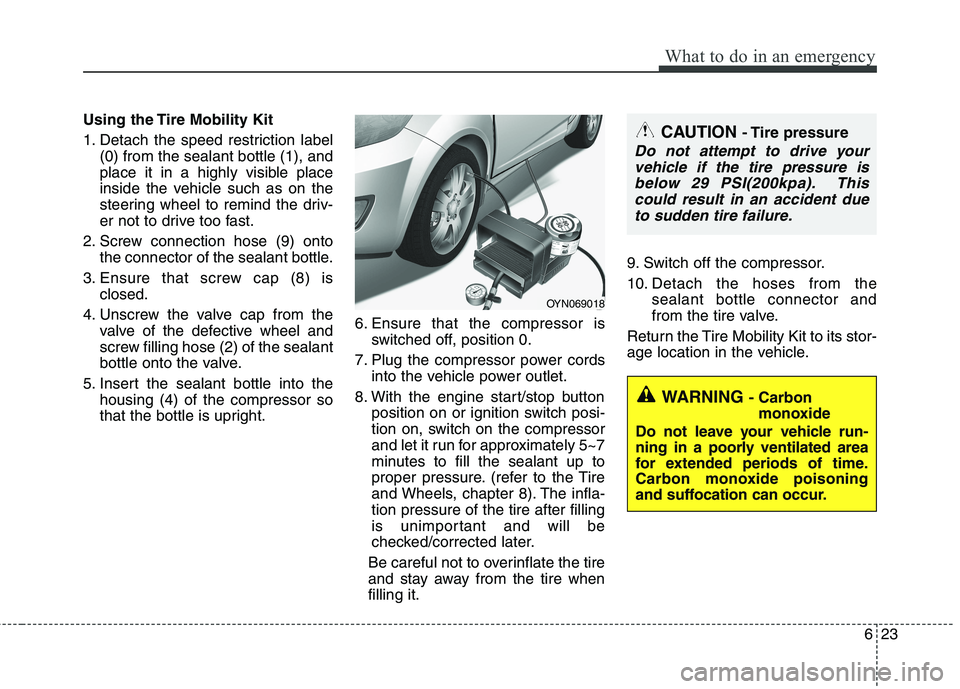
Using the Tire Mobility Kit
1. Detach the speed restriction label
(0) from the sealant bottle (1), and
place it in a highly visible place
inside the vehicle such as on the
steering wheel to remind the driv-
er not to drive too fast.
2. Screw connection hose (9) onto
the connector of the sealant bottle.
3. Ensure that screw cap (8) is
closed.
4. Unscrew the valve cap from the
valve of the defective wheel and
screw filling hose (2) of the sealant
bottle onto the valve.
5. Insert the sealant bottle into the
housing (4) of the compressor so
that the bottle is upright.6. Ensure that the compressor is
switched off, position 0.
7. Plug the compressor power cords
into the vehicle power outlet.
8. With the engine start/stop button
position on or ignition switch posi-
tion on, switch on the compressor
and let it run for approximately 5~7
minutes to fill the sealant up to
proper pressure. (refer to the Tire
and Wheels, chapter 8). The infla-
tion pressure of the tire after filling
is unimportant and will be
checked/corrected later.
Be careful not to overinflate the tire
and stay away from the tire when
filling it.9. Switch off the compressor.
10. Detach the hoses from the
sealant bottle connector and
from the tire valve.
Return the Tire Mobility Kit to its stor-
age location in the vehicle.CAUTION - Tire pressure
Do not attempt to drive your
vehicle if the tire pressure is
below 29 PSI(200kpa). This
could result in an accident due
to sudden tire failure.
WARNING - Carbon
monoxide
Do not leave your vehicle run-
ning in a poorly ventilated area
for extended periods of time.
Carbon monoxide poisoning
and suffocation can occur.
OYN069018
Page 333 of 372
Maintenance
68 7
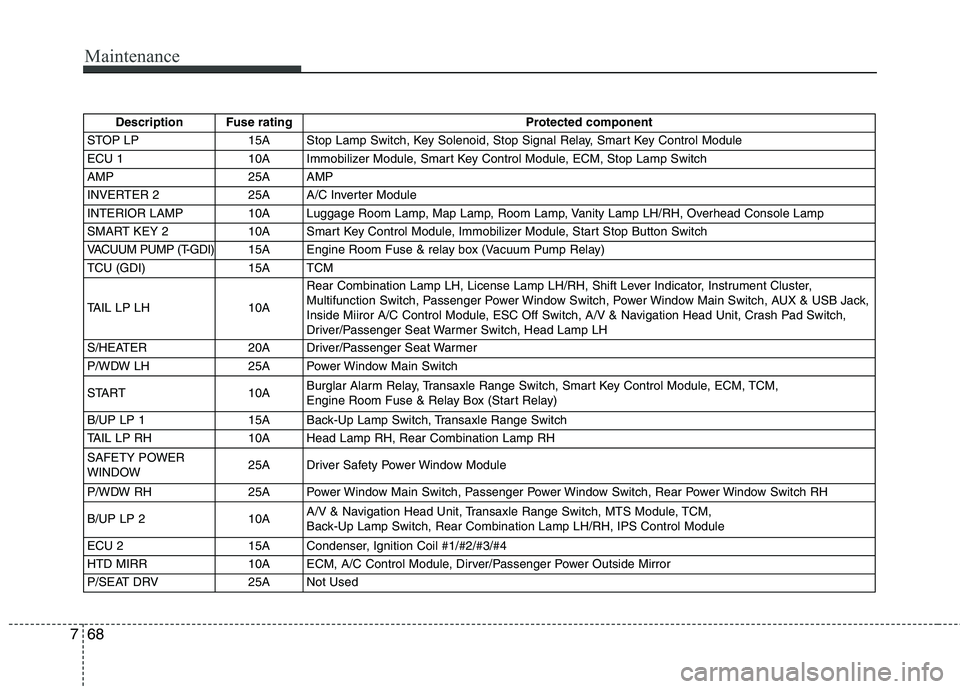
Description Fuse rating Protected component
STOP LP 15A Stop Lamp Switch, Key Solenoid, Stop Signal Relay, Smart Key Control Module
ECU 1 10A Immobilizer Module, Smart Key Control Module, ECM, Stop Lamp Switch
AMP 25A AMP
INVERTER 2 25A A/C Inverter Module
INTERIOR LAMP 10A Luggage Room Lamp, Map Lamp, Room Lamp, Vanity Lamp LH/RH, Overhead Console Lamp
SMART KEY 2 10A Smart Key Control Module, Immobilizer Module, Start Stop Button Switch
VACUUM PUMP (T-GDI) 15AEngine Room Fuse & relay box (Vacuum Pump Relay)
TCU (GDI) 15A TCM
TAIL LP LH 10ARear Combination Lamp LH, License Lamp LH/RH, Shift Lever Indicator, Instrument Cluster,
Multifunction Switch, Passenger Power Window Switch, Power Window Main Switch, AUX & USB Jack,
Inside Miiror A/C Control Module, ESC Off Switch, A/V & Navigation Head Unit, Crash Pad Switch,
Driver/Passenger Seat Warmer Switch, Head Lamp LH
S/HEATER 20A Driver/Passenger Seat Warmer
P/WDW LH 25A Power Window Main Switch
START 10ABurglar Alarm Relay, Transaxle Range Switch, Smart Key Control Module, ECM, TCM,
Engine Room Fuse & Relay Box (Start Relay)
B/UP LP 1 15A Back-Up Lamp Switch, Transaxle Range Switch
TAIL LP RH 10A Head Lamp RH, Rear Combination Lamp RH
SAFETY POWER
WINDOW25A Driver Safety Power Window Module
P/WDW RH 25A Power Window Main Switch, Passenger Power Window Switch, Rear Power Window Switch RH
B/UP LP 2 10AA/V & Navigation Head Unit, Transaxle Range Switch, MTS Module, TCM,
Back-Up Lamp Switch, Rear Combination Lamp LH/RH, IPS Control Module
ECU 2 15A Condenser, Ignition Coil #1/#2/#3/#4
HTD MIRR 10A ECM, A/C Control Module, Dirver/Passenger Power Outside Mirror
P/SEAT DRV 25A Not Used
Page 366 of 372
Index
2I
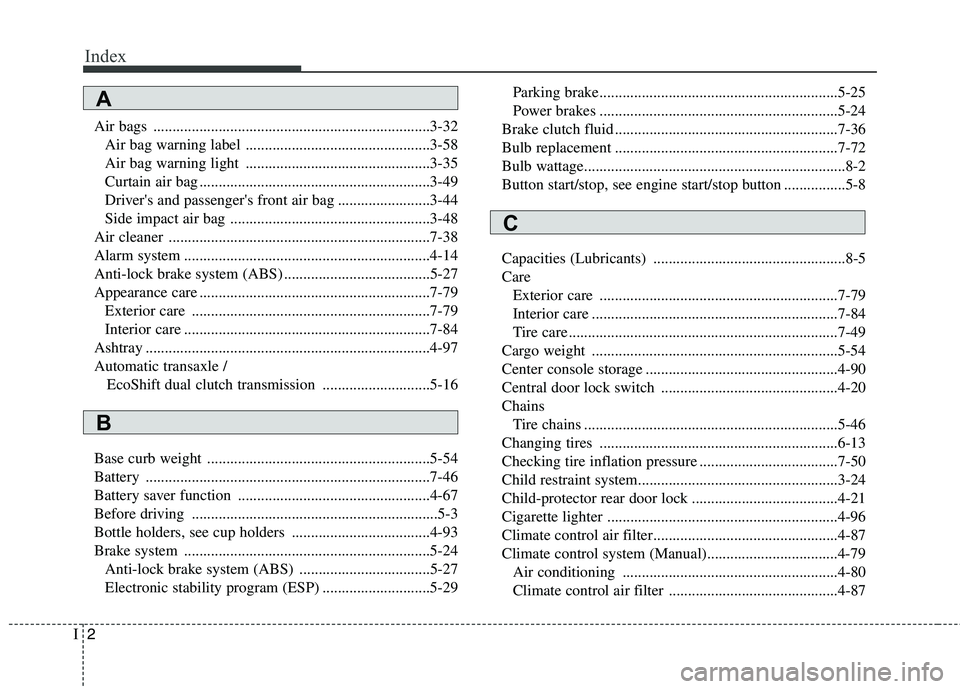
Air bags ........................................................................3-32
Air bag warning label ................................................3-58
Air bag warning light ................................................3-35
Curtain air bag ............................................................3-49
Driver's and passenger's front air bag ........................3-44
Side impact air bag ....................................................3-48
Air cleaner ....................................................................7-38
Alarm system ................................................................4-14
Anti-lock brake system (ABS) ......................................5-27
Appearance care ............................................................7-79
Exterior care ..............................................................7-79
Interior care ................................................................7-84
Ashtray ..........................................................................4-97
Automatic transaxle /
EcoShift dual clutch transmission ............................5-16
Base curb weight ..........................................................5-54
Battery ..........................................................................7-46
Battery saver function ..................................................4-67
Before driving ................................................................5-3
Bottle holders, see cup holders ....................................4-93
Brake system ................................................................5-24
Anti-lock brake system (ABS) ..................................5-27
Electronic stability program (ESP) ............................5-29Parking brake..............................................................5-25
Power brakes ..............................................................5-24
Brake clutch fluid ..........................................................7-36
Bulb replacement ..........................................................7-72
Bulb wattage....................................................................8-2
Button start/stop, see engine start/stop button ................5-8
Capacities (Lubricants) ..................................................8-5
Care
Exterior care ..............................................................7-79
Interior care ................................................................7-84
Tire care ......................................................................7-49
Cargo weight ................................................................5-54
Center console storage ..................................................4-90
Central door lock switch ..............................................4-20
Chains
Tire chains ..................................................................5-46
Changing tires ..............................................................6-13
Checking tire inflation pressure ....................................7-50
Child restraint system....................................................3-24
Child-protector rear door lock ......................................4-21
Cigarette lighter ............................................................4-96
Climate control air filter................................................4-87
Climate control system (Manual)..................................4-79
Air conditioning ........................................................4-80
Climate control air filter ............................................4-87
A
B
C
Page 367 of 372
I3
Index
Heating and air conditioning ......................................4-80
Clock (Digital) ..............................................................4-97
Clothes hanger ..............................................................4-98
Combined instrument, see instrument cluster ..............4-44
Compact spare tire replacement ....................................7-54
Coolant ..........................................................................7-33
Cooling fluid, see engine coolant ................................7-33
Crankcase emission control system ..............................7-85
Cruise control system ....................................................5-34
Cup holder ....................................................................4-93
Curtain air bag ..............................................................3-49
Dashboard illumination,
see instrument panel illumination ..............................4-45
Dashboard, see instrument cluster ................................4-44
Defogging (Windshield)................................................4-88
Defogging logic (Windshield) ......................................4-89
Defroster (Rear window) ..............................................4-78
Defrosting (Windshield)................................................4-88
Digital clock ..................................................................4-97
Dimensions ......................................................................8-2
Display illumination,
see instrument panel illumination ..............................4-45
Displays, see instrument cluster....................................4-44
Door locks ....................................................................4-18
Central door lock switch ............................................4-20Child-protector rear door lock....................................4-21
Drinks holders, see cup holders ....................................4-93
Driver's air bag ..............................................................3-44
Driving at night ............................................................5-42
Driving in flooded areas................................................5-43
Driving in the rain ........................................................5-43
Economical operation....................................................5-39
EcoShift dual clutch transmission ................................5-16
Electronic stability control (ESC) ................................5-29
Emergency starting..........................................................6-4
Jump starting ................................................................6-4
Push starting ................................................................6-5
Emergency towing ........................................................6-26
Emergency while driving ................................................6-2
Emission control system ..............................................7-85
Crankcase emission control system ..........................7-85
Evaporative emission control System ........................7-85
Exhaust emission control system ..............................7-86
Engine compartment ................................................2-4, 7-2
Engine coolant ..............................................................7-33
Engine number ................................................................8-9
Engine oil ......................................................................7-31
Engine overheats ............................................................6-6
Engine start/stop button ..................................................5-8
Engine temperature gauge ............................................4-46
D
E