manual transmission INFINITI G CONVERTIBLE 2013 Owner's Guide
[x] Cancel search | Manufacturer: INFINITI, Model Year: 2013, Model line: G CONVERTIBLE, Model: INFINITI G CONVERTIBLE 2013Pages: 466
Page 324 of 466

cruising speed, the cruise control will
disengage. Turn the MAIN switch off
once and then turn it on again.
. The cruise control will automatically
cancel if the vehicle slows more than
8 MPH (12 km/h) below the set speed.
. If you depress the clutch pedal (Manual
Transmission models) or move the
selector lever to N (Neutral) position
(Automatic Transmission models), the
cruise control will be canceled.
To reset at a faster cruising speed, use one
of the following methods:
. Depress the accelerator pedal. When
the vehicle attains the desired speed,
push and release the COAST/SET
switch.
. Push and hold the ACCELERATE/RE-
SUME switch. When the vehicle attains
the speed you desire, release the
switch.
. Push, then quickly release the ACCEL-
ERATE/RESUME switch. Each time you
do this, the set speed will increase by
about 1 MPH (1.6 km/h).
To reset at a slower cruising speed, use
one of the following methods:
. Lightly tap the brake pedal. When the vehicle attains the desired speed, push
the COAST/SET switch and release it.
. Push and hold the COAST/SET switch.
Release the switch when the vehicle
slows down to the desired speed.
. Push, then quickly release the COAST/
SET switch. Each time you do this, the
set speed will decrease by about 1 MPH
(1.6 km/h).
To resume the preset speed, push and
release the ACCELERATE/RESUME switch.
The vehicle will resume the last set
cruising speed when the vehicle speed is
over 25 MPH (40 km/h).
GUID-6316154E-789A-441A-99F5-37DBCF9C2F28The Intelligent Cruise Control (ICC) system
automatically maintains a selected dis-
tance from the vehicle traveling in front of
you according to that vehicle’s speed (up
to the set speed), or at the set speed when
the road ahead is clear.
The ICC function can be set to one of two
cruise control modes:
. Vehicle-to-vehicle distance control
mode:
For maintaining a selected distance
between your vehicle and the vehicle
in front of you up to the preset speed.
. Conventional (fixed speed) cruise con-
trol mode:
For cruising at a preset speed.
WARNING
. Always drive carefully and attentively
when using either cruise control mode.
Read and understand the Owner’s Man-
ual thoroughly before using the cruise
control. To avoid serious injury or death,
do not rely on the system to prevent
accidents or to control the vehicle’s
speed in emergency situations. Do not
use cruise control except in appropriate
road and traffic conditions.
Starting and driving5-23
INTELLIGENT CRUISE CONTROL (ICC)
SYSTEM (if so equipped)
Page 348 of 466

GUID-4DD9A0F8-1386-4A22-899B-3ECDD1F27745
SD1006MA
WARNING
.Do not stop or park the vehicle over
flammable materials such as dry grass,
waste paper or rags. They may ignite and
cause a fire.
. Never leave the engine running while the
vehicle is unattended.
. Do not leave children unattended inside
the vehicle. They could unknowingly
activate switches or controls. Unat-
tended children could become involved
in serious accidents. .
Safe parking procedures require that
both the parking brake be applied and
the transmission placed into P (Park) for
Automatic Transmission (AT) model or in
an appropriate gear for Manual Trans-
mission (MT) model. Failure to do so
could cause the vehicle to move un-
expectedly or roll away and result in an
accident.
. Make sure the automatic transmission
selector lever has been pushed as far
forward as it can go and cannot be
moved without depressing the foot brake pedal.
1. Firmly apply the parking brake.
2.
Automatic transmission models:
Move the selector lever to the P (Park)
position.
Manual transmission models:
Place the shift lever in the R (Reverse)
gear. When parking on an uphill grade,
place the shift lever in the 1st gear.
3. To help prevent the vehicle from rolling into the street when parked on a
sloping drive way, it is a good practice
to turn the wheels as illustrated.
.HEADED DOWNHILL WITH CURB:*1
Turn the wheels into the curb and
move the vehicle forward until the
curb side wheel gently touches the
curb.
.HEADED UPHILL WITH CURB:*2
Turn the wheels away from the curb
and move the vehicle back until the
curb side wheel gently touches the
curb.
.HEADED UPHILL OR DOWNHILL, NO
CURB:
*3
Turn the wheels toward the side of
the road so the vehicle will move
Starting and driving5-47
PARKING/PARKING ON HILLS
Page 364 of 466

the tires and increase the likelihood of
tire failure. Serious vehicle damage
could occur and may lead to an accident
and could result in serious personal
injury. Check the tire pressure for all
four tires. Adjust the tire pressure to the
recommended COLD tire pressure shown
on the Tire and Loading Information
label to turn the low tire pressure
warning light OFF. If the light still
illuminates while driving after adjusting
the tire pressure, a tire may be flat. If
you have a flat tire, replace it with a
spare tire as soon as possible.
. When a spare tire is mounted or a wheel
is replaced, the TPMS will not function
and the low tire pressure warning light
will flash for approximately 1 minute.
The light will remain on after 1 minute.
Contact your INFINITI retailer as soon as
possible for tire replacement and/or
system resetting.
. Replacing tires with those not originally
specified by INFINITI could affect the
proper operation of the TPMS.
. Do not inject any tire liquid or aerosol
tire sealant into the tires, as this may
cause a malfunction of the tire pressure
sensors (for models not equipped with the emergency tire puncture repair kit).
. If you used the Emergency Tire Sealant
to repair a minor tire puncture, your
INFINITI retailer will also need to replace
the TPMS sensor in addition to repairing
or replacing the tire (for models
equipped with the emergency tire punc-
ture repair kit).
. INFINITI recommends using only NISSAN
Genuine Emergency Tire Sealant pro-
vided with your vehicle. Other tire
sealants may damage the valve stem
seal which can cause the tire to lose air
pressure (for models equipped with the
emergency tire puncture repair kit).
CHANGING FLAT TIRE (for models
with spare tire)
GUID-9B15550A-ABA1-4A2C-950E-BDED2B28BCB5If you have a flat tire, follow the instruc-
tions below.
Stopping the vehicleGUID-5A5AD417-603B-4670-8520-ECD73BDFFD6C1. Safely move the vehicle off the road
and away from traffic.
2. Turn on the hazard warning flashers.
3. Park on a level surface and apply the parking brake.
4. Automatic Transmission model:
Move the selector lever to the P (Park)
position.
Manual Transmission model:
Move the shift lever to the R (Reverse)
position.
5. Turn off the engine.
6. Raise the hood to warn other traffic, and to signal professional road assis-
tance personnel that you need assis-
tance.
7. Have all passengers get out of the vehicle and stand in a safe place, away
from traffic and clear of the vehicle.
WARNING
. Make sure the parking brake is securely
applied and the manual transmission is
shifted into R (Reverse), or the automatic
In case of emergency6-3
Page 370 of 466

attached to the bottle)
—when the cut or the puncture isapproximately 0.25 in (6 mm) or
longer
—when the tire sidewall is damaged
—when the vehicle has been drivenwith extremely low tire pressure
—when the tire has come off theinside or the outside of the wheel.
—when the tire wheel is damaged
—when two or more tires are flat
Stopping the vehicleGUID-6C84A54D-4B5D-4178-B441-FBBC7590315C1. Safely move the vehicle off the road
and away from traffic.
2. Turn on the hazard warning flashers.
3. Park on a level surface and apply the parking brake.
4. Automatic Transmission models:
Move the selector lever to the P (Park)
position.
Manual Transmission models:
Move the shift lever to the R (Reverse)
position. 5. Turn off the engine.
6. Raise the hood to warn other traffic and
to signal professional road assistance
personnel that you need assistance.
7. Have all passengers get out of the vehicle and stand in a safe place, away
from traffic and clear of the vehicle.
WARNING
. Make sure the parking brake is securely
applied and the manual transmission is
shifted into R (Reverse) or the automatic
transmission into P (Park).
. Never repair tires when the vehicle is on
a slope, ice or slippery areas. This is
hazardous.
. Never repair tires if oncoming traffic is
close to your vehicle. Wait for profes-
sional road assistance.
SCE0887
Getting emergency tire puncture
repair kit
GUID-16CB7F23-E591-4102-B36C-83255DD3FB7FTake out the emergency tire puncture
repair kit located under the cargo room or
in the trunk. The repair kit consists of the
following items:
*1Tire sealant bottle
*2Air compressor
*3Speed restriction sticker
NOTE:
For models with the emergency tire punc-
ture repair kit, a spare tire, jack and rod
are not equipped as standard. These parts
are dealer options. Contact an INFINITI
In case of emergency6-9
Page 375 of 466

6-14In case of emergency
.Whenever working on or near a battery,
always wear suitable eye protectors (for
example, goggles or industrial safety
spectacles) and remove rings, metal
bands, or any other jewelry. Do not lean
over the battery when jump starting.
. Do not attempt to jump start a frozen
battery. It could explode and cause
serious injury.
. Your vehicle has an automatic engine
cooling fan. It could come on at any time.
Keep hands and other objects away from
it.
If needed, Roadside Assistance is avail-
able. Please see your Warranty Information
Booklet or Roadside Assistance I.D. Card
for the toll-free number to call (U.S.) or
Warranty Information Booklet (Canada).
SCE0653
WARNING
Always follow the instructions below. Failure
to do so could result in damage to the
charging system and cause personal injury.
1. If the booster battery is in another
vehicle
*A, position the two vehicles
(
*Aand*B) to bring their batteries
into close proximity to each other.
Do not allow the two vehicles to touch.
2. Apply the parking brake. 3.
Automatic Transmission model:
Move the selector lever to the P (Park)
position.
Manual Transmission model:
Move the shift lever to the N (Neutral)
position.
4. Switch off all unnecessary electrical
systems (headlights, heater, air condi-
tioner, etc.).
5. Remove the vent caps on the battery (if so equipped). Cover the battery with a
firmly wrung out moist cloth
*Cto
reduce explosion hazard.
Page 377 of 466
6-16In case of emergency
GUID-ACE17335-4E03-448D-9AFB-B5A07B6F0C0C
CAUTION
.Do not continue to drive if your vehicle
overheats. Doing so could cause engine
damage or a vehicle fire.
. To avoid the danger of being scalded,
never remove the radiator cap while the
engine is still hot. When the radiator cap
is removed, pressurized hot water will
spurt out, possibly causing serious
injury.
. Do not open the hood if steam is coming
out.
If your vehicle is overheating (indicated by
an extremely high temperature gauge
reading), or if you feel a lack of engine
power, detect abnormal noise, etc., take
the following steps:
1. Move the vehicle safely off the road,
apply the parking brake.
2. Automatic Transmission model:
Move the selector lever to the P (Park)
position.
Manual Transmission model:
Move the shift lever to the N (Neutral)
position. Do not stop the engine.
3. Turn off the air conditioner. Open all the windows, move the heater or air condi-
tioner temperature control to maximum
hot and fan control to high speed.
4. If engine overheating is caused by
climbing a long hill on a hot day, run
the engine at a fast idle (approximately
1,500 rpm) until the temperature gauge
indication returns to normal.
5. Get out of the vehicle. Look and listen for steam or coolant escaping from the
radiator before opening the hood. (If
steam or coolant is escaping, turn off
the engine.) Do not open the hood
further until no steam or coolant can be
seen.
6. Open the engine hood.
WARNING
If steam or water is coming from the engine,
stand clear to prevent getting burned.
7. Visually check the drive belt for damage or looseness. Also check if the cooling
fan is running. The radiator hoses and
radiator should not leak water. If cool- ant is leaking or the cooling fan does
not run, stop the engine.
WARNING
Be careful not to allow your hands, hair,
jewelry or clothing to come into contact
with, or get caught in, engine belts or the
engine cooling fan. The engine cooling fan
can start at any time.
8. After the engine cools down, check the
coolant level in the reservoir with the
engine running. Add coolant to the
reservoir if necessary. Have your vehi-
cle repaired at the nearest INFINITI
retailer.
If needed, Roadside Assistance is avail-
able. Please see your Warranty Information
Booklet or Roadside Assistance I.D. Card
for the toll-free number to call (U.S.) or
Warranty & Roadside Assistance Informa-
tion Booklet (Canada).
IF YOUR VEHICLE OVERHEATS
Page 379 of 466

6-18In case of emergency
SCE0967
TOWING RECOMMENDED BY
INFINITI
GUID-ED9538D8-F70E-46EA-B7DC-D0B36C79F2F0INFINITI recommends that your vehicle be
towed with the driving (rear) wheels off the
ground or place the vehicle on a flat bed
truck as illustrated.
CAUTION
.Never tow automatic transmission mod-
els with the rear wheels on the ground
or four wheels on the ground (forward or
backward), as this may cause serious
and expensive damage to the drivetrain. If it is necessary to tow the vehicle with
the front wheels raised, always use
towing dollies under the rear wheels.
. When towing rear wheel drive models
with the front wheels on the ground or
on towing dollies: Push the ignition
switch to the ACC or ON position, and
secure the steering wheel in a straight-
ahead position with a rope or similar
device.
. If you have to tow manual transmission
models with the rear wheels on the
ground (if you do not use towing dollies)
or four wheels on the ground:
—Push the ignition switch to the ON
position and turn off all accessories.
—Always release the parking brake.
—Move the transmission shift lever tothe N (Neutral) position.
—Observe the following restricted
towing speeds and distances for
manual transmission models only:
.Rear wheels on the ground:
Speed: Below 50 MPH (80 km/h)
Distance: Less than 50 miles (80
km)
.Four wheels on the ground:
Speed: Below 70 MPH (112 km/h)
Distance: Less than 500 miles
(800 km)
—If the speed or distance mustnecessarily be greater, remove the
propeller shaft before towing to
prevent damage to the drivetrain.
Page 383 of 466

6-22In case of emergency
.Never tow a vehicle using the vehicle tie
downs or recovery hooks.
. Always pull the cable straight out from
the front of the vehicle. Never pull on the
vehicle at an angle.
. Pulling devices should be routed so they
do not touch any part of the suspension,
steering, brake or cooling systems.
. Pulling devices such as ropes or canvas
straps are not recommended for use in
vehicle towing or recovery.
Rocking a stuck vehicleGUID-CAB6F3A9-C000-4766-AEE6-0D0457CAACBAIf your vehicle is stuck in sand, snow, mud,
etc., use the following procedure:
1. Turn off the Vehicle Dynamic Control
(VDC) system.
2. Make sure the area in front and behind the vehicle is clear of obstructions.
3. Turn the steering wheel right and left to clear an area around the front tires.
4. Slowly rock the vehicle forward and backward.
.Shift back and forth between R
(Reverse) and D (Drive) (automatic
transmission models) or 1st and R
(Reverse) (manual transmission models).
.Apply the accelerator as little as
possible to maintain the rocking
motion.
.Release the accelerator pedal beforeshifting between R (Reverse) and D
(Drive) (automatic transmission
models) or 1st and R (Reverse)
(manual transmission models).
.Do not spin the tires above 35 MPH(55 km/h).
5. If the vehicle cannot be freed after a few tries, contact a professional towing
service to remove the vehicle.
Page 396 of 466
Engine oil level*:Check the level after
parking the vehicle on a level surface and
turning off the engine. Wait more than 15
minutes for the oil to drain back into the oil
pan.
Exhaust system: Make sure there are no
loose supports, cracks or holes. If the
sound of the exhaust seems unusual or
there is a smell of exhaust fumes, im-
mediately have the exhaust system in-
spected by an INFINITI retailer. (See
“Precautions when starting and driving”
(P.5-3) for exhaust gas (Carbon monoxide).)
Fluid leaks: Check under the vehicle for
fuel, oil, water or other fluid leaks after the
vehicle has been parked for a while. Water
dripping from the air conditioner after use
is normal. If you should notice any leaks or
if gasoline fumes are evident, check for the
cause and have it corrected immediately.
Power steering fluid level* and lines:
Check the level with the engine off. Check
the lines for proper attachment, leaks,
cracks, etc.
Radiator and hoses: Check the front of the
radiator and clean off any dirt, insects,
leaves, etc., that may have accumulated.
Make sure the hoses have no cracks,
deformation, rot or loose connections. Underbody:
The underbody is frequently
exposed to corrosive substances such as
those used on icy roads or to control dust.
It is very important to remove these
substances, otherwise rust will form on
the floor pan, frame, fuel lines and around
the exhaust system. At the end of winter,
the underbody should be thoroughly
flushed with plain water, being careful to
clean those areas where mud and dirt may
accumulate. For additional information,
see “Cleaning exterior” (P.7-2).
Windshield washer fluid*: Check that there
is adequate fluid in the reservoir.
GUID-10AF39EE-6E4C-416A-9D4D-B725EAC05CA0When performing any inspection or main-
tenance work on your vehicle, always take
care to prevent serious accidental injury to
yourself or damage to the vehicle. The
following are general precautions which
should be closely observed.
WARNING
. Park the vehicle on a level surface, apply
the parking brake securely and block the
wheels to prevent the vehicle from
moving. For manual transmission mod-
els, move the shift lever to N (Neutral).
For automatic transmission models,
move the selector lever to P (Park).
. Be sure the ignition switch is in the OFF
or LOCK position when performing any
parts replacement or repairs.
. Never connect or disconnect the battery
or any transistorized component while
the ignition switch is in the ON position.
. Never leave the engine or automatic
transmission related component har-
nesses disconnected while the ignition
switch is in the ON position.
. If you must work with the engine
running, keep your hands, clothing, hair
Maintenance and do-it-yourself8-5
MAINTENANCE PRECAUTIONS
Page 433 of 466
9-2Technical and consumer information
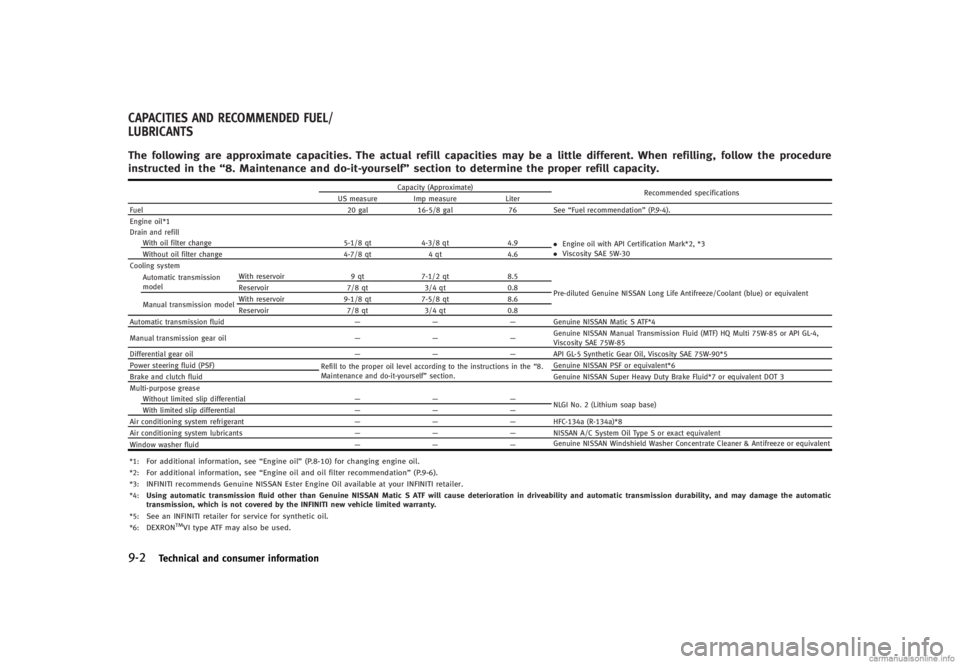
GUID-5C50C075-20DD-4C3C-BC1F-8D4154A4AB7AThe following are approximate capacities. The actual refill capacities may be a little different. When refilling, follow the procedure
instructed in the“8. Maintenance and do-it-yourself” section to determine the proper refill capacity.
Capacity (Approximate)
Recommended specifications
US measure Imp measure Liter
Fuel 20 gal16-5/8 gal 76 See“Fuel recommendation” (P.9-4).
Engine oil*1
Drain and refill With oil filter change 5-1/8 qt4-3/8 qt 4.9
.Engine oil with API Certification Mark*2, *3
. Viscosity SAE 5W-30
Without oil filter change 4-7/8 qt4 qt4.6
Cooling system
Automatic transmission
model With reservoir
9 qt7-1/2 qt 8.5
Pre-diluted Genuine NISSAN Long Life Antifreeze/Coolant (blue) or equivalent
Reservoir
7/8 qt3/4 qt 0.8
Manual transmission model With reservoir
9-1/8 qt7-5/8 qt 8.6
Reservoir 7/8 qt3/4 qt 0.8
Automatic transmission fluid ———Genuine NISSAN Matic S ATF*4
Manual transmission gear oil ———Genuine NISSAN Manual Transmission Fluid (MTF) HQ Multi 75W-85 or API GL-4,
Viscosity SAE 75W-85
Differential gear oil ———API GL-5 Synthetic Gear Oil, Viscosity SAE 75W-90*5
Power steering fluid (PSF) Refill to the proper oil level according to the instructions in the “8.
Maintenance and do-it-yourself” section. Genuine NISSAN PSF or equivalent*6
Brake and clutch fluid Genuine NISSAN Super Heavy Duty Brake Fluid*7 or equivalent DOT 3
Multi-purpose grease Without limited slip differential ———
NLGI No. 2 (Lithium soap base)
With limited slip differential ———
Air conditioning system refrigerant ———HFC-134a (R-134a)*8
Air conditioning system lubricants ———NISSAN A/C System Oil Type S or exact equivalent
Window washer fluid ———Genuine NISSAN Windshield Washer Concentrate Cleaner & Antifreeze or equivalent
*1:
For additional information, see “Engine oil”(P.8-10) for changing engine oil.*2:For additional information, see “Engine oil and oil filter recommendation” (P.9-6).*3:INFINITI recommends Genuine NISSAN Ester Engine Oil available at your INFINITI retailer.*4:Using automatic transmission fluid other than Genuine NISSAN Matic S ATF will cause deterioration in driveability and automatic transmission durability, and may damage the automatic
transmission, which is not covered by the INFINITI new vehicle limited warranty.
*5:See an INFINITI retailer for service for synthetic oil.*6:DEXRONTMVI type ATF may also be used.
CAPACITIES AND RECOMMENDED FUEL/
LUBRICANTS