transmission INFINITI Q70-HYBRID 2018 Owner's Manual
[x] Cancel search | Manufacturer: INFINITI, Model Year: 2018, Model line: Q70-HYBRID, Model: INFINITI Q70-HYBRID 2018Pages: 458, PDF Size: 2.22 MB
Page 361 of 458
6-12In case of emergency
NOTE:
If it is not possible to turn the hybrid system
ON by following this procedure, it is
recommended that you contact an INFINITI
retailer immediately.Do not attempt to start the engine by
pushing.
CAUTION
.
Automatic transmission models can-
not be push-started or tow-started.
Attempting to do so may cause
transmission damage.
. Three way catalyst equipped models
should not be started by pushing
since the three way catalyst may be
damaged.
. Never try to start the vehicle by
towing it; when the engine starts,
the forward surge could cause the
vehicle to collide with the tow vehi-
cle.
. Hybrid models cannot be push-
started or tow-started. Attempting
to do so may cause electrical or
transmission damage.
CAUTION
.Do not continue to drive if your
vehicle overheats. Doing so could
cause engine damage or a vehicle fire.
. To avoid the danger of being scalded,
never remove the radiator cap while
the engine is still hot. When the
radiator cap is removed, pressurized
hot water will spurt out, possibly
causing serious injury.
. Do not open the hood if steam is
coming out.
If your vehicle is overheating (indicated by an
extremely high temperature gauge reading),
or if you feel a lack of engine power, detect
abnormal noise, etc., take the following
steps:
1. Move the vehicle safely off the road, apply the parking brake and move the
shift lever to the P (Park) position.
Do not turn the INFINITI Direct Re-
sponse Hybrid
®System off.
2. Turn off the climate control. Open all the windows, move the heater or air condi-
tioner temperature control to maximum
hot and fan control to high speed.
PUSH STARTING IF YOUR VEHICLE OVERHEATS
Page 362 of 458

3. If engine overheating is caused by climb-ing a long hill on a hot day, run the engine
at a fast idle (approximately 1,500 rpm)
until the temperature gauge indication
returns to normal.
4. Get out of the vehicle. Look and listen for steam or coolant escaping from the
radiator before opening the hood. (If
steam or coolant is escaping, turn off the
hybrid system.) Do not open the hood
further until no steam or coolant can be
seen.
5. Open the engine hood.
WARNING
If steam or water is coming from the
engine, stand clear to prevent getting
burned.
6. Also check if the cooling fan is running. The radiator hoses and radiator should
not leak water. If coolant is leaking or the
cooling fan does not run, stop the hybrid
system.
WARNING
Be careful not to allow your hands, hair,
jewelry or clothing to come into contact
with, or get caught in, engine belts or the
engine cooling fan. The engine cooling
fan can start at any time.
7. After the engine cools down, check the coolant level in the reservoir tank with
the engine running. Add coolant to the
reservoir tank if necessary. Have your
vehicle repaired. It is recommended you
visit an INFINITI retailer for this service. When towing your vehicle, all State (Pro-
vincial in Canada) and local regulations for
towing must be followed. Incorrect towing
equipment could damage your vehicle. Tow-
ing instructions are available from an
INFINITI retailer. Local service operators
are familiar with the applicable laws and
procedures for towing. To assure proper
towing and to prevent accidental damage to
your vehicle, INFINITI recommends that you
have a service operator tow your vehicle. It is
advisable to have the service operator care-
fully read the following precautions.
WARNING
.
Never ride in a vehicle that is being
towed.
. Never get under your vehicle after it
has been lifted by a tow truck.
CAUTION
.When towing, make sure that the
transmission, axles, steering system
and powertrain are in working con-
dition. If any unit is damaged, dollies
must be used.
. Always attach safety chains before
In case of emergency6-13
TOWING YOUR VEHICLE
Page 363 of 458

6-14In case of emergency
towing.
For information about towing your vehicle
behind a recreational vehicle (RV), see “Flat
towing” (P.10-16).
SCE0788
Two-wheel drive models
TOWING RECOMMENDED BY
INFINITI
Two-Wheel Drive (2WD) models
INFINITI recommends that your vehicle be
towed with the driving (rear) wheels off the
ground or place the vehicle on a flat bed
truck as illustrated. The vehicle should only
be loaded onto a flat bed using a winch.
WARNING
If your vehicle needs to be towed, do it
with the rear wheels raised. If the rear wheels are on the ground when towing,
the electric motor may generate electri-
city. This may damage the INFINITI
Direct Response Hybrid
®System com-
ponents and cause a fire.
CAUTION
. Never tow automatic transmission
models with the rear wheels on the
ground or four wheels on the ground
(forward or backward), as this may
cause serious and expensive damage
Page 364 of 458

to the transmission. If it is necessary
to tow the vehicle with the front
wheels raised, always use towing
dollies under the rear wheels.
. When towing rear wheel drive models
with the front wheels on the ground
or on towing dollies: Push the ignition
switch to the ACC or ON position,
and secure the steering wheel in a
straight-ahead position with a rope
or similar device. For models with a
steering wheel lock mechanism:
Never secure the steering wheel by
selecting the LOCK position. This
may damage the steering lock me-
chanism.
VEHICLE RECOVERY (freeing a
stuck vehicle)
WARNING
To avoid vehicle damage, serious perso-
nal injury or death when recovering a
stuck vehicle:
.Contact a professional towing ser-
vice to recover the vehicle if you have
any questions regarding the recovery
procedure. .
Tow chains or cables must be at-
tached only to main structural mem-
bers of the vehicle.
. Do not use the vehicle tie-downs to
tow or free a stuck vehicle.
. Only use devices specifically designed
for vehicle recovery and follow the
manufacturer’s instructions.
. Always pull the recovery device
straight out from the front of the
vehicle. Never pull at an angle.
. Route recovery devices so they do
not touch any part of the vehicle
except the attachment point.
If your vehicle is stuck in sand, snow, mud,
etc., use a tow strap or other device
designed specifically for vehicle recovery.
Always follow the manufacturer’s instruc-
tions for the recovery device.
Rocking a stuck vehicle
If your vehicle is stuck in sand, snow, mud,
etc., use the following procedure:
1. Turn off the Vehicle Dynamic Control (VDC) system.
2. Make sure the area in front and behind the vehicle is clear of obstructions.
3. Turn the steering wheel right and left to clear an area around the front tires. 4. Slowly rock the vehicle forward and
backward.
.Shift back and forth between R (Re-verse) and D (Drive).
.Apply the accelerator as little aspossible to maintain the rocking mo-
tion.
.Release the accelerator pedal before
shifting between R and D.
.Do not spin the tires above 35 MPH(55 km/h).
5. If the vehicle cannot be freed after a few tries, contact a professional towing
service to remove the vehicle.
WARNING
.Stand clear of a stuck vehicle.
. Do not spin your tires at high speed.
This could cause them to explode and
result in serious injury. Parts of your
vehicle could also overheat and be
damaged.
In case of emergency6-15
Page 374 of 458
8 Do-it-yourself
Maintenance precautions ................................................ 8-2
Engine compartment check locations .......................... 8-3VQ35HR engine............................................................ 8-3
Engine cooling system...................................................... 8-5 Checking engine coolant level................................... 8-6
Changing engine coolant............................................ 8-6
Inverter cooling system.................................................... 8-7 Checking inverter coolant level ................................ 8-8
Changing inverter coolant.......................................... 8-8
Engine oil.....................................................................\
......... 8-8
Checking engine oil level ............................................ 8-8
Changing engine oil and filter................................... 8-9
Automatic Transmission Fluid (ATF).......................... 8-11
Power steering fluid........................................................ 8-11
Brake fluid...................................................................\
....... 8-12 Brake fluid .................................................................... 8-12
Window washer fluid...................................................... 8-12
12-volt battery ................................................................. 8-13 Checking battery fluid level..................................... 8-14
Jump starting............................................................... 8-15
Spark plugs ........................................................................\
8-15 Replacing spark plugs................................................ 8-15 Air cleaner........................................................................\
.. 8-16
Windshield wiper blades ............................................... 8-17
Cleaning....................................................................... 8-17
Replacing..................................................................... 8-17
Brakes..................................................................\
............... 8-18 Self-adjusting brakes............................................... 8-18
Brake pad wear warning........................................ 8-18
Fuses...................................................................\
................ 8-19 Engine compartment or trunk room ................... 8-19
Passenger compartment ....................................... 8-20
Intelligent Key battery replacement........................... 8-21
Lights........................................................................\
.......... 8-23 Headlights.................................................................. 8-24
Exterior and interior lights.................................... 8-24
Wheels and tires.............................................................. 8-26 Tire pressure .............................................................. 8-26
Tire labeling............................................................... 8-30
Types of tires............................................................. 8-32
Tire chains................................................................... 8-32
Changing wheels and tires..................................... 8-33
Page 380 of 458

The inverter cooling system is filled at the
factory with a pre-diluted mixture of 50%
Genuine NISSAN Long Life Antifreeze/
Coolant (blue) and 50% water to provide
year-round anti-freeze and coolant protec-
tion. The antifreeze solution contains rust
and corrosion inhibitors. Additional inverter
cooling system additives are not necessary.
WARNING
.Never remove the coolant reservoir
cap when the engine and inverter are
hot. Wait until the engine and in-
verter cool down. Serious burns could
be caused by high pressure fluid
escaping from the radiator.
. The inverter reservoir is equipped
with a pressure type cap. To prevent
engine and inverter damage, use only
a genuine NISSAN inverter reservoir
cap.
CAUTION
.When adding or replacing coolant, be
sure to use only Genuine NISSAN
Long Life Antifreeze/Coolant (blue)
or equivalent. Genuine NISSAN Long
Life Antifreeze/Coolant (blue) is pre- diluted to provide antifreeze protec-
tion to −34°F(−37°C). If additional
freeze protection is needed due to
weather where you operate your
vehicle, add Genuine NISSAN Long
Life Antifreeze/Coolant (blue) con-
centrate following the directions on
the container. If an equivalent cool-
ant other than Genuine NISSAN Long
Life Antifreeze/Coolant (blue) is
used, follow the coolant manufatur-
urer’s instructions to maintain mini-
mum antifreeze protection to −34°F
(−37°C). The use of other types of
coolant solutions other than Genuine
NISSAN Long Life Antifreeze/Cool-
ant (blue) or equivalent may damage
the inverter cooling system.
. The life expectancy of the factory-fill
coolant is 125,000 miles (200,000
km) or 15 years. Mixing any other
type of coolant other than Genuine
NISSAN Long Life Antifreeze/Cool-
ant (blue), including Genuine NISSAN
Long Life Antifreeze/Coolant
(green), or the use of non-distilled
water will reduce the life expectancy
of the factory-fill coolant. Refer to
the “9. Maintenance and schedules”
section of this manual for more de-
tails. .
Never use any additives in the cool-
ant such as radiator sealer in the
cooling system. This may cause da-
mage to electrical equipment such as
the motor and inverter, and also to
engine and transmission.
Do-it-yourself8-7
INVERTER COOLING SYSTEM
Page 384 of 458
When checking or replacement is required,
we recommend an INFINITI retailer for
servicing.
CAUTION
.It is recommended that you use only
Genuine NISSAN Matic S ATF. Do
not mix with other fluids.
. Using automatic transmission fluid
(ATF) other than Genuine NISSAN
Matic S ATF may cause deterioration
in driveability and automatic trans-
mission durability, and may damage
the automatic transmission. Damage
caused by use of fluids other than as
recommended is not covered by the
INFINITI new vehicle limited war-
ranty.
JVM0054X
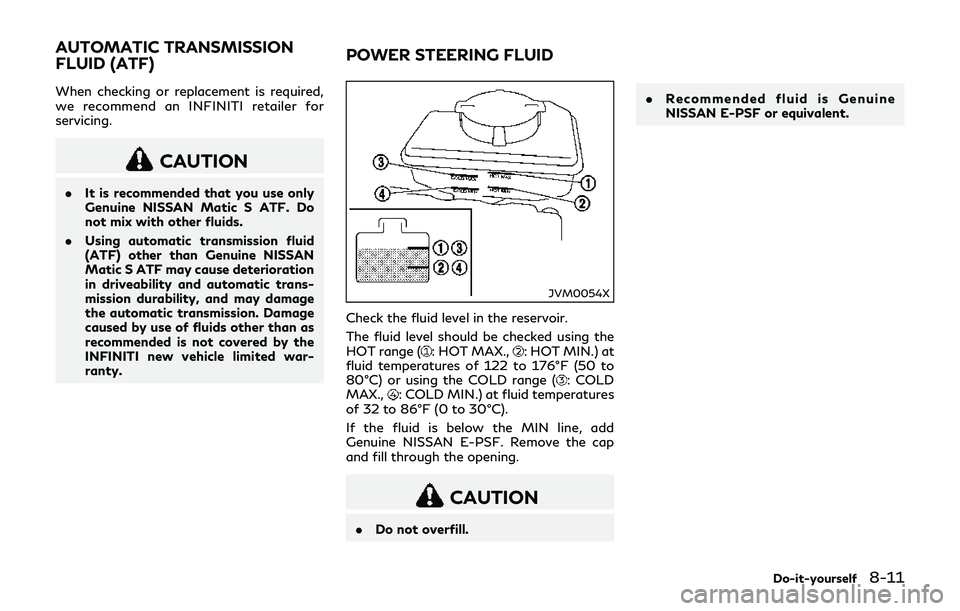
Check the fluid level in the reservoir.
The fluid level should be checked using the
HOT range (
: HOT MAX.,: HOT MIN.) at
fluid temperatures of 122 to 176°F (50 to
80°C) or using the COLD range (
: COLD
MAX.,: COLD MIN.) at fluid temperatures
of 32 to 86°F (0 to 30°C).
If the fluid is below the MIN line, add
Genuine NISSAN E-PSF. Remove the cap
and fill through the opening.
CAUTION
. Do not overfill. .
Recommended fluid is Genuine
NISSAN E-PSF or equivalent.
Do-it-yourself8-11
AUTOMATIC TRANSMISSION
FLUID (ATF) POWER STEERING FLUID
Page 412 of 458

other corrosive materials, check lubrication
frequently.
Lights*:Clean the headlights on a regular
basis. Make sure that the headlights, stop
lights, tail lights, turn signal lights, and other
lights are all operating properly and installed
securely. Also check headlight aim.
Road wheel nuts (lug nuts)*: When checking
the tires, make sure no wheel nuts are
missing, and check for any loose wheel nuts.
Tighten if necessary.
Tire rotation*: Tires should be rotated every
5,000 miles (8,000 km).
Tires*: Check the pressure with a gauge
often and always prior to long distance trips.
If necessary, adjust the pressure in all tires,
including the spare, to the pressure speci-
fied. Check carefully for damage, cuts or
excessive wear.
Tire Pressure Monitoring System (TPMS)
transmitter components: Replace the TPMS
transmitter grommet seal, valve core and
cap when the tires are replaced due to wear
or age.
Wheel alignment and balance: If the vehicle
should pull to either side while driving on a
straight and level road, or if you detect
uneven or abnormal tire wear, there may be
a need for wheel alignment.
If the steering wheel or seat vibrates at normal highway speeds, wheel balancing
may be needed.
For additional information regarding tires,
refer to “Important Tire Safety Information”
(US) or “Tire Safety Information” (Canada) in
the INFINITI Warranty Information Booklet.
Windshield:
Clean the windshield on a
regular basis. Check the windshield at least
every six months for cracks or other damage.
Have a damaged windshield repaired by a
qualified repair facility.
Windshield wiper blades*: Check for cracks
or wear if they do not wipe properly.
Inside the vehicle
The maintenance items listed here should be
checked on a regular basis, such as when
performing periodic maintenance, cleaning
the vehicle, etc.
Accelerator pedal: Check the pedal for
smooth operation and make sure the pedal
does not catch or require uneven effort.
Keep the floor mat away from the pedal.
Automatic transmission P (Park) mechan-
ism: On a fairly steep hill, check that your
vehicle is held securely with the shift lever in
the P (Park) position without applying any
brakes.
Brake pedal: Check the pedal for smooth
operation. If the brake pedal suddenly goes
down further than normal, the pedal feels spongy or the vehicle seems to take longer to
stop, have your vehicle checked immediately.
It is recommended you visit an INFINITI
retailer for this service. Keep the floor mat
away from the pedal.
Brakes:
Check that the brakes do not pull the
vehicle to one side when applied.
Parking brake: Check the parking brake
operation regularly. The vehicle should be
securely held on a fairly steep hill with only
the parking brake applied. If the parking
brake needs adjusted, it is recommended you
visit an INFINITI retailer for this service.
Seat belts: Check that all parts of the seat
belt system (for example, buckles, anchors,
adjuster and retractors) operate properly
and smoothly, and are installed securely.
Check the belt webbing for cuts, fraying,
wear or damage.
Seats: Check seat position controls such as
seat adjusters, seatback recliner, etc. to
ensure they operate smoothly and that all
latches lock securely in every position. Check
that the head restraints move up and down
smoothly and that the locks (if so equipped)
hold securely in all latched positions.
Steering wheel: Check for changes in the
steering conditions, such as excessive free
play, hard steering or strange noises.
Warning lights and chimes: Make sure that
all warning lights and chimes are operating
Maintenance and schedules9-3
Page 415 of 458
9-6Maintenance and schedules
CHASSIS AND BODY MAINTE-
NANCE
Brake lines and cables:
Visually inspect for proper installation.
Check for chafing, cracks, deterioration,
and signs of leaking. Replace any deterio-
rated or damaged parts immediately.
Brake pads, rotors, drums and linings:
Check for wear, deterioration and fluid
leaks. Replace any deteriorated or damaged
parts immediately.
Exhaust system:
Visually inspect the exhaust pipes, muffler
and hangers for leaks, cracks, deterioration,
and damage. Tighten connections or replace
parts as necessary.
In-cabin microfilter:
Replace at specified intervals. When driving
for prolonged periods in dusty conditions,
replace the filter more frequently.
Propeller shaft(s):
Check for damage, looseness, and grease
leakage. (4WD/AWD/RWD)
Steering gear and linkage, axle and suspen-
sion parts, drive shaft boots:
Check for damage, looseness, and leakage
of oil or grease. Under severe driving condi-
tions, inspect more frequently.Tire rotation:
Tires should be rotated every 5,000 miles
(8,000 km) according to the instructions
under “Explanation of maintenance items”
(P.9-2). When rotating tires, check for
damage and uneven wear. Replace if neces-
sary.
Transmission fluid/oil and differential oil:
Visually inspect for signs of leakage at
specified intervals.
To help ensure smooth, safe and economical
driving, INFINITI provides two maintenance
schedules that may be used, depending upon
the conditions in which you usually drive.
These schedules contain both distance and
time intervals, up to 120,000 miles
(192,000 km)/144 months. For most peo-
ple, the odometer reading will indicate when
service is needed. However, if you drive very
little, your vehicle should be serviced at the
regular time intervals shown in the schedule.
After 120,000 miles (192,000 km)/144
months, continue maintenance at the same
mileage/time intervals.
ADDITIONAL MAINTENANCE
ITEMS FOR SEVERE OPERATING
CONDITIONS
Additional maintenance items for severe
operating conditions;
should be performed
on vehicles that are driven under especially
demanding conditions. Additional mainte-
nance items should be performed if you
primarily operate your vehicle under the
following conditions:
. Repeated short trips of less than 5 miles
(8 km).
. Repeated short trips of less than 10 miles
(16 km) with outside temperatures re-
maining below freezing.
MAINTENANCE SCHEDULES
Page 419 of 458
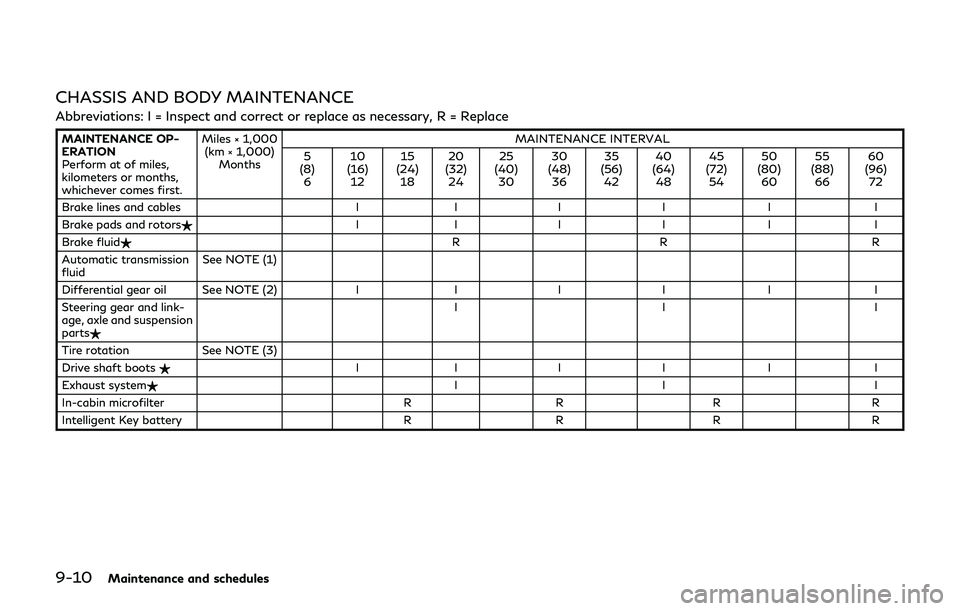
9-10Maintenance and schedules
CHASSIS AND BODY MAINTENANCE
Abbreviations: I = Inspect and correct or replace as necessary, R = Replace
MAINTENANCE OP-
ERATION
Perform at of miles,
kilometers or months,
whichever comes first.Miles × 1,000
(km × 1,000) Months MAINTENANCE INTERVAL
5
(8) 6 10
(16) 12 15
(24) 18 20
(32) 24 25
(40) 30 30
(48) 36 35
(56) 42 40
(64) 48 45
(72) 54 50
(80) 60 55
(88) 66 60
(96) 72
Brake lines and cables II I I I I
Brake pads and rotors$ II I I I I
Brake fluid$ RR R
Automatic transmission
fluid See NOTE (1)
Differential gear oil See NOTE (2) II I I I I
Steering gear and link-
age, axle and suspension
parts$ II I
Tire rotation See NOTE (3)
Drive shaft boots $ II I I I I
Exhaust system$ II I
In-cabin microfilter RR R R
Intelligent Key battery RR R R