brake light INFINITI QX50 2021 Manual Online
[x] Cancel search | Manufacturer: INFINITI, Model Year: 2021, Model line: QX50, Model: INFINITI QX50 2021Pages: 542, PDF Size: 3.51 MB
Page 491 of 542
71,250 miles/(114,000 km)/
114 months
Perform at number of miles, kilometers or
months, whichever comes first.
Standard maintenance:
• Not applicable. Proceed to the nextinterval.
Severe maintenance:
Inspections:
• Brake pads & rotors
• Exhaust system
• Propeller shaft (AWD models)
• Drive shaft boots
• Steering gear and linkage
• Axle & suspension parts
• Horn, lights, signals, wipers, rear hatch/ hood lift supports
• All fluids inspected (engine, wiper, brake, power steering, coolant)
• Engine drive belt and hose inspections
• Engine air filter
• Suspension components (shocks, sub- frame, tie rods)
• Differential and fluid (AWD models)
• Battery terminals and cables, battery test
• Tire pressure, treadwear and depth
75,000 miles/(120,000 km)/
120 months
Perform at number of miles, kilometers or
months, whichever comes first.
Standard maintenance:
Inspections:
• Brake lines & cables
• Brake pads & rotors
• CVT transmission fluid
• Engine drive belts*
• Fuel tank vapor vent system*
• Fuel lines/connections*
• Exhaust system
• Propeller shaft (AWD models)
• Steering gear and linkage
• Axle & suspension parts
• Differential gear oil (AWD models) (1)
• Transfer case oil (AWD models) (1)
• Drive shaft boots
• Horn, lights, signals, wipers, rear hatch/ hood lift supports
• All fluids inspected (engine, wiper, brake, power steering, coolant)
• Engine drive belt and hose inspections
• Engine air filter • Suspension components (shocks, sub-
frame, tie rods)
• Differential and fluid (AWD models)
• Battery terminals and cables, battery test
• Tire pressure, treadwear and depth
Essentials:
• Replace engine oil & filter (2)
• Tire rotation
• Replace brake fluid
Severe maintenance:
Inspections:
• Brake pads & rotors
• Exhaust system
• Propeller shaft (AWD models)
• Drive shaft boots
• Steering gear & linkage
• Axle & suspension parts
Essentials:
• Replace brake fluid
(1) If towing a trailer, using a camper or a
car-top carrier, or driving on rough or muddy
roads, change (not just inspect) oil every
20,000 miles (32,000 km) or 24 months.
(2) If the oil replacement indicator is dis-
played, change the engine oil and filter within
two weeks or less than 500 miles (800 km).
Maintenance and schedules9-21
Page 492 of 542
* Maintenance items and intervals with“*”
are recommended by NISSAN for reliable ve-
hicle operation. The owner need not perform
such maintenance in order to maintain the
emission warranty or manufacturer recall li-
ability. Other maintenance items and inter-
vals are required.78,750 miles/(126,000 km)/
126 months
Perform at number of miles, kilometers or
months, whichever comes first.
Standard maintenance:
Inspections:
• Horn, lights, signals, wipers, rear hatch/hood lift supports
• All fluids inspected (engine, wiper, brake, power steering, coolant)
• Engine drive belts and hose inspections
• Engine air filter
• Suspension components (shocks, sub- frame, tie rods)
• Differential and fluid (AWD models)
• Battery terminals and cables, battery test
• Tire pressure, treadwear and depth
Essentials:
• Replace in-cabin microfilter
• Replace intelligent key battery Severe maintenance:
Inspections:
• Brake pads & rotors
• Exhaust system
• Propeller shaft (AWD models)
• Drive shaft boots
• Steering gear & linkage
• Axle & suspension parts
9-22Maintenance and schedules
Page 493 of 542
82,500 miles/(132,000 km)/
132 months
Perform at number of miles, kilometers or
months, whichever comes first.
Standard maintenance:
Inspections:
• Brake lines & cables
• Brake pads & rotors
• CVT transmission fluid
• Engine drive belts*
• Propeller shaft (AWD models)
• Differential gear oil (AWD models) (1)
• Transfer case oil (AWD models) (1)
• Drive shaft boots
• Horn, lights, signals, wipers, rear hatch/hood lift supports
• All fluids inspected (engine, wiper, brake, power steering, coolant)
• Engine drive belt and hose inspections
• Engine air filter
• Suspension components (shocks, sub- frame, tie rods)
• Differential and fluid (AWD models)
• Battery terminals and cables, battery test
• Tire pressure, treadwear and depth Essentials:
• Replace engine oil & filter (2)
• Tire rotation
Severe maintenance:
Inspections:
• Brake pads & rotors
• Exhaust system
• Propeller shaft (AWD models)
• Drive shaft boots
• Steering gear & linkage
• Axle & suspension parts
Essentials:
• Replace brake fluid
(1) If towing a trailer, using a camper or a
car-top carrier, or driving on rough or muddy
roads, change (not just inspect) oil every
20,000 miles (32,000 km) or 24 months.
(2) If the oil replacement indicator is dis-
played, change the engine oil and filter within
two weeks or less than 500 miles (800 km).
* Maintenance items and intervals with“*”
are recommended by NISSAN for reliable ve-
hicle operation. The owner need not perform
such maintenance in order to maintain the
emission warranty or manufacturer recall li-
ability. Other maintenance items and inter-
vals are required.
86,250 miles/(138,000 km)/
138 months
Perform at number of miles, kilometers or
months, whichever comes first.
Standard maintenance:
Not applicable. Proceed to next interval.
Severe maintenance:
Inspections:
• Brake pads & rotors
• Exhaust system
• Propeller shaft (AWD models)
• Drive shaft boots
• Steering gear & linkage
• Axle & suspension parts
• Horn, lights, signals, wipers, rear hatch/
hood lift supports
• All fluids inspected (engine, wiper, brake, power steering, coolant)
• Engine drive belt and hose inspections
• Engine air filter
• Suspension components (shocks, sub- frame, tie rods)
• Differential and fluid (AWD models)
• Battery terminals and cables, battery test
• Tire pressure, treadwear and depth
Maintenance and schedules9-23
Page 494 of 542
90,000 miles/(144,000 km)/
144 months
Perform at number of miles, kilometers or
months, whichever comes first.
Standard maintenance:
Inspections:
• Brake lines & cables
• Brake pads & rotors
• CVT transmission fluid
• Engine drive belts*
• Fuel tank vapor vent system*
• Fuel lines/connections*
• Exhaust system
• Propeller shaft (AWD models)
• Steering gear and linkage
• Axle & suspension parts
• Differential gear oil (AWD models) (1)
• Transfer case oil (AWD models) (1)
• Drive shaft boots
• Horn, lights, signals, wipers, rear hatch/hood lift supports
• All fluids inspected (engine, wiper, brake, power steering, coolant)
• Engine drive belt and hose inspections
• Engine air filter • Suspension components (shocks, sub-
frame, tie rods)
• Differential and fluid (AWD models)
• Battery terminals and cables, battery test
• Tire pressure, treadwear and depth
Essentials:
• Replace engine oil & filter (2)
• Replace engine air filter (3)
• Replace brake fluid
• Replace in-cabin microfilter
• Replace intelligent key battery
• Tire rotation
Severe maintenance:
Inspections:
• Brake pads & rotors
• Exhaust system
• Propeller shaft (AWD models)
• Drive shaft boots
• Steering gear & linkage
• Axle & suspension parts Essentials:
• Replace brake fluid
(1) If towing a trailer, using a camper or a
car-top carrier, or driving on rough or muddy
roads, change (not just inspect) oil every
20,000 miles (32,000 km) or 24 months.
(2) If the oil replacement indicator is dis-
played, change the engine oil and filter within
two weeks or less than 500 miles (800 km).
(3) If operating mainly in dusty conditions,
more frequent maintenance may be required.
* Maintenance items and intervals with“*”
are recommended by NISSAN for reliable ve-
hicle operation. The owner need not perform
such maintenance in order to maintain the
emission warranty or manufacturer recall li-
ability. Other maintenance items and inter-
vals are required.
9-24Maintenance and schedules
Page 498 of 542
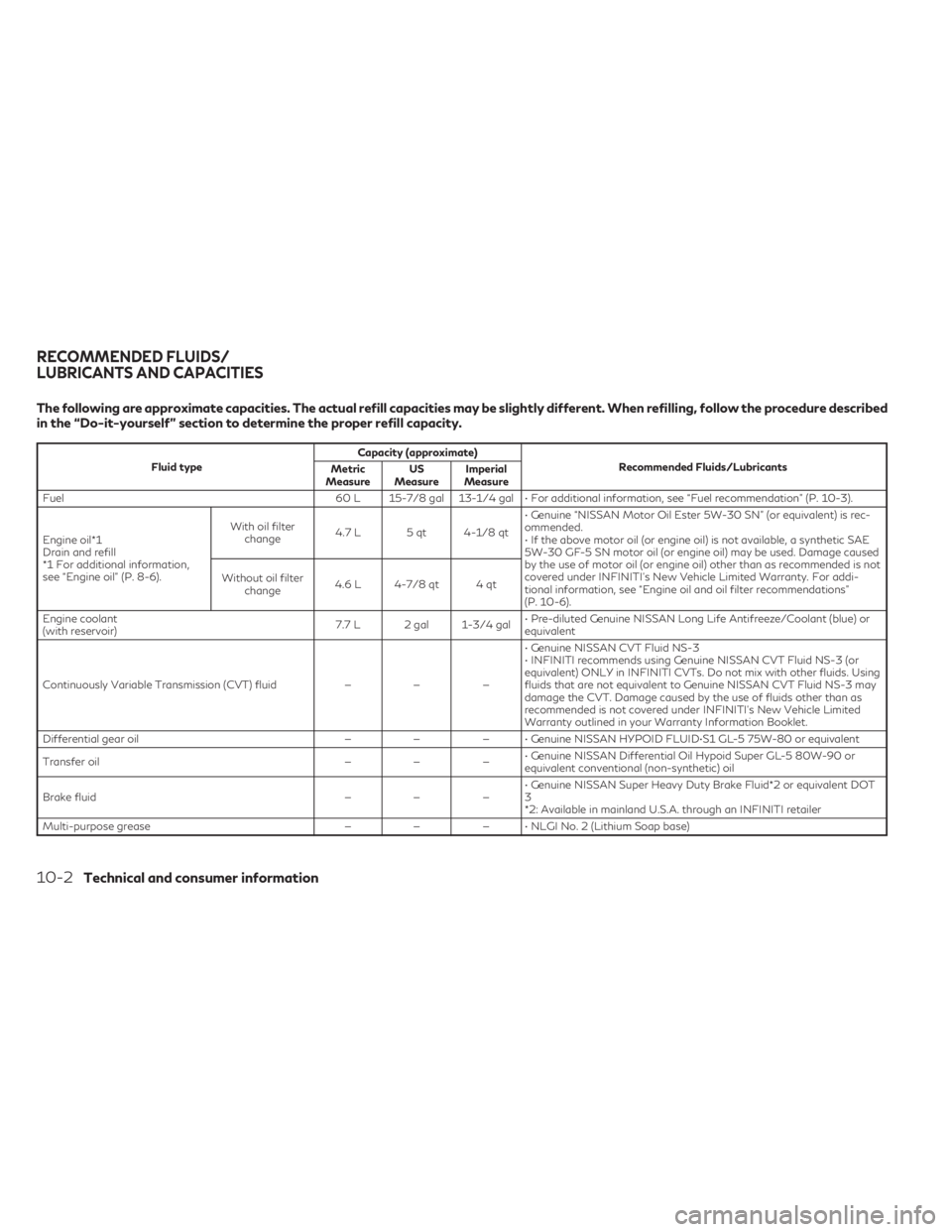
The following are approximate capacities. The actual refill capacities may be slightly different. When refilling, follow the procedure described
in the “Do-it-yourself” section to determine the proper refill capacity.
Fluid typeCapacity (approximate)
Recommended Fluids/Lubricants
Metric
Measure US
Measure Imperial
Measure
Fuel 60 L 15-7/8 gal 13-1/4 gal • For additional information, see “Fuel recommendation” (P. 10-3).
Engine oil*1
Drain and refill
*1 For additional information,
see “Engine oil” (P. 8-6). With oil filter
change 4.7 L 5 qt 4-1/8 qt • Genuine “NISSAN Motor Oil Ester 5W-30 SN” (or equivalent) is rec-
ommended.
• If the above motor oil (or engine oil) is not available, a synthetic SAE
5W-30 GF-5 SN motor oil (or engine oil) may be used. Damage caused
by the use of motor oil (or engine oil) other than as recommended is not
covered under INFINITI’s New Vehicle Limited Warranty. For addi-
tional information, see “Engine oil and oil filter recommendations”
(P. 10-6).
Without oil filter
change 4.6 L 4-7/8 qt 4 qt
Engine coolant
(with reservoir) 7.7 L 2 gal 1-3/4 gal• Pre-diluted Genuine NISSAN Long Life Antifreeze/Coolant (blue) or
equivalent
Continuously Variable Transmission (CVT) fluid —— —• Genuine NISSAN CVT Fluid NS-3
• INFINITI recommends using Genuine NISSAN CVT Fluid NS-3 (or
equivalent) ONLY in INFINITI CVTs. Do not mix with other fluids. Using
fluids that are not equivalent to Genuine NISSAN CVT Fluid NS-3 may
damage the CVT. Damage caused by the use of fluids other than as
recommended is not covered under INFINITI’s New Vehicle Limited
Warranty outlined in your Warranty Information Booklet.
Differential gear oil —— — • Genuine NISSAN HYPOID FLUID•S1 GL-5 75W-80 or equivalent
Transfer oil —— —• Genuine NISSAN Differential Oil Hypoid Super GL-5 80W-90 or
equivalent conventional (non-synthetic) oil
Brake fluid —— —• Genuine NISSAN Super Heavy Duty Brake Fluid*2 or equivalent DOT
3
*2: Available in mainland U.S.A. through an INFINITI retailer
Multi-purpose grease —— — • NLGI No. 2 (Lithium Soap base)
RECOMMENDED FLUIDS/
LUBRICANTS AND CAPACITIES
10-2Technical and consumer information
Page 522 of 542

The safety chains can be attached to the
bumper if the hitch ball is mounted to the
bumper. Be sure to leave enough slack in the
chains to permit turning corners.
Trailer lights
CAUTION
When splicing into the vehicle electrical
system, a commercially available power-
type module/converter must be used to
provide power for all trailer lighting. This
unit uses the vehicle battery as a direct
power source for all trailer lights while us-
ing the vehicle tail light, stop light and turn
signal circuits as a signal source. The
module/converter must draw no more
than 15 milliamps from the stop and tail
lamp circuits. Using a module/converter
that exceeds these power requirements
may damage the vehicle's electrical sys-
tem. See a reputable trailer retailer to ob-
tain the proper equipment and to have it
installed.
Trailer lights should comply with federal
and/or local regulations. For assistance in
hooking up trailer lights, contact an INFINITI
retailer or reputable trailer retailer. Vehicles
equipped with the optional trailer tow pack-
age are equipped with a 7-pin trailer harness connector. If your trailer is equipped with a
flat 4-pin connector, an adapter will be
needed to connect the trailer lights to the
vehicle. Adapters are available at auto parts
stores and hitch retailers.Trailer brakes
Most states require a separate braking sys-
tem on trailers with a loaded weight above a
specific amount, make sure the trailer meets
the local regulations and the regulations
where you plan to tow.
Several types of braking systems are
available.
Surge Brakes -
The surge brake actuator is
mounted on the trailer tongue with a hydrau-
lic line running to each trailer wheel. Surge
brakes are activated by the trailer pushing
against the hitch ball when the tow vehicle is
braking. Hydraulic surge brakes are common
on rental trailers and some boat trailers. In
this type of system, there is no hydraulic or
electric connection for brake operation be-
tween the tow vehicle and the trailer.
Electric Trailer Brakes - Electric braking sys-
tems are activated by an electronic signal
sent from a trailer brake controller (special
brake-sensing module). Have a professional supplier of towing
equipment make sure the trailer brakes are
properly installed and demonstrate proper
brake function testing.
WARNING
Never connect a trailer brake system di-
rectly to the vehicle brake system.
Pre-towing tips
• Be certain your vehicle maintains a level position when a loaded and/or unloaded
trailer is hitched. Do not drive the vehicle if
it has an abnormal nose-up or nose-down
condition; check for improper tongue load,
overload, worn suspension or other pos-
sible causes of either condition.
• Always secure items in the trailer to prevent load shift while driving.
• Keep the cargo load as low as possible in the trailer to keep the trailer center of grav-
ity low.
• Load the trailer so approximately 60% of the trailer load is in the front half and 40%
is in the back half. Also make sure the load is
balanced side to side.
10-26Technical and consumer information
Page 523 of 542
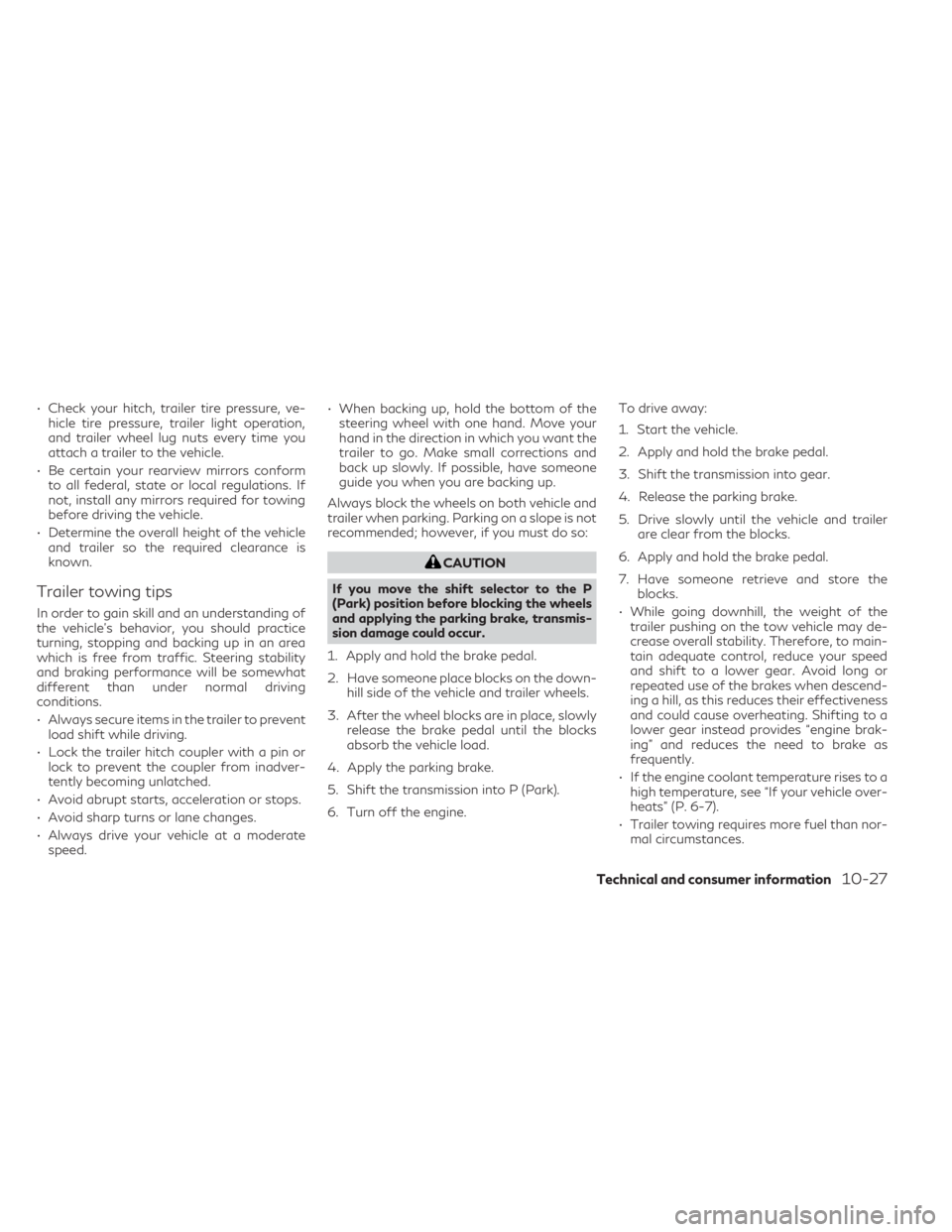
• Check your hitch, trailer tire pressure, ve-hicle tire pressure, trailer light operation,
and trailer wheel lug nuts every time you
attach a trailer to the vehicle.
• Be certain your rearview mirrors conform to all federal, state or local regulations. If
not, install any mirrors required for towing
before driving the vehicle.
• Determine the overall height of the vehicle and trailer so the required clearance is
known.
Trailer towing tips
In order to gain skill and an understanding of
the vehicle's behavior, you should practice
turning, stopping and backing up in an area
which is free from traffic. Steering stability
and braking performance will be somewhat
different than under normal driving
conditions.
• Always secure items in the trailer to preventload shift while driving.
• Lock the trailer hitch coupler with a pin or lock to prevent the coupler from inadver-
tently becoming unlatched.
• Avoid abrupt starts, acceleration or stops.
• Avoid sharp turns or lane changes.
• Always drive your vehicle at a moderate speed. • When backing up, hold the bottom of the
steering wheel with one hand. Move your
hand in the direction in which you want the
trailer to go. Make small corrections and
back up slowly. If possible, have someone
guide you when you are backing up.
Always block the wheels on both vehicle and
trailer when parking. Parking on a slope is not
recommended; however, if you must do so:
CAUTION
If you move the shift selector to the P
(Park) position before blocking the wheels
and applying the parking brake, transmis-
sion damage could occur.
1. Apply and hold the brake pedal.
2. Have someone place blocks on the down- hill side of the vehicle and trailer wheels.
3. After the wheel blocks are in place, slowly release the brake pedal until the blocks
absorb the vehicle load.
4. Apply the parking brake.
5. Shift the transmission into P (Park).
6. Turn off the engine. To drive away:
1. Start the vehicle.
2. Apply and hold the brake pedal.
3. Shift the transmission into gear.
4. Release the parking brake.
5. Drive slowly until the vehicle and trailer
are clear from the blocks.
6. Apply and hold the brake pedal.
7. Have someone retrieve and store the blocks.
• While going downhill, the weight of the trailer pushing on the tow vehicle may de-
crease overall stability. Therefore, to main-
tain adequate control, reduce your speed
and shift to a lower gear. Avoid long or
repeated use of the brakes when descend-
ing a hill, as this reduces their effectiveness
and could cause overheating. Shifting to a
lower gear instead provides “engine brak-
ing” and reduces the need to brake as
frequently.
• If the engine coolant temperature rises to a high temperature, see “If your vehicle over-
heats” (P. 6-7).
• Trailer towing requires more fuel than nor- mal circumstances.
Technical and consumer information10-27
Page 524 of 542
• Avoid towing a trailer for your vehicle's first500 miles (805 km).
• For the first 500 miles (805 km) that you do tow, do not drive over 50 mph (80
km/h).
• Have your vehicle serviced more often than at intervals specified in the recommended
maintenance schedule in “Maintenance and
schedules” (P. 9-2).
• When making a turn, your trailer wheels will be closer to the inside of the turn than your
vehicle wheels. To compensate for this,
make a larger than normal turning radius
during the turn.
• Crosswinds and rough roads will adversely affect vehicle/trailer handling, possibly
causing vehicle sway. When being passed
by larger vehicles, be prepared for possible
changes in crosswinds that could affect
vehicle handling.
Do the following if the trailer begins to sway:
1. Take your foot off the accelerator pedal to allow the vehicle to coast and steer as
straight ahead as the road conditions al-
low. This combination will help stabilize
the vehicle
– Do not correct trailer sway by steering or applying the brakes. 2. When the trailer sway stops, gently apply
the brakes and pull to the side of the road
in a safe area.
3. Try to rearrange the trailer load so it is balanced as described in this section.
• Be careful when passing other vehicles. Passing while towing a trailer requires con-
siderably more distance than normal pass-
ing. Remember, the length of the trailer
must also pass the other vehicle before you
can safely change lanes.
• Downshift the transmission to a lower gear for engine braking when driving down
steep or long hills. This will help slow the
vehicle without applying the brakes.
• Avoid holding the brake pedal down too long or too frequently. This could cause the
brakes to overheat, resulting in reduced
braking efficiency.
• Increase your following distance to allow for greater stopping distances while tow-
ing a trailer. Anticipate stops and brake
gradually.
• INFINITI recommends that the cruise con- trol not be used while towing a trailer.
• Some states or provinces have specific regulations and speed limits for vehicles
that are towing trailers. Obey the local
speed limits. • Check your hitch, trailer wiring harness
connections, and trailer wheel lug nuts af-
ter 50 miles (80 km) of travel and at every
break.
• When launching a boat, don't allow the water level to go over the exhaust tail pipe
or rear bumper.
• Make sure you disconnect the trailer lights before backing the trailer into the water or
the trailer lights may burn out.
When towing a trailer, final drive gear oil
should be replaced and transmission oil/
fluid should be changed more frequently. For
additional information, see“ Do-it-yourself”
(P. 8-2).
FLAT TOWING FOR ALL–WHEEL
DRIVE VEHICLE (if so equipped)
Towing your vehicle with all four wheels on
the ground is sometimes called flat towing.
This method is sometimes used when towing
a vehicle behind a recreational vehicle, such
as a motor home.
10-28Technical and consumer information
Page 528 of 542
WARNING
A vehicle equipped with All-Wheel Drive
(AWD) should never be tested using a two
wheel dynamometer (such as the dyna-
mometers used by some states for emis-
sions testing), or similar equipment. Make
sure you inform the test facility personnel
that your vehicle is equipped with AWD
before it is placed on a dynamometer. Us-
ing the wrong test equipment may result in
transmission damage or unexpected ve-
hicle movement which could result in seri-
ous vehicle damage or personal injury.
Due to legal requirements in some states and
Canadian Provinces, your vehicle may be re-
quired to be in what is called the “ready con-
dition” for an Inspection/Maintenance (I/M)
test of the emission control system.
The vehicle is set to the “ready condition”
when it is driven through certain driving pat-
terns. Usually, the ready condition can be
obtained by ordinary usage of the vehicle. If a powertrain system component is repaired
or the battery is disconnected, the vehicle
may be reset to a “not ready” condition. Be-
fore taking the I/M test, check the vehicle's
inspection/maintenance test readiness con-
dition. Place the ignition switch in the ON
position without starting the engine. If the
Malfunction Indicator Light (MIL) comes on
steady for 20 seconds and then blinks for 10
seconds , the I/M test condition is “not
ready”. If the MIL does not blink after 20
seconds, the I/M test condition is “ready”. It is
recommended that you visit an INFINITI re-
tailer to set the “ready condition” or to pre-
pare the vehicle for testing.
The ProPILOT Assist is equipped with an
Event Data Recording function.
The main purpose is to record, in certain crash
or near crash-like situations, such as an air
bag deployment or hitting a road obstacle,
data that will assist in understanding how a
vehicle’s systems performed. The Data re-
cording function is designed to record data
related to driver operation, vehicle dynamics
and system status for a short period of time.
The Data recording function in this vehicle is
designed to record such data as:
• Driver operational status of accelerator,
brake, handle etc.
• Detection status of a vehicle ahead and lane markers
• Vehicle information such as vehicle speed
• Information on the operation of the ProPI- LOT Assist
• ProPILOT Assist malfunction diagnosis information
• Images from multi-sensing front camera (Available only when SRS air bag or FEB
with Pedestrian Detection system is
activated)
The ProPILOT Assist does not record con-
versations, sounds or images of the inside of
the vehicle.
READINESS FOR INSPECTION/
MAINTENANCE (I/M) TEST EVENT DATA RECORDERS (EDR)
10-32Technical and consumer information
Page 531 of 542
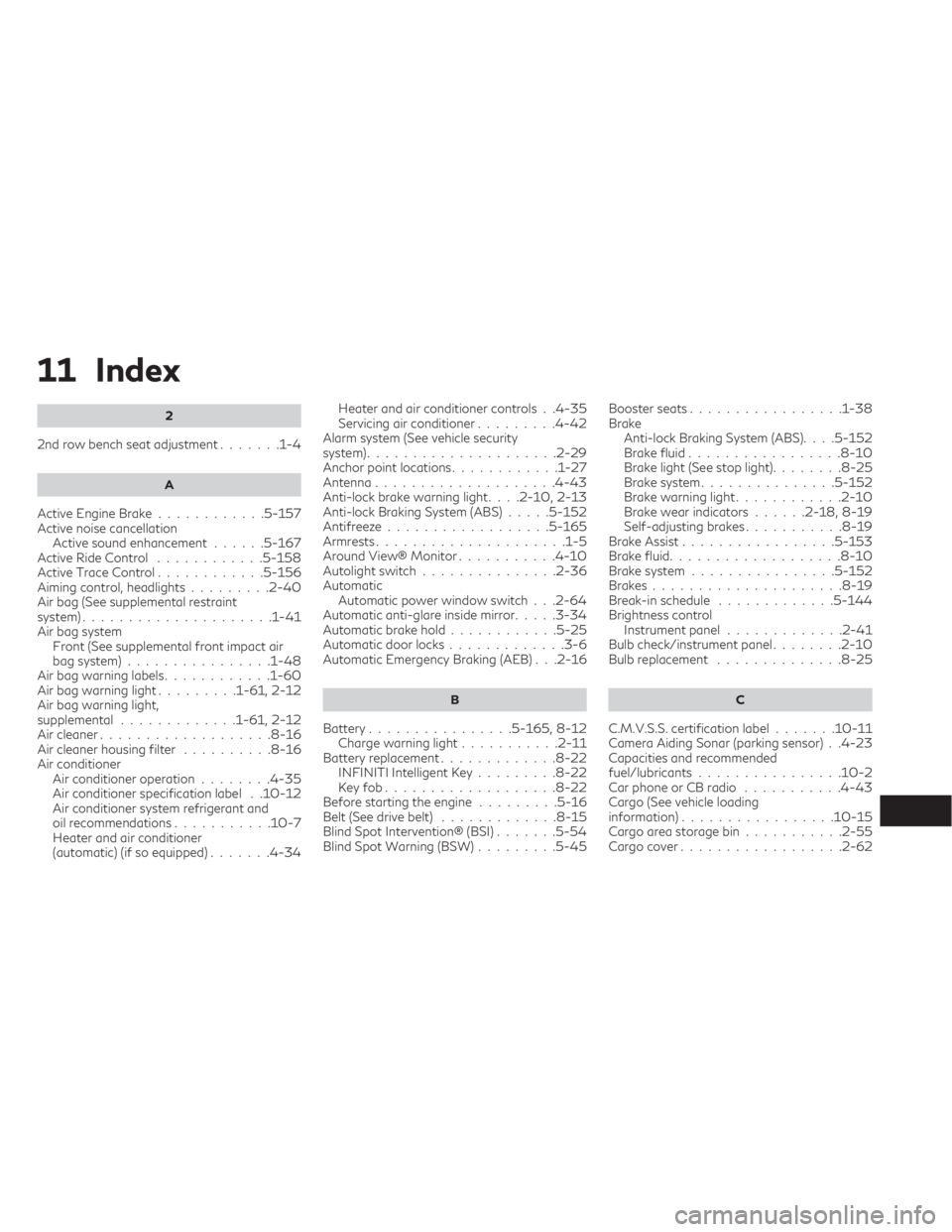
11 Index
2
2nd row bench seat adjustment.......1-4
A
Active Engine Brake............5-157Active noise cancellation
Active sound enhancement......5-167Active Ride Control........... .5-158Active Trace Control............5-156Aiming control, headlights.........2-40Air bag (See supplemental restraint
system).................... .1-41Air bag system
Front (See supplemental front impact air
bag system)
............... .1-48Air bag warning labels............1-60Air bag warning light.........1-61, 2-12Air bag warning light,
supplemental............ .1-61, 2-12Air cleaner.................. .8-16Air cleaner housing filter..........8-16Air conditioner
Air conditioner operation........4-35Air conditioner specification label. .10-12Air conditioner system refrigerant and
oil recommendations.......... .10-7Heater and air conditioner
(automatic) (if so equipped).......4-34
Heater and air conditioner controls. .4-35Servicing air conditioner.........4-42Alarm system (See vehicle security
system).................... .2-29Anchor point locations............1-27Antenna................... .4-43Anti-lock brake warning light. . . .2-10, 2-13Anti-lock Braking System (ABS).....5-152Antifreeze..................5-165Armrests.................... .1-5Around View® Monitor...........4-10Autolight switch.............. .2-36Automatic
Automatic power window switch. . .2-64Automatic anti-glare inside mirror.....3-34Automatic brake hold........... .5-25Automatic door locks............ .3-6Automatic Emergency Braking (AEB). . .2-16
B
Battery............... .5-165, 8-12Charge warning light...........2-11Battery replacement............ .8-22INFINITI Intelligent Key.........8-22Key fob.................. .8-22Before starting the engine.........5-16Belt (See drive belt).............8-15Blind Spot Intervention® (BSI).......5-54Blind Spot Warning (BSW).........5-45
Booster seats................ .1-38Brake
Anti-lock Braking System (ABS). . . .5-152Brake fluid................ .8-10Brake light (See stop light)........8-25Brake system...............5-152Brake warning light............2-10Brake wear indicators......2-18, 8-19Self-adjusting brakes...........8-19Brake Assist................ .5-153Brake fluid.................. .8-10Brake system................5-152Brakes.................... .8-19Break-in schedule.............5-144Brightness control
Instrument panel............ .2-41Bulb check/instrument panel........2-10Bulb replacement............. .8-25
C
C.M.V.S.S. certification label.......10-11Camera Aiding Sonar (parking sensor). .4-23Capacities and recommended
fuel/lubricants............... .10-2Car phone or CB radio...........4-43Cargo (See vehicle loading
information)................ .10-15Cargo area storage bin...........2-55Cargo cover................. .2-62