park assist INFINITI QX80 2021 User Guide
[x] Cancel search | Manufacturer: INFINITI, Model Year: 2021, Model line: QX80, Model: INFINITI QX80 2021Pages: 529, PDF Size: 2.05 MB
Page 357 of 529

5-94Starting and driving
Action to take:
When the conditions listed above are no
longer present, turn the system off with the
dynamic driver assistance switch
. Turn the
DCA system back on to use the system.
. If the vehicle is parked in direct sunlight
under high temperature conditions (over
approximately 104 °F (40 °C)) and then
started, the DCA system may be deacti-
vated automatically and the “Unavail-
able: High Accelerator Temperature”
message will appear in the vehicle in-
formation display for a period of time.
Action to take:
When the interior temperature is reduced,
turn on the DCA system again.
Condition B:
Under the following conditions, making it
impossible to detect a vehicle ahead, the
DCA system is automatically canceled.
The chime will sound, the DCA system
indicator (orange) will come on and the
“Not Available: Front Radar Blocked” warn-
ing message will appear in the vehicle
information display.
. When the radar sensor area of the front
bumper is covered with dirt or is ob-
structed Action to take:
If the DCA system indicator (orange) comes
on and the warning message appears, stop
the vehicle in a safe place, place the shift
lever in the P (Park) position and turn the
engine off. When the radar signal is tem-
porarily interrupted, clean the sensor area of
the front bumper and restart the engine. If
the warning message continues to be dis-
played, have the DCA system checked. It is
recommended you visit an INFINITI retailer
for this service.
.
When driving on roads with limited road
structures or buildings (for example, long
bridges, deserts, snow fields, driving next
to long walls)
Action to take:
When the above conditions no longer exist,
turn the DCA system back on to use the
system.
SYSTEM MALFUNCTION
Condition:
When the DCA system is not operating
properly, the chime sounds and the system
warning message “Malfunction” will appear.
Action to take:
If the warning message appears, park the
vehicle in a safe place. Turn the engine off,
restart the engine, and turn on the DCA
system again.
If it is not possible to set the system or the
indicator stays on, it may indicate that the
system is malfunctioning. Although the
vehicle is still driveable under normal con-
ditions, have the vehicle checked. It is
recommended you visit an INFINITI retailer
for this service.
Page 383 of 529
5-120Starting and driving
WARNING
.Never rely solely on the hill start
assist system to prevent the vehicle
from moving backward on a hill.
Always drive carefully and atten-
tively. Depress the brake pedal when
the vehicle is stopped on a steep hill.
Be especially careful when stopped
on a hill on frozen or muddy roads.
Failure to prevent the vehicle from
rolling backwards may result in a loss
of control of the vehicle and possible
serious injury or death.
. The hill start assist system is not
designed to hold the vehicle at a
standstill on a hill. Depress the brake
pedal when the vehicle is stopped on
a steep hill. Failure to do so may
cause the vehicle to roll backwards
and may result in a collision or serious
personal injury.
. The hill start assist system may not
prevent the vehicle from rolling back-
wards on a hill under all load or road
conditions. Always be prepared to
depress the brake pedal to prevent
the vehicle from rolling backwards.
Failure to do so may result in a
collision or serious personal injury. The hill start assist system automatically
keeps the brakes applied to help prevent the
vehicle from rolling backwards in the time it
takes the driver to release the brake pedal
and apply the accelerator when the vehicle is
stopped on a hill.
The hill start assist system will operate
automatically under the following condi-
tions:
.
The transmission is shifted to a forward
or reverse gear.
. The vehicle is stopped completely on a hill
by applying the brake.
The maximum holding time is 2 seconds.
After 2 seconds the vehicle will begin to roll
back and the hill start assist system will stop
operating completely.
The hill start assist system will not operate
when the transmission is shifted to the N
(Neutral) or P (Park) position or on a flat and
level road.
When the Vehicle Dynamic Control (VDC)
warning light illuminates in the meter, the hill
start assist system will not operate. (See
“Warning lights, indicator lights and audible
reminders” (P.2-11).)
HILL START ASSIST SYSTEM
Page 384 of 529

SD1006MA
WARNING
.Do not stop or park the vehicle over
flammable materials such as dry
grass, waste paper or rags. They
may ignite and cause a fire.
. Never leave the engine running while
the vehicle is unattended.
. Do not leave children unattended
inside the vehicle. They could un-
knowingly activate switches or con-
trols. Unattended children could
become involved in serious accidents. .
To help avoid risk of injury or death
through unintended operation of the
vehicle and/or its systems, do not
leave children, people who require the
assistance of others or pets unat-
tended in your vehicle. Additionally,
the temperature inside a closed ve-
hicle on a warm day can quickly
become high enough to cause a sig-
nificant risk of injury or death to
people and pets.
. Safe parking procedures require that
both the parking brake be applied
and the transmission be placed in the
P (Park) position. Failure to do so could cause the vehicle to move
unexpectedly or roll away and result
in an accident.
. Make sure the automatic transmis-
sion shift lever has been pushed as far
forward as it can go and cannot be
moved without depressing the foot
brake pedal.
1. Firmly apply the parking brake.
2. Move the shift lever to the P (Park) position.
3. To help prevent the vehicle from rolling into the street when parked on a sloping
drive way, it is a good practice to turn the
wheels as illustrated.
.HEADED DOWNHILL WITH CURB:
Turn the wheels into the curb and move
the vehicle forward until the curb side
wheel gently touches the curb.
.HEADED UPHILL WITH CURB:
Turn the wheels away from the curb and
move the vehicle back until the curb side
wheel gently touches the curb.
.HEADED UPHILL OR DOWNHILL,NO CURB:
Turn the wheels toward the side of the
road so the vehicle will move away from
the center of the road if it moves.
Starting and driving5-121
PARKING/PARKING ON HILLS
Page 386 of 529
WARNING
If the engine is not running or is turned
off while driving, the power assist for
the steering will not work. Steering will
be harder to operate.
The power assisted steering uses a hydraulic
pump, driven by the engine, to assist steer-
ing.
If the engine stops or the drive belt breaks,
you will still have control of the vehicle.
However, much greater steering effort is
needed, especially in sharp turns and at low
speeds.
BRAKING PRECAUTIONS
The brake system has two separate hydrau-
lic circuits. If one circuit malfunctions, you
will still have braking ability at two wheels.
You may feel a small click and hear a sound
when the brake pedal is fully depressed
slowly. This is not a malfunction and in-
dicates that the brake assist mechanism is
operating properly.
Hydraulically-assisted brakes
The hydraulically-assisted brake system is
designed to use a hydraulic pump driven
electrically, to assist braking. If the engine
stops, you can stop the vehicle by depressing
the foot brake pedal. However, greater foot
pressure on the foot brake pedal will be
required to stop the vehicle. The stopping
distance will be longer.
Wet brakes
When the vehicle is washed or driven
through water, the brakes may get wet. As
a result, your braking distance will be longer
and the vehicle may pull to one side during
braking.
To dry brakes, drive the vehicle at a safe
speed while lightly tapping the brake pedal
to heat-up the brakes. Do this until the
brakes return to normal. Avoid driving the
vehicle at high speeds until the brakes function correctly.
PARKING BRAKE BREAK-IN
Break in the parking brake shoes whenever
the stopping effect of the parking brake is
weakened or whenever the parking brake
shoes and/or drums/rotors are replaced, in
order to assure the best braking perfor-
mance.
This procedure is described in the vehicle
service manual. It is recommended you visit
an INFINITI retailer for this service.
Using the brakes
Avoid resting your foot on the brake pedal
while driving. This will cause overheating of
the brakes, wearing out the brake and pads
faster and reduce gas mileage.
To help save the brakes and to prevent the
brakes from overheating, reduce speed and
downshift to a lower gear before going
down a slope or long grade. Overheated
brakes may reduce braking performance and
could result in loss of vehicle control.
WARNING
.
While driving on a slippery surface,
be careful when braking, accelerating
or downshifting. Abrupt braking or
accelerating could cause the wheels
Starting and driving5-123
POWER STEERING BRAKE SYSTEM
Page 395 of 529
6-2In case of emergency
SIC2574
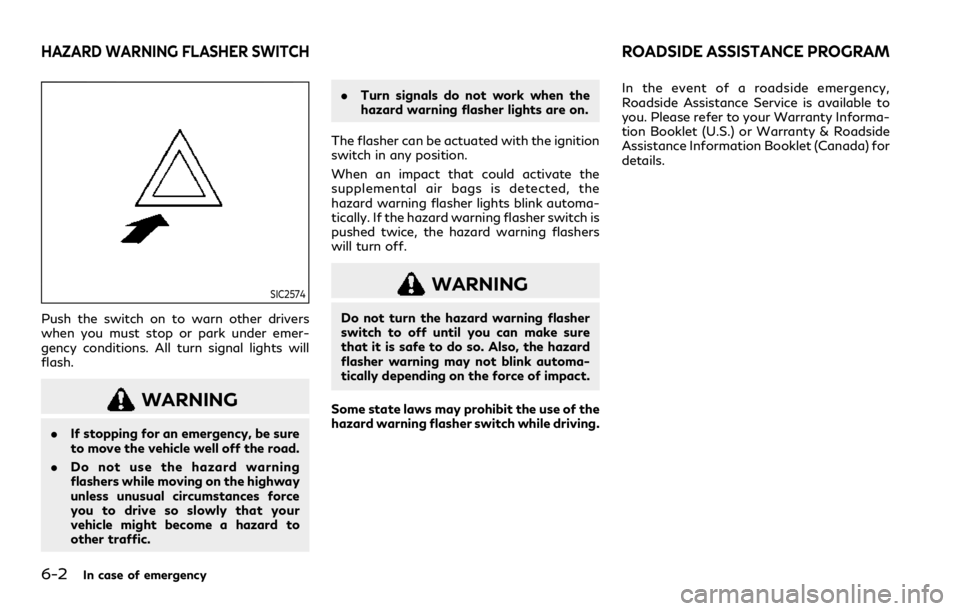
Push the switch on to warn other drivers
when you must stop or park under emer-
gency conditions. All turn signal lights will
flash.
WARNING
.If stopping for an emergency, be sure
to move the vehicle well off the road.
. Do not use the hazard warning
flashers while moving on the highway
unless unusual circumstances force
you to drive so slowly that your
vehicle might become a hazard to
other traffic. .
Turn signals do not work when the
hazard warning flasher lights are on.
The flasher can be actuated with the ignition
switch in any position.
When an impact that could activate the
supplemental air bags is detected, the
hazard warning flasher lights blink automa-
tically. If the hazard warning flasher switch is
pushed twice, the hazard warning flashers
will turn off.
WARNING
Do not turn the hazard warning flasher
switch to off until you can make sure
that it is safe to do so. Also, the hazard
flasher warning may not blink automa-
tically depending on the force of impact.
Some state laws may prohibit the use of the
hazard warning flasher switch while driving. In the event of a roadside emergency,
Roadside Assistance Service is available to
you. Please refer to your Warranty Informa-
tion Booklet (U.S.) or Warranty & Roadside
Assistance Information Booklet (Canada) for
details.
HAZARD WARNING FLASHER SWITCHROADSIDE ASSISTANCE PROGRAM
Page 397 of 529
6-4In case of emergency
cause a malfunction of the tire pres-
sure sensors.
CHANGING A FLAT TIRE
If you have a flat tire, follow the instructions
below.
Stopping the vehicle
1. Safely move the vehicle off the road andaway from traffic.
2. Turn on the hazard warning flashers.
3. Park on a level surface and apply the parking brake. Move the shift lever to the
P (Park) position.
4. Turn off the engine.
5. Raise the hood to warn other traffic, and to signal professional road assistance
personnel that you need assistance.
6. Have all passengers get out of the vehicle and stand in a safe place, away
from traffic and clear of the vehicle.
WARNING
.Make sure the parking brake is
securely applied and the automatic
transmission is in the P (Park) posi-
tion. .
Never change tires when the vehicle
is on a slope, ice or slippery areas.
This is hazardous.
. Never change tires if oncoming traf-
fic is close to your vehicle. Wait for
professional road assistance.
MCE0001A
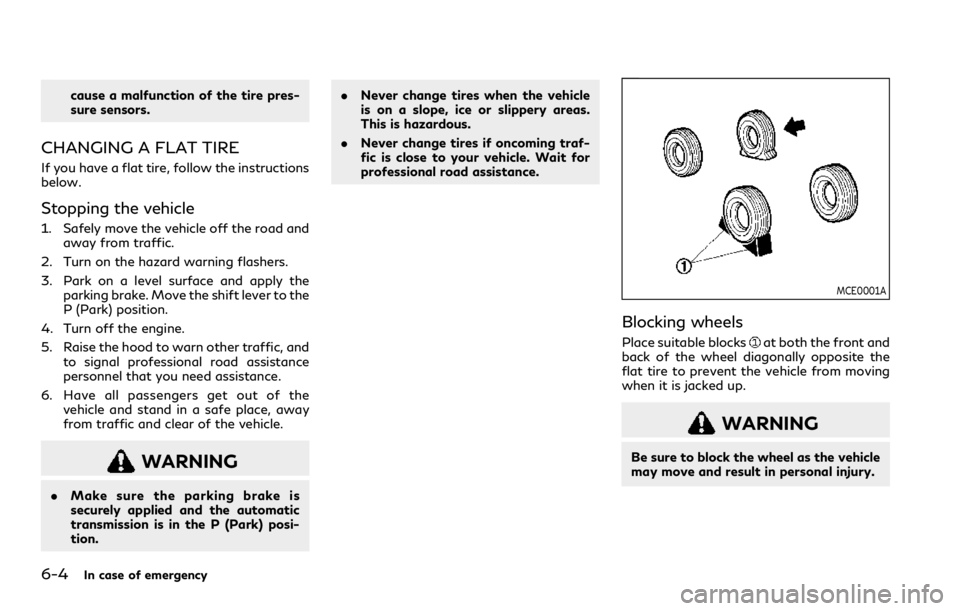
Blocking wheels
Place suitable blocksat both the front and
back of the wheel diagonally opposite the
flat tire to prevent the vehicle from moving
when it is jacked up.
WARNING
Be sure to block the wheel as the vehicle
may move and result in personal injury.
Page 416 of 529
WAXING
Regular waxing protects the paint surface
and helps retain new vehicle appearance.
Polishing is recommended to remove built-
up wax residue and to avoid a weathered
appearance before reapplying wax.
An INFINITI retailer can assist you in choos-
ing the proper product.
.Wax your vehicle only after a thorough
washing. Follow the instructions sup-
plied with the wax.
. Do not use a wax containing any abra-
sives, cutting compounds or cleaners
that may damage the vehicle finish.
Machine compound or aggressive polishing
on a base coat/clear coat paint finish may
dull the finish or leave swirl marks.
REMOVING SPOTS
Remove tar and oil spots, industrial dust,
insects, and tree sap as quickly as possible
from the paint surface to avoid lasting
damage or staining. Special cleaning pro-
ducts are available at an INFINITI retailer or
any automotive accessory stores.
UNDERBODY
In areas where road salt is used in winter, the
underbody must be cleaned regularly. This
will prevent dirt and salt from building up
and causing the acceleration of corrosion on
the underbody and suspension. Before the
winter period and again in the spring, the
underseal must be checked and, if necessary,
re-treated.
GLASS
Use glass cleaner to remove smoke and dust
film from the glass surfaces. It is normal for
glass to become coated with a film after the
vehicle is parked in the hot sun. Glass cleaner
and a soft cloth will easily remove this film.
CAUTION
When cleaning the inside of the win-
dows, do not use sharp-edged tools,
abrasive cleaners or chlorine-based dis-
infectant cleaners. They could damage
the electrical conductors, radio antenna
elements or rear window defroster ele-
ments.
WHEELS
Wash the wheels when washing the vehicle
to maintain their appearance.
. Clean the inner side of the wheels when
the wheel is changed or the underside of
the vehicle is washed.
. Inspect wheel rims regularly for dents or
corrosion. Such damage may cause loss
of pressure or poor seal at the tire bead.
. INFINITI recommends that the road
wheels be waxed to protect against road
salt in areas where it is used during
winter.
CAUTION
Do not use abrasive cleaners when
washing the wheels.
Aluminum alloy wheels
Wash regularly with a sponge dampened in a
mild soap solution, especially during winter
months in areas where road salt is used. Salt
could discolor the wheels if not removed.
Appearance and care7-3
Page 510 of 529

4. Release the parking brake.
5. Drive slowly until the vehicle and trailerare clear from the blocks.
6. Apply and hold the brake pedal.
7. Have someone retrieve and store the blocks.
. While going downhill, the weight of the
trailer pushing on the tow vehicle may
decrease overall stability. Therefore, to
maintain adequate control, reduce your
speed and shift to a lower gear. Avoid
long or repeated use of the brakes when
descending a hill, as this reduces their
effectiveness and could cause overheat-
ing. Shifting to a lower gear instead
provides “engine braking” and reduces
the need to brake as frequently.
. If the engine coolant temperature rises to
a high temperature, see “If your vehicle
overheats” (P.6-14).
. Trailer towing requires more fuel than
normal circumstances.
. Avoid towing a trailer for your vehicle’s
first 500 miles (800 km).
. Have your vehicle serviced more often
than at intervals specified in the recom-
mended maintenance schedule shown in
the “9. Maintenance and schedules”
section. .
When making a turn, your trailer wheels
will be closer to the inside of the turn
than your vehicle wheels. To compensate
for this, make a larger than normal
turning radius during the turn.
. Crosswinds and rough roads will ad-
versely affect vehicle/trailer handling,
possibly causing vehicle sway. When
being passed by larger vehicles, be pre-
pared for possible changes in crosswinds
that could affect vehicle handling.
Do the following if the trailer begins to sway:
1. Take your foot off the accelerator pedal to allow the vehicle to coast and steer as
straight ahead as the road conditions
allow. This combination will help stabilize
the vehicle.
.Do not correct trailer sway by steering
or applying the brakes.
2. When the trailer sway stops, gently apply the brakes and pull to the side of
the road in a safe area.
3. Try to rearrange the trailer load so it is balanced as described earlier in this
section.
. Be careful when passing other vehicles.
Passing while towing a trailer requires
considerably more distance than normal
passing. Remember the length of the
trailer must also pass the other vehicle
before you can safely change lanes. .
Use the TOW mode or downshift the
transmission to a lower gear for engine
braking when driving down steep or long
hills. This will help slow the vehicle
without applying the brakes.
. Avoid holding the brake pedal down too
long or too frequently. This could cause
the brakes to overheat, resulting in
reduced braking efficiency.
. Increase your following distance to allow
for greater stopping distances while
towing a trailer. Anticipate stops and
brake gradually.
. INFINITI recommends that the cruise
control not be used while towing a
trailer.
. While towing a trailer, do not use the
following systems (if so equipped):
— the Lane Departure Warning (LDW) system
— the Lane Departure Prevention (LDP) system
— the Blind Spot Warning (BSW) system
— the Blind Spot Intervention
®(BSI)
system
— the Back-up Collision Intervention (BCI) system
— the Intelligent Cruise Control (ICC) system
— the Distance Control Assist (DCA) system
Technical and consumer information10-29
Page 522 of 529

Map lights .............................................................. 2-74
Master warning light .............................. 2-14, 2-18
Mechanical key (Intelligent Key system) .......... 3-3
Memory storage, Automatic
drive positioner ................................................... 3-40
MeterTrip computer ................................................. 2-31
Meters and gauges ................................................ 2-6 Instrument brightness control ................... 2-46
Mirror
Inside mirror ................................................... 3-30
Outside mirrors .............................................. 3-37
Smart Rearview Mirror ................................ 3-31
Vanity mirror ................................................... 3-39
Monitor
Around View
®Monitor .................................. 4-3
Moonroof ............................................................... 2-70
Moving Object Detection (MOD) ................... 4-22
N
New vehicle break-in ........................................ 5-111
O
Odometer .................................................................. 2-7
Off-road recovery .................................................. 5-9
Oil Capacities and
recommended fluids/lubricants ................. 10-2
Changing engine oil and filter ...................... 8-6
Checking engine oil level ............................... 8-6 Engine oil ........................................................... 8-6
Engine oil pressure gauge ............................. 2-9
Engine oil viscosity ........................................ 10-7
Operation, operational indicators ................... 2-24
Outside air temperature .................................... 2-33
Outside mirrors .................................................... 3-37
Overheat, If your vehicle overheats ............... 6-14
Owner’s Manual/Service Manual
order information ............................................. 10-35
P
Panic alarm ............................................................ 3-17
Parking Brake break-in .............................................. 5-123
Parking brake operation .............................. 5-22
Parking on hills ............................................. 5-121
Phone
Car phone or CB radio ................................ 4-38
Pocket ..................................................................... 2-65
Power Front seat adjustment ................................... 1-4
Moonroof ......................................................... 2-70
Power door lock ............................................... 3-4
Power outlet ................................................... 2-56
Power steering fluid ....................................... 8-8
Power steering system .............................. 5-123
Power windows ............................................. 2-68
Precautions Braking precautions .................................... 5-123
Child restraints ............................................... 1-31
Cruise control ................................................. 5-62 Driving safety ................................................. 5-10
Maintenance ..................................................... 8-2
On-pavement and off-road driving ........... 5-8
Seat belt usage .............................................. 1-18
Supplemental restraint system .................. 1-52
When starting and driving ............................ 5-4
Predictive Forward Collision
Warning (PFCW) .............................................. 5-103
Push starting ......................................................... 6-13
Push-button ignition switch ............................. 5-12R
Radio Car phone or CB radio ................................ 4-38
Rain-sensing auto wiper system ..................... 2-38
Rapid air pressure loss .......................................... 5-9
Readiness for inspection/maintenance
(I/M) test ............................................................ 10-34
Rear door alert ..................................................... 2-54
Rear door lock, Child safety rear door lock .... 3-6
Rear personal lights ............................................ 2-74
Rear ventilators .................................................... 4-27
Rear window wiper and washer switch ....... 2-39
Rear window wiper blades ............................... 8-16
Recorders, Event data .................................... 10-35
Registering your vehicle in
another country ................................................. 10-11
Remote engine start ................................ 3-17, 3-19
Remote keyless entry system .......................... 3-15
Reporting safety defects ................................ 10-33
Roadside assistance program ............................. 6-2
11-5