power steering ISUZU AXIOM 2002 Service Workshop Manual
[x] Cancel search | Manufacturer: ISUZU, Model Year: 2002, Model line: AXIOM, Model: ISUZU AXIOM 2002Pages: 2100, PDF Size: 19.35 MB
Page 193 of 2100
2A±42
POWER±ASSISTED STEERING SYSTEM
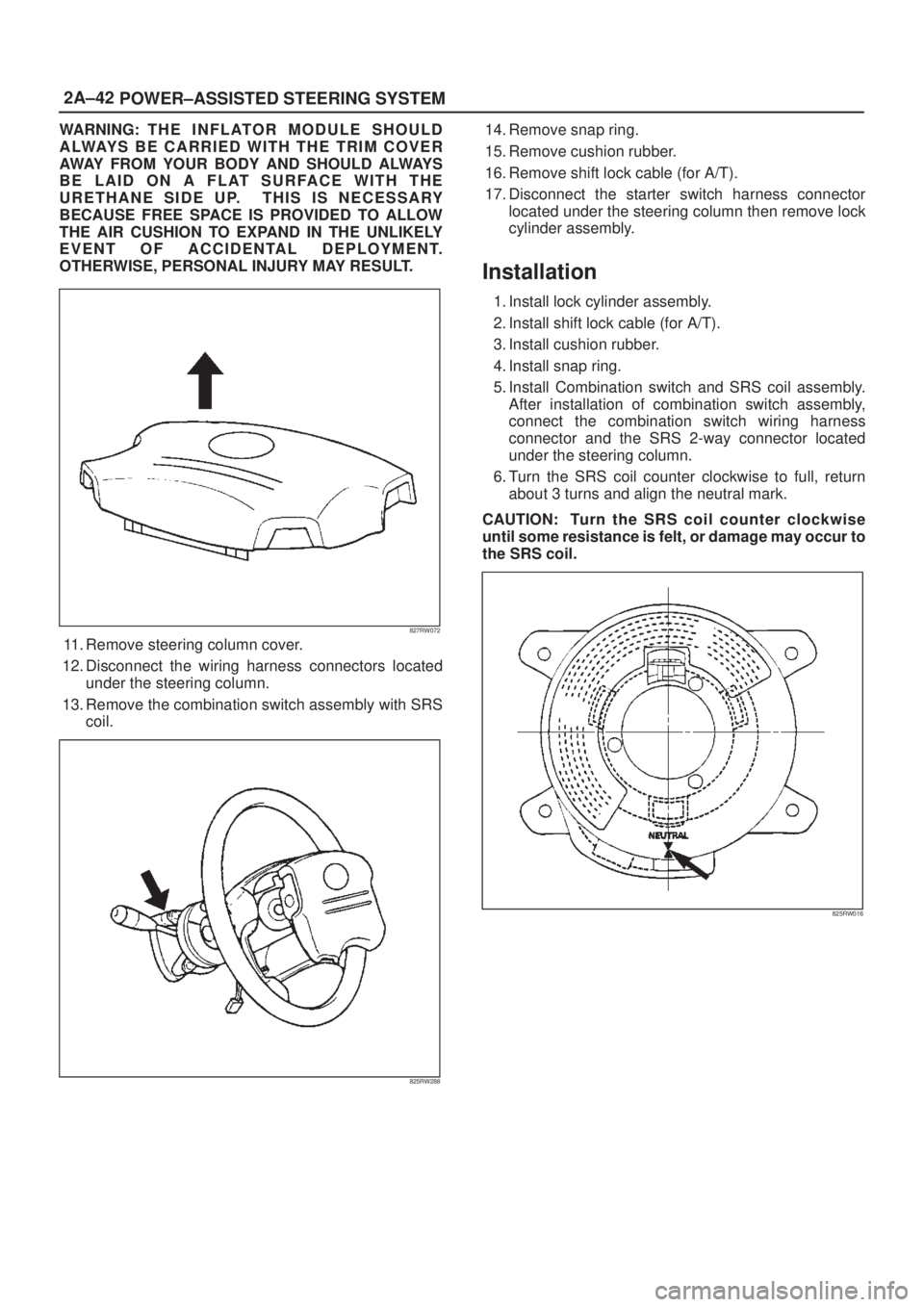
WARNING: T H E I N F L AT O R M O D U L E S H O U L D
ALWAYS BE CARRIED WITH THE TRIM COVER
AWAY FROM YOUR BODY AND SHOULD ALWAYS
BE LAID ON A FLAT SURFACE WITH THE
URETHANE SIDE UP. THIS IS NECESSARY
BECAUSE FREE SPACE IS PROVIDED TO ALLOW
THE AIR CUSHION TO EXPAND IN THE UNLIKELY
EVENT OF ACCIDENTAL DEPLOYMENT.
OTHERWISE, PERSONAL INJURY MAY RESULT.
827RW072
11. Remove steering column cover.
12. Disconnect the wiring harness connectors located
under the steering column.
13. Remove the combination switch assembly with SRS
coil.
825RW288
14. Remove snap ring.
15. Remove cushion rubber.
16. Remove shift lock cable (for A/T).
17. Disconnect the starter switch harness connector
located under the steering column then remove lock
cylinder assembly.
Installation
1. Install lock cylinder assembly.
2. Install shift lock cable (for A/T).
3. Install cushion rubber.
4. Install snap ring.
5. Install Combination switch and SRS coil assembly.
After installation of combination switch assembly,
connect the combination switch wiring harness
connector and the SRS 2-way connector located
under the steering column.
6. Turn the SRS coil counter clockwise to full, return
about 3 turns and align the neutral mark.
CAUTION: Turn the SRS coil counter clockwise
until some resistance is felt, or damage may occur to
the SRS coil.
825RW016
Page 194 of 2100
POWER±ASSISTED STEERING SYSTEM2A±43
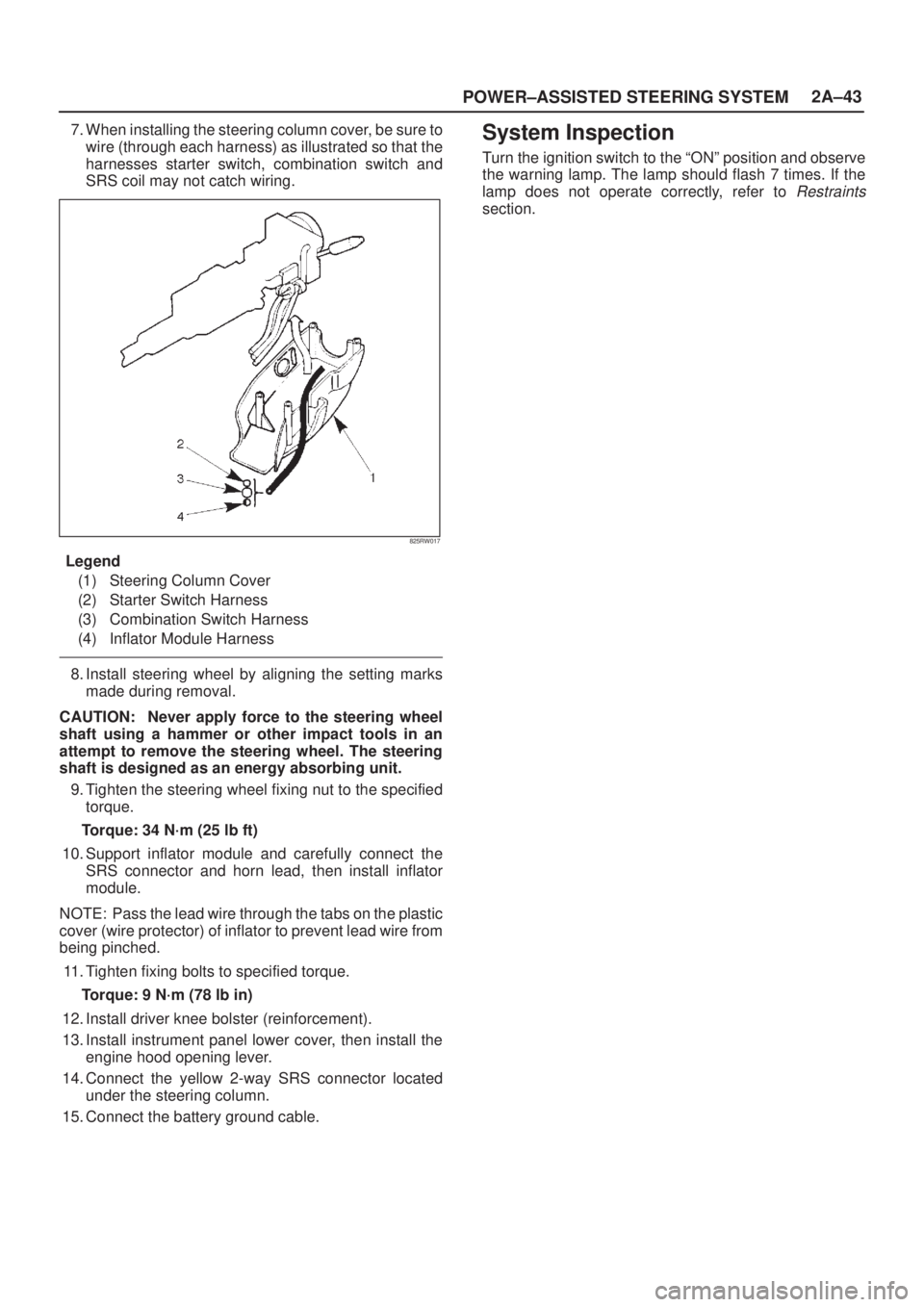
7. When installing the steering column cover, be sure to
wire (through each harness) as illustrated so that the
harnesses starter switch, combination switch and
SRS coil may not catch wiring.
825RW017
Legend
(1) Steering Column Cover
(2) Starter Switch Harness
(3) Combination Switch Harness
(4) Inflator Module Harness
8. Install steering wheel by aligning the setting marks
made during removal.
CAUTION: Never apply force to the steering wheel
shaft using a hammer or other impact tools in an
attempt to remove the steering wheel. The steering
shaft is designed as an energy absorbing unit.
9. Tighten the steering wheel fixing nut to the specified
torque.
Torque: 34 N´m (25 lb ft)
10. Support inflator module and carefully connect the
SRS connector and horn lead, then install inflator
module.
NOTE: Pass the lead wire through the tabs on the plastic
cover (wire protector) of inflator to prevent lead wire from
being pinched.
11. Tighten fixing bolts to specified torque.
Torque: 9 N´m (78 lb in)
12. Install driver knee bolster (reinforcement).
13. Install instrument panel lower cover, then install the
engine hood opening lever.
14. Connect the yellow 2-way SRS connector located
under the steering column.
15. Connect the battery ground cable.
System Inspection
Turn the ignition switch to the ªONº position and observe
the warning lamp. The lamp should flash 7 times. If the
lamp does not operate correctly, refer to
Restraints
section.
Page 195 of 2100
2A±44
POWER±ASSISTED STEERING SYSTEM
Steering Column
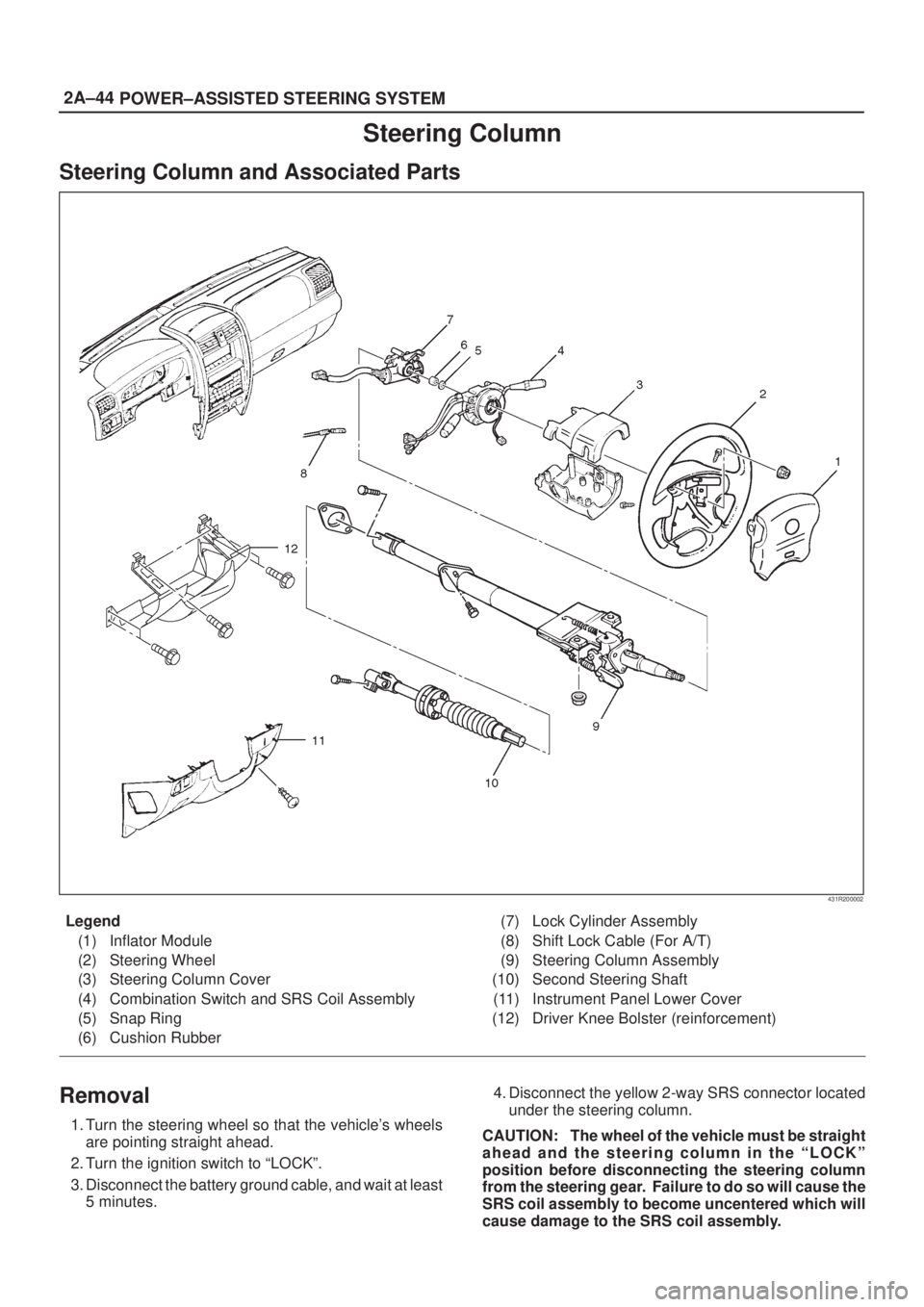
Steering Column and Associated Parts
431R200002
Legend
(1) Inflator Module
(2) Steering Wheel
(3) Steering Column Cover
(4) Combination Switch and SRS Coil Assembly
(5) Snap Ring
(6) Cushion Rubber(7) Lock Cylinder Assembly
(8) Shift Lock Cable (For A/T)
(9) Steering Column Assembly
(10) Second Steering Shaft
(11) Instrument Panel Lower Cover
(12) Driver Knee Bolster (reinforcement)
Removal
1. Turn the steering wheel so that the vehicle's wheels
are pointing straight ahead.
2. Turn the ignition switch to ªLOCKº.
3. Disconnect the battery ground cable, and wait at least
5 minutes.4. Disconnect the yellow 2-way SRS connector located
under the steering column.
CAUTION: The wheel of the vehicle must be straight
ahead and the steering column in the ªLOCKº
position before disconnecting the steering column
from the steering gear. Failure to do so will cause the
SRS coil assembly to become uncentered which will
cause damage to the SRS coil assembly.
Page 196 of 2100
POWER±ASSISTED STEERING SYSTEM2A±45
5. Remove the engine hood opening lever, then remove
instrument panel lower cover.
6. Remove driver knee bolster (reinforcement).
7. Loosen the inflator module fixing bolt from behind the
steering wheel assembly using a TORX) driver or
equivalent until the inflator module can be released
from steering assembly.
827RW070
8. Disconnect the yellow 2-way SRS connector and
horn lead located behind the inflator module.
9. Remove inflator module.
WARNING: T H E I N F L AT O R M O D U L E S H O U L D
ALWAYS BE CARRIED WITH THE TRIM COVER
AWAY FROM YOUR BODY AND SHOULD ALWAYS
BE LAID ON A FLAT SURFACE WITH THE
URETHANE SIDE UP. THIS IS NECESSARY
BECAUSE FREE SPACE IS PROVIDED TO ALLOW
THE AIR CUSHION TO EXPAND IN THE UNLIKELY
EVENT OF ACCIDENTAL DEPLOYMENT.
OTHERWISE, PERSONAL INJURY MAY RESULT.
827RW072
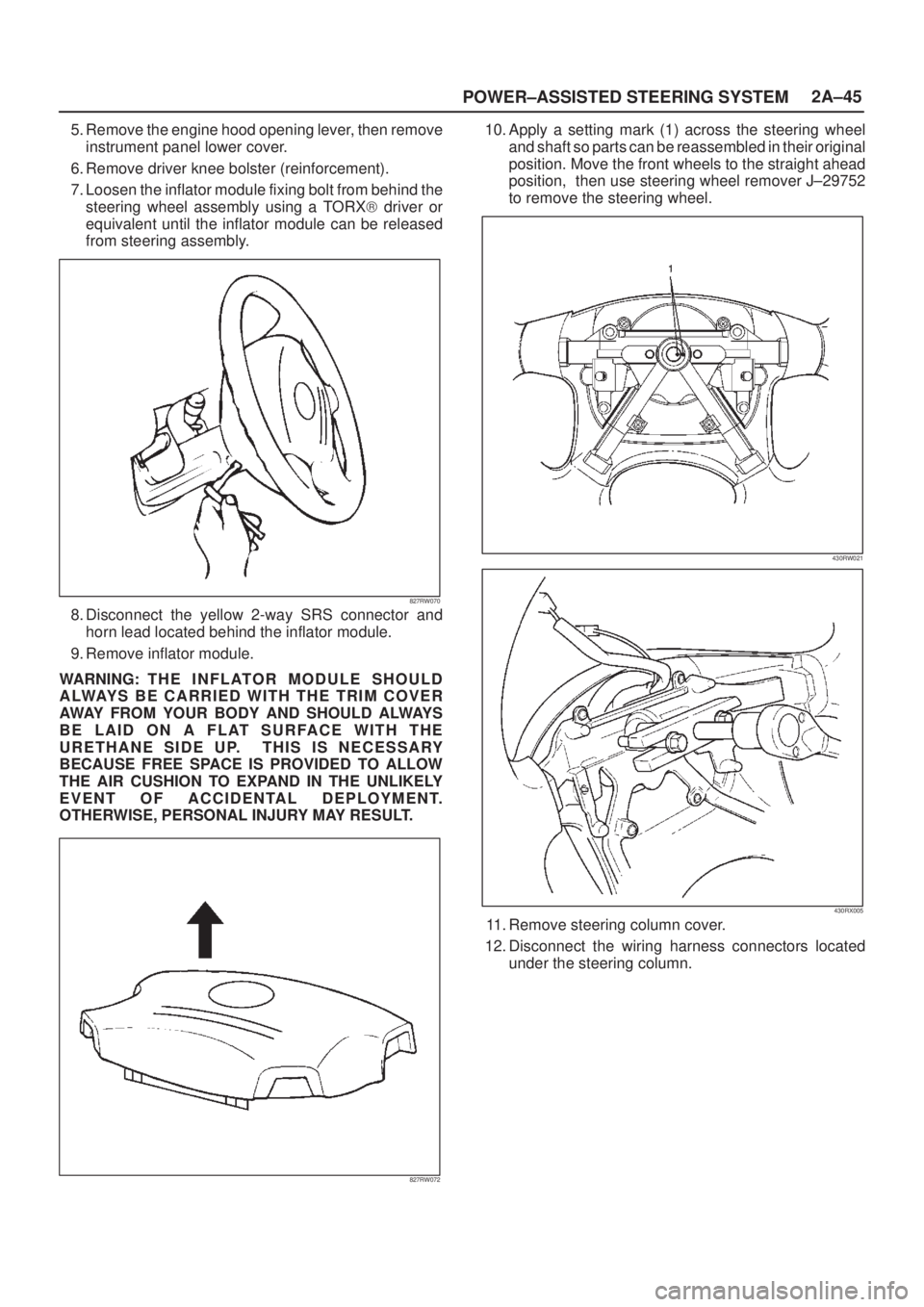
10. Apply a setting mark (1) across the steering wheel
and shaft so parts can be reassembled in their original
position. Move the front wheels to the straight ahead
position, then use steering wheel remover J±29752
to remove the steering wheel.
430RW021
430RX005
11. Remove steering column cover.
12. Disconnect the wiring harness connectors located
under the steering column.
Page 197 of 2100
2A±46
POWER±ASSISTED STEERING SYSTEM
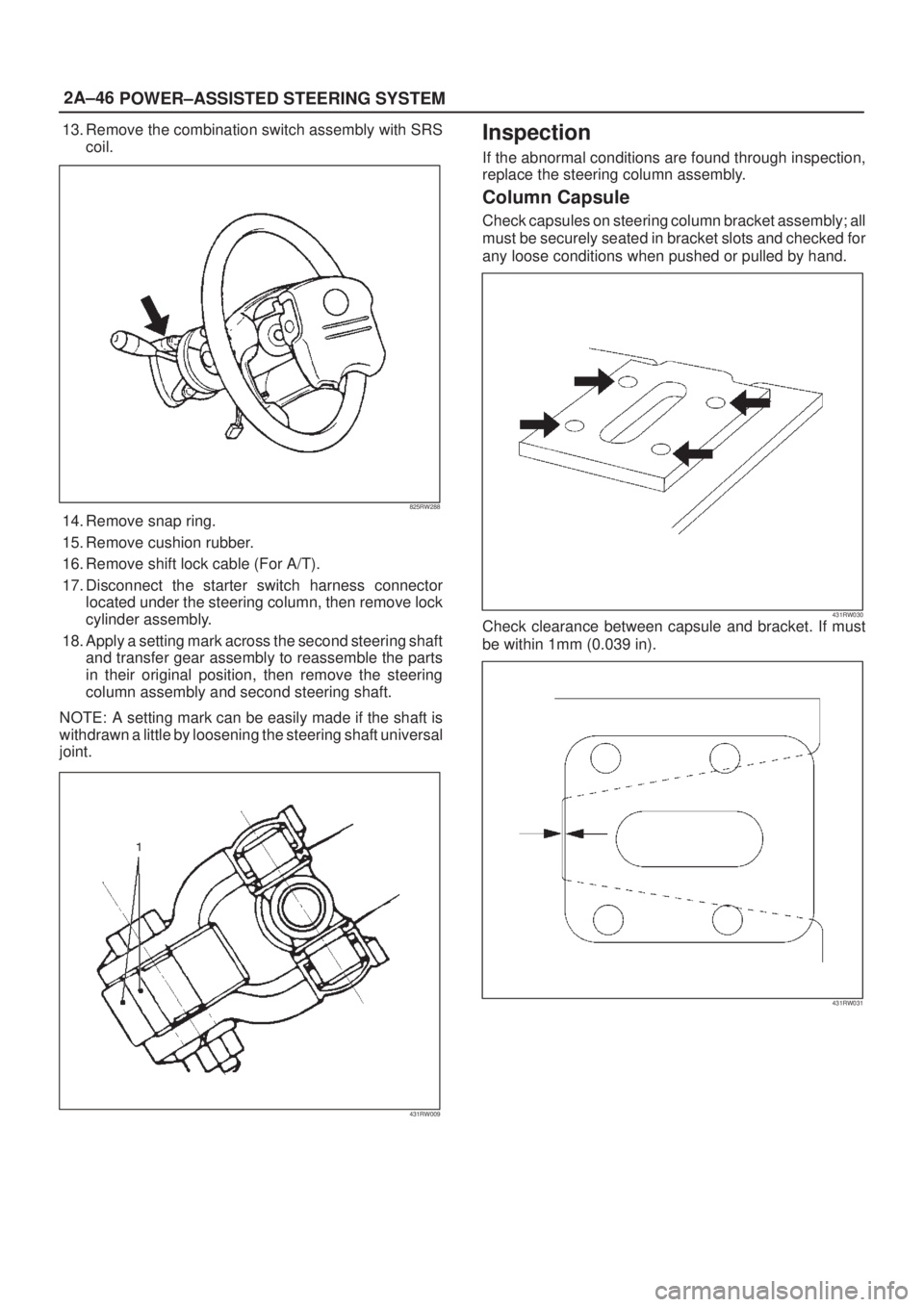
13. Remove the combination switch assembly with SRS
coil.
825RW288
14. Remove snap ring.
15. Remove cushion rubber.
16. Remove shift lock cable (For A/T).
17. Disconnect the starter switch harness connector
located under the steering column, then remove lock
cylinder assembly.
18. Apply a setting mark across the second steering shaft
and transfer gear assembly to reassemble the parts
in their original position, then remove the steering
column assembly and second steering shaft.
NOTE: A setting mark can be easily made if the shaft is
withdrawn a little by loosening the steering shaft universal
joint.
431RW009
Inspection
If the abnormal conditions are found through inspection,
replace the steering column assembly.
Column Capsule
Check capsules on steering column bracket assembly; all
must be securely seated in bracket slots and checked for
any loose conditions when pushed or pulled by hand.
431RW030Check clearance between capsule and bracket. If must
be within 1mm (0.039 in).
431RW031
Page 198 of 2100
POWER±ASSISTED STEERING SYSTEM2A±47
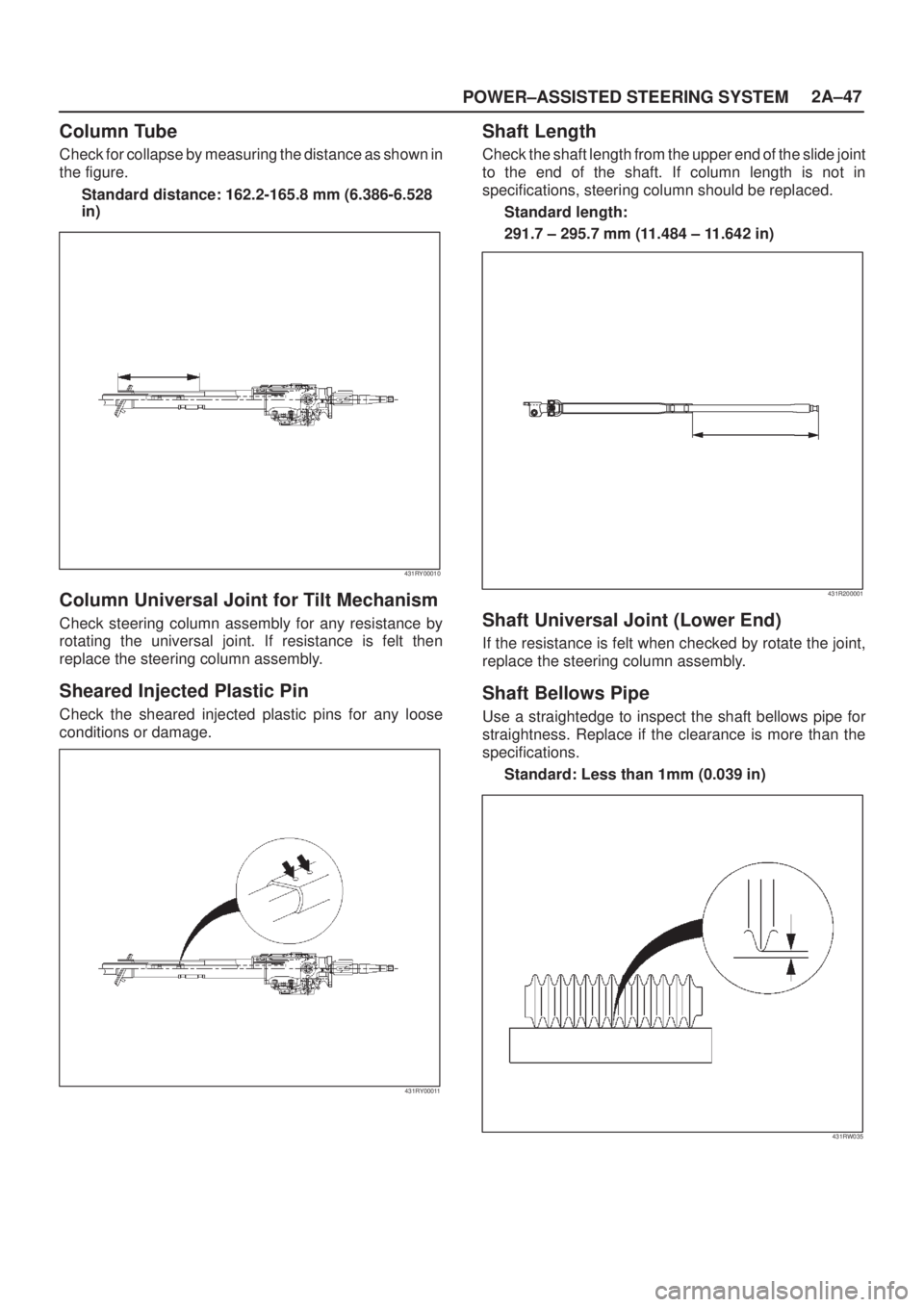
Column Tube
Check for collapse by measuring the distance as shown in
the figure.
Standard distance: 162.2-165.8 mm (6.386-6.528
in)
431RY00010
Column Universal Joint for Tilt Mechanism
Check steering column assembly for any resistance by
rotating the universal joint. If resistance is felt then
replace the steering column assembly.
Sheared Injected Plastic Pin
Check the sheared injected plastic pins for any loose
conditions or damage.
431RY00011
Shaft Length
Check the shaft length from the upper end of the slide joint
to the end of the shaft. If column length is not in
specifications, steering column should be replaced.
Standard length:
291.7 ± 295.7 mm (11.484 ± 11.642 in)
431R200001
Shaft Universal Joint (Lower End)
If the resistance is felt when checked by rotate the joint,
replace the steering column assembly.
Shaft Bellows Pipe
Use a straightedge to inspect the shaft bellows pipe for
straightness. Replace if the clearance is more than the
specifications.
Standard: Less than 1mm (0.039 in)
431RW035
Page 199 of 2100
2A±48
POWER±ASSISTED STEERING SYSTEM
Tilt Mechanism
Tilt mechanism should moves smoothly.
While locked the tilt mechanism, be sure the steering
column latch securely by pushing the steering wheel
upward and downward.
Installation
1. Pass through the steering column assembly to the
dash panel hole.
Temporary tightening the steering column bolt(cross
beam).
2. Tighten the steering column bolts(dash panel) to the
specified torque.
Torque: 20 N´m (14 lb ft)
3. Tighten the steering column nuts (cross beam) to the
specified torque.
Torque: 17 N´m (12 lb ft)
4. Install the universal joint assembly to the transfer
gear assembly align the setting marks made at
removal.
Then tighten the universal joint bolt.
Torque: 31 N´m (23 lb ft)
5. Install the second steering shaft to the universal joint
assembly, then tighten the universal joint bolt to the
specified torque.
Torque: 31 N´m (23 lb ft)
6. Install lock cylinder assembly.
7. Install shift lock cable (For A/T).
8. Install cushion rubber.
9. Install snap ring.
10. Install combination switch and SRS coil assembly.
After installation of combination switch assembly,
connect the combination switch wiring harness
connector and the SRS 2-way connector located
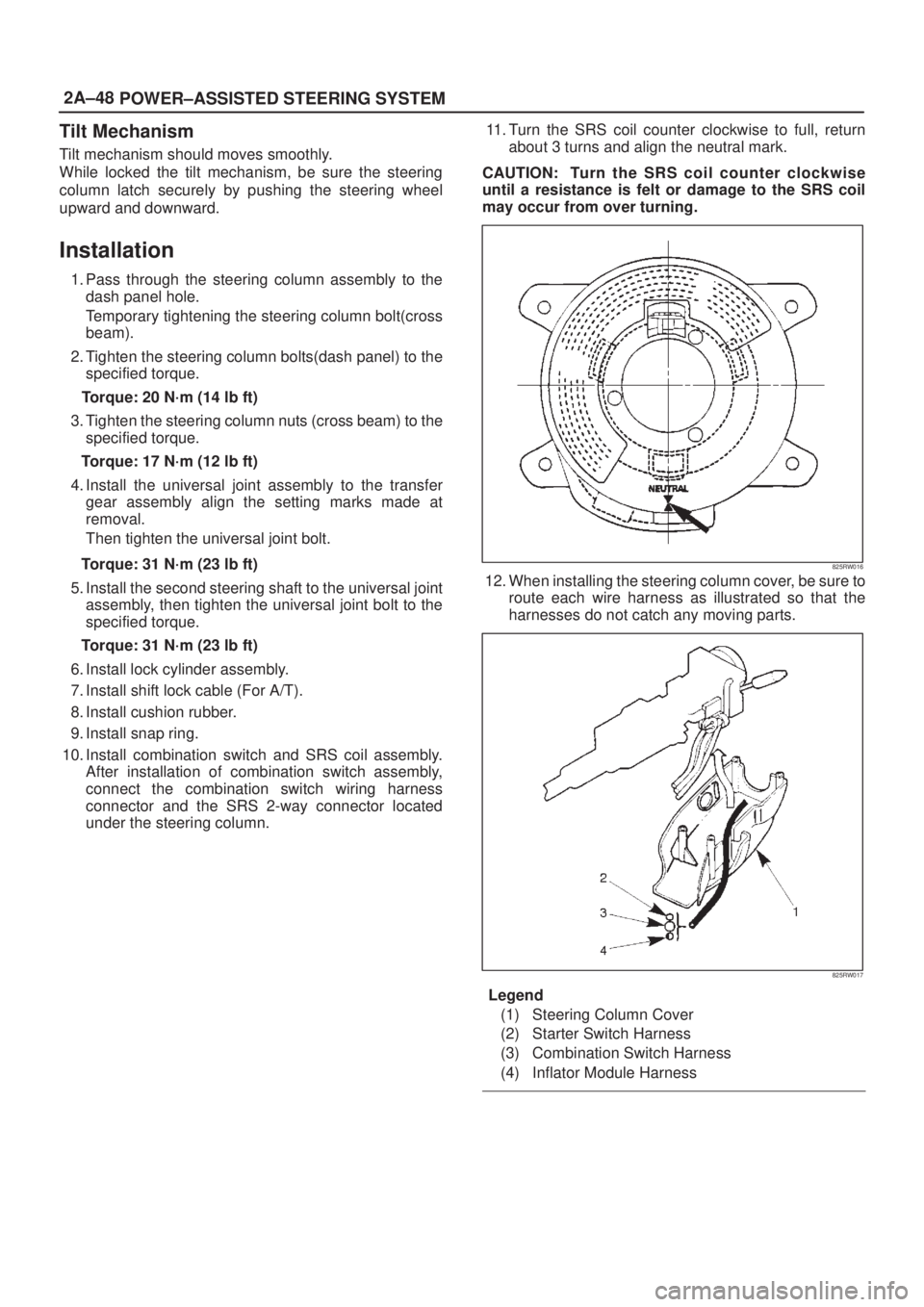
under the steering column.11. Turn the SRS coil counter clockwise to full, return
about 3 turns and align the neutral mark.
CAUTION: Turn the SRS coil counter clockwise
until a resistance is felt or damage to the SRS coil
may occur from over turning.
825RW016
12. When installing the steering column cover, be sure to
route each wire harness as illustrated so that the
harnesses do not catch any moving parts.
825RW017
Legend
(1) Steering Column Cover
(2) Starter Switch Harness
(3) Combination Switch Harness
(4) Inflator Module Harness
Page 200 of 2100
POWER±ASSISTED STEERING SYSTEM2A±49
13. Install steering wheel and align the setting marks
made when removing.
CAUTION: Never apply force to the steering wheel
shaft using a hammer or other impact tools in an
attempt to remove the steering wheel. The steering
shaft is designed as an energy absorbing unit.
14. Tighten the steering wheel fixing nut to the specified
torque.
Torque: 34 N´m (25 lb ft)
15. Support the module and carefully connect the module
connector and horn lead, then install inflator module.
NOTE: Pass the lead wire through the tabs on the plastic
cover (wire protector) of inflator to prevent lead wire from
being pinched.
16. Tighten bolts to specified torque.
Torque: 9 N´m (78 lb in)
17. Install driver knee bolster (reinforcement).
18. Install instrument panel lower cover.
19. Install the engine hood opening lever.
20. Connect the yellow 2-way SRS connector and horn
lead located under the steering column.
21. Connect the battery ground cable.
System Inspection
Turn the ignition switch ªONº and observe if the warning
lamp flashes 7 times. If the warning lamp does not
operate correctly, refer to
Restraints section.
Page 201 of 2100
2A±50
POWER±ASSISTED STEERING SYSTEM
Supplemental Restraint System Steering Wheel & Column and
Associated Parts
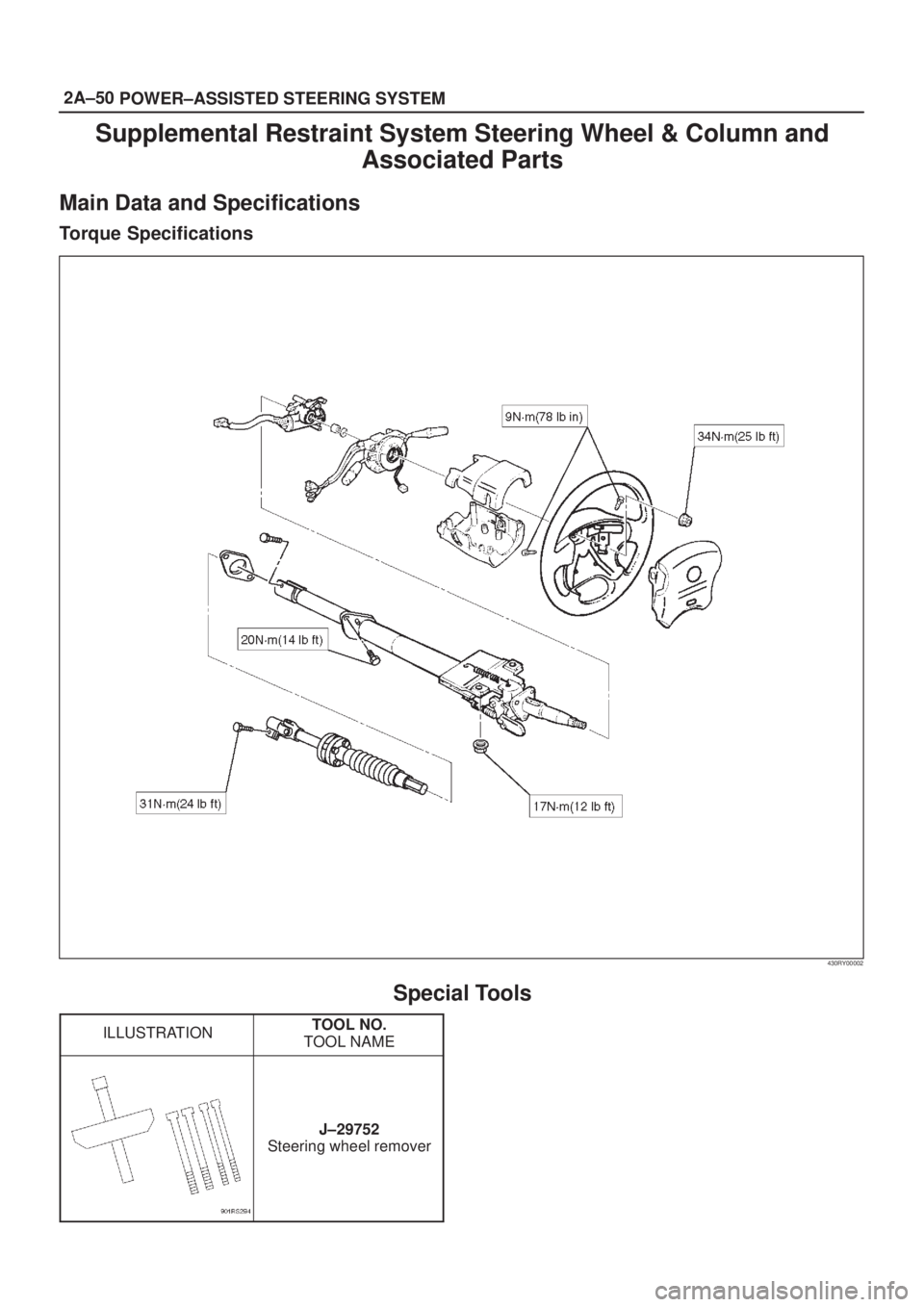
Main Data and Specifications
Torque Specifications
430RY00002
Special Tools
ILLUSTRATIONTOOL NO.
TOOL NAME
J±29752
Steering wheel remover
Page 203 of 2100
3C±2FRONT SUSPENSION
General Description
The front suspension is designed to allow each wheel to
compensate for changes in the road surface level without
greatly affecting the opposite wheel. Each wheel is
independently connected to the frame by a steering
knuckle, ball joint assemblies, and upper and lower
control arms. The front wheels are held in proper
relationship to each other by two tie-rods which are
connected to steering arms on the knuckles, and to a
steering unit.
All models have a front suspension system consisting of
control arms, stabilizer bar, shock absorber and a torsion
bar. The front end of the torsion bar is attached to the
lower control arm. The rear of the torsion bar is mounted
into a height control arm at the crossmember. Vehicle trim
height is controlled by adjusting this arm.
Shock absorbers are mounted between the brackets on
the frame and the lower control arms. The lower portion ofeach shock absorber is attached to the lower control arm.
The upper portion of each shock absorber extends
through a frame bracket and is secured with two rubber
bushings, two retainers and a nut.
Ball joint assemblies are bolted to the outer end of the
upper and lower control arm and are attached to the
steering knuckle.
The inner ends of the upper control arm have pressed in
bushings. Bolts, passing through the bushing, attach the
control arm to the frame. The inner ends of the lower
control arm are attached to the frame by bolts passing
through the bushings.
Side roll of the front suspension is controlled by a spring
steel stabilizer bar. It is mounted in rubber bushings,
which are held to the frame by brackets. The ends of the
stabilizer bar are connected to the lower control arms by
links.
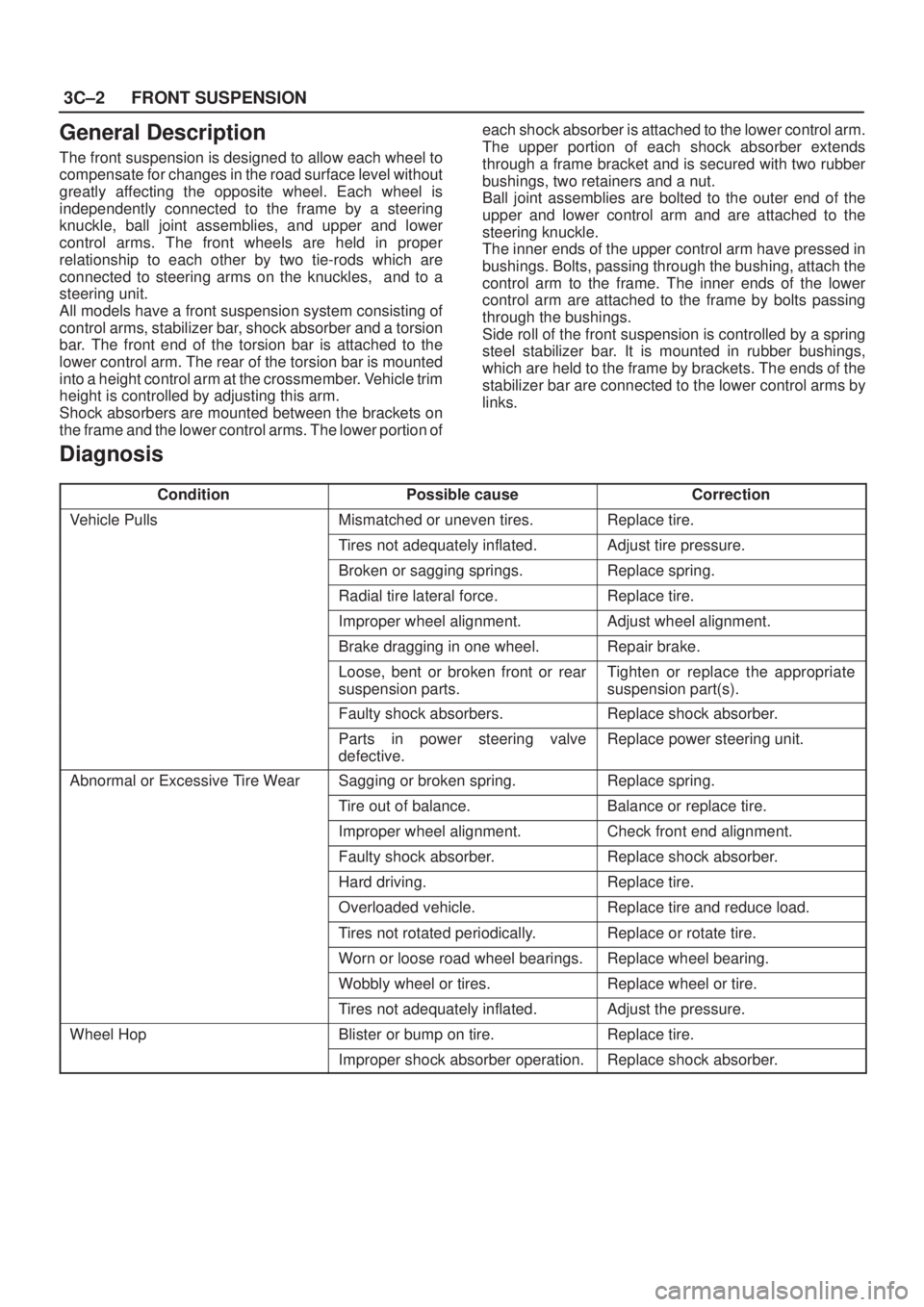
Diagnosis
ConditionPossible causeCorrection
Vehicle PullsMismatched or uneven tires.Replace tire.
Tires not adequately inflated.Adjust tire pressure.
Broken or sagging springs.Replace spring.
Radial tire lateral force.Replace tire.
Improper wheel alignment.Adjust wheel alignment.
Brake dragging in one wheel.Repair brake.
Loose, bent or broken front or rear
suspension parts.Tighten or replace the appropriate
suspension part(s).
Faulty shock absorbers.Replace shock absorber.
Parts in power steering valve
defective.Replace power steering unit.
Abnormal or Excessive Tire WearSagging or broken spring.Replace spring.
Tire out of balance.Balance or replace tire.
Improper wheel alignment.Check front end alignment.
Faulty shock absorber.Replace shock absorber.
Hard driving.Replace tire.
Overloaded vehicle.Replace tire and reduce load.
Tires not rotated periodically.Replace or rotate tire.
Worn or loose road wheel bearings.Replace wheel bearing.
Wobbly wheel or tires.Replace wheel or tire.
Tires not adequately inflated.Adjust the pressure.
Wheel HopBlister or bump on tire.Replace tire.
Improper shock absorber operation.Replace shock absorber.