engine oil ISUZU KB P190 2007 Workshop Owner's Manual
[x] Cancel search | Manufacturer: ISUZU, Model Year: 2007, Model line: KB P190, Model: ISUZU KB P190 2007Pages: 6020, PDF Size: 70.23 MB
Page 317 of 6020
3B-56 POWER-ASSISTED STEERING SYSTEM
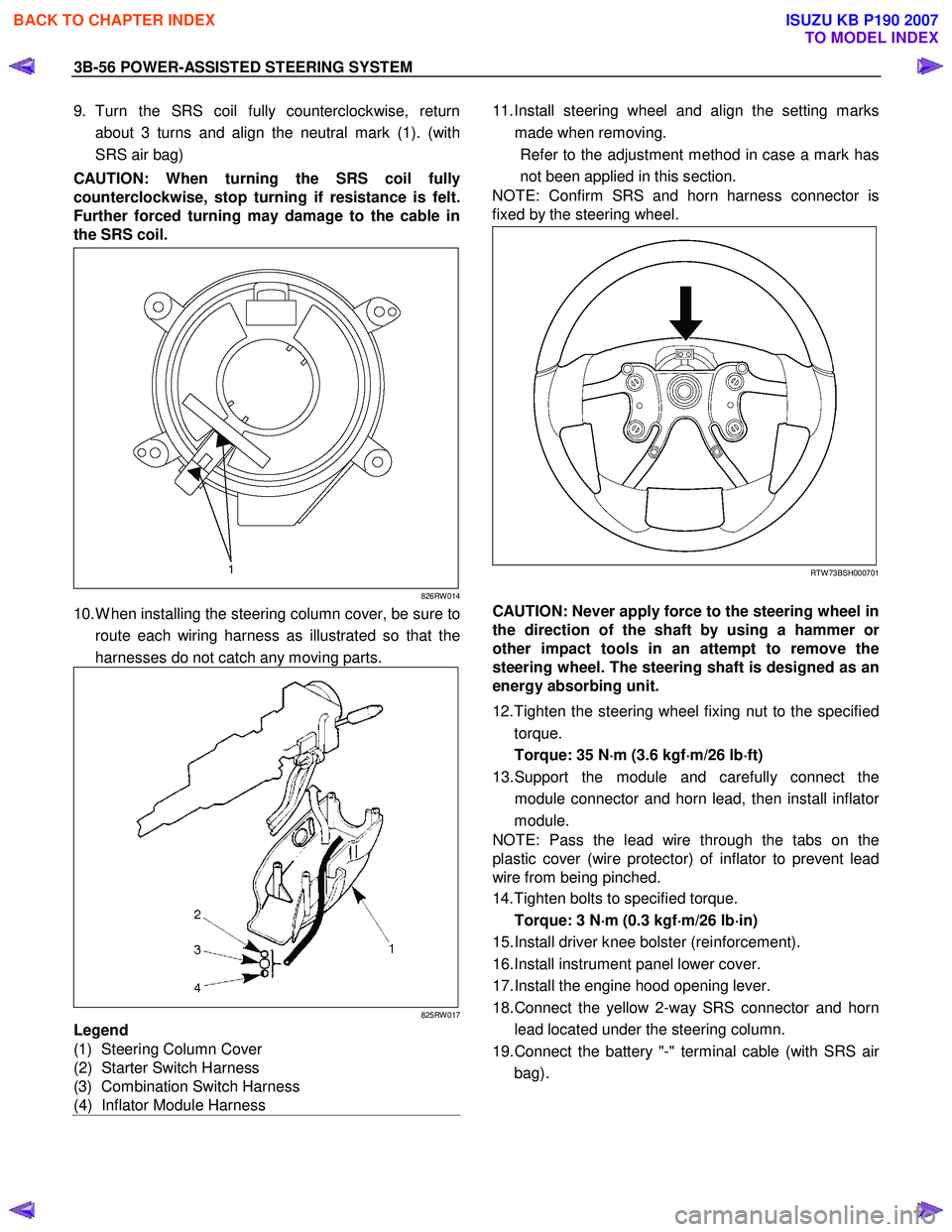
9. Turn the SRS coil fully counterclockwise, return
about 3 turns and align the neutral mark (1). (with
SRS air bag)
CAUTION: When turning the SRS coil fully
counterclockwise, stop turning if resistance is felt.
Further forced turning may damage to the cable in
the SRS coil.
826RW 014
10. W hen installing the steering column cover, be sure to
route each wiring harness as illustrated so that the
harnesses do not catch any moving parts.
825RW 017
Legend
(1) Steering Column Cover
(2) Starter Switch Harness
(3) Combination Switch Harness
(4) Inflator Module Harness
11. Install steering wheel and align the setting marks
made when removing. Refer to the adjustment method in case a mark has
not been applied in this section.
NOTE: Confirm SRS and horn harness connector is
fixed by the steering wheel.
RTW 73BSH000701
CAUTION: Never apply force to the steering wheel in
the direction of the shaft by using a hammer o
r
other impact tools in an attempt to remove the
steering wheel. The steering shaft is designed as an
energy absorbing unit.
12. Tighten the steering wheel fixing nut to the specified torque.
Torque: 35 N ⋅
⋅⋅
⋅
m (3.6 kgf ⋅
⋅⋅
⋅
m/26 lb ⋅
⋅⋅
⋅
ft)
13. Support the module and carefully connect the module connector and horn lead, then install inflato
r
module.
NOTE: Pass the lead wire through the tabs on the
plastic cover (wire protector) of inflator to prevent lead
wire from being pinched.
14. Tighten bolts to specified torque.
Torque: 3 N ⋅
⋅⋅
⋅
m (0.3 kgf ⋅
⋅⋅
⋅
m/26 lb ⋅
⋅⋅
⋅
in)
15. Install driver knee bolster (reinforcement).
16. Install instrument panel lower cover.
17. Install the engine hood opening lever.
18. Connect the yellow 2-way SRS connector and horn lead located under the steering column.
19. Connect the battery "-" terminal cable (with SRS ai
r
bag).
BACK TO CHAPTER INDEX
TO MODEL INDEX
ISUZU KB P190 2007
Page 489 of 6020
REAR AXLE 4B-45
TROUBLESHOOTING
Refer to this Section to quickly diagnose and repai
r
rear axle problems.
Each troubleshooting chart has three headings
arranged from left to right.
(1) Checkpoint
(2) Trouble Cause
(3) Countermeasure
This Section is divided into five sub-sections:
1. Abnormal Rear Axle Noise 1) Noise when the engine is driving the vehicle
2) Noise when the vehicle is coasting
3) Intermittent noise
4) Noise when the vehicle is turning
5) Constant noise
2. Vibration
3. Oil Leakage 1) Differential carrier leakage
2) Axle case leakage
3) Axle case to inside hub leakage
4) Axle case to inside brake drum leakage
4. Power Not Being Transmitted to the W heels (Propeller Shaft Operation is Normal)
BACK TO CHAPTER INDEX
TO MODEL INDEX
ISUZU KB P190 2007
Page 490 of 6020

4B-46 REAR AXLE
1. ABNORMAL REAR AXLE NOISE
1) Noise when the Engine is Driving the Vehicle
Checkpoint Trouble Cause Countermeasure
Replenish the gear oilInsufficient gear oil
NG
Differential side bearingAdjust the differential side
bearing preload
Replace the drive pinion
bearings
Adjust the drive pinion bearing
preload
Replace the gear oil
Loose differential side
bearings
W orn drive pinion bearings
Loose drive pinion bearings
W rong or poor grade gear oil
Drive pinion to ring gear
backlash
Drive pinion end play
Adjust the backlashToo much or too little backlash
Continued on the next page OK
OK
NG
NG
NG
NG
NG
OK
OK
Rear axle gear oil
Replace the differential side
bearingsW orn differential side bearings
NG
BACK TO CHAPTER INDEX
TO MODEL INDEX
ISUZU KB P190 2007
Page 724 of 6020
BRAKES 5C-25
Filling Master Cylinder Reservoir
CAUTION:
Use only specified brake fluid. Do not use any fluid which
contains a petroleum base. Do not use a container which
has been used for petroleum based fluids or a containe
r
which is wet with water. Petroleum based fluid will cause
swelling and distortion of rubber parts in the hydraulic
brake system. Water mixed with brake fluid lowers the
fluid boiling point. Keep all fluid containers capped to
prevent contamination.
Always fill the master cylinder reservoir when the engine
is cold.
Never allow the brake fluid to come in contact with the
painted surfaces.
The master cylinder reservoir must be kept properly filled
to ensure adequate reserve and to prevent air and
moisture from entering the hydraulic system. However,
because of expansion due to heat absorbed from the
brakes and the engine, the reservoir must not be
overfilled. Thoroughly clean reservoir cap before removal
to avoid getting dirt into reservoir. Add fluid as required to
bring level to the “MAX” mark on the reservoir tank. Use
“DOT 3” Hydraulic Brake Fluid.
Leakage of Brake Fluid
W ith engine idling, set shift lever in the neutral position and
continue to depress brake pedal at a constant pedal
application force.
Should the pedal stroke become deeper gradually, leakage
from the hydraulic pressure system is possible.
Make sure by visual check that there is no leak.
BLEEDING OF THE BRAKE HYDRAULIC
CIRCUIT
If air enters the bake lines, it will cause poor brake action.
Therefore, bleeding should be performed if the brakes have
been used with the level of brake fluid in the reservoi
r
excessively low or if brake pipes have been disconnected in
the course of brake servicing.
The bleeding operation calls for co-operative action of 2
persons.
• Set the parking brake firmly while bleeding.
• Perform bleeding operation with ENGINE RUNNING, to
prevent damage to push rod seal.
Make sure exhaust is suitably ventilated.
• Bleed the hydraulic system with the fluid reservoir filled to
the specified level.
• Bleed the system starting with the rear wheel cylinde
r
farthest from the master cylinder.
BACK TO CHAPTER INDEX
TO MODEL INDEX
ISUZU KB P190 2007
Page 761 of 6020

5C-62 BRAKES
360r300003
5. Vacuum Hose
The check valve (2) is built-in to the vacuum hose.
W hen installing the vacuum hose make sure that the arrow on
the hose is facing the engine (1).
Note:
• Do not apply oil to the vacuum hose.
• Installation direction is very important. The booster will not
operate if the vacuum hose is installed in the wrong
direction.
BACK TO CHAPTER INDEX
TO MODEL INDEX
ISUZU KB P190 2007
Page 786 of 6020
TROUBLESHOOTING 6 – 1
BASIC INSPECTION PROCEDURE....6– 2
1. HARD STARTING ............................6– 3
1-1.Starter Motor Inoperative ..........6– 3
1-2. Starter Motor Operates But
Engine Does Not Turn Over ...........6– 3
1-3. Engine Turns Over But Does
Not Start Engine ..............................6– 4
2. UNSTABLE IDLING .........................6– 5
3. INSUFFICIENT POWER ..................6– 6
4. EXCESSIVE FUEL
CONSUMPTION..................................6– 7
5. EXCESSIVE OIL CONSUMPTION ..6– 8
6. OVERHEATING ...............................6– 9
7. WHITE EXHAUST SMOKE..............6– 9
8. DARK EXHAUST SMOKE ...............6– 10
9. OIL PRESSURE DOES NOT RISE..6– 11
10. ABNORMAL ENGINE NOISE ........6– 12
10-1. Engine Knocking ....................6– 12
10-2. Gas Leakage Noise .................6– 12
10-3. Continuous Noise ...................6– 13
10-4. Slapping Noise ........................6– 13
10-5. Excessive Turbocharger
Noise ................................................6– 14
11. ROTATING PART WEAR OF
TURBOCHARGER.............................. 6– 14
12. OIL LEAKAGE FROM
TURBOCHRGER ................................ 6– 15
13. INSUFFICIENT ACCELERATION
AND/OR LACK OF POWER DUE
TO TURBOCHARGER........................ 6– 15
14. BATTERY CHARGING AND
NOISE PROBLEM .............................. 6– 16
14-1. Battery No Charging ............... 6– 16
14-2. Battery Overcharging ............. 6– 16
14-3. Battery Under Charging ......... 6– 17
14-4. Battery Unstable Charging
Current ............................................. 6– 17
14-5. Charging System Noise ......... 6– 18
15. STARTER MOTOR PROBLEM ..... 6– 19
15-1. Starter Motor Pinion Engages
to Ring Gear But Engine Does
Not Turn Over .................................. 6– 19
15-2. Incorrect Pinion And Ring
Gear Engagement ........................... 6– 19
15-3. Starter Motor Continues To
Run After The Starter Switch Is
Turned Off........................................ 6– 20
15-4. Excessive Commutator
Sparking .......................................... 6– 20
SECTION 6
TROUBLESHOOTING
TABLE OF CONTENTS
PAGE PAGE
BACK TO CHAPTER INDEX
TO MODEL INDEX
ISUZU KB P190 2007
Page 787 of 6020
6 – 2 TROUBLESHOOTING
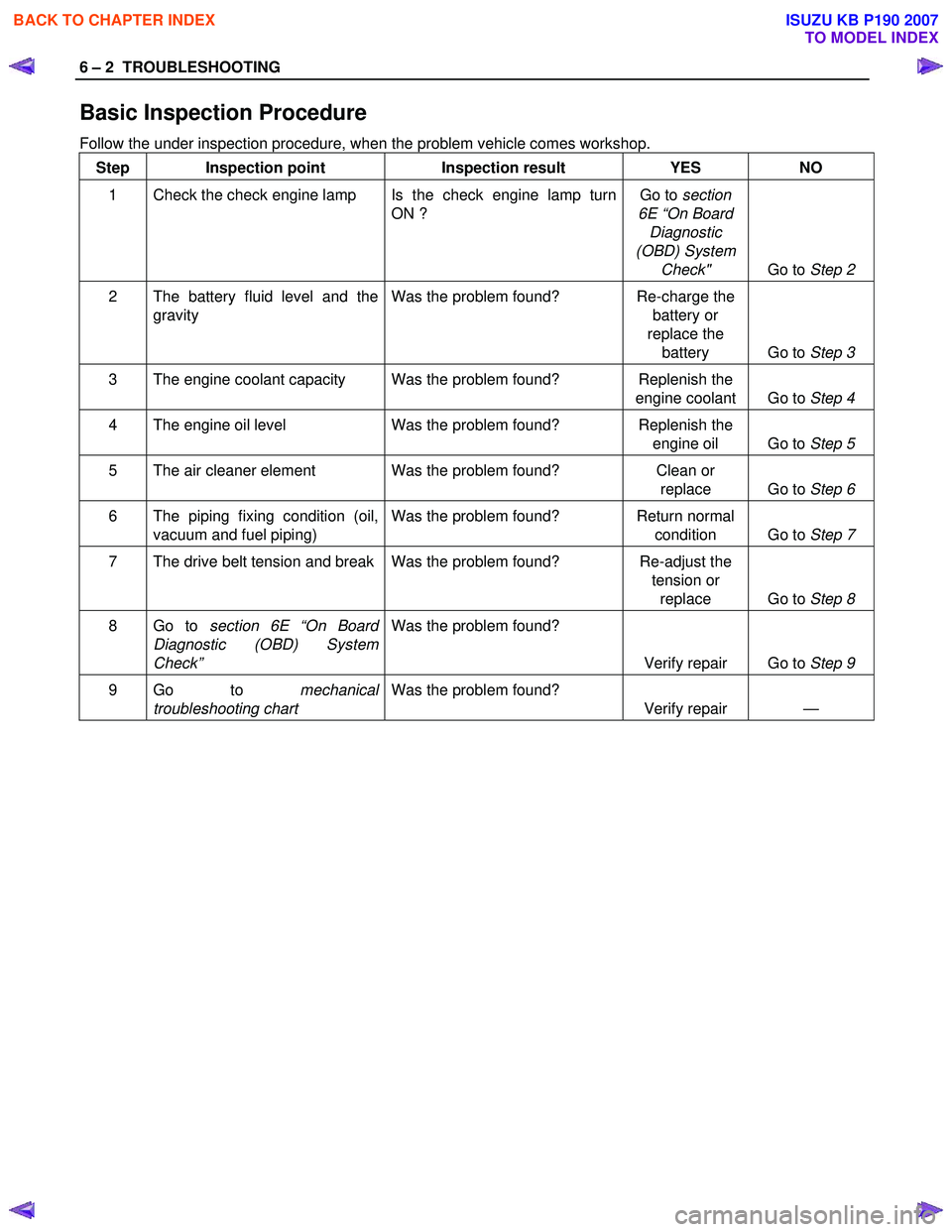
Basic Inspection Procedure
Follow the under inspection procedure, when the problem vehicle comes workshop. Step Inspection point Inspection result YES NO
1 Check the check engine lamp Is the check engine lamp turn ON ? Go to
section
6E “On Board Diagnostic
(OBD) System Check" Go to Step 2
2 The battery fluid level and the
gravity Was the problem found? Re-charge the
battery or
replace the battery Go to Step 3
3 The engine coolant capacity Was the problem found? Replenish the
engine coolant Go to Step 4
4 The engine oil level Was the problem found? Replenish the
engine oil Go to Step 5
5 The air cleaner element Was the problem found? Clean or
replace Go to Step 6
6 The piping fixing condition (oil,
vacuum and fuel piping) Was the problem found? Return normal
condition Go to Step 7
7 The drive belt tension and break Was the problem found? Re-adjust the
tension or replace Go to Step 8
8 Go to section 6E “On Board
Diagnostic (OBD) System
Check” Was the problem found?
Verify repair Go to Step 9
9 Go to mechanical
troubleshooting chart Was the problem found?
Verify repair —
BACK TO CHAPTER INDEX
TO MODEL INDEX
ISUZU KB P190 2007
Page 794 of 6020

TROUBLESHOOTING 6 – 9
6. Overheating
Step Action Value(s) Yes No
1 Was the engine coolant level OK? —
Go to Step 2 Replenish the
coolant
2 Was the water leakage or the radiator restriction found? (Include radiator cap) —
Repair or
replace the
leakage part. Go to Step 3
3 Was the fan belt slippage found? — Tension or
replace the fan belt. Go to Step 4
4 Was the fan clutch working completely? —
Go to Step 5 Replace the fan
clutch
assembly.
5 Was the oil leakage found from fan clutch? — Replace the fan
clutch
assembly Go to Step 6
6 Was the thermostat working normally? —
Go to Step 7 Replace the
thermostat.
7 Was the water pump working OK? —
Go to Step 8 Replace the
water pump assembly.
8 Was the restriction by the foreign materials in the cooling system found? For example, clog the water
hose between the cylinder body and radiator etc.. —
Clean or
replace the clog part. Go to Step 9
9 Was the water leakage found from the sealing cap
on the cylinder body? —
Replace the
sealing cap or replace the
cylinder body. Go to Step 10
10 Are any DTC stored? — Go to indicated
DTC. Solved
7. White Exhaust Smoke
Step Action Value(s) Yes No
1 Was the compression pressure OK? 3.0 MPa
(31.0 kg/cm2,
441 psi) at 200 rpm
Go to Step 2 Readjust the
valve clearance or replace the cylinder head gasket or
cylinder liner or
piston or piston ring or valve and relation parts.
2 Was the PCV (Positive Crankcase Ventilation) valve working completely? —
Go to Step 3 Repair or
replace the
PCV valve.
3 Was the turbocharger working completely? —
Go to Step 4 Replace the
turbocharger.
4 Are any DTC stored? — Go to indicated
DTC Solved
BACK TO CHAPTER INDEX
TO MODEL INDEX
ISUZU KB P190 2007
Page 799 of 6020
6 – 14 TROUBLESHOOTING
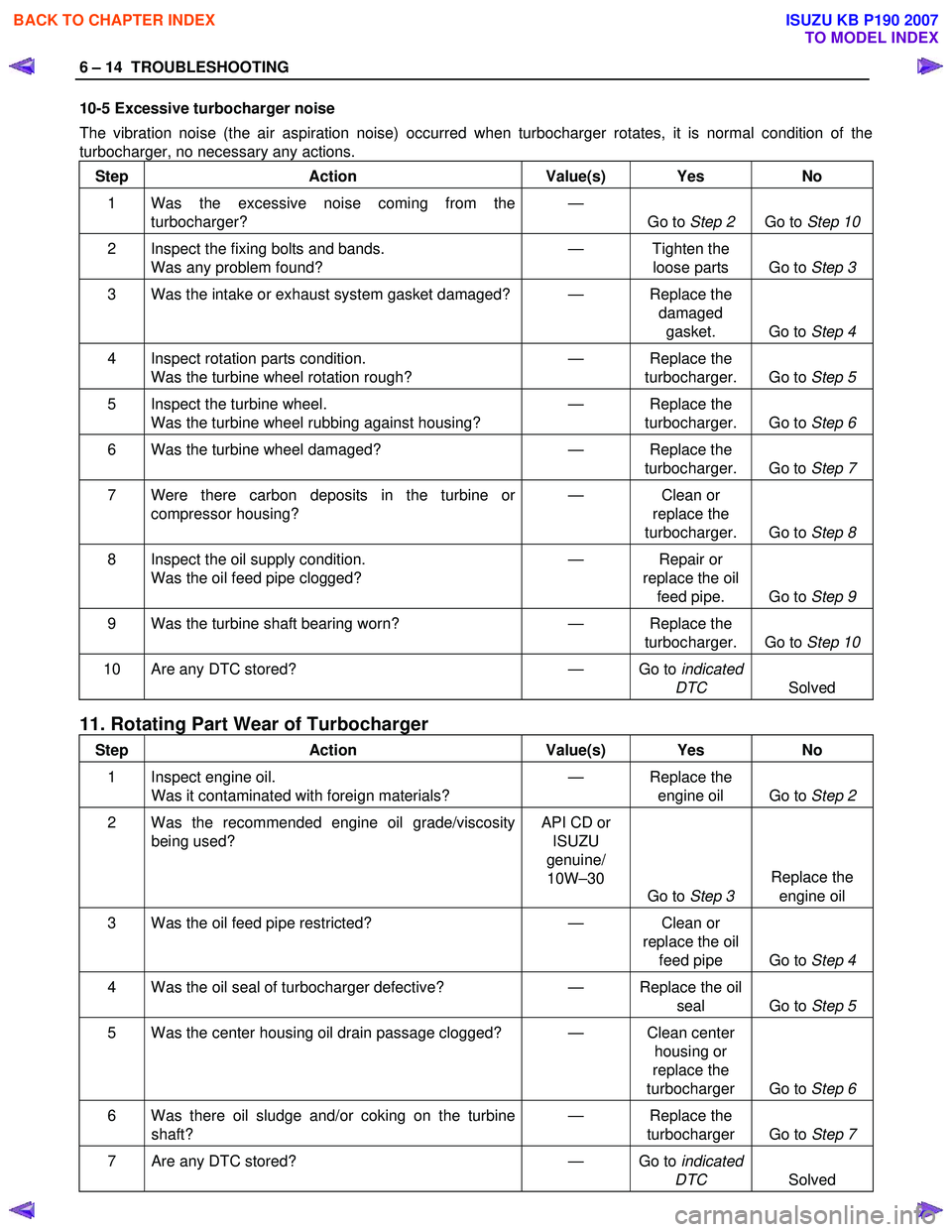
10-5 Excessive turbocharger noise
The vibration noise (the air aspiration noise) occurred when turbocharger rotates, it is normal condition of the
turbocharger, no necessary any actions.
Step Action Value(s) Yes No
1 Was the excessive noise coming from the turbocharger? —
Go to Step 2 Go to Step 10
2 Inspect the fixing bolts and bands.
Was any problem found? —
Tighten the
loose parts Go to Step 3
3 Was the intake or exhaust system gasket damaged? — Replace the
damaged gasket. Go to Step 4
4 Inspect rotation parts condition.
Was the turbine wheel rotation rough? —
Replace the
turbocharger. Go to Step 5
5 Inspect the turbine wheel.
Was the turbine wheel rubbing against housing? —
Replace the
turbocharger. Go to Step 6
6 Was the turbine wheel damaged? — Replace the
turbocharger. Go to Step 7
7 Were there carbon deposits in the turbine or
compressor housing? —
Clean or
replace the
turbocharger. Go to Step 8
8 Inspect the oil supply condition.
Was the oil feed pipe clogged? —
Repair or
replace the oil feed pipe. Go to Step 9
9 Was the turbine shaft bearing worn? — Replace the
turbocharger. Go to Step 10
10 Are any DTC stored? — Go to indicated
DTC Solved
11. Rotating Part Wear of Turbocharger
Step Action Value(s) Yes No
1 Inspect engine oil.
Was it contaminated with foreign materials? —
Replace the
engine oil Go to Step 2
2 Was the recommended engine oil grade/viscosity
being used? API CD or
ISUZU
genuine/ 10W –30
Go to Step 3 Replace the
engine oil
3 Was the oil feed pipe restricted? — Clean or
replace the oil feed pipe Go to Step 4
4 Was the oil seal of turbocharger defective? — Replace the oil
seal Go to Step 5
5 Was the center housing oil drain passage clogged? — Clean center
housing or
replace the
turbocharger Go to Step 6
6 Was there oil sludge and/or coking on the turbine
shaft? —
Replace the
turbocharger Go to Step 7
7 Are any DTC stored? — Go to indicated
DTC Solved
BACK TO CHAPTER INDEX
TO MODEL INDEX
ISUZU KB P190 2007
Page 803 of 6020
6 – 18 TROUBLESHOOTING
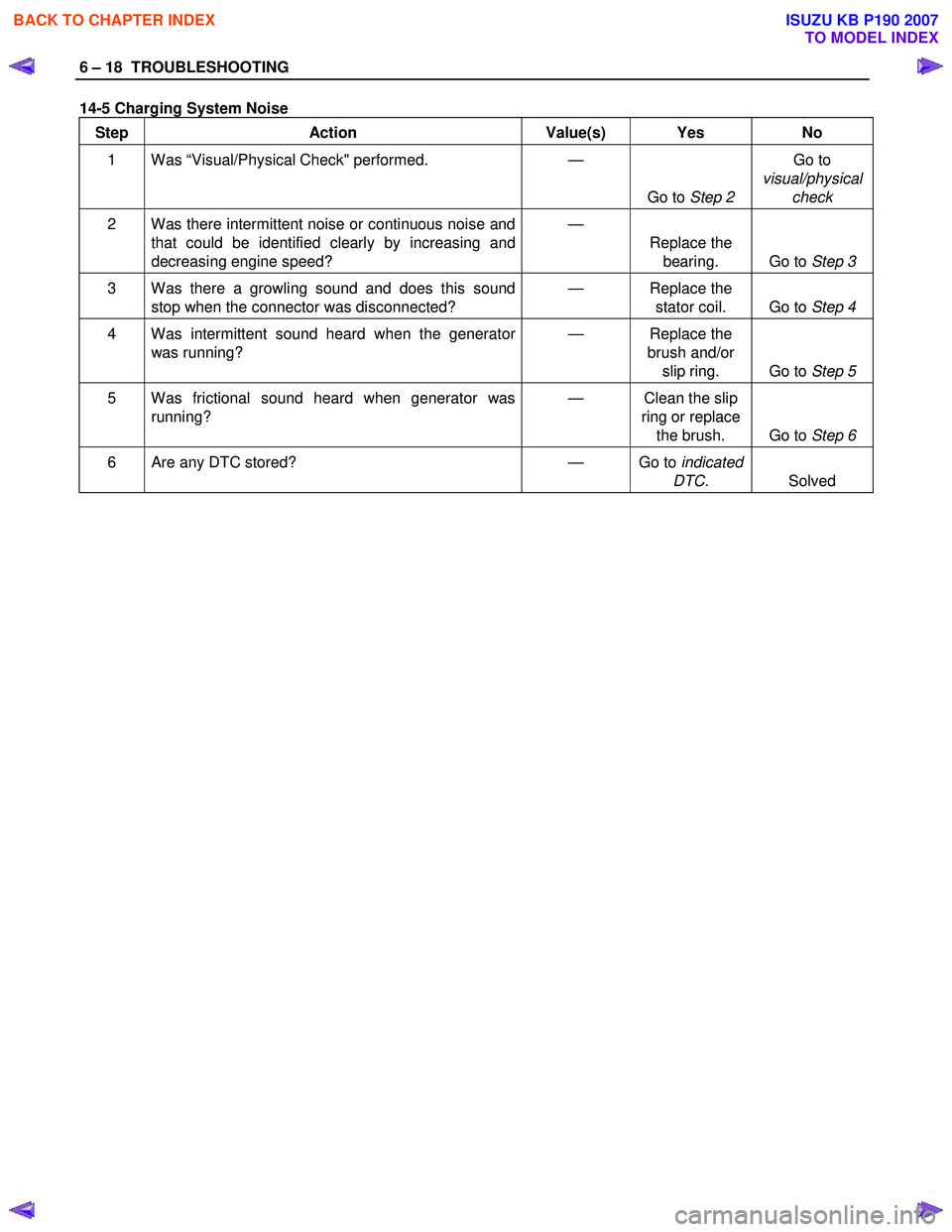
14-5 Charging System Noise Step Action Value(s) Yes No
1 Was “Visual/Physical Check" performed.
—
Go to Step 2 Go to
visual/physical check
2 Was there intermittent noise or continuous noise and
that could be identified clearly by increasing and
decreasing engine speed? —
Replace the bearing. Go to Step 3
3 Was there a growling sound and does this sound
stop when the connector was disconnected? —
Replace the
stator coil. Go to Step 4
4 Was intermittent sound heard when the generator
was running? —
Replace the
brush and/or slip ring. Go to Step 5
5 Was frictional sound heard when generator was
running? —
Clean the slip
ring or replace the brush. Go to Step 6
6 Are any DTC stored? — Go to indicated
DTC. Solved
BACK TO CHAPTER INDEX
TO MODEL INDEX
ISUZU KB P190 2007