ignition ISUZU KB P190 2007 Workshop Owner's Manual
[x] Cancel search | Manufacturer: ISUZU, Model Year: 2007, Model line: KB P190, Model: ISUZU KB P190 2007Pages: 6020, PDF Size: 70.23 MB
Page 617 of 6020
5A-24 BRAKE CONTROL SYSTEM
Computer System Service Precautions
The Anti-lock Brake System and Electronic Brake-force
Distribution interfaces directly with the Electronic
Hydraulic Control Unit (EHCU) which is a control
computer that is similar in some regards to the Engine
Control Module. These modules are designed to
withstand normal current draws associated with vehicle
operation. However, care must be taken to avoid
overloading any of the EHCU circuits. In testing for
opens or shorts, do not ground or apply voltage to any
of the circuits unless instructed to do so by the
appropriate diagnostic procedure. These circuits should
only be tested with a high impedance multimeter
5-8840-0366-0 or special tools as described in this
section. Power should never be removed or applied to
any control module with the ignition in the “ON” position.
Before removing or connecting battery cables, fuses or
connectors, always turn the ignition switch to the “OFF”
position.
General Service Precautions
The following are general precautions which should be
observed when servicing and diagnosing the Anti-lock
Brake System and/or other vehicle systems. Failure to
observe these precautions may result in Anti-lock Brake
System and Electronic Brake-force Distribution
damage.
• If welding work is to be performed on the vehicle using an electric arc welder, the EHCU and valve
block connectors should be disconnected before the
welding operation begins.
• The EHCU and valve block connectors should never be connected or disconnected with the
ignition “ON”.
Note:
• If only rear wheels are rotated using jacks or drum tester, the system will diagnose a speed sensor
malfunction and the “ABS and Brake” warning lamp
will illuminate. But actually no trouble exists. W hen
the DTC is not detected and the ABS and BRAKE
warning lamp is on, “How to erase code” is
performed and an ABS and BRAKE warning lamp
are off.
If the battery has been discharged
The engine may stall if the battery has been completely
discharged and the engine is started via jumper cables.
This is because the Anti-lock Brake System (ABS) and
Electronic Brake-force Distribution (EBD) System
requires a large quantity of electricity. In this case, wait
until the battery is recharged, or set the ABS and EBD
to a non-operative state by removing the fuse for the
ABS. After the battery has been recharged, stop the
engine and install the ABS fuse. Start the engine again,
and confirm that the ABS warning Lamp does not light.
Note on Intermittents
As with virtually any electronic system, it is difficult to
identify an intermittent failure. In such a case duplicating
the system malfunction during a test drive or a good
description of vehicle behavior from the customer may
be helpful in locating a “most likely” failed component or
circuit. The symptom diagnosis chart may also be
useful in isolating the failure. Most intermittent
problems are caused by faulty electrical connections or
wiring. W hen an intermittent failure is encountered,
check suspect circuits for:
• Suspected harness damage.
• Poor mating of connector halves or terminals not fully seated in the connector body (backed out).
• Improperly formed or damaged terminals.
Test Driving ABS Complaint Vehicles
If there has been an abnormality in the lighting pattern
of the “ABS” warning lamp, the fault can be located in
accordance with the “DIAGNOSIS BY “ABS” W ARNING
LAMP ILLUMINATION PATTERN”. Although such
problems can be detected by the driver as a vehicle
symptom, it is still necessary to perform a test drive
following the test procedure mentioned below, in order
to reproduce the symptom for problem diagnosis on a
symptom basis:
1. Start the engine and make sure that the “ABS” W /L
goes OFF. If the W /L remains ON, it means that
the Diagnostic Trouble Code (DTC) is stored.
Therefore, read the code and locate the fault.
Note: The DTC cannot be cleared if the vehicle speed
does not exceed about 10km/h (6mph) at DTC, even
though the repair operation is completed.
2. Start the vehicle and accelerate to about 30 km/h (19 mph) or more.
3. Slowly brake and stop the vehicle completely.
4. Then restart the vehicle and accelerate to about 40 km/h (25 mph) or more.
5. Brake at a time so as to actuate the ABS and stop the vehicle.
6. Be cautious of abnormality during the test. If the W /L is actuated while driving, read the DTC and
locate the fault.
7. If the abnormality is not reproduced by the test, make best efforts to reproduce the situation
reported by the customer.
8. If the abnormality has been detected, repair in accordance with the “SYMPTOM DIAGNOSIS”.
Note:
• Be sure to perform a test drive on a wide, even road
with light traffic.
• If an abnormality is detected, be sure to suspend the test and start trouble diagnosis at once.
BACK TO CHAPTER INDEX
TO MODEL INDEX
ISUZU KB P190 2007
Page 618 of 6020
BRAKE CONTROL SYSTEM 5A-25
“ABS” Warning Lamp
W hen ABS and problems occur that actuate the “ABS”
warning lamp, the code corresponding to the problem is
stored in the EHCU. Only ordinary braking is available
when the ABS is deactivated. Even when the “ABS”
warning lamp is actuated, if the starter switch is set ON
after setting it OFF once, the EHCU checks up on the
entire system. If there is no abnormality, the EHCU
judges ABS to work correctly and the warning lamp is lit
normally, even though the problem code is stored.
NOTE: Illumination of the “ABS” warning lamp indicates
that anti-lock braking is no longer available. Power
assisted braking without anti-lock control is still
available.
Normal Operation
“ABS ” Warning Lamp
W hen the ignition is first moved from “OFF” to “RUN”,
the amber “ABS” warning lamp will turn “ON”. The
“ABS” warning lamp will turn “ON” during engine
starting and will usually stay “ON” for approximately
three seconds after the ignition switch is returned to the
“ON” position. The warning lamp should remain “OFF”
at all other times.
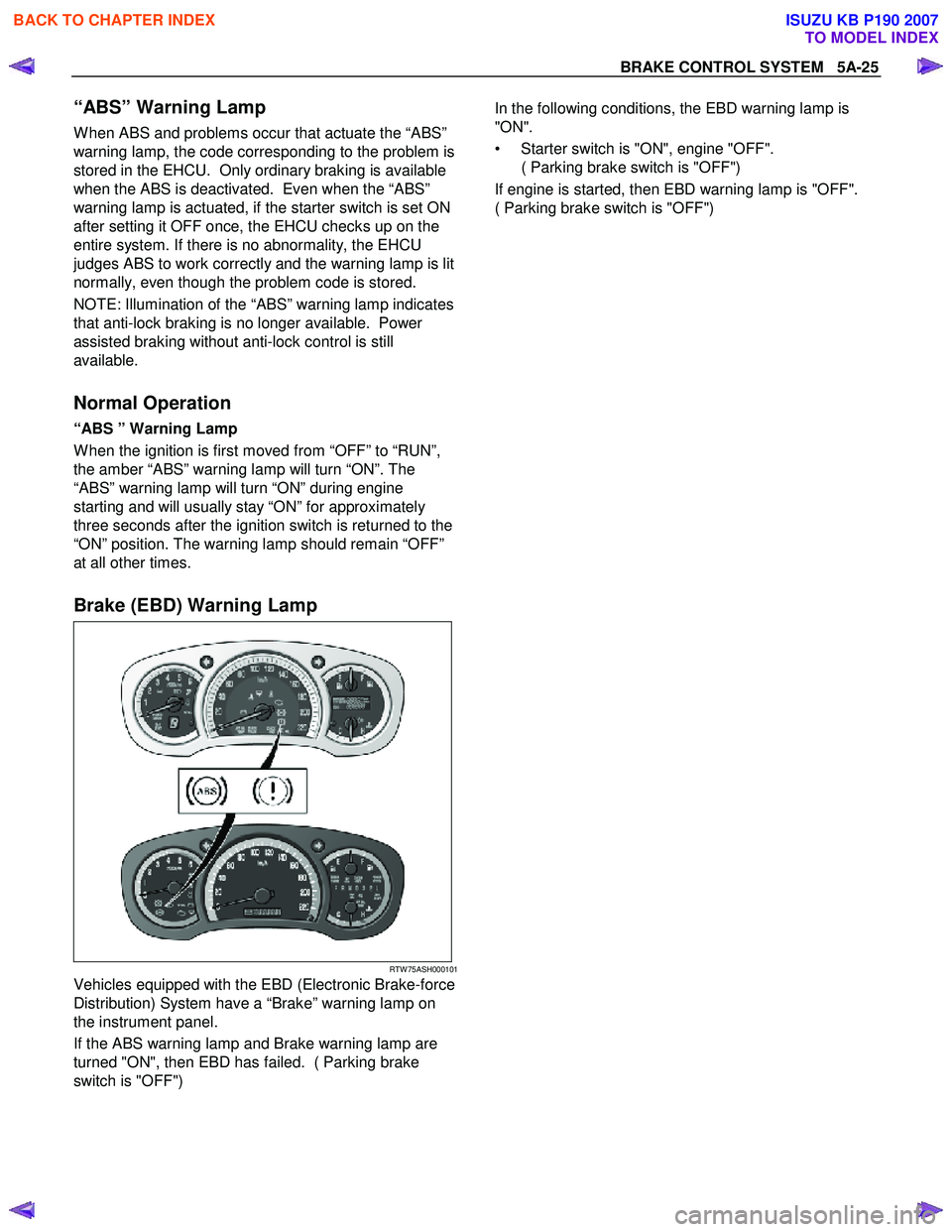
Brake (EBD) Warning Lamp
RTW 75ASH000101
Vehicles equipped with the EBD (Electronic Brake-force
Distribution) System have a “Brake” warning lamp on
the instrument panel.
If the ABS warning lamp and Brake warning lamp are
turned "ON", then EBD has failed. ( Parking brake
switch is "OFF")
In the following conditions, the EBD warning lamp is
"ON".
• Starter switch is "ON", engine "OFF". ( Parking brake switch is "OFF")
If engine is started, then EBD warning lamp is "OFF".
( Parking brake switch is "OFF")
BACK TO CHAPTER INDEX
TO MODEL INDEX
ISUZU KB P190 2007
Page 622 of 6020
BRAKE CONTROL SYSTEM 5A-29
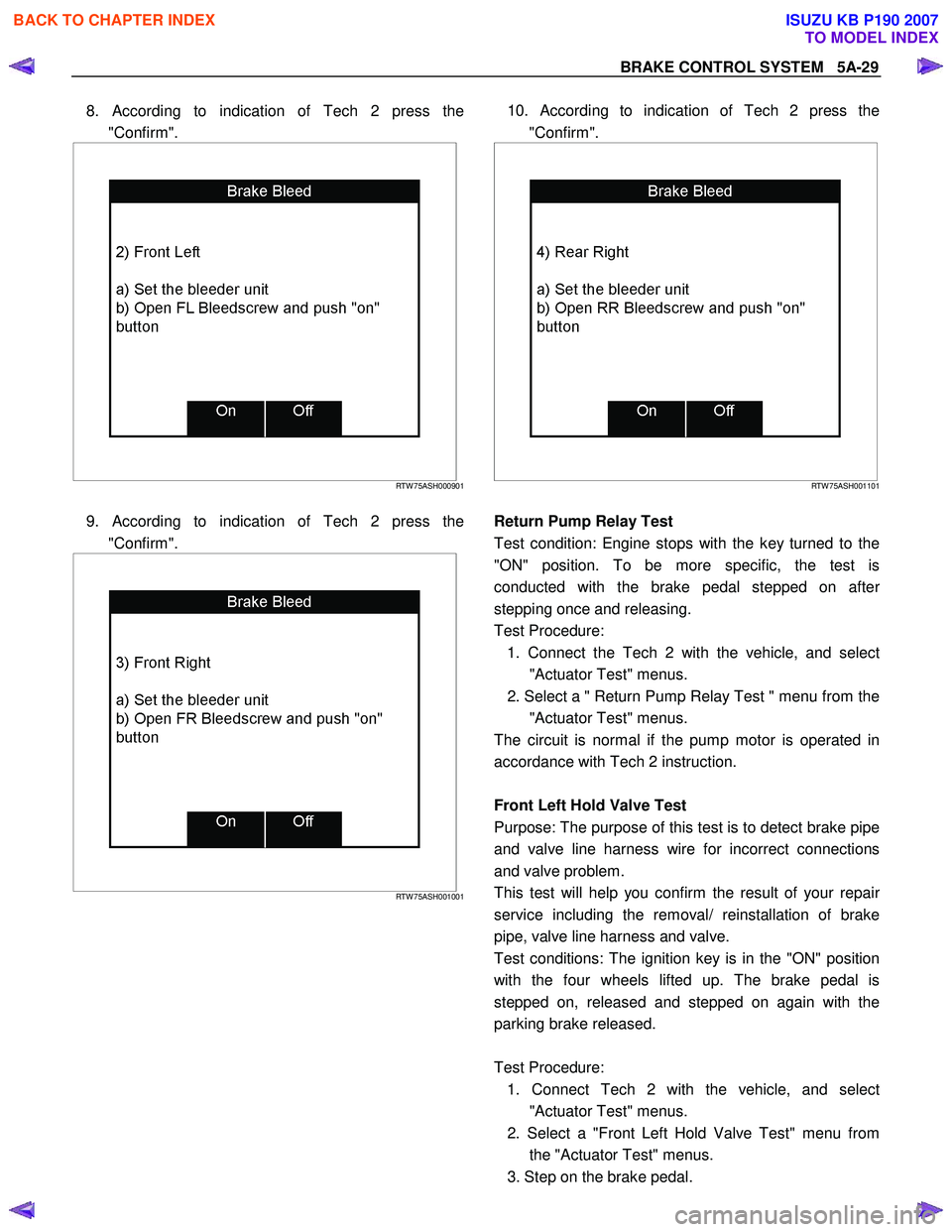
8. According to indication of Tech 2 press the
"Confirm".
RTW 75ASH000901
9. According to indication of Tech 2 press the
"Confirm".
RTW 75ASH001001
10. According to indication of Tech 2 press the
"Confirm".
RTW 75ASH001101
Return Pump Relay Test
Test condition: Engine stops with the key turned to the
"ON" position. To be more specific, the test is
conducted with the brake pedal stepped on afte
r
stepping once and releasing.
Test Procedure: 1. Connect the Tech 2 with the vehicle, and selec
t
"Actuator Test" menus.
2. Select a " Return Pump Relay Test " menu from the "Actuator Test" menus.
The circuit is normal if the pump motor is operated in
accordance with Tech 2 instruction.
Front Left Hold Valve Test
Purpose: The purpose of this test is to detect brake pipe
and valve line harness wire for incorrect connections
and valve problem.
This test will help you confirm the result of your repai
r
service including the removal/ reinstallation of brake
pipe, valve line harness and valve.
Test conditions: The ignition key is in the "ON" position
with the four wheels lifted up. The brake pedal is
stepped on, released and stepped on again with the
parking brake released.
Test Procedure: 1. Connect Tech 2 with the vehicle, and selec
t
"Actuator Test" menus.
2. Select a "Front Left Hold Valve Test" menu from the "Actuator Test" menus.
3. Step on the brake pedal.
BACK TO CHAPTER INDEX
TO MODEL INDEX
ISUZU KB P190 2007
Page 623 of 6020
5A-30 BRAKE CONTROL SYSTEM
4. Release the brake pedal.
5. Make sure that the front left hold solenoid valve "ON" aimed at by Tech 2 and the wheel locked
position are the same.
If different, check brake pipe, valve line harness wiring
and hydraulic unit. Repair is needed if abnormality is
found.
Front Left Release Valve Test
Purpose: The purpose of this test is to detect brake pipe
and valve line harness wire for incorrect connections and
valve problem.
This test will help you confirm the result of your repai
r
service including the removal/ reinstallation of brake
pipe, valve line harness and valve.
Test conditions: The ignition key is in the "ON" position
with the four wheels lifted up. The brake pedal is stepped
on, released and stepped on again with the parking
brake released.
Test Procedure: 1. Connect Tech 2 with the vehicle, and select "Actuator Test" menus.
2. Select a "Front Left Release Valve Test" menu from the "Actuator Test" menus.
3. Step on the brake pedal.
4. Make sure that the front left release solenoid valve "ON" aimed at by Tech 2 and the wheel released
position are the same.
If different, check brake pipe, valve line harness wiring
and hydraulic unit. Repair is needed if abnormality is
found.
Front Right Hold Valve Test
Purpose: The purpose of this test is to detect brake pipe
and valve line harness wire for incorrect connections and
valve problem.
This test will help you confirm the result of your repai
r
service including the removal/ reinstallation of brake
pipe, valve line harness and valve.
Test conditions: The ignition key is in the "ON" position
with the four wheels lifted up. The brake pedal is stepped
on, released and stepped on again with the parking
brake released.
Test Procedure: 1. Connect Tech 2 with the vehicle, and select "Actuator Test" menus.
2. Select a "Front Right Hold Valve Test" menu from the "Actuator Test" menus.
3. Step on the brake pedal.
4. Release the brake pedal.
5. Make sure that the front right hold solenoid valve "ON" aimed at by Tech 2 and the wheel locked
position are the same.
If different, check brake pipe, valve line harness wiring
and hydraulic unit. Repair is needed if abnormality is
found.
Front Right Release Valve Test
Purpose: The purpose of this test is to detect brake pipe
and valve line harness wire for incorrect connections
and valve problem.
This test will help you confirm the result of your repai
r
service including the removal/ reinstallation of brake
pipe, valve line harness and valve.
Test conditions: The ignition key is in the "ON" position
with the four wheels lifted up. The brake pedal is
stepped on, released and stepped on again with the
parking brake released.
Test Procedure: 1. Connect Tech 2 with the vehicle, and selec
t
"Actuator Test" menus.
2. Select a "Front Right Release Valve Test" menu from the "Actuator Test" menus.
3. Step on the brake pedal.
4. Make sure that the front right release solenoid valve "ON" aimed at by Tech 2 and the wheel released
position are the same.
If different, check brake pipe, valve line harness wiring
and hydraulic unit. Repair is needed if abnormality is
found.
Rear Hold Valve Test
Purpose: The purpose of this test is to detect brake pipe
and valve line harness wire for incorrect connections
and valve problem.
This test will help you confirm the result of your repai
r
service including the removal/ reinstallation of brake
pipe, valve line harness and valve.
Test conditions: The ignition key is in the "ON" position
with the four wheels lifted up. The brake pedal is
stepped on, released and stepped on again with the
parking brake released.
Test Procedure: 1. Connect Tech 2 with the vehicle, and selec
t
"Actuator Test" menus.
BACK TO CHAPTER INDEX
TO MODEL INDEX
ISUZU KB P190 2007
Page 624 of 6020
BRAKE CONTROL SYSTEM 5A-31
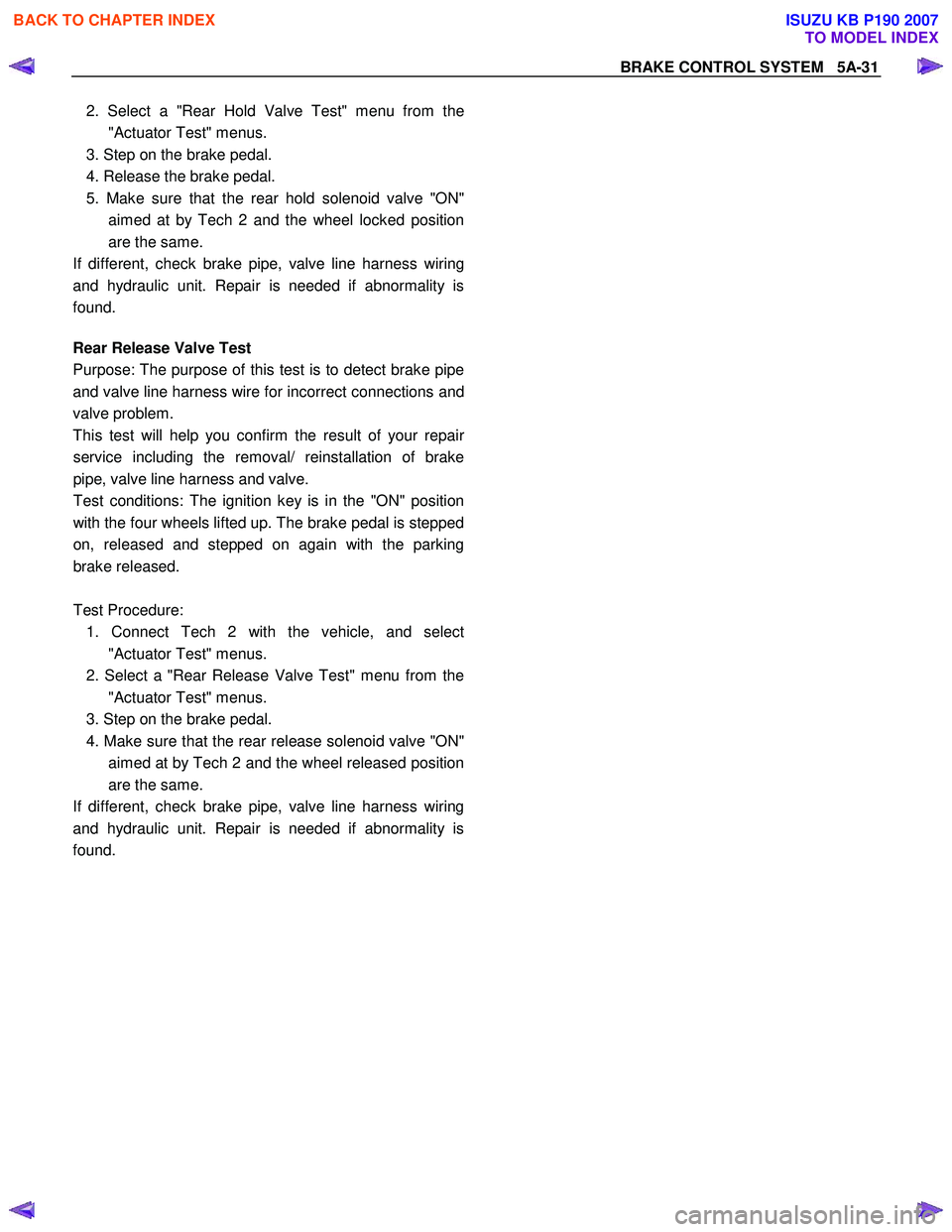
2. Select a "Rear Hold Valve Test" menu from the
"Actuator Test" menus.
3. Step on the brake pedal.
4. Release the brake pedal.
5. Make sure that the rear hold solenoid valve "ON" aimed at by Tech 2 and the wheel locked position
are the same.
If different, check brake pipe, valve line harness wiring
and hydraulic unit. Repair is needed if abnormality is
found.
Rear Release Valve Test
Purpose: The purpose of this test is to detect brake pipe
and valve line harness wire for incorrect connections and
valve problem.
This test will help you confirm the result of your repai
r
service including the removal/ reinstallation of brake
pipe, valve line harness and valve.
Test conditions: The ignition key is in the "ON" position
with the four wheels lifted up. The brake pedal is stepped
on, released and stepped on again with the parking
brake released.
Test Procedure: 1. Connect Tech 2 with the vehicle, and select "Actuator Test" menus.
2. Select a "Rear Release Valve Test" menu from the "Actuator Test" menus.
3. Step on the brake pedal.
4. Make sure that the rear release solenoid valve "ON" aimed at by Tech 2 and the wheel released position
are the same.
If different, check brake pipe, valve line harness wiring
and hydraulic unit. Repair is needed if abnormality is
found.
BACK TO CHAPTER INDEX
TO MODEL INDEX
ISUZU KB P190 2007
Page 627 of 6020

5A-34 BRAKE CONTROL SYSTEM
Warning Lamp System Control Main Items DTC
(Flash Code) Description
ABS Brake
(EBD) ABS EBD
× × Battery, W iring or EHCU
(less than 8V) C0277 (77) System Voltage Low
× × Battery or W iring
(less than 10V)
C0278 (78) System Voltage High
× × Battery or W iring EHCU
C0282
(82) 4 W heel Drive State Input Signal
Failure × × W iring
C0285
(85) Control Module Vehicle Options
Incorrect × × Vehicle (Sensor or EHCU)
*A : W hen three or more failures are detected, the EBD warning lamp is "ON" and control is canceled.
*B : The ABS lamp is “OFF” when the ABS lamp is “ON” after a repair, until the vehicle’s speed becomes
more than 10km/h (6mph) in the following ignition
cycle and failure is not detected.
BACK TO CHAPTER INDEX
TO MODEL INDEX
ISUZU KB P190 2007
Page 631 of 6020
5A-38 BRAKE CONTROL SYSTEM
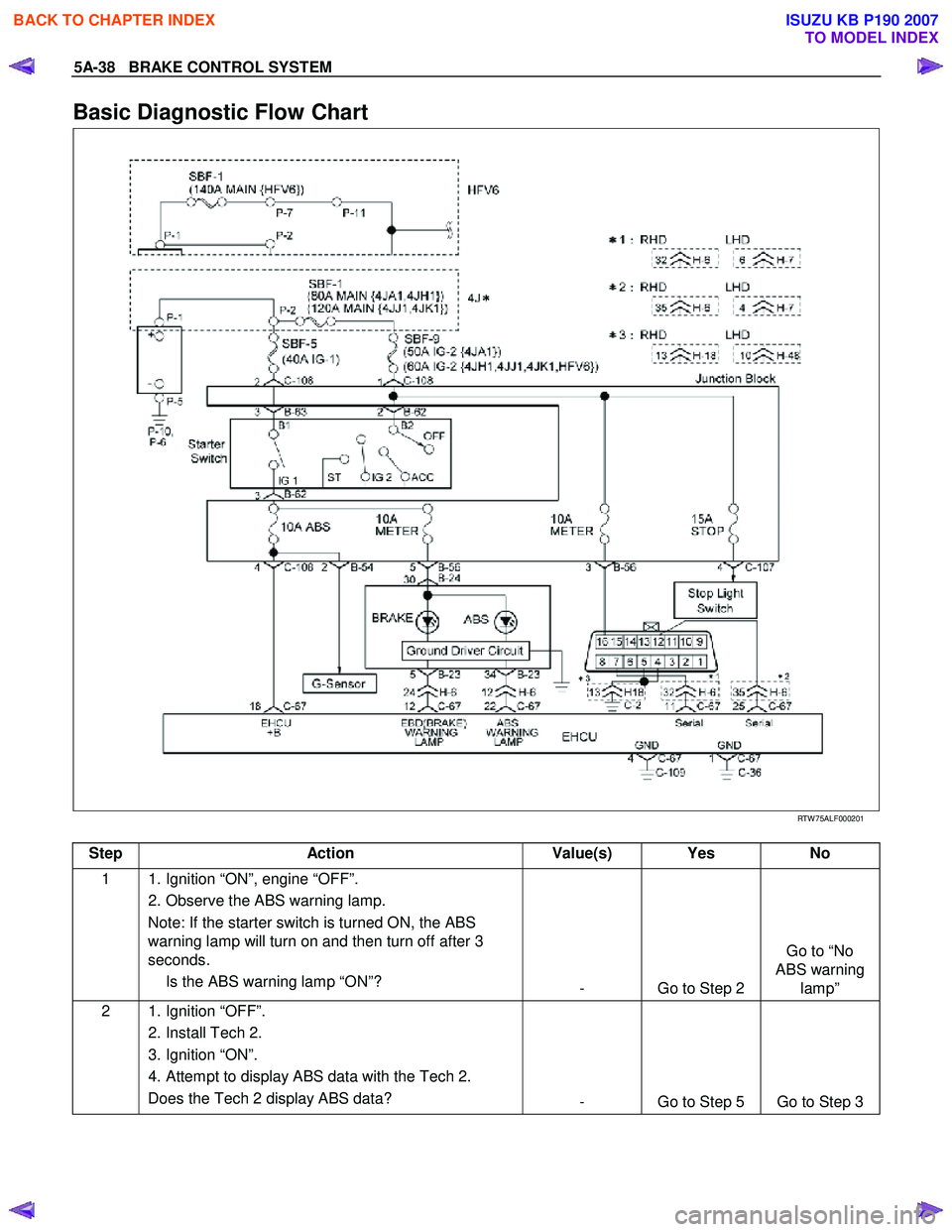
Basic Diagnostic Flow Chart
RTW 75ALF000201
Step Action Value(s) Yes No
1 1. Ignition “ON”, engine “OFF”.
2. Observe the ABS warning lamp. Note: If the starter switch is turned ON, the ABS
warning lamp will turn on and then turn off after 3
seconds.
Is the ABS warning lamp “ON”? - Go to Step 2 Go to “No
ABS warning lamp”
2 1. Ignition “OFF”.
2. Install Tech 2.
3. Ignition “ON”.
4. Attempt to display ABS data with the Tech 2. Does the Tech 2 display ABS data? - Go to Step 5 Go to Step 3
BACK TO CHAPTER INDEX
TO MODEL INDEX
ISUZU KB P190 2007
Page 632 of 6020
BRAKE CONTROL SYSTEM 5A-39
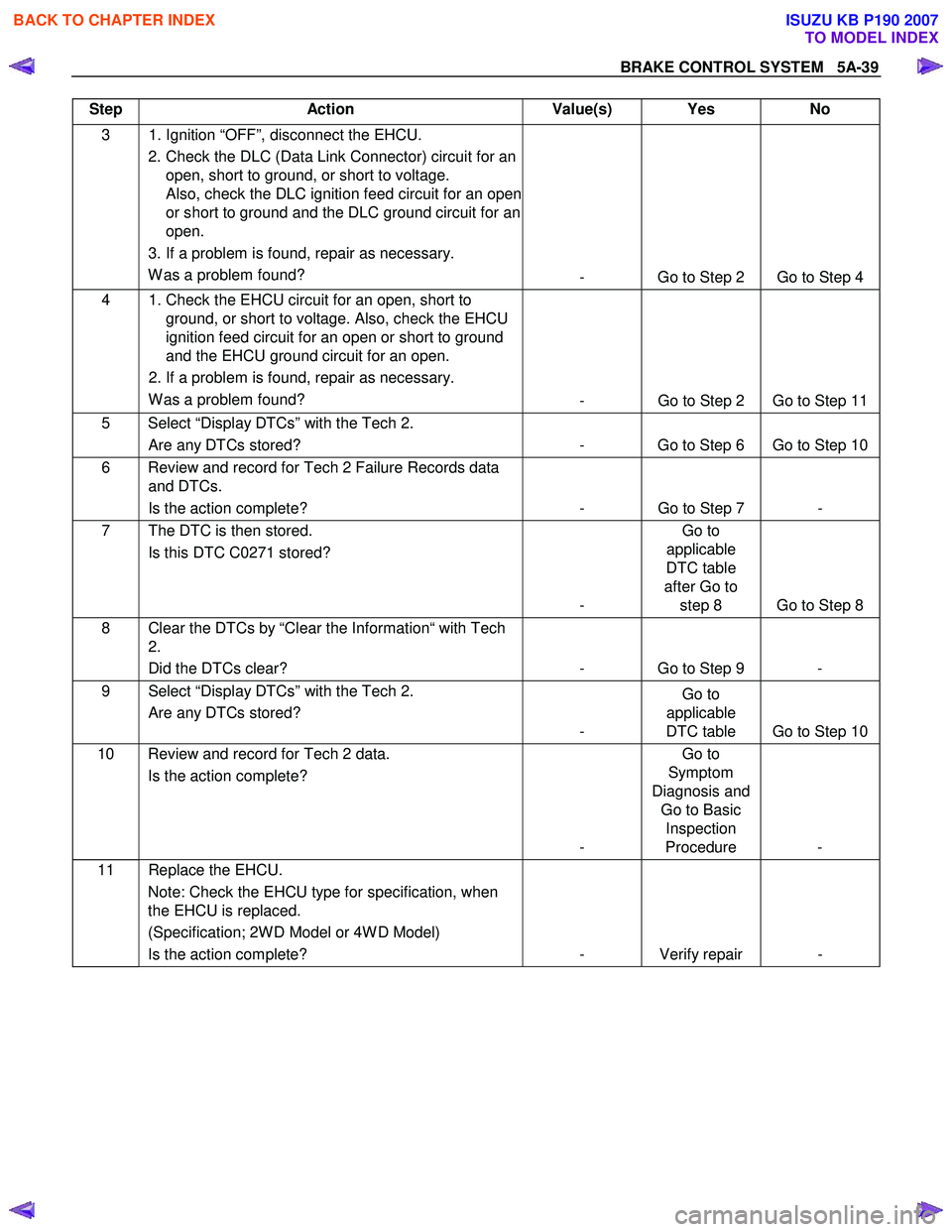
Step Action Value(s) Yes No
3 1. Ignition “OFF”, disconnect the EHCU.
2. Check the DLC (Data Link Connector) circuit for an open, short to ground, or short to voltage.
Also, check the DLC ignition feed circuit for an open
or short to ground and the DLC ground circuit for an
open.
3. If a problem is found, repair as necessary. W as a problem found? - Go to Step 2 Go to Step 4
4 1. Check the EHCU circuit for an open, short to
ground, or short to voltage. Also, check the EHCU
ignition feed circuit for an open or short to ground
and the EHCU ground circuit for an open.
2. If a problem is found, repair as necessary. W as a problem found? - Go to Step 2 Go to Step 11
5 Select “Display DTCs” with the Tech 2.
Are any DTCs stored? - Go to Step 6 Go to Step 10
6 Review and record for Tech 2 Failure Records data
and DTCs.
Is the action complete? - Go to Step 7 -
7 The DTC is then stored. Is this DTC C0271 stored?
- Go to
applicable
DTC table
after Go to step 8 Go to Step 8
8 Clear the DTCs by “Clear the Information“ with Tech 2.
Did the DTCs clear? - Go to Step 9 -
9 Select “Display DTCs” with the Tech 2. Are any DTCs stored? - Go to
applicable
DTC table Go to Step 10
10 Review and record for Tech 2 data.
Is the action complete?
- Go to
Symptom
Diagnosis and Go to Basic Inspection
Procedure -
11 Replace the EHCU.
Note: Check the EHCU type for specification, when
the EHCU is replaced.
(Specification; 2W D Model or 4W D Model)
Is the action complete? - Verify repair -
BACK TO CHAPTER INDEX
TO MODEL INDEX
ISUZU KB P190 2007
Page 634 of 6020

BRAKE CONTROL SYSTEM 5A-41
Wheel Speed Sensor Inspection Procedure
Procedure
1.Ignition "OFF".
2.Disconnect each of the wheel speed sensors.
3.Connect the resistance (50 Ω~100 Ω) as follows.
4.Check the voltage at sensor harness connector.
Note: Voltage measurement is performed in the phase
where the wheel speed sensor is installed in vehicles.
RTW 75AMF000701
Connector Pin-outs
・Front W heel Speed Sensor
1 (+) (+12V)
2 (-) (signal)
・Rear W heel Speed Sensor
1 LH (+) (+12V)
2 LH (-) (signal)
3 RH (+)(+12V)
4 RH (-) (signal)
Output Value
High State 0.7~1.4V (±30%)
Low State 0.4~0.7V (±30%)
BACK TO CHAPTER INDEX
TO MODEL INDEX
ISUZU KB P190 2007
Page 637 of 6020

5A-44 BRAKE CONTROL SYSTEM
Brake Pedal Feed Is Abnormal
Step Action Value(s) Yes No
1 Is the stop light actuated when the brake pedal is
depressed? - Go to Step 2 Go to Step 3
2 1. Turn the ignition switch off.
2. Disconnect EHCU connector. Is the check voltage for EHCU connector terminals
when brake pedal is depressed than battery voltage? - Go to Step 4 Harness NG
between stop light SW and EHCU.
Go to Step 6
3 Is stop light fuse normal?
- Go to Step 5 Replace stop
light fuse.
Go to Step 6
4 Is the check continuity between EHCU connector to body grounded?
- Go to Step 6 Repair body
grounded harness.
Go to Step 6
5 Is stop light switch operation normal?
- Repair stop
light harness.
Go to Step 6 Replace stop
light switch.
Go to Step 6
6 Reconnect all components, ensure all components are properly mounted.
Is this step finished? - Repeat the
“Basic
diagnostic
flow chart” Go to Step 6
BACK TO CHAPTER INDEX
TO MODEL INDEX
ISUZU KB P190 2007