front brake JAGUAR XFR 2010 1.G Owner's Guide
[x] Cancel search | Manufacturer: JAGUAR, Model Year: 2010, Model line: XFR, Model: JAGUAR XFR 2010 1.GPages: 3039, PDF Size: 58.49 MB
Page 587 of 3039
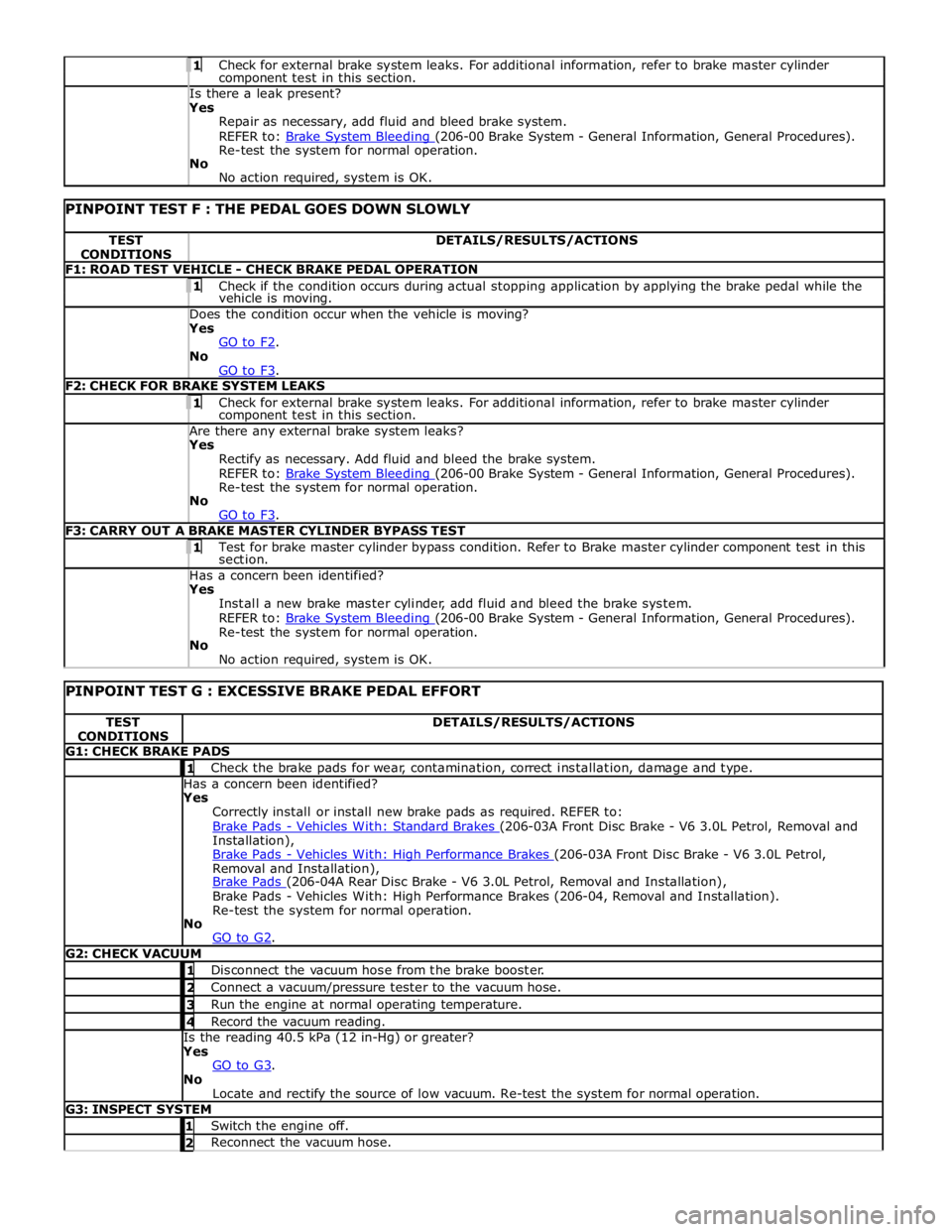
Check for external brake system leaks. For additional information, refer to brake master cylinder component test in this section. Is there a leak present? Yes
Repair as necessary, add fluid and bleed brake system.
REFER to: Brake System Bleeding (206-00 Brake System - General Information, General Procedures). Re-test the system for normal operation.
No
No action required, system is OK.
PINPOINT TEST F : THE PEDAL GOES DOWN SLOWLY TEST
CONDITIONS DETAILS/RESULTS/ACTIONS F1: ROAD TEST VEHICLE - CHECK BRAKE PEDAL OPERATION 1 Check if the condition occurs during actual stopping application by applying the brake pedal while the vehicle is moving. Does the condition occur when the vehicle is moving? Yes
GO to F2. No
GO to F3. F2: CHECK FOR BRAKE SYSTEM LEAKS 1 Check for external brake system leaks. For additional information, refer to brake master cylinder component test in this section. Are there any external brake system leaks? Yes
Rectify as necessary. Add fluid and bleed the brake system.
REFER to: Brake System Bleeding (206-00 Brake System - General Information, General Procedures). Re-test the system for normal operation.
No
GO to F3. F3: CARRY OUT A BRAKE MASTER CYLINDER BYPASS TEST 1 Test for brake master cylinder bypass condition. Refer to Brake master cylinder component test in this section. Has a concern been identified? Yes
Install a new brake master cylinder, add fluid and bleed the brake system.
REFER to: Brake System Bleeding (206-00 Brake System - General Information, General Procedures). Re-test the system for normal operation.
No
No action required, system is OK.
PINPOINT TEST G : EXCESSIVE BRAKE PEDAL EFFORT TEST
CONDITIONS DETAILS/RESULTS/ACTIONS G1: CHECK BRAKE PADS 1 Check the brake pads for wear, contamination, correct installation, damage and type. Has a concern been identified?
Yes
Correctly install or install new brake pads as required. REFER to:
Brake Pads - Vehicles With: Standard Brakes (206-03A Front Disc Brake - V6 3.0L Petrol, Removal and Installation),
Brake Pads - Vehicles With: High Performance Brakes (206-03A Front Disc Brake - V6 3.0L Petrol, Removal and Installation),
Brake Pads (206-04A Rear Disc Brake - V6 3.0L Petrol, Removal and Installation), Brake Pads - Vehicles With: High Performance Brakes (206-04, Removal and Installation).
Re-test the system for normal operation.
No
GO to G2. G2: CHECK VACUUM 1 Disconnect the vacuum hose from the brake booster. 2 Connect a vacuum/pressure tester to the vacuum hose. 3 Run the engine at normal operating temperature. 4 Record the vacuum reading. Is the reading 40.5 kPa (12 in-Hg) or greater?
Yes
GO to G3. No
Locate and rectify the source of low vacuum. Re-test the system for normal operation. G3: INSPECT SYSTEM 1 Switch the engine off. 2 Reconnect the vacuum hose.
Page 588 of 3039

Inspect the brake booster, rubber grommet, and all vacuum plumbing for cracks, holes, damaged connections, or missing clamps. 4 Pump the brake pedal several times to exhaust the vacuum. Push down on the brake pedal and hold. Does the brake pedal move down when the engine is started?
Yes
Vacuum system is OK.
No
GO to G4. G4: CHECK POWER BRAKE BOOSTER VALVE 1 Check the brake booster valve. For additional information, refer to Brake Booster component test in this section. Is the power brake booster valve OK?
Yes
Check the brake booster. For additional information, refer to Brake Booster component test in this
section. Install a new brake booster as required. REFER to:
Brake Booster (206-07 Power Brake Actuation, Removal and Installation), Brake Booster - RHD (206-07, Removal and Installation).
Re-test the system for normal operation.
No
Install a new brake booster valve. Re-test the system for normal operation.
PINPOINT TEST H : BRAKE LOCKUP DURING LIGHT BRAKE PEDAL FORCE TEST
CONDITIONS DETAILS/RESULTS/ACTIONS H1: TEST BRAKE LOCKUP 1 Road test the vehicle and apply the brake pedal lightly. Do the brakes lockup?
Yes
GO to H2. No
No action required, vehicle is OK. H2: INSPECT BRAKE PADS 1 Inspect brake pads for contamination, correct installation, damage and type. Has a concern been identified?
Yes
Correctly install or install new brake pads as required. REFER to:
Brake Pads - Vehicles With: Standard Brakes (206-03A Front Disc Brake - V6 3.0L Petrol, Removal and Installation),
Brake Pads - Vehicles With: High Performance Brakes (206-03A Front Disc Brake - V6 3.0L Petrol, Removal and Installation),
Brake Pads (206-04A Rear Disc Brake - V6 3.0L Petrol, Removal and Installation), Brake Pads - Vehicles With: High Performance Brakes (206-04, Removal and Installation).
Re-test the system for normal operation.
No
GO to H3. H3: INSPECT BRAKE CALIPERS 1 Inspect brake calipers for binding, leaking or sticking. Has a concern been identified?
Yes
Correctly install or install new brake calipers as required. REFER to:
Brake Caliper - Vehicles With: Standard Brakes (206-03A Front Disc Brake - V6 3.0L Petrol, Removal and Installation),
Brake Caliper - Vehicles With: High Performance Brakes (206-03A Front Disc Brake - V6 3.0L Petrol, Removal and Installation),
Brake Caliper (206-04A Rear Disc Brake - V6 3.0L Petrol, Removal and Installation), Brake Caliper - Vehicles With: High Performance Brakes (206-04, Removal and Installation).
Re-test the system for normal operation.
No
No action required, vehicle is OK.
PINPOINT TEST I : BRAKES DRAG TEST
CONDITIONS DETAILS/RESULTS/ACTIONS I1: ROAD TEST VEHICLE 1 Road test the vehicle and apply the brakes. Are the brakes functioning correctly? Yes
No action required, vehicle is OK.
No
GO to I2. I2: CHECK BRAKE CALIPERS 1 Check the front and rear calipers pistons and pins for binding, leaking or sticking.
Page 589 of 3039
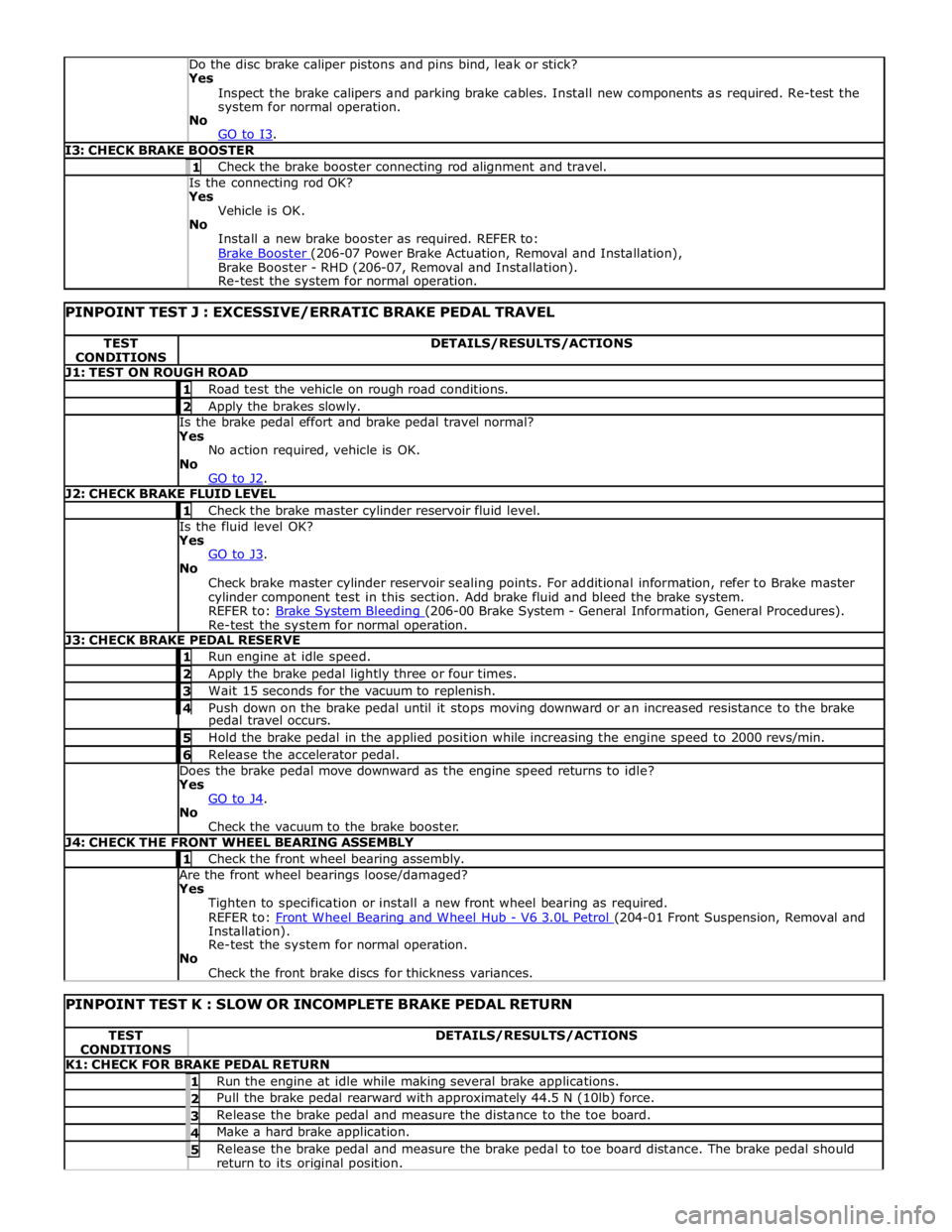
Yes
Inspect the brake calipers and parking brake cables. Install new components as required. Re-test the
system for normal operation.
No
GO to I3. I3: CHECK BRAKE BOOSTER 1 Check the brake booster connecting rod alignment and travel. Is the connecting rod OK? Yes
Vehicle is OK.
No
Install a new brake booster as required. REFER to:
Brake Booster (206-07 Power Brake Actuation, Removal and Installation), Brake Booster - RHD (206-07, Removal and Installation).
Re-test the system for normal operation.
PINPOINT TEST J : EXCESSIVE/ERRATIC BRAKE PEDAL TRAVEL TEST
CONDITIONS DETAILS/RESULTS/ACTIONS J1: TEST ON ROUGH ROAD 1 Road test the vehicle on rough road conditions. 2 Apply the brakes slowly. Is the brake pedal effort and brake pedal travel normal?
Yes
No action required, vehicle is OK.
No
GO to J2. J2: CHECK BRAKE FLUID LEVEL 1 Check the brake master cylinder reservoir fluid level. Is the fluid level OK?
Yes
GO to J3. No
Check brake master cylinder reservoir sealing points. For additional information, refer to Brake master
cylinder component test in this section. Add brake fluid and bleed the brake system.
REFER to: Brake System Bleeding (206-00 Brake System - General Information, General Procedures). Re-test the system for normal operation. J3: CHECK BRAKE PEDAL RESERVE 1 Run engine at idle speed. 2 Apply the brake pedal lightly three or four times. 3 Wait 15 seconds for the vacuum to replenish. 4 Push down on the brake pedal until it stops moving downward or an increased resistance to the brake pedal travel occurs. 5 Hold the brake pedal in the applied position while increasing the engine speed to 2000 revs/min. 6 Release the accelerator pedal. Does the brake pedal move downward as the engine speed returns to idle?
Yes
GO to J4. No
Check the vacuum to the brake booster. J4: CHECK THE FRONT WHEEL BEARING ASSEMBLY 1 Check the front wheel bearing assembly. Are the front wheel bearings loose/damaged?
Yes
Tighten to specification or install a new front wheel bearing as required.
REFER to: Front Wheel Bearing and Wheel Hub - V6 3.0L Petrol (204-01 Front Suspension, Removal and Installation).
Re-test the system for normal operation.
No
Check the front brake discs for thickness variances.
PINPOINT TEST K : SLOW OR INCOMPLETE BRAKE PEDAL RETURN TEST
CONDITIONS DETAILS/RESULTS/ACTIONS K1: CHECK FOR BRAKE PEDAL RETURN 1 Run the engine at idle while making several brake applications. 2 Pull the brake pedal rearward with approximately 44.5 N (10lb) force. 3 Release the brake pedal and measure the distance to the toe board. 4 Make a hard brake application. 5 Release the brake pedal and measure the brake pedal to toe board distance. The brake pedal should return to its original position.
Page 592 of 3039
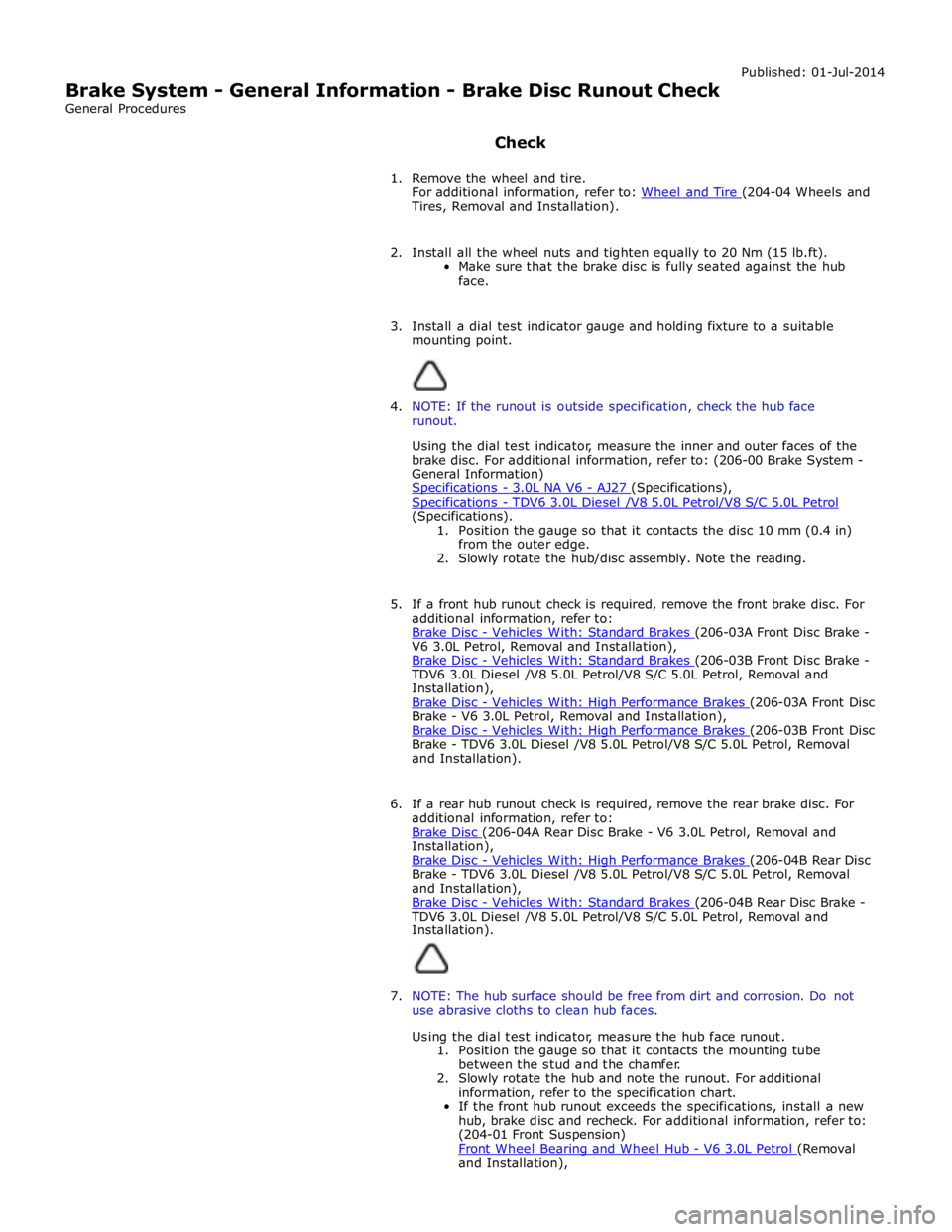
Brake System - General Information - Brake Disc Runout Check
General Procedures
Check Published: 01-Jul-2014
1. Remove the wheel and tire.
For additional information, refer to: Wheel and Tire (204-04 Wheels and Tires, Removal and Installation).
2. Install all the wheel nuts and tighten equally to 20 Nm (15 lb.ft).
Make sure that the brake disc is fully seated against the hub
face.
3. Install a dial test indicator gauge and holding fixture to a suitable
mounting point.
4. NOTE: If the runout is outside specification, check the hub face
runout.
Using the dial test indicator, measure the inner and outer faces of the
brake disc. For additional information, refer to: (206-00 Brake System -
General Information)
Specifications - 3.0L NA V6 - AJ27 (Specifications), Specifications - TDV6 3.0L Diesel /V8 5.0L Petrol/V8 S/C 5.0L Petrol (Specifications).
1. Position the gauge so that it contacts the disc 10 mm (0.4 in)
from the outer edge.
2. Slowly rotate the hub/disc assembly. Note the reading.
5. If a front hub runout check is required, remove the front brake disc. For
additional information, refer to:
Brake Disc - Vehicles With: Standard Brakes (206-03A Front Disc Brake - V6 3.0L Petrol, Removal and Installation),
Brake Disc - Vehicles With: Standard Brakes (206-03B Front Disc Brake - TDV6 3.0L Diesel /V8 5.0L Petrol/V8 S/C 5.0L Petrol, Removal and
Installation),
Brake Disc - Vehicles With: High Performance Brakes (206-03A Front Disc Brake - V6 3.0L Petrol, Removal and Installation),
Brake Disc - Vehicles With: High Performance Brakes (206-03B Front Disc Brake - TDV6 3.0L Diesel /V8 5.0L Petrol/V8 S/C 5.0L Petrol, Removal
and Installation).
6. If a rear hub runout check is required, remove the rear brake disc. For
additional information, refer to:
Brake Disc (206-04A Rear Disc Brake - V6 3.0L Petrol, Removal and Installation),
Brake Disc - Vehicles With: High Performance Brakes (206-04B Rear Disc Brake - TDV6 3.0L Diesel /V8 5.0L Petrol/V8 S/C 5.0L Petrol, Removal
and Installation),
Brake Disc - Vehicles With: Standard Brakes (206-04B Rear Disc Brake - TDV6 3.0L Diesel /V8 5.0L Petrol/V8 S/C 5.0L Petrol, Removal and
Installation).
7. NOTE: The hub surface should be free from dirt and corrosion. Do not
use abrasive cloths to clean hub faces.
Using the dial test indicator, measure the hub face runout.
1. Position the gauge so that it contacts the mounting tube
between the stud and the chamfer.
2. Slowly rotate the hub and note the runout. For additional
information, refer to the specification chart.
If the front hub runout exceeds the specifications, install a new
hub, brake disc and recheck. For additional information, refer to:
(204-01 Front Suspension)
Front Wheel Bearing and Wheel Hub - V6 3.0L Petrol (Removal and Installation),
Page 593 of 3039
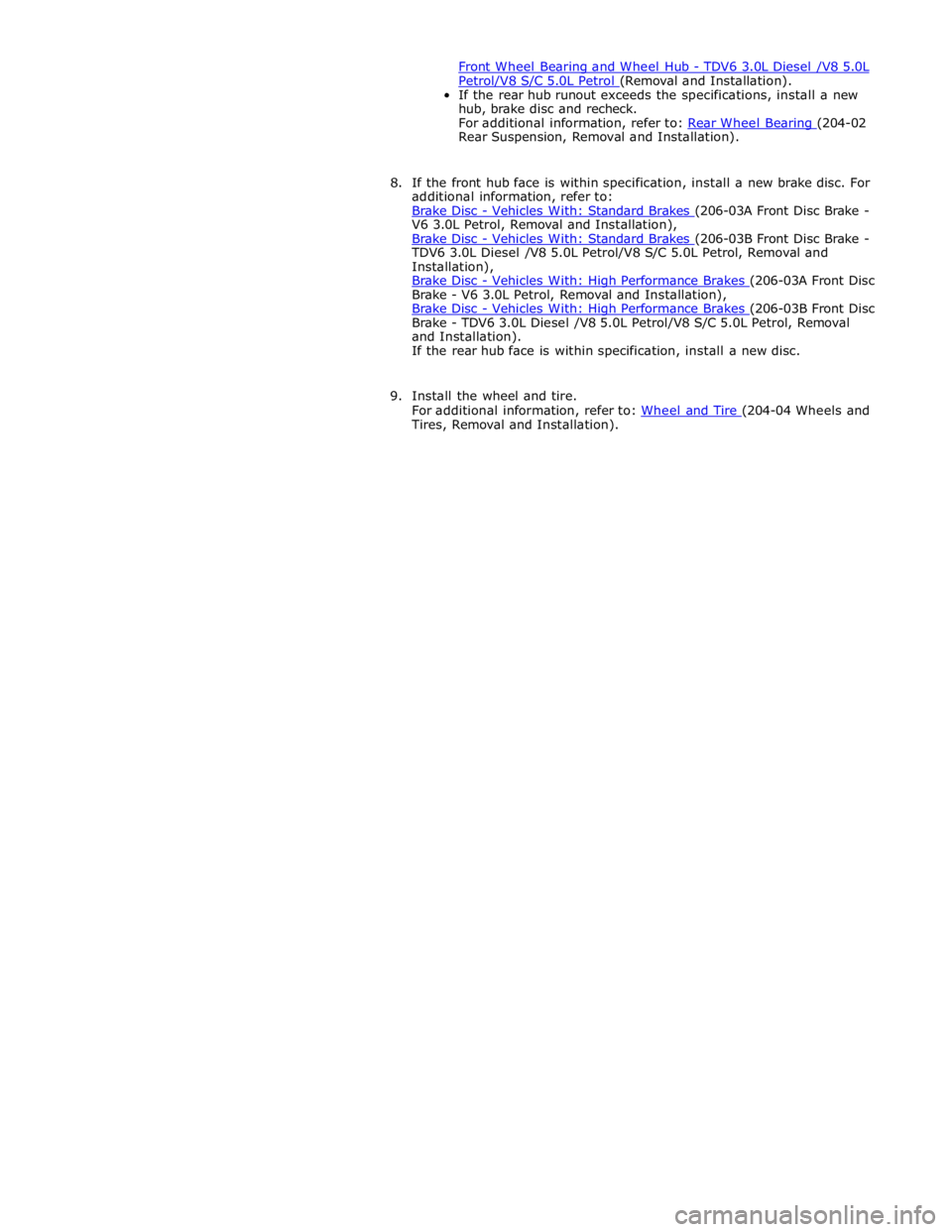
Petrol/V8 S/C 5.0L Petrol (Removal and Installation). If the rear hub runout exceeds the specifications, install a new
hub, brake disc and recheck.
For additional information, refer to: Rear Wheel Bearing (204-02 Rear Suspension, Removal and Installation).
8. If the front hub face is within specification, install a new brake disc. For
additional information, refer to:
Brake Disc - Vehicles With: Standard Brakes (206-03A Front Disc Brake - V6 3.0L Petrol, Removal and Installation),
Brake Disc - Vehicles With: Standard Brakes (206-03B Front Disc Brake - TDV6 3.0L Diesel /V8 5.0L Petrol/V8 S/C 5.0L Petrol, Removal and
Installation),
Brake Disc - Vehicles With: High Performance Brakes (206-03A Front Disc Brake - V6 3.0L Petrol, Removal and Installation),
Brake Disc - Vehicles With: High Performance Brakes (206-03B Front Disc Brake - TDV6 3.0L Diesel /V8 5.0L Petrol/V8 S/C 5.0L Petrol, Removal
and Installation).
If the rear hub face is within specification, install a new disc.
9. Install the wheel and tire.
For additional information, refer to: Wheel and Tire (204-04 Wheels and Tires, Removal and Installation).
Page 595 of 3039
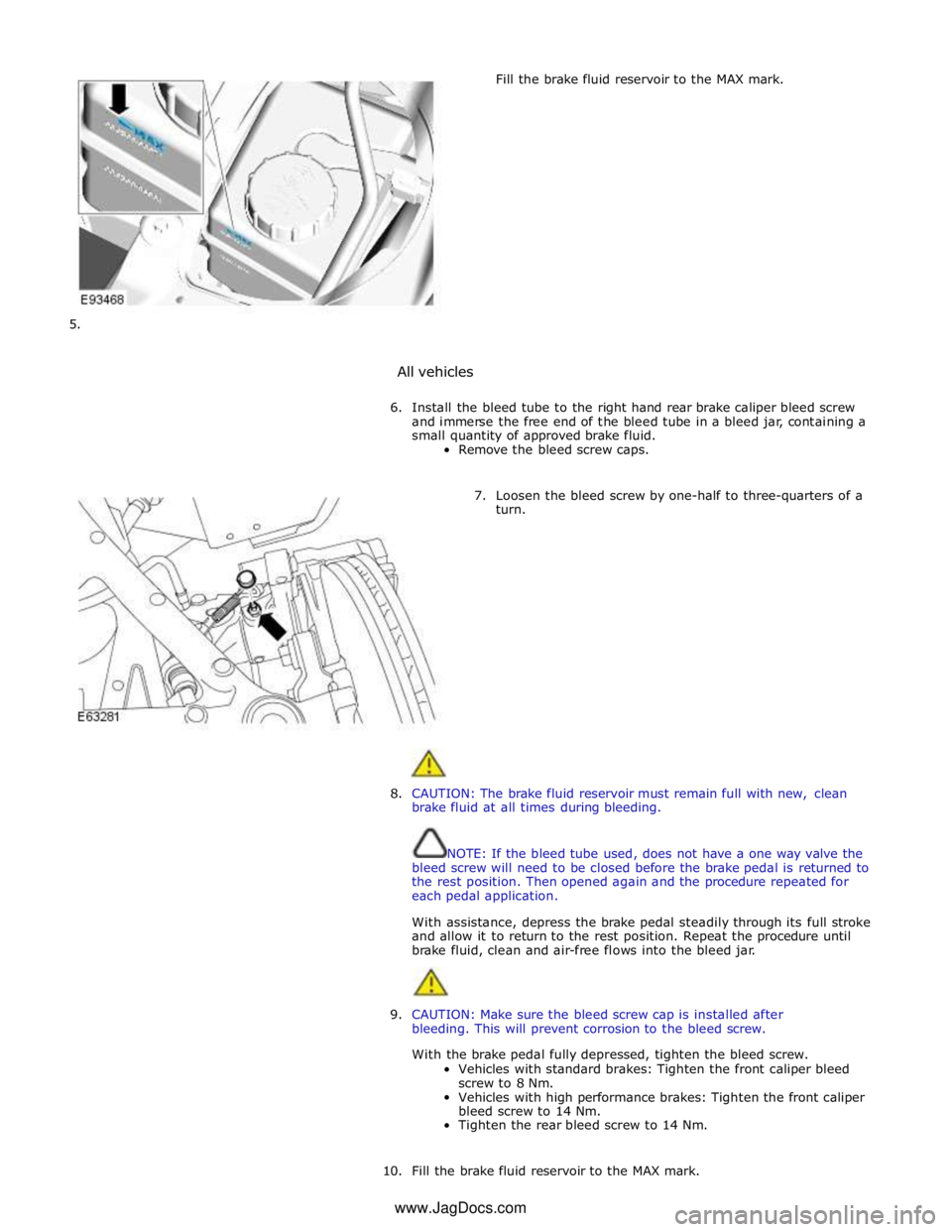
5.
All vehicles Fill the brake fluid reservoir to the MAX mark.
6. Install the bleed tube to the right hand rear brake caliper bleed screw
and immerse the free end of the bleed tube in a bleed jar, containing a
small quantity of approved brake fluid.
Remove the bleed screw caps.
7. Loosen the bleed screw by one-half to three-quarters of a
turn.
8. CAUTION: The brake fluid reservoir must remain full with new, clean
brake fluid at all times during bleeding.
NOTE: If the bleed tube used, does not have a one way valve the
bleed screw will need to be closed before the brake pedal is returned to
the rest position. Then opened again and the procedure repeated for
each pedal application.
With assistance, depress the brake pedal steadily through its full stroke
and allow it to return to the rest position. Repeat the procedure until
brake fluid, clean and air-free flows into the bleed jar.
9. CAUTION: Make sure the bleed screw cap is installed after
bleeding. This will prevent corrosion to the bleed screw.
With the brake pedal fully depressed, tighten the bleed screw.
Vehicles with standard brakes: Tighten the front caliper bleed
screw to 8 Nm.
Vehicles with high performance brakes: Tighten the front caliper
bleed screw to 14 Nm.
Tighten the rear bleed screw to 14 Nm.
10. Fill the brake fluid reservoir to the MAX mark. www.JagDocs.com
Page 597 of 3039
Published: 17-Feb-2012
Brake System - General Information - Front Brake Disc Runout Check - With
Wheel On Vehicles With: High Performance Brakes
General Procedures
1. NOTES:
Some variation in the illustrations may occur, but the essential
information is always correct.
RH illustration shown, LH similar
All measurements must taken with the wheel installed.
2. WARNING: Make sure to support the vehicle with axle stands.
Raise the front of the vehicle.
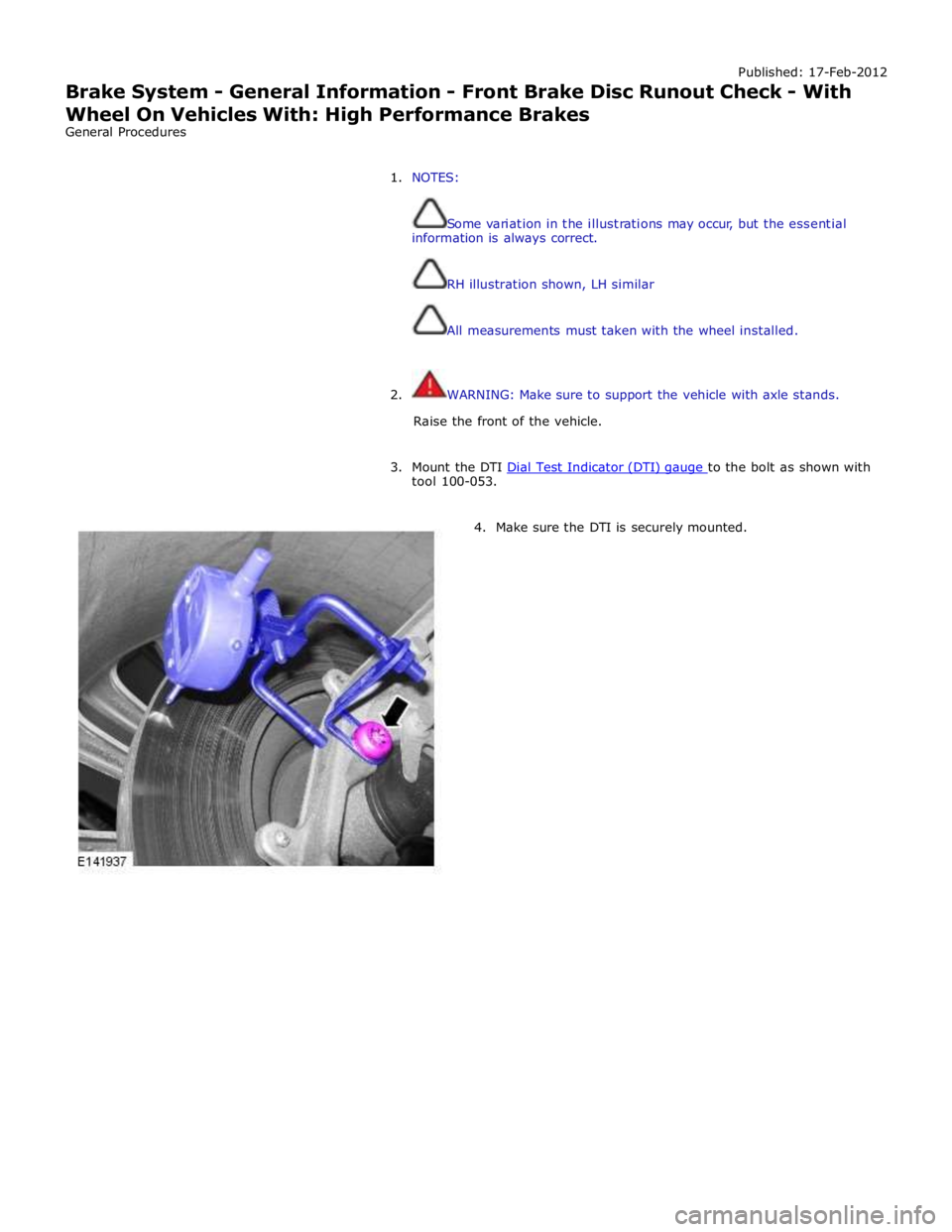
3. Mount the DTI Dial Test Indicator (DTI) gauge to the bolt as shown with tool 100-053.
4. Make sure the DTI is securely mounted.
Page 599 of 3039
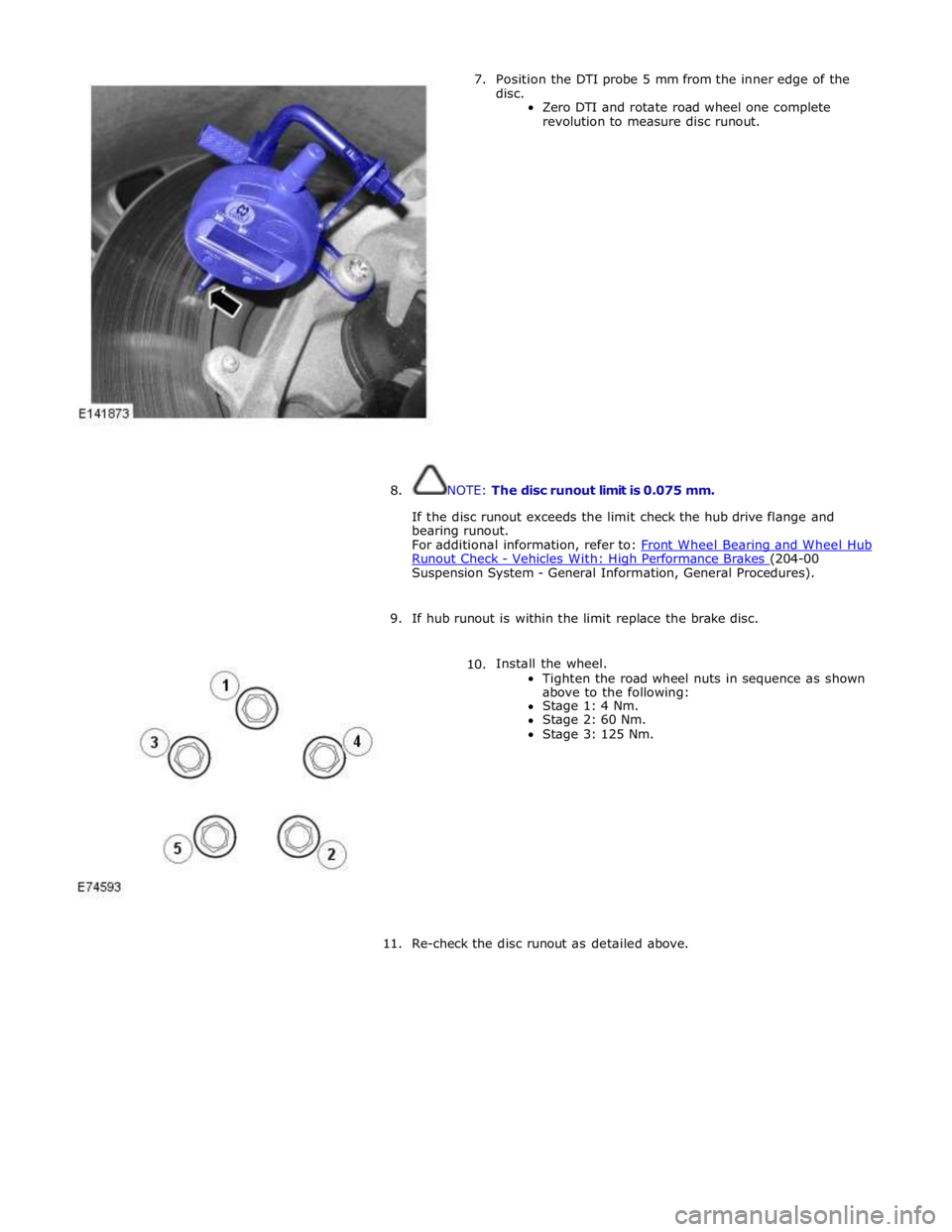
7. Position the DTI probe 5 mm from the inner edge of the
disc.
Zero DTI and rotate road wheel one complete
revolution to measure disc runout.
8. NOTE: The disc runout limit is 0.075 mm.
If the disc runout exceeds the limit check the hub drive flange and
bearing runout.
For additional information, refer to: Front Wheel Bearing and Wheel Hub Runout Check - Vehicles With: High Performance Brakes (204-00 Suspension System - General Information, General Procedures).
9. If hub runout is within the limit replace the brake disc.
10. Install the wheel.
Tighten the road wheel nuts in sequence as shown
above to the following:
Stage 1: 4 Nm.
Stage 2: 60 Nm.
Stage 3: 125 Nm.
11. Re-check the disc runout as detailed above.
Page 606 of 3039
Published: 11-May-2011
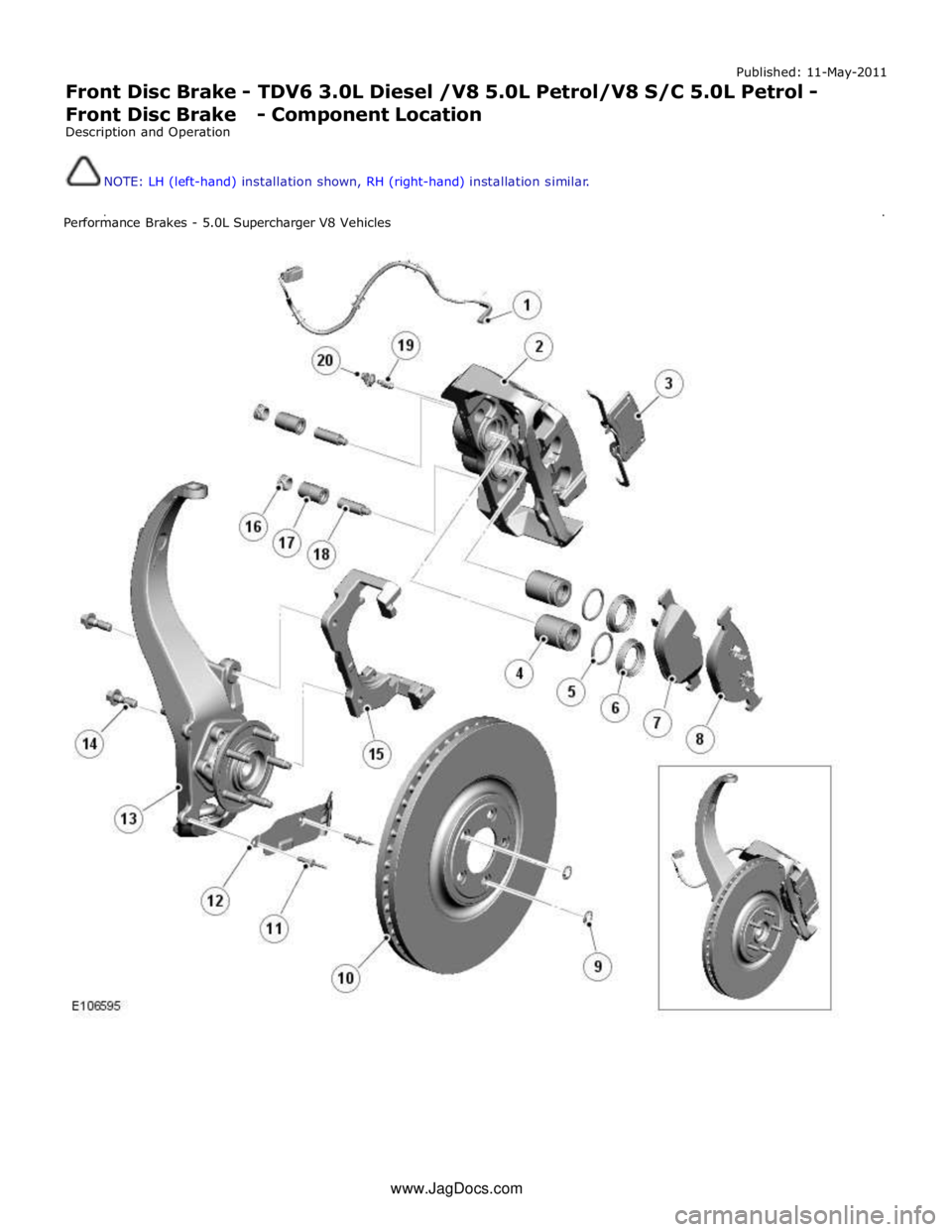
Front Disc Brake - TDV6 3.0L Diesel /V8 5.0L Petrol/V8 S/C 5.0L Petrol - Front Disc Brake - Component Location
Description and Operation
NOTE: LH (left-hand) installation shown, RH (right-hand) installation similar.
PerformanceBrakes-5.0LSuperchargerV8Vehicleswww.JagDocs.com
Page 607 of 3039

1 Brake pad wear sensor 2 Caliper body 3 Anti-rattle spring 4 Piston (2 off) 5 Piston seal (2 off) 6 Piston dust cover (2 off) 7 Inboard brake pad 8 Outboard brake pad 9 Retaining washer (2 off) 10 Brake disc 11 Rivet (2 off) 12 Heat shield 13 Front wheel knuckle/hub and bearing assembly 14 Caliper bolt (2 off) 15 Caliper carrier 16 Guide pin dust cover (2 off) 17 Guide pin bush (2 off) 18 Guide pin (2 off) 19 Bleed screw 20 Bleed screw dust cap