roof JAGUAR XJ6 1994 2.G User Guide
[x] Cancel search | Manufacturer: JAGUAR, Model Year: 1994, Model line: XJ6, Model: JAGUAR XJ6 1994 2.GPages: 521, PDF Size: 17.35 MB
Page 362 of 521
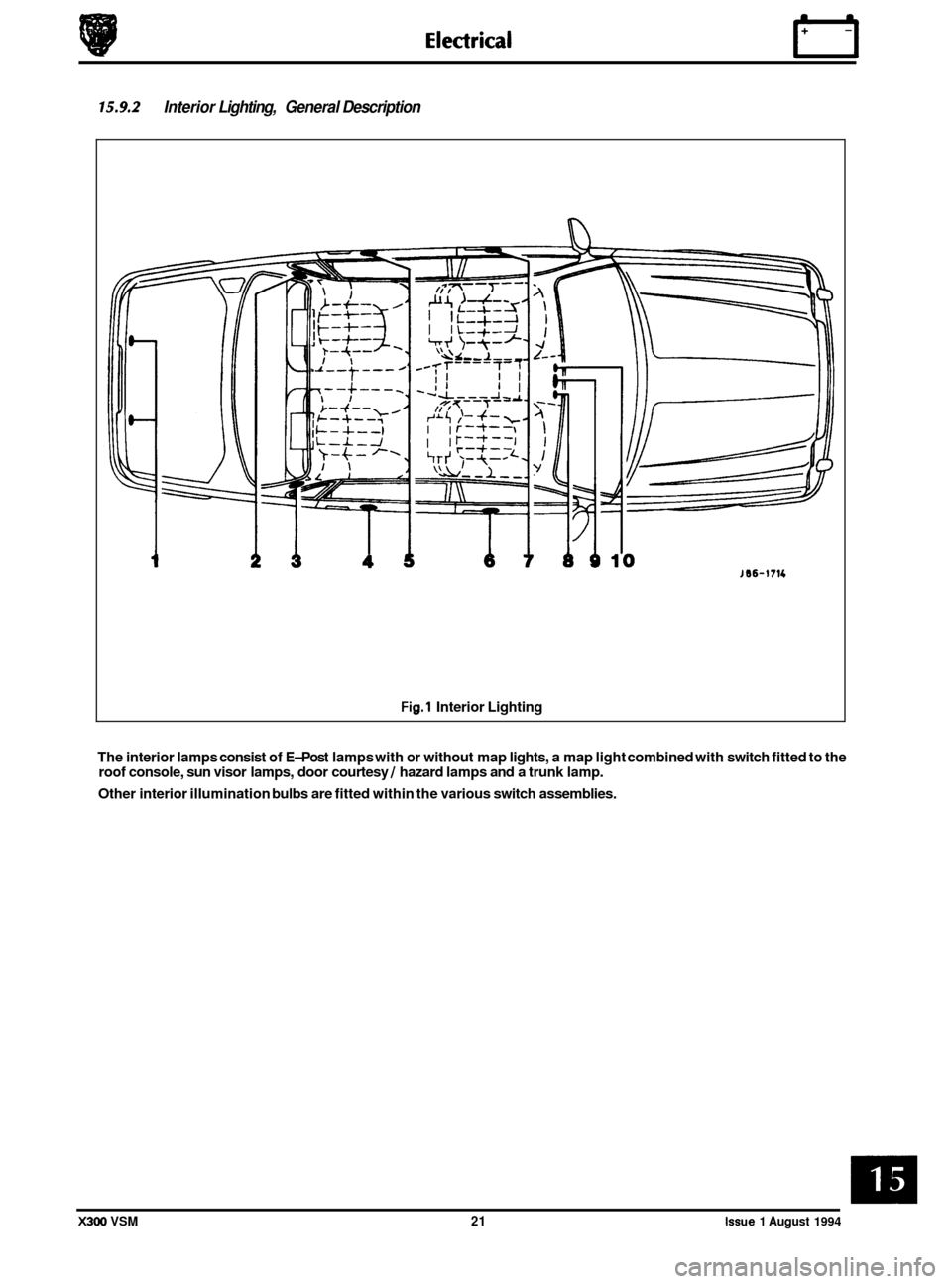
15.9.2 Interior Lighting, General Description
0
Fig.1 Interior Lighting
The interior lamps consist of
E-Post lamps with or without map lights, a map light combined with switch fitted to the
roof console, sun visor lamps, door courtesy / hazard lamps and a trunk lamp.
Other interior illumination bulbs are fitted within the various switch assemblies.
X300 VSM 21 Issue 1 August 1994
Page 380 of 521
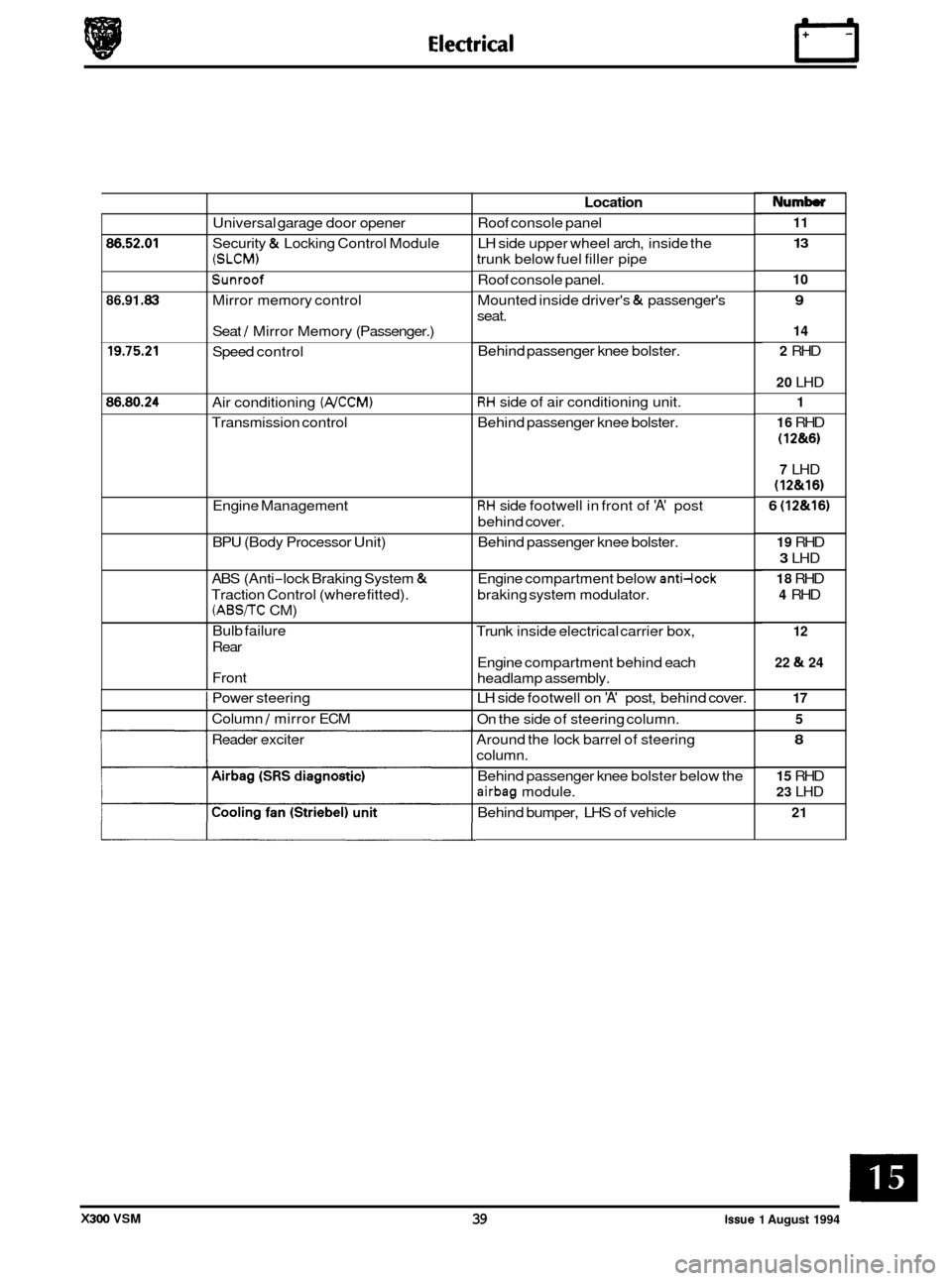
86.52.01
86.91 -83
19.75.21
86.80.24
Universal garage door opener
Security
& Locking Control Module
(SLCM)
Sunroof
Mirror memory control
Seat
/ Mirror Memory (Passenger.)
Speed control
Air conditioning
(NCCM)
Transmission control
Engine Management
BPU (Body Processor Unit)
ABS (Anti
-lock Braking System &
Traction Control (where fitted).
(ABS/TC CM)
Bulb failure
Rear
Front
I Power steering
I Column / mirror ECM
Reader exciter
Location
Roof console panel
LH side upper wheel arch, inside the
trunk below fuel filler pipe
Roof console panel.
Mounted inside driver's
& passenger's
seat.
Behind passenger knee bolster.
RH side of air conditioning unit.
Behind passenger knee bolster.
RH side footwell in front of 'A' post
behind cover.
Behind passenger knee bolster.
Engine compartment below
anti-lock
braking system modulator.
Trunk inside electrical carrier box,
Engine compartment behind each
headlamp assembly.
LH side footwell on
'A' post, behind cover.
On the side of steering column.
Around the lock barrel of steering
column.
Behind passenger knee bolster below the
airbag module.
Behind bumper, LHS of vehicle
Numb
11
13
10
9
14
2
RHD
20 LHD
1
16
RHD
(1 2&6)
7 LHD
(12&16)
6 (12&16)
19 RHD
3 LHD
18 RHD
4 RHD
12
22
& 24
17 5
8
15 RHD
23 LHD
21
X300 VSM 39 issue 1 August 1994
Page 395 of 521
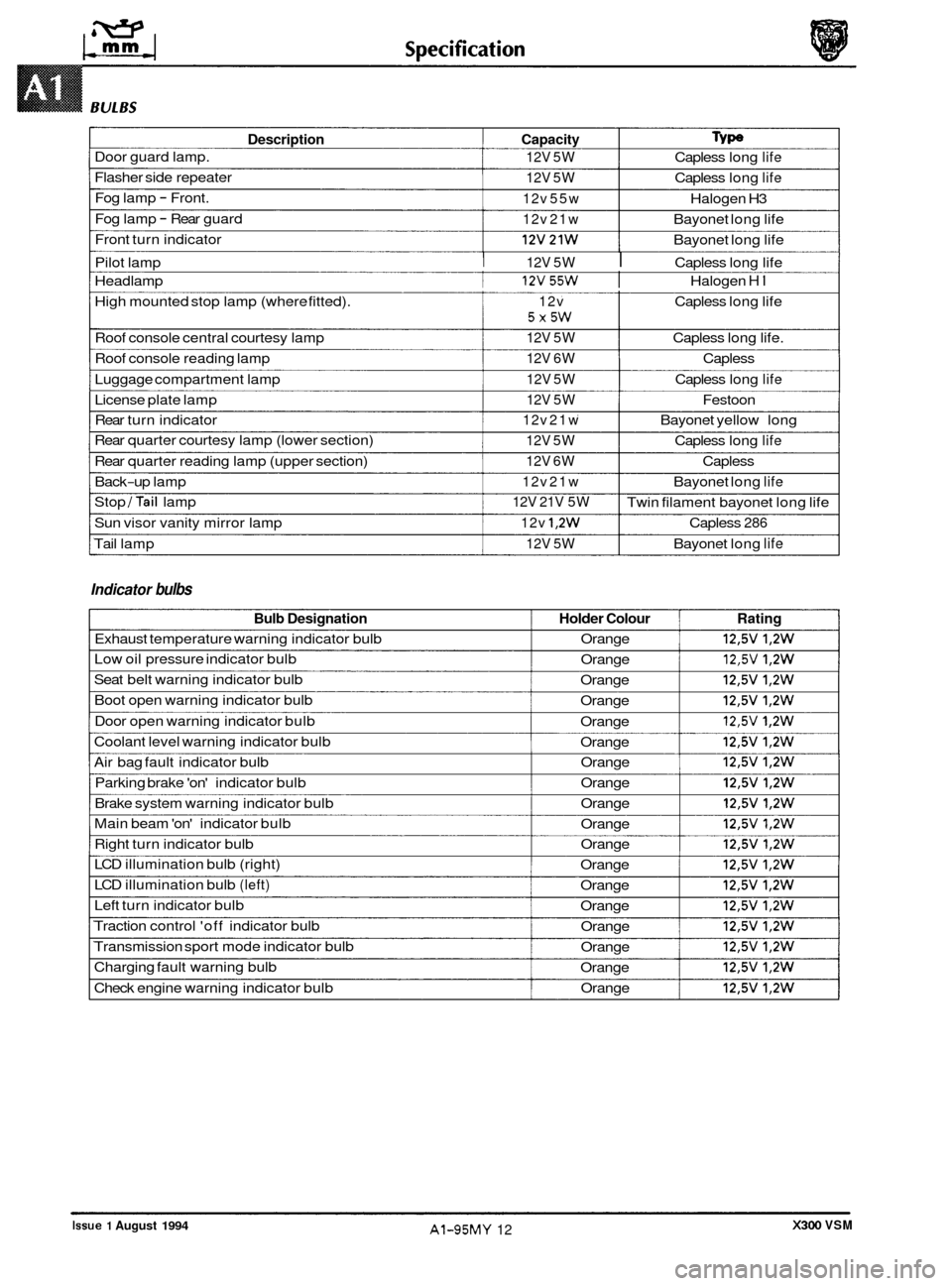
Description Capacity Type
Door guard lamp. 12V 5W Capless long life
Flasher side repeater 12V 5W Capless long life
Fog lamp - Front. 12v 55w Halogen H3
Fog lamp
- Rear guard 12v 21w Bayonet long life
Front turn indicator
I 12v21w I Bayonet long life
Pilot lamp
I 12V 5W I Capless long life
Headlamp
I 12v55w I Halogen HI
High mounted stop lamp (where fitted). 12v Capless long life
Roof console central courtesy lamp
12V 5W Capless long life.
Roof console reading lamp
12V 6W Capless
Luggage compartment lamp
12V 5W Capless long life
License plate lamp 12V 5W Festoon
Rear turn indicator
12v 21w Bayonet yellow long
Rear quarter courtesy lamp (lower section)
12V 5W Capless long life
Rear quarter reading lamp (upper section) 12V 6W Capless
Back
-up lamp 12v 21w Bayonet long life
Stop /Tail lamp
Sun visor vanity mirror lamp
12v 1,2w Capless 286
Tail lamp 12V 5W Bayonet long life
5X5W
12V 21V 5W Twin filament bayonet long life
Indicator bulbs
Bulb Designation Holder Colour Rating
Exhaust temperature warning indicator bulb Orange 12,5V 1,2W
Low oil pressure indicator bulb
Orange 12,5V 1,2W
Seat belt warning indicator bulb
Orange 12,5V 1,2W
Boot open warning indicator bulb
Orange 12,5V 1,2W
Door open warning indicator bulb
Orange 12,5V 1,2W
Coolant level warning indicator bulb
Orange 12,5V 1,2W
Air bag fault indicator bulb Orange 12,5V 1,2W
Parking brake 'on' indicator bulb Orange 12,5V 1,2W
Brake system warning indicator bulb Orange 12,5V 1,2W
Main beam 'on' indicator bulb
Orange 12,5V 1,2W
Right turn indicator bulb Orange 12,5V 1,2W
LCD illumination bulb (right)
Orange 12,5V 1,2W
LCD illumination bulb (left) Orange 12,5V 1,2W
Left turn indicator bulb
Orange 12,5V 1,2W
Traction control 'off indicator bulb
Orange 12,5V 1,2W
Transmission sport mode indicator bulb
Orange 12,5V 1,2W
Charging fault warning bulb
Orange 12,5V 1,2W
Check engine warning indicator bulb Orange 12,5V 1,2W
0
0
0
X300 VSM Issue 1 August 1994 AI-95MY 12
Page 400 of 521
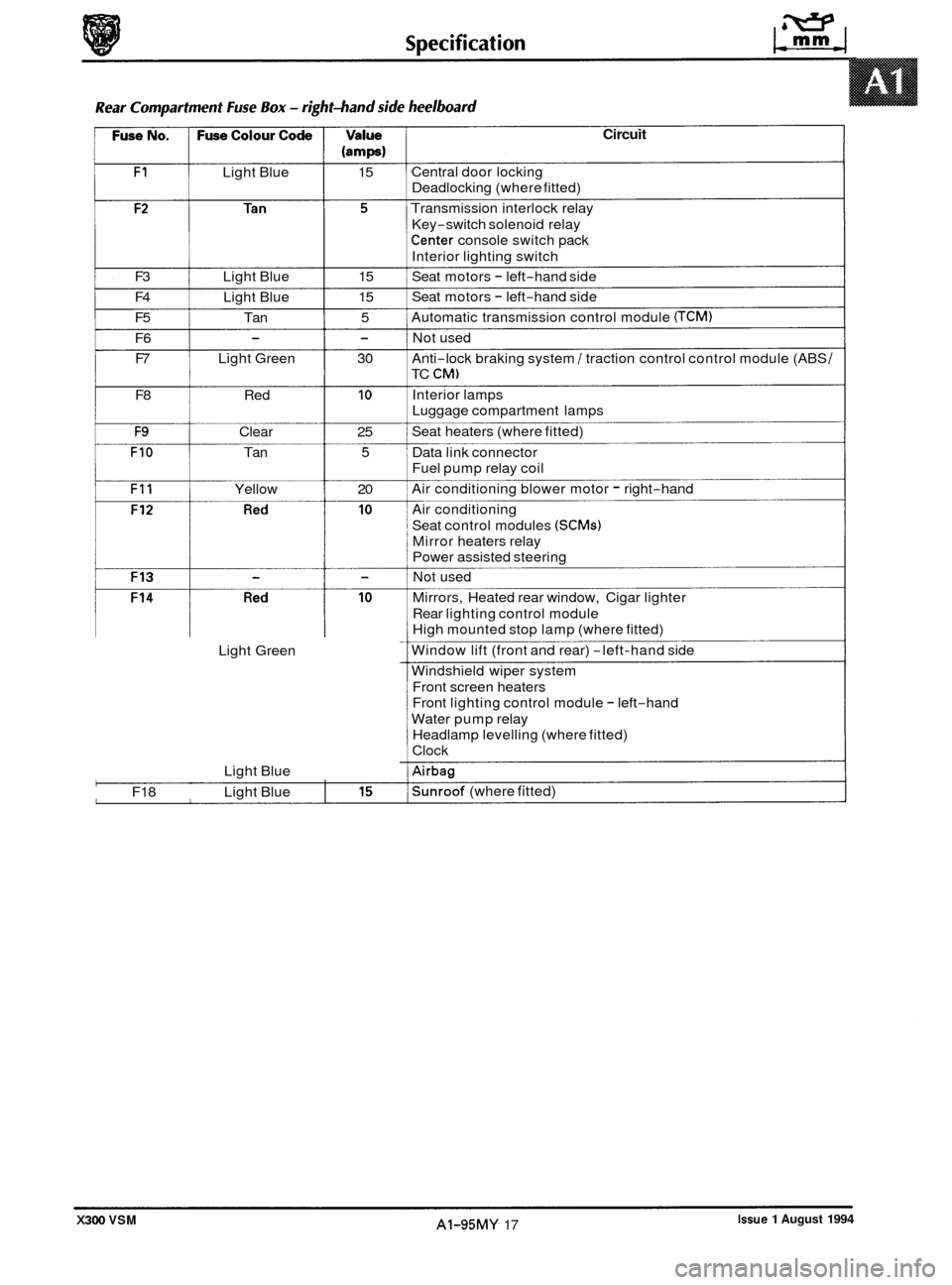
(amps)
F1 Light Blue 15
F3 Light Blue 15
F4 Light Blue 15
F5 Tan 5
F6 F7 Light Green 30
- -
F8 Red 10
F9 Clear 25
FIO Tan 5
F11 Yellow 20 0
Light Green
Light Blue
F18 Light Blue
0'
I
Circuit
Central door locking
Deadlocking (where fitted)
Transmission interlock relay
Key
-switch solenoid relay
Center console switch pack
Interior lighting switch
Seat motors
- left-hand side
Seat motors
- left-hand side
Automatic transmission control module
(TCM)
Not used
Anti
-lock braking system / traction control control module (ABS /
TC CM)
Interior lamps
Luggage compartment lamps
Seat heaters (where fitted)
Data link connector
Fuel pump relay coil
Air conditioning blower motor
- right-hand
Air conditioning
Seat control modules
(SCMs)
Mirror heaters relay
Power assisted steering
Not used
Mirrors, Heated rear window, Cigar lighter
Rear lighting control module
High mounted stop lamp (where fitted)
Window lift (front and rear)
-left-hand side
Windshield wiper system Front screen heaters
Front lighting control module
- left-hand
Water pump relay
Headlamp levelling (where fitted)
Clock
Airbag
Sunroof (where fitted)
Issue 1 August 1994 AI-95MY 17 X300 VSM
Page 413 of 521
General Fitting Instructions
A3.2 GENERAL FITTING INSTRUCTIONS
A3.2.1
Always fit covers to protect the wings before commencing work in the engine compartment. Cover the seats and
carpets, wear clean overalls and wash hands or wear gloves before working inside the car. Avoid spilling hydraulic
fluid, anti
-freeze or battery acid on the paintwork. In the event of spillage, wash off with water immediately. Use poly- thene sheets in the boot to protect carpets. Always use the recommended service tool, or a satisfactory equivalent,
where specified. Protect temporarily exposed screw threads by replacing nuts or fitting caps.
Precautions Against Damage To The Vehicle
A3.2.2 Preparation
Before disassembly, clean the surrounding area as thoroughly as possible. When components have been removed,
blank off any exposed openings using greaseproof paper and masking tape. Immediately seal fuel, oil and hydraulic
lines when separated, using plastic caps or plugs, to prevent loss of fluid and the entry of dirt. Close the open ends
of oilways, exposed by component removal, with tapered hardwood plugs or readily visible plastic plugs. Immediately
a component is removed, place
it in a suitable container; use a separate container for each component and its asso- ciated parts. Before dismantling a component, clean it thoroughly with a recommended cleaning agent: check that the
agent will not damage any of the materials within the component. Clean the bench and obtain marking materials, la-
bels, containers and locking wire before dismantling a component.
A3.2.3 Dismantling
Observe scrupulous cleanliness when dismantling components, particularly when parts of the brake, fuel or hydraulic
system are being worked on. A particle of dirt or a fragment of cloth could cause a dangerous malfunction if trapped in these systems. Clean all tapped holes, crevices, oilways and fluid passages with compressed air.
WRNIFLG: DO NOT PERMIT COMPRESSED AIR TO ENTER AN OPEN WOUND. ALWAYS USE EVE PROTECTION
WHEN USING COMPRESSED AIR.
Ensure that any 'O'-rings used for sealing are correctly refitted or renewed if disturbed. Mark mating parts to ensure
that they are replaced as dismantled. Whenever possible use marking materials which avoid the possibilities of caus- ing distortion or the initiation of cracks, which could occur if a center punch or scriber were used. Wire together mating
parts where necessary to prevent accidental interchange (e.g roller bearing components). Tie labels on to all parts to
be renewed and to parts requiring further inspection before being passed for reassembly.
Place labelled parts and other parts for rebuild
in separate containers.
Do not discard a part which is due for renewal until it has been compared with the new part, to ensure that the correct
part has been obtained.
A3.2.4 Inspection
Before inspecting a component for wear or performing a dimensional check, ensure that it is absolutely clean; a slight
smear of grease can conceal an incipient failure. When a component is to be checked dimensionally against figures
quoted for
it, use the correct equipment (surface plates, micrometers, dial gauges etc.) in serviceable condition. The
use of makeshift equipment can be dangerous. Reject a component if its dimensions are outside the limits quoted,
or if damage is apparent. A part may be refitted if its critical dimension is exactly to the limit size and it is otherwise
satisfactory. Use Plastigauge 12 Type PG-1 for checking bearing surface clearance e.g. big end bearing shell to crank
journal. Instructions for the use of Plastigauge and a scale giving bearing clearances in steps of
0,0025 mm (0.0001
in) are supplied with the package.
0
0
0
X300 VSM Issue 1 August 1994 2
Page 425 of 521
Body Systems & Body Repair
Sub-Section Title SRO Page
A4.4.4 ........... Underhood Labels. Location & Tvpe ................................................... 32
A4.4.5
........... Stonechip Protection Area ............................................................ 33
A4.5.1.1
.......... Glass And Body Preparation .......................................................... 34
A4.5.1.2
.......... Glazing Adhesive Application Temperature ............................................. 34
A4.5
............. Glazing ........................................................................\
... 34
A4.5.1
........... Glazing. Special Notes ............................................................... 34
A4.5.1.3
.......... Glazing Adhesive Application ......................................................... 34
A4.5.1.4
.......... Glazing Adhesive Curing ............................................................. 34
A4.6.1
........... Bumpers ........................................................................\
... 35
A4.6.1.2 .......... Bumpers. Features ................................................................... 35
A4.6.1.3
.......... BUmpeN. Service Procedures ......................................................... 37
A4.6.1.4 .......... Bumpers. Fitted Condition - Front ..................................................... 37
A4.6.2
........... BUmpeN. Cover Damage ............................................................. 39
A4.6.1.1
.......... Bumpers.
Major Components ......................................................... 35
A4.6.1.5 .......... Bumpers. Fitted Condition -Rear ...................................................... 38
A4.6.2.1
.......... Bumpers. Damage Assessment ........................................................ 39
A4.6.2.2
.......... Bumpers. Repair Materials ............................................................ 39
A4.6.3 ........... Bumpers. Refinishing ................................................................ 40
A4.6.3.1
.......... Bumpers. Refinishing - Original ....................................................... 40
A4.6.3.2
.......... Bumpers. Refinishing - New .......................................................... 40
A4.6.3.3
.......... Bumpers. Refinishing - All ............................................................ 40
A4.6.4
........... Bumpers. Replacement Covers ........................................................ 40
A4.6.5
........... Recycled Materials. General Note ..................................................... 40
A4.6.6.1
.......... Body-side Moulding, Introduction ..................................................... 41
A4.6.6.2
.......... Body-side Moulding. Fitted Condition - Illustration ....................................... 41
A4.6.6.3
.......... Body-side Moulding. Fitting Process ................................................... 41
A4.6.7
........... Finisher, Door Frame - Fitted Condition ................................................ 42
A4.6.8
........... Finisher, Roof Drip Rail - Fitted Condition .............................................. 42
A4.7.1
........... Body Exterior Clearances & Alignments ................................................. 43
A4.7.1.1
.......... Body Exterior Clearances & Alignments. Introduction ..................................... 43
A4.6.6
........... Body-side
Moulding ................................................................. 41
A4.7.1.2
.......... Body Exterior Clearances & Alignments. Criteria - Clearances ............................. 43
A4.7.1.3
.......... Body Exterior Clearances & Alignments. Criteria - Alignment .............................. 43
A4.7.1.4
.......... Body Exterior Clearances & Alignments. Criteria - Exterior Fitments ........................ 43
A4.7.1.5
.......... Body Exterior Clearances & Alignments. Illustrations (Specifications) ........................ 43
A4.7.2
........... DOON ........................................................................\
..... 47
A4.7.2.1
.......... DOON. Features ..................................................................... 47
A4.7.2.2
.......... DOON. Removal .................................................................... 47
A4.7.2.3
.......... DOON. Fitting ....................................................................... \
47
A4.7.2.4
.......... DOON. Alignment ................................................................... 47
A4.7.2.5
.......... Door Seals. Table ................................................................... 48
A4.7.2.6 .......... Door Seals - Typical Sections. Illustration ............................................... 48
0
0
0
0
Issue 1 August 1994 X300 VSM ii
Page 430 of 521
Systems Repair Body & Body -
A4.1.3. POTENTIAL RISKS I
A4.1.3. Paint
Organic solvents, found in paints, may cause damage or severe irritation to liver, kidneys, digestive tracts and respira- tory system if inhaled over long periods of time.
Prolonged exposure to isocyanates may cause lung sensitization. Asthma
-like symptoms may develop with subse-
quent exposure to very low concentrations of isocyanates.
Solvent inhalation can cause dizziness or loss of consciousness.
Splashes of solvents, paint activators and additives can cause damage to the eyes and may cause dermatitis. Peroxide
and acid catalysts may cause burns.
Inhalation of
spray dust and sanding debris may cause lung damage.
I
A4.1.3.2 Applied Heat (Welding)
There is considerable risk of damage to eyes and skin when welding or flame cutting.
Fire is a serious danger and many materials or fluids within the vehicle are highly flammable.
Toxic and dangerous fumes may be liberated when any of the following are subjected to heat:
0 Expanded foam
0 Corrosion protection
0 Trim and seat materials
0 Paints which contain isocyanates
0 Adhesive and sealing compounds
When heated to a temperature of 3OO0C, polyurethane based compounds may liberate small quantities of isocyanate.
Many types of nitrogen containing chemicals may be liberated as breakdown products; these chemicals can contain
isocyanates, oxides of nitrogen and hydrogen cyanide.
Potentially toxic or asphyxiant fumes and gases are produced by welding, for example; zinc oxide with zinc coated
panels, and ozone gas from the MIG process.
A4.1.3.3 Metal Repair
There is considerable risk of damage to eyes, ears and skin when metal cutting, forming, or dressing is being carried
out.
Soldering may be hazardous because of heat generated fumes and skin contact with the materials.
A4.1.4. PRECAUTIONS
A4.1.4.1 Paint
The inhalation of sprays, fumes, or dust during paint application or sanding processes should always be avoided. En- sure that there is efficient ventilation / extraction at all times. Paint spraying should be confined as far as possible to
spray booths. Personnel with a history of asthma should not be engaged in any process which involves the use of
isocyanates. Any operator working inside
a spray booth where isocyanate material is present must use air-fed breath- ing equipment. Supplied air to the visor should be fed at the recommended pressure and filtered to remove oil, water,
and fumes. Operators involved in handling mixing or spraying should wear protective clothing - gloves and goggles,
to avoid skin and eye contact.
A particle mask or canister type respirator should be worn when sanding.
A4.1.4.2 Applied Heat
When welding, flame cutting, brazing etc, the operator should use as appropriate, goggles, mask/fume extractor and
flameproof protective clothing. It is especially important when working with polyurethane compounds to use air-fed
breathing equipment.
Ensure that
at all times the appropriate fire fighting equipment is available and that personnel are trained in its use.
A4.1.4.3 Metal Repair
Appropriate eye and hand protection should be worn when sanding, drilling, cutting, chiselling, flatting or welding.
Operators should wear
a face mask or air-fed visor when sanding or flatting either body solder or fillers.
When
a soldering operation has been completed, swarf must be removed from the work area and the operator must
wash his hands thoroughly.
X300 VSM 3 Issue 1 August 1994
Page 436 of 521
Body Systems
A4.2.1.1 Constructional Steel Classification
Material 1 dnnlirdiam I
High strength low alloy (HLSA).
Double sided zinc plated mild steel.
1 Boron steel
1 Mild steel.
A4.2.2 BODY ALIGNMENT
The illustrations on pages 11 - Body Dimensions PLAN, and 13 -Body Dimensions SIDE VIEW, provide specifications
for damage assessment and location of replacement parts.
These dimensions must be strictly applied whether they are used for damage assessment, component location or post
repair verification.
The plan view MASTER datums are nominated on the right
-hand side of the body with the left-hand datums dimen- sioned from them. Therefore, the right-hand datums must be known to be correct before any other cross-ar dimen- sions are checked.
W: The right-hand side is always looking towards the front, from the rear of the vehicle.
All dimensions are derived from a single
(ZERO) datum point for all three axes; X for length, Z for height and V cross- car.
Issue 1 August 1994 9 X300 VSM
A4.2 BODY STRUCTURE
A4.2.1
Introduction
The Jaguar sedan range (with standard wheelbase) has a unit construction monocoque body structure with bolt-on
front fenders and welded rear fenders. The doors feature 'lift-off' hinges and welded dropglass frames.
n@#pn.s..v..
Impact prone areas, ie. seat frame and bumper mount- ings.
Exterior body panels subject to severe conditions such
as stone chipping and weather exposure (excluding
roof panel).
Door intrusion beams
Internal brackets, fillets and strengtheners.
I
Page 441 of 521

Body Systems & Body Repair
A4.2.3 ZINC COATED PANELS
A4.2.3.1
Description
Approximately 65% of the 'body in white' (BIW) mass is made up of zinc coated panels.
All exterior skin panels, with the exception of the roof, are double side zinc plated and this coating (nominally
7,5 mi- crons) provides corrosion protection in two ways.
1. Should the outer layer of paint become chipped but the zinc coating remain intact, the zinc will oxidize on contact
with air. This coat of oxidation is impermeable and will prevent corrosion damage to the base metal.
2. If both the outer layer of paint and the zinc coating become damaged, the zinc will react with the air and 'sacrifice'
itself to corrosion, rather than the base metal. In this process the zinc is known as a 'sacrificial anode'.
Iynpp: To maintain the protective qualities of the zinc treatment, repairs to any damaged coated area MUST be made as soon as possible after the damage has occurred.
A4.2.3.2 Wdding Preparation
Where 'resistance spot welding' is employed, the zinc coating should be lightly abraded away on the mating surfaces
and those in contact with the electrode tips. Do not remove more of the zinc coating than is absolutely necessary.
Before welding,
a weld-through primer or inter-weld sealer should be applied, as detailed in the Body Sealing and
Preservation man ua I.
Contamination of the weld will occur ifthe plating is not removed, thus making the joint less strong; another side effect
of this will be a greater need for electrode tip dressing and increased tool down time.
In exceptional cases where the plating must remain intact, increase the tip pressure and welding current by 10 to
20%.
Where MIG welding is used as an alternative to resistance spot welding for plug, butt welds, or limited access, the prob- lems caused by the presence of zinc coating are much the same as those previously mentioned. There may also be
the added problems of increased weld spatter and nozzle contamination.
0
A4.2.3.3 Body Fillers
Conventional polyester fillers do not adhere satisfactorily to zinc plated panels. Therefore, it is important to use only
those products specifically designed for this application and follow the manufacturers recommendations.
A4.2.3.4 Refinishing
Use only those products approved by Jaguar Cars Ltd and take special care with zinc coated panels.
Replacement panels are supplied ready primed
so there should be no need for bare metal to be exposed, other than
those areas prepared for welding etc (see 'Welding Preparation' sub section 4.2.3.2).
Where any part of a panel is dressed backto a bare surface, it should be treated with a zinc rich primer compatible with
the chosen paint application system, please refer to section A4.4.1.1.
X300 VSM Issue 1 August 1994 14
Page 451 of 521
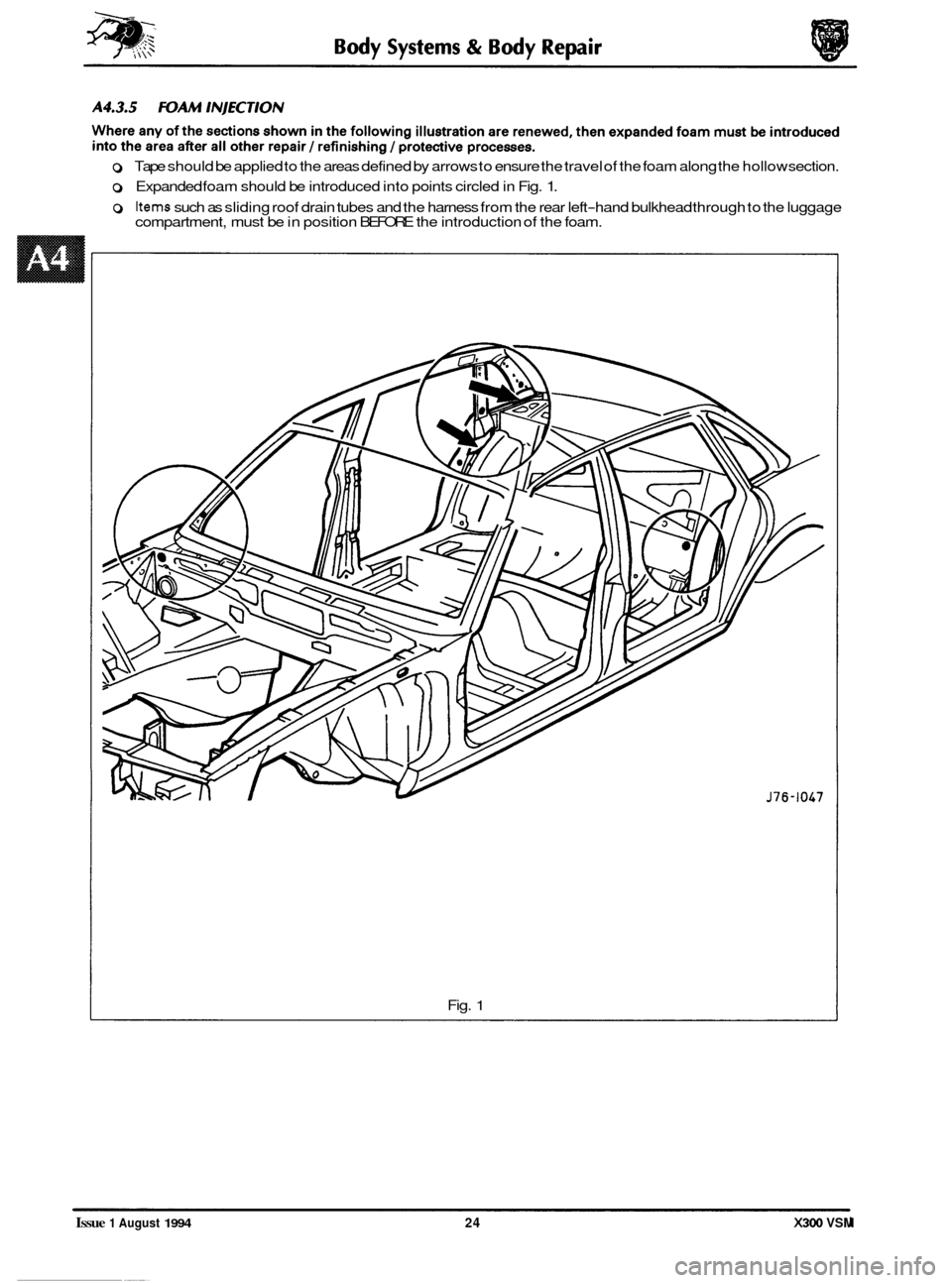
0 Tape should be applied to the areas defined by arrows to ensure the travel of the foam along the hollow section.
o Expanded foam should be introduced into points circled in Fig. 1.
0 Items such as sliding roof drain tubes and the harness from the rear left-hand bulkhead through to the luggage
compartment, must be in position BEFORE the introduction of the foam.
Fig.
1
Issue 1 August 1994 24 X300 VSM
0
0
0