service JAGUAR XJ6 1994 2.G Repair Manual
[x] Cancel search | Manufacturer: JAGUAR, Model Year: 1994, Model line: XJ6, Model: JAGUAR XJ6 1994 2.GPages: 521, PDF Size: 17.35 MB
Page 223 of 521

1. SERVICE TOOLS & EQUIPMENT
Description
Parking brake cable remover
Illustration
Notes
not
illustrated
Pipe connectors to hydraulic module:
M12
M10
Jaguar Number
JD.142
15
- 19
12 - 16
186.672
Description
U-
Molykote 11 1 Caliper to carrier securing bolts
6947017
Notes
JDS.9013
Replacer disc brake
piston seal
I
Brake hose clamp, Girling
Brake pedal hold down tool
11. TORQUE TIGHTENING SPECIFICATIONS
Fixing 1 Tightening Torque
(Nm)
Vacuum booster to pedal box I 21 -29 I
Tandem master cylinder to booster I 21 -29 I
Hvdraulic module to module bracket I 18 - 26 I
Caliper guide pins I 25 - 35 I
Caliper to vertical link I 120 - 160 I
Caliper to hub carrier I 54 - 66 I
111. SERVICE MATERIALS
Iv. SERVICE DATA
Front brake disc run out
Front brake
disc parallelism
Rear brake disc
run out
Rear brake disc parallelism 0.101
mm (0.004 in) max.
0.0127mm (0.0005in) max.
0.101
mm (0.004 in) max.
0.0127mm (0.0005in) max.
Issue 1 August 1994 ii X300 VSM
Page 239 of 521
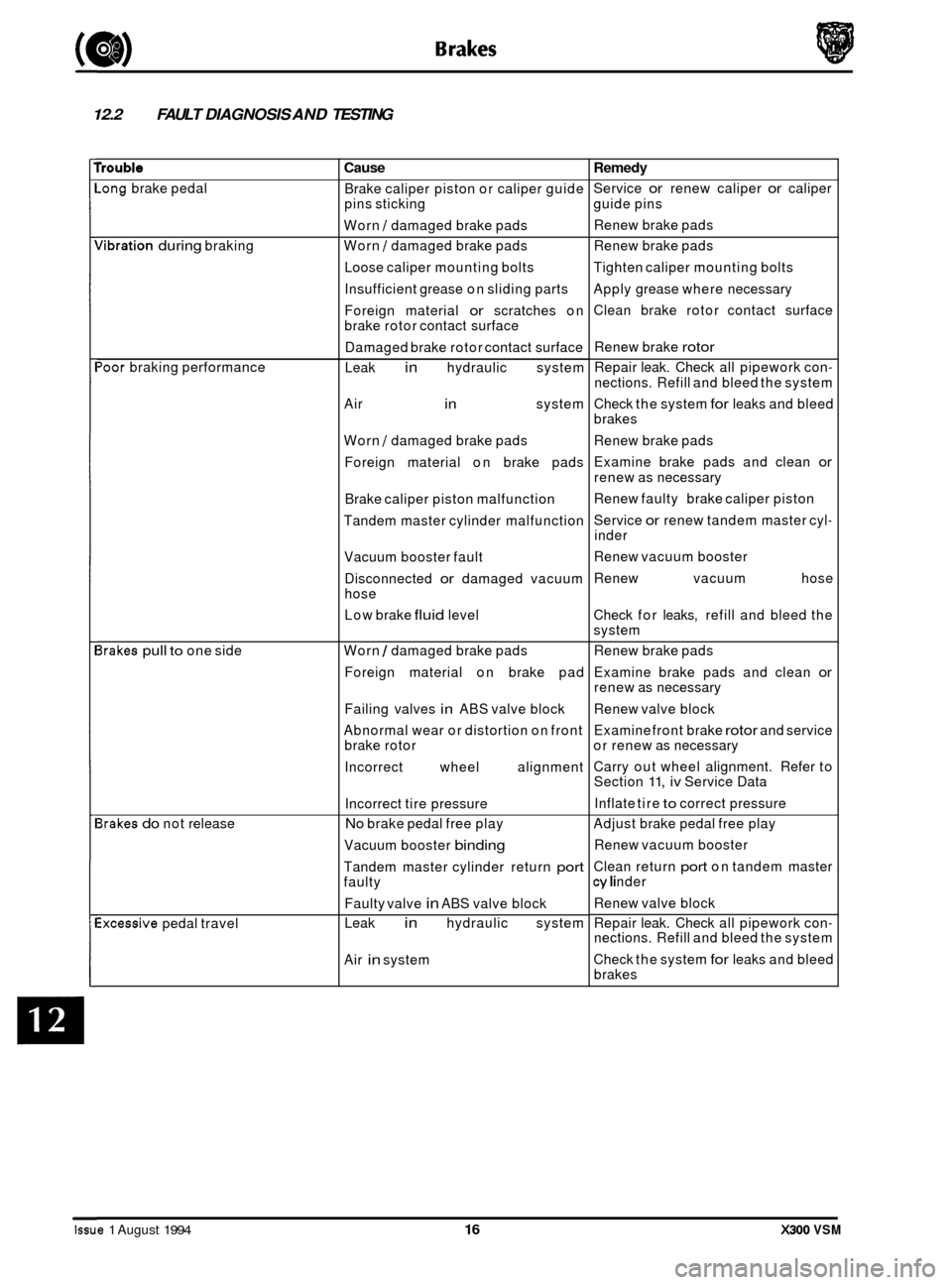
12.2 FAULT DIAGNOSIS AND TESTING
rrouble
-ong brake pedal
dibration during braking
'oor braking performance
3rakes pull to one side
3rakes do not release
ixcessive pedal travel
Cause
Brake caliper piston or caliper guide
pins sticking
Worn
I damaged brake pads
Worn
1 damaged brake pads
Loose caliper mounting bolts
Insufficient grease on sliding parts
Foreign material
or scratches on
brake rotor contact surface
Damaged brake rotor contact surface
Leak
in hydraulic system
Air
in system
Worn
I damaged brake pads
Foreign material on brake pads
Brake caliper piston malfunction
Tandem master cylinder malfunction
Vacuum booster fault
Disconnected
or damaged vacuum
hose
Low brake
fluid level
Worn
I damaged brake pads
Foreign material on brake pad
Failing valves
in ABS valve block
Abnormal wear or distortion on front
brake rotor
Incorrect wheel alignment
Incorrect tire pressure
No brake pedal free play
Vacuum booster
binding
Tandem master cylinder return port faulty
Faulty valve
in ABS valve block
Leak
in hydraulic system
Air
in system
Remedy
Service or renew caliper or caliper
guide pins
Renew brake pads
Renew brake pads
Tighten caliper mounting bolts
Apply grease where necessary
Clean brake rotor contact surface
Renew brake
rotor
Repair leak. Check all pipework con-
nections. Refill and bleed the system
Check the system
for leaks and bleed
brakes
Renew brake pads
Examine brake pads and clean
or
renew as necessary
Renew faulty brake caliper piston
Service
or renew tandem master cyl- inder
Renew vacuum booster
Renew vacuum hose
Check for leaks, refill and bleed the
system
Renew brake pads
Examine brake pads and clean
or renew as necessary
Renew valve block
Examine front brake
rotor and service
or renew as necessary
Carry out wheel alignment. Refer to
Section
11, iv Service Data
Inflate tire
to correct pressure
Adjust brake pedal free play
Renew vacuum booster
Clean return
port on tandem master cy I i nder
Renew valve block
Repair leak. Check all pipework con
- nections. Refill and bleed the system
Check the system
for leaks and bleed
brakes
0
0
0
Issue 1 August 1994 16 X300 VSM
Page 242 of 521
Brakes
12.4 BRAKE SYSTEM BLEEDING
WAR-: GREAT CARE MUST BE EXERCISED WHEN SERVICING OR REPAIRING THE SYSTEM. AVOID SKIN/ EYE
CONTACT OR INGESTION OF BRAKE FLUID. IF SKIN OR EYES ARE ACCIDENTALLY SPLASHED WITH
BRAKE FLUID,
RINSETHE AFFECTED AREA IMMEDIATELY WITH PLENTY OF WATER AND SEEK MEDICAL
ATTENTION. IF BRAKE FLUID IS INGESTED, SEEK MEDICAL ATTENTION IMMEDIATELY.
CAUm: Fluid must not be allowed to contact the vehicle paintwork. Remove any spilt fluid from the paintwork
by rinsing away with running water. Methylated spirit (denatured alcohol) must not be used to clean the
contaminated area.
CAUTION: Never use methylated spirit (denatured alcohol) for component cleaning purposes. Use only a proprietary
brake cleaning fluid.
WARNING : THROUGHOUT THE FOLLOWING MAINTENANCE / SERVICE OPERATIONS, ABSOLUTE CLEANLINESS
MUST BE OBSERVED TO PREVENT FOREIGN MATTER CONTAMINATING THE BRAKE SYSTEM.
12.4.1 System Bleeding - General Instructions
Use a brake bleeder bottle with a clear bleeder tube. Also recommended is a filler unit with a fill pressure of 1.0 bar. If a filler unit is not used, ensure that their is sufficient brake fluid in the reservoir throughout the bleeding procedure.
m: Always bleed the caliper furthest away from the actuation unit first. On right hand drive vehicles, bleed in the
following order: front
left (FL),front right (FR), rear left (RL) and rear right (RR). On left hand drive vehicles bleed in the following order: FR, FL, RR and RL.
12.4.2
. Ensure that the vehicle is standing level. Switch the igni-
tion off.
Check that the fluid level in the reservoir is between the min and max marks.
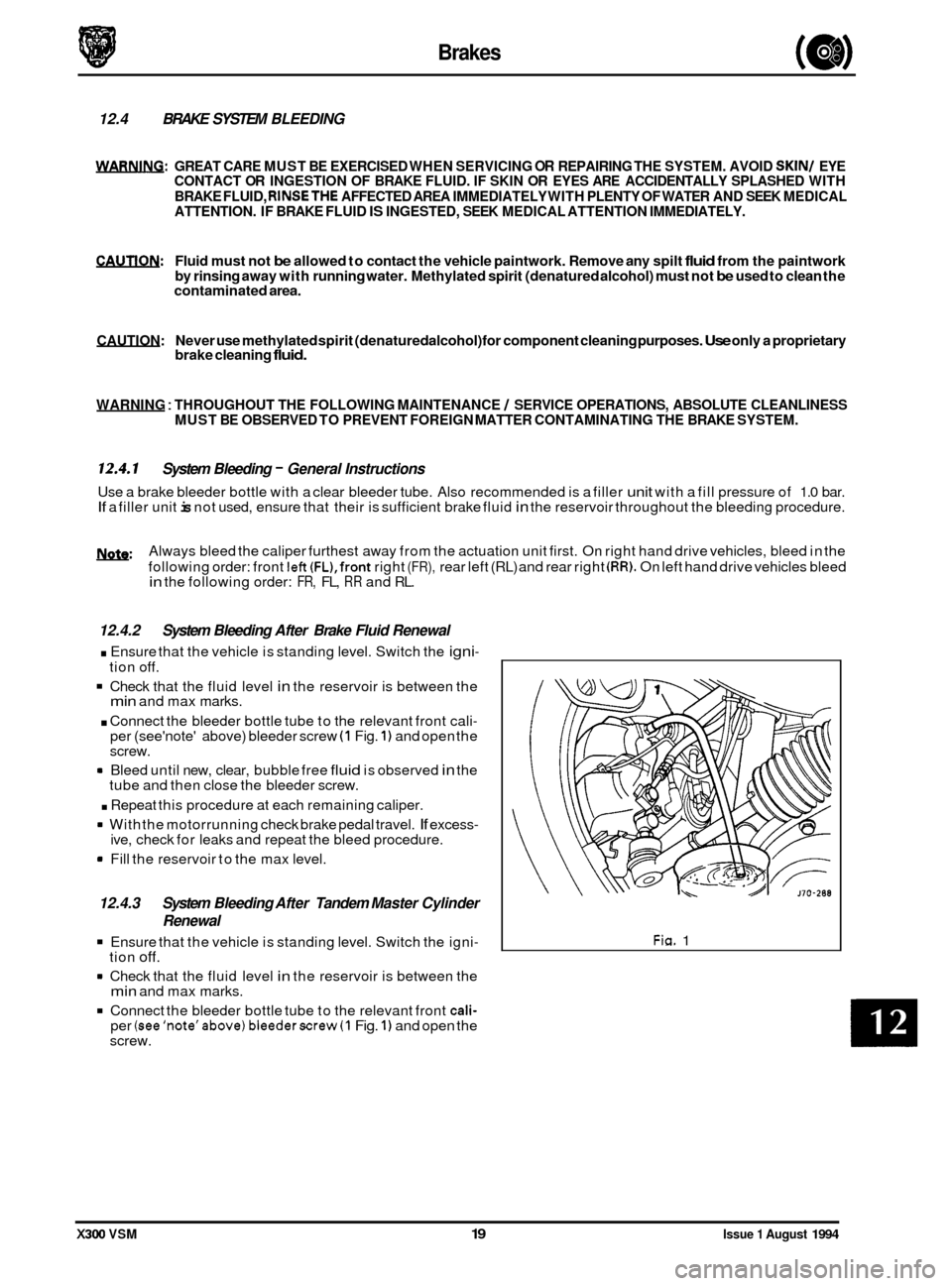
. Connect the bleeder bottle tube to the relevant front cali- per (see'note' above) bleeder screw (1 Fig. 1) and open the
screw.
rn Bleed until new, clear, bubble free fluid is observed in the
tube and then close the bleeder screw.
. Repeat this procedure at each remaining caliper.
With the motorrunning check brake pedal travel.
If excess- ive, check for leaks and repeat the bleed procedure.
Fill the reservoir to the max level.
System Bleeding After Brake Fluid Renewal
12.4.3 System Bleeding After Tandem Master Cylinder
Renewal
Ensure that the vehicle is standing level. Switch the igni- tion off.
rn Check that the fluid level in the reservoir is between the min and max marks.
Connect the bleeder bottle tube to the relevant front cali- per (see'note'above) bleederscrew(1 Fig. 1) and open the
screw.
Ficr. 1
X300 VSM 19 Issue 1 August 1994
Page 244 of 521
Brakes
a 12.5 GENERAL FI77lNG lNSTRUCTlONS
12.5.1 Brake Fluid
WARNING: BRAKE FLUID IS CORROSIVE. EXTREME CARE MUST BE TAKEN WHEN HANDLING. AVOID SKIN OR EYE
CONTACT. AVOID INGESTION. IF SKIN OR EYES ARE ACCIDENTALLY SPLASHED WITH BRAKE FLUID,
RINSE THE AFFECTED AREA IMMEDIATELY WITH PLENTY OF WATER AND SEEK MEDICAL ATTENTION.
IF BRAKE FLUID
IS INGESTED, SEEK MEDICAL ATTENTION IMMEDIATELY.
CAUTION:
Fluid must not be allowed to contact the vehicle paintwork. Remove any spilt fluid from the paintwork
by rinsing away with running water. Methylated spirit (denatured alcohol) must not be used to clean the
contaminated area.
Cleaning Solvents
CAUTION: Never use methylated spirit (denatured alcohol) for cleaning purposes. Use only a proprietary brake
cleaning fluid.
m: THROUGHOUT THE FOLLOWING MAINTENANCE / SERVICE OPERATIONS, ABSOLUTE CLEANLINESS
MUST BE OBSERVED TO PREVENT GRIT OR OTHER FOREIGN MATTER CONTAMINATING THE BRAKE
TION. TO CLEAN BRAKE SYSTEM COMPONENTS, WASH
IN A PROPRIETARY BRAKE CLEANING FLUID.
REMOVE ALL TRACES OF CLEANING FLUID BEFORE REASSEMBLY. ALL BRAKE SYSTEM RUBBER COh PONENTS MUST BE DIPPED IN CLEAN BRAKE FLUID AND ASSEMBLED USING THE FINGERS ONLY.
SYSTEM.
IFTHE SYSTEM IS TO
BE FLUSHED, USE CLEAN BRAKE FLUID TO MINIMUM DOT 4 SPECIFICA-
12.5.2 Hoses
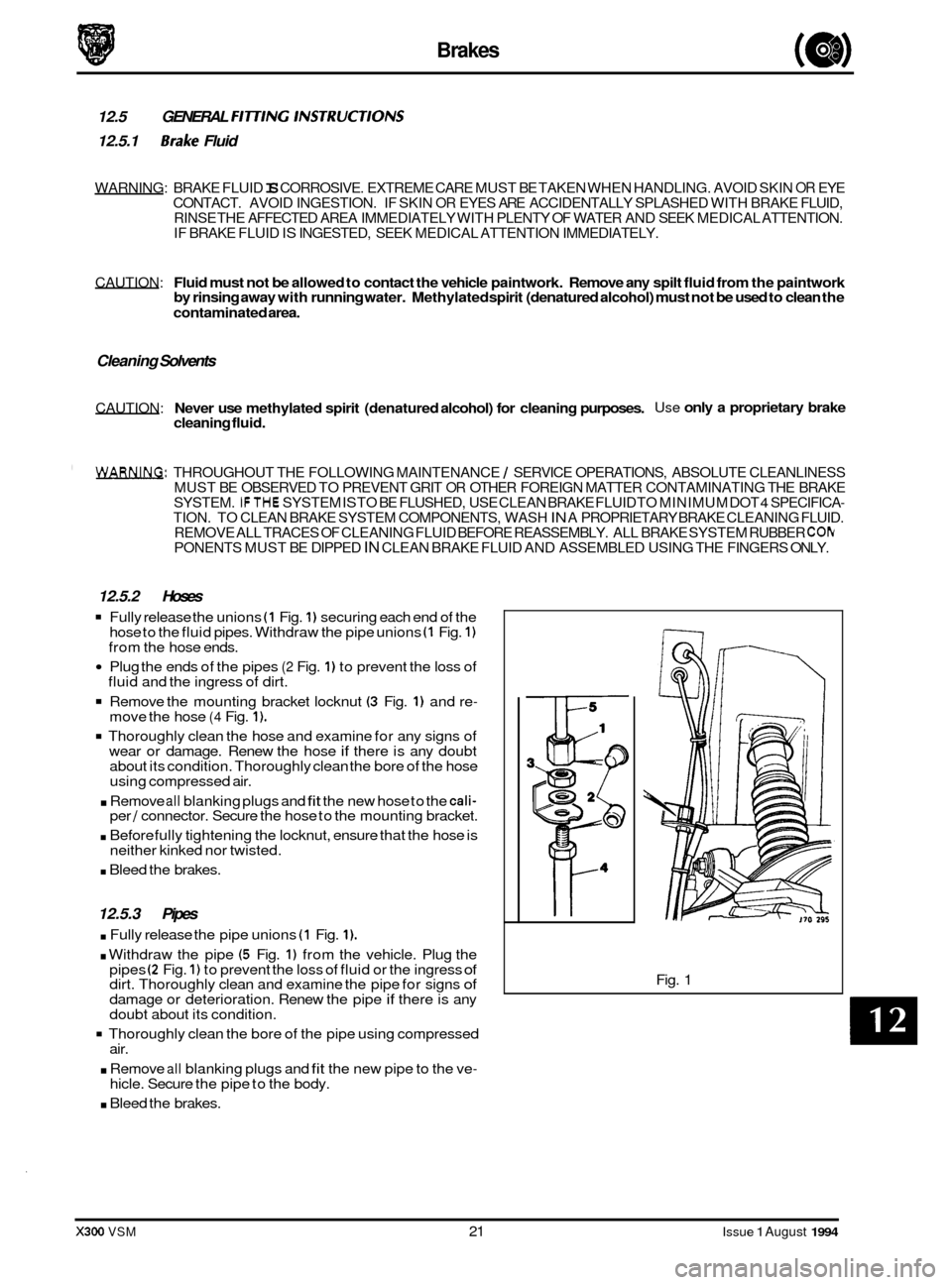
Fully release the unions (1 Fig. 1) securing each end of the
hose to the fluid pipes. Withdraw the pipe unions (1 Fig. 1) from the hose ends.
Plug the ends of the pipes (2 Fig. 1) to prevent the loss of
fluid and the ingress of dirt.
Remove the mounting bracket locknut (3 Fig. 1) and re- move the hose (4 Fig. 1).
Thoroughly clean the hose and examine for any signs of
wear or damage. Renew the hose if there is any doubt
about its condition. Thoroughly clean the bore of the hose
using compressed air.
. Remove all blanking plugs and fit the new hose to the cali- per / connector. Secure the hose to the mounting bracket.
. Before fully tightening the locknut, ensure that the hose is
neither kinked nor twisted.
. Bleed the brakes.
12.5.3 Pipes
. Fully release the pipe unions (1 Fig. 1).
. Withdraw the pipe (5 Fig. 1) from the vehicle. Plug the
pipes (2 Fig. 1) to prevent the loss of fluid or the ingress of dirt. Thoroughly clean and examine the pipe for signs of damage or deterioration. Renew the pipe if there is any
doubt about its condition.
Thoroughly clean the bore of the pipe using compressed
air.
. Remove all blanking plugs and fit the new pipe to the ve- hicle. Secure the pipe to the body.
. Bleed the brakes.
17
Fig. 1
X300 VSM 21 Issue 1 August 1994
Page 253 of 521
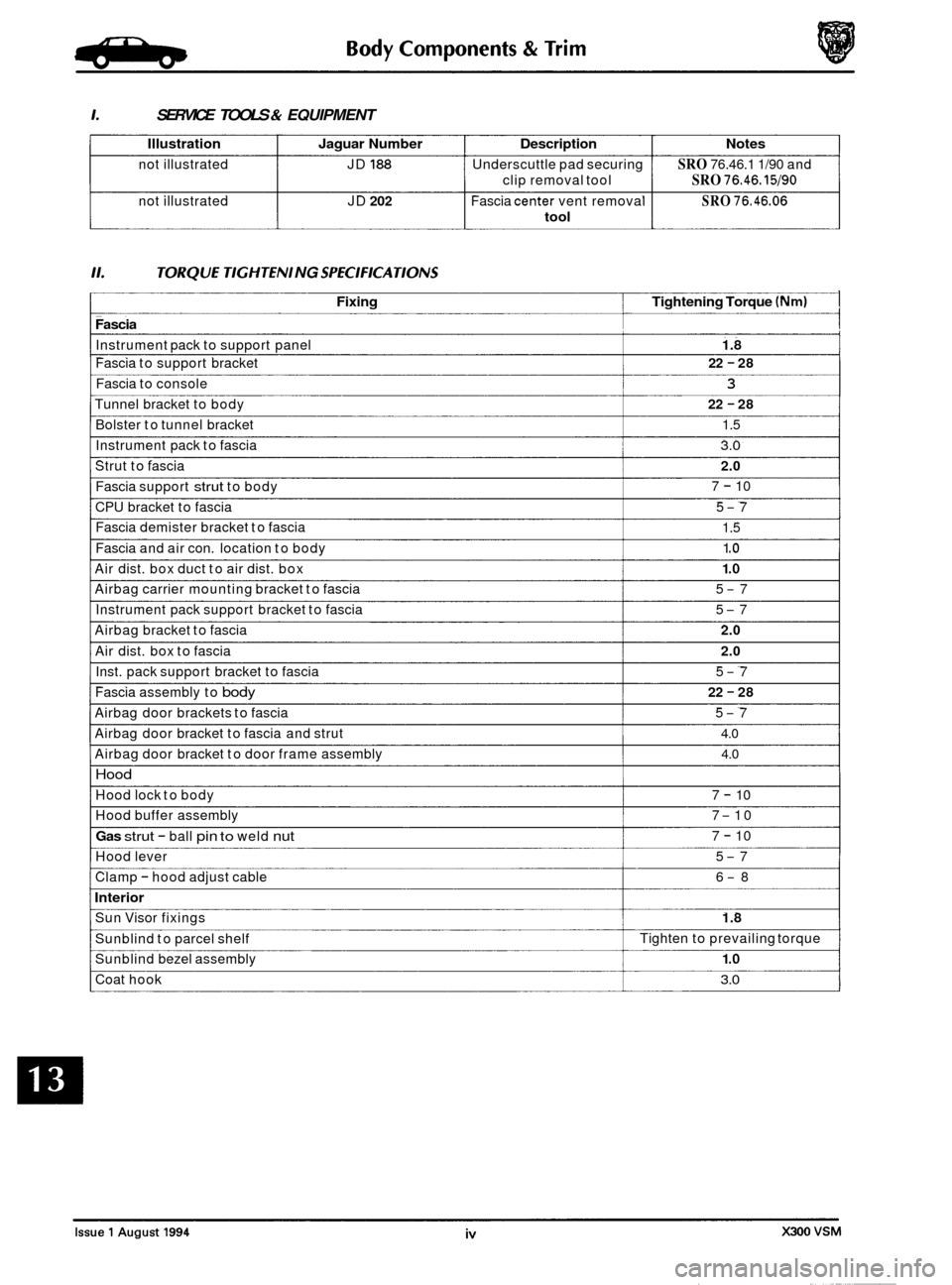
1. SERVICE TOOLS & EQUIPMENT
Illustration Jaguar Number Description Notes
not illustrated JD 188 Underscuttle pad securing SRO 76.46.1 1/90 and
not illustrated JD
202 Fascia center vent removal SRO 76.46.06
clip removal tool SRO 76.46.15190
tool
11. TORO U€ TIGHTEN1 NG SPEC1 FlCA TlONS
Fixing Tightening Torque (Nm) 1
Fascia I I
Instrument pack to support panel I 1.8 I
Fascia to support bracket
Fascia to console
3
Tunnel bracket to body
22 - 28
22
- 28
Bolster to tunnel bracket 1.5
Instrument pack to fascia
3.0
Strut to fascia 2.0
Fascia support strut to body 7 - 10
CPU bracket to fascia 5
-7
Fascia demister bracket to fascia
1.5
1 .o
1 .o
5-7
5
-7
Fascia
and air con. location to body
Air dist. box duct to air dist. box
Airbag carrier mounting bracket to fascia
Instrument pack support bracket to fascia
Airbag bracket to fascia
2.0
Air dist. box to fascia 2.0
Inst. pack support bracket to fascia 5-7
22 - 28 Fascia assembly to body
Airbag door brackets to fascia 5-7
4.0
4.0
Airbag door bracket to fascia and strut
Airbag door bracket to door frame assembly
Hood
Hood lock to body
Hood buffer assembly 7
-10
Gas strut - ball pin to weld nut
7 - 10
7
- 10
Hood lever 5
-7
Clamp
- hood adjust cable 6-8
Interior
Sun Visor fixings 1.8
Sunblind to parcel shelf
Sunblind bezel assembly
1 .o
Coat hook 3.0
Tighten to prevailing torque
Page 254 of 521
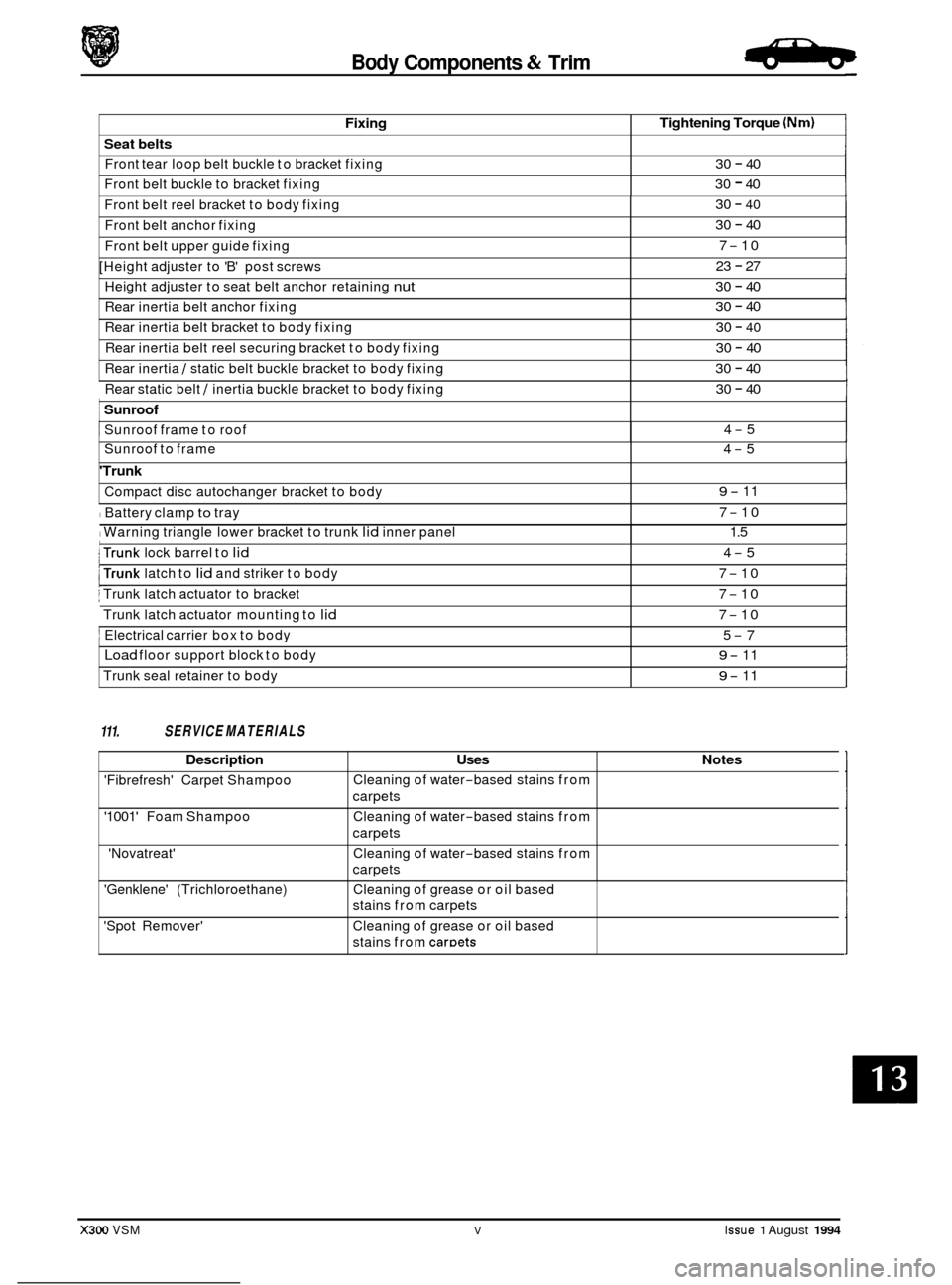
Body Components & Trim -
Fixing
Seat belts
Front tear loop belt buckle to bracket fixing
Front belt buckle to bracket fixing
Tightening Torque (Nm)
30 - 40
30
- 40
Front belt reel bracket to body fixing
Front belt anchor fixing 30 - 40
30 - 40
7
-10
23
- 27
30
- 40
30 - 40
30
- 40
30 - 40
30
- 40
Front belt upper guide fixing
[Height adjuster to 'B' post screws
Height adjuster to seat belt anchor retaining
nut
Rear inertia belt anchor fixing
Rear inertia belt bracket to body fixing
Rear inertia belt reel securing bracket to body fixing
Rear inertia
/ static belt buckle bracket to body fixing ~
Rear
static belt / inertia buckle bracket to body fixing
: Sunroof ~
Sunroof frame
to roof
30 - 40
4
-5
111. SERVICE MATERIALS
Sunroof to frame 4-5
'Trunk
Compact disc autochanger bracket to body
I Battery clamp to tray
I Warning triangle lower bracket to trunk lid inner panel
9- 11
7
-10
1.5
X300 VSM V Issue 1 August 1994
I trunk lock barrel to lid
j Trunk latch actuator to bracket
Trunk latch actuator mounting to
lid
j Electrical carrier box to body
Load floor support block to body
Trunk seal retainer to body
trunk latch to lid and striker to body
4-5
7
-10
7
-10
7
-10
5
-7
9- 11
9- 11
Description Uses
'Fibrefresh' Carpet Shampoo
'1001' Foam Shampoo
'Novatreat' Cleaning
of water
-based stains from
carpets
Cleaning of water
-based stains from
carpets
Cleaning of water
-based stains from
carpets
Notes
'Genklene' (Trichloroethane)
'Spot Remover' Cleaning
of grease or oil based
stains from carpets
Cleaning of grease or oil based
stains from
caroets
Page 263 of 521

13.2.18 Fuel Filler Flap, Description
The fuel filler flap comprises a hinged flap attached to the body decking panel by two M5 nuts; the flap incorporates
a rubber buffer, snap
-in striker, hinge spring and the fuel cap stowage magnet. The rubber fuel bowl moulding is at- tached via a steel armature to the body reinforcement panel by five M5 nuts and is retained at the filler neck by a clip.
The mating drain tube is fitted with an internal filter.
The fuel filler flap latch mechanism attached
tothe fuel bowl armature bytwo M5 nuts, includes a locking pin and actua- tor which are both serviceable items. The latch actuator operates independently from the central locking system; it is
driven directly
by the security and locking control module. Locking of the fuel filler flap is achieved only by operation
of the key or by the remote rf transmitter.
13.2.19 Filler Flap and Hinge, Renew
. Disconnect vehicle battery ground lead.
With filler cap open, remove hinge securing screws, fuel
. To refit, carry out reversal of the above procedure.
filler cap
and remove flap and hinge assembly.
13.2.20 Filler Cap Retention Magnet, Renew
. With filler flap open, use a blunt flat bladed implement and
CAUTION: Take care not to damage paintwork.
. To refit, carry out reversal of the above procedure.
Disconnect
vehicle battery ground lead.
remove the magnet assembly.
13.2.21 Filler Flap latching Assembly, Renew
. Disconnect vehicle battery ground lead.
. Depress the latching assembly retaining nut and remove
CAUTION: Take care not to damage paintwork.
. To refit, carry out reversal of the above procedure.
the
assembly.
1. Hingedflap 2. Striker 3. Hinge spring 4. Stowage magnet 5. Fuelbowl
Fig. 1 Fuel Filler Flap
X300 VSM Issue 1 August 1994 8
e
0
0
Page 293 of 521
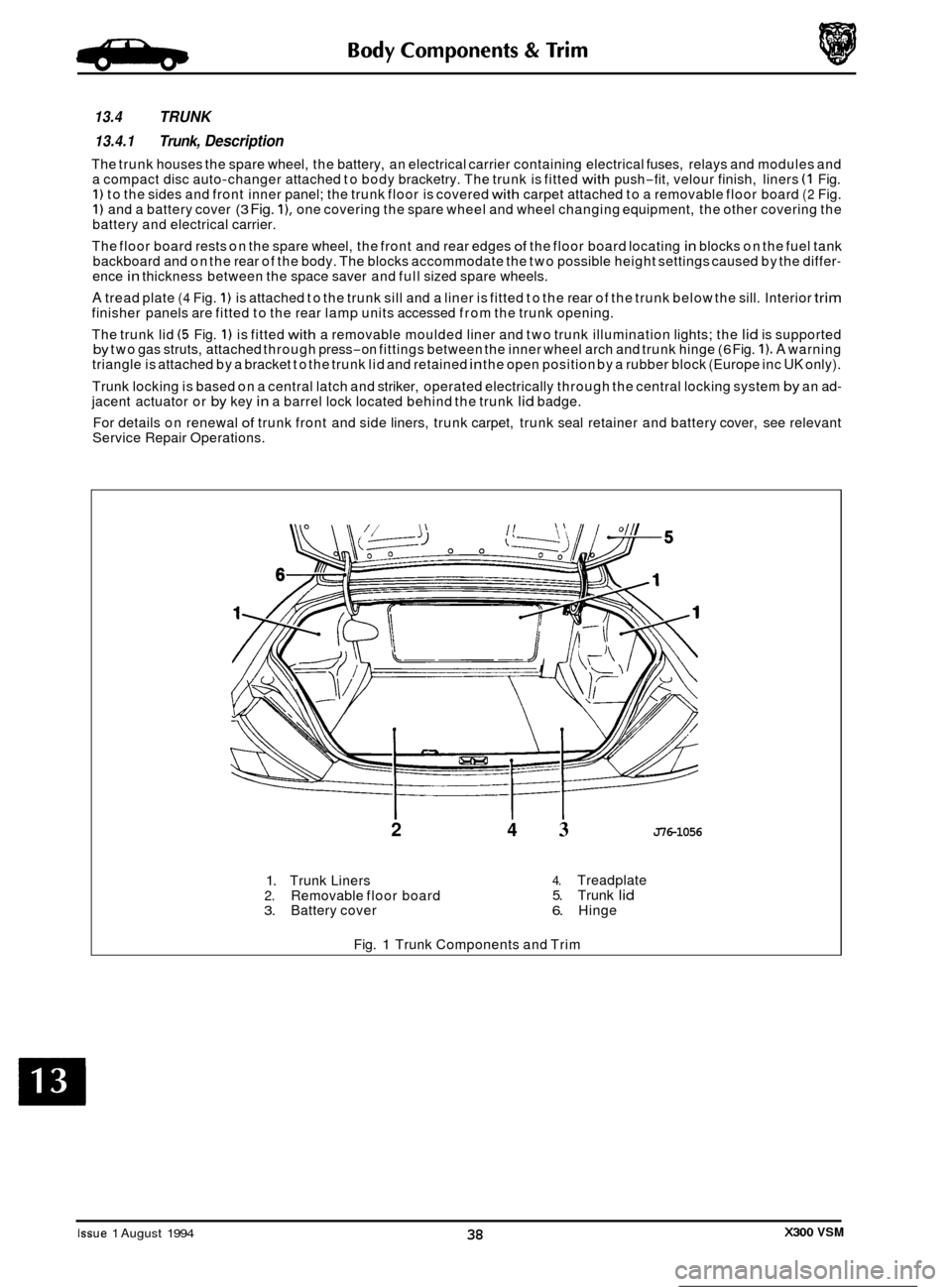
13.4 TRUNK
13.4.1 Trunk, Description
The trunk houses the spare wheel, the battery, an electrical carrier containing electrical fuses, relays and modules and
a compact disc auto-changer attached to body bracketry. The trunk is fitted with push-fit, velour finish, liners (1 Fig. 1) to the sides and front inner panel; the trunk floor is covered with carpet attached to a removable floor board (2 Fig. 1) and a battery cover (3 Fig. I), one covering the spare wheel and wheel changing equipment, the other covering the
battery and electrical carrier.
The floor board rests on the spare wheel, the front and rear edges
of the floor board locating in blocks on the fuel tank
backboard and on the rear of the body. The blocks accommodate the two possible height settings caused by the differ- ence in thickness between the space saver and full sized spare wheels.
A tread plate (4 Fig. 1) is attached to the trunk sill and a liner is fitted to the rear of the trunk below the sill. Interior trim finisher panels are fitted to the rear lamp units accessed from the trunk opening.
The trunk lid
(5 Fig. 1) is fitted with a removable moulded liner and two trunk illumination lights; the lid is supported by two gas struts, attached through press-on fittings between the inner wheel arch and trunk hinge (6 Fig. 1). A warning
triangle is attached by a bracket to the trunk lid and retained in the open position by a rubber block (Europe inc UK only).
Trunk locking is based on a central latch and striker, operated electrically through the central locking system
by an ad- jacent actuator or by key in a barrel lock located behind the trunk lid badge.
For details on renewal
of trunk front and side liners, trunk carpet, trunk seal retainer and battery cover, see relevant
Service Repair Operations.
2 4 3 J76-1056
1. Trunk Liners 2. Removable floor board 3. Battery cover
4. Treadplate 5. Trunk lid 6. Hinge
Fig.
1 Trunk Components and Trim
Issue 1 August 1994 X300 VSM 38
Page 302 of 521
Body Components & Trim
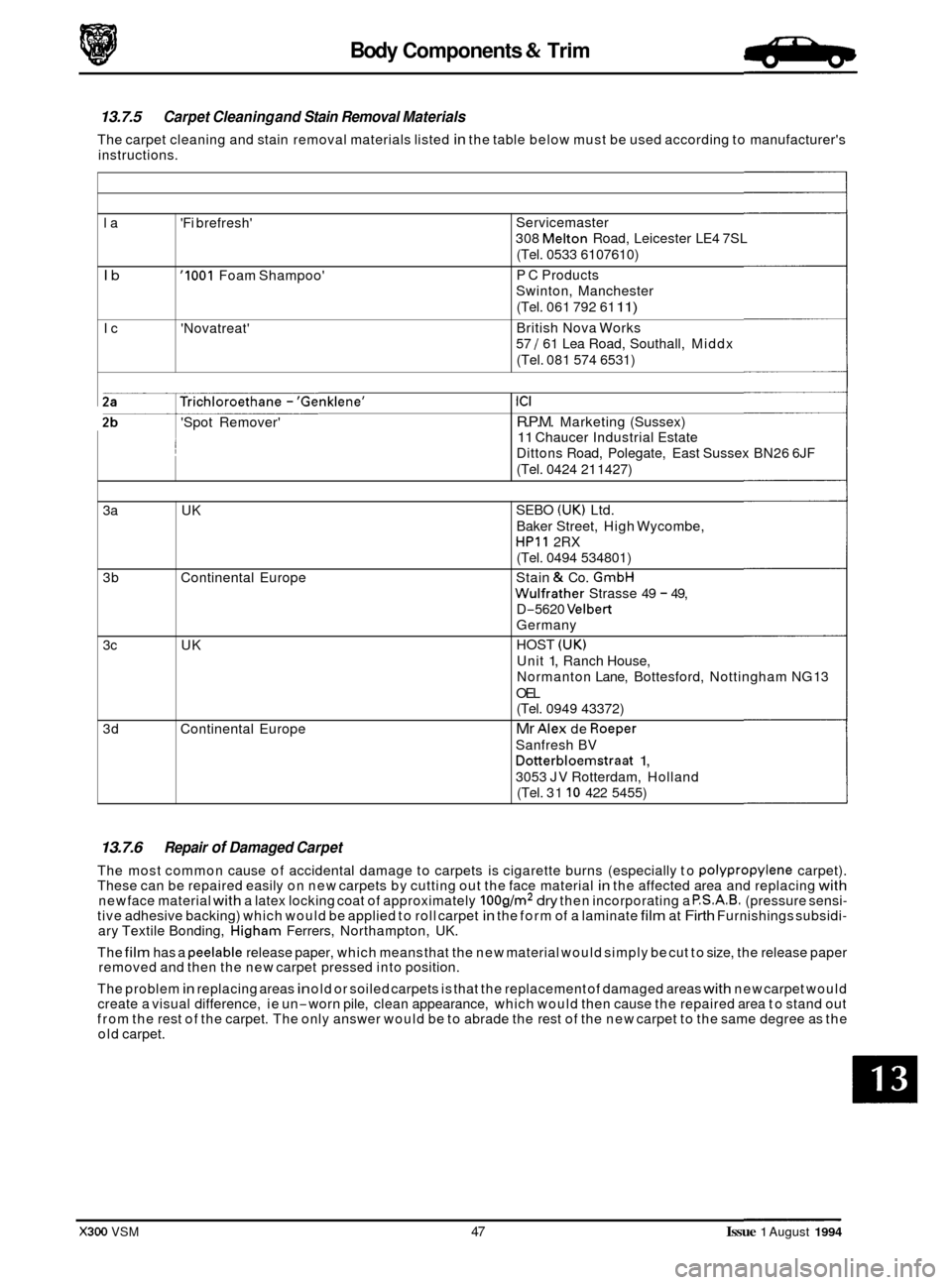
la 'Fi brefresh'
Ib '1001 Foam Shampoo'
Ic 'Novatreat'
13.7.5 Carpet Cleaning and Stain Removal Materials
The carpet cleaning and stain removal materials listed in the table below must be used according to manufacturer's
instructions.
Servicemaster
308
Melton Road, Leicester LE4 7SL
(Tel. 0533 6107610)
P C Products
Swinton, Manchester
(Tel. 061 792 61
11)
British Nova Works
57
/ 61 Lea Road, Southall, Middx
(Tel. 081 574 6531)
Trichloroethane - 'Genklene'
'Spot Remover' ~
ICI
R.P.M. Marketing
(Sussex)
11 Chaucer Industrial Estate
Dittons Road, Polegate, East Sussex BN26 6JF
(Tel. 0424 21 1427)
13.7.6 Repair of Damaged Carpet
The most common cause of accidental damage to carpets is cigarette burns (especially to polypropylene carpet).
These can be repaired easily on new carpets by cutting out the face material in the affected area and replacing with new face material with a latex locking coat of approximately 100g/m2 dry then incorporating a P.S.A.B. (pressure sensi- tive adhesive backing) which would be applied to roll carpet in the form of a laminate film at Firth Furnishings subsidi- ary Textile Bonding, Higham Ferrers, Northampton, UK.
The
film has a peelable release paper, which means that the new material would simply be cut to size, the release paper
removed and then the new carpet pressed into position.
The problem
in replacing areas in old or soiled carpets is that the replacement of damaged areas with new carpet would
create a visual difference, ie un-worn pile, clean appearance, which would then cause the repaired area to stand out
from the rest of the carpet. The only answer would be to abrade the rest of the new carpet to the same degree as the
old carpet.
3a
UK
3b Continental Europe
3c UK
3d Continental Europe
X300 VSM 47 Issue 1 August 1994
SEBO (UK) Ltd.
Baker Street, High Wycombe,
HPll 2RX
(Tel. 0494 534801)
Stain
& Co. GmbH
Wulfrather Strasse 49 - 49,
D
-5620 Velbert
Germany
HOST
(UK)
Unit 1, Ranch House,
Normanton Lane, Bottesford, Nottingham NG 13
OEL (Tel. 0949 43372)
Mr Alex de Roeper
Sanfresh BV
Dotterbloemstraat 1,
3053 JV Rotterdam, Holland
(Tel. 31
10 422 5455)
Page 312 of 521
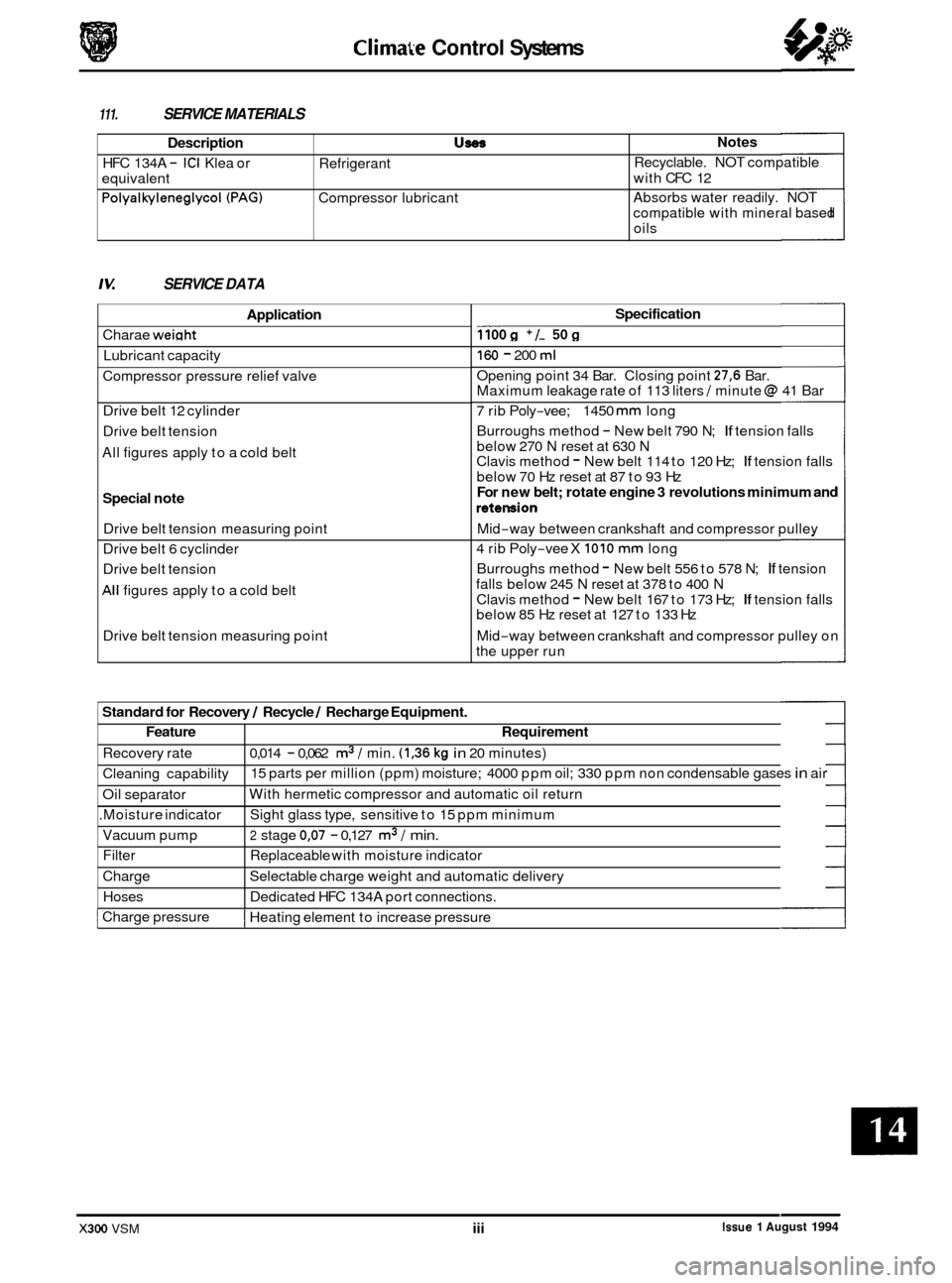
Climate Control Systems
Description U-
HFC 134A - ICI Klea or
equivalent
Polyalkyleneglycol (PAG) Compressor lubricant
Refrigerant
111.
Notes
Recyclable. NOT
compatible
with CFC 12
Absorbs water readily. NOT
compatible with mineral based
oils
SERVICE MATERIALS
Standard for Recovery I Recycle 1 Recharge Equipment.
Recovery rate
Cleaning capability
Oil separator
.Moisture indicator
Vacuum pump
Filter Replaceable with moisture indicator
Charge Hoses
Feature Requirement
0,014 - 0,062 m3 / min. (1,36 kg in 20 minutes)
15 parts per million (ppm) moisture; 4000 ppm oil; 330 ppm non condensable gases
in air
With hermetic compressor and automatic oil return
Sight glass type, sensitive to 15 ppm minimum
2 stage 0,07 - 0,127 m3 I min.
Selectable charge weight and automatic delivery
Dedicated HFC 134A port connections.
Iv. SERVICE DATA
Application
Charae weight
Lubricant capacity
Compressor pressure relief valve
Drive belt 12 cylinder
Drive belt tension
All figures apply to a cold belt
Special note
Drive belt tension measuring point
Drive belt 6 cyclinder
Drive belt tension
All figures apply to a cold belt
Drive belt tension measuring point
Specification
160 - 200 ml
Opening point 34 Bar. Closing point 27,6 Bar.
Maximum leakage rate of 113 liters 1 minute @ 41 Bar
7 rib Poly
-vee; 1450 mm long
Burroughs method
- New belt 790 N; If tension falls
below 270 N reset at 630 N
Clavis method
- New belt 114 to 120 Hz; If tension falls
below 70 Hz reset at 87 to 93 Hz
For new belt; rotate engine 3 revolutions minimum and
retension
Mid-way between crankshaft and compressor pulley ~
4
rib Poly-vee X 1010 mm long
Burroughs method
- New belt 556 to 578 N; If tension
falls below 245 N reset at 378 to 400
N
Clavis method - New belt 167 to 173 Hz; If tension falls
below 85 Hz reset at 127 to 133 Hz
Mid
-way between crankshaft and compressor pulley on
the upper run
1 Charge pressure I Heating element to increase pressure
Issue 1 August 1994 X300 VSM iii