ignition JAGUAR XJ6 1997 2.G User Guide
[x] Cancel search | Manufacturer: JAGUAR, Model Year: 1997, Model line: XJ6, Model: JAGUAR XJ6 1997 2.GPages: 227, PDF Size: 7.2 MB
Page 39 of 227
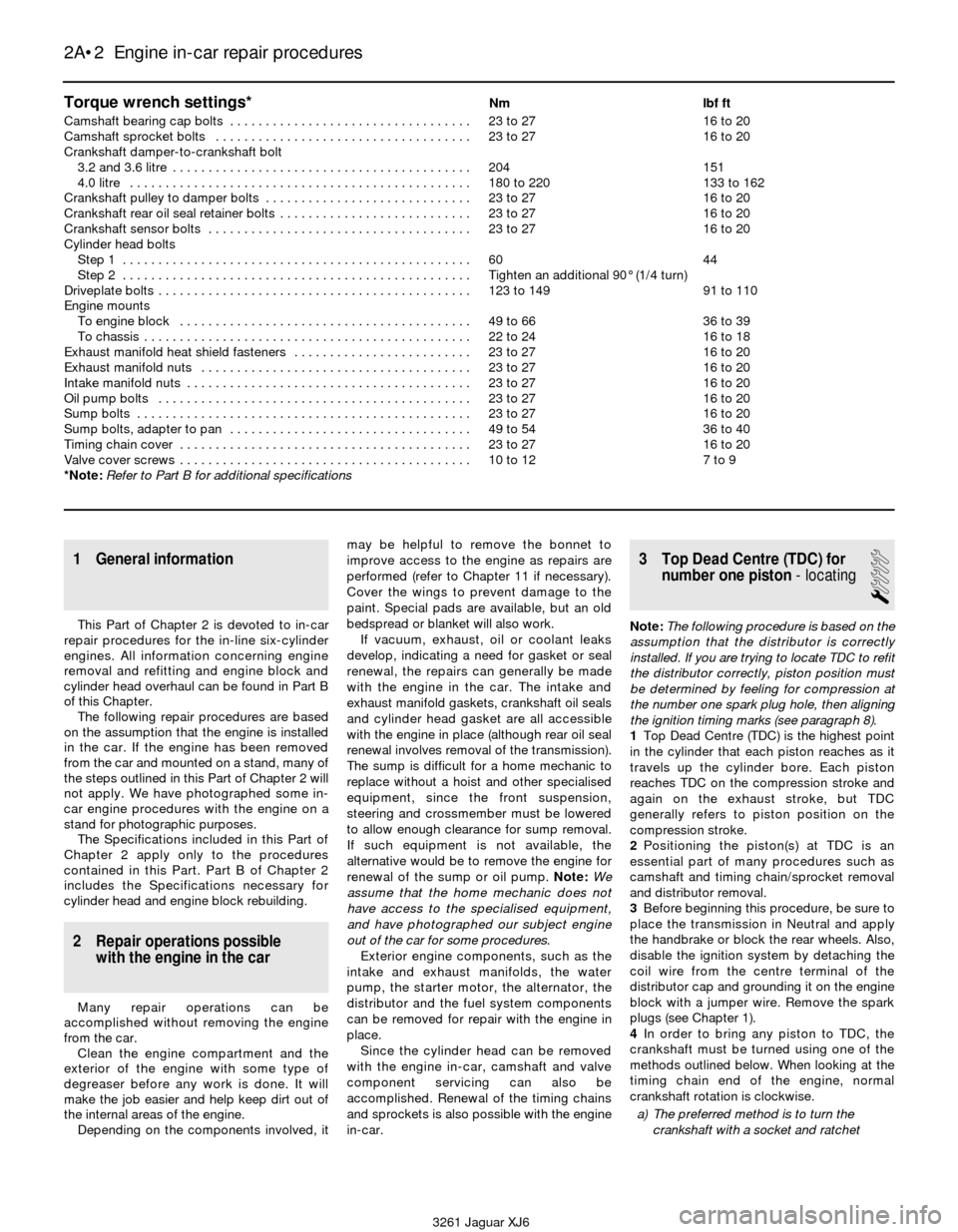
Torque wrench settings*Nm lbf ft
Camshaft bearing cap bolts . . . . . . . . . . . . . . . . . . . . . . . . . . . . . . . . . . 23 to 27 16 to 20
Camshaft sprocket bolts . . . . . . . . . . . . . . . . . . . . . . . . . . . . . . . . . . . . 23 to 27 16 to 20
Crankshaft damper-to-crankshaft bolt
3.2 and 3.6 litre . . . . . . . . . . . . . . . . . . . . . . . . . . . . . . . . . . . . . . . . . . 204 151
4.0 litre . . . . . . . . . . . . . . . . . . . . . . . . . . . . . . . . . . . . . . . . . . . . . . . . 180 to 220 133 to 162
Crankshaft pulley to damper bolts . . . . . . . . . . . . . . . . . . . . . . . . . . . . . 23 to 27 16 to 20
Crankshaft rear oil seal retainer bolts . . . . . . . . . . . . . . . . . . . . . . . . . . . 23 to 27 16 to 20
Crankshaft sensor bolts . . . . . . . . . . . . . . . . . . . . . . . . . . . . . . . . . . . . . 23 to 27 16 to 20
Cylinder head bolts
Step 1 . . . . . . . . . . . . . . . . . . . . . . . . . . . . . . . . . . . . . . . . . . . . . . . . . 60 44
Step 2 . . . . . . . . . . . . . . . . . . . . . . . . . . . . . . . . . . . . . . . . . . . . . . . . . Tighten an additional 90° (1/4 turn)
Driveplate bolts . . . . . . . . . . . . . . . . . . . . . . . . . . . . . . . . . . . . . . . . . . . . 123 to 149 91 to 110
Engine mounts
To engine block . . . . . . . . . . . . . . . . . . . . . . . . . . . . . . . . . . . . . . . . . 49 to 66 36 to 39
To chassis . . . . . . . . . . . . . . . . . . . . . . . . . . . . . . . . . . . . . . . . . . . . . . 22 to 24 16 to 18
Exhaust manifold heat shield fasteners . . . . . . . . . . . . . . . . . . . . . . . . . 23 to 27 16 to 20
Exhaust manifold nuts . . . . . . . . . . . . . . . . . . . . . . . . . . . . . . . . . . . . . . 23 to 27 16 to 20
Intake manifold nuts . . . . . . . . . . . . . . . . . . . . . . . . . . . . . . . . . . . . . . . . 23 to 27 16 to 20
Oil pump bolts . . . . . . . . . . . . . . . . . . . . . . . . . . . . . . . . . . . . . . . . . . . . 23 to 27 16 to 20
Sump bolts . . . . . . . . . . . . . . . . . . . . . . . . . . . . . . . . . . . . . . . . . . . . . . . 23 to 27 16 to 20
Sump bolts, adapter to pan . . . . . . . . . . . . . . . . . . . . . . . . . . . . . . . . . . 49 to 54 36 to 40
Timing chain cover . . . . . . . . . . . . . . . . . . . . . . . . . . . . . . . . . . . . . . . . . 23 to 27 16 to 20
Valve cover screws . . . . . . . . . . . . . . . . . . . . . . . . . . . . . . . . . . . . . . . . . 10 to 12 7 to 9
*Note:Refer to Part B for additional specifications
2A•2 Engine in-car repair procedures
3261 Jaguar XJ6
1 General information
This Part of Chapter 2 is devoted to in-car
repair procedures for the in-line six-cylinder
engines. All information concerning engine
removal and refitting and engine block and
cylinder head overhaul can be found in Part B
of this Chapter.
The following repair procedures are based
on the assumption that the engine is installed
in the car. If the engine has been removed
from the car and mounted on a stand, many of
the steps outlined in this Part of Chapter 2 will
not apply. We have photographed some in-
car engine procedures with the engine on a
stand for photographic purposes.
The Specifications included in this Part of
Chapter 2 apply only to the procedures
contained in this Part. Part B of Chapter 2
includes the Specifications necessary for
cylinder head and engine block rebuilding.
2 Repair operations possible
with the engine in the car
Many repair operations can be
accomplished without removing the engine
from the car.
Clean the engine compartment and the
exterior of the engine with some type of
degreaser before any work is done. It will
make the job easier and help keep dirt out of
the internal areas of the engine.
Depending on the components involved, itmay be helpful to remove the bonnet to
improve access to the engine as repairs are
performed (refer to Chapter 11 if necessary).
Cover the wings to prevent damage to the
paint. Special pads are available, but an old
bedspread or blanket will also work.
If vacuum, exhaust, oil or coolant leaks
develop, indicating a need for gasket or seal
renewal, the repairs can generally be made
with the engine in the car. The intake and
exhaust manifold gaskets, crankshaft oil seals
and cylinder head gasket are all accessible
with the engine in place (although rear oil seal
renewal involves removal of the transmission).
The sump is difficult for a home mechanic to
replace without a hoist and other specialised
equipment, since the front suspension,
steering and crossmember must be lowered
to allow enough clearance for sump removal.
If such equipment is not available, the
alternative would be to remove the engine for
renewal of the sump or oil pump. Note:We
assume that the home mechanic does not
have access to the specialised equipment,
and have photographed our subject engine
out of the car for some procedures.
Exterior engine components, such as the
intake and exhaust manifolds, the water
pump, the starter motor, the alternator, the
distributor and the fuel system components
can be removed for repair with the engine in
place.
Since the cylinder head can be removed
with the engine in-car, camshaft and valve
component servicing can also be
accomplished. Renewal of the timing chains
and sprockets is also possible with the engine
in-car.
3 Top Dead Centre (TDC) for
number one piston- locating
1
Note:The following procedure is based on the
assumption that the distributor is correctly
installed. If you are trying to locate TDC to refit
the distributor correctly, piston position must
be determined by feeling for compression at
the number one spark plug hole, then aligning
the ignition timing marks (see paragraph 8).
1Top Dead Centre (TDC) is the highest point
in the cylinder that each piston reaches as it
travels up the cylinder bore. Each piston
reaches TDC on the compression stroke and
again on the exhaust stroke, but TDC
generally refers to piston position on the
compression stroke.
2Positioning the piston(s) at TDC is an
essential part of many procedures such as
camshaft and timing chain/sprocket removal
and distributor removal.
3Before beginning this procedure, be sure to
place the transmission in Neutral and apply
the handbrake or block the rear wheels. Also,
disable the ignition system by detaching the
coil wire from the centre terminal of the
distributor cap and grounding it on the engine
block with a jumper wire. Remove the spark
plugs (see Chapter 1).
4In order to bring any piston to TDC, the
crankshaft must be turned using one of the
methods outlined below. When looking at the
timing chain end of the engine, normal
crankshaft rotation is clockwise.
a) The preferred method is to turn the
crankshaft with a socket and ratchet
Page 40 of 227
attached to the bolt threaded into the
front of the crankshaft. Apply pressure on
the bolt in a clockwise direction only.
Never turn the bolt anti-clockwise.
b) A remote starter switch, which may save
some time, can also be used. Follow the
instructions included with the switch.
Once the piston is close to TDC, use a
socket and ratchet as described in the
previous paragraph.
c) If an assistant is available to turn the
ignition switch to the Start position in
short bursts, you can get the piston close
to TDC without a remote starter switch.
Make sure your assistant is out of the car,
away from the ignition switch, then use a
socket and ratchet as described in
Paragraph a) to complete the procedure.
5Note the position of the terminal for the
number one spark plug lead on the distributor
cap. If the terminal isn’t marked, follow the
plug lead from the number one cylinder spark
plug to the cap.
6Use a felt-tip pen or chalk to make a mark
on the distributor body directly under the
number one terminal (see Chapter 5).
7Detach the cap from the distributor and set
it aside (see Chapter 1 if necessary).
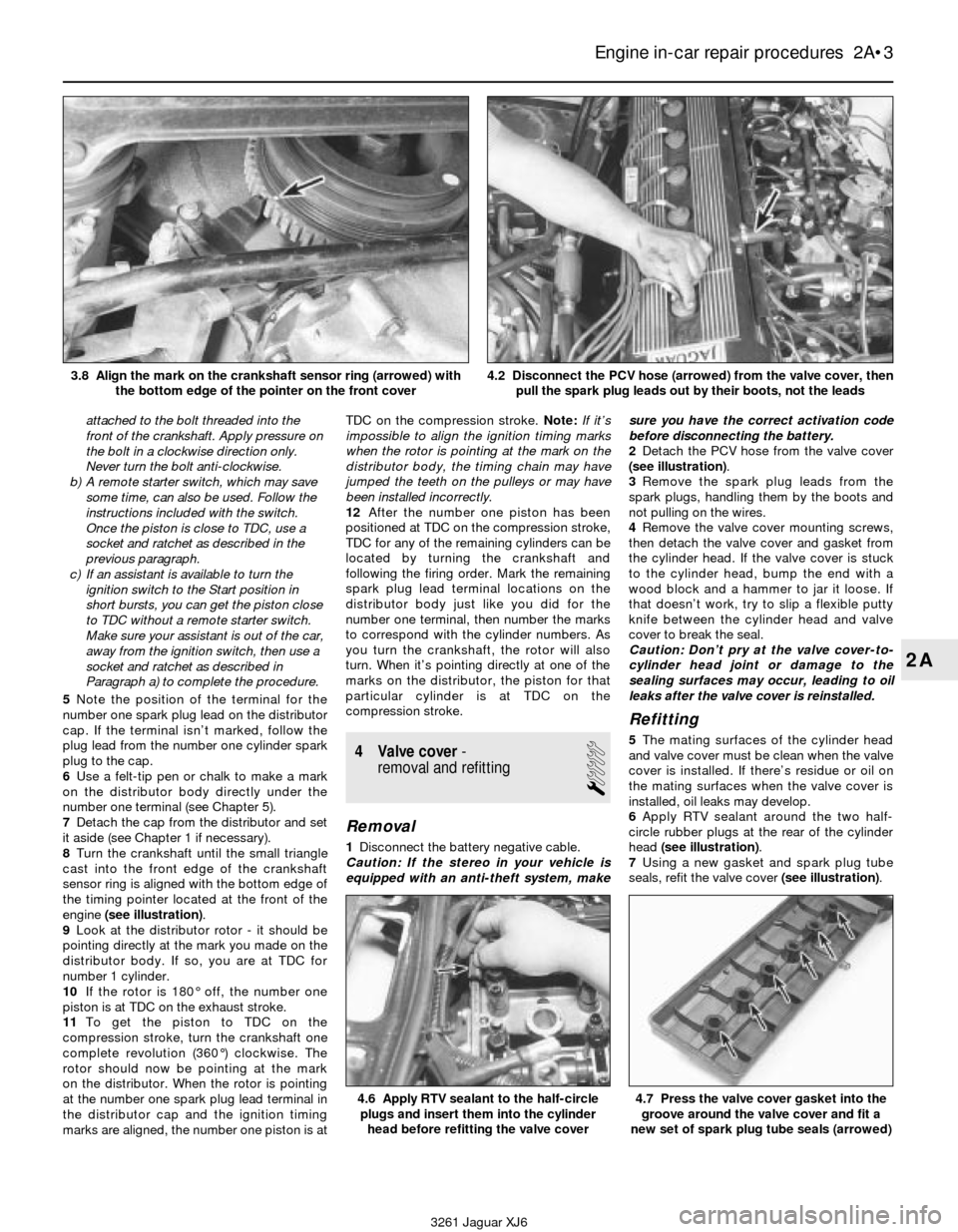
8Turn the crankshaft until the small triangle
cast into the front edge of the crankshaft
sensor ring is aligned with the bottom edge of
the timing pointer located at the front of the
engine(see illustration).
9Look at the distributor rotor - it should be
pointing directly at the mark you made on the
distributor body. If so, you are at TDC for
number 1 cylinder.
10If the rotor is 180° off, the number one
piston is at TDC on the exhaust stroke.
11To get the piston to TDC on the
compression stroke, turn the crankshaft one
complete revolution (360°) clockwise. The
rotor should now be pointing at the mark
on the distributor. When the rotor is pointing
at the number one spark plug lead terminal in
the distributor cap and the ignition timing
marks are aligned, the number one piston is atTDC on the compression stroke. Note:If it’s
impossible to align the ignition timing marks
when the rotor is pointing at the mark on the
distributor body, the timing chain may have
jumped the teeth on the pulleys or may have
been installed incorrectly.
12After the number one piston has been
positioned at TDC on the compression stroke,
TDC for any of the remaining cylinders can be
located by turning the crankshaft and
following the firing order. Mark the remaining
spark plug lead terminal locations on the
distributor body just like you did for the
number one terminal, then number the marks
to correspond with the cylinder numbers. As
you turn the crankshaft, the rotor will also
turn. When it’s pointing directly at one of the
marks on the distributor, the piston for that
particular cylinder is at TDC on the
compression stroke.
4 Valve cover-
removal and refitting
1
Removal
1Disconnect the battery negative cable.
Caution: If the stereo in your vehicle is
equipped with an anti-theft system, makesure you have the correct activation code
before disconnecting the battery.
2Detach the PCV hose from the valve cover
(see illustration).
3Remove the spark plug leads from the
spark plugs, handling them by the boots and
not pulling on the wires.
4Remove the valve cover mounting screws,
then detach the valve cover and gasket from
the cylinder head. If the valve cover is stuck
to the cylinder head, bump the end with a
wood block and a hammer to jar it loose. If
that doesn’t work, try to slip a flexible putty
knife between the cylinder head and valve
cover to break the seal.
Caution: Don’t pry at the valve cover-to-
cylinder head joint or damage to the
sealing surfaces may occur, leading to oil
leaks after the valve cover is reinstalled.
Refitting
5The mating surfaces of the cylinder head
and valve cover must be clean when the valve
cover is installed. If there’s residue or oil on
the mating surfaces when the valve cover is
installed, oil leaks may develop.
6Apply RTV sealant around the two half-
circle rubber plugs at the rear of the cylinder
head (see illustration).
7Using a new gasket and spark plug tube
seals, refit the valve cover (see illustration).
Engine in-car repair procedures 2A•3
2A
4.6 Apply RTV sealant to the half-circle
plugs and insert them into the cylinder
head before refitting the valve cover4.7 Press the valve cover gasket into the
groove around the valve cover and fit a
new set of spark plug tube seals (arrowed)
3261 Jaguar XJ6 3.8 Align the mark on the crankshaft sensor ring (arrowed) with
the bottom edge of the pointer on the front cover
4.2 Disconnect the PCV hose (arrowed) from the valve cover, then
pull the spark plug leads out by their boots, not the leads
Page 51 of 227
21There are variations in cooling holes in
some models. Before refitting the cylinder
head gasket, carefully check all of the
passages and bolt holes in the new cylinder
head gasket to be sure it matches your engine
block. Also make sure the new cylinder head
gasket you’re using is equipped with the
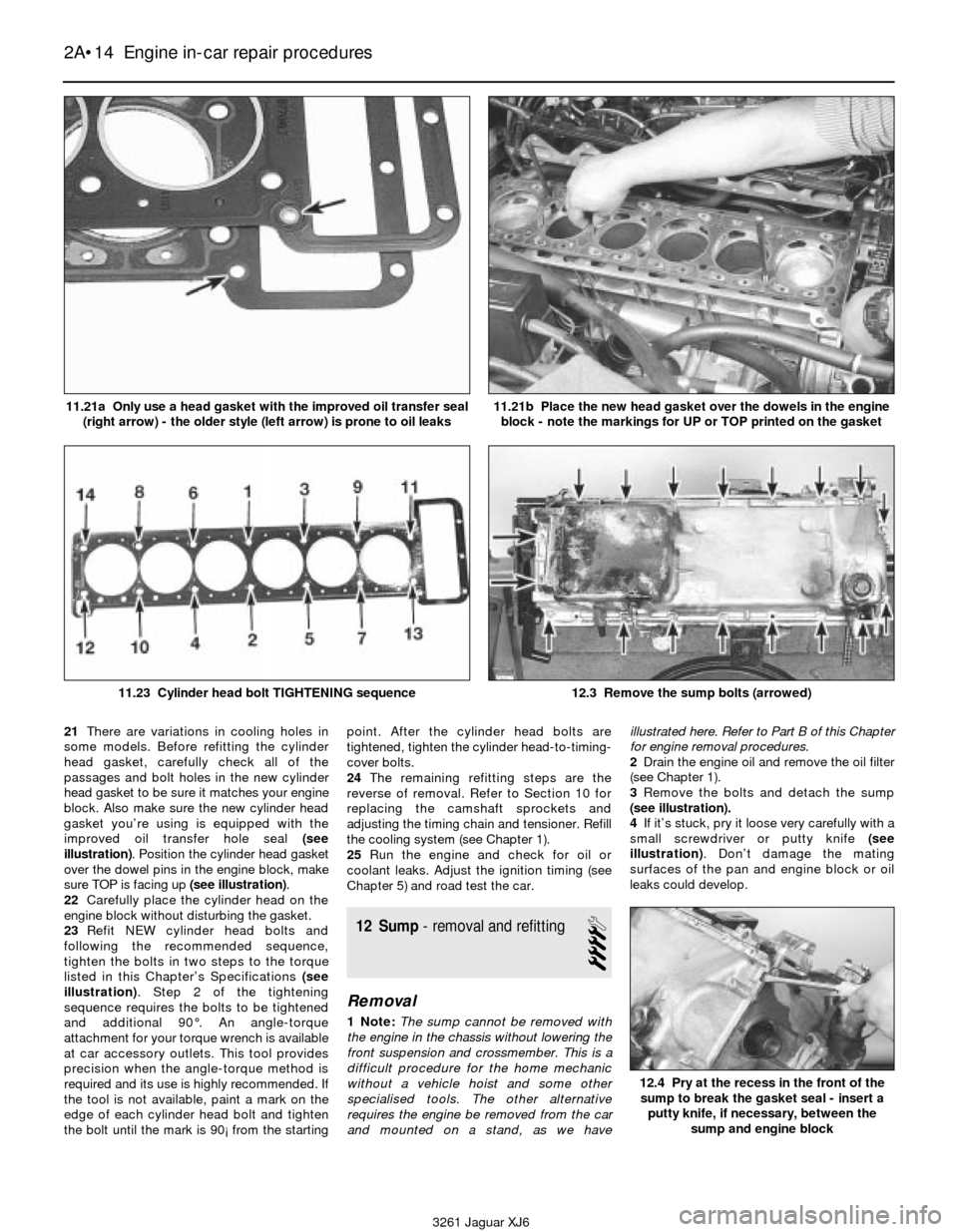
improved oil transfer hole seal (see
illustration). Position the cylinder head gasket
over the dowel pins in the engine block, make
sure TOP is facing up (see illustration).
22Carefully place the cylinder head on the
engine block without disturbing the gasket.
23Refit NEW cylinder head bolts and
following the recommended sequence,
tighten the bolts in two steps to the torque
listed in this Chapter’s Specifications(see
illustration). Step 2 of the tightening
sequence requires the bolts to be tightened
and additional 90°. An angle-torque
attachment for your torque wrench is available
at car accessory outlets. This tool provides
precision when the angle-torque method is
required and its use is highly recommended. If
the tool is not available, paint a mark on the
edge of each cylinder head bolt and tighten
the bolt until the mark is 90¡ from the startingpoint. After the cylinder head bolts are
tightened, tighten the cylinder head-to-timing-
cover bolts.
24The remaining refitting steps are the
reverse of removal. Refer to Section 10 for
replacing the camshaft sprockets and
adjusting the timing chain and tensioner. Refill
the cooling system (see Chapter 1).
25Run the engine and check for oil or
coolant leaks. Adjust the ignition timing (see
Chapter 5) and road test the car.
12 Sump- removal and refitting
4
Removal
1 Note:The sump cannot be removed with
the engine in the chassis without lowering the
front suspension and crossmember. This is a
difficult procedure for the home mechanic
without a vehicle hoist and some other
specialised tools. The other alternative
requires the engine be removed from the car
and mounted on a stand, as we haveillustrated here. Refer to Part B of this Chapter
for engine removal procedures.
2Drain the engine oil and remove the oil filter
(see Chapter 1).
3Remove the bolts and detach the sump
(see illustration).
4If it’s stuck, pry it loose very carefully with a
small screwdriver or putty knife (see
illustration). Don’t damage the mating
surfaces of the pan and engine block or oil
leaks could develop.
2A•14 Engine in-car repair procedures
3261 Jaguar XJ6 11.21a Only use a head gasket with the improved oil transfer seal
(right arrow) - the older style (left arrow) is prone to oil leaks
11.21b Place the new head gasket over the dowels in the engine
block - note the markings for UP or TOP printed on the gasket
11.23 Cylinder head bolt TIGHTENING sequence12.3 Remove the sump bolts (arrowed)
12.4 Pry at the recess in the front of the
sump to break the gasket seal - insert a
putty knife, if necessary, between the
sump and engine block
Page 58 of 227
rebuilt engine or short block, some rebuilders
will not warranty their engines unless the
radiator has been professionally flushed. Also,
we don’t recommend overhauling the oil
pump - always refit a new one when an engine
is rebuilt.
Before beginning the engine overhaul, read
through the entire procedure to familiarise
yourself with the scope and requirements of
the job. Overhauling an engine isn’t difficult,
but it is time-consuming. Plan on the vehicle
being tied up for a minimum of two weeks,
especially if parts must be taken to an
automotive machine workshop for repair or
reconditioning. Check on availability of parts
and make sure that any necessary special
tools and equipment are obtained in advance.
Most work can be done with typical hand
tools, although a number of precision
measuring tools are required for inspecting
parts to determine if they must be renewed.
Often an automotive machine workshop will
handle the inspection of parts and offer
advice concerning reconditioning and
renewal. Note:Always wait until the engine
has been completely dismantled and all
components, especially the engine block,
have been inspected before deciding what
service and repair operations must be
performed by an automotive machine
workshop. Since the engine block’s condition
will be the major factor to consider when
determining whether to overhaul the original
engine or buy a rebuilt one, never purchase
parts or have machine work done on other
components until the engine block has been
thoroughly inspected. As a general rule, time
is the primary cost of an overhaul, so it
doesn’t pay to refit worn or substandard
parts.
If it turns out that a number of major
components are beyond reconditioning, it
may be cost effective to buy a factory-rebuilt
engine from a Jaguar dealership.
As a final note, to ensure maximum life and
minimum trouble from a rebuilt engine,
everything must be assembled with care in a
spotlessly-clean environment.
3 Vacuum gauge
diagnostic checks
2
A vacuum gauge provides valuable
information about what is going on in the
engine at a low cost. You can check for worn
rings or cylinder walls, leaking cylinder head or
intake manifold gaskets, incorrect carburettor
adjustments, restricted exhaust, stuck or
burned valves, weak valve springs, improper
ignition or valve timing and ignition problems.
Unfortunately, vacuum gauge readings are
easy to misinterpret, so they should be used
with other tests to confirm the diagnosis.
Both the absolute readings and the rate of
needle movement are important for accurate
interpretation. Most gauges measure vacuumin inches of mercury (in-Hg). As vacuum
increases (or atmospheric pressure decreases),
the reading will decrease. Also, for every
1000 foot increase in elevation above sea level;
the gauge readings will decrease about one
inch of mercury.
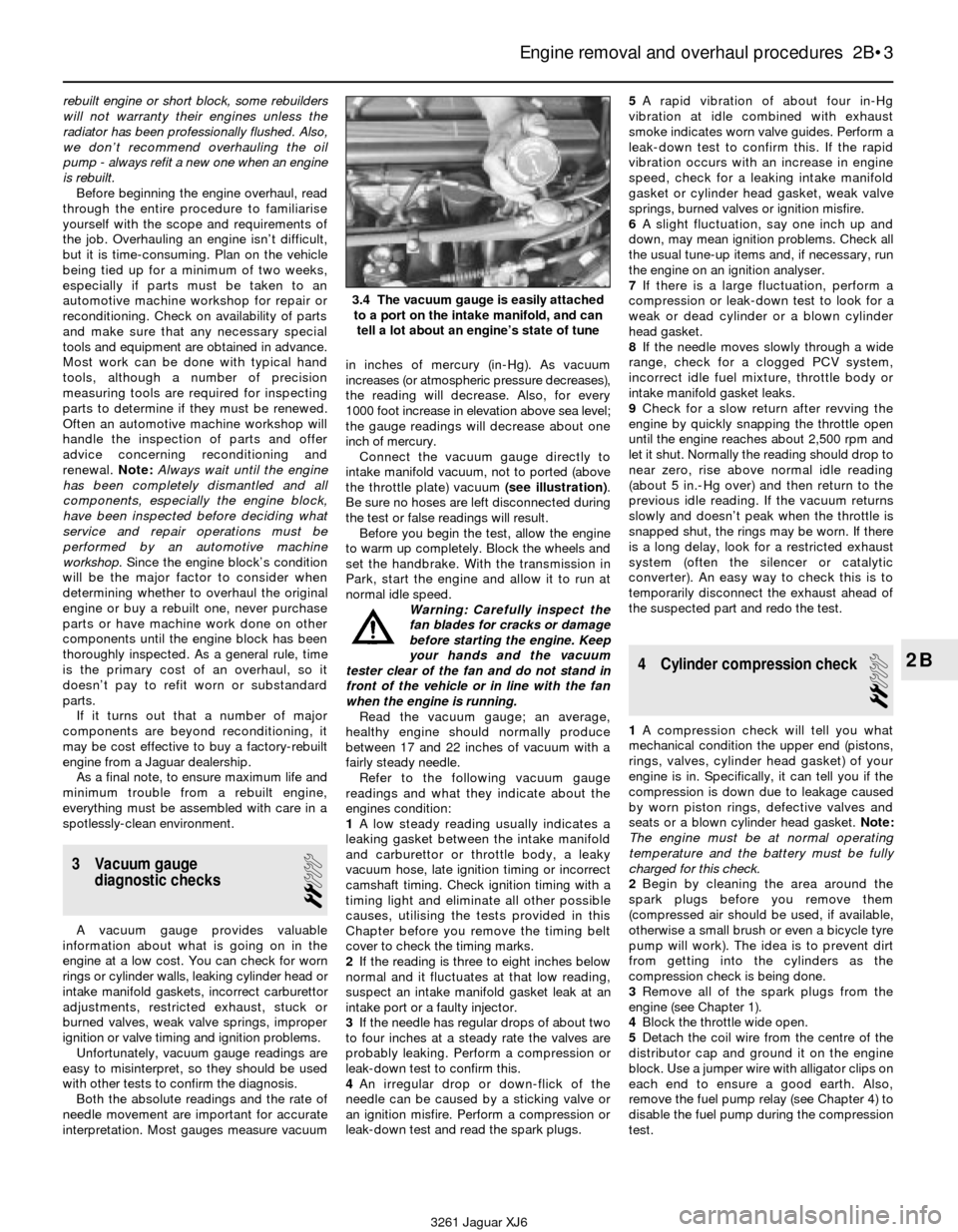
Connect the vacuum gauge directly to
intake manifold vacuum, not to ported (above
the throttle plate) vacuum (see illustration).
Be sure no hoses are left disconnected during
the test or false readings will result.
Before you begin the test, allow the engine
to warm up completely. Block the wheels and
set the handbrake. With the transmission in
Park, start the engine and allow it to run at
normal idle speed.
Warning: Carefully inspect the
fan blades for cracks or damage
before starting the engine. Keep
your hands and the vacuum
tester clear of the fan and do not stand in
front of the vehicle or in line with the fan
when the engine is running.
Read the vacuum gauge; an average,
healthy engine should normally produce
between 17 and 22 inches of vacuum with a
fairly steady needle.
Refer to the following vacuum gauge
readings and what they indicate about the
engines condition:
1A low steady reading usually indicates a
leaking gasket between the intake manifold
and carburettor or throttle body, a leaky
vacuum hose, late ignition timing or incorrect
camshaft timing. Check ignition timing with a
timing light and eliminate all other possible
causes, utilising the tests provided in this
Chapter before you remove the timing belt
cover to check the timing marks.
2If the reading is three to eight inches below
normal and it fluctuates at that low reading,
suspect an intake manifold gasket leak at an
intake port or a faulty injector.
3If the needle has regular drops of about two
to four inches at a steady rate the valves are
probably leaking. Perform a compression or
leak-down test to confirm this.
4An irregular drop or down-flick of the
needle can be caused by a sticking valve or
an ignition misfire. Perform a compression or
leak-down test and read the spark plugs.5A rapid vibration of about four in-Hg
vibration at idle combined with exhaust
smoke indicates worn valve guides. Perform a
leak-down test to confirm this. If the rapid
vibration occurs with an increase in engine
speed, check for a leaking intake manifold
gasket or cylinder head gasket, weak valve
springs, burned valves or ignition misfire.
6A slight fluctuation, say one inch up and
down, may mean ignition problems. Check all
the usual tune-up items and, if necessary, run
the engine on an ignition analyser.
7If there is a large fluctuation, perform a
compression or leak-down test to look for a
weak or dead cylinder or a blown cylinder
head gasket.
8If the needle moves slowly through a wide
range, check for a clogged PCV system,
incorrect idle fuel mixture, throttle body or
intake manifold gasket leaks.
9Check for a slow return after revving the
engine by quickly snapping the throttle open
until the engine reaches about 2,500 rpm and
let it shut. Normally the reading should drop to
near zero, rise above normal idle reading
(about 5 in.-Hg over) and then return to the
previous idle reading. If the vacuum returns
slowly and doesn’t peak when the throttle is
snapped shut, the rings may be worn. If there
is a long delay, look for a restricted exhaust
system (often the silencer or catalytic
converter). An easy way to check this is to
temporarily disconnect the exhaust ahead of
the suspected part and redo the test.
4 Cylinder compression check
2
1A compression check will tell you what
mechanical condition the upper end (pistons,
rings, valves, cylinder head gasket) of your
engine is in. Specifically, it can tell you if the
compression is down due to leakage caused
by worn piston rings, defective valves and
seats or a blown cylinder head gasket. Note:
The engine must be at normal operating
temperature and the battery must be fully
charged for this check.
2Begin by cleaning the area around the
spark plugs before you remove them
(compressed air should be used, if available,
otherwise a small brush or even a bicycle tyre
pump will work). The idea is to prevent dirt
from getting into the cylinders as the
compression check is being done.
3Remove all of the spark plugs from the
engine (see Chapter 1).
4Block the throttle wide open.
5Detach the coil wire from the centre of the
distributor cap and ground it on the engine
block. Use a jumper wire with alligator clips on
each end to ensure a good earth. Also,
remove the fuel pump relay (see Chapter 4) to
disable the fuel pump during the compression
test.
Engine removal and overhaul procedures 2B•3
2B
3.4 The vacuum gauge is easily attached
to a port on the intake manifold, and can
tell a lot about an engine’s state of tune
3261 Jaguar XJ6
Page 68 of 227
in the back sides of the ring grooves and the
oil hole in the lower end of each rod are clear.
6If the pistons and cylinder walls aren’t
damaged or worn excessively, and if the
engine block is not rebored, new pistons
won’t be necessary. Normal piston wear
appears as even vertical wear on the piston
thrust surfaces and slight looseness of the top
ring in its groove. New piston rings, however,
should always be used when an engine is
rebuilt.
7Carefully inspect each piston for cracks
around the skirt, at the pin bosses and at the
ring lands.
Caution: Some early 1988 3.6 litre engines
(before engine no. 9D 121113) have
incorrectly-stamped pistons. On these, the
word FRONT is actually stamped on the rear
of the pistons. Correct pistons will have the
cast arrows on the inside of the skirt to your
left when facing the word FRONT.
8Look for scoring and scuffing on the thrust
faces of the skirt, holes in the piston crown
and burned areas at the edge of the crown. If
the skirt is scored or scuffed, the engine may
have been suffering from overheating and/or
abnormal combustion, which caused
excessively high operating temperatures. The
cooling and lubrication systems should be
checked thoroughly. A hole in the piston
crown is an indication that abnormal
combustion (pre-ignition) was occurring.
Burned areas at the edge of the piston crown
are usually evidence of spark knock
(detonation). If any of the above problems
exist, the causes must be corrected or the
damage will occur again. The causes may
include intake air leaks, incorrect air/fuel
mixture, incorrect ignition timing and EGR
system malfunctions.
9Corrosion of the piston, in the form of small
pits, indicates that coolant is leaking into the
combustion chamber and/or the crankcase.
Again, the cause must be corrected or the
problem may persist in the rebuilt engine.
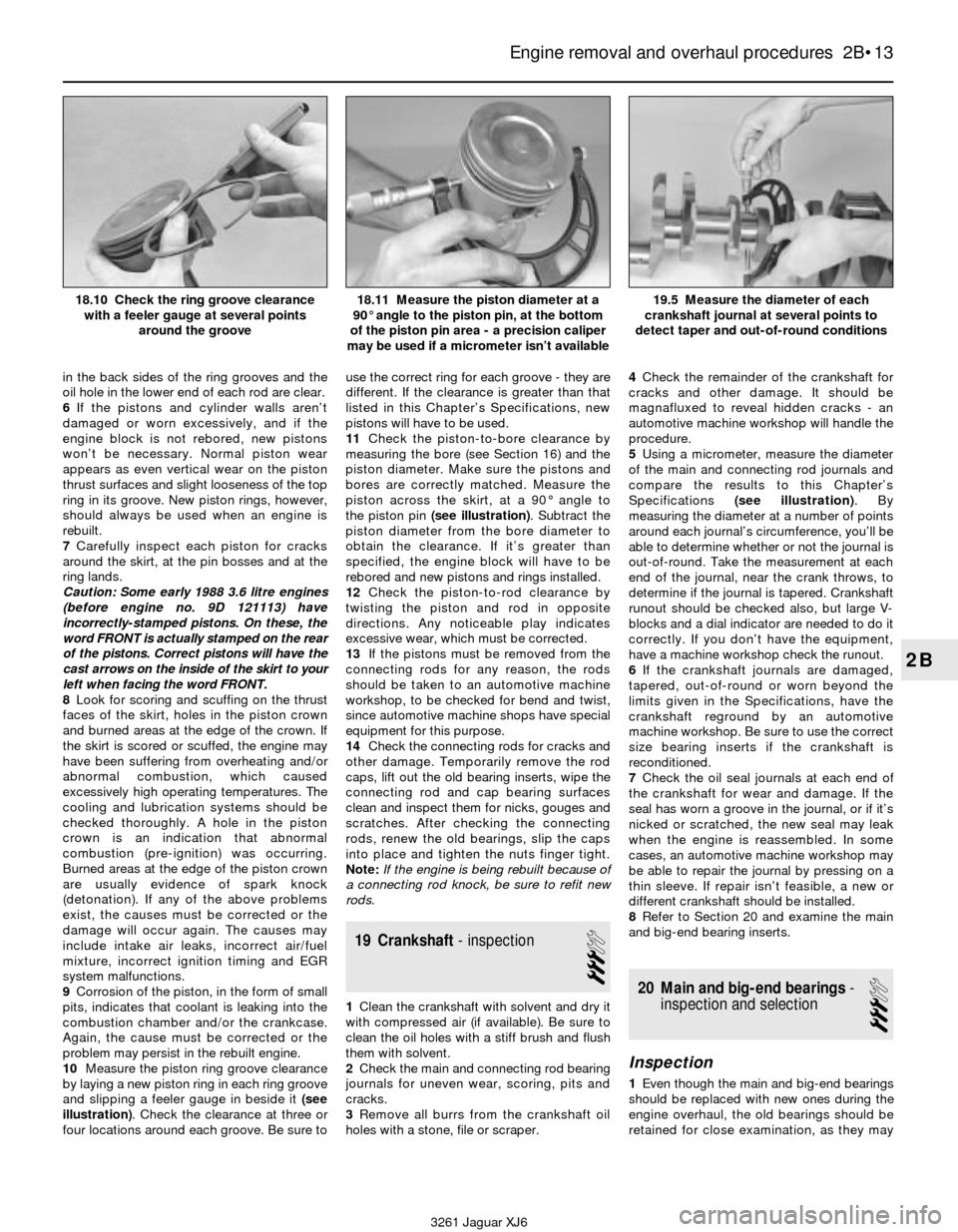
10Measure the piston ring groove clearance
by laying a new piston ring in each ring groove
and slipping a feeler gauge in beside it (see
illustration). Check the clearance at three or
four locations around each groove. Be sure touse the correct ring for each groove - they are
different. If the clearance is greater than that
listed in this Chapter’s Specifications, new
pistons will have to be used.
11Check the piston-to-bore clearance by
measuring the bore (see Section 16) and the
piston diameter. Make sure the pistons and
bores are correctly matched. Measure the
piston across the skirt, at a 90° angle to
the piston pin (see illustration). Subtract the
piston diameter from the bore diameter to
obtain the clearance. If it’s greater than
specified, the engine block will have to be
rebored and new pistons and rings installed.
12Check the piston-to-rod clearance by
twisting the piston and rod in opposite
directions. Any noticeable play indicates
excessive wear, which must be corrected.
13If the pistons must be removed from the
connecting rods for any reason, the rods
should be taken to an automotive machine
workshop, to be checked for bend and twist,
since automotive machine shops have special
equipment for this purpose.
14Check the connecting rods for cracks and
other damage. Temporarily remove the rod
caps, lift out the old bearing inserts, wipe the
connecting rod and cap bearing surfaces
clean and inspect them for nicks, gouges and
scratches. After checking the connecting
rods, renew the old bearings, slip the caps
into place and tighten the nuts finger tight.
Note:If the engine is being rebuilt because of
a connecting rod knock, be sure to refit new
rods.
19 Crankshaft- inspection
3
1Clean the crankshaft with solvent and dry it
with compressed air (if available). Be sure to
clean the oil holes with a stiff brush and flush
them with solvent.
2Check the main and connecting rod bearing
journals for uneven wear, scoring, pits and
cracks.
3Remove all burrs from the crankshaft oil
holes with a stone, file or scraper.4Check the remainder of the crankshaft for
cracks and other damage. It should be
magnafluxed to reveal hidden cracks - an
automotive machine workshop will handle the
procedure.
5Using a micrometer, measure the diameter
of the main and connecting rod journals and
compare the results to this Chapter’s
Specifications (see illustration). By
measuring the diameter at a number of points
around each journal’s circumference, you’ll be
able to determine whether or not the journal is
out-of-round. Take the measurement at each
end of the journal, near the crank throws, to
determine if the journal is tapered. Crankshaft
runout should be checked also, but large V-
blocks and a dial indicator are needed to do it
correctly. If you don’t have the equipment,
have a machine workshop check the runout.
6If the crankshaft journals are damaged,
tapered, out-of-round or worn beyond the
limits given in the Specifications, have the
crankshaft reground by an automotive
machine workshop. Be sure to use the correct
size bearing inserts if the crankshaft is
reconditioned.
7Check the oil seal journals at each end of
the crankshaft for wear and damage. If the
seal has worn a groove in the journal, or if it’s
nicked or scratched, the new seal may leak
when the engine is reassembled. In some
cases, an automotive machine workshop may
be able to repair the journal by pressing on a
thin sleeve. If repair isn’t feasible, a new or
different crankshaft should be installed.
8Refer to Section 20 and examine the main
and big-end bearing inserts.
20 Main and big-end bearings-
inspection and selection
3
Inspection
1Even though the main and big-end bearings
should be replaced with new ones during the
engine overhaul, the old bearings should be
retained for close examination, as they may
Engine removal and overhaul procedures 2B•13
2B
19.5 Measure the diameter of each
crankshaft journal at several points to
detect taper and out-of-round conditions
3261 Jaguar XJ6 18.10 Check the ring groove clearance
with a feeler gauge at several points
around the groove
18.11 Measure the piston diameter at a
90° angle to the piston pin, at the bottom
of the piston pin area - a precision caliper
may be used if a micrometer isn’t available
Page 73 of 227
working up to it in three steps. Note:Use the
old bolts for this step (save the new bolts for
final refitting).Use a thin-wall socket to avoid
erroneous torque readings that can result if
the socket is wedged between the rod cap
and nut. If the socket tends to wedge itself
between the nut and the cap, lift up on it
slightly until it no longer contacts the cap. Do
not rotate the crankshaft at any time during
this operation.
16Remove the nuts and detach the rod cap,
being careful not to disturb the Plastigauge.
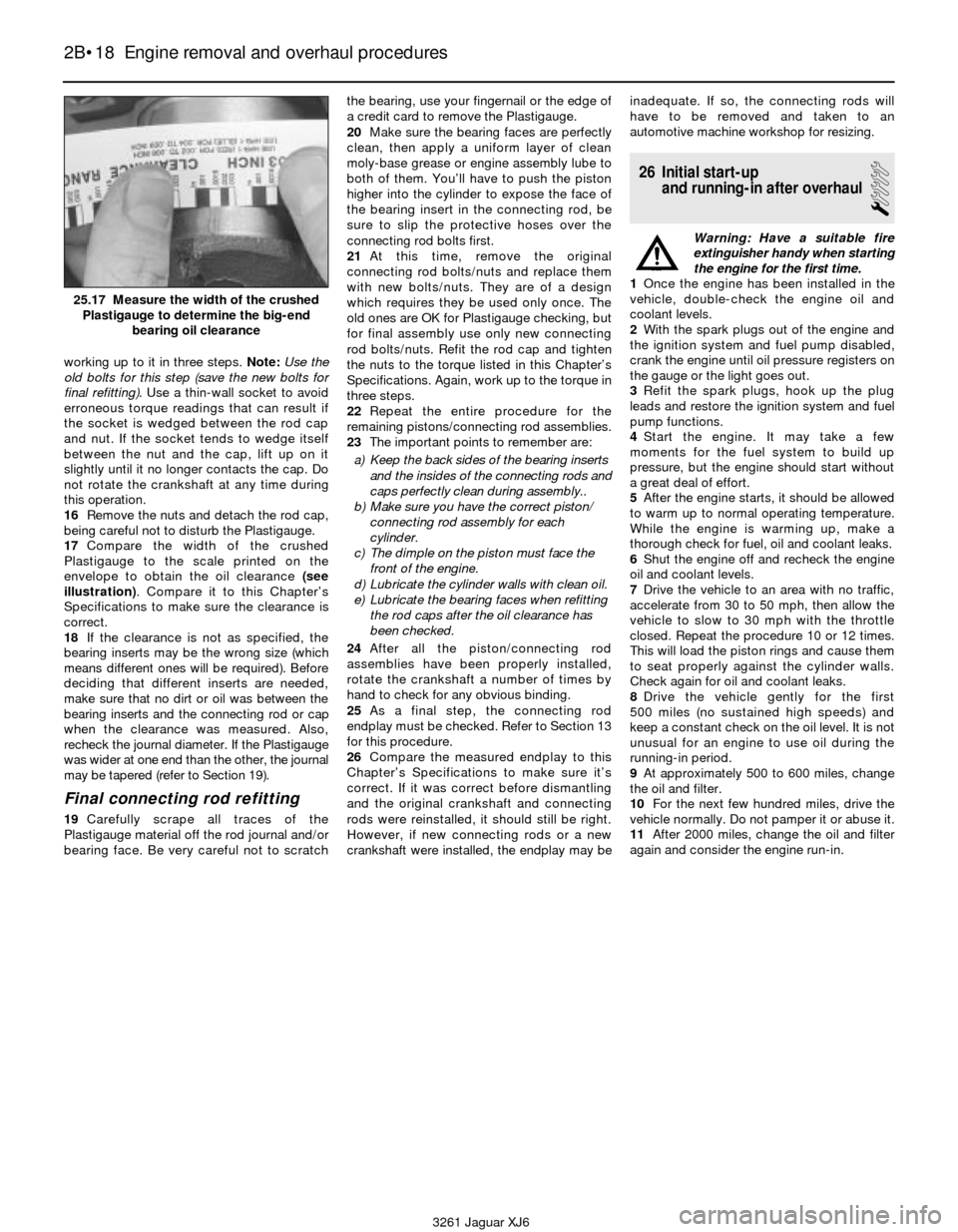
17Compare the width of the crushed
Plastigauge to the scale printed on the
envelope to obtain the oil clearance (see
illustration). Compare it to this Chapter’s
Specifications to make sure the clearance is
correct.
18If the clearance is not as specified, the
bearing inserts may be the wrong size (which
means different ones will be required). Before
deciding that different inserts are needed,
make sure that no dirt or oil was between the
bearing inserts and the connecting rod or cap
when the clearance was measured. Also,
recheck the journal diameter. If the Plastigauge
was wider at one end than the other, the journal
may be tapered (refer to Section 19).
Final connecting rod refitting
19Carefully scrape all traces of the
Plastigauge material off the rod journal and/or
bearing face. Be very careful not to scratchthe bearing, use your fingernail or the edge of
a credit card to remove the Plastigauge.
20Make sure the bearing faces are perfectly
clean, then apply a uniform layer of clean
moly-base grease or engine assembly lube to
both of them. You’ll have to push the piston
higher into the cylinder to expose the face of
the bearing insert in the connecting rod, be
sure to slip the protective hoses over the
connecting rod bolts first.
21At this time, remove the original
connecting rod bolts/nuts and replace them
with new bolts/nuts. They are of a design
which requires they be used only once. The
old ones are OK for Plastigauge checking, but
for final assembly use only new connecting
rod bolts/nuts. Refit the rod cap and tighten
the nuts to the torque listed in this Chapter’s
Specifications. Again, work up to the torque in
three steps.
22Repeat the entire procedure for the
remaining pistons/connecting rod assemblies.
23The important points to remember are:
a) Keep the back sides of the bearing inserts
and the insides of the connecting rods and
caps perfectly clean during assembly..
b) Make sure you have the correct piston/
connecting rod assembly for each
cylinder.
c) The dimple on the piston must face the
front of the engine.
d) Lubricate the cylinder walls with clean oil.
e) Lubricate the bearing faces when refitting
the rod caps after the oil clearance has
been checked.
24After all the piston/connecting rod
assemblies have been properly installed,
rotate the crankshaft a number of times by
hand to check for any obvious binding.
25As a final step, the connecting rod
endplay must be checked. Refer to Section 13
for this procedure.
26Compare the measured endplay to this
Chapter’s Specifications to make sure it’s
correct. If it was correct before dismantling
and the original crankshaft and connecting
rods were reinstalled, it should still be right.
However, if new connecting rods or a new
crankshaft were installed, the endplay may beinadequate. If so, the connecting rods will
have to be removed and taken to an
automotive machine workshop for resizing.
26 Initial start-up
and running-in after overhaul
1
Warning: Have a suitable fire
extinguisher handy when starting
the engine for the first time.
1Once the engine has been installed in the
vehicle, double-check the engine oil and
coolant levels.
2With the spark plugs out of the engine and
the ignition system and fuel pump disabled,
crank the engine until oil pressure registers on
the gauge or the light goes out.
3Refit the spark plugs, hook up the plug
leads and restore the ignition system and fuel
pump functions.
4Start the engine. It may take a few
moments for the fuel system to build up
pressure, but the engine should start without
a great deal of effort.
5After the engine starts, it should be allowed
to warm up to normal operating temperature.
While the engine is warming up, make a
thorough check for fuel, oil and coolant leaks.
6Shut the engine off and recheck the engine
oil and coolant levels.
7Drive the vehicle to an area with no traffic,
accelerate from 30 to 50 mph, then allow the
vehicle to slow to 30 mph with the throttle
closed. Repeat the procedure 10 or 12 times.
This will load the piston rings and cause them
to seat properly against the cylinder walls.
Check again for oil and coolant leaks.
8Drive the vehicle gently for the first
500 miles (no sustained high speeds) and
keep a constant check on the oil level. It is not
unusual for an engine to use oil during the
running-in period.
9At approximately 500 to 600 miles, change
the oil and filter.
10For the next few hundred miles, drive the
vehicle normally. Do not pamper it or abuse it.
11After 2000 miles, change the oil and filter
again and consider the engine run-in.
2B•18 Engine removal and overhaul procedures
25.17 Measure the width of the crushed
Plastigauge to determine the big-end
bearing oil clearance
3261 Jaguar XJ6
Page 76 of 227
pull loose, tap it with a soft-faced hammer. Do
not use a screwdriver between the cover and
the thermostat housing.
8Remove the thermostat, noting the
direction in which it was installed in the
housing, and thoroughly clean the sealing
surfaces.
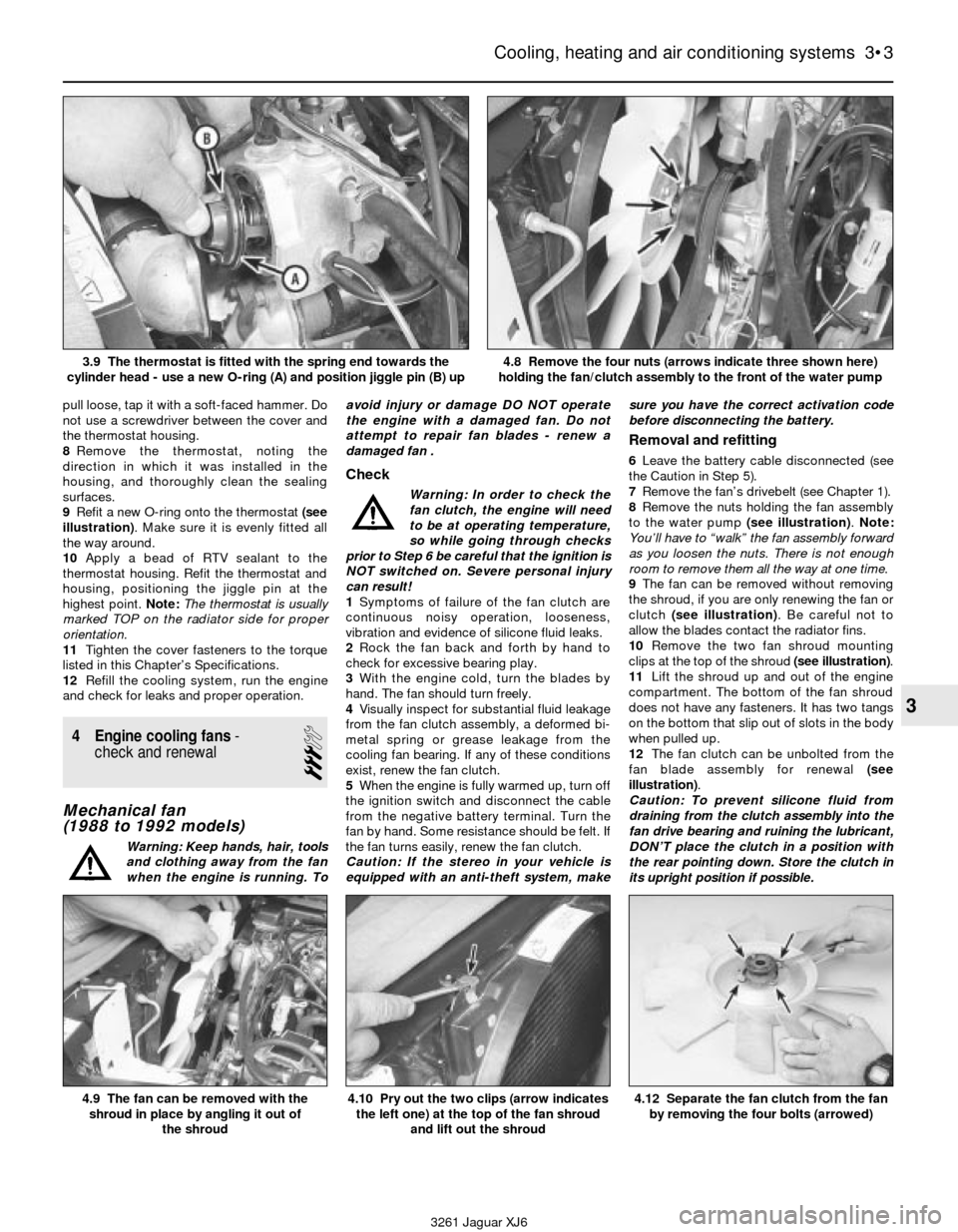
9Refit a new O-ring onto the thermostat (see
illustration). Make sure it is evenly fitted all
the way around.
10Apply a bead of RTV sealant to the
thermostat housing. Refit the thermostat and
housing, positioning the jiggle pin at the
highest point. Note:The thermostat is usually
marked TOP on the radiator side for proper
orientation.
11Tighten the cover fasteners to the torque
listed in this Chapter’s Specifications.
12Refill the cooling system, run the engine
and check for leaks and proper operation.
4 Engine cooling fans-
check and renewal
3
Mechanical fan
(1988 to 1992 models)
Warning: Keep hands, hair, tools
and clothing away from the fan
when the engine is running. Toavoid injury or damage DO NOT operate
the engine with a damaged fan. Do not
attempt to repair fan blades - renew a
damaged fan .
Check
Warning: In order to check the
fan clutch, the engine will need
to be at operating temperature,
so while going through checks
prior to Step 6 be careful that the ignition is
NOT switched on. Severe personal injury
can result!
1Symptoms of failure of the fan clutch are
continuous noisy operation, looseness,
vibration and evidence of silicone fluid leaks.
2Rock the fan back and forth by hand to
check for excessive bearing play.
3With the engine cold, turn the blades by
hand. The fan should turn freely.
4Visually inspect for substantial fluid leakage
from the fan clutch assembly, a deformed bi-
metal spring or grease leakage from the
cooling fan bearing. If any of these conditions
exist, renew the fan clutch.
5When the engine is fully warmed up, turn off
the ignition switch and disconnect the cable
from the negative battery terminal. Turn the
fan by hand. Some resistance should be felt. If
the fan turns easily, renew the fan clutch.
Caution: If the stereo in your vehicle is
equipped with an anti-theft system, makesure you have the correct activation code
before disconnecting the battery.
Removal and refitting
6Leave the battery cable disconnected (see
the Caution in Step 5).
7Remove the fan’s drivebelt (see Chapter 1).
8Remove the nuts holding the fan assembly
to the water pump (see illustration). Note:
You’ll have to “walk” the fan assembly forward
as you loosen the nuts. There is not enough
room to remove them all the way at one time.
9The fan can be removed without removing
the shroud, if you are only renewing the fan or
clutch (see illustration). Be careful not to
allow the blades contact the radiator fins.
10Remove the two fan shroud mounting
clips at the top of the shroud (see illustration).
11Lift the shroud up and out of the engine
compartment. The bottom of the fan shroud
does not have any fasteners. It has two tangs
on the bottom that slip out of slots in the body
when pulled up.
12The fan clutch can be unbolted from the
fan blade assembly for renewal (see
illustration).
Caution: To prevent silicone fluid from
draining from the clutch assembly into the
fan drive bearing and ruining the lubricant,
DON’T place the clutch in a position with
the rear pointing down. Store the clutch in
its upright position if possible.
Cooling, heating and air conditioning systems 3•3
3
4.9 The fan can be removed with the
shroud in place by angling it out of
the shroud4.10 Pry out the two clips (arrow indicates
the left one) at the top of the fan shroud
and lift out the shroud
3261 Jaguar XJ6 3.9 The thermostat is fitted with the spring end towards the
cylinder head - use a new O-ring (A) and position jiggle pin (B) up
4.8 Remove the four nuts (arrows indicate three shown here)
holding the fan/clutch assembly to the front of the water pump
4.12 Separate the fan clutch from the fan
by removing the four bolts (arrowed)
Page 77 of 227

13Refitting is the reverse of removal. Tighten
the fan clutch-to-fan blade bolts and the fan
assembly-to-drive hub nut to the torque listed
in this Chapter’s Specifications.
Electric fans
Check
Warning: Keep your hands or
clothing away from the fan
blades at all times.
14On 1988 through 1992 models, a single
electric fan is mounted in front of the radiator,
controlled by a thermostatic switch. Access to
the fan is with the grille removed. The 1993
and 1994 models have a fan shroud assembly
that includes two electric fans, and a “twin”
thermostatic switch, with the assembly
mounted on the engine side of the radiator.
15If the electric fan does not come on at any
time, bypass the thermostatic switch by
disconnecting the electrical connector at the
switch and connecting the two pins with a
jumper wire (see illustration). If the fan now
operates, renew the thermostatic switch. If the
fan doesn’t operate, the problem is either the
fan relay or the fan motor. On 1993 and 1994
models with twin electric fans, jumpering one
set of connections in the plug from the switch
should make both fans operate at slow speed
(fans in series) and jumpering the other two
should run both fans at higher speed (fans in
parallel). In normal operation, the fans operate
at the higher-speed only when the air
conditioning is on, or when coolant
temperature exceeds 212° F. When the
coolant cools down to below 200° F, the fans
revert to the normal speed.
16To renew a defective thermostatic switch,
allow the vehicle to cool off and drain the
coolant (see Chapter 1). Remove the switch
from the radiator and refit the new switch.
Connect the electrical connector and test
again for proper fan operation.17To test an inoperative fan motor (one that
doesn’t come on when the engine gets hot or
when the air conditioner is on), first check the
fuses and/or fusible links (see Chapter 12).
Then disconnect the electrical connector at
the motor (refer to Chapter 11 for removal of
the grille for access on front-mounted-fan
models) and use fused jumper wires to
connect the fan directly to the battery and to
chassis ground (see illustration). If the fan
still does not work, renew the fan motor.
Warning: Do not allow the test
clips to contact each other or
any metallic part of the vehicle.
18If the motor tested OK in the previous test
but is still inoperative, then the fault lies in the
relay, fuse, or wiring. The fan relay can be
tested for continuity (see Chapter 12).
Renewal
19Disconnect the negative battery cable.
Caution: If the stereo in your vehicle is
equipped with an anti-theft system, make
sure you have the correct activation code
before disconnecting the battery.20Access the 1988 through 1992 single
electric fan with the grille removed (see
Chapter 11 for grille removal). Disconnect the
electrical connector and remove the bolts
holding the fan assembly to the body (see
illustration).
21On 1993 and 1994 models, remove the
two bolts holding the fan shroud to the top of
the radiator and lift the shroud/fans assembly
from the vehicle.
22If the fan on 1988 to 1992 models must be
renewed, renew the fan, motor and shroud as
a unit. The fan is separate from the shroud on
later models.
23Refitting is the reverse of removal. If the
thermostatic switch was renewed, refill the
cooling system.5 Radiator, expansion tank
and coolant reservoir-
removal and refitting
3
Warning: Do not start this
procedure until the engine is
completely cool.
Radiator
Removal
1Disconnect the negative battery cable.
Caution: If the stereo in your vehicle is
equipped with an anti-theft system, make
sure you have the correct activation code
before disconnecting the battery.
2Drain the coolant into a container (see
Chapter 1).
3Remove both the upper and lower radiator
hoses, and the small expansion tank hose from
the top left of the radiator (see illustration).
4Remove the cooling fan and shroud (see
Section 4).
3•4 Cooling, heating and air conditioning systems
4.20 Disconnect the fan’s electrical
connector (large arrow) and remove the
bolts (small arrows) on single-fan models -
grille is removed here
3261 Jaguar XJ6 4.15 Disconnect the electrical connector (A) from the
thermostatic switch (B) in the radiator and bypass it with a
jumper wire (C) - the fan should operate now with the ignition on
4.17 Disconnect the fan wiring connector and connect jumper
wires from there directly to the positive and negative terminals of
the battery - the purple wire’s terminal should receive the battery
power and the black wire’s terminal should be earthed
Page 80 of 227
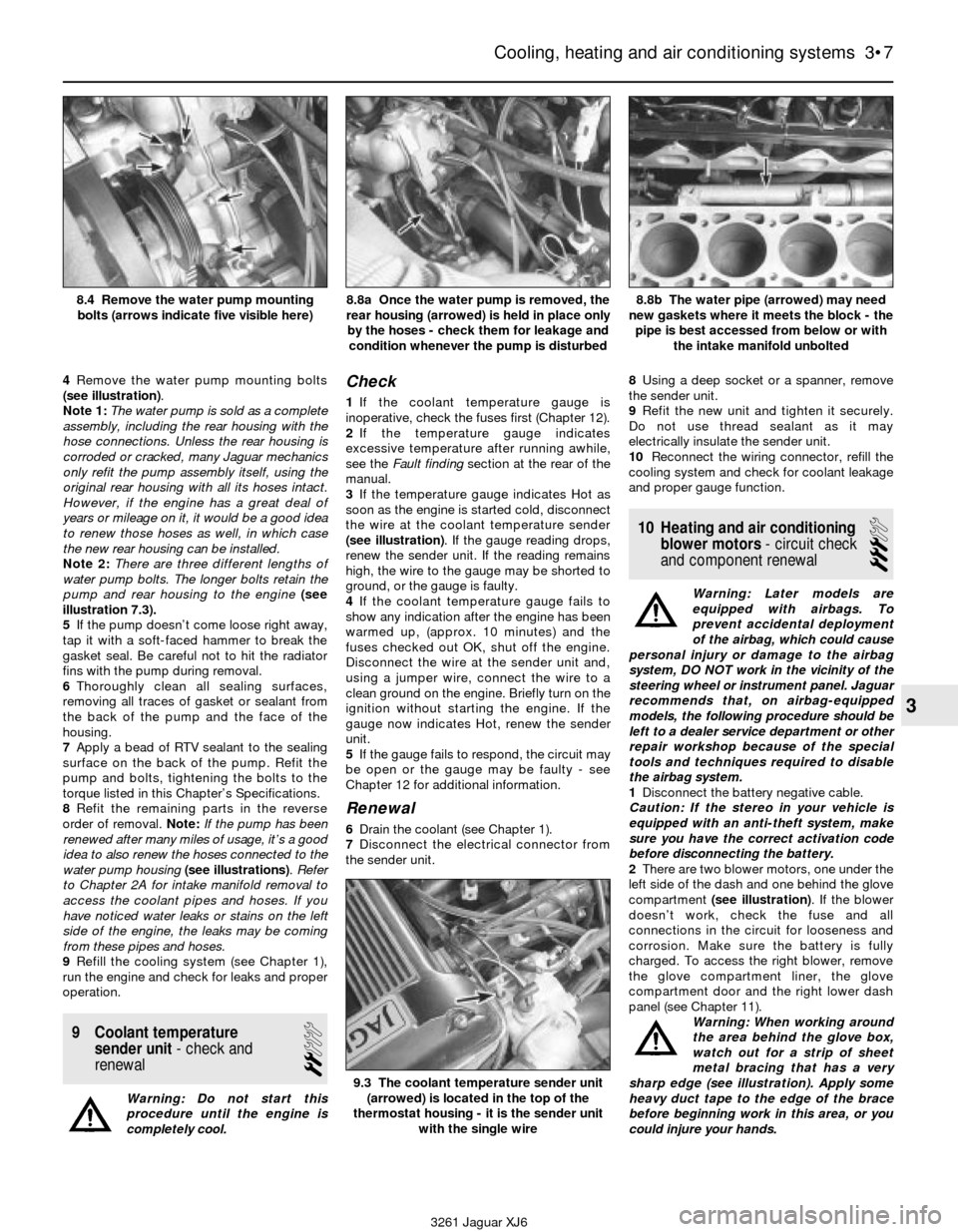
4Remove the water pump mounting bolts
(see illustration).
Note 1:The water pump is sold as a complete
assembly, including the rear housing with the
hose connections. Unless the rear housing is
corroded or cracked, many Jaguar mechanics
only refit the pump assembly itself, using the
original rear housing with all its hoses intact.
However, if the engine has a great deal of
years or mileage on it, it would be a good idea
to renew those hoses as well, in which case
the new rear housing can be installed.
Note 2:There are three different lengths of
water pump bolts. The longer bolts retain the
pump and rear housing to the engine(see
illustration 7.3).
5If the pump doesn’t come loose right away,
tap it with a soft-faced hammer to break the
gasket seal. Be careful not to hit the radiator
fins with the pump during removal.
6Thoroughly clean all sealing surfaces,
removing all traces of gasket or sealant from
the back of the pump and the face of the
housing.
7Apply a bead of RTV sealant to the sealing
surface on the back of the pump. Refit the
pump and bolts, tightening the bolts to the
torque listed in this Chapter’s Specifications.
8Refit the remaining parts in the reverse
order of removal. Note:If the pump has been
renewed after many miles of usage, it’s a good
idea to also renew the hoses connected to the
water pump housing(see illustrations). Refer
to Chapter 2A for intake manifold removal to
access the coolant pipes and hoses. If you
have noticed water leaks or stains on the left
side of the engine, the leaks may be coming
from these pipes and hoses.
9Refill the cooling system (see Chapter 1),
run the engine and check for leaks and proper
operation.
9 Coolant temperature
sender unit- check and
renewal
2
Warning: Do not start this
procedure until the engine is
completely cool.
Check
1If the coolant temperature gauge is
inoperative, check the fuses first (Chapter 12).
2If the temperature gauge indicates
excessive temperature after running awhile,
see the Fault finding section at the rear of the
manual.
3If the temperature gauge indicates Hot as
soon as the engine is started cold, disconnect
the wire at the coolant temperature sender
(see illustration). If the gauge reading drops,
renew the sender unit. If the reading remains
high, the wire to the gauge may be shorted to
ground, or the gauge is faulty.
4If the coolant temperature gauge fails to
show any indication after the engine has been
warmed up, (approx. 10 minutes) and the
fuses checked out OK, shut off the engine.
Disconnect the wire at the sender unit and,
using a jumper wire, connect the wire to a
clean ground on the engine. Briefly turn on the
ignition without starting the engine. If the
gauge now indicates Hot, renew the sender
unit.
5If the gauge fails to respond, the circuit may
be open or the gauge may be faulty - see
Chapter 12 for additional information.
Renewal
6Drain the coolant (see Chapter 1).
7Disconnect the electrical connector from
the sender unit.8Using a deep socket or a spanner, remove
the sender unit.
9Refit the new unit and tighten it securely.
Do not use thread sealant as it may
electrically insulate the sender unit.
10Reconnect the wiring connector, refill the
cooling system and check for coolant leakage
and proper gauge function.
10 Heating and air conditioning
blower motors- circuit check
and component renewal
3
Warning: Later models are
equipped with airbags. To
prevent accidental deployment
of the airbag, which could cause
personal injury or damage to the airbag
system, DO NOT work in the vicinity of the
steering wheel or instrument panel. Jaguar
recommends that, on airbag-equipped
models, the following procedure should be
left to a dealer service department or other
repair workshop because of the special
tools and techniques required to disable
the airbag system.
1Disconnect the battery negative cable.
Caution: If the stereo in your vehicle is
equipped with an anti-theft system, make
sure you have the correct activation code
before disconnecting the battery.
2There are two blower motors, one under the
left side of the dash and one behind the glove
compartment (see illustration). If the blower
doesn’t work, check the fuse and all
connections in the circuit for looseness and
corrosion. Make sure the battery is fully
charged. To access the right blower, remove
the glove compartment liner, the glove
compartment door and the right lower dash
panel (see Chapter 11).
Warning: When working around
the area behind the glove box,
watch out for a strip of sheet
metal bracing that has a very
sharp edge (see illustration). Apply some
heavy duct tape to the edge of the brace
before beginning work in this area, or you
could injure your hands.
Cooling, heating and air conditioning systems 3•7
3
8.4 Remove the water pump mounting
bolts (arrows indicate five visible here)8.8a Once the water pump is removed, the
rear housing (arrowed) is held in place only
by the hoses - check them for leakage and
condition whenever the pump is disturbed8.8b The water pipe (arrowed) may need
new gaskets where it meets the block - the
pipe is best accessed from below or with
the intake manifold unbolted
9.3 The coolant temperature sender unit
(arrowed) is located in the top of the
thermostat housing - it is the sender unit
with the single wire
3261 Jaguar XJ6
Page 85 of 227

blower at the highest setting. Open the doors
(to make sure the air conditioning system
doesn’t cycle off as soon as it cools the
passenger compartment).
9With the compressor engaged - the clutch
will make an audible click and the centre of
the clutch will rotate. After the system reaches
operating temperature, feel the two pipes
connected to the evaporator at the bulkhead
(see illustration).
10The pipe (thinner tubing) leading from the
condenser outlet to the evaporator should be
cold, and the evaporator outlet line (the
thicker tubing that leads back to the
compressor) should be slightly colder (3 to
10° F). If the evaporator outlet is considerably
warmer than the inlet, the system needs a
charge. Insert a thermometer in the centre air
distribution duct while operating the air
conditioning system - the temperature of the
output air should be 35 to 40° F below the
ambient air temperature (down to approxi-
mately 40° F). If the ambient (outside) air
temperature is very high, say 110° F, the duct
air temperature may be as high as 60° F, but
generally the air conditioning is 30 to 50° F
cooler than the ambient air. If the air isn’t as
cold as it used to be, the system probably
needs a charge. Further inspection or testing
of the system is beyond the scope of the
home mechanic and should be left to a
professional.
11Inspect the sight glass (see illustration).
If the refrigerant looks foamy when running,
it’s low. When ambient temperatures are very
hot, bubbles may show in the sight glass even
with the proper amount of refrigerant. With the
proper amount of refrigerant, when the air
conditioning is turned off, the sight glass
should show refrigerant that foams, then
clears. Note:1993 and 1994 models are
equipped with R-134a refrigerant systems and
do not have a sight glass.Heating systems
12If the air coming out of the heater vents
isn’t hot, the problem could stem from any of
the following causes:
a) The thermostat is stuck open, preventing
the engine coolant from warming up
enough to carry heat to the heater core.
Renew the thermostat (see Section 3).
b) A heater hose is blocked, preventing the
flow of coolant through the heater core.
Feel both heater hoses at the bulkhead.
They should be hot. If one of them is cold,
there is an obstruction in one of the hoses
or in the heater core, or the heater control
valve is shut. Detach the hoses and back
flush the heater core with a water hose. If
the heater core is clear but circulation is
impeded, remove the two hoses and flush
them out with a water hose.
c) If flushing fails to remove the blockage
from the heater core, the core must be
renewed.(see Section 11).
13If the blower motor speed does not
correspond to the setting selected on the
blower switch, the problem could be a badfuse, circuit, control panel or climate control
computer (see Sections 10 and 12).
14If there isn’t any air coming out of the
vents:
a) Turn the ignition ON and activate the fan
control. Place your ear at the heating/air
conditioning register (vent) and listen.
Most motors are audible. Can you hear
the motor running?
b) If you can’t (and have already verified that
the blower switch and the blower motor
resistor are good), the blower motor itself
is probably bad (see Section 10).
15If the carpet under the heater core is
damp, or if antifreeze vapour or steam is
coming through the vents, the heater core is
leaking. Remove it (see Section 11) and refit a
new unit (most radiator shops will not repair a
leaking heater core).
16Inspect the drain hose from the heat/AC
assembly at the right side of the bulkhead,
make sure it is not clogged (see illustration).
If there is a humid mist coming from the
system ducts, this hose may be plugged. In
some early models, the hose may have been
pinched during assembly or blocked with
insulation or underseal.
14 Air conditioning
receiver/drier-
removal and refitting
4
Warning: The air conditioning
system is under high pressure.
Do not loosen any hose fittings
or remove any components until
the system has been discharged. Air
conditioning refrigerant should be properly
discharged into an EPA-approved recovery/
recycling unit by a dealer service depart-
ment or an automotive air conditioning
3•12 Cooling, heating and air conditioning systems
13.16 This drain hose (arrowed) from the
heater/air conditioning unit should be kept
clear to allow drainage of condensation
3261 Jaguar XJ6 13.9 Feel the inlet (small arrow) and outlet (large arrow) pipes at
the bulkhead leading to the air conditioning evaporator (battery
removed here for clarity only)
13.11 The sight glass (arrowed) is located on the top of the
receiver/drier, to the right of the radiator