warning JAGUAR XJ6 1997 2.G Owner's Manual
[x] Cancel search | Manufacturer: JAGUAR, Model Year: 1997, Model line: XJ6, Model: JAGUAR XJ6 1997 2.GPages: 227, PDF Size: 7.2 MB
Page 62 of 227

done during the engine overhaul. Note:If the
engine was severely overheated, the cylinder
head is probably warped (see paragraph 12).
Cleaning
2Scrape all traces of old gasket material and
sealing compound off the cylinder head
gasket, intake manifold and exhaust manifold
sealing surfaces. Be very careful not to gouge
the cylinder head. Special gasket-removal
solvents that soften gaskets and make
removal much easier are available at car
accessory outlets.
3Remove all built up scale from the coolant
passages.
4Run a stiff wire brush through the various
holes to remove deposits that may have
formed in them. If there are heavy deposits in
the water passages, the bare head should be
professionally cleaned at a machine
workshop.
5Run an appropriate-size tap into each of the
threaded holes to remove corrosion and
any thread sealant that may be present. If
compressed air is available, use it to clear the
holes of debris produced by this operation.
Warning: Wear eye protection
when using compressed air!
6Clean the exhaust and intake manifold stud
threads with a wire brush.
7Clean the cylinder head with solvent and dry
it thoroughly. Compressed air will speed the
drying process and ensure that all holes and
recessed areas are clean. Note:Decarbonising
chemicals are available and may prove very
useful when cleaning cylinder heads and valve
train components. They are very caustic and
should be used with caution. Be sure to follow
the instructions on the container.
8Clean the lifters with solvent and dry themthoroughly. Compressed air will speed the
drying process and can be used to clean out
the oil passages. Don’t mix them up during
cleaning - keep them in a box with numbered
compartments.
9Clean all the valve springs, spring seats,
keepers and retainers with solvent and dry
them thoroughly. Work on the components
from one valve at a time to avoid mixing up
the parts.
10Scrape off any heavy deposits that may
have formed on the valves, then use a
motorised wire brush to remove deposits from
the valve heads and stems. Again, make sure
that the valves don’t get mixed up.
Inspection
Note:Be sure to perform all of the following
inspection procedures before concluding that
machine workshop work is required. Make a
list of the items that need attention. The
inspection procedures for the lifters and
camshafts, can be found in Part A.
Cylinder head
11Inspect the cylinder head very carefully for
cracks, evidence of coolant leakage and other
damage. If cracks are found, check with an
automotive machine workshop concerning
repair. If repair isn’t possible, a new cylinder
head should be obtained.
12A common problem on aluminium engines
is erosion of the cylinder head or engine block
coolant passages due to improper sealing.
Using a new cylinder head gasket held
against the cylinder head, trace the bolt holes
and coolant passage outlines in pencil on the
cylinder head. Use the gasket to trace the
same on the top of the engine block (see
illustration). If the top of the engine block has
eroded outsideof the pattern around thewater passages or cylinder head bolt holes,
the engine block must be renewed; the
manufacturer doesn’t recommend resurfacing
it. If the cylinder head has eroded outside of
the water passage holes but the erosion is
away fromthe combustion chamber, the
eroded area can be built up with metal-
impregnated epoxy and machined flat again.
13Using a straightedge and feeler gauge,
check the cylinder head gasket mating
surface (on the engine block and cylinder
head) for warpage (see illustration). If the
warpage exceeds the limit found in this
Chapter’s Specifications, it can be resurfaced
at an automotive machine workshop, but no
more then 0.010-inch of material should be
removed. If the cylinder head had been
overheated, take it to the machinist for
inspection before proceeding further. It’s
possible that the overheating could have
annealed (softened) the aluminium of the
cylinder head, making it unsuitable for
machine work. In this case, a new cylinder
head is required.
Note 1:To check if a cylinder head has been
machined previously, measure the height
between the cylinder head gasket surface and
the valve cover mounting surface with a large
micrometer or vernier caliper and compare
with Specifications.
Note 2:Jaguar aluminium cylinder heads
require precision machine work. It is best to
find a machine workshop that has
considerable experience in servicing Jaguar
cylinder heads.
14Examine the valve seats in each of the
combustion chambers. If they’re pitted,
cracked or burned, the cylinder head will
require valve service that’s beyond the scope
of the home mechanic.
Engine removal and overhaul procedures 2B•7
2B
3261 Jaguar XJ6 10.12 Place the new head gasket on the engine block, and trace
around the water passages and bolt holes - make sure there is no
erosion of the aluminium beyond these lines
10.13 Check the cylinder head and engine block gasket surfaces
for warpage by trying to slip a feeler gauge under a precision
straightedge (see the Specifications for the maximum warpage
allowed and use a feeler gauge of that thickness) - check both the
cylinder head and engine block (shown)
Page 66 of 227

2Using a gasket scraper, remove all traces of
gasket material from the engine block. Be very
careful not to nick or gouge the gasket sealing
surfaces.
3Remove the main bearing caps and
separate the bearing inserts from the caps
and the engine block. Tag the bearings,
indicating which cylinder they were removed
from and whether they were in the cap or the
engine block, then set them aside.
4Remove all of the threaded oil gallery plugs
from the engine block. The plugs are usually
very tight - they may have to be drilled out and
the holes retapped. Use new plugs when the
engine is reassembled.
5If the engine is extremely dirty, it should be
taken to an automotive machine workshop to
be steam cleaned or hot tanked.
6After the engine block is returned, clean all
oil holes and oil galleries one more time.
Brushes specifically designed for this purpose
are available at most car accessory outlets.
Flush the passages with warm water until the
water runs clear, dry the engine block
thoroughly and wipe all machined surfaces
with a light, rust preventive oil. If you have
access to compressed air, use it to speed the
drying process and to blow out all the oil
holes and galleries. Warning: Wear eye protection
when using compressed air!
7If the engine block isn’t extremely dirty or
sludged up, you can do an adequate cleaning
job with hot soapy water and a stiff brush.
Take plenty of time and do a thorough job.
Regardless of the cleaning method used, be
sure to clean all oil holes and galleries very
thoroughly, dry the engine block completely
and coat all machined surfaces with light oil.
8The threaded holes in the engine block
must be clean to ensure accurate torque
readings during reassembly. Run the proper
size tap into each of the holes to remove rust,
corrosion, thread sealant or sludge and
restore damaged threads (see illustration). If
possible, use compressed air to clear the
holes of debris produced by this operation.
9Refit the main bearing caps and tighten the
bolts finger tight.
10After coating the sealing surfaces of the
new core plugs with suitable sealant, refit
them in the engine block (see illustration).
Make sure they’re driven in straight and
seated properly or leakage could result.
Special tools are available for this purpose,
but a large socket, with an outside diameter
that will just slip into the core plug, a 1/2-inchdrive extension and a hammer will work just
as well.
11Apply non-hardening sealant (such as
Permatex no. 2 or Teflon pipe sealant) to the
new oil gallery plugs and thread them into the
holes in the engine block. Make sure they’re
tightened securely.
12If the engine isn’t going to be
reassembled right away, cover it with a large
plastic trash bag to keep it clean.
16 Engine block- inspection
2
1Before the engine block is inspected, it
should be cleaned as described in Section 15.
2Visually check the engine block for cracks,
rust and corrosion (see illustration 10.12).
Look for stripped threads in the threaded
holes. It’s also a good idea to have the engine
block checked for hidden cracks by an
automotive machine workshop that has the
special equipment to do this type of work,
especially if the vehicle had a history of
overheating or using coolant. If defects are
found, have the engine block repaired, if
possible, or renewed. If the top of the engine
block has been eroded by coolant leakage
and the erosion is near the cylinder bores, the
engine block must be renewed.
3Check the cylinder bores for scuffing and
scoring.
4Check the cylinders for taper and out-of-
round conditions as follows (see illustrations):
5Measure the diameter of each cylinder at
the top (just under the ridge area), centre and
bottom of the cylinder bore, parallel to the
crankshaft axis.
6Next, measure each cylinder’s diameter at
the same three locations perpendicular to the
crankshaft axis.
7The taper of each cylinder is the difference
between the bore diameter at the top of the
cylinder and the diameter at the bottom. The
out-of-round specification of the cylinder bore
Engine removal and overhaul procedures 2B•11
2B
16.4a Measure the diameter of each
cylinder at 90° to engine centreline (A), and
parallel to engine centreline (B) - out-of-
round is the difference between A and B;
taper is the difference between A and B at
the top of the cylinder and A and B at the
bottom of the cylinder16.4b The ability to “feel” when the
telescoping gauge is at the correct point
will be developed over time, so work
slowly and repeat the check until you’re
satisfied that the bore measurement is
accurate
3261 Jaguar XJ6
15.8 All bolt holes in the engine block -
particularly the main bearing cap and
cylinder head bolt holes - should be
cleaned and restored with a tap (remove
debris from holes after this is done)15.10 A large socket on an extension can
be used to drive the new core plugs into
the bores
16.4c The gauge is then measured with a
micrometer to determine the bore size
Page 67 of 227
is the difference between the parallel and
perpendicular readings. Compare your results
to this Chapter’s Specifications.
8If the cylinder walls are badly scuffed or
scored, or if they’re out-of-round or tapered
beyond the limits given in this Chapter’s
Specifications, have the engine block rebored
and honed at an automotive machine
workshop. If a rebore is done, oversize
pistons and rings will be required.
9Using a precision straightedge and feeler
gauge, check the engine block deck (the
surface that mates with the cylinder head) for
distortion (see illustration 10.13). If it’s
distorted beyond the specified limit, it can be
resurfaced by an automotive machine
workshop.
10If the cylinders are in reasonably good
condition and not worn to the outside of the
limits, and if the piston-to-cylinder clearances
can be maintained properly, then they don’t
have to be rebored. Honing is all that’s
necessary (refer to Section 17).
17 Cylinder honing
3
1Prior to engine reassembly, the cylinder
bores must be honed so the new piston rings
will seat correctly and provide the best
possible combustion chamber seal. Note:If
you don’t have the tools or don’t want to
tackle the honing operation, most automotive
machine shops will do it for a reasonable fee.
2Before honing the cylinders, refit the main
bearing caps (without bearing inserts) and
tighten the bolts to the specified torque.
3Two types of cylinder hones are commonly
available - the flex hone or “bottle brush” type
and the more traditional surfacing hone with
spring-loaded stones. Both will do the job, but
for the less-experienced mechanic the “bottle
brush” hone will probably be easier to use.
You’ll also need some paraffin or honing oil,
rags and a variable-speed electric drill motor.
The drill motor should be operated at a
steady, slow speed. Proceed as follows:
a) Mount the hone in the drill motor,
compress the stones and slip it into the
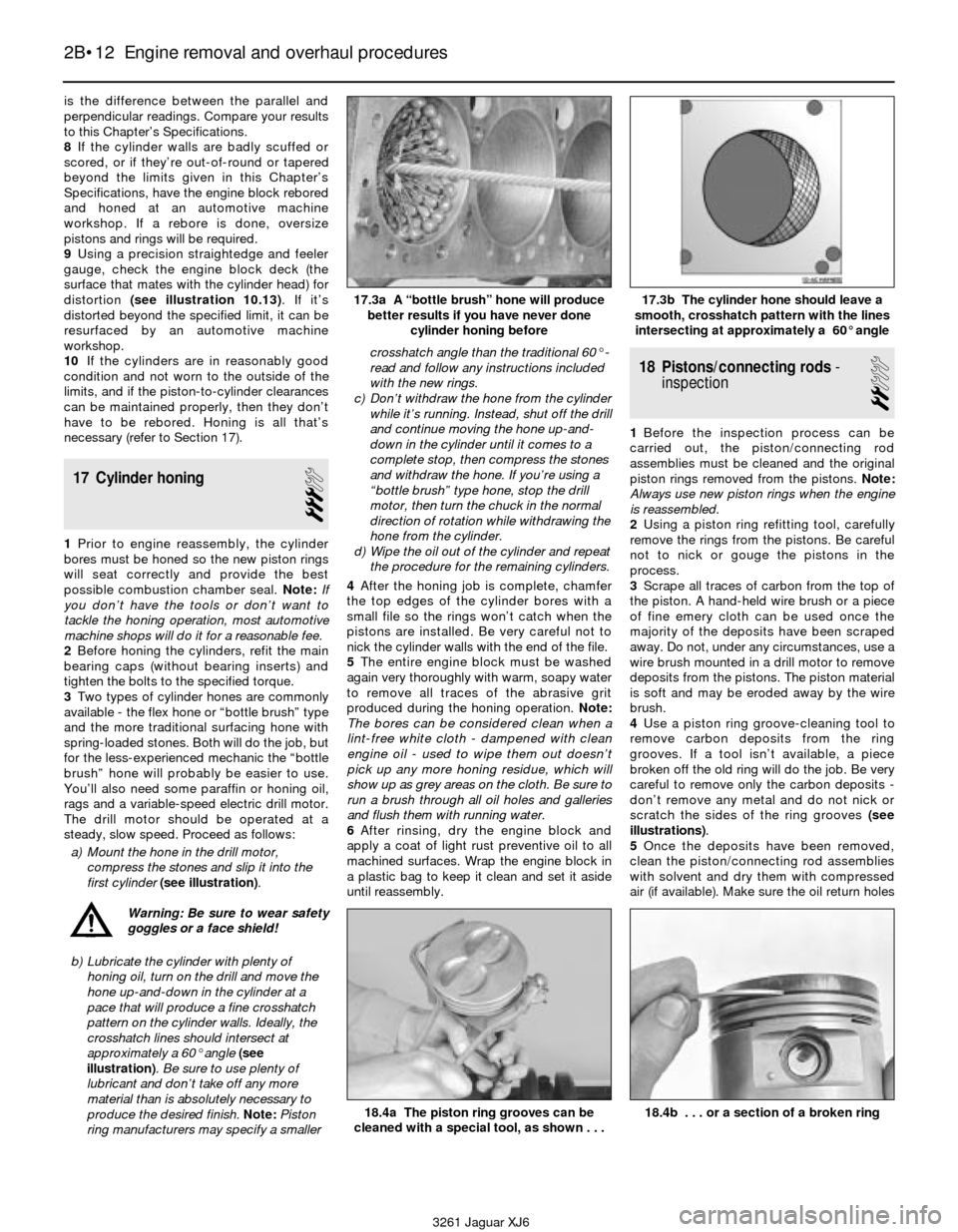
first cylinder (see illustration).
Warning: Be sure to wear safety
goggles or a face shield!
b) Lubricate the cylinder with plenty of
honing oil, turn on the drill and move the
hone up-and-down in the cylinder at a
pace that will produce a fine crosshatch
pattern on the cylinder walls. Ideally, the
crosshatch lines should intersect at
approximately a 60° angle (see
illustration). Be sure to use plenty of
lubricant and don’t take off any more
material than is absolutely necessary to
produce the desired finish. Note:Piston
ring manufacturers may specify a smallercrosshatch angle than the traditional 60° -
read and follow any instructions included
with the new rings.
c) Don’t withdraw the hone from the cylinder
while it’s running. Instead, shut off the drill
and continue moving the hone up-and-
down in the cylinder until it comes to a
complete stop, then compress the stones
and withdraw the hone. If you’re using a
“bottle brush” type hone, stop the drill
motor, then turn the chuck in the normal
direction of rotation while withdrawing the
hone from the cylinder.
d) Wipe the oil out of the cylinder and repeat
the procedure for the remaining cylinders.
4After the honing job is complete, chamfer
the top edges of the cylinder bores with a
small file so the rings won’t catch when the
pistons are installed. Be very careful not to
nick the cylinder walls with the end of the file.
5The entire engine block must be washed
again very thoroughly with warm, soapy water
to remove all traces of the abrasive grit
produced during the honing operation. Note:
The bores can be considered clean when a
lint-free white cloth - dampened with clean
engine oil - used to wipe them out doesn’t
pick up any more honing residue, which will
show up as grey areas on the cloth. Be sure to
run a brush through all oil holes and galleries
and flush them with running water.
6After rinsing, dry the engine block and
apply a coat of light rust preventive oil to all
machined surfaces. Wrap the engine block in
a plastic bag to keep it clean and set it aside
until reassembly.
18 Pistons/connecting rods-
inspection
2
1Before the inspection process can be
carried out, the piston/connecting rod
assemblies must be cleaned and the original
piston rings removed from the pistons. Note:
Always use new piston rings when the engine
is reassembled.
2Using a piston ring refitting tool, carefully
remove the rings from the pistons. Be careful
not to nick or gouge the pistons in the
process.
3Scrape all traces of carbon from the top of
the piston. A hand-held wire brush or a piece
of fine emery cloth can be used once the
majority of the deposits have been scraped
away. Do not, under any circumstances, use a
wire brush mounted in a drill motor to remove
deposits from the pistons. The piston material
is soft and may be eroded away by the wire
brush.
4Use a piston ring groove-cleaning tool to
remove carbon deposits from the ring
grooves. If a tool isn’t available, a piece
broken off the old ring will do the job. Be very
careful to remove only the carbon deposits -
don’t remove any metal and do not nick or
scratch the sides of the ring grooves (see
illustrations).
5Once the deposits have been removed,
clean the piston/connecting rod assemblies
with solvent and dry them with compressed
air (if available). Make sure the oil return holes
2B•12 Engine removal and overhaul procedures
17.3a A “bottle brush” hone will produce
better results if you have never done
cylinder honing before17.3b The cylinder hone should leave a
smooth, crosshatch pattern with the lines
intersecting at approximately a 60° angle
18.4a The piston ring grooves can be
cleaned with a special tool, as shown . . .18.4b . . . or a section of a broken ring
3261 Jaguar XJ6
Page 73 of 227
working up to it in three steps. Note:Use the
old bolts for this step (save the new bolts for
final refitting).Use a thin-wall socket to avoid
erroneous torque readings that can result if
the socket is wedged between the rod cap
and nut. If the socket tends to wedge itself
between the nut and the cap, lift up on it
slightly until it no longer contacts the cap. Do
not rotate the crankshaft at any time during
this operation.
16Remove the nuts and detach the rod cap,
being careful not to disturb the Plastigauge.
17Compare the width of the crushed
Plastigauge to the scale printed on the
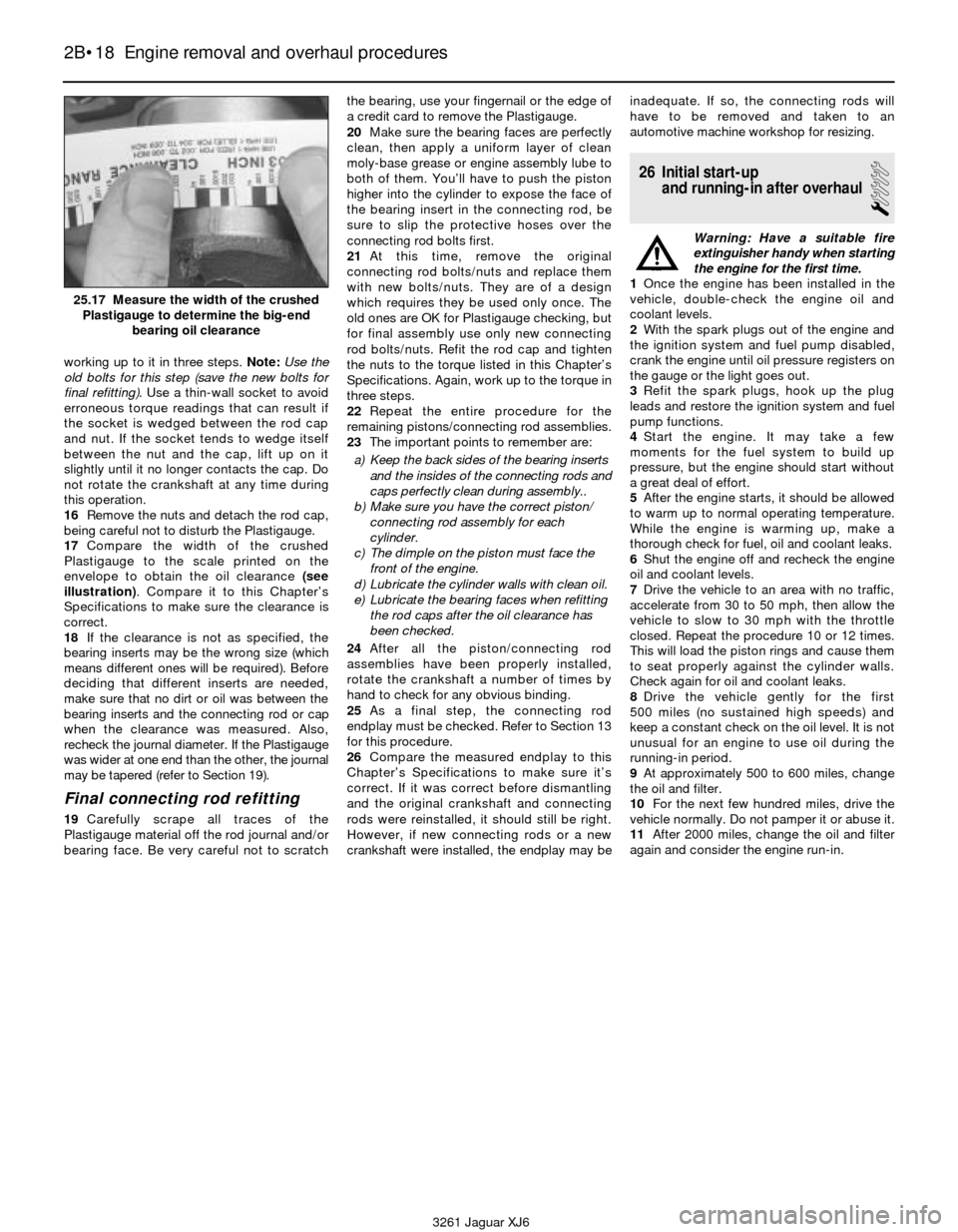
envelope to obtain the oil clearance (see
illustration). Compare it to this Chapter’s
Specifications to make sure the clearance is
correct.
18If the clearance is not as specified, the
bearing inserts may be the wrong size (which
means different ones will be required). Before
deciding that different inserts are needed,
make sure that no dirt or oil was between the
bearing inserts and the connecting rod or cap
when the clearance was measured. Also,
recheck the journal diameter. If the Plastigauge
was wider at one end than the other, the journal
may be tapered (refer to Section 19).
Final connecting rod refitting
19Carefully scrape all traces of the
Plastigauge material off the rod journal and/or
bearing face. Be very careful not to scratchthe bearing, use your fingernail or the edge of
a credit card to remove the Plastigauge.
20Make sure the bearing faces are perfectly
clean, then apply a uniform layer of clean
moly-base grease or engine assembly lube to
both of them. You’ll have to push the piston
higher into the cylinder to expose the face of
the bearing insert in the connecting rod, be
sure to slip the protective hoses over the
connecting rod bolts first.
21At this time, remove the original
connecting rod bolts/nuts and replace them
with new bolts/nuts. They are of a design
which requires they be used only once. The
old ones are OK for Plastigauge checking, but
for final assembly use only new connecting
rod bolts/nuts. Refit the rod cap and tighten
the nuts to the torque listed in this Chapter’s
Specifications. Again, work up to the torque in
three steps.
22Repeat the entire procedure for the
remaining pistons/connecting rod assemblies.
23The important points to remember are:
a) Keep the back sides of the bearing inserts
and the insides of the connecting rods and
caps perfectly clean during assembly..
b) Make sure you have the correct piston/
connecting rod assembly for each
cylinder.
c) The dimple on the piston must face the
front of the engine.
d) Lubricate the cylinder walls with clean oil.
e) Lubricate the bearing faces when refitting
the rod caps after the oil clearance has
been checked.
24After all the piston/connecting rod
assemblies have been properly installed,
rotate the crankshaft a number of times by
hand to check for any obvious binding.
25As a final step, the connecting rod
endplay must be checked. Refer to Section 13
for this procedure.
26Compare the measured endplay to this
Chapter’s Specifications to make sure it’s
correct. If it was correct before dismantling
and the original crankshaft and connecting
rods were reinstalled, it should still be right.
However, if new connecting rods or a new
crankshaft were installed, the endplay may beinadequate. If so, the connecting rods will
have to be removed and taken to an
automotive machine workshop for resizing.
26 Initial start-up
and running-in after overhaul
1
Warning: Have a suitable fire
extinguisher handy when starting
the engine for the first time.
1Once the engine has been installed in the
vehicle, double-check the engine oil and
coolant levels.
2With the spark plugs out of the engine and
the ignition system and fuel pump disabled,
crank the engine until oil pressure registers on
the gauge or the light goes out.
3Refit the spark plugs, hook up the plug
leads and restore the ignition system and fuel
pump functions.
4Start the engine. It may take a few
moments for the fuel system to build up
pressure, but the engine should start without
a great deal of effort.
5After the engine starts, it should be allowed
to warm up to normal operating temperature.
While the engine is warming up, make a
thorough check for fuel, oil and coolant leaks.
6Shut the engine off and recheck the engine
oil and coolant levels.
7Drive the vehicle to an area with no traffic,
accelerate from 30 to 50 mph, then allow the
vehicle to slow to 30 mph with the throttle
closed. Repeat the procedure 10 or 12 times.
This will load the piston rings and cause them
to seat properly against the cylinder walls.
Check again for oil and coolant leaks.
8Drive the vehicle gently for the first
500 miles (no sustained high speeds) and
keep a constant check on the oil level. It is not
unusual for an engine to use oil during the
running-in period.
9At approximately 500 to 600 miles, change
the oil and filter.
10For the next few hundred miles, drive the
vehicle normally. Do not pamper it or abuse it.
11After 2000 miles, change the oil and filter
again and consider the engine run-in.
2B•18 Engine removal and overhaul procedures
25.17 Measure the width of the crushed
Plastigauge to determine the big-end
bearing oil clearance
3261 Jaguar XJ6
Page 74 of 227
3261 Jaguar XJ6
3
Chapter 3
Cooling, heating and air conditioning systems
General
Radiator cap pressure rating . . . . . . . . . . . . . . . . . . . . . . . . . . . . . . . . . 13.5 to 117.5 psi
Thermostat rating . . . . . . . . . . . . . . . . . . . . . . . . . . . . . . . . . . . . . . . . . . 180 to 207° F
Torque wrench settingsNm lbf ft
Coolant pipe to block . . . . . . . . . . . . . . . . . . . . . . . . . . . . . . . . . . . . . . . 22 to 28 16 to 21
Fan assembly-to-drive hub nuts . . . . . . . . . . . . . . . . . . . . . . . . . . . . . . . 22 to 28 16 to 21
Fan clutch-to-fan blade bolts . . . . . . . . . . . . . . . . . . . . . . . . . . . . . . . . . 22 to 28 16 to 21
Thermostat cover bolts . . . . . . . . . . . . . . . . . . . . . . . . . . . . . . . . . . . . . . 22 to 28 16 to 21
Thermostat housing-to-block bolts . . . . . . . . . . . . . . . . . . . . . . . . . . . . 22 to 28 16 to 21
Water pump bolts . . . . . . . . . . . . . . . . . . . . . . . . . . . . . . . . . . . . . . . . . . 22 to 28 16 to 21 Air conditioning and heating system - check and maintenance . . . . 13
Air conditioning compressor - removal and refitting . . . . . . . . . . . . . 15
Air conditioning condenser - removal and refitting . . . . . . . . . . . . . . 16
Air conditioning evaporator and expansion valve - removal
and refitting . . . . . . . . . . . . . . . . . . . . . . . . . . . . . . . . . . . . . . . . . . 17
Air conditioning receiver/drier - removal and refitting . . . . . . . . . . . . 14
Antifreeze/coolant - general information . . . . . . . . . . . . . . . . . . . . . . 2
Coolant level check . . . . . . . . . . . . . . . . . . . . . . . . . . . . See Chapter 1
Coolant temperature sender unit - check and renewal . . . . . . . . . . . .9
Cooling system check . . . . . . . . . . . . . . . . . . . . . . . . . . See Chapter 1
Cooling system draining, flushing and refilling . . . . . . . . See Chapter 1
Drivebelt check, adjustment and renewal . . . . . . . . . . . See Chapter 1
Engine cooling fans - check and renewal . . . . . . . . . . . . . . . . . . . . . 4Engine oil cooler - renewal . . . . . . . . . . . . . . . . . . . . . . . . . . . . . . . . 6
General information . . . . . . . . . . . . . . . . . . . . . . . . . . . . . . . . . . . . . . 1
Heater and air conditioning blower motors -circuit check
and component renewal . . . . . . . . . . . . . . . . . . . . . . . . . . . . . . . . 10
Heater and air conditioning control assembly -
check, removal and refitting . . . . . . . . . . . . . . . . . . . . . . . . . . . . . 12
Heater core - removal and refitting . . . . . . . . . . . . . . . . . . . . . . . . . . 11
Radiator, expansion tank and coolant reservoir -
removal and refitting . . . . . . . . . . . . . . . . . . . . . . . . . . . . . . . . . . . 5
Thermostat - check and renewal . . . . . . . . . . . . . . . . . . . . . . . . . . . . 3
Underbonnet hose check and renewal . . . . . . . . . . . . . . See Chapter 1
Water pump - check . . . . . . . . . . . . . . . . . . . . . . . . . . . . . . . . . . . . . 7
Water pump and pipes - renewal . . . . . . . . . . . . . . . . . . . . . . . . . . . 8
3•1
Specifications Contents
Easy,suitable for
novice with little
experienceFairly easy,suitable
for beginner with
some experienceFairly difficult,
suitable for competent
DIY mechanic
Difficult,suitable for
experienced DIY
mechanicVery difficult,
suitable for expert DIY
or professional
Degrees of difficulty
54321
1 General information
Engine cooling system
All vehicles covered by this manual employ a
pressurised engine cooling system with
thermostatically-controlled coolant circulation.
An impeller type water pump mounted on the
front of the block pumps coolant through the
engine. The coolant flows around each cylinder
and toward the rear of the engine. Cast-in
coolant passages direct coolant around the
intake and exhaust ports, near the spark plug
areas and in proximity to the exhaust valve
guides.A wax-pellet type thermostat is located in
the thermostat housing at the front of the
engine. During warm up, the closed
thermostat prevents coolant from circulating
through the radiator. When the engine
reaches normal operating temperature, the
thermostat opens and allows hot coolant to
travel through the radiator, where it is cooled
before returning to the engine.
The cooling system is sealed by a pressure-
type radiator cap. This raises the boiling point
of the coolant, and the higher boiling point of
the coolant increases the cooling efficiency
of the radiator. If the system pressure exceeds
the cap pressure-relief value, the excess
pressure in the system forces the spring-
loaded valve inside the cap off its seat and
allows the coolant to escape through the
overflow tube into a coolant reservoir. Whenthe system cools, the excess coolant is
automatically drawn from the reservoir back
into the radiator. This type of cooling system is
known as a closed design because coolant
that escapes past the pressure cap is saved
and reused.
The Jaguar cooling system on 1988 and
1989 models has both a manifold tank and a
coolant recovery tank. The manifold tank is the
highest point in the cooling system and is the
location of the “radiator” cap (the cap is not on
the radiator). The recovery tank down in the
passenger’s footwell collects heated coolant
as described above. Models from 1990 to
1994 do not have a coolant recovery tank, but
have an enlarged manifold tank. In all models,
the recovery tank has a sensor in it to detect a
low coolant level, and the instrument panel has
a warning light to that effect.
Page 75 of 227
Heating system
The heating system consists of two blower
fans, one under the dash on the right and one
on the left, and a heater core located within
the heater/air conditioning assembly which is
under the dash and behind the console.
Hoses connect the heater core to the engine
cooling system. Heater function is controlled
by the heater/air conditioning control head on
the dashboard. Hot engine coolant is
circulated through the heater core. When the
heater mode is activated, a flap door opens to
expose the heater box to the passenger
compartment. A fan switch on the control
head activates the blower motor, which forces
air through the core, heating the air.
Air conditioning system
The air conditioning system consists of a
condenser mounted in front of the radiator, an
evaporator mounted in the heat/air
conditioning assembly behind the console and
under the centre of the dash, a compressor
mounted on the engine, a filter-drier which
contains a high pressure relief valve and the
plumbing connecting all of the above.
A blower fan forces the warmer air of the
passenger compartment through the
evaporator core (sort of a radiator-in-reverse),
transferring the heat from the air to the
refrigerant. The liquid refrigerant boils off into
low pressure vapour, taking the heat with it
when it leaves the evaporator. The
compressor keeps refrigerant circulating
through the system, pumping the warmed
coolant through the condenser where it is
cooled and then circulated back to the
evaporator.
2 Antifreeze/coolant-
general information
Warning: Do not allow antifreeze
to come in contact with your
skin or painted surfaces of the
vehicle. Rinse off spills immediately withplenty of water. Antifreeze is highly toxic if
ingested. Never leave antifreeze lying
around in an open container or in puddles
on the floor; children and pets are
attracted by it’s sweet smell and may drink
it. Check with local authorities about
disposing of used antifreeze. Many
communities have collection centres which
will see that antifreeze is disposed of
safely. Never dump used antifreeze on the
ground or into drains.
Note:Non-toxic antifreeze is now
manufactured and available at local car
accessory outlets, but even these types
should be disposed of properly.
The cooling system should be filled with a
water/ethylene-glycol based antifreeze
solution, which will prevent freezing down to
at least -20° F, or lower if local climate
requires it. It also provides protection against
corrosion and increases the coolant boiling
point.
The cooling system should be drained,
flushed and refilled every 24,000 miles or
every two years (see Chapter 1). The use of
antifreeze solutions for periods of longer than
two years is likely to cause damage and
encourage the formation of rust and scale in
the system. If your tap water is “hard”, i.e.
contains a lot of dissolved minerals, use
distilled water with the antifreeze.
Before adding antifreeze to the system,
check all hose connections, because
antifreeze tends to leak through very minute
openings. Engines do not normally consume
coolant. Therefore, if the level goes down, find
the cause and correct it.
The exact mixture of antifreeze-to-water
you should use depends on the relative
weather conditions. The mixture should
contain at least 50-percent antifreeze, but
should never contain more than 70-percent
antifreeze. Consult the mixture ratio chart on
the antifreeze container before adding
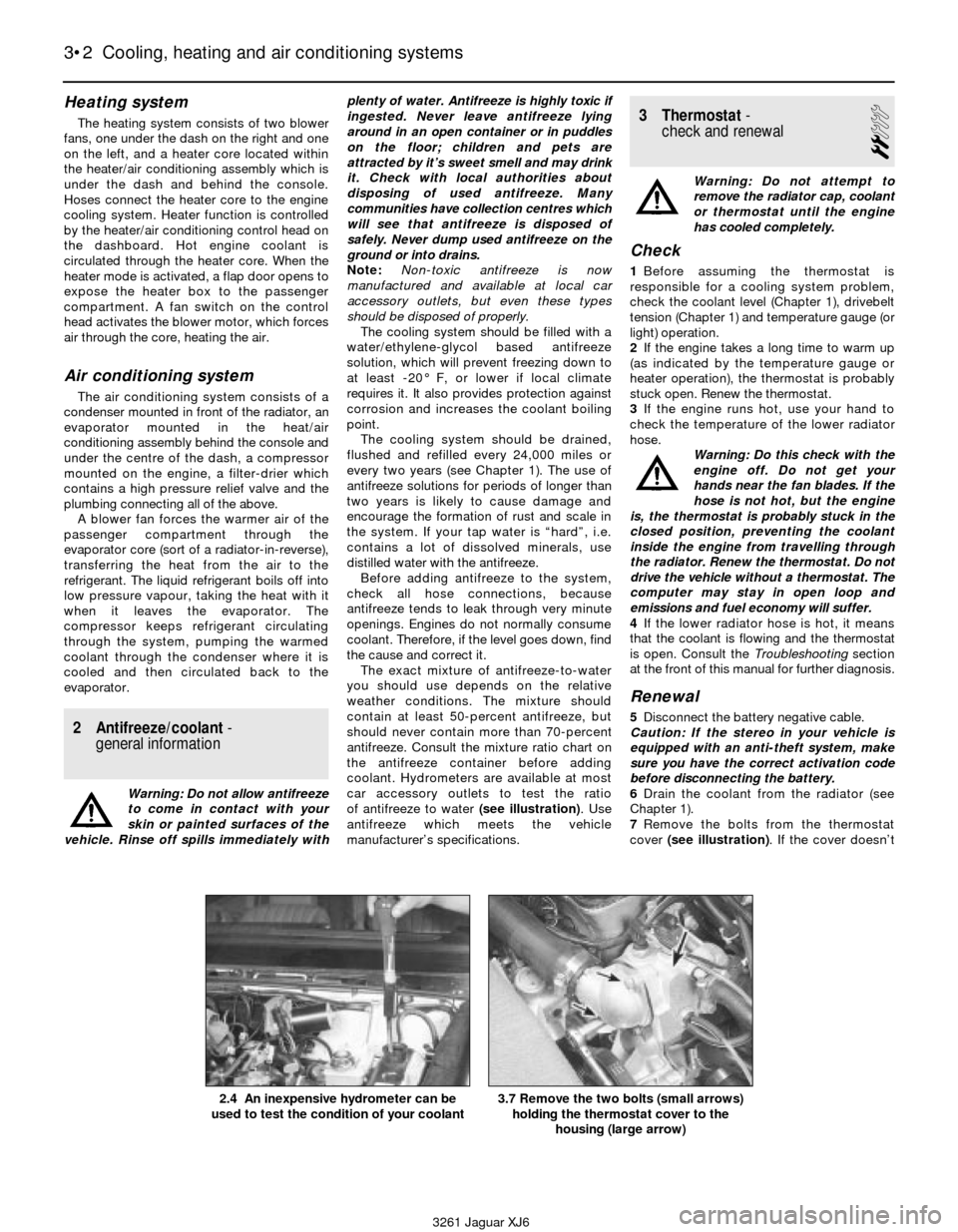
coolant. Hydrometers are available at most
car accessory outlets to test the ratio
of antifreeze to water (see illustration). Use
antifreeze which meets the vehicle
manufacturer’s specifications.
3 Thermostat-
check and renewal
2
Warning: Do not attempt to
remove the radiator cap, coolant
or thermostat until the engine
has cooled completely.
Check
1Before assuming the thermostat is
responsible for a cooling system problem,
check the coolant level (Chapter 1), drivebelt
tension (Chapter 1) and temperature gauge (or
light) operation.
2If the engine takes a long time to warm up
(as indicated by the temperature gauge or
heater operation), the thermostat is probably
stuck open. Renew the thermostat.
3If the engine runs hot, use your hand to
check the temperature of the lower radiator
hose.
Warning: Do this check with the
engine off. Do not get your
hands near the fan blades. If the
hose is not hot, but the engine
is, the thermostat is probably stuck in the
closed position, preventing the coolant
inside the engine from travelling through
the radiator. Renew the thermostat. Do not
drive the vehicle without a thermostat. The
computer may stay in open loop and
emissions and fuel economy will suffer.
4If the lower radiator hose is hot, it means
that the coolant is flowing and the thermostat
is open. Consult the Troubleshootingsection
at the front of this manual for further diagnosis.
Renewal
5Disconnect the battery negative cable.
Caution: If the stereo in your vehicle is
equipped with an anti-theft system, make
sure you have the correct activation code
before disconnecting the battery.
6Drain the coolant from the radiator (see
Chapter 1).
7Remove the bolts from the thermostat
cover (see illustration). If the cover doesn’t
3•2 Cooling, heating and air conditioning systems
3261 Jaguar XJ6 2.4 An inexpensive hydrometer can be
used to test the condition of your coolant
3.7 Remove the two bolts (small arrows)
holding the thermostat cover to the
housing (large arrow)
Page 76 of 227
pull loose, tap it with a soft-faced hammer. Do
not use a screwdriver between the cover and
the thermostat housing.
8Remove the thermostat, noting the
direction in which it was installed in the
housing, and thoroughly clean the sealing
surfaces.
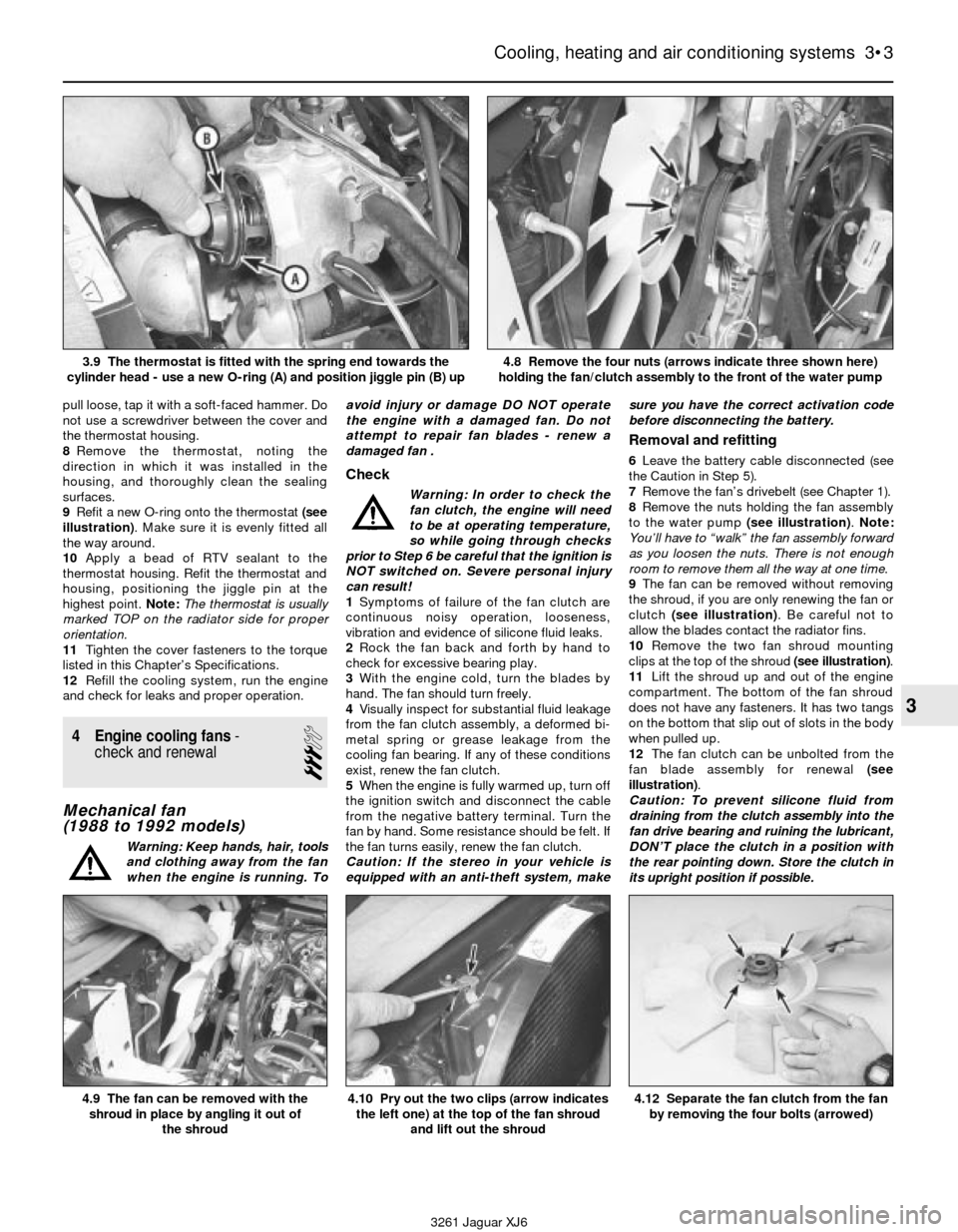
9Refit a new O-ring onto the thermostat (see
illustration). Make sure it is evenly fitted all
the way around.
10Apply a bead of RTV sealant to the
thermostat housing. Refit the thermostat and
housing, positioning the jiggle pin at the
highest point. Note:The thermostat is usually
marked TOP on the radiator side for proper
orientation.
11Tighten the cover fasteners to the torque
listed in this Chapter’s Specifications.
12Refill the cooling system, run the engine
and check for leaks and proper operation.
4 Engine cooling fans-
check and renewal
3
Mechanical fan
(1988 to 1992 models)
Warning: Keep hands, hair, tools
and clothing away from the fan
when the engine is running. Toavoid injury or damage DO NOT operate
the engine with a damaged fan. Do not
attempt to repair fan blades - renew a
damaged fan .
Check
Warning: In order to check the
fan clutch, the engine will need
to be at operating temperature,
so while going through checks
prior to Step 6 be careful that the ignition is
NOT switched on. Severe personal injury
can result!
1Symptoms of failure of the fan clutch are
continuous noisy operation, looseness,
vibration and evidence of silicone fluid leaks.
2Rock the fan back and forth by hand to
check for excessive bearing play.
3With the engine cold, turn the blades by
hand. The fan should turn freely.
4Visually inspect for substantial fluid leakage
from the fan clutch assembly, a deformed bi-
metal spring or grease leakage from the
cooling fan bearing. If any of these conditions
exist, renew the fan clutch.
5When the engine is fully warmed up, turn off
the ignition switch and disconnect the cable
from the negative battery terminal. Turn the
fan by hand. Some resistance should be felt. If
the fan turns easily, renew the fan clutch.
Caution: If the stereo in your vehicle is
equipped with an anti-theft system, makesure you have the correct activation code
before disconnecting the battery.
Removal and refitting
6Leave the battery cable disconnected (see
the Caution in Step 5).
7Remove the fan’s drivebelt (see Chapter 1).
8Remove the nuts holding the fan assembly
to the water pump (see illustration). Note:
You’ll have to “walk” the fan assembly forward
as you loosen the nuts. There is not enough
room to remove them all the way at one time.
9The fan can be removed without removing
the shroud, if you are only renewing the fan or
clutch (see illustration). Be careful not to
allow the blades contact the radiator fins.
10Remove the two fan shroud mounting
clips at the top of the shroud (see illustration).
11Lift the shroud up and out of the engine
compartment. The bottom of the fan shroud
does not have any fasteners. It has two tangs
on the bottom that slip out of slots in the body
when pulled up.
12The fan clutch can be unbolted from the
fan blade assembly for renewal (see
illustration).
Caution: To prevent silicone fluid from
draining from the clutch assembly into the
fan drive bearing and ruining the lubricant,
DON’T place the clutch in a position with
the rear pointing down. Store the clutch in
its upright position if possible.
Cooling, heating and air conditioning systems 3•3
3
4.9 The fan can be removed with the
shroud in place by angling it out of
the shroud4.10 Pry out the two clips (arrow indicates
the left one) at the top of the fan shroud
and lift out the shroud
3261 Jaguar XJ6 3.9 The thermostat is fitted with the spring end towards the
cylinder head - use a new O-ring (A) and position jiggle pin (B) up
4.8 Remove the four nuts (arrows indicate three shown here)
holding the fan/clutch assembly to the front of the water pump
4.12 Separate the fan clutch from the fan
by removing the four bolts (arrowed)
Page 77 of 227

13Refitting is the reverse of removal. Tighten
the fan clutch-to-fan blade bolts and the fan
assembly-to-drive hub nut to the torque listed
in this Chapter’s Specifications.
Electric fans
Check
Warning: Keep your hands or
clothing away from the fan
blades at all times.
14On 1988 through 1992 models, a single
electric fan is mounted in front of the radiator,
controlled by a thermostatic switch. Access to
the fan is with the grille removed. The 1993
and 1994 models have a fan shroud assembly
that includes two electric fans, and a “twin”
thermostatic switch, with the assembly
mounted on the engine side of the radiator.
15If the electric fan does not come on at any
time, bypass the thermostatic switch by
disconnecting the electrical connector at the
switch and connecting the two pins with a
jumper wire (see illustration). If the fan now
operates, renew the thermostatic switch. If the
fan doesn’t operate, the problem is either the
fan relay or the fan motor. On 1993 and 1994
models with twin electric fans, jumpering one
set of connections in the plug from the switch
should make both fans operate at slow speed
(fans in series) and jumpering the other two
should run both fans at higher speed (fans in
parallel). In normal operation, the fans operate
at the higher-speed only when the air
conditioning is on, or when coolant
temperature exceeds 212° F. When the
coolant cools down to below 200° F, the fans
revert to the normal speed.
16To renew a defective thermostatic switch,
allow the vehicle to cool off and drain the
coolant (see Chapter 1). Remove the switch
from the radiator and refit the new switch.
Connect the electrical connector and test
again for proper fan operation.17To test an inoperative fan motor (one that
doesn’t come on when the engine gets hot or
when the air conditioner is on), first check the
fuses and/or fusible links (see Chapter 12).
Then disconnect the electrical connector at
the motor (refer to Chapter 11 for removal of
the grille for access on front-mounted-fan
models) and use fused jumper wires to
connect the fan directly to the battery and to
chassis ground (see illustration). If the fan
still does not work, renew the fan motor.
Warning: Do not allow the test
clips to contact each other or
any metallic part of the vehicle.
18If the motor tested OK in the previous test
but is still inoperative, then the fault lies in the
relay, fuse, or wiring. The fan relay can be
tested for continuity (see Chapter 12).
Renewal
19Disconnect the negative battery cable.
Caution: If the stereo in your vehicle is
equipped with an anti-theft system, make
sure you have the correct activation code
before disconnecting the battery.20Access the 1988 through 1992 single
electric fan with the grille removed (see
Chapter 11 for grille removal). Disconnect the
electrical connector and remove the bolts
holding the fan assembly to the body (see
illustration).
21On 1993 and 1994 models, remove the
two bolts holding the fan shroud to the top of
the radiator and lift the shroud/fans assembly
from the vehicle.
22If the fan on 1988 to 1992 models must be
renewed, renew the fan, motor and shroud as
a unit. The fan is separate from the shroud on
later models.
23Refitting is the reverse of removal. If the
thermostatic switch was renewed, refill the
cooling system.5 Radiator, expansion tank
and coolant reservoir-
removal and refitting
3
Warning: Do not start this
procedure until the engine is
completely cool.
Radiator
Removal
1Disconnect the negative battery cable.
Caution: If the stereo in your vehicle is
equipped with an anti-theft system, make
sure you have the correct activation code
before disconnecting the battery.
2Drain the coolant into a container (see
Chapter 1).
3Remove both the upper and lower radiator
hoses, and the small expansion tank hose from
the top left of the radiator (see illustration).
4Remove the cooling fan and shroud (see
Section 4).
3•4 Cooling, heating and air conditioning systems
4.20 Disconnect the fan’s electrical
connector (large arrow) and remove the
bolts (small arrows) on single-fan models -
grille is removed here
3261 Jaguar XJ6 4.15 Disconnect the electrical connector (A) from the
thermostatic switch (B) in the radiator and bypass it with a
jumper wire (C) - the fan should operate now with the ignition on
4.17 Disconnect the fan wiring connector and connect jumper
wires from there directly to the positive and negative terminals of
the battery - the purple wire’s terminal should receive the battery
power and the black wire’s terminal should be earthed
Page 78 of 227
5If equipped with an automatic transmission,
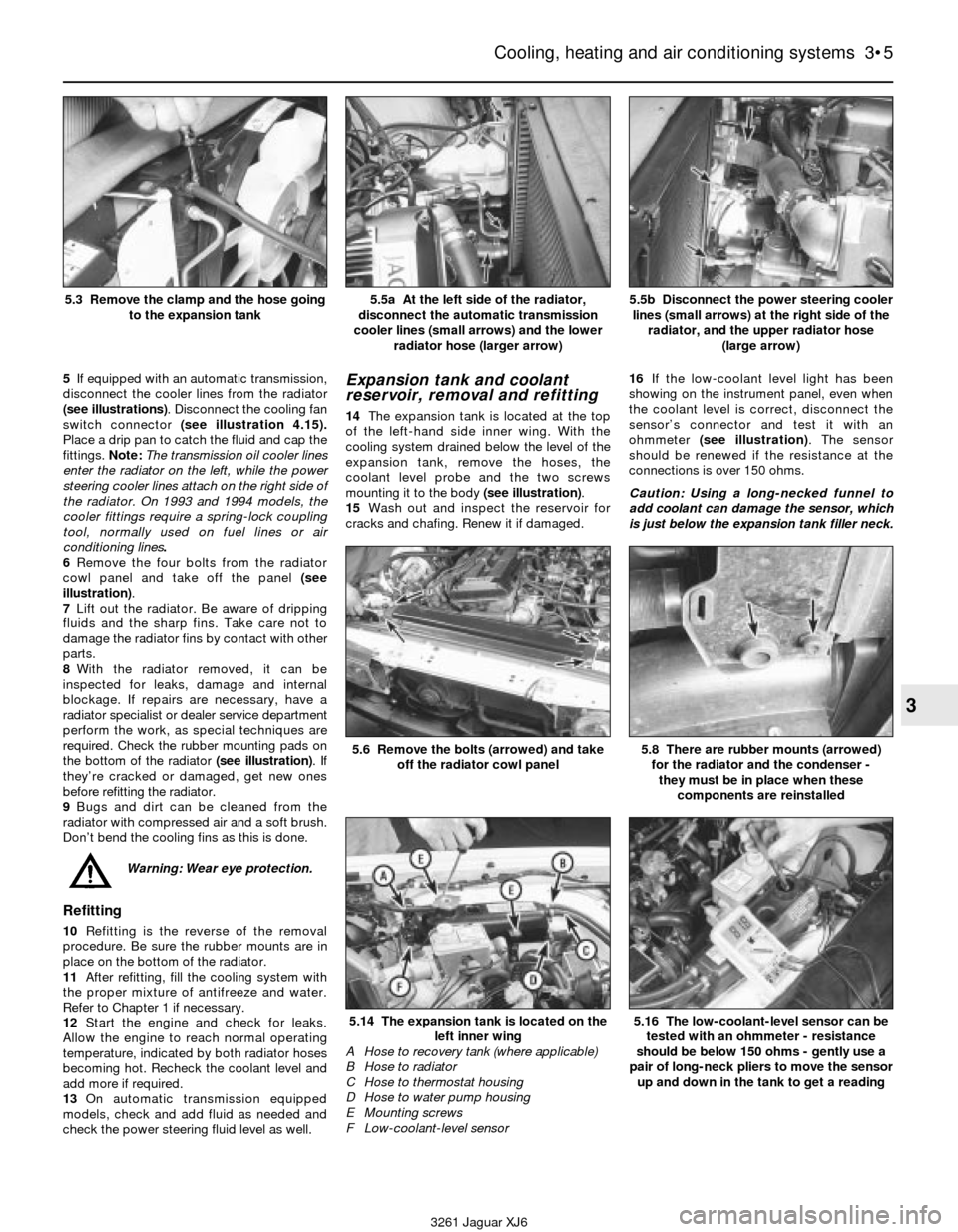
disconnect the cooler lines from the radiator
(see illustrations). Disconnect the cooling fan
switch connector (see illustration 4.15).
Place a drip pan to catch the fluid and cap the
fittings. Note:The transmission oil cooler lines
enter the radiator on the left, while the power
steering cooler lines attach on the right side of
the radiator. On 1993 and 1994 models, the
cooler fittings require a spring-lock coupling
tool, normally used on fuel lines or air
conditioning lines.
6Remove the four bolts from the radiator
cowl panel and take off the panel (see
illustration).
7Lift out the radiator. Be aware of dripping
fluids and the sharp fins. Take care not to
damage the radiator fins by contact with other
parts.
8With the radiator removed, it can be
inspected for leaks, damage and internal
blockage. If repairs are necessary, have a
radiator specialist or dealer service department
perform the work, as special techniques are
required. Check the rubber mounting pads on
the bottom of the radiator (see illustration). If
they’re cracked or damaged, get new ones
before refitting the radiator.
9Bugs and dirt can be cleaned from the
radiator with compressed air and a soft brush.
Don’t bend the cooling fins as this is done.
Warning: Wear eye protection.
Refitting
10Refitting is the reverse of the removal
procedure. Be sure the rubber mounts are in
place on the bottom of the radiator.
11After refitting, fill the cooling system with
the proper mixture of antifreeze and water.
Refer to Chapter 1 if necessary.
12Start the engine and check for leaks.
Allow the engine to reach normal operating
temperature, indicated by both radiator hoses
becoming hot. Recheck the coolant level and
add more if required.
13On automatic transmission equipped
models, check and add fluid as needed and
check the power steering fluid level as well.
Expansion tank and coolant
reservoir, removal and refitting
14The expansion tank is located at the top
of the left-hand side inner wing. With the
cooling system drained below the level of the
expansion tank, remove the hoses, the
coolant level probe and the two screws
mounting it to the body (see illustration).
15Wash out and inspect the reservoir for
cracks and chafing. Renew it if damaged.16If the low-coolant level light has been
showing on the instrument panel, even when
the coolant level is correct, disconnect the
sensor’s connector and test it with an
ohmmeter (see illustration). The sensor
should be renewed if the resistance at the
connections is over 150 ohms.
Caution: Using a long-necked funnel to
add coolant can damage the sensor, which
is just below the expansion tank filler neck.
Cooling, heating and air conditioning systems 3•5
3
5.5a At the left side of the radiator,
disconnect the automatic transmission
cooler lines (small arrows) and the lower
radiator hose (larger arrow)5.5b Disconnect the power steering cooler
lines (small arrows) at the right side of the
radiator, and the upper radiator hose
(large arrow)
3261 Jaguar XJ6 5.3 Remove the clamp and the hose going
to the expansion tank
5.6 Remove the bolts (arrowed) and take
off the radiator cowl panel
5.14 The expansion tank is located on the
left inner wing
A Hose to recovery tank (where applicable)
B Hose to radiator
C Hose to thermostat housing
D Hose to water pump housing
E Mounting screws
F Low-coolant-level sensor
5.8 There are rubber mounts (arrowed)
for the radiator and the condenser -
they must be in place when these
components are reinstalled
5.16 The low-coolant-level sensor can be
tested with an ohmmeter - resistance
should be below 150 ohms - gently use a
pair of long-neck pliers to move the sensor
up and down in the tank to get a reading
Page 79 of 227

17A coolant recovery bottle is used on 1988
and 1989 models, located in the passenger’s
inner wing. The plastic inner wing splash
shield must be removed for access to the
recovery bottle (see Chapter 11). Disconnect
the recovery hose and remove the mounting
screws to renew the recovery bottle (see
illustration). Models from 1990 on do not
have the recovery bottle, but do have a larger
expansion tank.
18Refitting of either expansion tank or
recovery bottle is the reverse of removal.
6 Engine oil cooler- renewal
2
1Models from 1988 through 1991 have a
engine oil cooler, mounted ahead of the
radiator. The engine’s mechanical fan draws
air through the oil cooler, cooling off hot
engine oil that is circulated from the engine by
steel tubes. Access to the cooler is with the
grille removed (refer to Chapter 11 for grille
removal).
2To renew the oil cooler, first disconnect thetwo fittings connecting the lines to the cooler
(see illustration).
Caution: The engine should be cool for this
procedure, and you should have a small
drain pan handy because the fittings are
on the bottom of the cooler and will
probably drip some oil on dismantling.
3Remove the mounting nuts to take the
cooler out of the vehicle (see illustration).
4The other ends of the oil cooler tubes
mount to a block just below the oil filter. With
a drain pan handy, remove the nut retaining
both pipes to the block.
5Refitting the oil cooler and oil lines is the
reverse of removal. When refitting the lines to
the block or the cooler, use new O-rings.7 Water pump- check
1
1A failure in the water pump can cause
serious engine damage due to overheating.
2With the engine running and warmed to
normal operating temperature, squeeze the
upper radiator hose. If the water pump is
working properly, a pressure surge should be
felt as the hose is released.
Warning: Keep hands away from
fan blades!
3Water pumps are equipped with weep or
vent holes (see illustration). If a failure occurs
in the pump seal, coolant will leak from this
hole. In most cases it will be necessary to use
a flashlight to find the hole on the water pump
by looking through the space behind the
pulley just below the water pump shaft.
4If the water pump shaft bearings fail there
may be a howling sound at the front of the
engine while it is running. Bearing wear can be
felt if the water pump pulley is rocked up anddown. Do not mistake drivebelt slippage,
which causes a squealing sound, for water
pump failure. Spray automotive drivebelt
dressing on the belts to eliminate the belt as a
possible cause of the noise.
8 Water pump and pipes-
renewal
3
Warning: Do not start this
procedure until the engine is
completely cool.
1Disconnect the negative battery cable and
drain the cooling system (see Chapter 1).
Caution: If the stereo in your vehicle is
equipped with an anti-theft system, make
sure you have the correct activation code
before disconnecting the battery.
2Refer to Section 4 to remove the
mechanical fan and clutch (if applicable to
your model).
3Refer to Chapter 1 for removal of the
drivebelts.
3•6 Cooling, heating and air conditioning systems
6.3 Remove the mounting nuts (arrowed)
to take the oil cooler out
7.3 Check the weep hole (arrowed) for
signs of leakage (pump removed for
clarity) - grey discolouration is normal,
large brown stains indicates seal failure
3261 Jaguar XJ6 5.17 The recovery bottle (arrowed) on 1988 and 1989 models is
located in the footwell - disconnect the hoses and the two
mounting screws
6.2 Disconnect the two metal oil lines (arrowed) where they
mount to the bottom of the cooler - use two spanners