battery JEEP COMPASS 2023 Owner's Guide
[x] Cancel search | Manufacturer: JEEP, Model Year: 2023, Model line: COMPASS, Model: JEEP COMPASS 2023Pages: 344, PDF Size: 18.8 MB
Page 261 of 344
IN CASE OF EMERGENCY259
4. If using another vehicle to jump start the battery, park the vehicle within the jumper
cables reach, set the parking brake and make
sure the ignition is OFF.
JUMP STARTING PROCEDURE
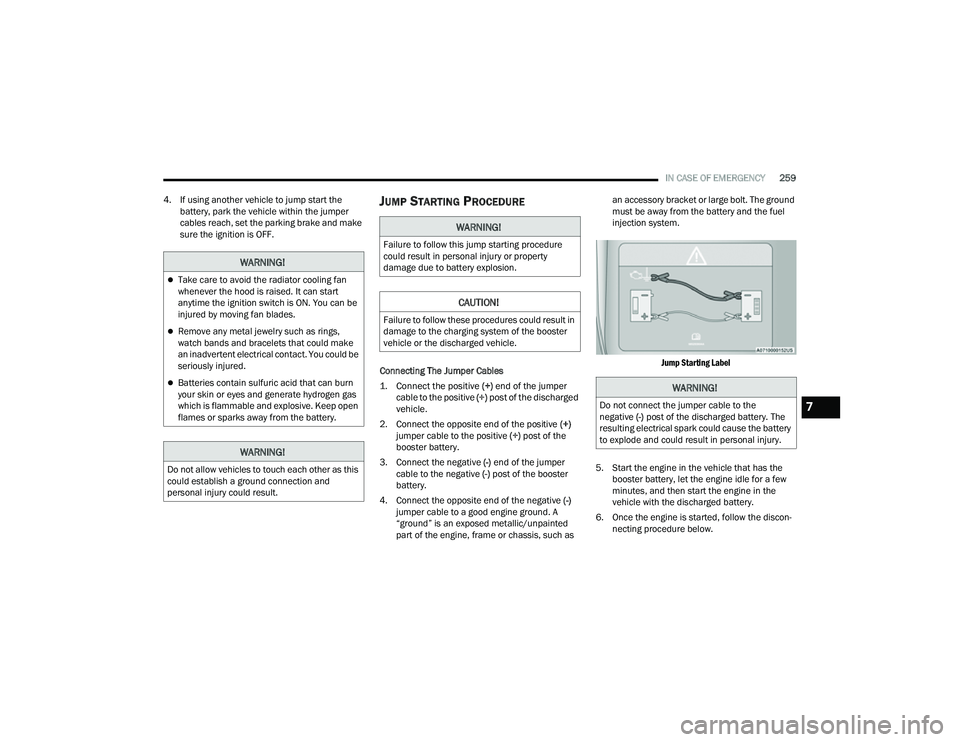
Connecting The Jumper Cables
1. Connect the positive
(+) end of the jumper
cable to the positive (+)
post of the discharged
vehicle.
2. Connect the opposite end of the positive (+)
jumper cable to the positive (+) post of the
booster battery.
3. Connect the negative (-) end of the jumper
cable to the negative (-) post of the booster
battery.
4. Connect the opposite end of the negative (-)
jumper cable to a good engine ground. A
“ground” is an exposed metallic/unpainted
part of the engine, frame or chassis, such as an accessory bracket or large bolt. The ground
must be away from the battery and the fuel
injection system.
Jump Starting Label
5. Start the engine in the vehicle that has the booster battery, let the engine idle for a few
minutes, and then start the engine in the
vehicle with the discharged battery.
6. Once the engine is started, follow the discon -
necting procedure below.
WARNING!
Take care to avoid the radiator cooling fan
whenever the hood is raised. It can start
anytime the ignition switch is ON. You can be
injured by moving fan blades.
Remove any metal jewelry such as rings,
watch bands and bracelets that could make
an inadvertent electrical contact. You could be
seriously injured.
Batteries contain sulfuric acid that can burn
your skin or eyes and generate hydrogen gas
which is flammable and explosive. Keep open
flames or sparks away from the battery.
WARNING!
Do not allow vehicles to touch each other as this
could establish a ground connection and
personal injury could result.
WARNING!
Failure to follow this jump starting procedure
could result in personal injury or property
damage due to battery explosion.
CAUTION!
Failure to follow these procedures could result in
damage to the charging system of the booster
vehicle or the discharged vehicle.
WARNING!
Do not connect the jumper cable to the
negative (-) post of the discharged battery. The
resulting electrical spark could cause the battery
to explode and could result in personal injury.7
22_MP_OM_EN_USC_t.book Page 259
Page 262 of 344
260IN CASE OF EMERGENCY
Disconnecting The Jumper Cables
1. Disconnect the negative
(-)
end of the jumper
cable from the engine ground of the vehicle
with the discharged battery.
2. Disconnect the opposite end of the negative (-)
jumper cable from the negative (-) post of the
booster battery.
3. Disconnect the positive (+) end of the jumper
cable from the positive (+) post of the booster
battery.
4. Disconnect the opposite end of the positive (+)
jumper cable from the positive (+) post of the
vehicle with the discharged battery.
If frequent jump starting is required to start your
vehicle, you should have the battery and charging
system inspected at an authorized dealer.
REFUELING IN EMERGENCY
The vehicle is equipped with a refueling funnel for
a Capless Fuel System. If refueling is necessary,
while using an approved gas can, insert the
refueling funnel into the filler neck opening. Take
care to open both flappers with the funnel to avoid
spills.
NOTE:In certain cold conditions, ice may prevent the fuel
door from opening. If this occurs, lightly push on
the fuel door to break the ice buildup and
re-release the fuel door using the inside release
button. Do not pry on the door.
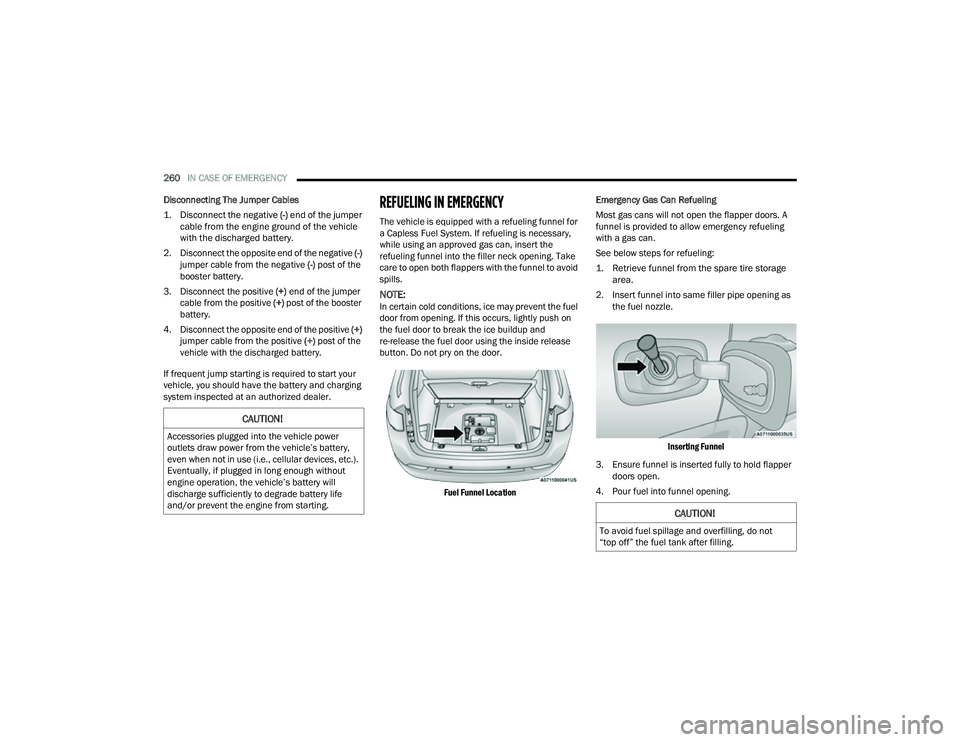
Fuel Funnel Location
Emergency Gas Can Refueling
Most gas cans will not open the flapper doors. A
funnel is provided to allow emergency refueling
with a gas can.
See below steps for refueling:
1. Retrieve funnel from the spare tire storage
area.
2. Insert funnel into same filler pipe opening as the fuel nozzle.
Inserting Funnel
3. Ensure funnel is inserted fully to hold flapper doors open.
4. Pour fuel into funnel opening.
CAUTION!
Accessories plugged into the vehicle power
outlets draw power from the vehicle’s battery,
even when not in use (i.e., cellular devices, etc.).
Eventually, if plugged in long enough without
engine operation, the vehicle’s battery will
discharge sufficiently to degrade battery life
and/or prevent the engine from starting.
CAUTION!
To avoid fuel spillage and overfilling, do not
“top off” the fuel tank after filling.
22_MP_OM_EN_USC_t.book Page 260
Page 266 of 344
264IN CASE OF EMERGENCY
TOWING A DISABLED VEHICLE
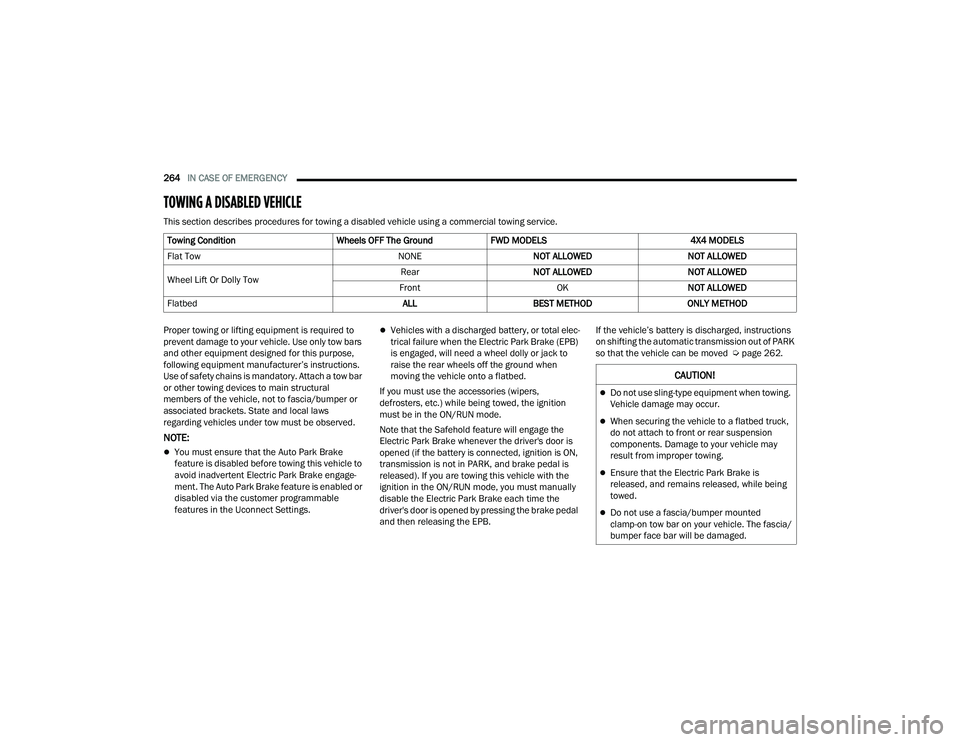
This section describes procedures for towing a disabled vehicle using a commercial towing service.
Proper towing or lifting equipment is required to
prevent damage to your vehicle. Use only tow bars
and other equipment designed for this purpose,
following equipment manufacturer’s instructions.
Use of safety chains is mandatory. Attach a tow bar
or other towing devices to main structural
members of the vehicle, not to fascia/bumper or
associated brackets. State and local laws
regarding vehicles under tow must be observed.
NOTE:
You must ensure that the Auto Park Brake
feature is disabled before towing this vehicle to
avoid inadvertent Electric Park Brake engage -
ment. The Auto Park Brake feature is enabled or
disabled via the customer programmable
features in the Uconnect Settings.
Vehicles with a discharged battery, or total elec -
trical failure when the Electric Park Brake (EPB)
is engaged, will need a wheel dolly or jack to
raise the rear wheels off the ground when
moving the vehicle onto a flatbed.
If you must use the accessories (wipers,
defrosters, etc.) while being towed, the ignition
must be in the ON/RUN mode.
Note that the Safehold feature will engage the
Electric Park Brake whenever the driver's door is
opened (if the battery is connected, ignition is ON,
transmission is not in PARK, and brake pedal is
released). If you are towing this vehicle with the
ignition in the ON/RUN mode, you must manually
disable the Electric Park Brake each time the
driver's door is opened by pressing the brake pedal
and then releasing the EPB. If the vehicle’s battery is discharged, instructions
on shifting the automatic transmission out of PARK
so that the vehicle can be moved Ú
page 262.
Towing Condition
Wheels OFF The GroundFWD MODELS 4X4 MODELS
Flat Tow NONENOT ALLOWED NOT ALLOWED
Wheel Lift Or Dolly Tow Rear
NOT ALLOWED NOT ALLOWED
Front OKNOT ALLOWED
Flatbed ALLBEST METHOD ONLY METHOD
CAUTION!
Do not use sling-type equipment when towing.
Vehicle damage may occur.
When securing the vehicle to a flatbed truck,
do not attach to front or rear suspension
components. Damage to your vehicle may
result from improper towing.
Ensure that the Electric Park Brake is
released, and remains released, while being
towed.
Do not use a fascia/bumper mounted
clamp-on tow bar on your vehicle. The fascia/
bumper face bar will be damaged.
22_MP_OM_EN_USC_t.book Page 264
Page 270 of 344
268SERVICING AND MAINTENANCE
MAINTENANCE PLAN
Refer to the Maintenance Plan for the required maintenance intervals.
NOTE:Using white lithium grease, lubricate the door hinge roller pivot joints twice a year to prevent premature wear.
At Every Oil Change Interval As Indicated By Oil Change Indicator System:
Change oil and filter.
Rotate the tires at the first sign of irregular wear, even if it occurs before the oil indicator system turns on.
Inspect battery and clean and tighten terminals as required.
Inspect the CV/Universal joints.
Inspect brake pads, shoes, rotors, drums, and hoses.
Inspect engine cooling system protection and hoses.
Inspect exhaust system.
Inspect engine air cleaner filter if using in dusty or off-road conditions, replace the engine air cleaner filter if necessary.
22_MP_OM_EN_USC_t.book Page 268
Page 273 of 344
SERVICING AND MAINTENANCE271
ENGINE COMPARTMENT
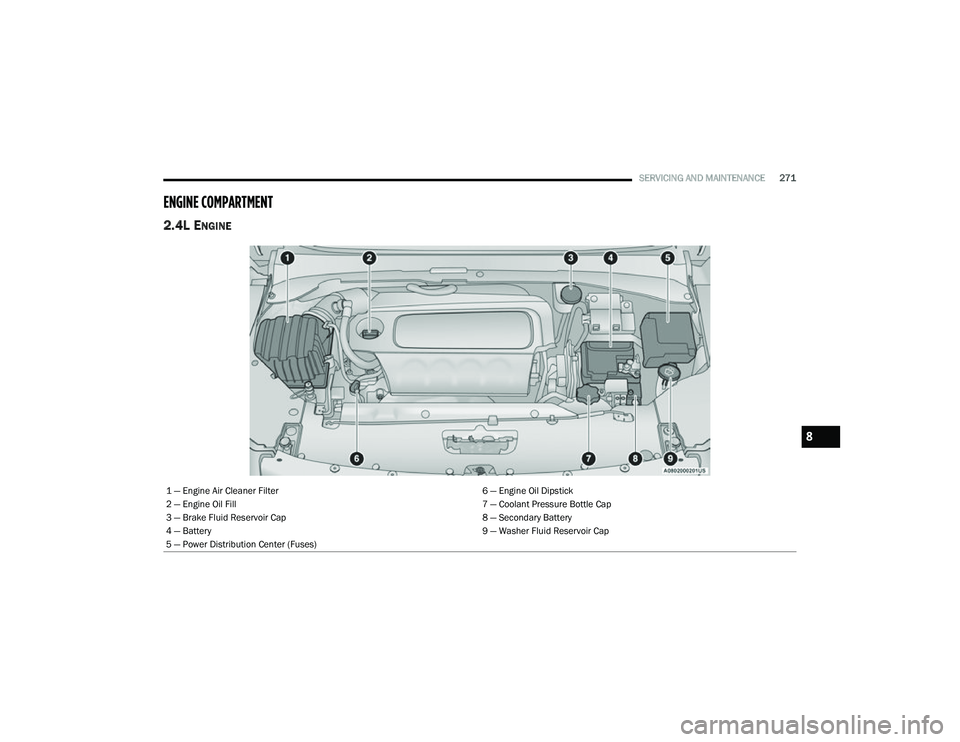
2.4L ENGINE
1 — Engine Air Cleaner Filter 6 — Engine Oil Dipstick
2 — Engine Oil Fill 7 — Coolant Pressure Bottle Cap
3 — Brake Fluid Reservoir Cap 8 — Secondary Battery
4 — Battery 9 — Washer Fluid Reservoir Cap
5 — Power Distribution Center (Fuses)
8
22_MP_OM_EN_USC_t.book Page 271
Page 274 of 344
272SERVICING AND MAINTENANCE
CHECKING OIL LEVEL
To ensure proper engine lubrication, the engine oil
must be maintained at the correct level. Check the
oil level at regular intervals, such as every fuel
stop. The best time to check the engine oil level is
about five minutes after a fully warmed up engine
is shut off.
Checking the oil while the vehicle is on level ground
will improve the accuracy of the oil level readings.
There are four possible dipstick types:
Crosshatched zone.
Crosshatched zone marked SAFE.
Crosshatched zone marked with MIN at the low
end of the range and MAX at the high end of the
range.
Crosshatched zone marked with dimples at the
MIN and the MAX ends of the range.
NOTE:Always maintain the oil level within the crosshatch
markings on the dipstick.
Adding 1 quart (1 liter) of oil when the reading is at
the low end of the dipstick range will raise the oil
level to the high end of the range marking.
ADDING WASHER FLUID
The fluid reservoir is located in the front of the
engine compartment. Be sure to check the fluid
level in the reservoir at regular intervals. Fill the
reservoir with windshield washer solvent (not
radiator antifreeze) and operate the system for a
few seconds to flush out the residual washer fluid.
When refilling the washer fluid reservoir, take
some washer fluid, apply it to a cloth or towel, and
wipe clean the wiper blades; this will help blade
performance.
To prevent freeze-up of your windshield washer
system in cold weather, select a solution or mixture
that meets or exceeds the temperature range of
your climate. This rating information can be found
on most washer fluid containers.
MAINTENANCE-FREE BATTERY
Your vehicle is equipped with a maintenance-free
battery. You will never have to add water, and
periodic maintenance is not required.
CAUTION!
Overfilling or underfilling the crankcase will
cause aeration or loss of oil pressure. This could
damage your engine.
WARNING!
Commercially available windshield washer
solvents are flammable. They could ignite and
burn you. Care must be exercised when filling or
working around the washer solution.
WARNING!
Battery fluid is a corrosive acid solution and
can burn or even blind you. Do not allow
battery fluid to contact your eyes, skin, or
clothing. Do not lean over a battery when
attaching clamps. If acid splashes in eyes or
on skin, flush the area immediately with large
amounts of water Úpage 258.
Battery gas is flammable and explosive. Keep
flame or sparks away from the battery. Do not
use a booster battery or any other booster
source with an output greater than 12 Volts.
Do not allow cable clamps to touch each
other.
Battery posts, terminals, and related accesso -
ries contain lead and lead compounds. Wash
hands after handling.
22_MP_OM_EN_USC_t.book Page 272
Page 275 of 344
SERVICING AND MAINTENANCE273
PRESSURE WASHING
Cleaning the engine compartment with a high
pressure washer is not recommended.
VEHICLE MAINTENANCE
An authorized dealer has the qualified service
personnel, special tools, and equipment to
perform all service operations in an expert
manner. Service Manuals are available which
include detailed service information for your
vehicle. Refer to these Service Manuals before
attempting any procedure yourself.
NOTE:Intentional tampering with emissions control
systems may void your warranty and could result in
civil penalties being assessed against you.
ENGINE OIL
Engine Oil Selection
For engine oil selection Úpage 323.
American Petroleum Institute (API)
Approved Engine Oil
These symbols mean that the oil has been certified
by the API. The manufacturer only recommends
API trademark oils.
The API Starburst trademark certifies
0W-20, 0W-30 and 5W-30 engine oils.
The API Donut trademark certifies 0W-40
and 5W-40 engine oil.
Synthetic Engine Oils
Your engine was designed for synthetic engine oils,
only use synthetic API approved engine oils.
CAUTION!
It is essential when replacing the cables on
the battery that the positive cable is attached
to the positive post and the negative cable is
attached to the negative post. Battery posts
are marked positive (+) and negative (-) and
are identified on the battery case. Cable
clamps should be tight on the terminal posts
and free of corrosion.
If a “fast charger” is used while the battery is
in the vehicle, disconnect both vehicle battery
cables before connecting the charger to the
battery. Do not use a “fast charger” to provide
starting voltage.
CAUTION!
Precautions have been taken to safeguard all
parts and connections however, the pressures
generated by these machines is such that
complete protection against water ingress
cannot be guaranteed.
WARNING!
You can be badly injured working on or around a
motor vehicle. Only do service work for which
you have the knowledge and the proper
equipment. If you have any doubt about your
ability to perform a service job, take your vehicle
to a competent mechanic.
CAUTION!
Do not use chemical flushes in your engine oil as
the chemicals can damage your engine. Such
damage is not covered by the New Vehicle
Limited Warranty.
8
22_MP_OM_EN_USC_t.book Page 273
Page 286 of 344
284SERVICING AND MAINTENANCE
(Continued)
FUSES
General Information
The fuses protect electrical systems against
excessive current.
When a device does not work, you must check the
fuse element inside the blade fuse for a break/
melt.
Also, please be aware that using power outlets for
extended periods of time with the engine off may
result in vehicle battery discharge.
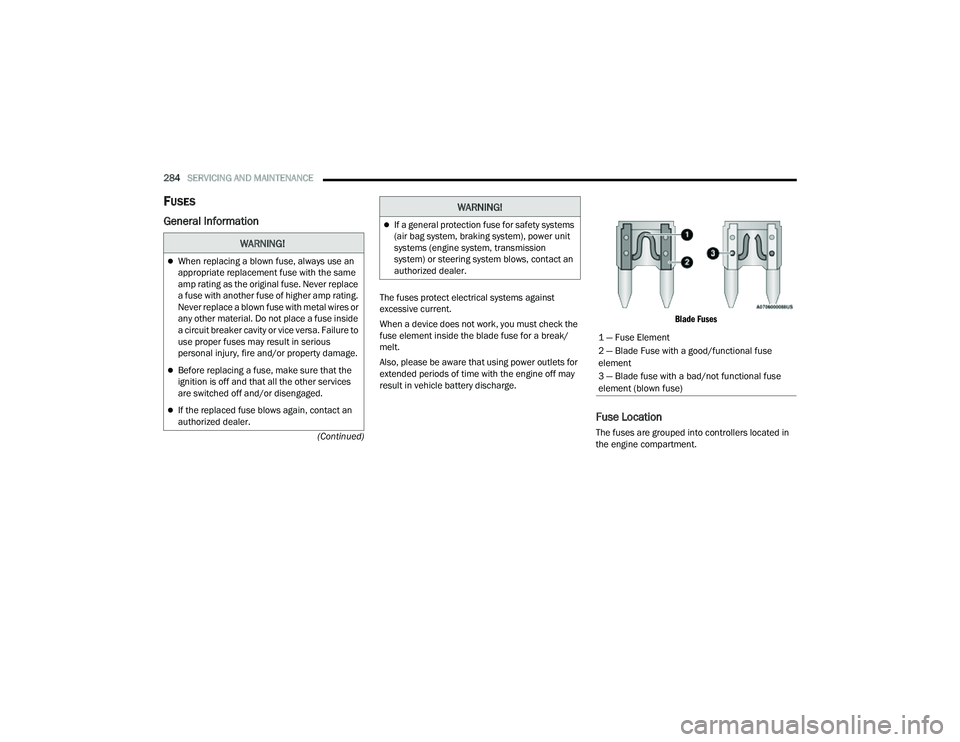
Blade Fuses
Fuse Location
The fuses are grouped into controllers located in
the engine compartment.
WARNING!
When replacing a blown fuse, always use an
appropriate replacement fuse with the same
amp rating as the original fuse. Never replace
a fuse with another fuse of higher amp rating.
Never replace a blown fuse with metal wires or
any other material. Do not place a fuse inside
a circuit breaker cavity or vice versa. Failure to
use proper fuses may result in serious
personal injury, fire and/or property damage.
Before replacing a fuse, make sure that the
ignition is off and that all the other services
are switched off and/or disengaged.
If the replaced fuse blows again, contact an
authorized dealer.
If a general protection fuse for safety systems
(air bag system, braking system), power unit
systems (engine system, transmission
system) or steering system blows, contact an
authorized dealer.
WARNING!
1 — Fuse Element
2 — Blade Fuse with a good/functional fuse
element
3 — Blade fuse with a bad/not functional fuse
element (blown fuse)
22_MP_OM_EN_USC_t.book Page 284
Page 289 of 344
SERVICING AND MAINTENANCE287
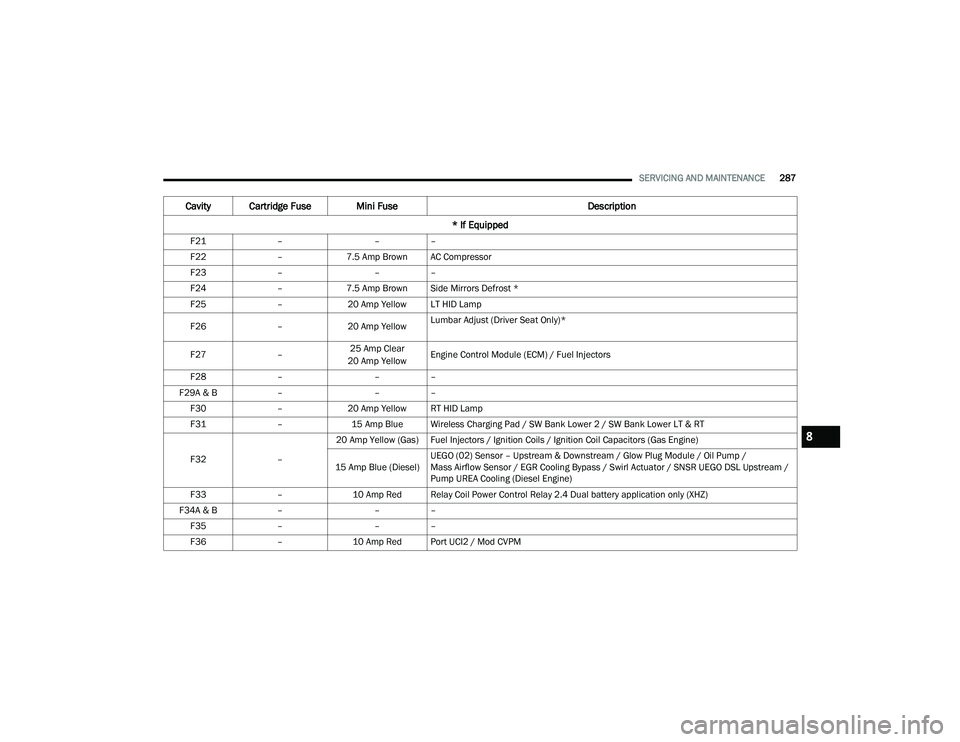
F21 – ––
F22 –7.5 Amp Brown AC Compressor
F23 – ––
F24 –7.5 Amp Brown Side Mirrors Defrost *
F25 –20 Amp Yellow LT HID Lamp
F26 –20 Amp Yellow Lumbar Adjust (Driver Seat Only)*
F27 –25 Amp Clear
20 Amp Yellow Engine Control Module (ECM) / Fuel Injectors
F28 – ––
F29A & B –––
F30 –20 Amp Yellow RT HID Lamp
F31 –15 Amp Blue Wireless Charging Pad / SW Bank Lower 2 / SW Bank Lower LT & RT
F32 –20 Amp Yellow (Gas) Fuel Injectors / Ignition Coils / Ignition Coil Capacitors (Gas Engine)
15 Amp Blue (Diesel) UEGO (02) Sensor – Upstream & Downstream / Glow Plug Module / Oil Pump /
Mass Airflow Sensor / EGR Cooling Bypass / Swirl Actuator / SNSR UEGO DSL Upstream /
Pump UREA Cooling (Diesel Engine)
F33 –10 Amp Red Relay Coil Power Control Relay 2.4 Dual battery application only (XHZ)
F34A & B –––
F35 – ––
F36 –10 Amp Red Port UCI2 / Mod CVPM
Cavity Cartridge Fuse Mini Fuse Description
* If Equipped
8
22_MP_OM_EN_USC_t.book Page 287
Page 290 of 344
288SERVICING AND MAINTENANCE
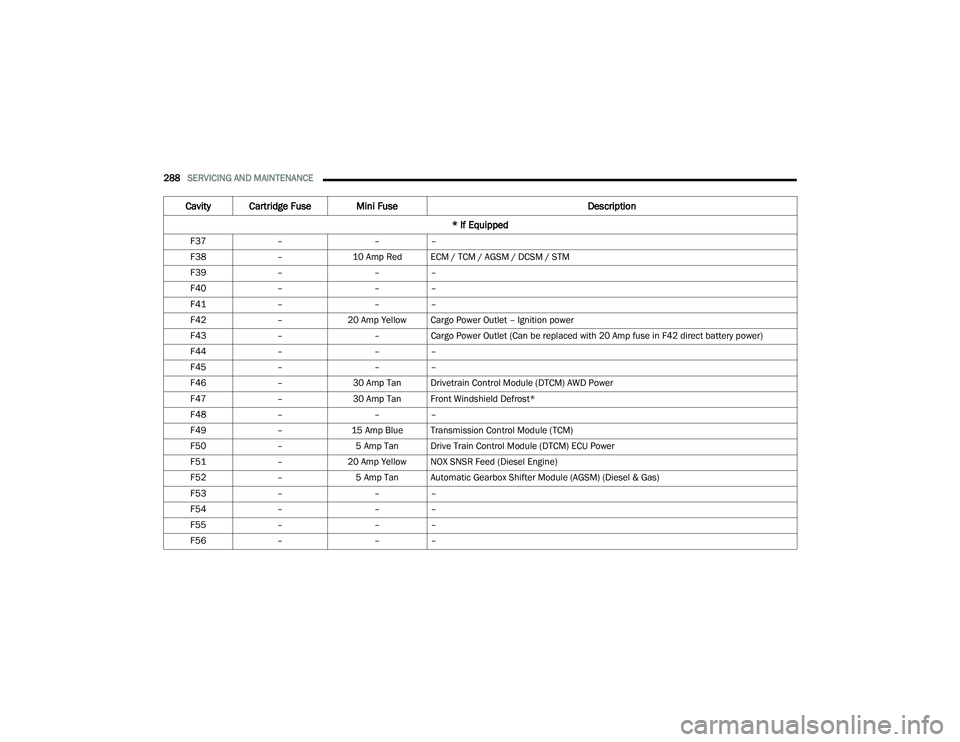
F37 – ––
F38 –10 Amp Red ECM / TCM / AGSM / DCSM / STM
F39 – ––
F40 – ––
F41 – ––
F42 –20 Amp Yellow Cargo Power Outlet – Ignition power
F43 – –Cargo Power Outlet (Can be replaced with 20 Amp fuse in F42 direct battery power)
F44 – ––
F45 – ––
F46 –30 Amp Tan Drivetrain Control Module (DTCM) AWD Power
F47 –30 Amp Tan Front Windshield Defrost*
F48 – ––
F49 –15 Amp Blue Transmission Control Module (TCM)
F50 –5 Amp Tan Drive Train Control Module (DTCM) ECU Power
F51 –20 Amp Yellow NOX SNSR Feed (Diesel Engine)
F52 –5 Amp Tan Automatic Gearbox Shifter Module (AGSM) (Diesel & Gas)
F53 – ––
F54 – ––
F55 – ––
F56 – ––
Cavity Cartridge Fuse Mini Fuse Description
* If Equipped
22_MP_OM_EN_USC_t.book Page 288