engine coolant JEEP GRAND CHEROKEE 2015 WK2 / 4.G SRT User Guide
[x] Cancel search | Manufacturer: JEEP, Model Year: 2015, Model line: GRAND CHEROKEE, Model: JEEP GRAND CHEROKEE 2015 WK2 / 4.GPages: 636, PDF Size: 5.35 MB
Page 561 of 636
150,000 miles (240,000 km) before replacement. To pre-
vent reducing this extended maintenance period, it is
important that you use the same engine coolant (OAT
coolant conforming to MS.90032) throughout the life of
your vehicle.
Please review these recommendations for using Organic
Additive Technology (OAT) engine coolant (antifreeze)
that meets the requirements of FCA Material Standard
MS.90032. When adding engine coolant (antifreeze):
•We recommend using MOPAR® Antifreeze/Coolant
10 Year/150,000 Mile Formula OAT (Organic Additive
Technology) that meets the requirements of FCA Ma-
terial Standard MS.90032.
•Mix a minimum solution of 50% OAT engine coolant
that meets the requirements of FCA Material Standard
MS.90032 and distilled water. Use higher concentra-
tions (not to exceed 70%) if temperatures below 34° F
(37° C) are anticipated.•Use only high purity water such as distilled or deion-
ized water when mixing the water/engine coolant
(antifreeze) solution. The use of lower quality water
will reduce the amount of corrosion protection in the
engine cooling system.
Please note that it is the owner’s responsibility to main-
tain the proper level of protection against freezing ac-
cording to the temperatures occurring in the area where
the vehicle is operated.
NOTE:
•Some vehicles require special tools to add coolant
properly. Failure to fill these systems properly could
lead to severe internal engine damage. If any coolant is
needed to be added to the system please contact your
local authorized dealer.
•Mixing engine coolant (antifreeze) types is not recom-
mended and can result in cooling system damage. If
7
MAINTAINING YOUR VEHICLE 559
Page 562 of 636
HOAT and OAT coolant are mixed in an emergency,
have a authorized dealer drain, flush, and refill with
OAT coolant (conforming to MS.90032) as soon as
possible.
Cooling System Pressure Cap
The cap must be fully tightened to prevent loss of engine
coolant (antifreeze), and to ensure that engine coolant
(antifreeze) will return to the radiator from the coolant
recovery tank.
The cap should be inspected and cleaned if there is any
accumulation of foreign material on the sealing surfaces.
WARNING!
•Do not open hot engine cooling system. Never add
engine coolant (antifreeze) when the engine is
overheated. Do not loosen or remove the cap to cool
(Continued)
WARNING!(Continued)
an overheated engine. Heat causes pressure to
build up in the cooling system. To prevent scalding
or injury, do not remove the pressure cap while the
system is hot or under pressure.
•Do not use a pressure cap other than the one
specified for your vehicle. Personal injury or en-
gine damage may result.
Disposal Of Used Engine Coolant
Used ethylene glycol-based engine coolant (antifreeze) is
a regulated substance requiring proper disposal. Check
with your local authorities to determine the disposal
rules for your community. To prevent ingestion by ani-
mals or children, do not store ethylene glycol-based
engine coolant in open containers or allow it to remain in
560 MAINTAINING YOUR VEHICLE
Page 563 of 636
puddles on the ground. If ingested by a child or pet, seek
emergency assistance immediately. Clean up any ground
spills immediately.
Coolant Level
The coolant bottle provides a quick visual method for
determining that the coolant level is adequate. With the
engine OFF and cold, the level of the engine coolant
(antifreeze) in the bottle should be between the ranges
indicated on the bottle.
The radiator normally remains completely full, so there is
no need to remove the radiator/coolant pressure cap
unless checking for engine coolant (antifreeze) freeze
point or replacing coolant. Advise your service attendant
of this. As long as the engine operating temperature is
satisfactory, the coolant bottle need only be checked once
a month.When additional engine coolant (antifreeze) is needed to
maintain the proper level, only OAT coolant that meets
the requirements of FCA Material Standard MS.90032
should be added to the coolant bottle. Do not overfill.Points To Remember
NOTE:When the vehicle is stopped after a few miles/
kilometers of operation, you may observe vapor coming
from the front of the engine compartment. This is nor-
mally a result of moisture from rain, snow, or high
humidity accumulating on the radiator and being vapor-
ized when the thermostat opens, allowing hot engine
coolant (antifreeze) to enter the radiator.
7
MAINTAINING YOUR VEHICLE 561
Page 564 of 636
If an examination of your engine compartment shows no
evidence of radiator or hose leaks, the vehicle may be
safely driven. The vapor will soon dissipate.
•Do not overfill the coolant expansion bottle.
•Check the coolant freeze point in the radiator and in
the coolant expansion bottle. If engine coolant (anti-
freeze) needs to be added, the contents of the coolant
expansion bottle must also be protected against freez-
ing.
•If frequent engine coolant (antifreeze) additions are
required, the cooling system should be pressure tested
for leaks.
•Maintain engine coolant (antifreeze) concentration at a
minimum of 50% OAT coolant (conforming to
MS.90032) and distilled water for proper corrosion
protection of your engine which contains aluminum
components.•Make sure that the coolant expansion bottle overflow
hoses are not kinked or obstructed.
•Keep the front of the radiator clean. If your vehicle is
equipped with air conditioning, keep the front of the
condenser clean.
•Do not change the thermostat for Summer or Winter
operation. If replacement is ever necessary, install
ONLY the correct type thermostat. Other designs may
result in unsatisfactory engine coolant (antifreeze)
performance, poor gas mileage, and increased emis-
sions.
Brake System
In order to assure brake system performance, all brake
system components should be inspected periodically.
Refer to the “Maintenance Schedule” for the proper
maintenance intervals.
562 MAINTAINING YOUR VEHICLE
Page 593 of 636
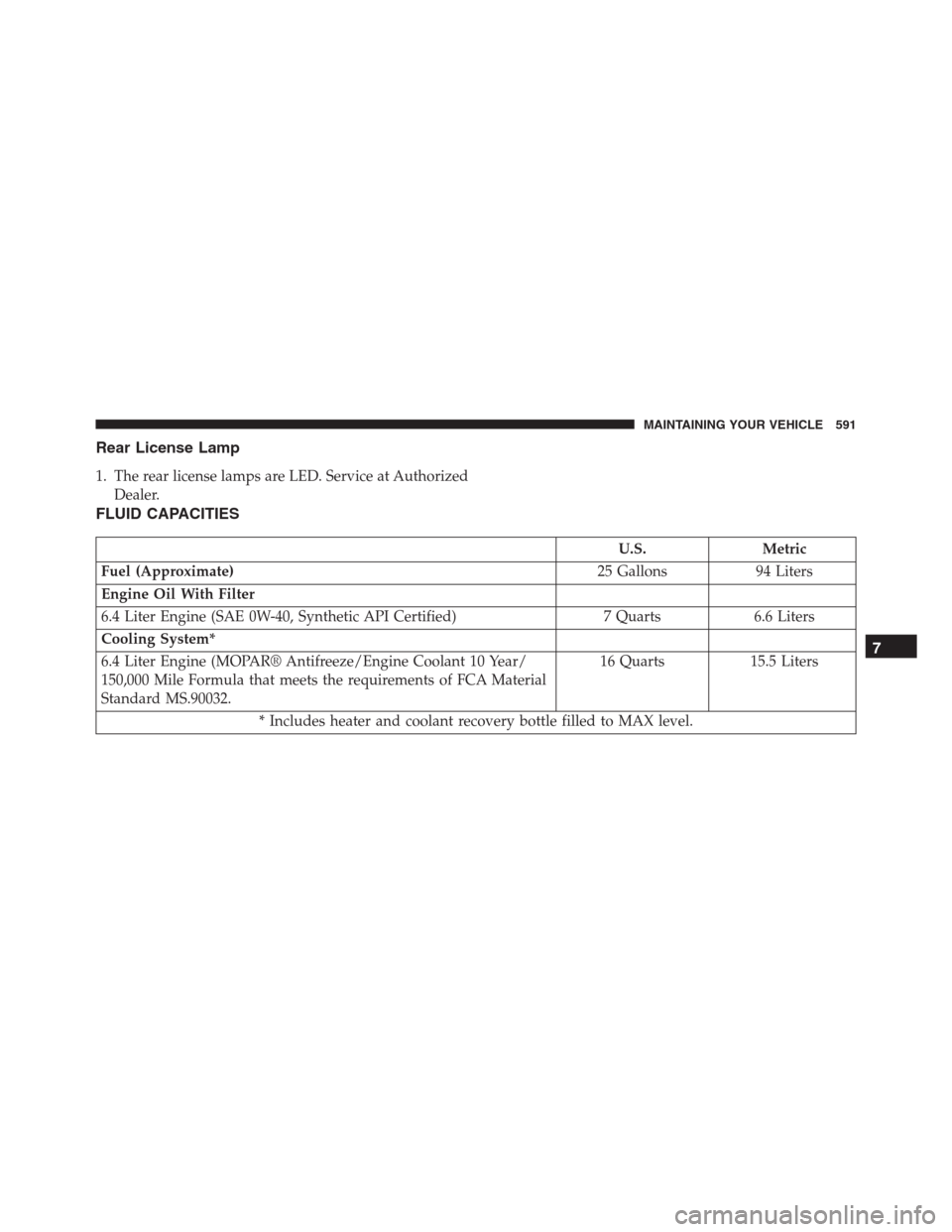
Rear License Lamp
1. The rear license lamps are LED. Service at Authorized
Dealer.
FLUID CAPACITIES
U.S. Metric
Fuel (Approximate)25 Gallons 94 Liters
Engine Oil With Filter
6.4 Liter Engine (SAE 0W-40, Synthetic API Certified) 7 Quarts 6.6 Liters
Cooling System*
6.4 Liter Engine (MOPAR® Antifreeze/Engine Coolant 10 Year/
150,000 Mile Formula that meets the requirements of FCA Material
Standard MS.90032.16 Quarts 15.5 Liters
* Includes heater and coolant recovery bottle filled to MAX level.
7
MAINTAINING YOUR VEHICLE 591
Page 594 of 636
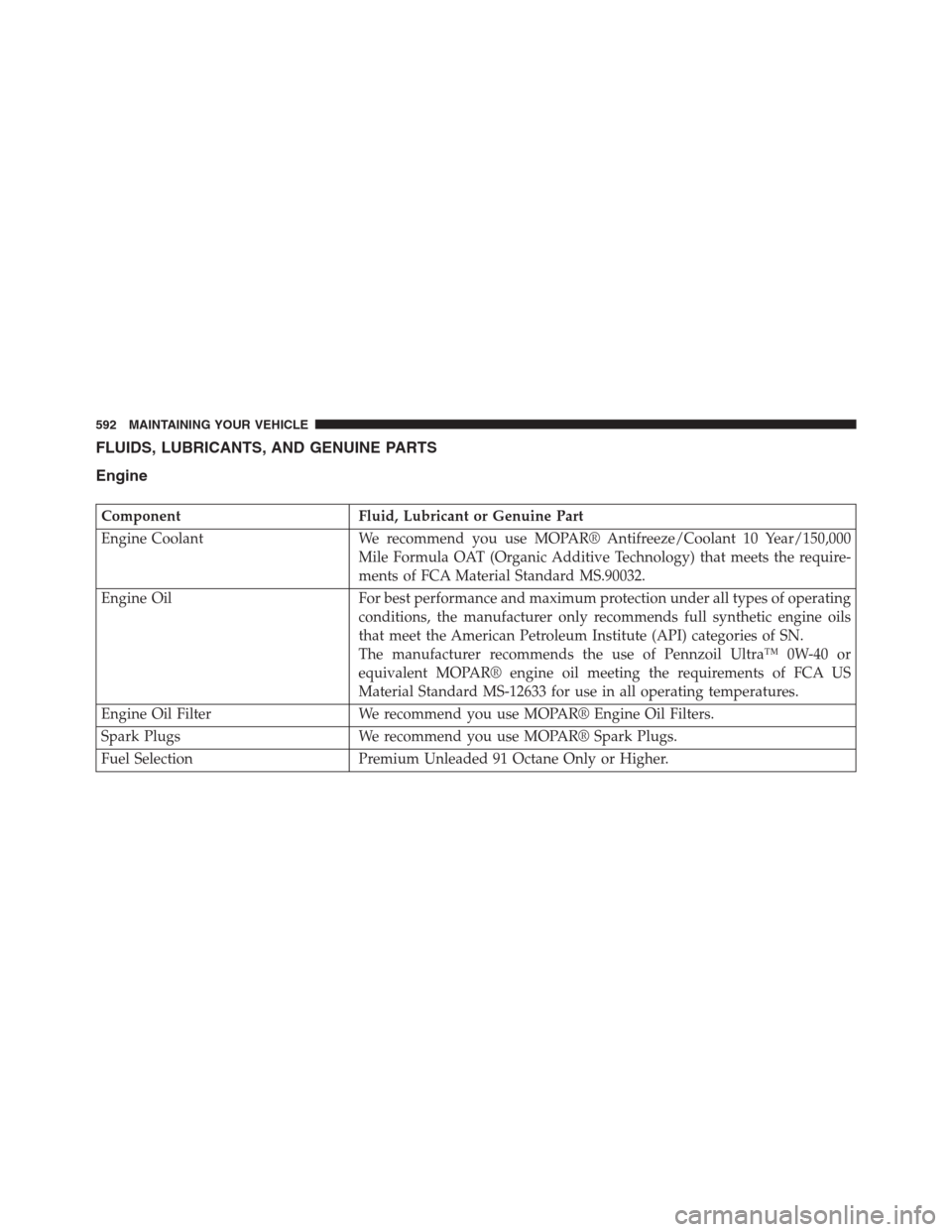
FLUIDS, LUBRICANTS, AND GENUINE PARTS
Engine
Component Fluid, Lubricant or Genuine Part
Engine Coolant We recommend you use MOPAR® Antifreeze/Coolant 10 Year/150,000
Mile Formula OAT (Organic Additive Technology) that meets the require-
ments of FCA Material Standard MS.90032.
Engine Oil For best performance and maximum protection under all types of operating
conditions, the manufacturer only recommends full synthetic engine oils
that meet the American Petroleum Institute (API) categories of SN.
The manufacturer recommends the use of Pennzoil Ultra™ 0W-40 or
equivalent MOPAR® engine oil meeting the requirements of FCA US
Material Standard MS-12633 for use in all operating temperatures.
Engine Oil Filter We recommend you use MOPAR® Engine Oil Filters.
Spark Plugs We recommend you use MOPAR® Spark Plugs.
Fuel Selection Premium Unleaded 91 Octane Only or Higher.
592 MAINTAINING YOUR VEHICLE
Page 599 of 636
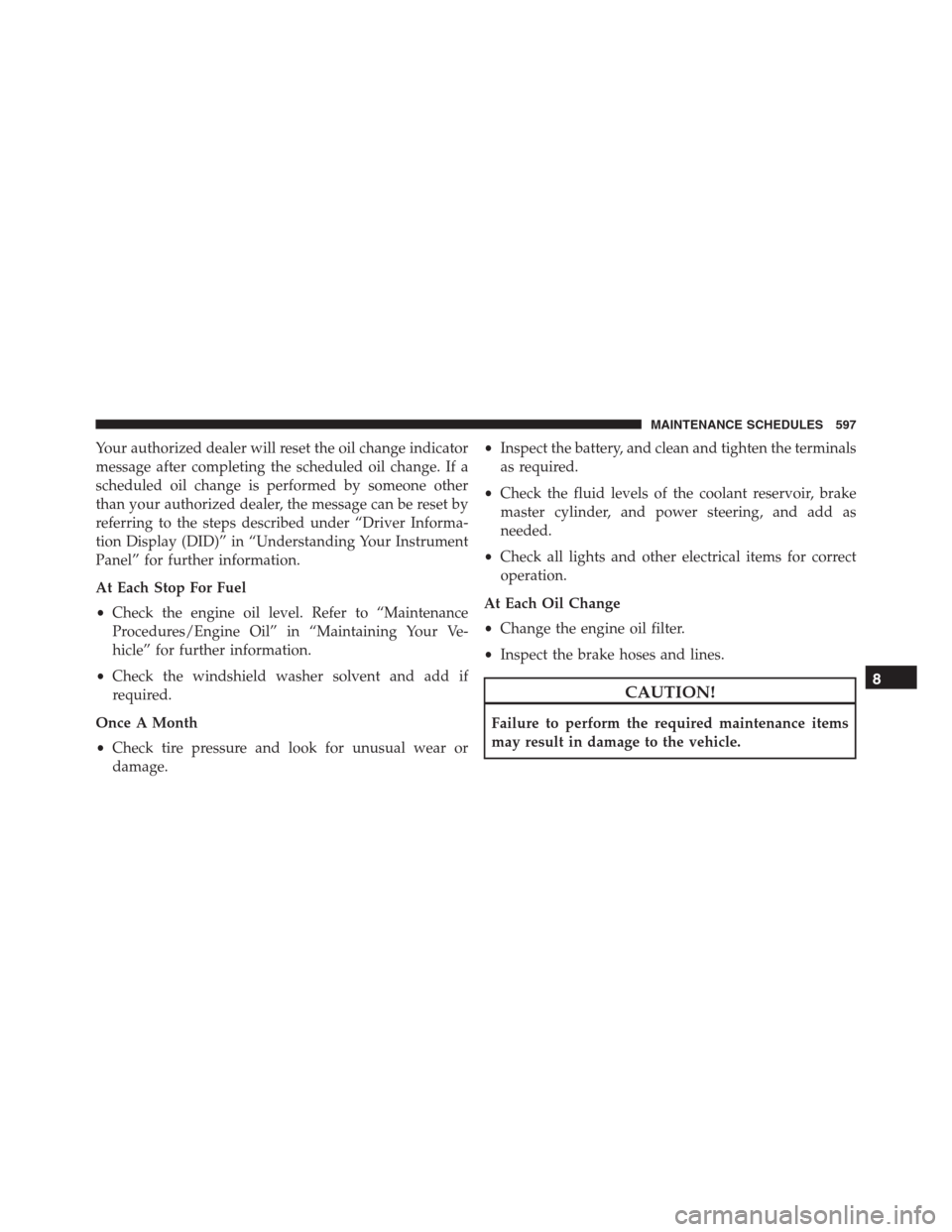
Your authorized dealer will reset the oil change indicator
message after completing the scheduled oil change. If a
scheduled oil change is performed by someone other
than your authorized dealer, the message can be reset by
referring to the steps described under “Driver Informa-
tion Display (DID)” in “Understanding Your Instrument
Panel” for further information.
At Each Stop For Fuel
•Check the engine oil level. Refer to “Maintenance
Procedures/Engine Oil” in “Maintaining Your Ve-
hicle” for further information.
•Check the windshield washer solvent and add if
required.
Once A Month
•Check tire pressure and look for unusual wear or
damage.•Inspect the battery, and clean and tighten the terminals
as required.
•Check the fluid levels of the coolant reservoir, brake
master cylinder, and power steering, and add as
needed.
•Check all lights and other electrical items for correct
operation.
At Each Oil Change
•Change the engine oil filter.
•Inspect the brake hoses and lines.
CAUTION!
Failure to perform the required maintenance items
may result in damage to the vehicle.
8
MAINTENANCE SCHEDULES 597
Page 603 of 636
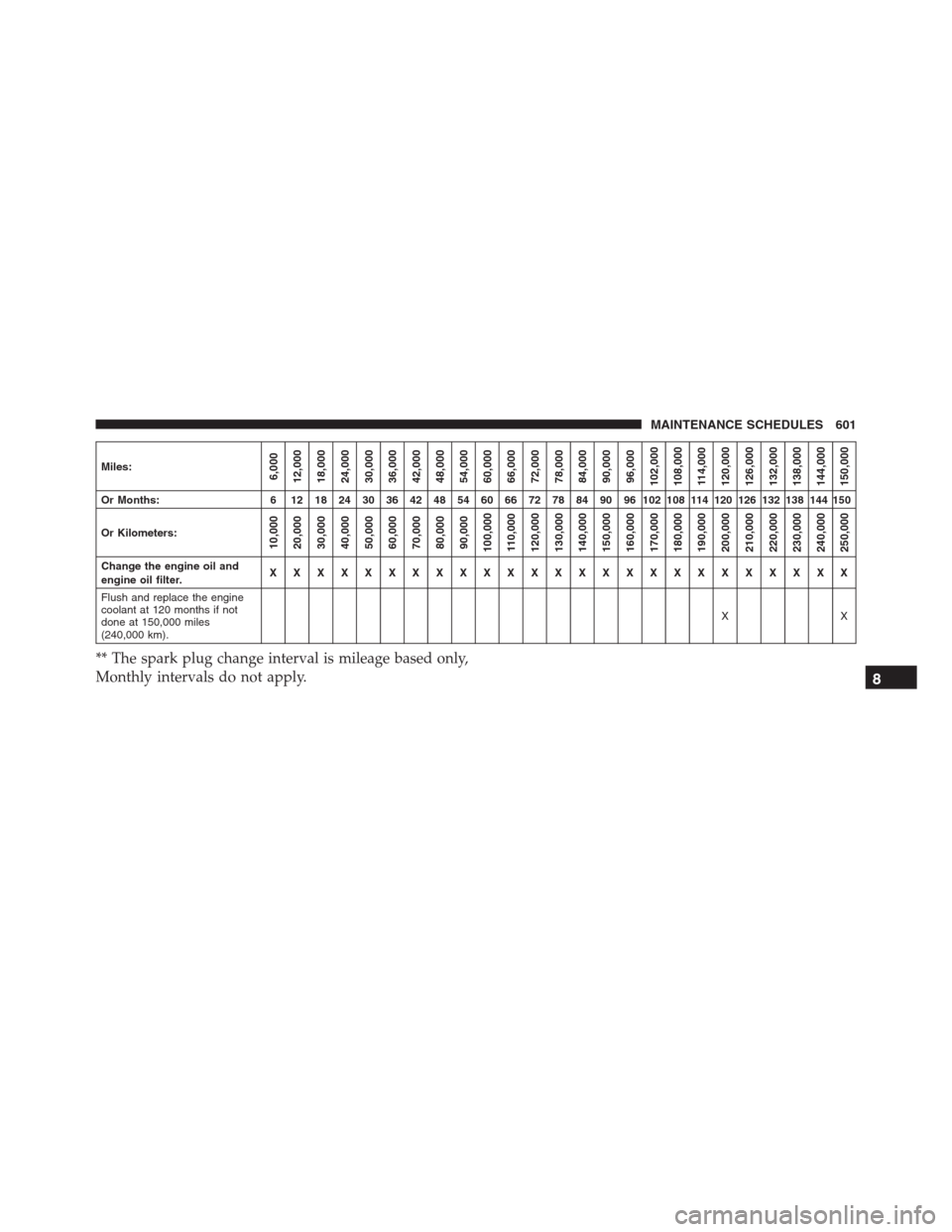
Miles:6,000
12,000
18,000
24,000
30,000
36,000
42,000
48,000
54,000
60,000
66,000
72,000
78,000
84,000
90,000
96,000
102,000
108,000
114,000
120,000
126,000
132,000
138,000
144,000
150,000
Or Months: 6 12 18 24 30 36 42 48 54 60 66 72 78 84 90 96 102 108 114 120 126 132 138 144 150
Or Kilometers:
10,000
20,000
30,000
40,000
50,000
60,000
70,000
80,000
90,000
100,000
110,000
120,000
130,000
140,000
150,000
160,000
170,000
180,000
190,000
200,000
210,000
220,000
230,000
240,000
250,000
Change the engine oil and
engine oil filter.XXXXXXXXXXXXXXXXXXXXXXXXX
Flush and replace the engine
coolant at 120 months if not
done at 150,000 miles
(240,000 km).XX
** The spark plug change interval is mileage based only,
Monthly intervals do not apply.
8
MAINTENANCE SCHEDULES 601
Page 616 of 636
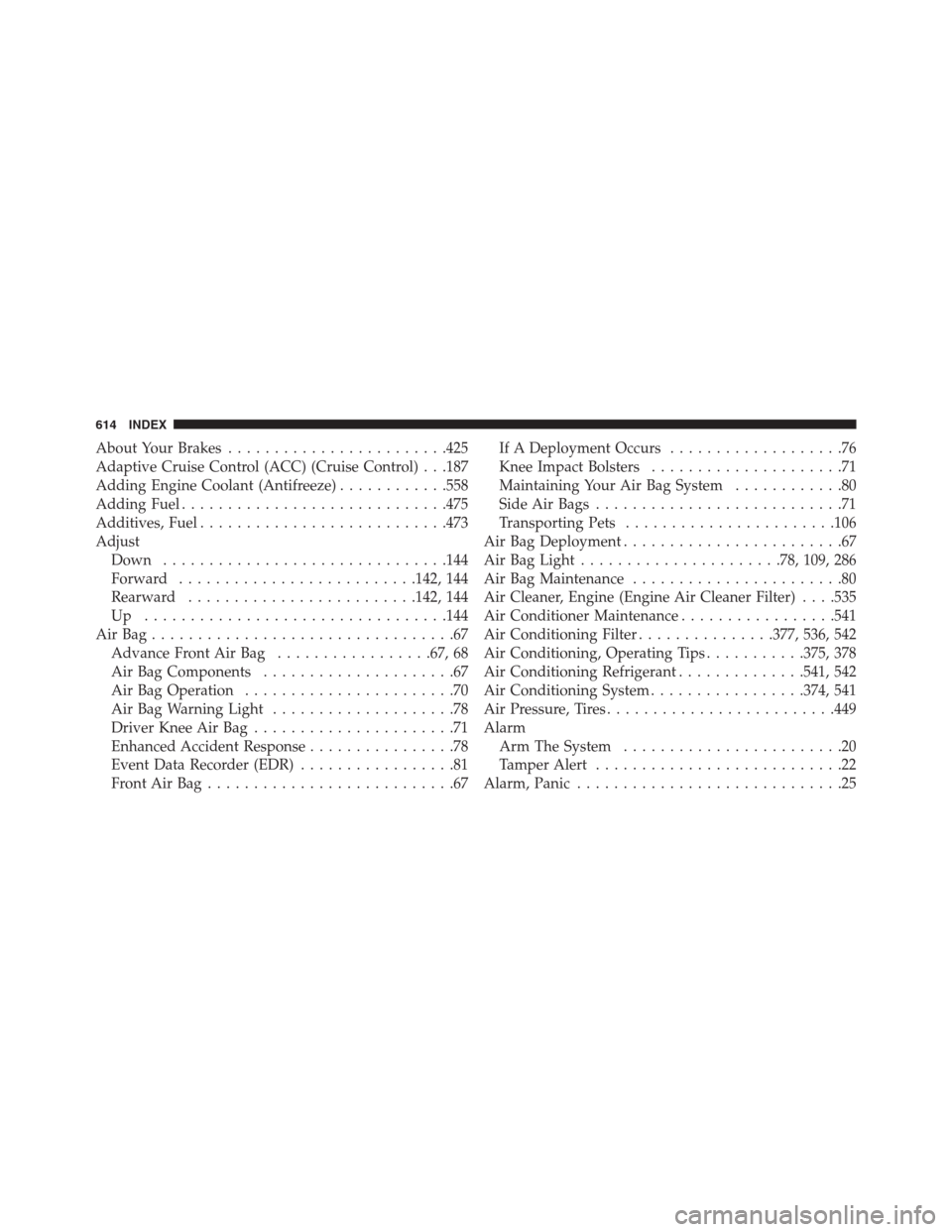
About Your Brakes........................425
Adaptive Cruise Control (ACC) (Cruise Control) . . .187
Adding Engine Coolant (Antifreeze)............558
Adding Fuel.............................475
Additives, Fuel...........................473
Adjust
Down...............................144
Forward..........................142, 144
Rearward.........................142, 144
Up .................................144
AirBag.................................67
Advance Front Air Bag.................67, 68
Air Bag Components.....................67
Air Bag Operation.......................70
Air Bag Warning Light....................78
Driver Knee Air Bag......................71
Enhanced Accident Response................78
Event Data Recorder (EDR).................81
FrontAirBag...........................67If A Deployment Occurs...................76
Knee Impact Bolsters.....................71
Maintaining Your Air Bag System............80
Side Air Bags...........................71
Transporting Pets.......................106
Air Bag Deployment........................67
Air Bag Light......................78, 109, 286
Air Bag Maintenance.......................80
Air Cleaner, Engine (Engine Air Cleaner Filter). . . .535
Air Conditioner Maintenance.................541
Air Conditioning Filter...............377, 536, 542
Air Conditioning, Operating Tips...........375, 378
Air Conditioning Refrigerant..............541, 542
Air Conditioning System.................374, 541
Air Pressure, Tires.........................449
Alarm
Arm The System........................20
Tamper Alert...........................22
Alarm, Panic.............................25
614 INDEX
Page 617 of 636
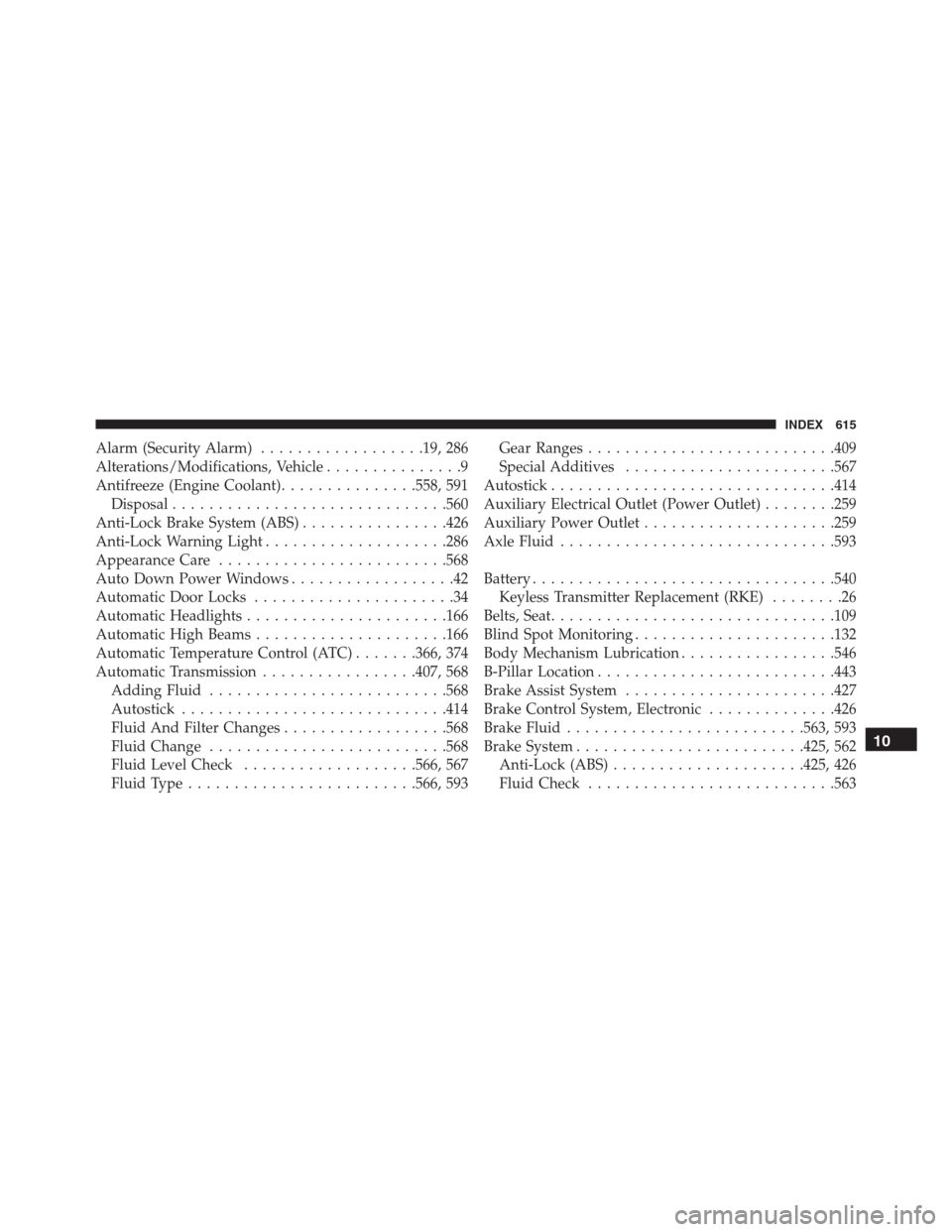
Alarm (Security Alarm)..................19, 286
Alterations/Modifications, Vehicle...............9
Antifreeze (Engine Coolant)...............558, 591
Disposal..............................560
Anti-Lock Brake System (ABS)................426
Anti-Lock Warning Light....................286
Appearance Care.........................568
Auto Down Power Windows..................42
Automatic Door Locks......................34
Automatic Headlights......................166
Automatic High Beams.....................166
Automatic Temperature Control (ATC).......366, 374
Automatic Transmission.................407, 568
Adding Fluid..........................568
Autostick.............................414
Fluid And Filter Changes..................568
Fluid Change..........................568
Fluid Level Check...................566, 567
Fluid Type.........................566, 593Gear Ranges...........................409
Special Additives.......................567
Autostick...............................414
Auxiliary Electrical Outlet (Power Outlet)........259
Auxiliary Power Outlet.....................259
Axle Fluid..............................593
Battery.................................540
Keyless Transmitter Replacement (RKE)........26
Belts, Seat...............................109
Blind Spot Monitoring......................132
Body Mechanism Lubrication.................546
B-Pillar Location..........................443
Brake Assist System.......................427
Brake Control System, Electronic..............426
Brake Fluid..........................563, 593
Brake System.........................425, 562
Anti-Lock (ABS).....................425, 426
Fluid Check...........................563
10
INDEX 615