Cluster illumination diagnosis JEEP LIBERTY 2002 KJ / 1.G User Guide
[x] Cancel search | Manufacturer: JEEP, Model Year: 2002, Model line: LIBERTY, Model: JEEP LIBERTY 2002 KJ / 1.GPages: 1803, PDF Size: 62.3 MB
Page 426 of 1803

when it is provided a path to ground by the instru-
ment cluster transistor. The instrument cluster will
turn on the low fuel indicator for the following rea-
sons:
²Bulb Test- Each time the ignition switch is
turned to the On position the low fuel indicator is
illuminated for about three seconds as a bulb test.
²Less Than 12.5 Percent Tank Full Message-
Each time the cluster receives a message from the
PCM indicating that the percent tank full is less
than 12.5 (one-eighth), the low fuel indicator is illu-
minated. The indicator remains illuminated until the
cluster receives messages from the PCM indicating
that the percent tank full has increased to greater
than 12.5 (one-eighth). The PCM applies an algo-
rithm to the input from the fuel tank sender to
dampen the illumination of the low fuel indicator
against the negative effect that fuel sloshing within
the fuel tank can have on accurate inputs to the
PCM.
²Less Than Empty Percent Tank Full Mes-
sage- Each time the cluster receives a message from
the PCM indicating the percent tank full is less than
empty, the low fuel indicator is illuminated immedi-
ately. This message would indicate that the fuel tank
sender input to the PCM is a short circuit.
²More Than Full Percent Tank Full Message
- Each time the cluster receives a message from the
PCM indicating the percent tank full is more than
full, the low fuel indicator is illuminated immedi-
ately. This message would indicate that the fuel tank
sender input to the PCM is an open circuit.
²Communication Error- If the cluster fails to
receive a percent tank full message for more than
about twelve seconds, the cluster control circuitry
will illuminate the low fuel indicator until a new per-
cent tank full message is received, or until the igni-
tion switch is turned to the Off position, whichever
occurs first.
²Actuator Test- Each time the cluster is put
through the actuator test, the low fuel indicator will
be turned on, then off again during the bulb check
portion of the test to confirm the functionality of the
LED and the cluster control circuitry.
The PCM continually monitors the fuel tank
sender input to determine the fuel level. The PCM
then applies an algorithm to the input and sends the
proper percent tank full messages to the instrument
cluster. For further diagnosis of the low fuel indicator
or the instrument cluster circuitry that controls the
LED, (Refer to 8 - ELECTRICAL/INSTRUMENT
CLUSTER - DIAGNOSIS AND TESTING). For
proper diagnosis of the fuel tank sender, the PCM,
the PCI data bus, or the electronic message inputs to
the instrument cluster that control the low fuel indi-cator, a DRBIIItscan tool is required. Refer to the
appropriate diagnostic information.
LOW OIL PRESSURE
INDICATOR
DESCRIPTION
A low oil pressure indicator is standard equipment
on all instrument clusters. The low oil pressure indi-
cator is located near the lower edge of the instrument
cluster, between the tachometer and the speedometer.
The low oil pressure indicator consists of a stencil-
like cutout of the International Control and Display
Symbol icon for ªEngine Oilº in the opaque layer of
the instrument cluster overlay. The dark outer layer
of the overlay prevents the indicator from being
clearly visible when it is not illuminated. A red Light
Emitting Diode (LED) behind the cutout in the
opaque layer of the overlay causes the icon to appear
in red through the translucent outer layer of the
overlay when it is illuminated from behind by the
LED, which is soldered onto the instrument cluster
electronic circuit board. The low oil pressure indica-
tor is serviced as a unit with the instrument cluster.
OPERATION
The low oil pressure indicator gives an indication
to the vehicle operator when the engine oil pressure
is low. This indicator is controlled by a transistor on
the instrument cluster electronic circuit board based
upon cluster programming and electronic messages
received by the cluster from the Powertrain Control
Module (PCM) over the Programmable Communica-
tions Interface (PCI) data bus. The low oil pressure
indicator Light Emitting Diode (LED) is completely
controlled by the instrument cluster logic circuit, and
that logic will only allow this indicator to operate
when the instrument cluster receives a battery cur-
rent input on the fused ignition switch output (run-
start) circuit. Therefore, the LED will always be off
when the ignition switch is in any position except On
or Start. The LED only illuminates when it is pro-
vided a path to ground by the instrument cluster
transistor. The instrument cluster will turn on the
low oil pressure indicator for the following reasons:
²Bulb Test- Each time the ignition switch is
turned to the On position the low oil pressure indica-
tor is illuminated as a bulb test. The indicator will
remain illuminated until the engine is started
(engine speed is greater than 450 rpm), or until the
ignition switch is turned to the Off position, which-
ever occurs first.
²Engine Oil Pressure Low Message- Once the
engine has been started (engine speed has been
greater than 450 rpm), each time the cluster receives
KJINSTRUMENT CLUSTER 8J - 23
LOW FUEL INDICATOR (Continued)
Page 429 of 1803

On or Start positions, the trip odometer will be reset
to 0.0 kilometers (miles). The VFD must be display-
ing the trip odometer information in order for the
trip odometer information to be reset.
²Warning Display- The odometer or trip odom-
eter information will be toggled at two second inter-
vals with a warning display when certain monitored
conditions are active. If multiple conditions are
active, the VFD will toggle each active warning and
the odometer/trip odometer information at two sec-
ond intervals. Once the vehicle is moving and a vehi-
cle speed input is received by the instrument cluster,
each active warning will be displayed for three two-
second intervals before the VFD reverts to displaying
only the selected odometer or trip odometer informa-
tion. The warnings and monitored conditions include:
²ªdoorº- A door is open or not fully latched.
²ªgateº- The tailgate is open or not fully
latched.
²ªglassº- The rear flip-up glass is open or not
fully latched.
²ªlowashº- The fluid level in the washer reser-
voir is low.
²ªno busº- The instrument cluster can detect no
PCI bus communication. This message is illuminated
solid when there is no PCI bus communication, and
will override the display of all other active warning
displays.
²Communication Error- If the cluster fails to
receive a distance message during normal operation,
it will hold and display the last data received until
the ignition switch is turned to the Off position. If
the cluster does not receive a distance message
within one second after the ignition switch is turned
to the On position, it will display the last distance
message stored in the cluster memory. If the cluster
is unable to display distance information due to an
error internal to the cluster, ªerrorº will be displayed
in the VFD.
²Actuator Test- Each time the cluster is put
through the actuator test, the VFD will step sequen-
tially through a display of ª111111 ºthrough ª999999º,
then display the cluster software version number to
confirm the functionality of the VFD and the cluster
control circuitry.
The PCM continually monitors the vehicle speed
pulse information received from the Body Control
Module (BCM), then sends the proper distance mes-
sages to the instrument cluster. For further diagnosis
of the odometer/trip odometer or the instrument clus-
ter circuitry that controls these functions, (Refer to 8
- ELECTRICAL/INSTRUMENT CLUSTER - DIAG-
NOSIS AND TESTING). For proper diagnosis of the
vehicle speed sensor, the BCM, the PCM, the PCI
data bus, or the electronic message inputs to the
instrument cluster that control the odometer/tripodometer, a DRBIIItscan tool is required. Refer to
the appropriate diagnostic information.
OVERDRIVE OFF INDICATOR
DESCRIPTION
An overdrive off indicator is standard equipment
on all instrument clusters, but is only functional on
vehicles equipped with the optional overdrive auto-
matic transmission. The overdrive off indicator is
located above the fuel gauge and to the left of the
tachometer in the instrument cluster. The overdrive
off indicator consists of a stencil-like cutout of the
text ªO/D OFFº in the opaque layer of the instrument
cluster overlay. The dark outer layer of the overlay
prevents the indicator from being clearly visible
when it is not illuminated. An amber Light Emitting
Diode (LED) behind the cutout in the opaque layer of
the overlay causes the ªO/D OFFº text to appear in
amber through the translucent outer layer of the
overlay when it is illuminated from behind by the
LED, which is soldered onto the instrument cluster
electronic circuit board. When the exterior lighting is
turned On, the illumination intensity of the overdrive
off indicator is dimmable, which is adjusted using the
panel lamps dimmer control ring on the left control
stalk of the multi-function switch. The overdrive off
indicator is serviced as a unit with the instrument
cluster.
OPERATION
The overdrive off indicator gives an indication to
the vehicle operator when the Off position of the
overdrive off switch has been selected, disabling the
electronically controlled overdrive feature of the auto-
matic transmission. This indicator is controlled by a
transistor on the instrument cluster electronic circuit
board based upon the cluster programming and elec-
tronic messages received by the cluster from the
Powertrain Control Module (PCM) over the Program-
mable Communications Interface (PCI) data bus. The
overdrive off indicator Light Emitting Diode (LED) is
completely controlled by the instrument cluster logic
circuit, and that logic will only allow this indicator to
operate when the instrument cluster receives a bat-
tery current input on the fused ignition switch out-
put (run-start) circuit. Therefore, the LED will
always be off when the ignition switch is in any posi-
tion except On or Start. The LED only illuminates
when it is provided a path to ground by the instru-
ment cluster transistor. The instrument cluster will
turn on the overdrive off indicator for the following
reasons:
²Overdrive Off Lamp-On Message- Each time
the cluster receives an overdrive off lamp-on message
8J - 26 INSTRUMENT CLUSTERKJ
ODOMETER (Continued)
Page 430 of 1803

from the PCM indicating that the Off position of the
overdrive off switch has been selected, the overdrive
off indicator will be illuminated. The indicator
remains illuminated until the cluster receives an
overdrive off lamp-off message from the PCM or until
the ignition switch is turned to the Off position,
whichever occurs first.
²Actuator Test- Each time the cluster is put
through the actuator test, the overdrive off indicator
will be turned on, then off again during the bulb
check portion of the test in order to confirm the func-
tionality of the LED and the cluster control circuitry.
The PCM continually monitors the overdrive off
switch to determine the proper outputs to the auto-
matic transmission. The PCM then sends the proper
overdrive off lamp-on and lamp-off messages to the
instrument cluster. For further diagnosis of the over-
drive off indicator or the instrument cluster circuitry
that controls the indicator, (Refer to 8 - ELECTRI-
CAL/INSTRUMENT CLUSTER - DIAGNOSIS AND
TESTING). For proper diagnosis of the overdrive con-
trol system, the PCM, the PCI data bus, or the elec-
tronic message inputs to the instrument cluster that
control the overdrive off indicator, a DRBIIItscan
tool is required. Refer to the appropriate diagnostic
information.
REAR FOG LAMP INDICATOR
DESCRIPTION
A rear fog lamp indicator is standard equipment on
all instrument clusters, but is only functional on
vehicles equipped with the optional rear fog lamps,
which are available only in certain markets where
they are required. The rear fog lamp indicator is
located above the engine temperature gauge and to
the right of the speedometer in the instrument clus-
ter. The rear fog lamp indicator consists of a stencil-
like cutout of the International Control and Display
Symbol icon for ªRear Fog Lightº in the opaque layer
of the instrument cluster overlay. The dark outer
layer of the overlay prevents the indicator from being
clearly visible when it is not illuminated. An amber
Light Emitting Diode (LED) behind the cutout in the
opaque layer of the overlay causes the icon to appear
in amber through the translucent outer layer of the
overlay when it is illuminated from behind by the
LED, which is soldered onto the instrument cluster
electronic circuit board. When the exterior lighting is
turned On, the illumination intensity of the rear fog
lamp indicator is dimmable, which is adjusted using
the panel lamps dimmer control ring on the left con-
trol stalk of the multi-function switch. The rear fog
lamp indicator is serviced as a unit with the instru-
ment cluster.
OPERATION
The rear fog lamp indicator gives an indication to
the vehicle operator whenever the rear fog lamps are
illuminated. This indicator is controlled by a transis-
tor on the instrument cluster electronic circuit board
based upon the cluster programming and electronic
messages received by the cluster from the Body Con-
trol Module (BCM) over the Programmable Commu-
nications Interface (PCI) data bus. The rear fog lamp
indicator Light Emitting Diode (LED) is completely
controlled by the instrument cluster logic circuit, and
that logic will allow this indicator to operate when-
ever the instrument cluster receives a battery cur-
rent input on the fused B(+) circuit. Therefore, the
LED can be illuminated regardless of the ignition
switch position. The LED only illuminates when it is
provided a path to ground by the instrument cluster
transistor. The instrument cluster will turn on the
rear fog lamp indicator for the following reasons:
²Rear Fog Lamp-On Message- Each time the
cluster receives a rear fog lamp-on message from the
BCM indicating the rear fog lamps are turned On,
the rear fog lamp indicator will be illuminated. The
indicator remains illuminated until the cluster
receives a rear fog lamp-off message from the BCM.
²Actuator Test- Each time the cluster is put
through the actuator test, the rear fog lamp indicator
will be turned on, then off again during the bulb
check portion of the test to confirm the functionality
of the LED and the cluster control circuitry.
The BCM continually monitors the exterior light-
ing (multi-function) switch to determine the proper
outputs to the rear fog lamp relay. The BCM then
sends the proper rear fog lamp indicator lamp-on and
lamp-off messages to the instrument cluster. For fur-
ther diagnosis of the rear fog lamp indicator or the
instrument cluster circuitry that controls the indica-
tor, (Refer to 8 - ELECTRICAL/INSTRUMENT
CLUSTER - DIAGNOSIS AND TESTING). For
proper diagnosis of the rear fog lamp system, the
BCM, the PCI data bus, or the electronic message
inputs to the instrument cluster that control the rear
fog lamp indicator, a DRBIIItscan tool is required.
Refer to the appropriate diagnostic information.
SEATBELT INDICATOR
DESCRIPTION
A seatbelt indicator is standard equipment on all
instrument clusters. The seatbelt indicator is located
above the fuel gauge and to the right of the tachom-
eter in the instrument cluster. The seatbelt indicator
consists of a stencil-like cutout of the International
Control and Display Symbol icon for ªSeat Beltº in
the opaque layer of the instrument cluster overlay.
KJINSTRUMENT CLUSTER 8J - 27
OVERDRIVE OFF INDICATOR (Continued)
Page 432 of 1803

indicator will be illuminated for the following rea-
sons:
²VTSS Indication- During the sixteen second
VTA pre-arming function, the BCM will flash the
security indicator on and off repeatedly at a steady,
fast rate to indicate that the VTA is in the process of
arming. Following successful VTA arming, the BCM
flashes the security indicator on and off continuously
at a slower rate to indicate that the VTA is armed.
The security indicator continues flashing at the
slower rate until the VTA is disarmed.
The BCM provides a hard wired ground input to
the instrument cluster circuitry through the VTSS
indicator driver circuit whenever the ignition switch
is in the Off position and the VTA is arming, armed,
or triggered. The VTSS indicator driver circuit
between the BCM and the instrument cluster can be
diagnosed using conventional diagnostic tools and
methods. However, for proper diagnosis of the VTA
and the BCM, or the hard wired inputs to the instru-
ment cluster that control the security indicator, a
DRBIIItscan tool is required. Refer to the appropri-
ate diagnostic information.
SHIFT INDICATOR (TRANSFER
CASE)
DESCRIPTION
DESCRIPTION - PART TIME INDICATOR
A part time indicator is standard equipment on all
instrument clusters. The part time indicator is
located near the lower edge of the tachometer dial
face in the instrument cluster. The part time indica-
tor consists of a stencil-like cutout of the words
ªPART TIMEº in the opaque layer of the instrument
cluster overlay. The dark outer layer of the overlay
prevents the indicator from being clearly visible
when it is not illuminated. An amber Light Emitting
Diode (LED) behind the cutout in the opaque layer of
the overlay causes the ªPART TIMEº text to appear
in amber through the translucent outer layer of the
overlay when it is illuminated from behind by the
LED, which is soldered onto the instrument cluster
electronic circuit board. When the exterior lighting is
turned On, the illumination intensity of the part
time indicator is dimmable, which is adjusted using
the panel lamps dimmer control ring on the left con-
trol stalk of the multi-function switch. The part time
indicator is serviced as a unit with the instrument
cluster.
DESCRIPTION - FULL TIME INDICATOR
A full time indicator is standard equipment on all
instrument clusters, but is only functional on vehi-
cles equipped with the optional Selec-Trac four-wheel
drive system. The full time indicator is located near
the lower edge of the tachometer dial face in the
instrument cluster. The full time indicator consists of
a stencil-like cutout of the words ªFULL TIMEº in
the opaque layer of the instrument cluster overlay.
The dark outer layer of the overlay prevents the indi-
cator from being clearly visible when it is not illumi-
nated. A green Light Emitting Diode (LED) behind
the cutout in the opaque layer of the cluster overlay
causes the ªFULL TIMEº text to appear in green
through the translucent outer layer of the overlay
when it is illuminated from behind by the LED,
which is soldered onto the instrument cluster elec-
tronic circuit board. When the exterior lighting is
turned On, the illumination intensity of the full time
indicator is dimmable, which is adjusted using the
panel lamps dimmer control ring on the left control
stalk of the multi-function switch. The full time indi-
cator is serviced as a unit with the instrument clus-
ter.
DESCRIPTION - FOUR LOW MODE INDICATOR
A four low mode indicator is standard equipment
on all instrument clusters. The four low mode indica-
tor is located above the coolant temperature gauge
and to the right of the speedometer in the instru-
ment cluster. The four low mode indicator consists of
a stencil-like cutout of the words ª4 LO MODEº in
the opaque layer of the instrument cluster overlay.
The dark outer layer of the overlay prevents the indi-
cator from being clearly visible when it is not illumi-
nated. An amber Light Emitting Diode (LED) behind
the cutout in the opaque layer of the overlay causes
the ª4 LO MODEº text to appear in amber through
the translucent outer layer of the overlay when it is
illuminated from behind by the LED, which is sol-
dered onto the instrument cluster electronic circuit
board. The four low mode indicator is serviced as a
unit with the instrument cluster.
OPERATION
OPERATION - PART TIME INDICATOR
The part time indicator gives an indication to the
vehicle operator that a four-wheel drive part time
operating mode of the transfer case is selected. On
vehicles equipped with the standard Command-Trac
four-wheel drive system, the part time indicator
lights when the transfer case is engaged in the 4H or
4L positions. On vehicles equipped with the optional
Selec-Trac four-wheel drive system, the part time
KJINSTRUMENT CLUSTER 8J - 29
SECURITY INDICATOR (Continued)
Page 435 of 1803

message from the SKIM or until the ignition switch
is turned to the Off position, whichever occurs first.
²Communication Error- If the cluster receives
no SKIS lamp-on or lamp-off messages from the
SKIM for twenty consecutive seconds, the SKIS indi-
cator is illuminated by the instrument cluster. The
indicator remains controlled and illuminated by the
cluster until a valid SKIS lamp-on or lamp-off mes-
sage is received from the SKIM.
²Actuator Test- Each time the cluster is put
through the actuator test, the SKIS indicator will be
turned on, then off again during the bulb check por-
tion of the test to confirm the functionality of the
LED and the cluster control circuitry.
The SKIM performs a self-test each time the igni-
tion switch is turned to the On position to decide
whether the system is in good operating condition
and whether a valid key is present in the ignition
lock cylinder. The SKIM then sends the proper SKIS
lamp-on or lamp-off messages to the instrument clus-
ter. For further diagnosis of the SKIS indicator or the
instrument cluster circuitry that controls the indica-
tor, (Refer to 8 - ELECTRICAL/INSTRUMENT
CLUSTER - DIAGNOSIS AND TESTING). If the
instrument cluster flashes the SKIS indicator upon
ignition On, or turns on the SKIS indicator solid
after the bulb test, it indicates that a SKIS malfunc-
tion has occurred or that the SKIS is inoperative. For
proper diagnosis of the SKIS, the PCI data bus, or
the electronic message inputs to the instrument clus-
ter that control the SKIS indicator, a DRBIIItscan
tool is required. Refer to the appropriate diagnostic
information.
SPEEDOMETER
DESCRIPTION
A speedometer is standard equipment on all instru-
ment clusters. The speedometer is located to the
right of the tachometer in the instrument cluster.
The speedometer consists of a movable gauge needle
or pointer controlled by the instrument cluster cir-
cuitry, and a fixed 255 degree primary scale on the
gauge dial face that reads left-to-right either from 0
to 120 mph, or from 0 to 240 km/h, depending upon
the market for which the vehicle is manufactured.
Most models also have a smaller secondary inner
scale on the gauge dial face that provides the equiv-
alent opposite measurement units from the primary
scale. Text appearing on the cluster overlay just
below the hub of the speedometer needle abbreviates
the unit of measure for the primary scale first (i.e.:
MPH or km/h), followed by the unit of measure for
the secondary scale (i.e.: MPH or km/h). The speed-
ometer graphics are dark blue (primary scale) andlight blue (secondary scale) against a beige field,
making them clearly visible within the instrument
cluster in daylight. When illuminated from behind by
the panel lamps dimmer controlled cluster illumina-
tion lighting with the exterior lamps turned On, both
the dark blue and light blue graphics retain their
blue colors. The orange gauge needle is internally
illuminated. Gauge illumination is provided by
replaceable incandescent bulb and bulb holder units
located on the instrument cluster electronic circuit
board. The speedometer is serviced as a unit with the
instrument cluster.
OPERATION
The speedometer gives an indication to the vehicle
operator of the vehicle road speed. This gauge is con-
trolled by the instrument cluster electronic circuit
board based upon cluster programming and elec-
tronic messages received by the cluster from the
Powertrain Control Module (PCM) over the Program-
mable Communications Interface (PCI) data bus. The
speedometer is an air core magnetic unit that
receives battery current on the instrument cluster
electronic circuit board through the fused ignition
switch output (run-start) circuit whenever the igni-
tion switch is in the On or Start positions. The clus-
ter is programmed to move the gauge needle back to
the low end of the scale after the ignition switch is
turned to the Off position. The instrument cluster
circuitry controls the gauge needle position and pro-
vides the following features:
²Vehicle Speed Message- Each time the clus-
ter receives a vehicle speed message from the PCM it
will calculate the correct vehicle speed reading and
position the gauge needle at that speed position on
the gauge scale. The cluster will receive a new vehi-
cle speed message and reposition the gauge pointer
accordingly about every 86 milliseconds. The gauge
needle will continue to be positioned at the actual
vehicle speed position on the gauge scale until the
ignition switch is turned to the Off position.
²Communication Error- If the cluster fails to
receive a speedometer message, it will hold the gauge
needle at the last indication for about six seconds, or
until the ignition switch is turned to the Off position,
whichever occurs first. If a new speed message is not
received after about six seconds, the gauge needle
will return to the far left (low) end of the scale.
²Actuator Test- Each time the cluster is put
through the actuator test, the gauge needle will be
swept to several calibration points on the gauge scale
in sequence in order to confirm the functionality of
the gauge and the cluster control circuitry.
The PCM continually monitors the vehicle speed
information received from the Body Control Module
(BCM) to determine the vehicle road speed, then
8J - 32 INSTRUMENT CLUSTERKJ
SKIS INDICATOR (Continued)
Page 436 of 1803

sends the proper vehicle speed messages to the
instrument cluster. For further diagnosis of the
speedometer or the instrument cluster circuitry that
controls the gauge, (Refer to 8 - ELECTRICAL/IN-
STRUMENT CLUSTER - DIAGNOSIS AND TEST-
ING). For proper diagnosis of the BCM, the PCM, the
PCI data bus, or the electronic message inputs to the
instrument cluster that control the speedometer, a
DRBIIItscan tool is required. Refer to the appropri-
ate diagnostic information.
TACHOMETER
DESCRIPTION
A tachometer is standard equipment on all instru-
ment clusters. The tachometer is located to the left of
the speedometer in the instrument cluster. The
tachometer consists of a movable gauge needle or
pointer controlled by the instrument cluster circuitry,
and a fixed 255 degree scale on the gauge dial face
that reads left-to-right from 0 to 7 for gasoline
engines, or from 0 to 5 for diesel engines. The text
ªRPM X 1000º imprinted on the cluster overlay
directly below the hub of the tachometer needle iden-
tifies that each number on the tachometer scale is to
be multiplied by 1000 rpm. The gasoline engine
tachometer has a red zone beginning at 5800 RPM,
while the red zone for the diesel engine tachometer
begins at 4300 RPM. The tachometer graphics are
dark blue and red against a beige field, making them
clearly visible within the instrument cluster in day-
light. When illuminated from behind by the panel
lamps dimmer controlled cluster illumination lighting
with the exterior lamps turned On, the dark blue
graphics appear blue and the red graphics appear
red. The orange gauge needle is internally illumi-
nated. Gauge illumination is provided by replaceable
incandescent bulb and bulb holder units located on
the instrument cluster electronic circuit board. The
tachometer is serviced as a unit with the instrument
cluster.
OPERATION
The tachometer gives an indication to the vehicle
operator of the engine speed. This gauge is controlled
by the instrument cluster electronic circuit board
based upon cluster programming and electronic mes-
sages received by the cluster from the Powertrain
Control Module (PCM) over the Programmable Com-
munications Interface (PCI) data bus. The tachome-
ter is an air core magnetic unit that receives battery
current on the instrument cluster electronic circuit
board through the fused ignition switch output (run-
start) circuit whenever the ignition switch is in the
On or Start positions. The cluster is programmed tomove the gauge needle back to the low end of the
scale after the ignition switch is turned to the Off
position. The instrument cluster circuitry controls
the gauge needle position and provides the following
features:
²Engine Speed Message- Each time the cluster
receives an engine speed message from the PCM it
will calculate the correct engine speed reading and
position the gauge needle at that speed position on
the gauge scale. The cluster will receive a new
engine speed message and reposition the gauge
pointer accordingly about every 86 milliseconds. The
gauge needle will continue to be positioned at the
actual engine speed position on the gauge scale until
the ignition switch is turned to the Off position.
²Communication Error- If the cluster fails to
receive an engine speed message, it will hold the
gauge needle at the last indication for about six sec-
onds, or until the ignition switch is turned to the Off
position, whichever occurs first. If a new engine
speed message is not received after about six sec-
onds, the gauge needle will return to the far left
(low) end of the scale.
²Actuator Test- Each time the cluster is put
through the actuator test, the gauge needle will be
swept to several calibration points on the gauge scale
in sequence in order to confirm the functionality of
the gauge and the cluster control circuitry.
The PCM continually monitors the crankshaft posi-
tion sensor to determine the engine speed, then
sends the proper engine speed messages to the
instrument cluster. For further diagnosis of the
tachometer or the instrument cluster circuitry that
controls the gauge, (Refer to 8 - ELECTRICAL/IN-
STRUMENT CLUSTER - DIAGNOSIS AND TEST-
ING). For proper diagnosis of the crankshaft position
sensor, the PCM, the PCI data bus, or the electronic
message inputs to the instrument cluster that control
the tachometer, a DRBIIItscan tool is required.
Refer to the appropriate diagnostic information.
TRANS TEMP INDICATOR
DESCRIPTION
A transmission over-temperature indicator is stan-
dard equipment on all instrument clusters, but is
only functional on vehicles equipped with an optional
automatic transmission. The transmission over-tem-
perature indicator is located near the lower edge of
the instrument cluster, between the tachometer and
the speedometer. The transmission over-temperature
indicator consists of a stencil-like cutout of the words
ªTRANS TEMPº in the opaque layer of the instru-
ment cluster overlay. The dark outer layer of the
overlay prevents the indicator from being clearly vis-
KJINSTRUMENT CLUSTER 8J - 33
SPEEDOMETER (Continued)
Page 446 of 1803

trols for both the exterior and interior lighting sys-
tems.
²Park Lamp Relay- A park lamp relay is
located in the Junction Block (JB) of all vehicles.
²Rear Fog Lamp Relay- Vehicles manufac-
tured for certain markets where rear fog lamps are
required equipment have a rear fog lamp relay
located in the Junction Block (JB).
²Trailer Tow Adapter- Vehicles equipped with
a factory-installed trailer towing package have an
adapter provided that adapts the factory-installed
heavy duty 7-way trailer tow connector to a conven-
tional 4-way light duty connector.
²Trailer Tow Connector- Vehicles equipped
with a factory-installed trailer towing package have a
heavy duty 7-way trailer tow connector installed in a
bracket on the trailer hitch receiver.
²Trailer Tow Relays- Vehicles equipped with a
factory-installed trailer towing package have a con-
nector bank containing four relays located behind the
right quarter trim panel and over the right rear
wheel housing. The four relays are used to supply
fused ignition switch output (run), brake lamps, right
turn signal, and left turn signal outputs to a trailer
through the trailer tow wiring and connectors.
Hard wired circuitry connects the exterior lighting
system components to the electrical system of the
vehicle. These hard wired circuits are integral to sev-
eral wire harnesses, which are routed throughout the
vehicle and retained by many different methods.
These circuits may be connected to each other, to the
vehicle electrical system and to the exterior lighting
system components through the use of a combination
of soldered splices, splice block connectors, and many
different types of wire harness terminal connectors
and insulators. Refer to the appropriate wiring infor-
mation. The wiring information includes wiring dia-
grams, proper wire and connector repair procedures,
further details on wire harness routing and reten-
tion, as well as pin-out and location views for the
various wire harness connectors, splices and grounds.
OPERATION
Following are paragraphs that briefly describe the
operation of each of the major exterior lighting sys-
tems. The hard wired circuits and components of the
exterior lighting systems may be diagnosed and
tested using conventional diagnostic tools and proce-
dures. However, conventional diagnostic methods
may not prove conclusive in the diagnosis of the Body
Control Module (BCM), the ElectroMechanical
Instrument Cluster (EMIC), the Powertrain Control
Module (PCM), or the Programmable Communica-
tions Interface (PCI) data bus network. The most
reliable, efficient, and accurate means to diagnose
the BCM, the EMIC, the PCM, and the PCI data busnetwork inputs and outputs related to the various
exterior lighting systems requires the use of a
DRBIIItscan tool. Refer to the appropriate diagnos-
tic information.
BACKUP LAMPS
The backup (or reverse) lamps have a path to
ground at all times through their connection to the
rear lighting wire harness from a take out of the rear
body wire harness with an eyelet terminal connector
that is secured by a ground screw to the base of the
right D-pillar behind the quarter trim panel. The
backup lamps receive battery current from a fused
ignition switch output (run) fuse in the Junction
Block (JB) on the back-up lamp feed circuit only
when the backup lamp switch (manual transmission),
or backup lamp switch circuit of the Transmission
Range Sensor (TRS - electronic automatic transmis-
sion) is closed by the gearshift mechanism within the
transmission.
BRAKE LAMPS
The brake (or stop) lamps have a path to ground at
all times through their connection to the rear light-
ing wire harness from a take out of the rear body
wire harness with an eyelet terminal connector that
is secured by a screw to the base of the right D-pillar
behind the quarter trim panel. The Center High
Mounted Stop Lamp (CHMSL) has a path to ground
at all times through its connection to the rear body
wire harness from a take out of the rear body wire
harness with an eyelet terminal connector that is
secured by a ground screw to the driver side D-pillar
(left side D-pillar for left-hand drive, right side D-pil-
lar for right-hand drive) behind the quarter trim
panel. The brake lamps and CHMSL receive battery
current from a fused B(+) fuse in the Junction Block
(JB) on the brake lamp switch output circuit only
when the brake lamp switch circuit of the brake
lamp switch is closed by the brake pedal arm.
DAYTIME RUNNING LAMPS
Vehicles manufactured for sale in Canada illumi-
nate the high beam filament at a reduced intensity
when the engine is running and the exterior lamps
are turned off. This feature is enabled by the Body
Control Module (BCM) and a solid state Daytime
Running Lamps (DRL) relay, which is installed in the
Junction Block (JB) and the high beam relay is omit-
ted. When the BCM monitors an engine speed signal
of greater than 450 RPM and the status of the exte-
rior lighting switch input from the multi-function
switch is Off, the BCM duty cycles the DRL relay to
produce illumination of the headlamp high beam fil-
aments at a reduced intensity. The BCM also pro-
vides normal headlamp high beam operation through
the DRL relay on vehicles so equipped. When the
KJLAMPS/LIGHTING - EXTERIOR 8L - 5
LAMPS/LIGHTING - EXTERIOR (Continued)
Page 509 of 1803

path to the switches using another internal driver
through the courtesy lamp load shed circuit. The
BCM provides a battery saver (load shedding) feature
for all courtesy lamps, which will automatically turn
these lamps off if they are left on for more than
about eight minutes with the ignition switch in the
Off position.
PANEL LAMPS DIMMER CIRCUIT The panel
lamps dimmer circuit includes the ElectroMechanical
Instrument Cluster (EMIC), heater-air conditioner
control, hazard switch and, depending upon the
selected vehicle options, ash receiver, and automatic
transmission range indicator illumination lamps. All
lamps in the panel lamps dimmer circuit are pro-
vided a path to ground at all times through a hard
wired ground circuit. These lamps illuminate based
upon inputs to the Body Control Module (BCM) from
the exterior lighting control knob and the interior
lighting control ring on the left (lighting) control
stalk of the multi-function switch. The control knob
on the left control stalk of the multi-function switch
selects the exterior lights, while the control ring
selects the panel lamps intensity (dimming) level.
When the exterior lighting is turned On, the BCM
energizes the park lamp relay and provides an elec-
tronic dimming level message to the ElectroMechani-
cal Instrument Cluster (EMIC), the radio, and the
Compass Mini-Trip Computer (CMTC) over the Pro-
grammable Communications Interface (PCI) data
bus. The energized park lamp relay provides a hard
wired battery current signal input to the EMIC on
the park lamp relay output circuit. The EMIC
responds to these inputs by supplying a 12-volt Pulse
Width Modulated (PWM) output to all of the incan-
descent lamps in the panel lamps dimmer circuit
over the fused panel lamps dimmer switch signal cir-
cuit. This shared PWM output synchronizes the
selected illumination intensity level of all of the
incandescent lamps in the panel lamps dimmer cir-
cuit.
The EMIC and the radio each use the electronic
dimming level message from the BCM to control and
synchronize the illumination intensity of their own
Vacuum Fluorescent Display (VFD), while the CMTC
uses the dimming level message to control the illumi-
nation intensity of both its VFD and its incandescent
lighting. In addition, when the control ring on the
left (lighting) control stalk of the multi-function
switch is moved to the Parade Mode detent position,
all of the VFDs are illuminated at their full intensity
levels for increased visibility when the vehicle is
driven during daylight hours with the exterior lights
turned On.DIAGNOSIS AND TESTING - LAMPS/LIGHTING
- INTERIOR
The hard wired circuits and components of the
interior lighting system may be diagnosed and tested
using conventional diagnostic tools and procedures.
However, conventional diagnostic methods may not
prove conclusive in the diagnosis of the Body Control
Module (BCM), the ElectroMechanical Instrument
Cluster (EMIC), or the Programmable Communica-
tions Interface (PCI) data bus network. The most
reliable, efficient, and accurate means to diagnose
the BCM, the EMIC, and the PCI data bus network
inputs and outputs related to the various interior
lighting systems requires the use of a DRBIIItscan
tool. Refer to the appropriate diagnostic information.
When diagnosing the interior lighting circuits,
remember that high generator output can burn out
bulbs rapidly and repeatedly; and, that dim or flick-
ering bulbs can be caused by low generator output or
poor battery condition. If one of these symptoms is a
problem on the vehicle being diagnosed, be certain to
diagnose and repair the battery and charging system
as required. Also keep in mind that a good ground is
necessary for proper lighting operation. If a lighting
problem is being diagnosed that involves multiple
symptoms, systems, or components the problem can
often be traced to a loose, corroded, or open ground.
For complete circuit diagrams, refer to the appropri-
ate wiring information. The wiring information
includes wiring diagrams, proper wire and connector
repair procedures, details of wire harness routing
and retention, connector pin-out information and
location views for the various wire harness connec-
tors, splices and grounds.
WARNING: ON VEHICLES EQUIPPED WITH AIR-
BAGS, DISABLE THE SUPPLEMENTAL RESTRAINT
SYSTEM BEFORE ATTEMPTING ANY STEERING
WHEEL, STEERING COLUMN, DRIVER AIRBAG,
PASSENGER AIRBAG, SEAT BELT TENSIONER,
FRONT IMPACT SENSORS, SIDE CURTAIN AIRBAG,
OR INSTRUMENT PANEL COMPONENT DIAGNOSIS
OR SERVICE. DISCONNECT AND ISOLATE THE
BATTERY NEGATIVE (GROUND) CABLE, THEN
WAIT TWO MINUTES FOR THE SYSTEM CAPACI-
TOR TO DISCHARGE BEFORE PERFORMING FUR-
THER DIAGNOSIS OR SERVICE. THIS IS THE ONLY
SURE WAY TO DISABLE THE SUPPLEMENTAL
RESTRAINT SYSTEM. FAILURE TO TAKE THE
PROPER PRECAUTIONS COULD RESULT IN ACCI-
DENTAL AIRBAG DEPLOYMENT AND POSSIBLE
PERSONAL INJURY.
8L - 68 LAMPS/LIGHTING - INTERIORKJ
LAMPS/LIGHTING - INTERIOR (Continued)
Page 512 of 1803
SPECIFICATIONS - LAMPS/LIGHTING -
INTERIOR
BULB SPECIFICATIONS
LAMP BULB
Ash Receiver 161
Cargo 214-2
Cluster Illumination 103
Compass Mini-Trip
IlluminationMOPAR 4437661
Courtesy 906
Heater-A/C Control
Illumination74
Map/Reading 192
Transmission Range
Indicator IlluminationS14V
Vanity Mirror MOPAR 6501966
ASH RECEIVER LAMP BULB
REMOVAL
WARNING: ON VEHICLES EQUIPPED WITH AIR-
BAGS, DISABLE THE SUPPLEMENTAL RESTRAINT
SYSTEM BEFORE ATTEMPTING ANY STEERING
WHEEL, STEERING COLUMN, DRIVER AIRBAG,
PASSENGER AIRBAG, SEAT BELT TENSIONER,
FRONT IMPACT SENSORS, SIDE CURTAIN AIRBAG,
OR INSTRUMENT PANEL COMPONENT DIAGNOSIS
OR SERVICE. DISCONNECT AND ISOLATE THE
BATTERY NEGATIVE (GROUND) CABLE, THEN
WAIT TWO MINUTES FOR THE SYSTEM CAPACI-
TOR TO DISCHARGE BEFORE PERFORMING FUR-
THER DIAGNOSIS OR SERVICE. THIS IS THE ONLY
SURE WAY TO DISABLE THE SUPPLEMENTAL
RESTRAINT SYSTEM. FAILURE TO TAKE THE
PROPER PRECAUTIONS COULD RESULT IN ACCI-
DENTAL AIRBAG DEPLOYMENT AND POSSIBLE
PERSONAL INJURY.
(1) Disconnect and isolate the battery negative
cable.
(2) Remove the ash receiver lamp unit from the
top of the ash receiver housing. (Refer to 8 - ELEC-
TRICAL/LAMPS/LIGHTING - INTERIOR/ASH
RECEIVER LAMP UNIT - REMOVAL).
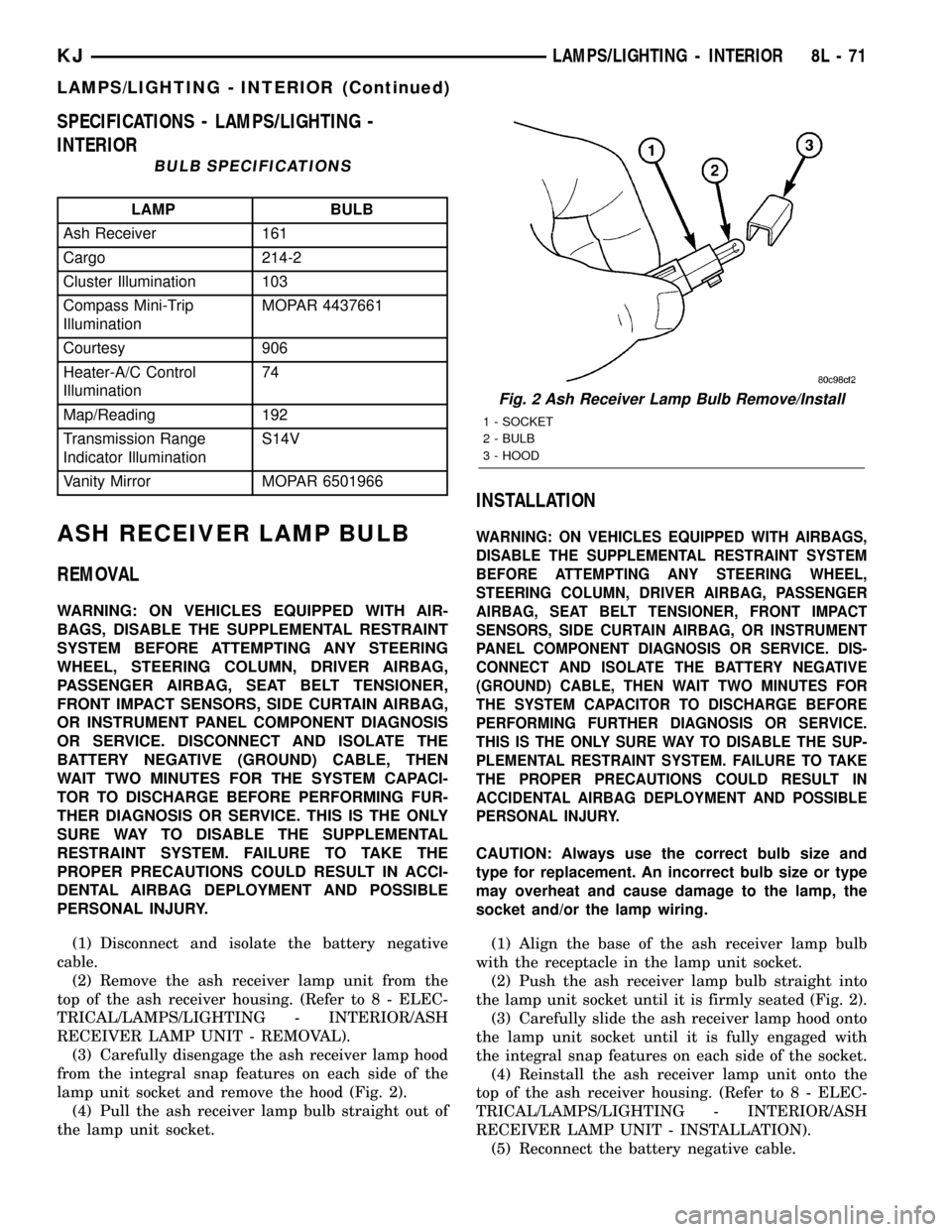
(3) Carefully disengage the ash receiver lamp hood
from the integral snap features on each side of the
lamp unit socket and remove the hood (Fig. 2).
(4) Pull the ash receiver lamp bulb straight out of
the lamp unit socket.
INSTALLATION
WARNING: ON VEHICLES EQUIPPED WITH AIRBAGS,
DISABLE THE SUPPLEMENTAL RESTRAINT SYSTEM
BEFORE ATTEMPTING ANY STEERING WHEEL,
STEERING COLUMN, DRIVER AIRBAG, PASSENGER
AIRBAG, SEAT BELT TENSIONER, FRONT IMPACT
SENSORS, SIDE CURTAIN AIRBAG, OR INSTRUMENT
PANEL COMPONENT DIAGNOSIS OR SERVICE. DIS-
CONNECT AND ISOLATE THE BATTERY NEGATIVE
(GROUND) CABLE, THEN WAIT TWO MINUTES FOR
THE SYSTEM CAPACITOR TO DISCHARGE BEFORE
PERFORMING FURTHER DIAGNOSIS OR SERVICE.
THIS IS THE ONLY SURE WAY TO DISABLE THE SUP-
PLEMENTAL RESTRAINT SYSTEM. FAILURE TO TAKE
THE PROPER PRECAUTIONS COULD RESULT IN
ACCIDENTAL AIRBAG DEPLOYMENT AND POSSIBLE
PERSONAL INJURY.
CAUTION: Always use the correct bulb size and
type for replacement. An incorrect bulb size or type
may overheat and cause damage to the lamp, the
socket and/or the lamp wiring.
(1) Align the base of the ash receiver lamp bulb
with the receptacle in the lamp unit socket.
(2) Push the ash receiver lamp bulb straight into
the lamp unit socket until it is firmly seated (Fig. 2).
(3) Carefully slide the ash receiver lamp hood onto
the lamp unit socket until it is fully engaged with
the integral snap features on each side of the socket.
(4) Reinstall the ash receiver lamp unit onto the
top of the ash receiver housing. (Refer to 8 - ELEC-
TRICAL/LAMPS/LIGHTING - INTERIOR/ASH
RECEIVER LAMP UNIT - INSTALLATION).
(5) Reconnect the battery negative cable.
Fig. 2 Ash Receiver Lamp Bulb Remove/Install
1 - SOCKET
2 - BULB
3 - HOOD
KJLAMPS/LIGHTING - INTERIOR 8L - 71
LAMPS/LIGHTING - INTERIOR (Continued)
Page 530 of 1803

²Trailer Tow Adapter- Vehicles equipped with
a factory-installed trailer towing package have an
adapter provided that adapts the factory-installed
heavy duty 7-way trailer tow connector to a conven-
tional 4-way light duty connector.
²Trailer Tow Connector- Vehicles equipped
with a factory-installed trailer towing package have a
heavy duty 7-way trailer tow connector installed in a
bracket on the trailer hitch receiver.
²Trailer Tow Relays- Vehicles equipped with a
factory-installed trailer towing package have a con-
nector bank containing four relays located behind the
right quarter trim panel and over the right rear
wheel housing. The four relays are used to supply
fused ignition switch output (run), brake lamps, right
turn signal, and left turn signal outputs to a trailer
through the trailer tow wiring and connectors.
Hard wired circuitry connects the exterior lighting
system components to the electrical system of the
vehicle. These hard wired circuits are integral to sev-
eral wire harnesses, which are routed throughout the
vehicle and retained by many different methods.
These circuits may be connected to each other, to the
vehicle electrical system and to the exterior lighting
system components through the use of a combination
of soldered splices, splice block connectors, and many
different types of wire harness terminal connectors
and insulators. Refer to the appropriate wiring infor-
mation. The wiring information includes wiring dia-
grams, proper wire and connector repair procedures,
further details on wire harness routing and reten-
tion, as well as pin-out and location views for the
various wire harness connectors, splices and grounds.
OPERATION
Following are paragraphs that briefly describe the
operation of each of the major exterior lighting sys-
tems. The hard wired circuits and components of the
exterior lighting systems may be diagnosed and
tested using conventional diagnostic tools and proce-
dures. However, conventional diagnostic methods
may not prove conclusive in the diagnosis of the Body
Control Module (BCM), the ElectroMechanical
Instrument Cluster (EMIC), the Powertrain Control
Module (PCM), or the Programmable Communica-
tions Interface (PCI) data bus network. The most
reliable, efficient, and accurate means to diagnose
the BCM, the EMIC, the PCM, and the PCI data bus
network inputs and outputs related to the various
exterior lighting systems requires the use of a
DRBIIItscan tool. Refer to the appropriate diagnos-
tic information.BACKUP LAMPS
The backup (or reverse) lamps have a path to
ground at all times through their connection to the
rear lighting wire harness from a take out of the rear
body wire harness with an eyelet terminal connector
that is secured by a ground screw to the base of the
right D-pillar behind the quarter trim panel. The
backup lamps receive battery current from a fused
ignition switch output (run) fuse in the Junction
Block (JB) on the back-up lamp feed circuit only
when the backup lamp switch (manual transmission),
or backup lamp switch circuit of the Transmission
Range Sensor (TRS - electronic automatic transmis-
sion) is closed by the gearshift mechanism within the
transmission.
BRAKE LAMPS
The brake (or stop) lamps have a path to ground at
all times through their connection to the rear light-
ing wire harness from a take out of the rear body
wire harness with an eyelet terminal connector that
is secured by a screw to the base of the right D-pillar
behind the quarter trim panel. The Center High
Mounted Stop Lamp (CHMSL) has a path to ground
at all times through its connection to the rear body
wire harness from a take out of the rear body wire
harness with an eyelet terminal connector that is
secured by a ground screw to the driver side D-pillar
(left side D-pillar for left-hand drive, right side D-pil-
lar for right-hand drive) behind the quarter trim
panel. The brake lamps and CHMSL receive battery
current from a fused B(+) fuse in the Junction Block
(JB) on the brake lamp switch output circuit only
when the brake lamp switch circuit of the brake
lamp switch is closed by the brake pedal arm.
DAYTIME RUNNING LAMPS
Vehicles manufactured for sale in Canada illumi-
nate the high beam filament at a reduced intensity
when the engine is running and the exterior lamps
are turned off. This feature is enabled by the Body
Control Module (BCM) and a solid state Daytime
Running Lamps (DRL) relay, which is installed in the
Junction Block (JB) and the high beam relay is omit-
ted. When the BCM monitors an engine speed signal
of greater than 450 RPM and the status of the exte-
rior lighting switch input from the multi-function
switch is Off, the BCM duty cycles the DRL relay to
produce illumination of the headlamp high beam fil-
aments at a reduced intensity. The BCM also pro-
vides normal headlamp high beam operation through
the DRL relay on vehicles so equipped. When the
DRL relay is energized, it provides battery current
from a fused B(+) fuse in the JB to the headlamp
high beam filament through the DRL relay output
circuit.
KJLAMPS8Ls-5
LAMPS/LIGHTING - EXTERIOR (Continued)