check oil JEEP PATRIOT 2021 Owner handbook (in English)
[x] Cancel search | Manufacturer: JEEP, Model Year: 2021, Model line: PATRIOT, Model: JEEP PATRIOT 2021Pages: 332, PDF Size: 1.99 MB
Page 265 of 332
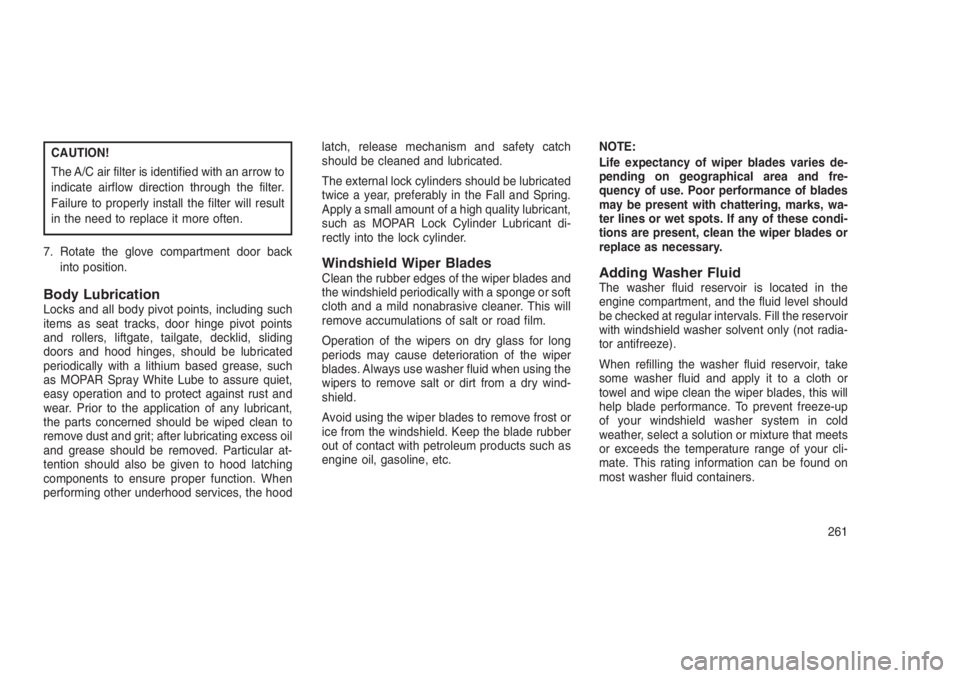
CAUTION!
The A/C air filter is identified with an arrow to
indicate airflow direction through the filter.
Failure to properly install the filter will result
in the need to replace it more often.
7. Rotate the glove compartment door back
into position.
Body LubricationLocks and all body pivot points, including such
items as seat tracks, door hinge pivot points
and rollers, liftgate, tailgate, decklid, sliding
doors and hood hinges, should be lubricated
periodically with a lithium based grease, such
as MOPAR Spray White Lube to assure quiet,
easy operation and to protect against rust and
wear. Prior to the application of any lubricant,
the parts concerned should be wiped clean to
remove dust and grit; after lubricating excess oil
and grease should be removed. Particular at-
tention should also be given to hood latching
components to ensure proper function. When
performing other underhood services, the hoodlatch, release mechanism and safety catch
should be cleaned and lubricated.
The external lock cylinders should be lubricated
twice a year, preferably in the Fall and Spring.
Apply a small amount of a high quality lubricant,
such as MOPAR Lock Cylinder Lubricant di-
rectly into the lock cylinder.
Windshield Wiper BladesClean the rubber edges of the wiper blades and
the windshield periodically with a sponge or soft
cloth and a mild nonabrasive cleaner. This will
remove accumulations of salt or road film.
Operation of the wipers on dry glass for long
periods may cause deterioration of the wiper
blades. Always use washer fluid when using the
wipers to remove salt or dirt from a dry wind-
shield.
Avoid using the wiper blades to remove frost or
ice from the windshield. Keep the blade rubber
out of contact with petroleum products such as
engine oil, gasoline, etc.NOTE:
Life expectancy of wiper blades varies de-
pending on geographical area and fre-
quency of use. Poor performance of blades
may be present with chattering, marks, wa-
ter lines or wet spots. If any of these condi-
tions are present, clean the wiper blades or
replace as necessary.Adding Washer FluidThe washer fluid reservoir is located in the
engine compartment, and the fluid level should
be checked at regular intervals. Fill the reservoir
with windshield washer solvent only (not radia-
tor antifreeze).
When refilling the washer fluid reservoir, take
some washer fluid and apply it to a cloth or
towel and wipe clean the wiper blades, this will
help blade performance. To prevent freeze-up
of your windshield washer system in cold
weather, select a solution or mixture that meets
or exceeds the temperature range of your cli-
mate. This rating information can be found on
most washer fluid containers.
261
Page 274 of 332
Fluid Level Check
Check the fluid level by removing the fill plug.
The fluid level should be between the bottom of
the fill hole and a point not more than 3/16 inch
(4.7 mm) below the bottom of the hole.
Add fluid, if necessary, to maintain the proper
level.
Please see your authorized dealer for service.
Frequency Of Fluid Change
Under normal operating conditions, the fluid
installed at the factory will give satisfactory
lubrication for the life of the vehicle. Fluid
changes are not necessary unless lubricant has
become contaminated with water.
NOTE:
If contaminated with water, the fluid should
be changed immediately.Rear Drive Assembly (RDA) —
AWD/4WD Models Only
Lubricant Selection
Use only the manufacturer’s recommended
fluid. Refer to “Fluids, Lubricants, And Genuine
Parts” in “Maintaining Your Vehicle” for further
information.
Fluid Level Check
Visually inspect the unit at each oil change for
leakage. If leakage is detected, check the fluid
level by removing the fill plug. The fluid level
should be maintained between the bottom of
the fill hole to 1/8 inch (4 mm) below the fill hole.
Add fluid, if necessary, to maintain the proper
level.
Frequency Of Fluid Change
Refer to the “Maintenance Schedule” for the
proper maintenance intervals.
Power Transfer Unit (PTU) —
AWD/4WD Models Only
Lubricant Selection
Use only the manufacturer’s recommended
fluid. Refer to “Fluids, Lubricants, And Genuine
Parts” in “Maintaining Your Vehicle” for further
information.
Fluid Level Check
Visually inspect the unit at each oil change for
leakage. If leakage is detected, Check the fluid
level by removing the fill plug. The fluid level
should be maintained between the bottom of
the fill hole to 1/8 inch (4 mm) below the fill hole.
Add fluid, if necessary, to maintain the proper
level.
Frequency Of Fluid Change
Refer to the “Maintenance Schedule” for the
proper maintenance intervals.
270
Page 288 of 332
MAINTENANCE SCHEDULE
Maintenance Schedule — Gasoline
Engine
The Scheduled Maintenance services listed in
this manual must be done at the times or
mileages specified to protect your vehicle war-
ranty and ensure the best vehicle performance
and reliability. More frequent maintenance may
be needed for vehicles in severe operating
conditions, such as dusty areas and very short
trip driving. Inspection and service should also
be done anytime a malfunction is suspected.
The oil change indicator system will remind you
that it is time to take your vehicle in for sched-
uled maintenance.
On Non-EVIC equipped vehicles, “CHANgE
OIL” will flash in the instrument cluster odom-
eter and a single chime will sound, indicating
that an oil change is necessary.
The oil change indicator message will illuminate
approximately 7,000 miles (11,200 km) after the
most recent oil change was performed. Have
your vehicle serviced as soon as possible,
within 500 miles (800 km). However, an earlieroil change at 4,500 miles (7,500 km) may be
required if the vehicle is operated under “Se-
vere Duty Conditions” later in this section.
NOTE:
•The oil change indicator message will not
monitor the time since the last oil change.
Change your vehicle’s oil if it has been 12
months since your last oil change even if
the oil change indicator message is NOT
illuminated.
•Change your engine oil more often if you
drive your vehicle off-road for an ex-
tended period of time.
•Under no circumstances should oil
change intervals exceed 7,500 miles
(12,000 km) or 12 months, whichever
comes first.
Your dealer will reset the oil change indicator
message after completing the scheduled oil
change. If this scheduled oil change is per-
formed by someone other than your dealer, the
message can be reset by referring to the steps
described under “Instrument ClusterDescription/Odometer/Trip Odometer” in “Un-
derstanding Your Instrument Panel” for further
information.
Once A Month Or Before A Long Trip
•Check the engine oil level about five minutes
after a fully warmed engine is shut off.
Checking the oil level while the vehicle is on
level ground will improve the accuracy of the
oil level reading. Add oil only when the level
is at or below the ADD or MIN mark.
•Check the windshield washer solvent and
add if required.
•Check tire pressure and look for unusual
wear or damage. Rotate tires at the first sign
of irregular wear, even if it occurs before the
oil indicator system turns on.
•Inspect the battery and clean and tighten the
terminals as required.
•Check the fluid levels of coolant reservoir,
automatic transmission, brake master cylin-
der and power steering and fill as needed.
•Check all lights and other electrical items for
correct operation.
284
Page 323 of 332
Oil (Engine)..........253, 254, 257
Power Steering.............184
Radiator (Coolant Pressure)......264
Car Washes..................271
Carbon Monoxide Warning..........58
Cargo Area Cover..............111
Cargo Area Features.............111
Cargo Compartment.............111
Light....................111
Luggage Carrier.............114
Cargo Light..................111
Cargo Load Floor...............112
Cargo Tie-Downs...............112
Cellular Phone.................67
Center High Mounted Stop Light......280
Chains, Tire..................202
Changing A Flat Tire.............228
Checking Your Vehicle For Safety......58
Checks, Safety.................58
Child Restraints
How To Stow An Unused ALR Seat Belt .56
Child Safety Locks...............23
Clean Air Gasoline..............211
Cleaning
Wheels..................272
Climate Control................150
Clutch.....................266Clutch Fluid..................266
Coin Holder..................111
Compact Disc (CD) Maintenance......150
Compact Spare Tire.............199
Compass Calibration.............144
Compass Variance..............143
Connector
UCI ....................145
Universal Consumer Interface (UCI) . .145
Console....................111
Coolant (Antifreeze).............280
Coolant Pressure Cap (Radiator Cap) . . .264
Cooling System................263
Adding Coolant (Antifreeze)......264
Coolant Level...........263, 265
Disposal Of Used Coolant.......265
Drain, Flush, And Refill
.........263
Inspection................265
Points To Remember..........265
Pressure Cap..............264
Radiator Cap...............264
Selection Of Coolant (Antifreeze) . . .263
Corrosion Protection.............271
Cupholders..................111
Customer Assistance.............296
Data Recorder, Event.............45Defroster, Rear Window...........114
Defroster, Windshield.......59, 152, 156
Delay (Intermittent) Wipers.........100
Diagnostic System, Onboard........255
Dimmer Switch, Headlight...........98
Dipsticks
Power Steering..............184
Disposal
Antifreeze (Engine Coolant)......265
Door Locks
Child-Protection Door Lock — Rear
Doors....................23
Door Locks.................21
KeyFob ..................21
Remote...................21
Remote Keyless Entry (RKE).......21
Door Locks, Automatic............22
Downshifting.................168
Driver’s Seat Back Tilt.............91
Driving.....................179
Off-Pavement..............179
Off-Road.................179
Electric Remote Mirrors............66
Electrical Power Outlets...........108
Electronic Brake Control System......187
Anti-Lock Brake System........187
319
Page 324 of 332
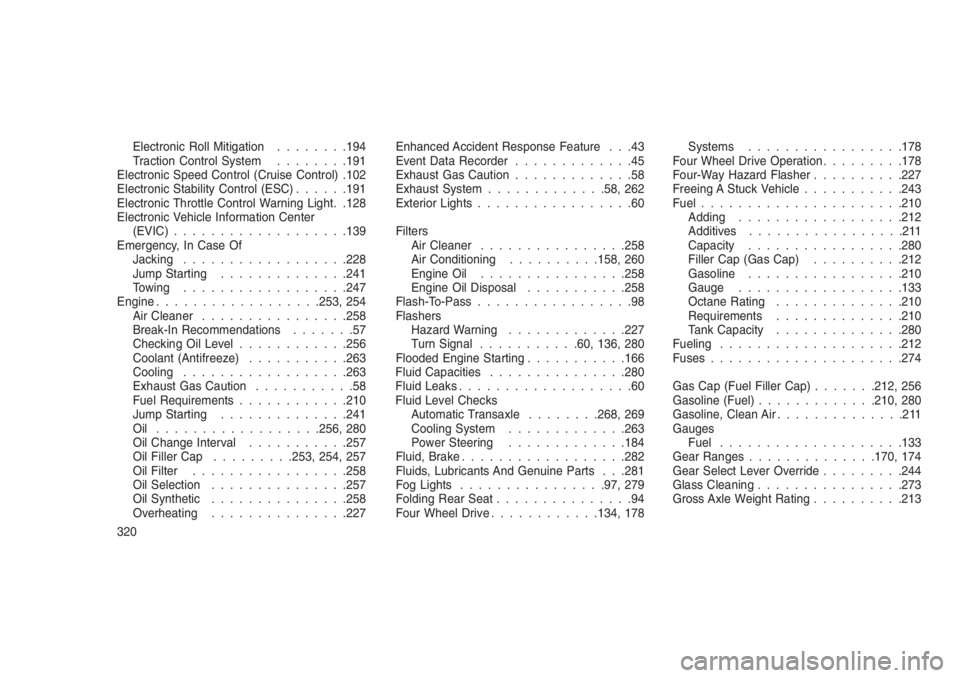
Electronic Roll Mitigation........194
Traction Control System........191
Electronic Speed Control (Cruise Control) .102
Electronic Stability Control (ESC)......191
Electronic Throttle Control Warning Light. .128
Electronic Vehicle Information Center
(EVIC)...................139
Emergency, In Case Of
Jacking..................228
Jump Starting..............241
Towing..................247
Engine..................253, 254
Air Cleaner................258
Break-In Recommendations.......57
Checking Oil Level............256
Coolant (Antifreeze)...........263
Cooling..................263
Exhaust Gas Caution...........58
Fuel Requirements............210
Jump Starting..............241
Oil ..................256, 280
Oil Change Interval...........257
Oil Filler Cap.........253, 254, 257
Oil Filter.................258
Oil Selection...............257
Oil Synthetic...............258
Overheating...............227Enhanced Accident Response Feature . . .43
Event Data Recorder.............45
Exhaust Gas Caution.............58
Exhaust System.............58, 262
Exterior Lights.................60
Filters
Air Cleaner................258
Air Conditioning..........158, 260
Engine Oil................258
Engine Oil Disposal...........258
Flash-To-Pass.................98
Flashers
Hazard Warning.............227
Turn Signal...........60, 136, 280
Flooded Engine Starting...........166
Fluid Capacities...............280
Fluid Leaks...................60
Fluid Level Checks
Automatic Transaxle........268, 269
Cooling System.............263
Power Steering.............184
Fluid, Brake..................282
Fluids, Lubricants And Genuine Parts . . .281
Fog Lights................97, 279
Folding Rear Seat...............94
Four Wheel Drive............134, 178Systems.................178
Four Wheel Drive Operation.........178
Four-Way Hazard Flasher..........227
Freeing A Stuck Vehicle...........243
Fuel......................210
Adding..................212
Additives.................211
Capacity.................280
Filler Cap (Gas Cap)..........212
Gasoline.................210
Gauge..................133
Octane Rating..............210
Requirements..............210
Tank Capacity..............280
Fueling....................212
Fuses.....................274
Gas Cap (Fuel Filler Cap).......212, 256
Gasoline (Fuel).............210, 280
Gasoline, Clean Air..............211
Gauges
Fuel....................133
Gear Ranges..............170, 174
Gear Select Lever Override.........244
Glass Cleaning................273
Gross Axle Weight Rating..........213
320
Page 326 of 332
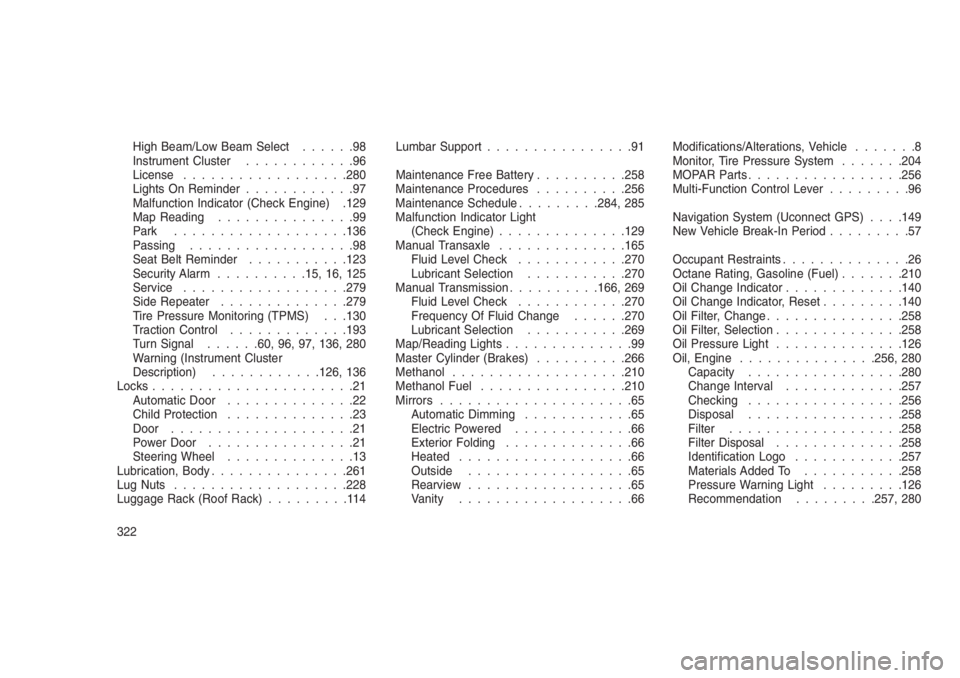
High Beam/Low Beam Select......98
Instrument Cluster............96
License..................280
Lights On Reminder............97
Malfunction Indicator (Check Engine) .129
Map Reading...............99
Park...................136
Passing..................98
Seat Belt Reminder...........123
Security Alarm..........15, 16, 125
Service..................279
Side Repeater..............279
Tire Pressure Monitoring (TPMS) . . .130
Traction Control.............193
Turn Signal......60, 96, 97, 136, 280
Warning (Instrument Cluster
Description)............126, 136
Locks......................21
Automatic Door..............22
Child Protection..............23
Door....................21
Power Door................21
Steering Wheel..............13
Lubrication, Body...............261
Lug Nuts...................228
Luggage Rack (Roof Rack).........114Lumbar Support................91
Maintenance Free Battery..........258
Maintenance Procedures..........256
Maintenance Schedule.........284, 285
Malfunction Indicator Light
(Check Engine)..............129
Manual Transaxle..............165
Fluid Level Check............270
Lubricant Selection...........270
Manual Transmission..........166, 269
Fluid Level Check............270
Frequency Of Fluid Change......270
Lubricant Selection...........269
Map/Reading Lights..............99
Master Cylinder (Brakes)..........266
Methanol..................
.210
Methanol Fuel................210
Mirrors.....................65
Automatic Dimming............65
Electric Powered.............66
Exterior Folding..............66
Heated...................66
Outside..................65
Rearview..................65
Vanity...................66Modifications/Alterations, Vehicle.......8
Monitor, Tire Pressure System.......204
MOPAR Parts.................256
Multi-Function Control Lever.........96
Navigation System (Uconnect GPS). . . .149
New Vehicle Break-In Period.........57
Occupant Restraints..............26
Octane Rating, Gasoline (Fuel).......210
Oil Change Indicator.............140
Oil Change Indicator, Reset.........140
Oil Filter, Change...............258
Oil Filter, Selection..............258
Oil Pressure Light..............126
Oil, Engine...............256, 280
Capacity.................280
Change Interval.............257
Checking.................256
Disposal.................258
Filter...................258
Filter Disposal..............258
Identification Logo............257
Materials Added To...........258
Pressure Warning Light.........126
Recommendation.........257, 280
322