manual transmission JEEP PATRIOT 2021 Owner handbook (in English)
[x] Cancel search | Manufacturer: JEEP, Model Year: 2021, Model line: PATRIOT, Model: JEEP PATRIOT 2021Pages: 332, PDF Size: 1.99 MB
Page 226 of 332
Towing TipsBefore setting out on a trip, practice turning,
stopping and backing the trailer in an area away
from heavy traffic.
Manual Transmission — If Equipped
If using a manual transmission vehicle for trailer
towing, all starts must be in first gear to avoid
excessive clutch slippage.
Automatic Transmission — If Equipped
The DRIVE range can be selected when towing.
However, if frequent shifting or changes in
engine speed occur while in DRIVE, use the
AutoStick shift control to manually select a
lower gear ratio.
NOTE:
Using a lower gear ratio while operating the
vehicle under heavy loading conditions, will
improve performance and extend transmis-
sion life by reducing excessive shifting and
heat buildup. This action will also provide
better engine braking.
If you REGULARLY tow a trailer for more than
45 minutes of continuous operation, then
change the transmission fluid and filter asspecified for"police, taxi, fleet, or frequent
trailer towing."Refer to the “Maintenance
Schedule” for the proper maintenance intervals.
AutoStick
•When using the AutoStick shift control, select
the highest gear that allows for adequate
performance and avoids frequent downshifts.
For example, choose"4"if the desired speed
can be maintained. Choose"3"or"2"if
needed to maintain the desired speed.
•To prevent excess heat generation, avoid
continuous driving at high RPM. Reduce
vehicle speed as necessary to avoid ex-
tended driving at high RPM. Return to a
higher gear or vehicle speed when grade and
road conditions allow.
Electronic Speed Control — If Equipped
•Do not use in hilly terrain or with heavy loads.
•When using the speed control, if you experi-
ence speed drops greater than 10 mph
(16 km/h), disengage until you can get back
to cruising speed.•Use speed control in flat terrain and with light
loads to maximize fuel efficiency.
Cooling System
To reduce potential for engine and transmission
overheating, take the following actions:
City Driving
When stopped for short periods of time, shift the
transmission into NEUTRAL and increase en-
gine idle speed.
Highway Driving
Reduce speed.
Air Conditioning
Turn off temporarily.
222
Page 227 of 332
RECREATIONAL TOWING (BEHIND MOTORHOME, ETC.)
Towing This Vehicle Behind Another Vehicle
Towing Condition Wheels OFF the Ground Manual Transmission Automatic Transmission
Flat Tow None
•Transmission in NEUTRAL
•Key in ACC PositionNOT ALLOWED
Dolly TowFront FWD Models ONLY FWD Models ONLY
Rear NOT ALLOWED NOT ALLOWED
On Trailer All OK OK
NOTE:
•
When recreational towing your vehicle, al-
ways follow applicable state and provincial
laws. Contact state and provincial Highway
Safety offices for additional details.
•Vehicles equipped with manual transmis-
sions may be recreational towed (flat
towed) at any legal highway speed, for
any distance, if the manual transmission
is in NEUTRAL and the ignition key is in
the ACC position.
CAUTION!
•DO NOT flat tow any vehicle equipped with
an automatic transmission. Damage to the
drivetrain will result. If these vehicles re-
quire towing, make sure all drive wheels
are OFF the ground.
•DO NOT dolly tow any 4WD vehicle. Inter-
nal damage to the transmission or transfer
case will occur if a dolly is used when
recreational towing.
223
Page 233 of 332
WARNING!(Continued)
•Being under a jacked-up vehicle is danger-
ous. The vehicle could slip off the jack and
fall on you. You could be crushed. Never
put any part of your body under a vehicle
that is on a jack. If you need to get under a
raised vehicle, take it to a service center
where it can be raised on a lift.
•Never start or run the engine while the
vehicle is on a jack.
•The jack is designed to be used as a tool
for changing tires only. The jack should not
be used to lift the vehicle for service pur-
poses. The vehicle should be jacked on a
firm level surface only. Avoid ice or slippery
areas.
Jack LocationThe jack and jack-handle are stowed under the
load floor in the cargo area.
Spare Tire StowageThe compact spare tire is stowed under the rear
load floor in the cargo area.
Spare Tire Removal
Lift up the load floor cover and remove the hold
down.
Preparations For Jacking
1. Park the vehicle on a firm level surface,
avoiding ice or slippery areas.
WARNING!
Do not attempt to change a tire on the side of
the vehicle close to moving traffic, pull far
enough off the road to avoid the danger of
being hit when operating the jack or chang-
ing the wheel.
2. Turn on the Hazard Warning flasher.
3. Set the parking brake.
4. Place the gear selector in PARK (automatic
transmission) or REVERSE (manual trans-
mission).
5. Turn OFF the ignition.
6. Block both the front and rear
of the wheel diagonally op-
posite of the jacking posi-
tion. For example, if chang-
ing the right front tire, block
the left rear wheel.
Spare Tire And Jack Stowage
229
Page 234 of 332
NOTE:
Passengers should not remain in the vehicle
while the vehicle is being jacked.
Jacking Instructions
WARNING!
Carefully follow these tire changing warnings
to help prevent personal injury or damage to
your vehicle:
•Always park on a firm, level surface as far
from the edge of the roadway as possible
before raising the vehicle.
•Turn on the Hazard Warning flasher.
•Block the wheel diagonally opposite the
wheel to be raised.
•Set the parking brake firmly and set an
automatic transmission in PARK; a manual
transmission in REVERSE.
•Never start or run the engine with the
vehicle on a jack.
(Continued)
WARNING!(Continued)
•Do not let anyone sit in the vehicle when it
is on a jack.
•Do not get under the vehicle when it is on
a jack. If you need to get under a raised
vehicle, take it to a service center where it
can be raised on a lift.
•Only use the jack in the positions indicated
and for lifting this vehicle during a tire
change.
•If working on or near a roadway, be ex-
tremely careful of motor traffic.
•To assure that spare tires, flat or inflated,
are securely stowed, spares must be
stowed with the valve stem facing the
ground.NOTE:
Refer to “Tires — General Information” in
“Starting And Operating” for further infor-
mation about the spare tire, it’s use, and
operation.
1. Remove the scissors jack and lug wrench
from the spare wheel as an assembly. Turn
the jack screw to the left to loosen the lug
wrench and remove the wrench from the
jack assembly.
Jack Warning Label
230
Page 241 of 332
WARNING!(Continued)
•Keep Tire Service Kit away from open
flames or heat source.
•A loose Tire Service Kit thrown forward in a
collision or hard stop could endanger the
occupants of the vehicle. Always stow the
Tire Service Kit in the place provided.
Failure to follow these warnings can result
in injuries that are serious or fatal to you,
your passengers, and others around you.
•Take care not to allow the contents of Tire
Service Kit to come in contact with hair,
eyes, or clothing. Tire Service Kit sealant is
harmful if inhaled, swallowed, or absorbed
through the skin. It causes skin, eye, and
respiratory irritation. Flush immediately
with plenty of water if there is any contact
with eyes or skin. Change clothing as soon
as possible, if there is any contact with
clothing.
(Continued)
WARNING!(Continued)
•Tire Service Kit Sealant solution contains
latex. In case of an allergic reaction or
rash, consult a physician immediately.
Keep Tire Service Kit out of reach of
children. If swallowed, rinse mouth imme-
diately with plenty of water and drink plenty
of water. Do not induce vomiting! Consult a
physician immediately.
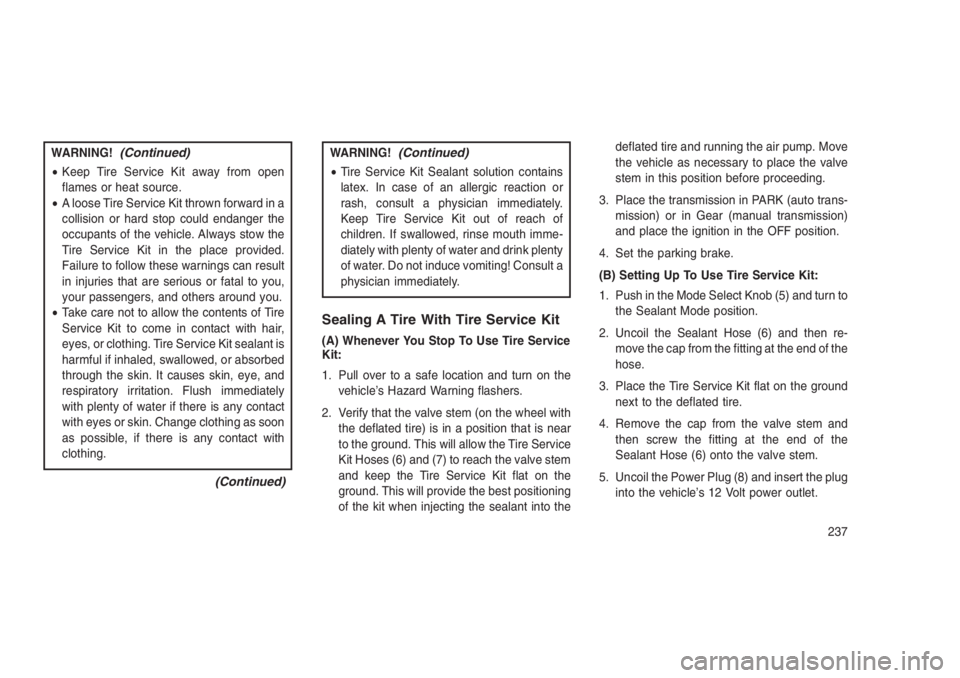
Sealing A Tire With Tire Service Kit
(A) Whenever You Stop To Use Tire Service
Kit:
1. Pull over to a safe location and turn on the
vehicle’s Hazard Warning flashers.
2. Verify that the valve stem (on the wheel with
the deflated tire) is in a position that is near
to the ground. This will allow the Tire Service
Kit Hoses (6) and (7) to reach the valve stem
and keep the Tire Service Kit flat on the
ground. This will provide the best positioning
of the kit when injecting the sealant into thedeflated tire and running the air pump. Move
the vehicle as necessary to place the valve
stem in this position before proceeding.
3. Place the transmission in PARK (auto trans-
mission) or in Gear (manual transmission)
and place the ignition in the OFF position.
4. Set the parking brake.
(B) Setting Up To Use Tire Service Kit:
1. Push in the Mode Select Knob (5) and turn to
the Sealant Mode position.
2. Uncoil the Sealant Hose (6) and then re-
move the cap from the fitting at the end of the
hose.
3. Place the Tire Service Kit flat on the ground
next to the deflated tire.
4. Remove the cap from the valve stem and
then screw the fitting at the end of the
Sealant Hose (6) onto the valve stem.
5. Uncoil the Power Plug (8) and insert the plug
into the vehicle’s 12 Volt power outlet.
237
Page 242 of 332
NOTE:
Do not remove foreign objects (e.g., screws
or nails) from the tire.
(C) Injecting Tire Service Kit Sealant Into
The Deflated Tire:
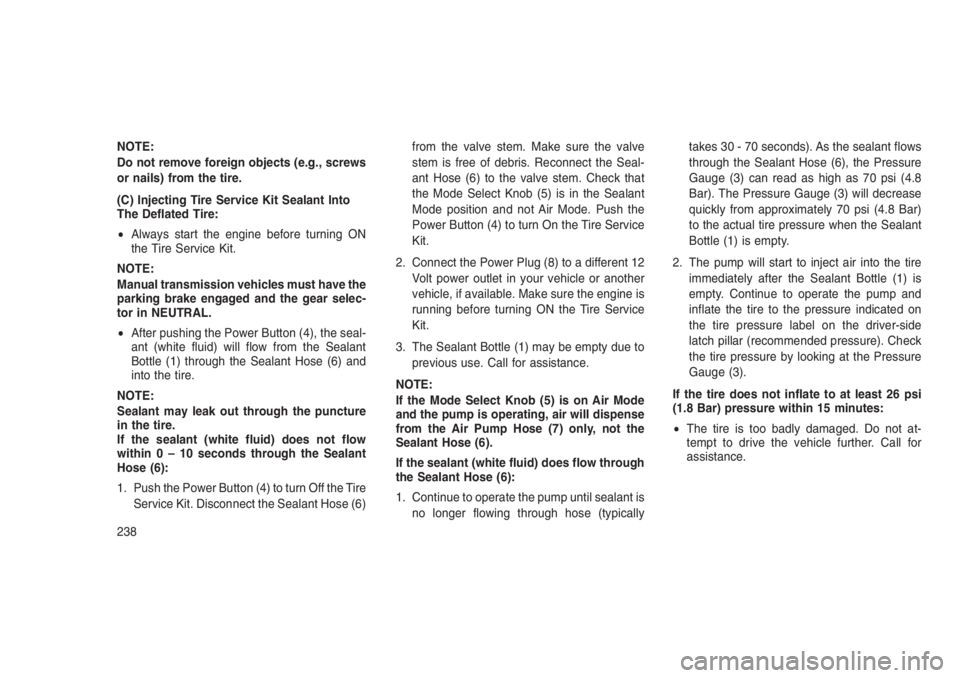
•Always start the engine before turning ON
the Tire Service Kit.
NOTE:
Manual transmission vehicles must have the
parking brake engaged and the gear selec-
tor in NEUTRAL.
•After pushing the Power Button (4), the seal-
ant (white fluid) will flow from the Sealant
Bottle (1) through the Sealant Hose (6) and
into the tire.
NOTE:
Sealant may leak out through the puncture
in the tire.
If the sealant (white fluid) does not flow
within0–10seconds through the Sealant
Hose (6):
1. Push the Power Button (4) to turn Off the Tire
Service Kit. Disconnect the Sealant Hose (6)from the valve stem. Make sure the valve
stem is free of debris. Reconnect the Seal-
ant Hose (6) to the valve stem. Check that
the Mode Select Knob (5) is in the Sealant
Mode position and not Air Mode. Push the
Power Button (4) to turn On the Tire Service
Kit.
2. Connect the Power Plug (8) to a different 12
Volt power outlet in your vehicle or another
vehicle, if available. Make sure the engine is
running before turning ON the Tire Service
Kit.
3. The Sealant Bottle (1) may be empty due to
previous use. Call for assistance.
NOTE:
If the Mode Select Knob (5) is on Air Mode
and the pump is operating, air will dispense
from the Air Pump Hose (7) only, not the
Sealant Hose (6).
If the sealant (white fluid) does flow through
the Sealant Hose (6):
1. Continue to operate the pump until sealant is
no longer flowing through hose (typicallytakes 30 - 70 seconds). As the sealant flows
through the Sealant Hose (6), the Pressure
Gauge (3) can read as high as 70 psi (4.8
Bar). The Pressure Gauge (3) will decrease
quickly from approximately 70 psi (4.8 Bar)
to the actual tire pressure when the Sealant
Bottle (1) is empty.
2. The pump will start to inject air into the tire
immediately after the Sealant Bottle (1) is
empty. Continue to operate the pump and
inflate the tire to the pressure indicated on
the tire pressure label on the driver-side
latch pillar (recommended pressure). Check
the tire pressure by looking at the Pressure
Gauge (3).
If the tire does not inflate to at least 26 psi
(1.8 Bar) pressure within 15 minutes:
•The tire is too badly damaged. Do not at-
tempt to drive the vehicle further. Call for
assistance.
238
Page 246 of 332
WARNING!(Continued)
•Batteries contain sulfuric acid that can
burn your skin or eyes and generate hy-
drogen gas which is flammable and explo-
sive. Keep open flames or sparks away
from the battery.
1. Set the parking brake, shift the automatic
transmission into PARK (manual transmis-
sion to NEUTRAL) and turn the ignition to
LOCK.
2. Turn off the heater, radio, and all unneces-
sary electrical accessories.
3. If using another vehicle to jump-start the
battery, park the vehicle within the jumper
cables reach, set the parking brake and
make sure the ignition is OFF.
WARNING!
Do not allow vehicles to touch each other as
this could establish a ground connection and
personal injury could result.
Jump-Starting Procedure
WARNING!
Failure to follow this jump-starting procedure
could result in personal injury or property
damage due to battery explosion.
CAUTION!
Failure to follow these procedures could re-
sult in damage to the charging system of the
booster vehicle or the discharged vehicle.
NOTE:
Remove Air Intake before proceeding with
this Jump-Starting procedure.Connecting The Jumper Cables
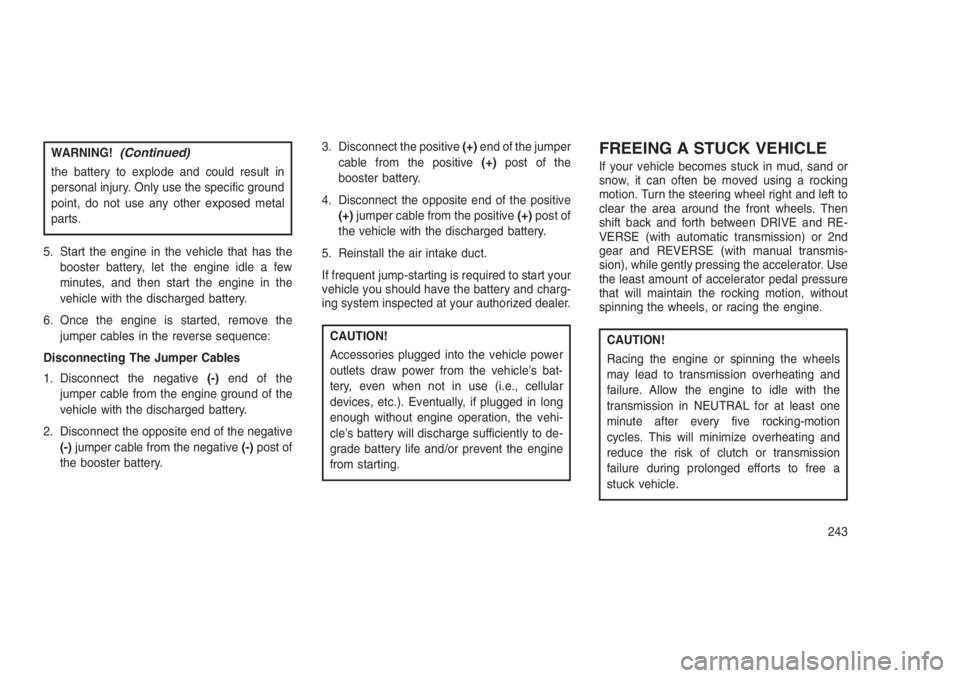
1. Connect the positive(+)end of the jumper
cable to the positive(+)post of the dis-
charged vehicle.
2. Connect the opposite end of the positive(+)
jumper cable to the positive(+)post of the
booster battery.
3. Connect the negative end(-)of the jumper
cable to the negative(-)post of the booster
battery.
4. Connect the opposite end of the negative(-)
jumper cable to a good engine ground (ex-
posed metal part of the discharged vehicle’s
engine) away from the battery and the fuel
injection system.
WARNING!
Do not connect the jumper cable to the
negative(-)post of the discharged battery.
The resulting electrical spark could cause
(Continued)
242
Page 247 of 332
WARNING!(Continued)
the battery to explode and could result in
personal injury. Only use the specific ground
point, do not use any other exposed metal
parts.
5. Start the engine in the vehicle that has the
booster battery, let the engine idle a few
minutes, and then start the engine in the
vehicle with the discharged battery.
6. Once the engine is started, remove the
jumper cables in the reverse sequence:
Disconnecting The Jumper Cables
1. Disconnect the negative(-)end of the
jumper cable from the engine ground of the
vehicle with the discharged battery.
2. Disconnect the opposite end of the negative
(-)jumper cable from the negative(-)post of
the booster battery.3. Disconnect the positive(+)end of the jumper
cable from the positive(+)post of the
booster battery.
4. Disconnect the opposite end of the positive
(+)jumper cable from the positive(+)post of
the vehicle with the discharged battery.
5. Reinstall the air intake duct.
If frequent jump-starting is required to start your
vehicle you should have the battery and charg-
ing system inspected at your authorized dealer.
CAUTION!
Accessories plugged into the vehicle power
outlets draw power from the vehicle’s bat-
tery, even when not in use (i.e., cellular
devices, etc.). Eventually, if plugged in long
enough without engine operation, the vehi-
cle’s battery will discharge sufficiently to de-
grade battery life and/or prevent the engine
from starting.
FREEING A STUCK VEHICLE
If your vehicle becomes stuck in mud, sand or
snow, it can often be moved using a rocking
motion. Turn the steering wheel right and left to
clear the area around the front wheels. Then
shift back and forth between DRIVE and RE-
VERSE (with automatic transmission) or 2nd
gear and REVERSE (with manual transmis-
sion), while gently pressing the accelerator. Use
the least amount of accelerator pedal pressure
that will maintain the rocking motion, without
spinning the wheels, or racing the engine.
CAUTION!
Racing the engine or spinning the wheels
may lead to transmission overheating and
failure. Allow the engine to idle with the
transmission in NEUTRAL for at least one
minute after every five rocking-motion
cycles. This will minimize overheating and
reduce the risk of clutch or transmission
failure during prolonged efforts to free a
stuck vehicle.
243
Page 251 of 332
TOWING A DISABLED
VEHICLE
This section describes procedures for towing a
disabled vehicle using a commercial towing
service.
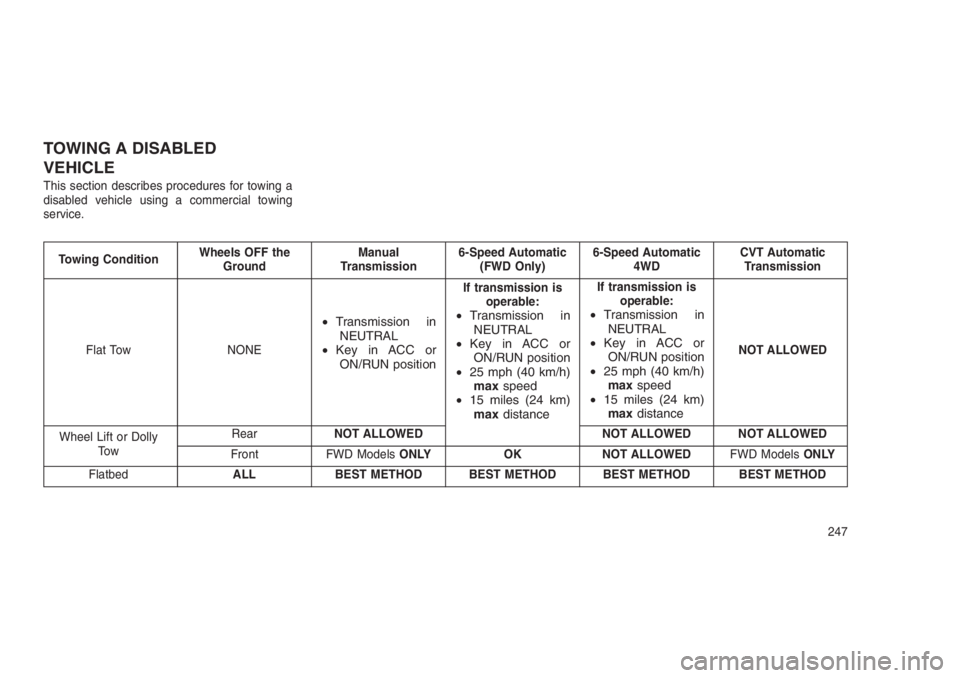
Towing ConditionWheels OFF the
GroundManual
Transmission6-Speed Automatic
(FWD Only)6-Speed Automatic
4WDCVT Automatic
Transmission
Flat Tow NONE
•Transmission in
NEUTRAL
•Key in ACC or
ON/RUN position
If transmission is
operable:
•Transmission in
NEUTRAL
•Key in ACC or
ON/RUN position
•25 mph (40 km/h)
maxspeed
•15 miles (24 km)
maxdistance
If transmission is
operable:
•Transmission in
NEUTRAL
•Key in ACC or
ON/RUN position
•25 mph (40 km/h)
maxspeed
•15 miles (24 km)
maxdistance
NOT ALLOWED
Wheel Lift or Dolly
To wRearNOT ALLOWED NOT ALLOWED NOT ALLOWED
Front FWD ModelsONLY OK NOT ALLOWEDFWD ModelsONLY
FlatbedALL BEST METHOD BEST METHOD BEST METHOD BEST METHOD
247
Page 252 of 332
With Ignition Key
Automatic Transmission
•Front Wheel Drive (FWD) vehicles can be
towed with the front wheels elevated, or on a
flatbed truck (all four wheelsOFFthe
ground).
•Four-Wheel Drive (4WD) vehicles can be
towed on a flatbed truck (all four wheelsOFF
the ground).
If the transmission is operable, Front Wheel
Drive (FWD) and Four Wheel Drive (4WD)
vehicles, with the 6-speed automatic transmis-
sion only (NOTthe Continuously Variable auto-
matic transmission [CVT]), may be flat towed
(with all four wheels on the ground) under the
following conditions:
•The transmission must be in NEUTRAL.
•The key must be in the ACC or ON/RUN
position.
•The towing speed must not exceed 25 mph
(40 km/h).
•The towing distance must not exceed 15
miles (24 km).Front Wheel Drive (FWD) models (with 6-speed
automaticonly) may also be towed (under the
same limitations shown above) with the rear
wheels elevated.
CAUTION!
DO NOT flat tow any vehicle equipped with a
CVT automatic transmission. Damage to the
drivetrain will result. If these vehicles require
towing, make sure all drive wheels are OFF
the ground.
Towing this vehicle in violation of the above
requirements can cause severe transmission
and/or transfer case damage. Damage from
improper towing is not covered under the
New Vehicle Limited Warranty..
If the vehicle’s battery is discharged, refer to
“Gear Selector Override” in this section for
instructions on shifting the automatic transmis-
sion out of PARK for towing.Manual Transmission
•Front Wheel Drive (FWD) or Four-Wheel
Drive (4WD) vehicles can be flat towed (all
four wheels on the ground) with the transmis-
sion in NEUTRAL and the key in the ACC or
ON/RUN position.
•FWD vehicles can be towed with the front
wheels elevated.
•FWD or 4WD vehicles can be towed on a
flatbed truck (all wheelsOFFthe ground).
CAUTION!
•DO NOTflat tow any disabled vehicle if
condition is related to the clutch, transmis-
sion or driveline. Additional damage to the
drivetrain could result.
•
Towing this vehicle in violation of the above
requirements can cause severe engine,
transmission, or drivetrain damage. Damage
from improper towing is not covered under
the New Vehicle Limited Warranty.
248