transmission JEEP PATRIOT 2021 Owner handbook (in English)
[x] Cancel search | Manufacturer: JEEP, Model Year: 2021, Model line: PATRIOT, Model: JEEP PATRIOT 2021Pages: 332, PDF Size: 1.99 MB
Page 181 of 332
will remain in the selected gear until another
upshift or downshift is chosen, except as de-
scribed below:
•The transmission will automatically upshift
when necessary to prevent engine over-
speed.
•The transmission will automatically downshift
as the vehicle slows (to prevent engine lug-
ging) and will display the current gear.
•The transmission will automatically downshift
to first gear when coming to a stop. After a
stop, the driver should manually upshift (+)
the transmission as the vehicle is
accelerated.
•You can start out, from a stop, in first or
second gear. Tapping (+) (at a stop) will allow
starting in second gear. Starting out in sec-
ond gear can be helpful in snowy or icy
conditions.
•If a requested downshift would cause the
engine to overspeed, that shift will not occur.
•Avoid using speed control when AutoStick is
engaged.•Transmission shifting will be more noticeable
when AutoStick is engaged.
•The system may revert to automatic shift
mode if a fault or overheat condition is
detected.
To disengage AutoStick mode, hold the gear
selector to the right (+) until “D” is once again
displayed in the instrument cluster. You can shift
in or out of the AutoStick mode at any time
without taking your foot off the accelerator
pedal.
WARNING!
Do not downshift for additional engine brak-
ing on a slippery surface. The drive wheels
could lose their grip and the vehicle could
skid, causing a collision or personal injury.
AutoStick (CVT) — If EquippedAutoStick is a driver-interactive transmission
feature providing six manually selectable gear
ratios, giving you more control of the vehicle.
AutoStick allows you to maximize engine brak-
ing, eliminate undesirable upshifts and down-shifts, and improve overall vehicle performance.
This system can also provide you with more
control during passing, city driving, cold slippery
conditions, mountain driving, trailer towing, and
many other situations.
Operation
NOTE:
AutoStick is not available until the CVT
warms up in cold weather.
When the gear selector is in the DRIVE position,
AutoStick is activated by moving the gear se-
lector side-to-side. Moving the gear selector to
the right (+) will activate AutoStick and shift up
to the next higher manual ratio, unless you are
already operating in or near Overdrive, in which
case sixth gear ratio will be selected. In like
manner, moving the gear selector to the left (-)
will activate AutoStick and shift to the next lower
manual ratio. The manually-selected gear will
be displayed in the instrument cluster.
In AutoStick mode, the transmission will shift up
or down when (+/-) is manually selected by the
driver, unless an engine lugging or overspeed
condition would result. It will remain in the
177
Page 182 of 332
selected gear until another upshift or downshift
is chosen, except as described below:
•The transmission will automatically upshift
when necessary to prevent engine over-
speed.
•The transmission will automatically downshift
as the vehicle slows (to prevent engine lug-
ging) and will display the current gear.
•The transmission will automatically downshift
to first gear when coming to a stop. After a
stop, the driver should manually upshift (+)
the transmission as the vehicle is
accelerated.
•If a requested downshift would cause the
engine to overspeed, that shift will not occur.
•Transmission shifting will be more noticeable
when AutoStick is engaged.
•Heavy Anti-Lock Brake System (ABS) appli-
cation will disengage AutoStick mode.
•The system may revert to automatic shift
mode if a fault or overheat condition is
detected.To disengage AutoStick mode, hold the gear
selector to the right (+) until “D” is once again
displayed in the instrument cluster. You can shift
in or out of the AutoStick mode at any time
without taking your foot off the accelerator
pedal.
WARNING!
Do not downshift for additional engine brak-
ing on a slippery surface. The drive wheels
could lose their grip and the vehicle could
skid, causing a collision or personal injury.
FOUR-WHEEL DRIVE
OPERATION — IF EQUIPPED
This feature provides full time, on-demand,
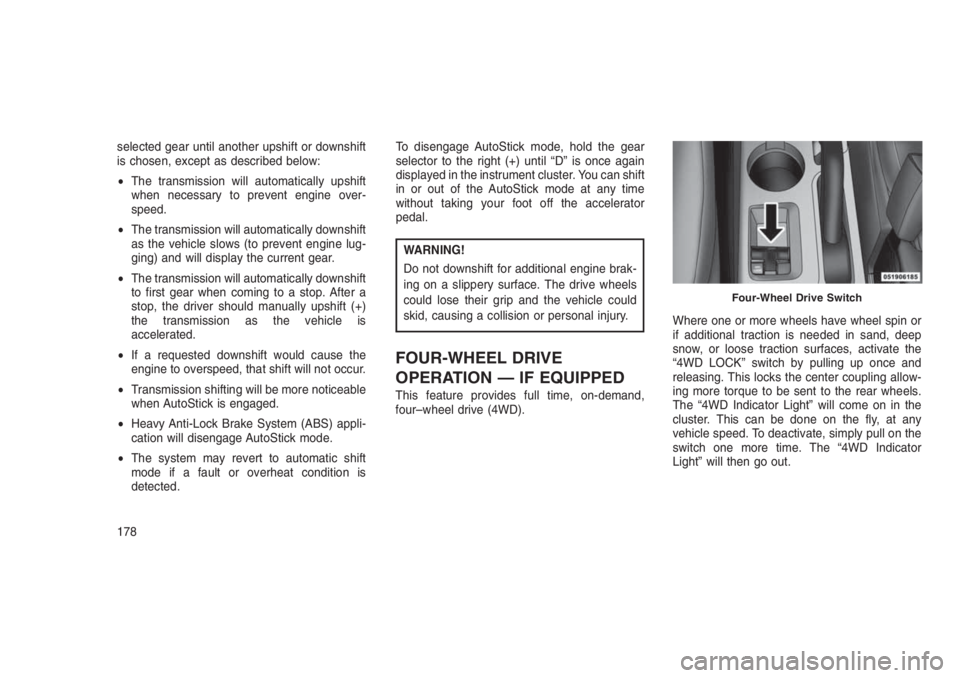
four–wheel drive (4WD).Where one or more wheels have wheel spin or
if additional traction is needed in sand, deep
snow, or loose traction surfaces, activate the
“4WD LOCK” switch by pulling up once and
releasing. This locks the center coupling allow-
ing more torque to be sent to the rear wheels.
The “4WD Indicator Light” will come on in the
cluster. This can be done on the fly, at any
vehicle speed. To deactivate, simply pull on the
switch one more time. The “4WD Indicator
Light” will then go out.
Four-Wheel Drive Switch
178
Page 189 of 332
WARNING!(Continued)
curate fluid level reading. Do not overfill. Use
only manufacturer’s recommended power
steering fluid.
If necessary, add fluid to restore to the proper
indicated level. With a clean cloth, wipe any
spilled fluid from all surfaces. Refer to “Fluids,
Lubricants, And Genuine Parts” in “Maintaining
Your Vehicle” for further information.
PARKING BRAKE
Before leaving the vehicle, make sure that the
parking brake is fully applied. Also, be certain to
leave an automatic transmission in PARK, or
manual transmission in REVERSE or first gear.
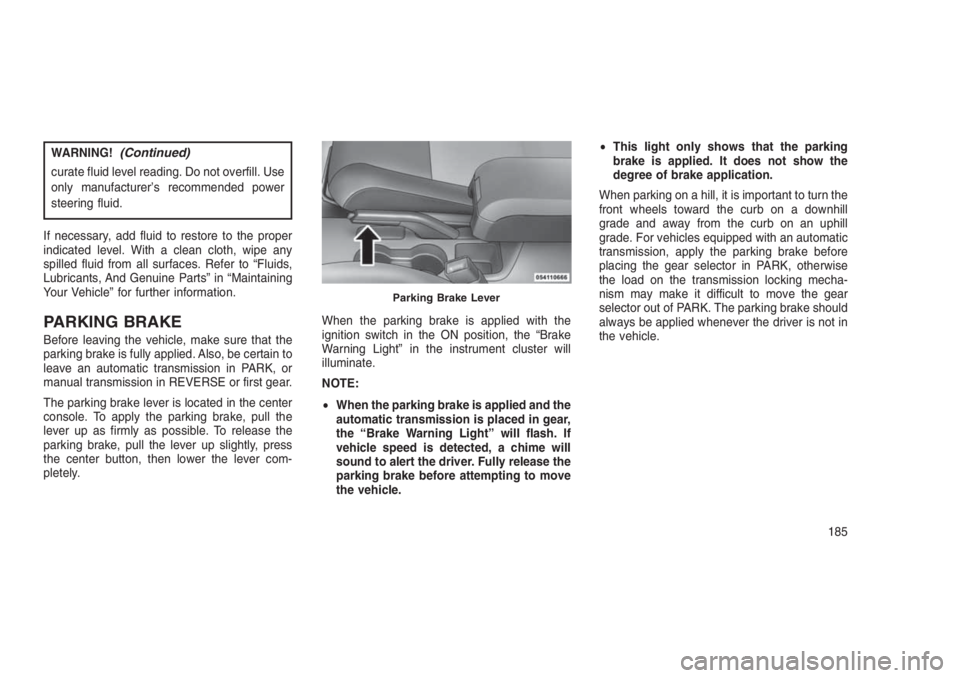
The parking brake lever is located in the center
console. To apply the parking brake, pull the
lever up as firmly as possible. To release the
parking brake, pull the lever up slightly, press
the center button, then lower the lever com-
pletely.When the parking brake is applied with the
ignition switch in the ON position, the “Brake
Warning Light” in the instrument cluster will
illuminate.
NOTE:
•When the parking brake is applied and the
automatic transmission is placed in gear,
the “Brake Warning Light” will flash. If
vehicle speed is detected, a chime will
sound to alert the driver. Fully release the
parking brake before attempting to move
the vehicle.•This light only shows that the parking
brake is applied. It does not show the
degree of brake application.
When parking on a hill, it is important to turn the
front wheels toward the curb on a downhill
grade and away from the curb on an uphill
grade. For vehicles equipped with an automatic
transmission, apply the parking brake before
placing the gear selector in PARK, otherwise
the load on the transmission locking mecha-
nism may make it difficult to move the gear
selector out of PARK. The parking brake should
always be applied whenever the driver is not in
the vehicle.
Parking Brake Lever
185
Page 190 of 332
WARNING!
•Never leave children alone in a vehicle, or
with access to an unlocked vehicle. Allow-
ing children to be in a vehicle unattended
is dangerous for a number of reasons. A
child or others could be seriously or fatally
injured. Children should be warned not to
touch the parking brake, brake pedal or the
gear selector.
•Do not leave the Key Fob in or near the
vehicle, or in a location accessible to chil-
dren. A child could operate power win-
dows, other controls, or move the vehicle.
•Be sure the parking brake is fully disen-
gaged before driving; failure to do so can
lead to brake failure and a collision.
•
Always fully apply the parking brake when
leaving your vehicle, or it may roll and cause
damage or injury. Also, be certain to leave a
manual transmission in REVERSE or first
gear. Failure to do so may cause the vehicle
to roll and cause damage or injury.
CAUTION!
If the “Brake Warning Light” remains on with
the parking brake released, a brake system
malfunction is indicated. Have the brake
system serviced by an authorized dealer
immediately.
BRAKE SYSTEM
Your vehicle is equipped with power assisted
brakes as standard equipment. In the event
power assist is lost for any reason (for example,
repeated brake applications with the engine off),
the brakes will still function. However, the effort
required to brake the vehicle will be much
greater than that required with the power sys-
tem operating.
WARNING!
Riding the brakes can lead to brake failure
and possibly a collision. Driving with your
foot resting or riding on the brake pedal can
(Continued)
WARNING!(Continued)
result in abnormally high brake tempera-
tures, excessive lining wear, and possible
brake damage. You would not have your full
braking capacity in an emergency.
If either of the two hydraulic systems lose
normal capability, the remaining system will still
function with some loss of overall braking effec-
tiveness. This will be evident by increased pedal
travel during application and greater pedal force
required to slow or stop. In addition, if the
malfunction is caused by an internal leak, as the
brake fluid in the master cylinder drops, the
“Brake Warning Light” will light.
WARNING!
Driving a vehicle with the “Brake Warning
Light” on is dangerous. A significant de-
crease in braking performance or vehicle
stability during braking may occur. It will take
you longer to stop the vehicle or will make
(Continued)
186
Page 193 of 332
Brake Assist System (BAS)The BAS is designed to optimize the vehicle’s
braking capability during emergency braking
maneuvers. The system detects an emergency
braking situation by sensing the rate and
amount of brake application and then applies
optimum pressure to the brakes. This can help
reduce braking distances. The BAS comple-
ments the anti-lock brake system (ABS). Apply-
ing the brakes very quickly results in the best
BAS assistance. To receive the benefit of the
system, you must apply continuous braking
pressure during the stopping sequence, (do not
“pump” the brakes). Do not reduce brake pedal
pressure unless braking is no longer desired.
Once the brake pedal is released, the BAS is
deactivated.
WARNING!
The Brake Assist System (BAS) cannot pre-
vent the natural laws of physics from acting
on the vehicle, nor can it increase the trac-
tion afforded by prevailing road conditions.
(Continued)
WARNING!(Continued)
BAS cannot prevent collisions, including
those resulting from excessive speed in
turns, driving on very slippery surfaces, or
hydroplaning. The capabilities of a BAS-
equipped vehicle must never be exploited in
a reckless or dangerous manner, which
could jeopardize the user’s safety or the
safety of others.
Hill Start Assist (HSA)The HSA system is designed to mitigate roll
back from a complete stop while on an incline. If
the driver releases the brake while stopped on
an incline, HSA will continue to hold the brake
pressure for a short period. If the driver does not
apply the throttle before this time expires, the
system will release brake pressure and the
vehicle will roll down the hill as normal.
The following conditions must be met in order
for HSA to activate:
•The feature must be enabled.
•The vehicle must be stopped.•Park brake must be off.
•Driver door must be closed.
•The vehicle must be on a sufficient grade.
•The gear selection must match vehicle uphill
direction (i.e., vehicle facing uphill is in for-
ward gear; vehicle backing uphill is in RE-
VERSE gear).
•HSA will work in REVERSE gear and all
forward gears. The system will not activate if
the transmission is in PARK or NEUTRAL.
For vehicles equipped with a manual trans-
mission, if the clutch is pressed, HSA will
remain active.
WARNING!
There may be situations where the Hill Start
Assist (HSA) will not activate and slight roll-
ing may occur, such as on minor hills or with
a loaded vehicle, or while pulling a trailer.
HSA is not a substitute for active driving
involvement. It is always the driver’s respon-
sibility to be attentive to distance to other
(Continued)
189
Page 194 of 332
WARNING!(Continued)
vehicles, people, and objects, and most im-
portantly brake operation to ensure safe
operation of the vehicle under all road con-
ditions. Your complete attention is always
required while driving to maintain safe con-
trol of your vehicle. Failure to follow these
warnings can result in a collision or serious
personal injury.
Towing With HSA
HSA will also provide assistance to mitigate roll
back while towing a trailer.
WARNING!
•If you use a trailer brake controller with
your trailer, the trailer brakes may be acti-
vated and deactivated with the brake
switch. If so, there may not be enough
brake pressure to hold both the vehicle
and the trailer on a hill when the brake
(Continued)
WARNING!(Continued)
pedal is released. In order to avoid rolling
down an incline while resuming accelera-
tion, manually activate the trailer brake or
apply more vehicle brake pressure prior to
releasing the brake pedal.
•HSA is not a parking brake. Always apply
the parking brake fully when leaving your
vehicle. Also, be certain to leave the trans-
mission in PARK.
•Failure to follow these warnings may
cause the vehicle to roll down the incline
and could collide with another vehicle,
object or person, and cause serious or
fatal injury. Always remember to use the
parking brake while parking on a hill and
that the driver is responsible for braking
the vehicle.
Disabling And Enabling HSA
This feature can be turned on or turned off. To
change the current setting, proceed as follows:•For vehicles equipped with the Electronic
Vehicle Information Center (EVIC), refer to
“Electronic Vehicle Information Center
(EVIC)” in “Understanding Your Instrument
Panel” for further information.
•If disabling HSA using Uconnect Settings,
refer to “Uconnect Settings” in “Understand-
ing Your Instrument Panel” for further
information.
For vehicles not equipped with the EVIC, per-
form the following steps:
1. Center the steering wheel (front wheels
pointing straight forward).
2. Shift the transmission into PARK.
3. Apply the parking brake.
4. Start the engine.
5. Rotate the steering wheel slightly more than
one-half turn to the left.
6. Push the “ESC Off” button located in the
lower switch bank below the climate control
190
Page 220 of 332
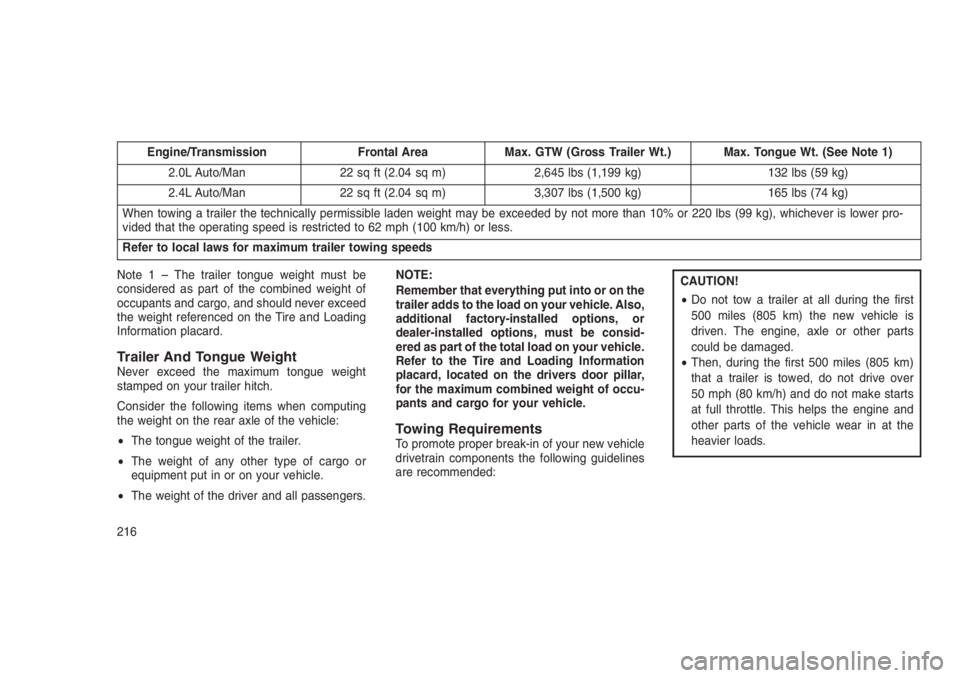
Engine/Transmission Frontal Area Max. GTW (Gross Trailer Wt.) Max. Tongue Wt. (See Note 1)
2.0L Auto/Man 22 sq ft (2.04 sq m) 2,645 lbs (1,199 kg) 132 lbs (59 kg)
2.4L Auto/Man 22 sq ft (2.04 sq m) 3,307 lbs (1,500 kg) 165 lbs (74 kg)
When towing a trailer the technically permissible laden weight may be exceeded by not more than 10% or 220 lbs (99 kg), whichever is lower pro-
vided that the operating speed is restricted to 62 mph (100 km/h) or less.
Refer to local laws for maximum trailer towing speeds
Note 1 – The trailer tongue weight must be
considered as part of the combined weight of
occupants and cargo, and should never exceed
the weight referenced on the Tire and Loading
Information placard.
Trailer And Tongue WeightNever exceed the maximum tongue weight
stamped on your trailer hitch.
Consider the following items when computing
the weight on the rear axle of the vehicle:
•The tongue weight of the trailer.
•The weight of any other type of cargo or
equipment put in or on your vehicle.
•The weight of the driver and all passengers.NOTE:
Remember that everything put into or on the
trailer adds to the load on your vehicle. Also,
additional factory-installed options, or
dealer-installed options, must be consid-
ered as part of the total load on your vehicle.
Refer to the Tire and Loading Information
placard, located on the drivers door pillar,
for the maximum combined weight of occu-
pants and cargo for your vehicle.
Towing RequirementsTo promote proper break-in of your new vehicle
drivetrain components the following guidelines
are recommended:
CAUTION!
•Do not tow a trailer at all during the first
500 miles (805 km) the new vehicle is
driven. The engine, axle or other parts
could be damaged.
•Then, during the first 500 miles (805 km)
that a trailer is towed, do not drive over
50 mph (80 km/h) and do not make starts
at full throttle. This helps the engine and
other parts of the vehicle wear in at the
heavier loads.
216
Page 221 of 332
WARNING!
Improper towing can lead to an injury acci-
dent. Follow these guidelines to make your
trailer towing as safe as possible:
•Make certain that the load is secured in the
trailer and that it will not shift during travel.
When trailering cargo that is not fully se-
cured, dynamic load shifts can occur that
may be difficult for the driver to control. You
could lose control of your vehicle and have
an accident.
•All trailer hitches should be professionally
installed on your vehicle.
•When hauling cargo or towing a trailer, do
not overload your vehicle or trailer. Over-
loading can cause a loss of control, poor
performance, or damage to brakes, axle,
engine, transmission, steering, suspen-
sion, chassis structure, or tires.
(Continued)
WARNING!(Continued)
•Safety chains must always be used be-
tween your vehicle and trailer. Always con-
nect the chains to the frame or hook re-
tainers of the vehicle hitch. Cross the
chains under the trailer tongue and allow
enough slack for turning corners.
•Vehicles with trailers should not be parked
on a grade. When parking, apply the park-
ing brake on the tow vehicle. Always, block
or"chock"the trailer wheels.
•GCWR must not be exceeded.
•Total weight must be distributed be-
tween the tow vehicle and the trailer
such that the following four ratings are
not exceeded:
1. GVWR
2. GTW
3. GAWR
4. Tongue weight rating for the trailer hitch
utilized.Towing Requirements — Tires
•Do not attempt to tow a trailer while using a
compact spare tire.
•Proper tire inflation pressures are essential
for the safe and satisfactory operation of your
vehicle. Refer to “Tires – General Informa-
tion” in “Starting and Operating” for proper
tire inflation procedures.
•Check the trailer tires for proper tire inflation
pressures before trailer usage.
•Check for signs of tire wear or visible tire
damage before towing a trailer. Refer to
“Tires – General Information” in “Starting and
Operating” for the proper inspection
procedure.
•When replacing tires, refer to “Tires – Gen-
eral Information” in “Starting and Operating”
for proper tire replacement procedures. Re-
placing tires with a higher load carrying ca-
pacity will not increase the vehicle’s GVWR
and GAWR limits.
217
Page 226 of 332
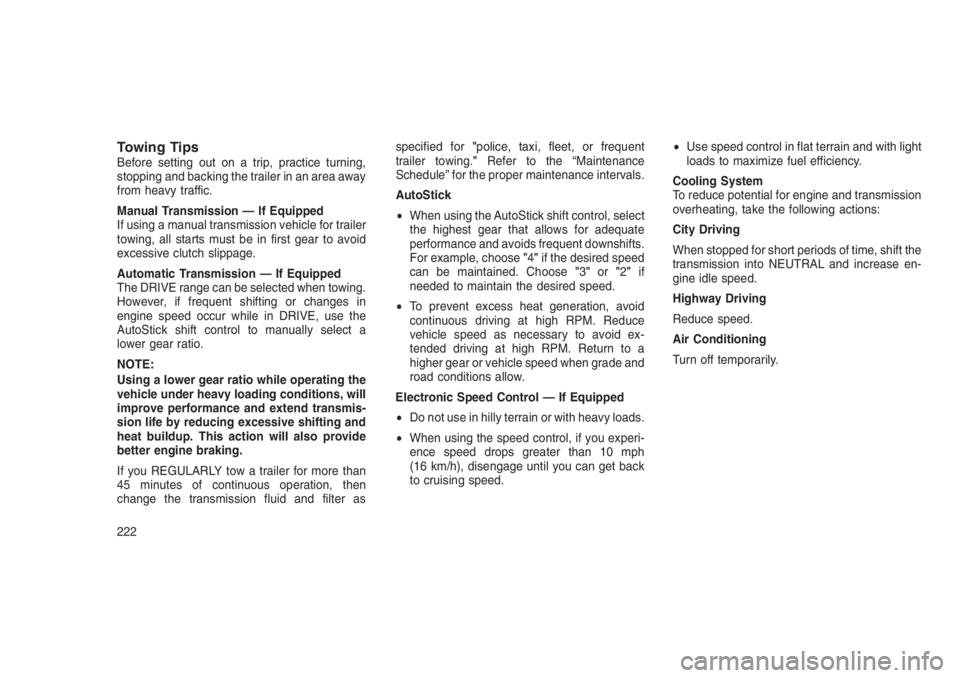
Towing TipsBefore setting out on a trip, practice turning,
stopping and backing the trailer in an area away
from heavy traffic.
Manual Transmission — If Equipped
If using a manual transmission vehicle for trailer
towing, all starts must be in first gear to avoid
excessive clutch slippage.
Automatic Transmission — If Equipped
The DRIVE range can be selected when towing.
However, if frequent shifting or changes in
engine speed occur while in DRIVE, use the
AutoStick shift control to manually select a
lower gear ratio.
NOTE:
Using a lower gear ratio while operating the
vehicle under heavy loading conditions, will
improve performance and extend transmis-
sion life by reducing excessive shifting and
heat buildup. This action will also provide
better engine braking.
If you REGULARLY tow a trailer for more than
45 minutes of continuous operation, then
change the transmission fluid and filter asspecified for"police, taxi, fleet, or frequent
trailer towing."Refer to the “Maintenance
Schedule” for the proper maintenance intervals.
AutoStick
•When using the AutoStick shift control, select
the highest gear that allows for adequate
performance and avoids frequent downshifts.
For example, choose"4"if the desired speed
can be maintained. Choose"3"or"2"if
needed to maintain the desired speed.
•To prevent excess heat generation, avoid
continuous driving at high RPM. Reduce
vehicle speed as necessary to avoid ex-
tended driving at high RPM. Return to a
higher gear or vehicle speed when grade and
road conditions allow.
Electronic Speed Control — If Equipped
•Do not use in hilly terrain or with heavy loads.
•When using the speed control, if you experi-
ence speed drops greater than 10 mph
(16 km/h), disengage until you can get back
to cruising speed.•Use speed control in flat terrain and with light
loads to maximize fuel efficiency.
Cooling System
To reduce potential for engine and transmission
overheating, take the following actions:
City Driving
When stopped for short periods of time, shift the
transmission into NEUTRAL and increase en-
gine idle speed.
Highway Driving
Reduce speed.
Air Conditioning
Turn off temporarily.
222
Page 227 of 332
RECREATIONAL TOWING (BEHIND MOTORHOME, ETC.)
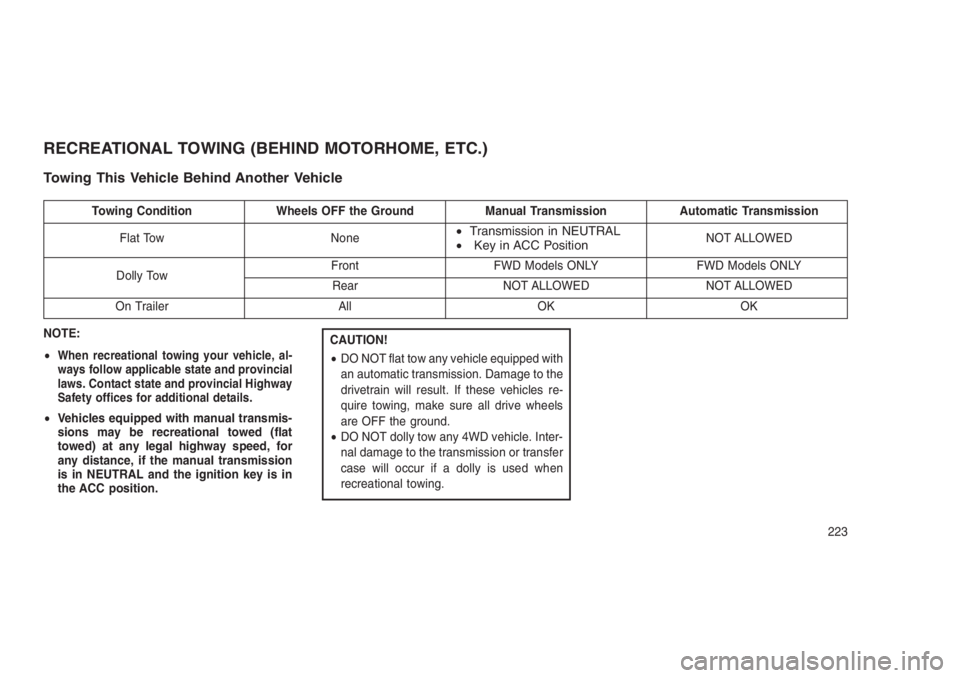
Towing This Vehicle Behind Another Vehicle
Towing Condition Wheels OFF the Ground Manual Transmission Automatic Transmission
Flat Tow None
•Transmission in NEUTRAL
•Key in ACC PositionNOT ALLOWED
Dolly TowFront FWD Models ONLY FWD Models ONLY
Rear NOT ALLOWED NOT ALLOWED
On Trailer All OK OK
NOTE:
•
When recreational towing your vehicle, al-
ways follow applicable state and provincial
laws. Contact state and provincial Highway
Safety offices for additional details.
•Vehicles equipped with manual transmis-
sions may be recreational towed (flat
towed) at any legal highway speed, for
any distance, if the manual transmission
is in NEUTRAL and the ignition key is in
the ACC position.
CAUTION!
•DO NOT flat tow any vehicle equipped with
an automatic transmission. Damage to the
drivetrain will result. If these vehicles re-
quire towing, make sure all drive wheels
are OFF the ground.
•DO NOT dolly tow any 4WD vehicle. Inter-
nal damage to the transmission or transfer
case will occur if a dolly is used when
recreational towing.
223