transmission JEEP PATRIOT 2021 Owner handbook (in English)
[x] Cancel search | Manufacturer: JEEP, Model Year: 2021, Model line: PATRIOT, Model: JEEP PATRIOT 2021Pages: 332, PDF Size: 1.99 MB
Page 253 of 332
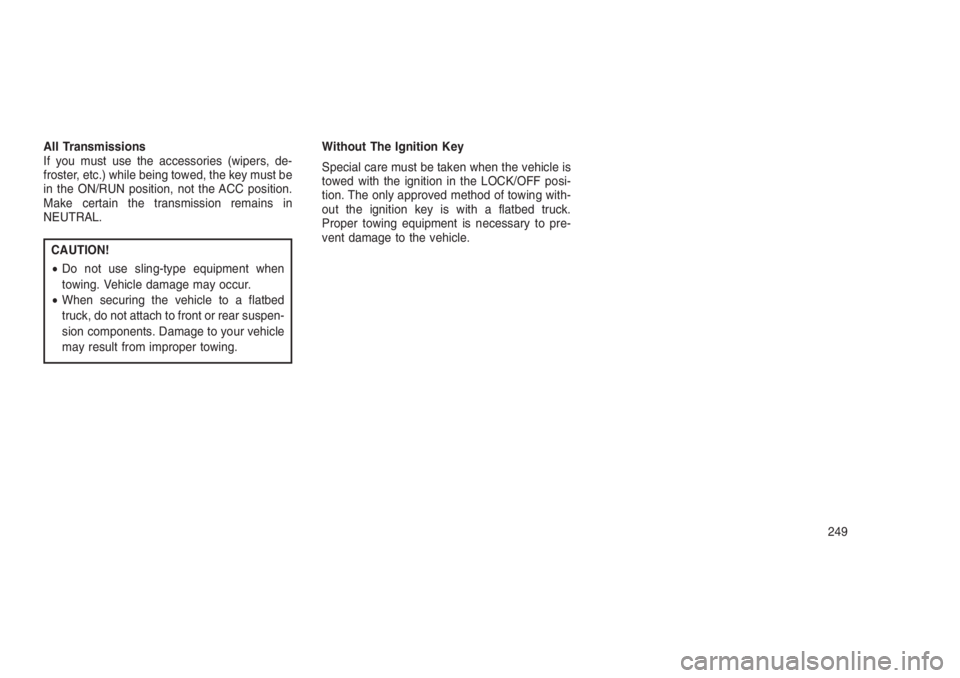
All Transmissions
If you must use the accessories (wipers, de-
froster, etc.) while being towed, the key must be
in the ON/RUN position, not the ACC position.
Make certain the transmission remains in
NEUTRAL.
CAUTION!
•Do not use sling-type equipment when
towing. Vehicle damage may occur.
•When securing the vehicle to a flatbed
truck, do not attach to front or rear suspen-
sion components. Damage to your vehicle
may result from improper towing.Without The Ignition Key
Special care must be taken when the vehicle is
towed with the ignition in the LOCK/OFF posi-
tion. The only approved method of towing with-
out the ignition key is with a flatbed truck.
Proper towing equipment is necessary to pre-
vent damage to the vehicle.
249
Page 255 of 332
7
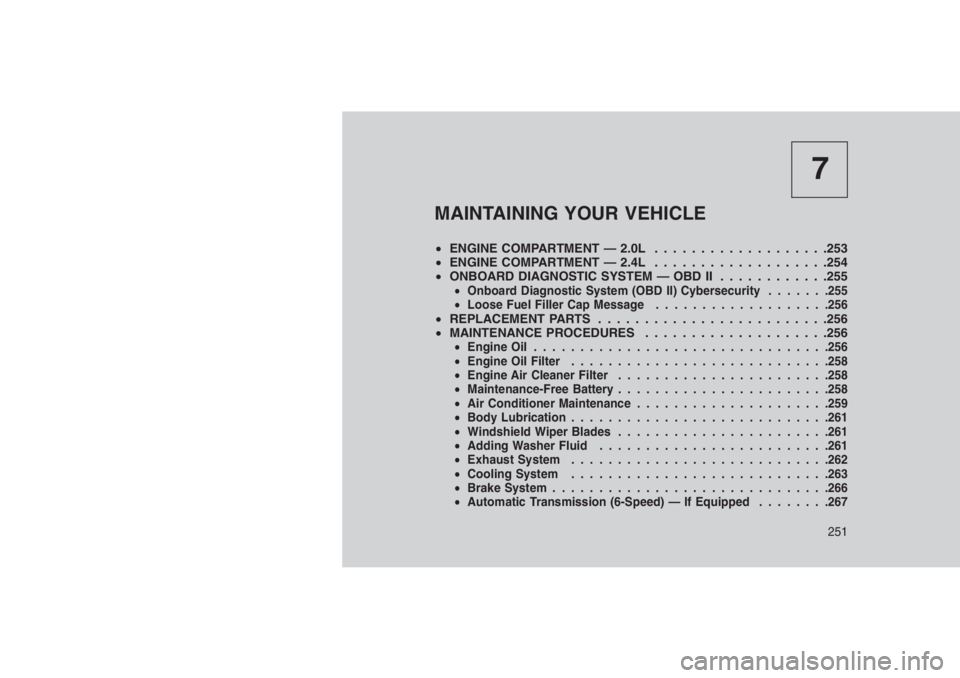
MAINTAINING YOUR VEHICLE
•ENGINE COMPARTMENT — 2.0L . . . . . . . . . . . . .. . . . . .253
•ENGINE COMPARTMENT — 2.4L . . . . . . . . . . . . .. . . . . .254
•ONBOARD DIAGNOSTIC SYSTEM — OBD II . . ..........255
•Onboard Diagnostic System (OBD II) Cybersecurity.......255
•Loose Fuel Filler Cap Message...................256
•REPLACEMENT PARTS . . . . . . . . . . . . . . . . . . . . . . . . .256
•MAINTENANCE PROCEDURES . . . . . . . . . . . . . . ......256
•Engine Oil................................256
•Engine Oil Filter............................258
•Engine Air Cleaner Filter.......................258
•Maintenance-Free Battery.......................258
•Air Conditioner Maintenance.....................259
•Body Lubrication............................261
•Windshield Wiper Blades.......................261
•Adding Washer Fluid.........................261
•Exhaust System............................262
•Cooling System............................263
•Brake System..............................266
•Automatic Transmission (6-Speed) — If Equipped........267
251
Page 256 of 332
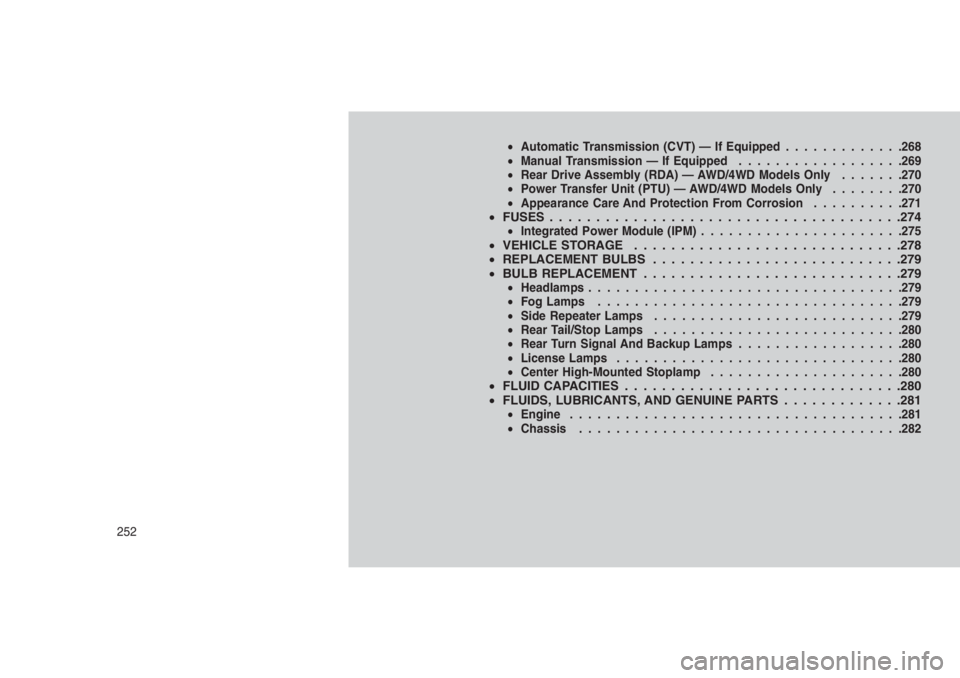
•Automatic Transmission (CVT) — If Equipped.............268
•Manual Transmission — If Equipped..................269
•Rear Drive Assembly (RDA) — AWD/4WD Models Only.......270
•Power Transfer Unit (PTU) — AWD/4WD Models Only........270
•Appearance Care And Protection From Corrosion..........271
•FUSES......................................274•Integrated Power Module (IPM)......................275•VEHICLE STORAGE . . . . . . . . . . . . . . ...............278
•REPLACEMENT BULBS...........................279
•BULB REPLACEMENT . . . . . . . . . . . . . . . .............279
•Headlamps..................................279
•Fog Lamps.................................279
•Side Repeater Lamps...........................279
•Rear Tail/Stop Lamps...........................280
•Rear Turn Signal And Backup Lamps..................280
•License Lamps...............................280
•Center High-Mounted Stoplamp.....................280
•FLUID CAPACITIES . . . . . . . . . . . . . . . . . . . . . . . . . . . . . .280
•FLUIDS, LUBRICANTS, AND GENUINE PARTS.............281
•Engine....................................281
•Chassis...................................282
252
Page 259 of 332
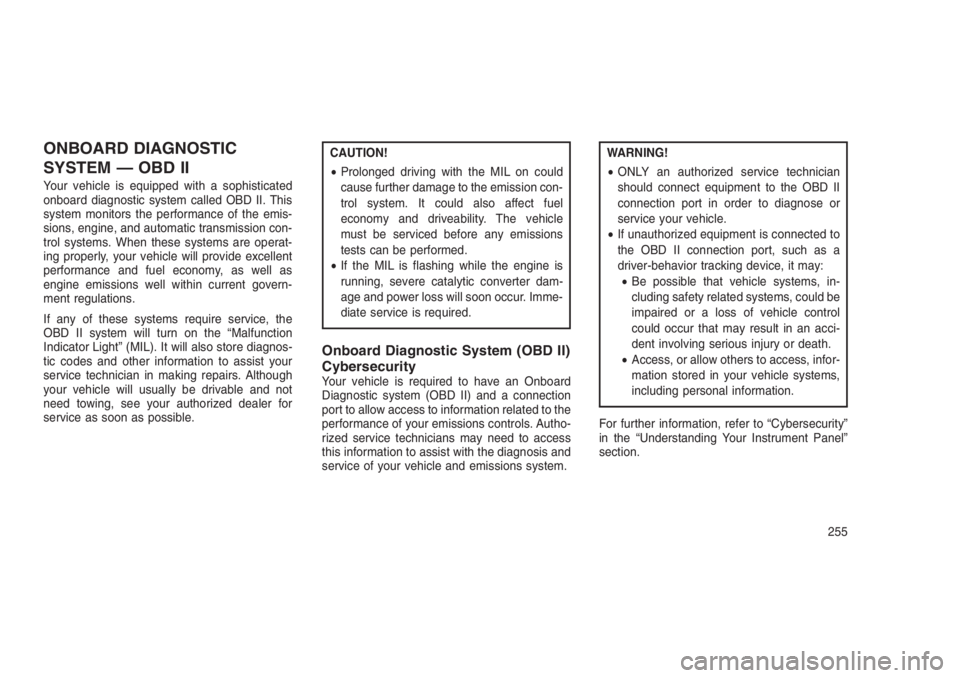
ONBOARD DIAGNOSTIC
SYSTEM — OBD II
Your vehicle is equipped with a sophisticated
onboard diagnostic system called OBD II. This
system monitors the performance of the emis-
sions, engine, and automatic transmission con-
trol systems. When these systems are operat-
ing properly, your vehicle will provide excellent
performance and fuel economy, as well as
engine emissions well within current govern-
ment regulations.
If any of these systems require service, the
OBD II system will turn on the “Malfunction
Indicator Light” (MIL). It will also store diagnos-
tic codes and other information to assist your
service technician in making repairs. Although
your vehicle will usually be drivable and not
need towing, see your authorized dealer for
service as soon as possible.
CAUTION!
•Prolonged driving with the MIL on could
cause further damage to the emission con-
trol system. It could also affect fuel
economy and driveability. The vehicle
must be serviced before any emissions
tests can be performed.
•If the MIL is flashing while the engine is
running, severe catalytic converter dam-
age and power loss will soon occur. Imme-
diate service is required.
Onboard Diagnostic System (OBD II)
Cybersecurity
Your vehicle is required to have an Onboard
Diagnostic system (OBD II) and a connection
port to allow access to information related to the
performance of your emissions controls. Autho-
rized service technicians may need to access
this information to assist with the diagnosis and
service of your vehicle and emissions system.
WARNING!
•ONLY an authorized service technician
should connect equipment to the OBD II
connection port in order to diagnose or
service your vehicle.
•If unauthorized equipment is connected to
the OBD II connection port, such as a
driver-behavior tracking device, it may:
•Be possible that vehicle systems, in-
cluding safety related systems, could be
impaired or a loss of vehicle control
could occur that may result in an acci-
dent involving serious injury or death.
•Access, or allow others to access, infor-
mation stored in your vehicle systems,
including personal information.
For further information, refer to “Cybersecurity”
in the “Understanding Your Instrument Panel”
section.
255
Page 260 of 332
Loose Fuel Filler Cap MessageAfter fuel is added, the vehicle diagnostic sys-
tem can determine if the fuel filler cap is possi-
bly loose or improperly installed. A “gASCAP”
message will be displayed in the instrument
cluster. Tighten the gas cap until a “clicking”
sound is heard. This is an indication that the gas
cap is properly tightened. Push the trip odom-
eter RESET button to turn off the message. If
the problem persists, the message will appear
the next time the vehicle is started. This might
indicate a damaged cap. If the problem is
detected twice in a row, the system will turn on
the MIL. Resolving the problem will turn the MIL
light off.
REPLACEMENT PARTS
Use of genuine MOPAR parts for normal/
scheduled maintenance and repairs is highly
recommended to ensure the designed perfor-
mance. Damage or failures caused by the use
of non-MOPAR parts for maintenance and re-
pairs will not be covered by the New Vehicle
Limited Warranty.
MAINTENANCE PROCEDURES
The pages that follow contain therequired
maintenance services determined by the engi-
neers who designed your vehicle.
Besides those maintenance items specified in
the fixed “Maintenance Schedule”, there are
other components which may require servicing
or replacement in the future.
CAUTION!
•Failure to properly maintain your vehicle or
perform repairs and service when neces-
sary could result in more costly repairs,
damage to other components or negatively
impact vehicle performance. Immediately
have potential malfunctions examined by
an authorized dealer or qualified repair
center.
(Continued)
CAUTION!(Continued)
•Your vehicle has been built with improved
fluids that protect the performance and
durability of your vehicle and also allow
extended maintenance intervals. Do not
use chemical flushes in these components
as the chemicals can damage your engine,
transmission, or air conditioning. Such
damage is not covered by the New Vehicle
Limited Warranty. If a flush is needed
because of component malfunction, use
only the specified fluid for the flushing
procedure.
Engine Oil
Checking Oil Level
To assure proper engine lubrication, the engine
oil must be maintained at the correct level.
Check the oil level at regular intervals, such as
every fuel stop.
The best time to check the engine oil level is
about five minutes after a fully warmed engine is
shut off. Do not check oil level before starting
256
Page 267 of 332
NOTE:
Intentional tampering with emissions con-
trol systems can result in civil penalties
being assessed against you.
In unusual situations involving grossly malfunc-
tioning engine operation, a scorching odor may
suggest severe and abnormal catalyst over-
heating. If this occurs, stop the vehicle, turn off
the engine and allow it to cool. Service, includ-
ing a tune-up to manufacturer’s specifications,
should be obtained immediately.
To minimize the possibility of catalytic converter
damage:
•Do not shut off the engine or interrupt the
ignition, when the transmission is in gear and
the vehicle is in motion.
•Do not try to start the engine by pushing or
towing the vehicle.
•Do not idle the engine with any spark plug
wires disconnected or removed, such as
when diagnostic testing, or for prolonged
periods during very rough idle or malfunction-
ing operating conditions.Cooling System
WARNING!
•When working near the radiator cooling
fan, disconnect the fan motor lead or turn
the ignition switch to the OFF position. The
fan is temperature controlled and can start
at any time the ignition switch is in the ON
position.
•You or others can be badly burned by hot
engine coolant (antifreeze) or steam from
your radiator. If you see or hear steam
coming from under the hood, do not open
the hood until the radiator has had time to
cool. Never try to open a cooling system
pressure cap when the radiator is hot.
Coolant Checks
Check engine coolant (antifreeze) protection
every 12 months (before the onset of freezing
weather, where applicable). If the engine cool-
ant (antifreeze) is dirty or rusty in appearance,
the system should be drained, flushed, and
refilled with fresh engine coolant (antifreeze).Check the front of the A/C condenser for any
accumulation of bugs, leaves, etc. If dirty, clean
by gently spraying water from a garden hose
vertically down the face of the condenser.
Check the coolant recovery bottle tubing for
brittle rubber, cracking, tears, cuts, and tight-
ness of the connection at the bottle and radiator.
Inspect the entire system for leaks.
Cooling System – Drain, Flush, And Refill
Refer to the “Maintenance Schedule” for the
proper maintenance intervals.
If the engine coolant (antifreeze) is dirty or
contains a considerable amount of sediment,
clean and flush with a reliable cooling system
cleaner. Follow with a thorough rinsing to re-
move all deposits and chemicals. Properly dis-
pose of old engine coolant (antifreeze).
Selection Of Coolant
Refer to “Fluids, Lubricants, And Genuine
Parts” in “Maintaining Your Vehicle” for further
information.
263
Page 270 of 332
•If frequent engine coolant (antifreeze) addi-
tions are required, the cooling system should
be pressure tested for leaks.
•Maintain engine coolant (antifreeze) concen-
tration at a minimum of 50% OAT coolant
(conforming to MS.90032) and distilled water
for proper corrosion protection of your engine
which contains aluminum components.
•Make sure that the coolant expansion bottle
overflow hoses are not kinked or obstructed.
•Keep the front of the radiator clean. If your
vehicle is equipped with air conditioning,
keep the front of the condenser clean.
•Do not change the thermostat for Summer or
Winter operation. If replacement is ever nec-
essary, install ONLY the correct type thermo-
stat. Other designs may result in unsatisfac-
tory engine coolant (antifreeze) performance,
poor gas mileage, and increased emissions.
Brake SystemIn order to assure brake system performance,
all brake system components should be in-spected periodically. Refer to the “Maintenance
Schedule” for the proper maintenance intervals.
WARNING!
Riding the brakes can lead to brake failure
and possibly a collision. Driving with your
foot resting or riding on the brake pedal can
result in abnormally high brake tempera-
tures, excessive lining wear, and possible
brake damage. You would not have your full
braking capacity in an emergency.
Brake Master Cylinder
The fluid level in the master cylinder should be
checked when performing under hood services,
or immediately if the brake system warning light
is on.
Be sure to clean the top of the master cylinder
area before removing the cap. If necessary, add
fluid to bring the fluid level up to the require-
ments described on the brake fluid reservoir.
Fluid level can be expected to fall as the brake
pads wear. The brake fluid level should be
checked when the pads are replaced. However,low fluid level may be caused by a leak and a
checkup may be needed.
NOTE:
If your vehicle is equipped with a manual
transmission, the brake fluid reservoir sup-
plies fluid to both the brake system and the
clutch release system. The two systems are
separated in the reservoir, and a leak in one
system will not affect the other system. The
manual transmission clutch release system
should not require fluid replacement during
the life of the vehicle. If the brake fluid
reservoir is low and the brake system does
not indicate any leaks or other problems, it
may be a result of a leak in the hydraulic
clutch release system. See your local autho-
rized dealer for service.
Use only manufacturer’s recommended brake
fluid. Refer to “Fluids, Lubricants, And Genuine
Parts” in “Maintaining Your Vehicle” for further
information.
266
Page 271 of 332
WARNING!
•Use only manufacturer’s recommended
brake fluid. Refer to “Fluids, Lubricants,
And Genuine Parts” in “Maintaining Your
Vehicle” for further information. Using the
wrong type of brake fluid can severely
damage your brake system and/or impair
its performance. The proper type of brake
fluid for your vehicle is also identified on
the original factory installed hydraulic mas-
ter cylinder reservoir.
•To avoid contamination from foreign matter
or moisture, use only new brake fluid or
fluid that has been in a tightly closed
container. Keep the master cylinder reser-
voir cap secured at all times. Brake fluid in
a open container absorbs moisture from
the air resulting in a lower boiling point.
This may cause it to boil unexpectedly
during hard or prolonged braking, resulting
in sudden brake failure. This could result in
a collision.
(Continued)
WARNING!(Continued)
•Overfilling the brake fluid reservoir can
result in spilling brake fluid on hot engine
parts, causing the brake fluid to catch fire.
Brake fluid can also damage painted and
vinyl surfaces, care should be taken to
avoid its contact with these surfaces.
•Do not allow petroleum based fluid to
contaminate the brake fluid. Brake seal
components could be damaged, causing
partial or complete brake failure. This
could result in a collision.
CAUTION!
Use of improper brake fluids will affect over-
all clutch system performance. Improper
brake fluids may damage the clutch system
resulting in loss of clutch function and the
ability to shift the transmission.
Automatic Transmission (6-Speed)
— If Equipped
Selection Of Lubricant — 6-Speed
Transmission
It is important to use the proper transmission
fluid to ensure optimum transmission perfor-
mance and life. Use only the manufacturer’s
specified transmission fluid. Refer to “Fluids,
Lubricants, and Genuine Parts” in this section
for fluid specifications. It is important to maintain
the transmission fluid at the correct level using
the recommended fluid.
No chemical flushes should be used in any
transmission; only the approved lubricant
should be used.
CAUTION!
Using a transmission fluid other than the
manufacturer’s recommended fluid may
cause deterioration in transmission shift
quality and/or torque converter shudder. Re-
fer to “Fluids, Lubricants, And Genuine
Parts” in this section for fluid specifications.
267
Page 272 of 332
Special Additives
The manufacturer strongly recommends
against using any special additives in the trans-
mission.
Automatic Transmission Fluid (ATF) is an engi-
neered product and its performance may be
impaired by supplemental additives. Therefore,
do not add any fluid additives to the transmis-
sion. The only exception to this policy is the use
of special dyes for diagnosing fluid leaks. Avoid
using transmission sealers as they may ad-
versely affect seals.
CAUTION!
Do not use chemical flushes in your trans-
mission as the chemicals can damage your
transmission components. Such damage is
not covered by the New Vehicle Limited
Warranty.
Fluid Level Check
The fluid level is preset at the factory and does
not require adjustment under normal operating
conditions.Routine fluid level checks are not required,
therefore the transmission filler tube is capped
and no dipstick is provided. Your authorized
dealer can check your transmission fluid level
using special service tools. If you notice fluid
leakage or transmission malfunction, visit your
authorized dealer immediately to have the
transmission fluid level checked. Operating the
vehicle with an improper fluid level can cause
severe transmission damage.
CAUTION!
If a transmission fluid leak occurs, visit your
authorized dealer immediately. Severe trans-
mission damage may occur. Your authorized
dealer has the proper tools to adjust the fluid
level accurately.
Fluid And Filter Changes
Under normal operating conditions, the fluid
installed at the factory will provide satisfactory
lubrication for the life of the vehicle. However, if
the vehicle is frequently driven on rough or
unpaved roads, on mountain roads, on short
trips, or in heavy city traffic during hot weather,or is used for frequent trailer towing, police,
fleet, taxi, etc., change the fluid as indicated in
the Maintenance Schedule. In addition, change
the fluid and filter if the fluid becomes contami-
nated (with water, etc.), or if the transmission is
disassembled for any reason.
Automatic Transmission (CVT) — If
Equipped
Selection Of Lubricant (CVT)
It is important to use the proper transmission
fluid to ensure optimum transmission perfor-
mance and life. Use only the manufacturer’s
specified transmission fluid which has the spe-
cial friction coefficient additives necessary for
proper steel belt traction on the drive and driven
pulleys. Refer to “Fluids, Lubricants, And Genu-
ine Parts” in this section for fluid specifications.
It is important to maintain the transmission fluid
at the correct level using the recommended
fluid.
No chemical flushes should be used in any
transmission; only the approved lubricant
should be used.
268
Page 273 of 332
CAUTION!
Using a transmission fluid other than the
manufacturer’s recommended fluid may
cause belt slip and result in a complete
transmission failure! Refer to “Fluids, Lubri-
cants, And Genuine Parts” in this section for
fluid specifications.
Special Additives
The manufacturer strongly recommends
against using any special additives in the trans-
mission.
Automatic Transmission Fluid (ATF) is an engi-
neered product and its performance may be
impaired by supplemental additives. Therefore,
do not add any fluid additives to the transmis-
sion. The only exception to this policy is the use
of special dyes for diagnosing fluid leaks. Avoid
using transmission sealers as they may ad-
versely affect seals.CAUTION!
Do not use chemical flushes in your trans-
mission as the chemicals can damage your
transmission components. Such damage is
not covered by the New Vehicle Limited
Warranty.
Fluid Level Check
The fluid level is preset at the factory and does
not require adjustment under normal operating
conditions.
Routine fluid level checks are not required,
therefore the transmission filler tube is capped
and no dipstick is provided. Your authorized
dealer can check your transmission fluid level
using special service tools. If you notice fluid
leakage or transmission malfunction, visit your
authorized dealer immediately to have the
transmission fluid level checked. Operating the
vehicle with an improper fluid level can cause
severe transmission damage.CAUTION!
If a transmission fluid leak occurs, visit your
authorized dealer immediately. Severe trans-
mission damage may occur. Your authorized
dealer has the proper tools to adjust the fluid
level accurately.
Fluid And Filter Changes
Refer to the"Maintenance Schedule"for the
proper maintenance intervals. In addition,
change the fluid and filter if the fluid becomes
contaminated (with water, etc.), or if the trans-
mission is disassembled for any reason.
Manual Transmission — If Equipped
Lubricant Selection
Use only the manufacturers recommended
transmission fluid. Refer to “Fluids, Lubricants,
And Genuine Parts” in “Maintaining Your Ve-
hicle” for further information.
269