brake JEEP WRANGLER 2DOORS 2020 Owner handbook (in English)
[x] Cancel search | Manufacturer: JEEP, Model Year: 2020, Model line: WRANGLER 2DOORS, Model: JEEP WRANGLER 2DOORS 2020Pages: 330, PDF Size: 9.16 MB
Page 82 of 330
SAFETY
80
Electronic Brake Force Distribution (EBD)
The Electronic Brake Force Distribution
(EBD) manages the distribution of the
braking torque between the front and rear
axles by limiting braking pressure to the rear
axle. This is done to prevent overslip of the
rear wheels to avoid vehicle instability, and
to prevent the rear axle from entering ABS
before the front axle.
Electronic Roll Mitigation (ERM)
Electronic Roll Mitigation (ERM) anticipates
the potential for wheel lift by monitoring the
driver’s steering wheel input and the speed
of the vehicle. When ERM determines that
the rate of change of the steering wheel
angle and vehicle’s speed are sufficient to
potentially cause wheel lift, it then applies
the appropriate brake and may also reduce
engine power to lessen the chance that
wheel lift will occur. ERM can only reduce
the chance of wheel lift occurring during
severe or evasive driving maneuvers; it
cannot prevent wheel lift due to other
factors, such as road conditions, leaving the
roadway, or striking objects or other vehicles.NOTE:
ERM is disabled anytime the ESC is in “Full
Off” mode (if equipped). Refer to “Electronic
Stability Control (ESC)” in this section for a
complete explanation of the available ESC
modes.
Electronic Stability Control (ESC)
Electronic Stability Control (ESC) enhances
directional control and stability of the
vehicle under various driving conditions.
ESC corrects for oversteering or under
-
steering of the vehicle by applying the brake
of the appropriate wheel(s) to assist in coun -teracting the oversteer or understeer condi
-
tion. Engine power may also be reduced to
help the vehicle maintain the desired path.
ESC uses sensors in the vehicle to determine
the vehicle path intended by the driver and
compares it to the actual path of the vehicle.
When the actual path does not match the
intended path, ESC applies the brake of the
appropriate wheel to assist in counteracting
the oversteer or understeer condition.
Oversteer — when the vehicle is turning
more than appropriate for the steering
wheel position.
Understeer — when the vehicle is turning
less than appropriate for the steering
wheel position.
The “ESC Activation/Malfunction Indicator
Light” located in the instrument cluster will
start to flash as soon as the ESC system
becomes active. The “ESC Activation/
Malfunction Indicator Light” also flashes
when the TCS is active. If the “ESC Activa -
tion/Malfunction Indicator Light” begins to
flash during acceleration, ease up on the
accelerator and apply as little throttle as
possible. Be sure to adapt your speed and
driving to the prevailing road conditions.
WARNING!
Many factors, such as vehicle loading,
road conditions and driving conditions,
influence the chance that wheel lift or
rollover may occur. ERM cannot prevent all
wheel lift or roll overs, especially those
that involve leaving the roadway or striking
objects or other vehicles. The capabilities
of an ERM-equipped vehicle must never
be exploited in a reckless or dangerous
manner which could jeopardize the user's
safety or the safety of others.
2020_JEEP_JL_WRANGLER_UG_RHD_UK.book Page 80
Page 85 of 330
83
The “ESC Activation/Malfunction Indicator
Light” (located in the instrument cluster)
starts to flash as soon as the tires lose trac-
tion and the ESC system becomes active.
The “ESC Activation/Malfunction Indicator
Light” also flashes when TCS is active. If the
“ESC Activation/Malfunction Indicator
Light” begins to flash during acceleration,
ease up on the accelerator and apply as little
throttle as possible. Be sure to adapt your
speed and driving to the prevailing road
conditions.
NOTE:
The “ESC Activation/Malfunction Indi -
cator Light” and the “ESC OFF Indicator
Light” come on momentarily each time
the ignition is turned ON.
Each time the ignition is turned ON, the
ESC system will be on even if it was turned
off previously.
The ESC system will make buzzing or
clicking sounds when it is active. This is
normal; the sounds will stop when ESC
becomes inactive following the maneuver
that caused the ESC activation. The “ESC OFF Indicator Light”
indicates the customer has elected
to have the Electronic Stability
Control (ESC) in a reduced mode.
Hill Descent Control (HDC) — If Equipped
Hill Descent Control (HDC) is intended for
low speed off road driving while in 4L Range.
HDC maintains vehicle speed while
descending hills during various driving situa
-
tions. HDC controls vehicle speed by actively
controlling the brakes.
HDC has three states:
1. Off (feature is not enabled and will not activate)
2. Enabled (feature is enabled and ready but activation conditions are not met, or
driver is actively overriding with brake or
throttle application)
3. Active (feature is enabled and actively controlling vehicle speed) Enabling HDC
HDC is enabled by pushing the HDC switch,
but the following conditions must also be
met to enable HDC:
Driveline is in 4L Range
Vehicle speed is below 5 mph (8 km/h)
Park brake is released
Driver door is closed (If doors are
attached, then door must be closed. If
doors are detached, then driver seatbelt
must be buckled)
Activating HDC
Once HDC is enabled it will activate auto -
matically if driven down a grade of sufficient
magnitude. The set speed for HDC is select -
able by the driver, and can be adjusted by
using the gear shift +/-. The following
summarizes the HDC set speeds:
HDC Target Set Speeds
P = No set speed. HDC may be enabled
but will not activate
R = 0.6 mph (1 km/h)
N = 1.2 mph (2 km/h)
2020_JEEP_JL_WRANGLER_UG_RHD_UK.book Page 83
Page 86 of 330
SAFETY
84
D = 0.6 mph (1 km/h)
1st = 0.6 mph (1 km/h)
2nd = 1.2 mph (2 km/h)
3rd = 1.8 mph (3 km/h)
4th = 2.5 mph (4 km/h)
5th = 3.1 mph (5 km/h)
6th = 3.7 mph (6 km/h)
7th = 4.3 mph (7 km/h)
8th = 5.0 mph (8 km/h)
9th = 5.6 mph (9 km/h) – If Equipped
NOTE:
During HDC the +/- shifter input is used for
HDC target speed selection, but will not
affect the gear chosen by the transmission.
When actively controlling HDC, the transmis -
sion will shift appropriately for the
driver-selected set speed and corresponding
driving conditions. Driver Override
The driver may override HDC activation with
throttle or brake application at anytime.
Deactivating HDC
HDC will be deactivated but remain available
if any of the following conditions occur:
Driver overrides HDC set speed with
throttle or brake application
Vehicle speed exceeds 20 mph (32 km/h)
but remains below 40 mph (64 km/h)
Vehicle is on a downhill grade of insuffi -
cient magnitude, is on level ground, or is
on an uphill grade
Vehicle is shifted to PARK (P)
Disabling HDC
HDC will be deactivated and disabled if any
of the following conditions occur:
The driver pushes the HDC switch
The driveline is shifted out of 4L Range
The park brake is applied
Driver door opens (Driver door opens if
doors are attached or driver seatbelt is
unbuckled if doors are detached)
The vehicle is driven greater than 20 mph
(32 km/h) for greater than 70 seconds
The vehicle is driven greater than 40 mph
(64 km/h) (HDC exits immediately)
HDC detects excessive brake temperature
Feedback To The Driver
The instrument cluster has an HDC icon and
the HDC switch has an indicator light, which
offers feedback to the driver about the state
HDC is in.
The cluster icon and switch indicator light
will illuminate and remain on solid when
HDC is enabled or activated. This is the
normal operating condition for HDC.
The cluster icon and switch indicator light
will flash for several seconds then extin -
guish when the driver pushes the HDC
switch but enable conditions are not met.
The cluster icon and switch indicator light will
flash for several seconds then extinguish when
HDC disables due to excess speed.
2020_JEEP_JL_WRANGLER_UG_RHD_UK.book Page 84
Page 87 of 330
85
The cluster icon and switch indicator light
will flash when HDC deactivates due to
overheated brakes. The flashing will stop
and HDC will activate again once the
brakes have cooled sufficiently.
Hill Start Assist (HSA)
The Hill Start Assist (HSA) system is designed to
mitigate roll back from a complete stop while on
an incline. If the driver releases the brake while
stopped on an incline, HSA will continue to hold
the brake pressure for a short period. If the driver
does not apply the throttle before this time
expires, the system will release brake pressure
and the vehicle will roll down the hill as normal.
The following conditions must be met in
order for HSA to activate:
The feature must be enabled
The vehicle must be stopped
Park brake must be off
Driver door must be closed. (If the doors
are attached, then the door must be
closed. If the doors are detached then the
driver's seatbelt must be buckled)
The vehicle must be on a sufficient grade
The gear selection must match vehicle
uphill direction (i.e., vehicle facing uphill
is in forward gear; vehicle backing uphill is
in REVERSE (R) gear)
HSA will work in REVERSE gear and all
forward gears. The system will not activate
if the transmission is in PARK (P) or
NEUTRAL (N). For vehicles equipped with
a manual transmission, if the clutch is
pressed, HSA will remain active.
Disabling And Enabling HSA
This feature can be turned on or turned off.
To change the current setting, refer to
“Instrument Cluster Display” in “Getting To
Know Your Instrument Panel” for further
information.
WARNING!
HDC is only intended to assist the driver in
controlling vehicle speed when descending
hills. The driver must remain attentive to
the driving conditions and is responsible
for maintaining a safe vehicle speed.
WARNING!
There may be situations where the Hill
Start Assist (HSA) will not activate and
slight rolling may occur, such as on minor
hills or with a loaded vehicle, or while
pulling a trailer. HSA is not a substitute for
active driving involvement. It is always the
driver’s responsibility to be attentive to
distance to other vehicles, people, and
objects, and most importantly brake
operation to ensure safe operation of the
vehicle under all road conditions. Your
complete attention is always required
while driving to maintain safe control of
your vehicle. Failure to follow these
warnings can result in a collision or serious
personal injury.
2020_JEEP_JL_WRANGLER_UG_RHD_UK.book Page 85
Page 88 of 330
SAFETY
86
Towing With HSA
HSA will also provide assistance to mitigate
roll back while towing a trailer.
Ready Alert Braking (RAB)
Ready Alert Braking (RAB) may reduce the
time required to reach full braking during
emergency braking situations. It anticipates
when an emergency braking situation may
occur by monitoring how fast the throttle is
released by the driver. The Electronic Brake
Control (EBC) system will prepare the brake
system for a panic stop.
Rain Brake Support (RBS)
Rain Brake Support (RBS) may improve
braking performance in wet conditions. It
will periodically apply a small amount of
brake pressure to remove any water buildup
on the front brake rotors. It functions when
the windshield wipers are in LO or HI speed.
When RBS is active, there is no notification
to the driver and no driver interaction is
required.
Trailer Sway Control (TSC)
Trailer Sway Control (TSC) uses sensors in
the vehicle to recognize an excessively
swaying trailer and will take the appropriate
actions to attempt to stop the sway. TSC will
become active automatically once an exces-
sively swaying trailer is recognized.
NOTE:
TSC cannot stop all trailers from swaying.
Always use caution when towing a trailer and
follow the trailer tongue weight recommenda-
tions. Refer to “Trailer Towing” in “Starting
And Operating” for further information.
When TSC is functioning, the “ESC Activa -
tion/Malfunction Indicator Light” will flash,
the engine power may be reduced and you
may feel the brakes being applied to indi -
vidual wheels to attempt to stop the trailer
from swaying. TSC is disabled when the ESC
system is in the “Partial Off” or “Full Off”
modes.
WARNING!
If you use a trailer brake controller with
your trailer, the trailer brakes may be
activated and deactivated with the brake
switch. If so, there may not be enough
brake pressure to hold both the vehicle
and the trailer on a hill when the brake
pedal is released. In order to avoid
rolling down an incline while resuming
acceleration, manually activate the
trailer brake or apply more vehicle brake
pressure prior to releasing the brake
pedal.
HSA is not a parking brake. Always apply
the parking brake fully when exiting your
vehicle. Also, be certain to place the
transmission in PARK (P).
Failure to follow these warnings can
result in a collision or serious personal
injury. WARNING!
If TSC activates while driving, slow the
vehicle down, stop at the nearest safe
location, and adjust the trailer load to
eliminate trailer sway.
2020_JEEP_JL_WRANGLER_UG_RHD_UK.book Page 86
Page 89 of 330
87
Traction Control System (TCS)
The Traction Control System (TCS) monitors the
amount of wheel spin of each of the driven
wheels. If wheel spin is detected, the TCS may
apply brake pressure to the spinning wheel(s) and/
or reduce engine power to provide enhanced
acceleration and stability. A feature of the TCS,
Brake Limited Differential (BLD), functions
similar to a limited slip differential and controls
the wheel spin across a driven axle. If one wheel
on a driven axle is spinning faster than the other,
the system will apply the brake of the spinning
wheel. This will allow more engine torque to be
applied to the wheel that is not spinning. BLD
may remain enabled even if TCS and Electronic
Stability Control (ESC) are in a reduced mode.
AUXILIARY DRIVING
SYSTEMS
Blind Spot Monitoring (BSM) — If
Equipped
The Blind Spot Monitoring (BSM) system
uses two radar-based sensors, located inside
the taillights, to detect highway licensable
vehicles (automobiles, trucks, motorcycles,
etc.) that enter the blind spot zones from the
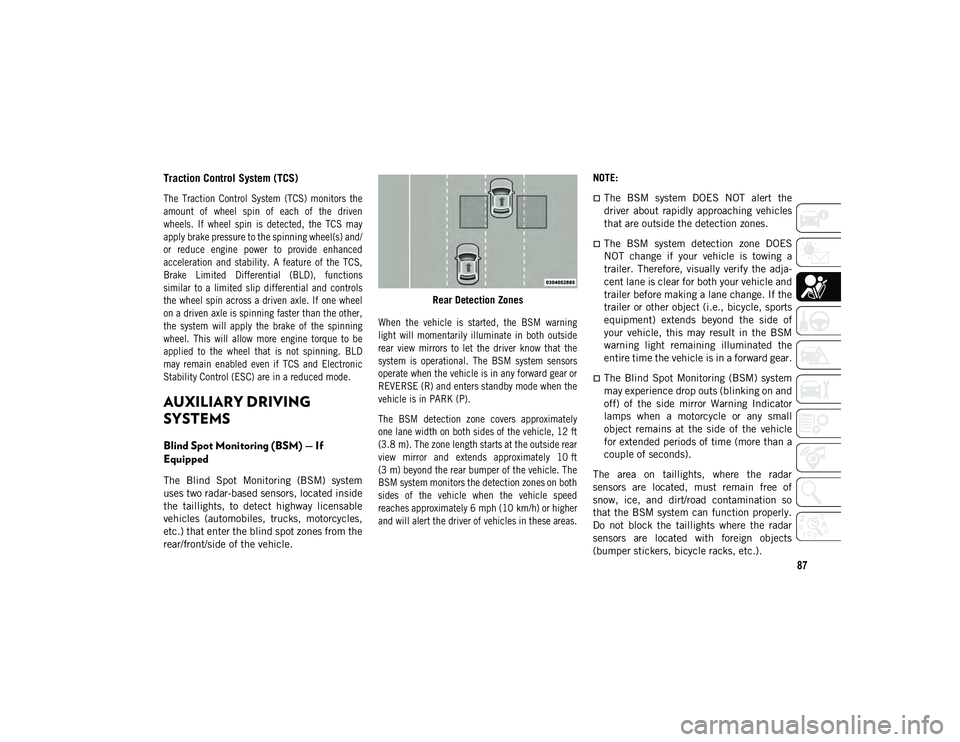
rear/front/side of the vehicle.Rear Detection Zones
When the vehicle is started, the BSM warning
light will momentarily illuminate in both outside
rear view mirrors to let the driver know that the
system is operational. The BSM system sensors
operate when the vehicle is in any forward gear or
REVERSE (R) and enters standby mode when the
vehicle is in PARK (P).
The BSM detection zone covers approximately
one lane width on both sides of the vehicle, 12 ft
(3.8 m). The zone length starts at the outside rear
view mirror and extends approximately 10 ft
(3 m) beyond the rear bumper of the vehicle. The
BSM system monitors the detection zones on both
sides of the vehicle when the vehicle speed
reaches approximately 6 mph (10 km/h) or higher and will alert the driver of vehicles in these areas.
NOTE:
The BSM system DOES NOT alert the
driver about rapidly approaching vehicles
that are outside the detection zones.
The BSM system detection zone DOES
NOT change if your vehicle is towing a
trailer. Therefore, visually verify the adja-
cent lane is clear for both your vehicle and
trailer before making a lane change. If the
trailer or other object (i.e., bicycle, sports
equipment) extends beyond the side of
your vehicle, this may result in the BSM
warning light remaining illuminated the
entire time the vehicle is in a forward gear.
The Blind Spot Monitoring (BSM) system
may experience drop outs (blinking on and
off) of the side mirror Warning Indicator
lamps when a motorcycle or any small
object remains at the side of the vehicle
for extended periods of time (more than a
couple of seconds).
The area on taillights, where the radar
sensors are located, must remain free of
snow, ice, and dirt/road contamination so
that the BSM system can function properly.
Do not block the taillights where the radar
sensors are located with foreign objects
(bumper stickers, bicycle racks, etc.).
2020_JEEP_JL_WRANGLER_UG_RHD_UK.book Page 87
Page 91 of 330
89
Modes Of Operation
Three selectable modes of operation are
available in the Uconnect System. Refer to
“Uconnect Settings” in “Multimedia” in the
Owner’s Manual for further information.
Blind Spot Alert Lights Only
When operating in Blind Spot Alert mode,
the BSM system will provide a visual alert in
the appropriate side view mirror based on a
detected object. However, when the system
is operating in Rear Cross Path (RCP) mode,
the system will respond with both visual andaudible alerts when a detected object is
present. Whenever an audible alert is
requested, the radio is muted.
Blind Spot Alert Lights/Chime
When operating in Blind Spot Alert Lights/
Chime mode, the BSM system will provide a
visual alert in the appropriate side view
mirror based on a detected object. If the turn
signal is then activated, and it corresponds
to an alert present on that side of the vehicle,
an audible chime will also be sounded.
Whenever a turn signal and detected object
are present on the same side at the same
time, both the visual and audible alerts will
be issued. In addition to the audible alert the
radio (if on) will also be muted.
NOTE:
Whenever an audible alert is requested by
the BSM system, the radio is also muted.
When the system is in RCP, the system shall
respond with both visual and audible alerts
when a detected object is present. Whenever
an audible alert is requested, the radio is
also muted. Turn/hazard signal status is
ignored; the RCP state always requests the
chime.Blind Spot Alert Off
When the BSM system is turned off there will
be no visual or audible alerts from either the
BSM or RCP systems.
NOTE:
The BSM system will store the current oper
-
ating mode when the vehicle is shut off.
Each time the vehicle is started the previ -
ously stored mode will be recalled and used.
Forward Collision Warning (FCW) With
Mitigation — If Equipped
The Forward Collision Warning (FCW) system
provides the driver with audible, visual warn -
ings (within the instrument cluster display),
and may apply a haptic warning in the form
of a brake jerk, to warn the driver when it
detects a potential frontal collision. The
warnings are intended to provide the driver
with enough time to react, avoid or mitigate
the potential collision.
NOTE:
FCW monitors the information from the
forward looking sensors as well as Electronic
Brake Controller (EBC), to calculate the
probability of a forward collision. When the
WARNING!
Rear Cross Path Detection (RCP) is not a
back up aid system. It is intended to be
used to help a driver detect an oncoming
vehicle in a parking lot situation. Drivers
must be careful when backing up, even
when using RCP. Always check carefully
behind your vehicle, look behind you, and
be sure to check for pedestrians, animals,
other vehicles, obstructions, and blind
spots before backing up. Failure to do so
can result in serious injury or death.
2020_JEEP_JL_WRANGLER_UG_RHD_UK.book Page 89
Page 92 of 330
SAFETY
90
system determines that a forward collision is
probable, the driver will be provided with
audible and visual warnings as well as a
possible haptic warning in the form of a
brake jerk.
If the driver does not take action based upon
these progressive warnings, then the system
will provide a limited level of active braking
to help slow the vehicle and mitigate the
potential forward collision. If the driver
reacts to the warnings by braking and the
system determines that the driver intends to
avoid the collision by braking but has not
applied sufficient brake force, the system
will compensate and provide additional
brake force as required.
If a FCW with Mitigation event begins at a
speed below 32 mph (52 km/h), the system
may provide the maximum braking possible
to mitigate the potential forward collision. If
the Forward Collision Warning with Mitiga-
tion event stops the vehicle completely, the
system will hold the vehicle at standstill for
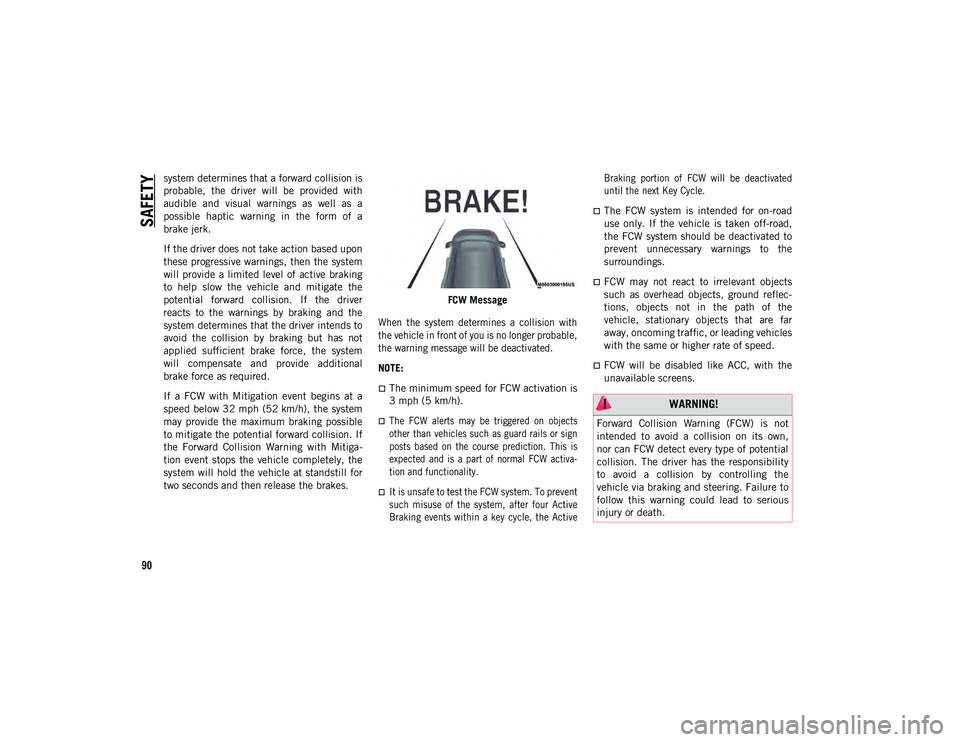
two seconds and then release the brakes. FCW Message
When the system determines a collision with
the vehicle in front of you is no longer probable,
the warning message will be deactivated.
NOTE:
The minimum speed for FCW activation is
3 mph (5 km/h).
The FCW alerts may be triggered on objects
other than vehicles such as guard rails or sign
posts based on the course prediction. This is
expected and is a part of normal FCW activa-
tion and functionality.
It is unsafe to test the FCW system. To prevent
such misuse of the system, after four Active
Braking events within a key cycle, the Active Braking portion of FCW will be deactivated
until the next Key Cycle.
The FCW system is intended for on-road
use only. If the vehicle is taken off-road,
the FCW system should be deactivated to
prevent unnecessary warnings to the
surroundings.
FCW may not react to irrelevant objects
such as overhead objects, ground reflec-
tions, objects not in the path of the
vehicle, stationary objects that are far
away, oncoming traffic, or leading vehicles
with the same or higher rate of speed.
FCW will be disabled like ACC, with the
unavailable screens.
WARNING!
Forward Collision Warning (FCW) is not
intended to avoid a collision on its own,
nor can FCW detect every type of potential
collision. The driver has the responsibility
to avoid a collision by controlling the
vehicle via braking and steering. Failure to
follow this warning could lead to serious
injury or death.
2020_JEEP_JL_WRANGLER_UG_RHD_UK.book Page 90
Page 93 of 330
91
Turning FCW On or Off
The default status of FCW is “on”, this allows
the system to warn you of a possible collision
with the vehicle in front of you.
The FCW button is located in the Uconnect
display in the control settings. Refer to
“Uconnect Settings” in “Multimedia” in the
Owner's Manual for further information.
To turn the FCW system on, press the
forward collision button once.
To turn the FCW system off, press the
forward collision button once.
NOTE:
When the FCW is “on”, this allows the
system to warn the driver of a possible
collision with the vehicle in front.
When the FCW is “off”, this prevents the
system from warning the driver of a possible
collision with the vehicle in front. If the FCW
is set to “off”, “FCW OFF” will be displayed
in the instrument cluster display.
When FCW status is set to “Only
Warning”, this prevents the system from
providing limited active braking, or addi -tional brake support if the driver is not
braking adequately in the event of a poten
-
tial frontal collision.
When FCW status is set to “Warning and
Braking”, this allows the system to warn
the driver of a possible collision with the
vehicle in front using audible/visual warn -
ings and it applies autonomous braking.
The system will retain the last setting selected
by the driver after ignition shutdown.
FCW Braking Status And Sensitivity
The FCW Sensitivity and Active Braking status are
programmable through the Uconnect System.
Refer to “Uconnect Settings” in “Multimedia” in
the Owner’s Manual for further information.
Far
When the sensitivity of FCW is set to the “Far” setting and the system
status is “Only Warning”, this allows
the system to warn the driver of apossible more distant collisions with
the vehicle in front using audible/ visual warnings.
More cautious drivers that do not mindfrequent warnings may prefer this setting.
Medium
When the sensitivity of FCW is set to the “Medium” setting and the system
status is “Only Warning”, this allows
the system to warn the driver of apossible collision with the v ehicle in
front using audible/visual warnings.
Near
When the sensitivity of FCW is set to the “Near” setting and the system
status is “Only Warning”, this allows
the system to warn the driver of apossible closer collision with the
vehicle in front using audible/visual
warnings.
This setting provides less reaction time than the “Far” and “Medium”
settings, which allows for a moredynamic driving experience.
More dynamic or aggressive drivers that want to avoid frequent warnings may prefer this setting.
2020_JEEP_JL_WRANGLER_UG_RHD_UK.book Page 91
Page 117 of 330
115
As the air bags deflate, you may see some
smoke-like particles. The particles are a
normal by-product of the process that
generates the non-toxic gas used for air
bag inflation. These airborne particles may
irritate the skin, eyes, nose, or throat. If
you have skin or eye irritation, rinse the
area with cool water. For nose or throat irri-
tation, move to fresh air. If the irritation
continues, see your doctor. If these parti -
cles settle on your clothing, follow the
garment manufacturer’s instructions for
cleaning.
Do not drive your vehicle after the air bags
have deployed. If you are involved in another
collision, the air bags will not be in place to
protect you. NOTE:
Air bag covers may not be obvious in the
interior trim, but they will open during air
bag deployment.
After any collision, the vehicle should be
taken to an authorized dealer immediately.
Enhanced Accident Response System
In the event of an impact, if the communica
-
tion network remains intact, and the power
remains intact, depending on the nature of
the event, the Occupant Restraint Controller
(ORC) will determine whether to have the
Enhanced Accident Response System
perform the following functions:
Cut off fuel to the engine (If Equipped)
Cut off battery power to the electric motor
(If Equipped)
Flash hazard lights as long as the battery
has power
Turn on the interior lights, which remain
on as long as the battery has power or for
15 minutes from the intervention of the
Enhanced Accident Response System.
Unlock the power door locks. Your vehicle may also be designed to perform
any of these other functions in response to
the Enhanced Accident Response System:
Turn off the Fuel Filter Heater, Turn off
the HVAC Blower Motor, Close the HVAC
Circulation Door
Cut off battery power to the:
Engine
Electric Motor (if equipped)
Electric power steering
Brake booster
Electric park brake
Automatic transmission gear selector
Horn
Front wiper
Headlamp washer pump
WARNING!
Deployed air bags and seat belt
pretensioners cannot protect you in
another collision. Have the air bags, seat
belt pretensioners, and the seat belt
retractor assemblies replaced by an
authorized dealer immediately. Also, have
the Occupant Restraint Controller System
serviced as well.
2020_JEEP_JL_WRANGLER_UG_RHD_UK.book Page 115