fuel KIA CARNIVAL 2007 User Guide
[x] Cancel search | Manufacturer: KIA, Model Year: 2007, Model line: CARNIVAL, Model: KIA CARNIVAL 2007Pages: 1575, PDF Size: 44.86 MB
Page 192 of 1575
2007 > 2.7L V6 GASOLINE >
DESCRIPTION
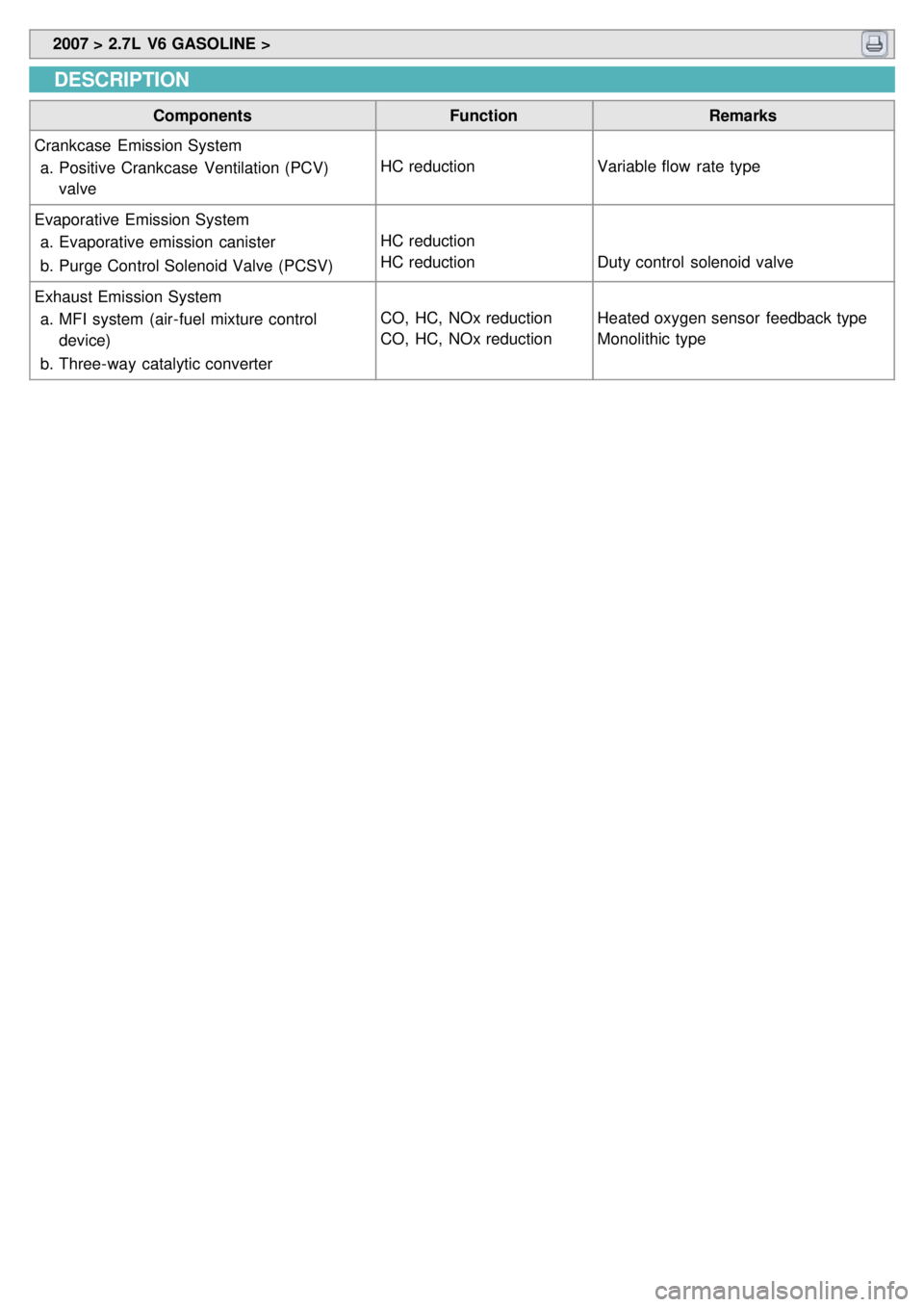
Components FunctionRemarks
Crankcase Emission System a. Positive Crankcase Ventilation (PCV)
valve HC reduction
Variable flow rate type
Evaporative Emission System a. Evaporative emission canister
b. Purge Control Solenoid Valve (PCSV) HC reduction
HC reduction
Duty control solenoid valve
Exhaust Emission System a. MFI system (air- fuel mixture control
device)
b. Three- way catalytic converter CO, HC, NOx reduction
CO, HC, NOx reduction
Heated oxygen sensor feedback type
Monolithic type
Page 208 of 1575
INSTALLATION
Install the canister according to the reverse order of "REMOVAL" procedure.
INSPECTION
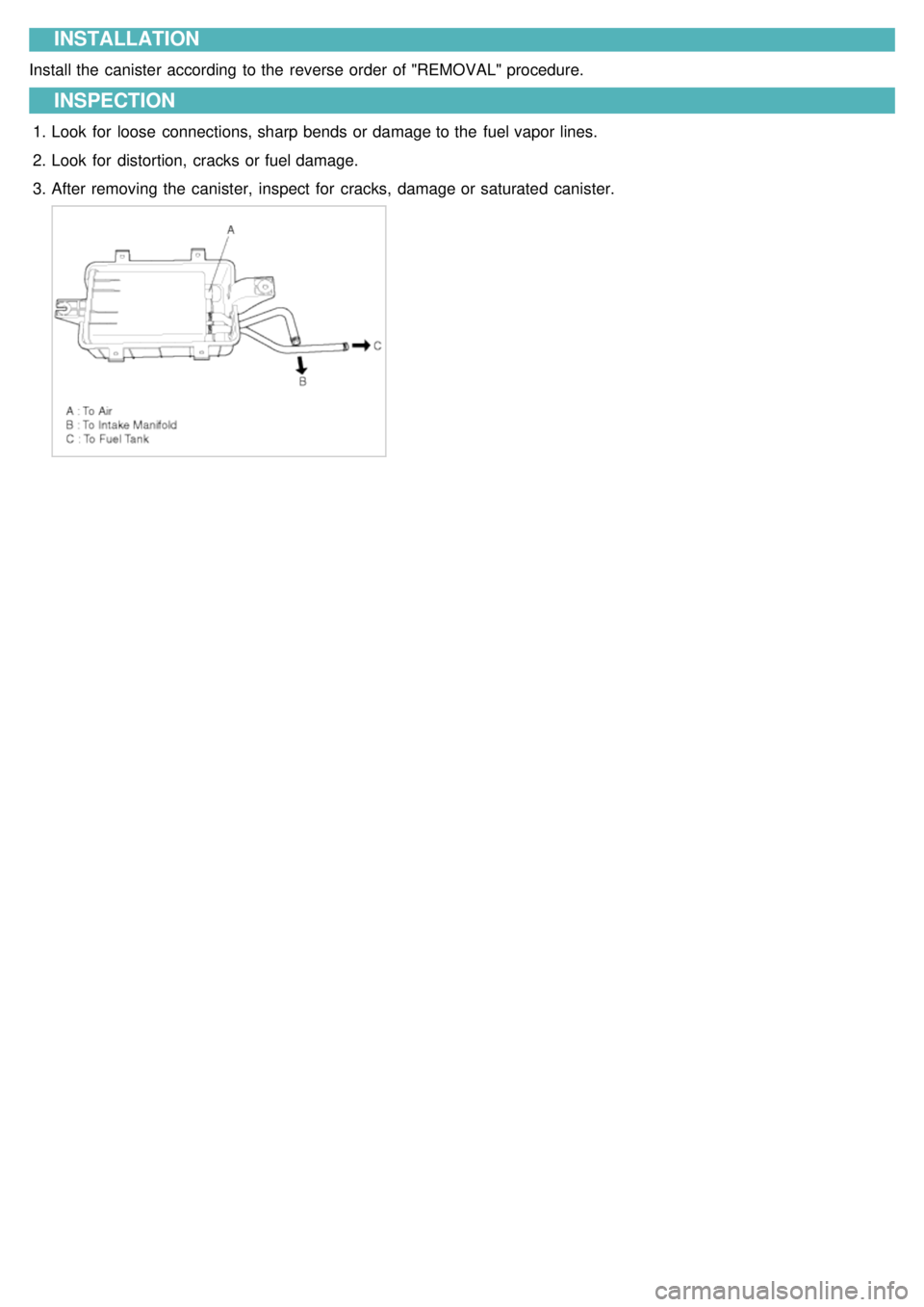
1.Look for loose connections, sharp bends or damage to the fuel vapor lines.
2. Look for distortion, cracks or fuel damage.
3. After removing the canister, inspect for cracks, damage or saturated canister.
Page 210 of 1575

2007 > 2.7L V6 GASOLINE >
INSPECTION
When disconnecting the vacuum hose, make an identification mark on it so that it can be reconnected to its
original position.
1. Disconnect the vacuum hose from the solenoid valve.
2. Detach the harness connector.
3. Connect a vacuum pump to the nipple which is connected to intake manifold.
4. Apply vacuum and check when voltage is applied to the PCSV and when the voltage is discontinued.
Battery voltage Normal condition
When applied Vacuum is released
When discontinued Vacuum is maintained
5. Measure the resistance between the terminals of the solenoid valve.
PCSV coil resistance(Ω) :
14.0 ~ 18.0Ω at 20°C (68°F)
INSPECTION
FUNCTION AND OPERATION PRICIPLE
Purge Control Solenoid Valve (PCSV) is installed on the surge tank and controls the passage between the canister
and the intake manifold. It is a solenoid valve and is open when the PCM grounds the valve control line. When the
passage is open (PCSV ON), fuel vapors stored in the canister is transferred to the intake manifold.
SPECIFICATION
Item Specification
Coil Resistance (Ω) 14.0 ~ 18.0Ω at 20°C (68°F)
CIRCUIT DIAGRAM
Page 212 of 1575
Fuel Filler cap
Page 215 of 1575
2007 > 2.7L V6 GASOLINE >
DESCRIPTION
Modifications to the combustion chamber, intake manifold, camshaft and ignition system form the basic control system.
These items have been integrated into a highly effective system which controls exhaust emissions while maintaining
good driveability and fuel economy.
AIR/FUEL MIXTURE CONTROL SYSTEM [MULTIPORT FUEL INJECTION (MFI) SYSTEM]
This in turn allows the engine to produce exhaust gases of the proper composition to permit the use of a three way
catalyst. The three way catalyst is designed to convert the three pollutants (1) hydrocarbons (HC), (2) carbon
monoxide (CO), and (3) oxides of nitrogen (NOx) into harmless substances. There are two operating modes in the MFI
system.
1. Open Loop air/fuel ratio is controlled by information programmed into the ECM.
2. Closed Loop air/fuel ratio is adjusted by the ECM based on information supplied by the oxygen sensor.
Page 217 of 1575
2007 > 2.7L V6 GASOLINE >
DESCRIPTION
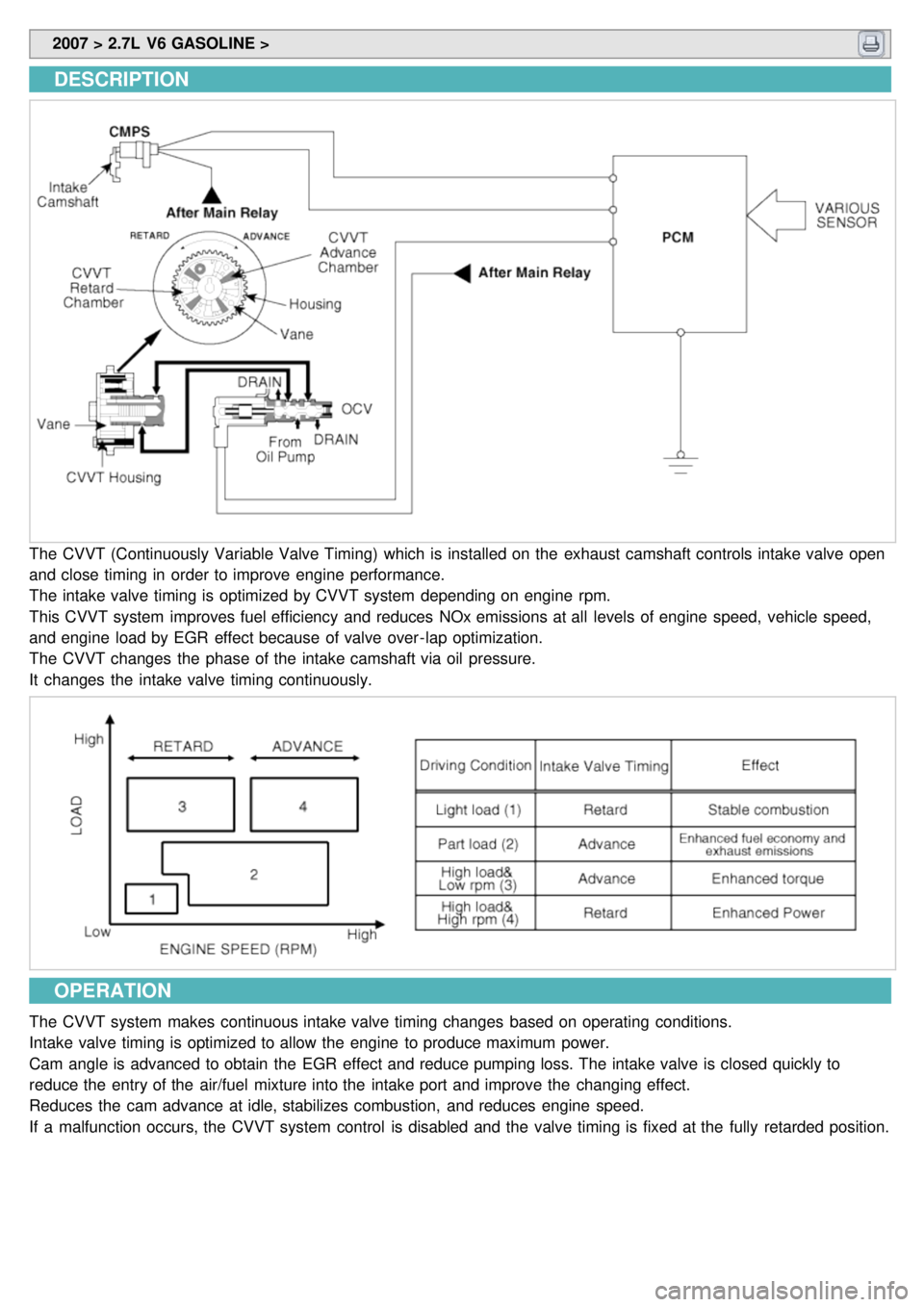
The CVVT (Continuously Variable Valve Timing) which is installed on the exhaust camshaft controls intake valve open
and close timing in order to improve engine performance.
The intake valve timing is optimized by CVVT system depending on engine rpm.
This CVVT system improves fuel efficiency and reduces NOx emissions at all levels of engine speed, vehicle speed,
and engine load by EGR effect because of valve over - lap optimization.
The CVVT changes the phase of the intake camshaft via oil pressure.
It changes the intake valve timing continuously.
OPERATION
The CVVT system makes continuous intake valve timing changes based on operating conditions.
Intake valve timing is optimized to allow the engine to produce maximum power.
Cam angle is advanced to obtain the EGR effect and reduce pumping loss. The intake valve is closed quickly to
reduce the entry of the air/fuel mixture into the intake port and improve the changing effect.
Reduces the cam advance at idle, stabilizes combustion, and reduces engine speed.
If a malfunction occurs, the CVVT system control is disabled and the valve timing is fixed at the fully retarded position.
Page 219 of 1575
CHAPTER 5:
Fuel System
Page 221 of 1575
2007 > 2.7L V6 GASOLINE >
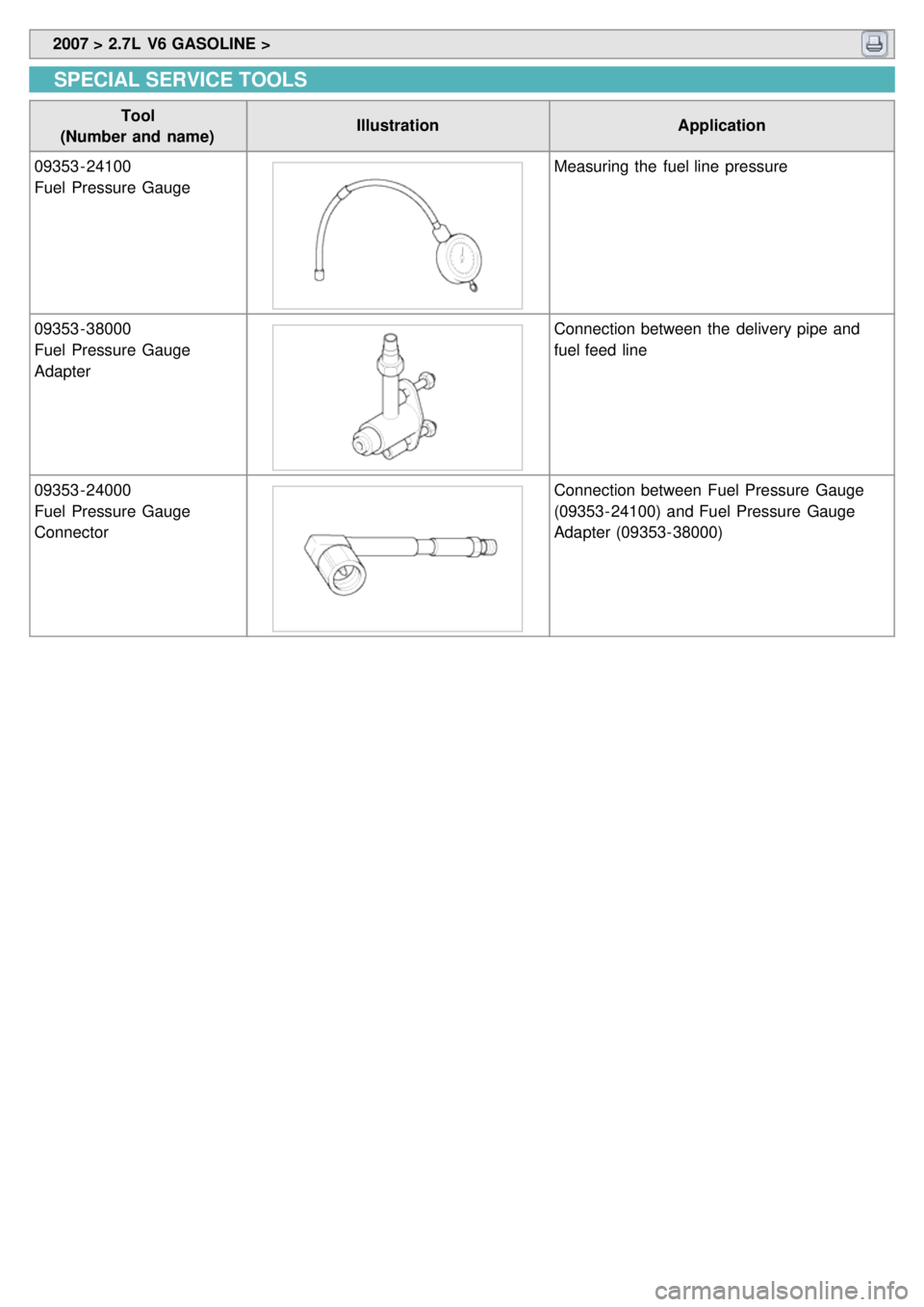
SPECIAL SERVICE TOOLS
Tool
(Number and name) Illustration
Application
09353 - 24100
Fuel Pressure Gauge
Measuring the fuel line pressure
09353 - 38000
Fuel Pressure Gauge
Adapter
Connection between the delivery pipe and
fuel feed line
09353 - 24000
Fuel Pressure Gauge
Connector
Connection between Fuel Pressure Gauge
(09353- 24100) and Fuel Pressure Gauge
Adapter (09353- 38000)
Page 230 of 1575
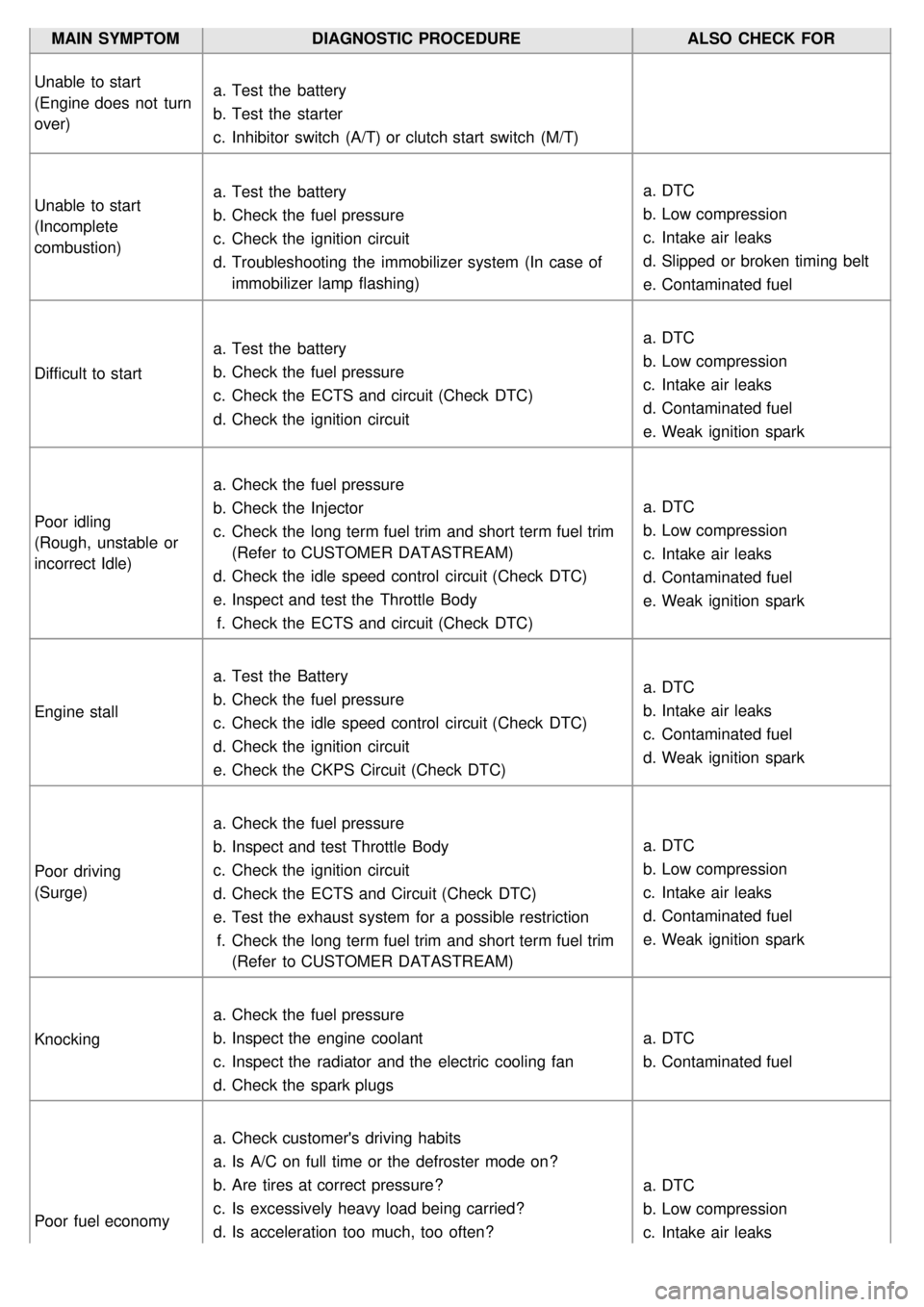
MAIN SYMPTOMDIAGNOSTIC PROCEDURE ALSO CHECK FOR
Unable to start
(Engine does not turn
over) a.
Test the battery
b. Test the starter
c. Inhibitor switch (A/T) or clutch start switch (M/T)
Unable to start
(Incomplete
combustion) a.
Test the battery
b. Check the fuel pressure
c. Check the ignition circuit
d. Troubleshooting the immobilizer system (In case of
immobilizer lamp flashing) a.
DTC
b. Low compression
c. Intake air leaks
d. Slipped or broken timing belt
e. Contaminated fuel
Difficult to start a.
Test the battery
b. Check the fuel pressure
c. Check the ECTS and circuit (Check DTC)
d. Check the ignition circuit a.
DTC
b. Low compression
c. Intake air leaks
d. Contaminated fuel
e. Weak ignition spark
Poor idling
(Rough, unstable or
incorrect Idle) a.
Check the fuel pressure
b. Check the Injector
c. Check the long term fuel trim and short term fuel trim
(Refer to CUSTOMER DATASTREAM)
d. Check the idle speed control circuit (Check DTC)
e. Inspect and test the Throttle Body
f. Check the ECTS and circuit (Check DTC) a.
DTC
b. Low compression
c. Intake air leaks
d. Contaminated fuel
e. Weak ignition spark
Engine stall a.
Test the Battery
b. Check the fuel pressure
c. Check the idle speed control circuit (Check DTC)
d. Check the ignition circuit
e. Check the CKPS Circuit (Check DTC) a.
DTC
b. Intake air leaks
c. Contaminated fuel
d. Weak ignition spark
Poor driving
(Surge) a.
Check the fuel pressure
b. Inspect and test Throttle Body
c. Check the ignition circuit
d. Check the ECTS and Circuit (Check DTC)
e. Test the exhaust system for a possible restriction
f. Check the long term fuel trim and short term fuel trim
(Refer to CUSTOMER DATASTREAM) a.
DTC
b. Low compression
c. Intake air leaks
d. Contaminated fuel
e. Weak ignition spark
Knocking a.
Check the fuel pressure
b. Inspect the engine coolant
c. Inspect the radiator and the electric cooling fan
d. Check the spark plugs a.
DTC
b. Contaminated fuel
Poor fuel economy a.
Check customer's driving habits
a. Is A/C on full time or the defroster mode on?
b. Are tires at correct pressure?
c. Is excessively heavy load being carried?
d. Is acceleration too much, too often? a.
DTC
b. Low compression
c. Intake air leaks
Page 231 of 1575
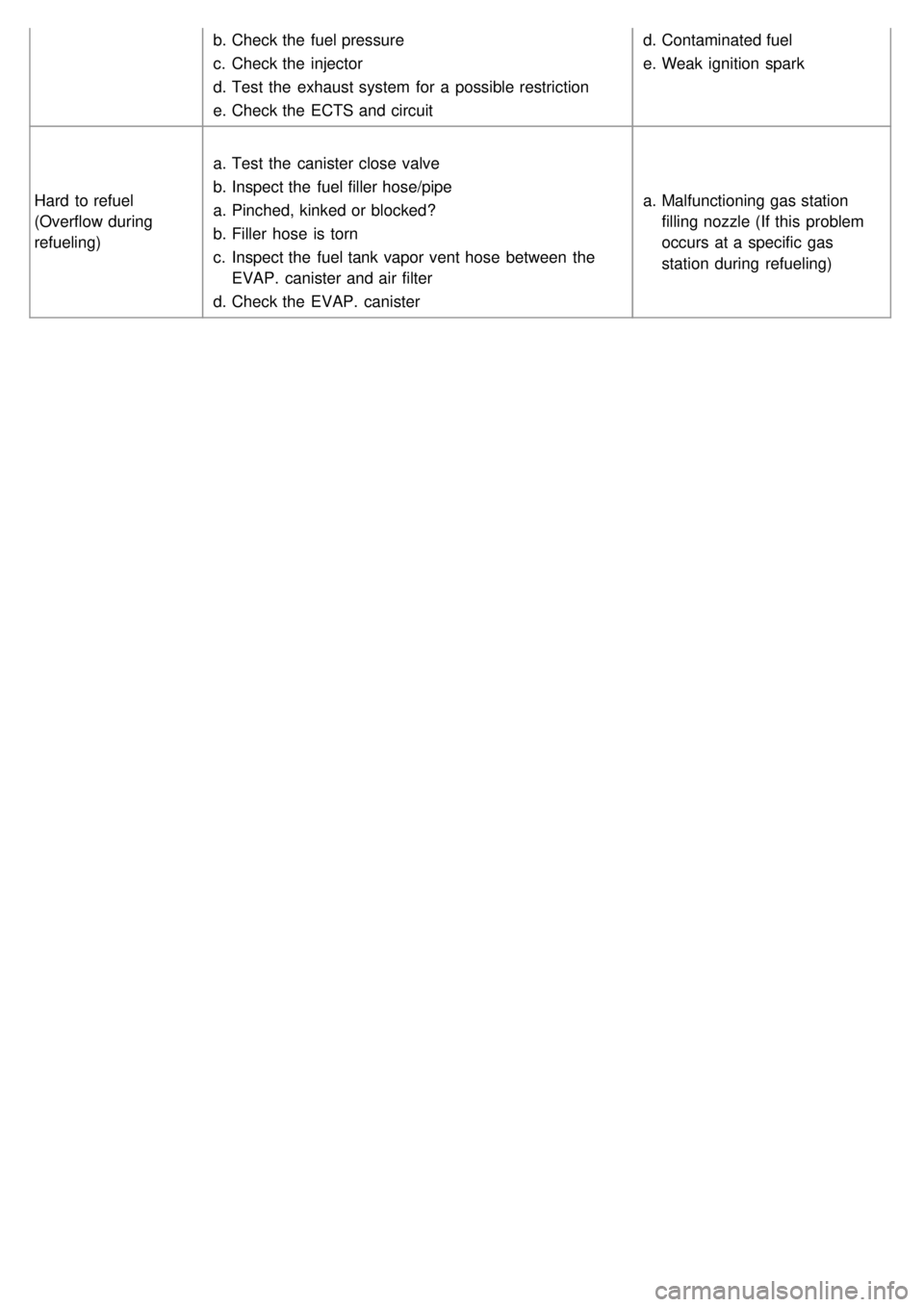
b.Check the fuel pressure
c. Check the injector
d. Test the exhaust system for a possible restriction
e. Check the ECTS and circuit d.
Contaminated fuel
e. Weak ignition spark
Hard to refuel
(Overflow during
refueling) a.
Test the canister close valve
b. Inspect the fuel filler hose/pipe
a. Pinched, kinked or blocked?
b. Filler hose is torn
c. Inspect the fuel tank vapor vent hose between the
EVAP. canister and air filter
d. Check the EVAP. canister a.
Malfunctioning gas station
filling nozzle (If this problem
occurs at a specific gas
station during refueling)