key battery KIA CARNIVAL 2007 Owner's Manual
[x] Cancel search | Manufacturer: KIA, Model Year: 2007, Model line: CARNIVAL, Model: KIA CARNIVAL 2007Pages: 1575, PDF Size: 44.86 MB
Page 1332 of 1575

BCM or sliding door control module
critical fault codesCheck for diagnostic trouble codes
Failure of latch assembly Check wire connections and for blown fuse
Check for foreign matter preventing the
operation of latch assembly
Failure of motor assembly Test motor assembly
Binding or sticking of components Establish location of binding and replace
necessary components
Wiring problems (system or vehicle) Troubleshoot using electrical schematics
Refer to wiring diagrams
Power loss during Sliding
Door operation Wiring problems (system or vehicle)
Troubleshoot using electrical schematics
Refer to wiring diagrams
Battery voltage at PSDM is too low
<9.5V to start operation and
<8.0V to continue operation Check for proper voltage at the PSDM.
Charge battery
Failure of Power Sliding Door or Body
Control Module Check for diagnostic trouble codes
Failure of motor assembly Test motor assembly
Sliding Door does not close
to primary latch position Door mis - alignment Check latch and striker alignment
Check rollers and track alignment
Binding or sticking of components Establish location of binding and adjust or
replace necessary components
Failure of Power Sliding Door or Body
Control Module Check for diagnostic trouble codes
Sliding Door seal force too high Inspect seals for damage, mis - assembly,
foreign matter or other possible obstruction
Failure of motor assembly Test motor assembly
Latch will not release from
primary position Not in Park or false indication
Check switch status with SCAN tool
Battery voltage at PSDM is too low Check for proper voltage at the PSDM
Charge battery
Blown fuse Check fuse and replace if required
Failure of latch assembly Check switch status with scan tool
Check for foreign matter or damaged
components preventing the operation of latch
assembly
Troubleshoot using body diagnostic manual.
Replace latch assembly, if necessary
Failure of outside or inside handle
connection Check handle connections on brainplate.
Failure of Power Sliding Door or Body
Control Module Check for diagnostic trouble codes.
Binding or sticking of components Establish location of binding and adjust or
replace necessary components
Key fob or overhead
console switch does not
power operate sliding door Blown Fuse
Check fuse and replace
Battery voltage at PSDM is too low Check for proper voltage at the PSDM.
Charge battery
Refer to wiring diagrams
Page 1333 of 1575

Wiring problems (system or vehicle)Refer to wiring diagrams
Check for diagnostic trouble codes.
Does Not Power Unlatch
Failure of latch assembly Check for foreign matter preventing the
operation of latch assembly
Check for diagnostic trouble codes.
Check Detent switch.
Troubleshoot using body diagnostic manual
Failure of Latch Release Actuator Check actuator and replace if necessary
Wiring problems (system or vehicle) Refer to wiring diagrams
Check for diagnostic trouble codes.
Failure of Body Control Module (BCM) Troubleshoot using body diagnostic manual
Replace BCM if necessary
Failure of key fob Reprogram key fob
Replace key fob if necessary
Failure of Power Sliding Door Module Check for diagnostic trouble codes.
See Body Diagnostic Manual for detailed
procedures
Failure of sliding door motor assembly Check for foreign matter preventing the
operation of motor assembly
Check wire connections
Drive Unit clutch does not engage.
Replace Drive Unit.
Troubleshoot using Body Diagnostic Manual
Replace motor if necessary
Sliding Door does not stay
open Hold Open Latch not working Check if sliding door powers open to hold
open latch
Check if H- O - L is working
High inside/outside opening
effort Bound cables Check for smooth manual operation
Check for broken attachments
Drive unit jammed or did not disengage Troubleshoot using Body Diagnostic Manual
Replace components, if necessary
Binding or sticking of components Establish location of binding and replace
necessary components
Sliding Door continues to
power close Failure of latch assembly Check wire connections and Detent switch
Check for foreign matter
Troubleshoot using Body Diagnostic Manual
Control Module Check for diagnostic trouble codes
Wiring problems (system or vehicle) Troubleshoot using electrical schematics
Refer to wiring diagrams
Sliding Door continues to
power open Failure of PSDM Check for diagnostic trouble codes
See Body Diagnostic Manual for detailed
procedures
Wiring problems (system or vehicle) Troubleshoot using electrical schematics
Refer to Wiring Diagrams
Sliding Door opens very
slowly Battery voltage at PSDM is too low
Check for proper voltage at the PSDM
Charge battery
Page 1373 of 1575

No power latching in
primary and/or secondary
positionsReplace latch assembly, if necessary
Binding or sticking of components Establish location of binding and replace
necessary components
Failure of Power Tailgate or Body
Control Module Check for diagnostic trouble codes with scan
tool
Tail Gate seal force too high Inspect seals for damage, mis - assembly,
foreign matter or other possible obstruction
Failure of motor assembly Test motor assembly
Latch will not release from
primary position Not in Park or false indication
Check switch status with SCAN tool
Battery voltage at PTGM is too low Check for proper voltage at the PTGM
Charge battery
Blown fuse Check fuse and replace if required
Failure of latch assembly Check switch status with scan tool
Check for foreign matter or damaged
components preventing the operation of latch
assembly
Troubleshoot using body diagnostic manual.
Replace latch assembly, if necessary
Failure of outside handle connection Check handle of brainplate.
Failure of Power Tailgate or Body
Control Module Check for diagnostic trouble codes and cycle
with scan tool
Binding or sticking of components Establish location of binding and replace
necessary components
Key fob or overhead
console switch does not
power operate tailgate Blown Fuse
Check fuse and replace
Battery voltage at PTGM is too low Check for proper voltage at the PTGM
Charge battery
Does Not Power Unlatch Failure of latch assembly Check for foreign matter preventing the
operation of latch assembly
Check for diagnostic trouble codes and cycle
with scan tool
Check pawl and/or ratchet switch with SCAN
tool
Troubleshoot using body diagnostic manual
Does Not Power Unlatch Failure of Power Tailgate Module
Troubleshoot using body diagnostic manual
Failure of Body Control Module (BCM) Troubleshoot using body diagnostic manual
Replace BCM if necessary
Failure of RAM Replace RAM if necessary
Failure of key fob Reprogram key fob
Replace key fob if necessary
Failure of Power Tailgate Module Check for diagnostic trouble codes with scan
tool, see
Body Diagnostic Manual for detailed
procedures
Check for foreign matter preventing the
operation of motor assembly
Check wire connections
Page 1387 of 1575

2007 > 2.7L V6 GASOLINE >
INPECTION
1.Check the power tail gate control module input/output value by using the diagnostic tool. If the operation of tailgate
control module is abnormal, replace power latch.
2. To check the power latch operation, select a vehicle type and "POWER SLIDING/TAILGATE" menu.
3.Select "POWER TAILGATE".
4.Select the sensor output. And then check the cinch feedback and unlatch feedback output while operating power
tailgate in power mode.
※ Above voltage and numerical value may be different from the real value.
5. Change the anti pinch strip sensor, if there is no change during operation.
REPLACEMENT
1.Disconnect the negative ( - ) battery terminal.
2. Remove the tail gate trim (Refer to the Body group - tail gate).
3. Remove the tail gate handle rod, actuator rod and key rod.
4. Remove the unlatch actuator assembly (A) after removing the connector and nuts (3EA).
Page 1464 of 1575
2007 > 2.7L V6 GASOLINE >
REPLACEMENT
1.Disconnect the negative ( - ) battery terminal.
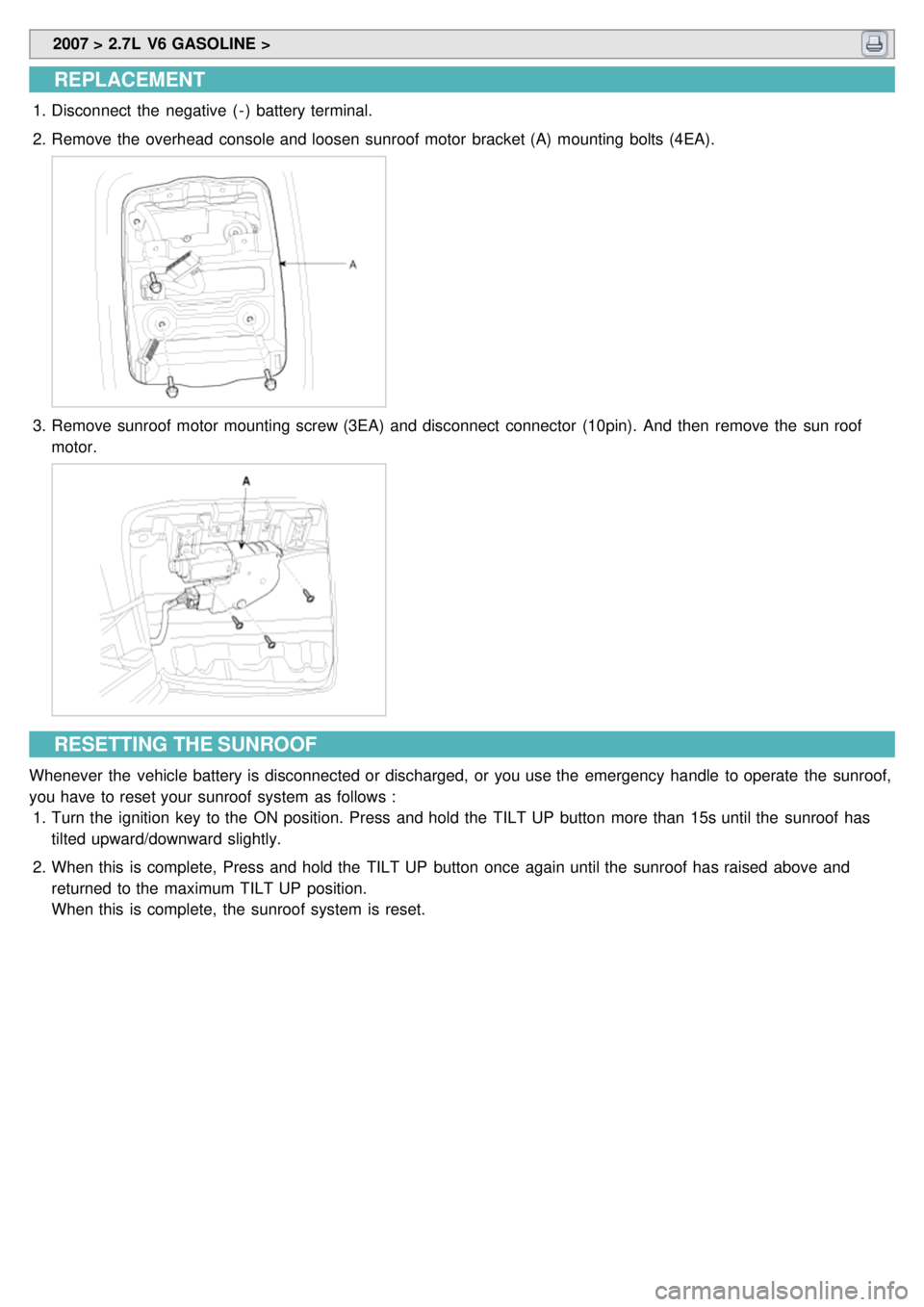
2. Remove the overhead console and loosen sunroof motor bracket (A) mounting bolts (4EA).
3.Remove sunroof motor mounting screw (3EA) and disconnect connector (10pin). And then remove the sun roof
motor.
RESETTING THE SUNROOF
Whenever the vehicle battery is disconnected or discharged, or you use the emergency handle to operate the sunroof,
you have to reset your sunroof system as follows :
1. Turn the ignition key to the ON position. Press and hold the TILT UP button more than 15s until the sunroof has
tilted upward/downward slightly.
2. When this is complete, Press and hold the TILT UP button once again until the sunroof has raised above and
returned to the maximum TILT UP position.
When this is complete, the sunroof system is reset.
Page 1508 of 1575
2007 > 2.7L V6 GASOLINE >
TEACHING PROCEDURES
1.Key Teaching Procedure
Key teaching must be done after replacing an inoperative PCM(ECM) or when providing additional keys to the
vehicle owner.
The procedure starts with an PCM(ECM) request for vehicle specific data (PIN code: 6digits) from the tester. The
"virgin" PCM(ECM) stores the vehicle specific data and the key teaching can be started. The "learnt" PCM(ECM)
compares the vehicle specific data from the tester with the stored data. If the data are correct, the teaching can
proceed.
If incorrect vehicle specific data have been sent to the PCM(ECM) three times, the PCM(ECM) will reject the
request of key teaching for one hour. This time cannot be reduced by disconnecting the battery or any other
manipulation. After reconnecting the battery, the timer starts again for one hour.
The key teaching is done by ignition on with the key and additional tester commands. The PCM(ECM) stores the
relevant data in the EEPROM and in the transponder. Then the PCM(ECM) runs the authentication required for
confirmation of the teaching process. The successful programming is then confirmed by a message to the tester.
If the key is already known to the PCM(ECM) from a previous teaching, the authentication will be accepted and the
EEPROM data are updated. There is no changed transponder content (this is impossible for a learnt transponder).
The attempt to repeatedly teach a key, which has been taught already during the same teaching cycle, is
recognized by the PCM(ECM). This rejects the key and a message is sent to the tester.
The PCM(ECM) rejects invalid keys, which are presented for teaching. A message is sent to the tester. The key
can be invalid due to faults in the transponder or other reasons, which result from unsuccessful programming of
data. If the PCM(ECM) detects different authenticators of a transponder and an PCM(ECM), the key is considered
to be invalid.
The maximum number of taught keys is 4
If an error occurs during the Immobilizer Service Menu, the PCM(ECM) status remains unchanged and a specific
fault code is stored.
If the PCM(ECM) status and the key status do not match for teaching of keys, the tester procedure will be stopped
and a specific fault code will be stored at PCM(ECM).
Page 1512 of 1575

2.User Password Teaching Procedure
The user password for limp home is taught at the service station. The owner of the vehicle can select a number
with four digits.
User password teaching is only accepted by a "learnt" PCM(ECM). Before first teaching of user password to an
PCM(ECM), the status of the password is "virgin" No limp home function is possible.
The teaching is started by ignition on, with a valid key and sending the user password by tester. After successful
teaching, the status of the user password changes from "virgin" to "learnt"
The learnt user password can also be changed. This can be done if the user password status is "learnt" and the
tester sends authorization of access, either the old user password or the vehicle specific data. After correct
authorization, the PCM(ECM) requests the new user password. The status remains "learnt" and the new user
password will be valid for the next limp home mode.
If incorrect user passwords or wrong vehicle specific data have been sent to the PCM(ECM) three times, the
PCM(ECM) will reject the request to change the password for one hour. This time cannot be reduced by
disconnecting the battery or any other actions. After reconnecting the battery, the timer starts again for one hour.
(1) User password teaching
Page 1547 of 1575

2007 > 2.7L V6 GASOLINE >
REPLACEMENT
1.Disconnect the negative ( - ) battery terminal.
2. Remove the crash pad lower panel (Refer to the Body group - crash pad).
3.Remove the screws (2EA) and trip switch connector. Then remove the crash facia panel (B).
4.Remove the ignition switch (A) after loosening the screw with IG ON and disconnecting the 6P connector.
5.Remove the door warning switch and key illumination lamp (A) after loosening the screws (B) and disconnecting
the 6P connector.
Page 1552 of 1575
direction.
OUTSIDE MIRROR MEMORY OPERATION BY THE MEMORY SWITCH
1.If position switch (POS1 or POS2) is pressed within 5 seconds after pressing the memory switch under ignition 2
on, it registers current mirror position. (Switch module sends in LIN communication). (Memory permit status lasts for
5 seconds after memory switch ON. After 5 seconds, memory permits status terminates. In other words, current
position is registered if the position switch (POS1 or POS2) is turned on, during the memory permit status).
However, RH side mirror position is not registered during the LH side mirror manual switch operation.
2. Memory permit status is released if any of the following conditions is met
a. If 5 seconds is elapsed after the memory switch is turned on
b. If the ignition 2 is turned off
c. When saving is completed
d. If Ignition switch of the CAN communication data sent by the IPM is not "Run" or "Start".
e. If Inhibit switch of the CAN communication data sent by the FAM is not "P".
f. If vehicle speed of the CAN communication data sent by the cluster is "3Km/h" or more.
3. Memory is cleared if the battery is removed.
OUTSIDE MIRROR MEMORY AND REPLAY OPERATION BY KEYLESS
1.Memory operation
a. Outside mirror LH position is registered in the driver side power window switch when the ignition is turned off
from on.
b. When door is locked by the keyless, outside mirror position is registered corresponding to the keyless code.
c. Data related to the memory operation is received from BCM in CAN communication.
2. Replay operation
a. When door is unlocked by the keyless under ignition off state, it replays the position corresponding to the
keyless code.
b. Data related to the replay operation is received from BCM in CAN communication on CAN line.
3. Replay prohibit condition
a. If the mirror switch on the LH side is pressed
b. If Ignition switch of the CAN communication data sent by the IPM is not "Run" or "Start".
c. If Inhibit switch of the CAN communication data sent by the FAM is not "P".
d. If vehicle speed of the CAN communication data sent by the CLUSTER is "3Km/h" or more.
OUTSIDE MIRROR MEMORY AND REPLAY OPERATION BY KEYLESS
1.Memory operation
a. Outside mirror LH position is registered in the driver side power window switch when the ignition is turned off
from on.
b. When door is locked by the keyless, outside mirror position is registered corresponding to the keyless code.
c. Data related to the memory operation is received from BCM in CAN communication.
2. Replay operation
a. When door is unlocked by the keyless under ignition off state, it replays the position corresponding to the
keyless code.
b. Data related to the replay operation is received from BCM in CAN communication on CAN line.
3. Replay prohibit condition
a. When the inhibit "P" switch is OFF.
b. When RH side mirror switch is pressed.
c. When mirror switch is pressed after ignition on.
d. When the vehicle speed is over 3km/h
AUTO REVERSE FUNCTION
No. Operation Select
SW Shift
Lever MIR Position
Manipulation Result
Page 1558 of 1575

OUT SIDE MIRROR CONTROL BY THE SWITCH
1.Manual control of left outside mirror
If the mirror direction switch (up, down, left and right) is pressed when mirror selection switch on driver side power
window switch is in outside LH under ACC ON condition, then mirror motor moves to the corresponding direction.
2. Manual control of right outside mirror
If the mirror direction switch (up, down, left and right) is pressed when mirror selection switch on driver side power
window switch is in outside RH under ACC ON condition, then operating signal is sent to passenger side power
window switch through CAN communication.
OUTSIDE MIRROR MEMORY OPERATION BY THE MEMORY SWITCH
1.IMS Message from DDM is sent to RETURN1 or RETURN2, out side mirror returns to the position stored.
2. Memory permit status is released if any of the following conditions is met
a. If 5 seconds is elapsed after the memory switch is turned on
b. If the ignition 2 is turned off
c. When saving is completed
d. If Ignition switch of the CAN communication data sent by the IPM is not "Run" or "Start".
e. If Inhibit switch of the CAN communication data sent by the FAM is not "P".
f. If vehicle speed of the CAN communication data sent by the cluster is "3Km/h" or more.
3. Memory is cleared if the battery is removed
OUTSIDE MIRROR MEMORY AND REPLAY OPERATION BY THE MEMORY SWITCH
1.IMS message from DDM is sent to RETURN1 or RETURN2, O/S MIRROR returns to the position stored.
2. Replacing not stored position doesn't work.
3. If RETURN Message is sent during replacing, the last Message has priority.
4. Replacing Prohibition Conditions.
(1) If the mirror switch on the LH side is pressed
(2) If Ignition switch of the CAN communication data sent by the IPM is not "Run".
(3) If Inhibit switch of the CAN communication data sent by the FAM is not "P".
(4) If vehicle speed of the CAN communication data sent by the CLUSTER is "3Km/h".
OUTSIDE MIRROR MEMORY AND REPLAY OPERATION BY KEYLESS
1.Memory operation
a. If the ignition is turned off after being on, the position of the O/S mirror RH is saved in the switch ASSY power
window main.
b. If the door was keyless- locked, the outside mirror RH position is saved corresponding to the keyless code.
2. Replay operation
a. If the door is keyless- unlocked while the IGN SW is off, replacing is made to the saved position corresponding
to the keyless code.
3. Replay prohibit condition
a. When the inhibit "P" switch is OFF
b. When RH side mirror switch is pressed
c. When mirror switch is pressed after ignition on
d. When the vehicle speed is over 3km/h
AUTO REVERSE FUNCTION
No. Operation Select
SW Shift
Lever MIR Position
Manipulation Result
L R
1 Basic
Operation LH
PPosition A Position
B
Changing the shift
lever from "P" to
"R" MIR L:Auto reverse to position (A-
5°)
MIR R:Auto reverse to position (B-
5°)
2 RHPPosition A Position
B MIR L:NO change
MIR R:Auto reverse to position (B-
5°)
Position MIR L:NO change