ignition KIA CARNIVAL 2007 Repair Manual
[x] Cancel search | Manufacturer: KIA, Model Year: 2007, Model line: CARNIVAL, Model: KIA CARNIVAL 2007Pages: 1575, PDF Size: 44.86 MB
Page 304 of 1575
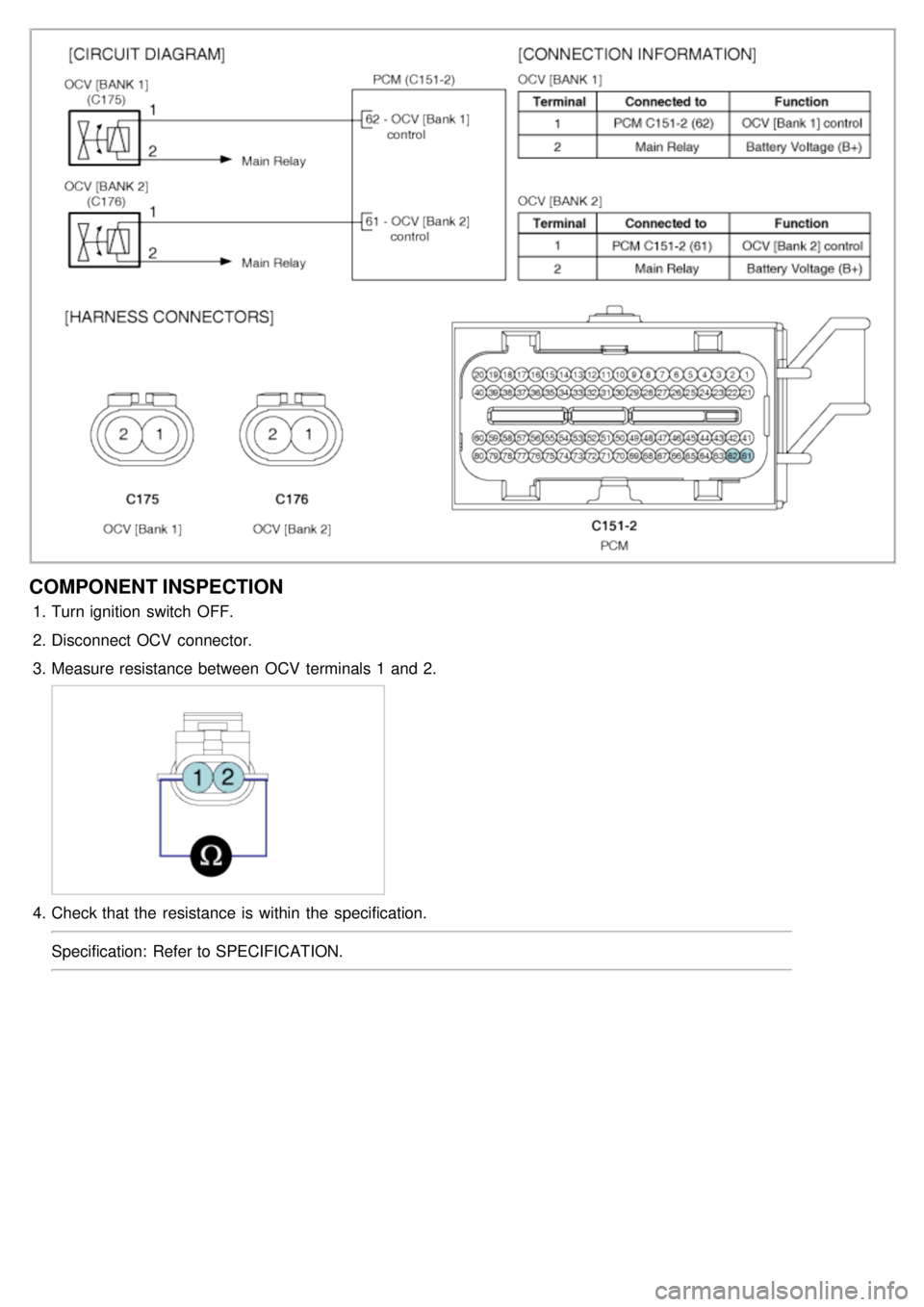
COMPONENT INSPECTION
1.Turn ignition switch OFF.
2. Disconnect OCV connector.
3. Measure resistance between OCV terminals 1 and 2.
4.Check that the resistance is within the specification.
Specification: Refer to SPECIFICATION.
Page 307 of 1575
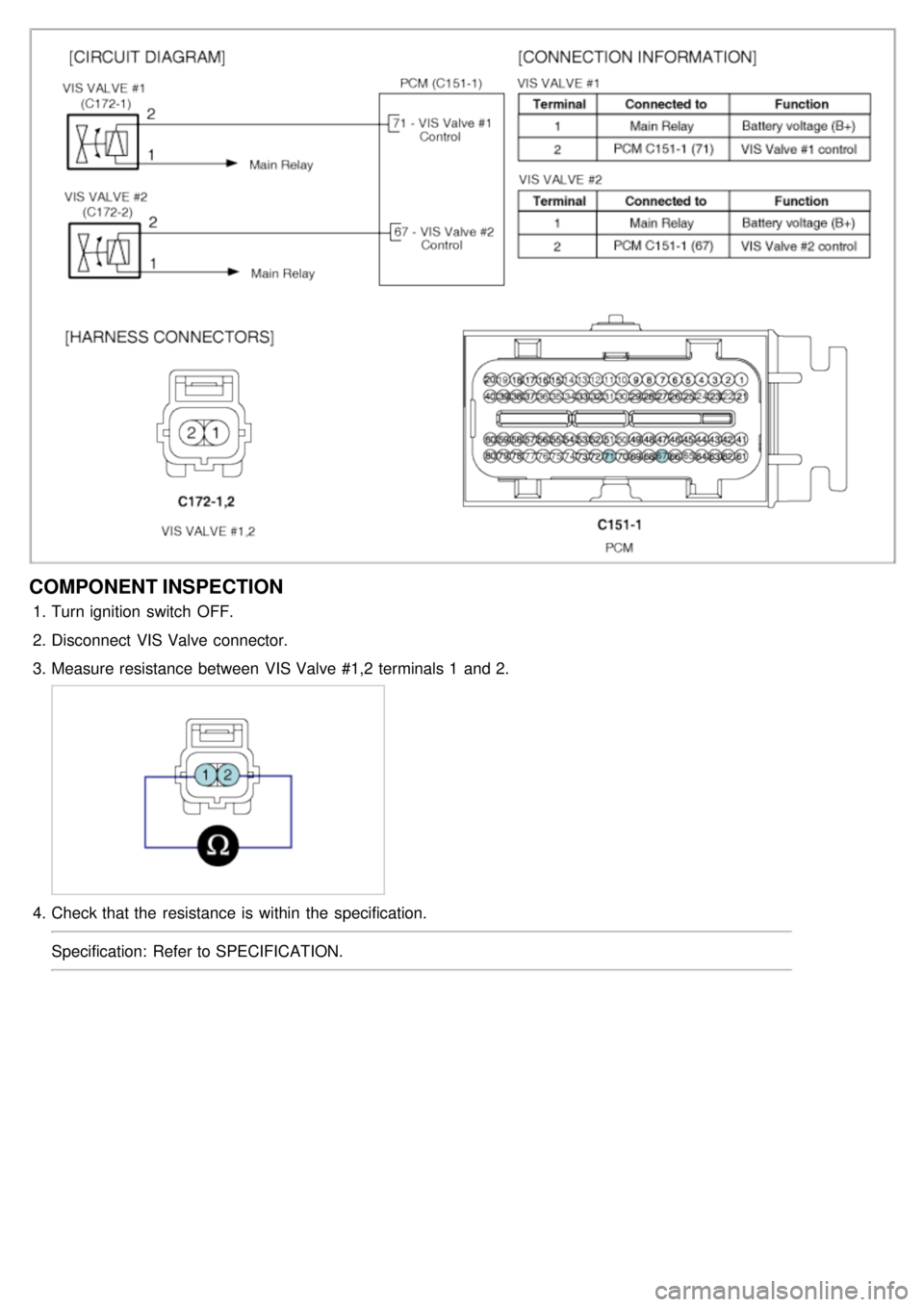
COMPONENT INSPECTION
1.Turn ignition switch OFF.
2. Disconnect VIS Valve connector.
3. Measure resistance between VIS Valve #1,2 terminals 1 and 2.
4.Check that the resistance is within the specification.
Specification: Refer to SPECIFICATION.
Page 312 of 1575

MODE 1FORCED ENGINE
SHUTDOWN Engine stop algorithm procedure
a. Fatal PCM internal programming error
b. Faulty intake system or throttle body
MODE 2 FORCED IDLE &
POWER
MANAGEMENT Forced idle state controlled by
fuel quantity regulation and
ignition timing adjustment a.
ETC system can't control engine power
via throttle device
b. Disabled throttle control or broken throttle
position information
MODE 3 FORCED IDLE Forced idle state and no response
for accelerator activation a.
No information about the accelerator
position
a. Malfuctioning APS 1 and 2, faulty A/D
converter or internal controller
MODE 4 LIMIT
PERFORMANCE & POWER
MANAGEMENT Engine power is determined by
accelerator position and idle
power requirement (Limited
vehicle running)
a.
ETC system can't securely control engine
power
MODE 5 LIMIT
PERFORMANCE a.
Engine power varies with
accelerator position, but driver
perceives lack of engine
power.
b. MIL ON (Normal vehicle
running) a.
Not reliable accelerator position signal or
bad maximum power generation
a. Faulty APS, ignition voltage or internal
controller
MODE 6 NORMALNormal
COMPONENT INSPECTION
1.Connect a scantool on Diagnoisis Link Connector (DLC).
2. Start engine and check output voltages of TPS 1 and 2 at C.T and W.O.T.
Condition Output Voltage (V)
TPS 1 TPS 2
C.T 0.25 ~ 0.9V Min. 4.0V
W.O.T Min. 4.0V 0.25 ~ 0.9V
3. Turn ignition switch OFF and disconnect the scantool from the DLC.
4. Disconnect ETC module connector and measure resistance between ETC module terminals 4 and 1 (TPS 1).
5. Measure resistance between ETC module terminals 7 and 6 (TPS 2).
Specification: Refer to SPECIFICATION.
ETC MOTOR
1.Disconnect ETC module connector and measure resistance between ETC module terminals 5 and 8.
Page 313 of 1575
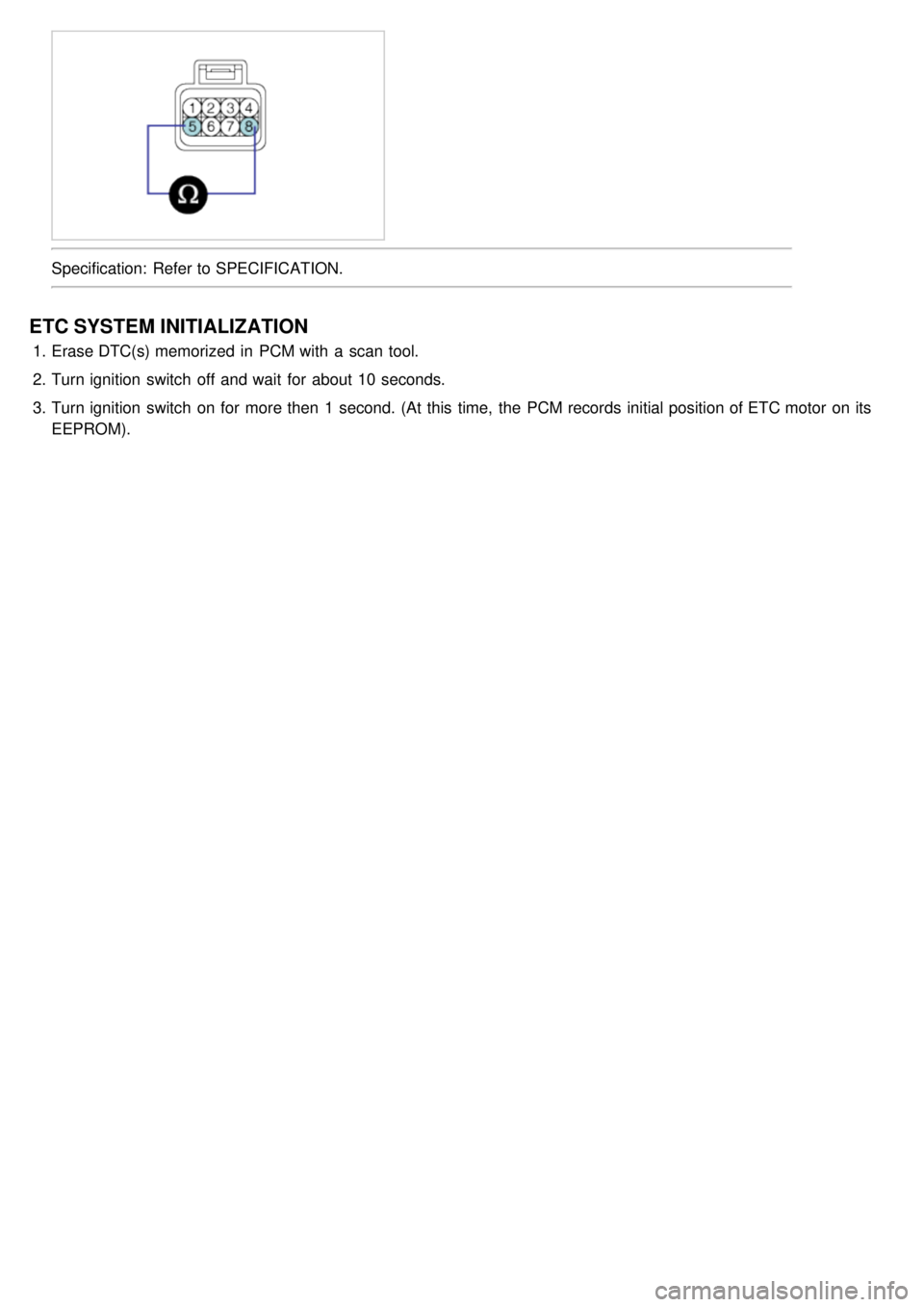
Specification: Refer to SPECIFICATION.
ETC SYSTEM INITIALIZATION
1.Erase DTC(s) memorized in PCM with a scan tool.
2. Turn ignition switch off and wait for about 10 seconds.
3. Turn ignition switch on for more then 1 second. (At this time, the PCM records initial position of ETC motor on its
EEPROM).
Page 320 of 1575
2007 > 2.7L V6 GASOLINE >
REMOVAL
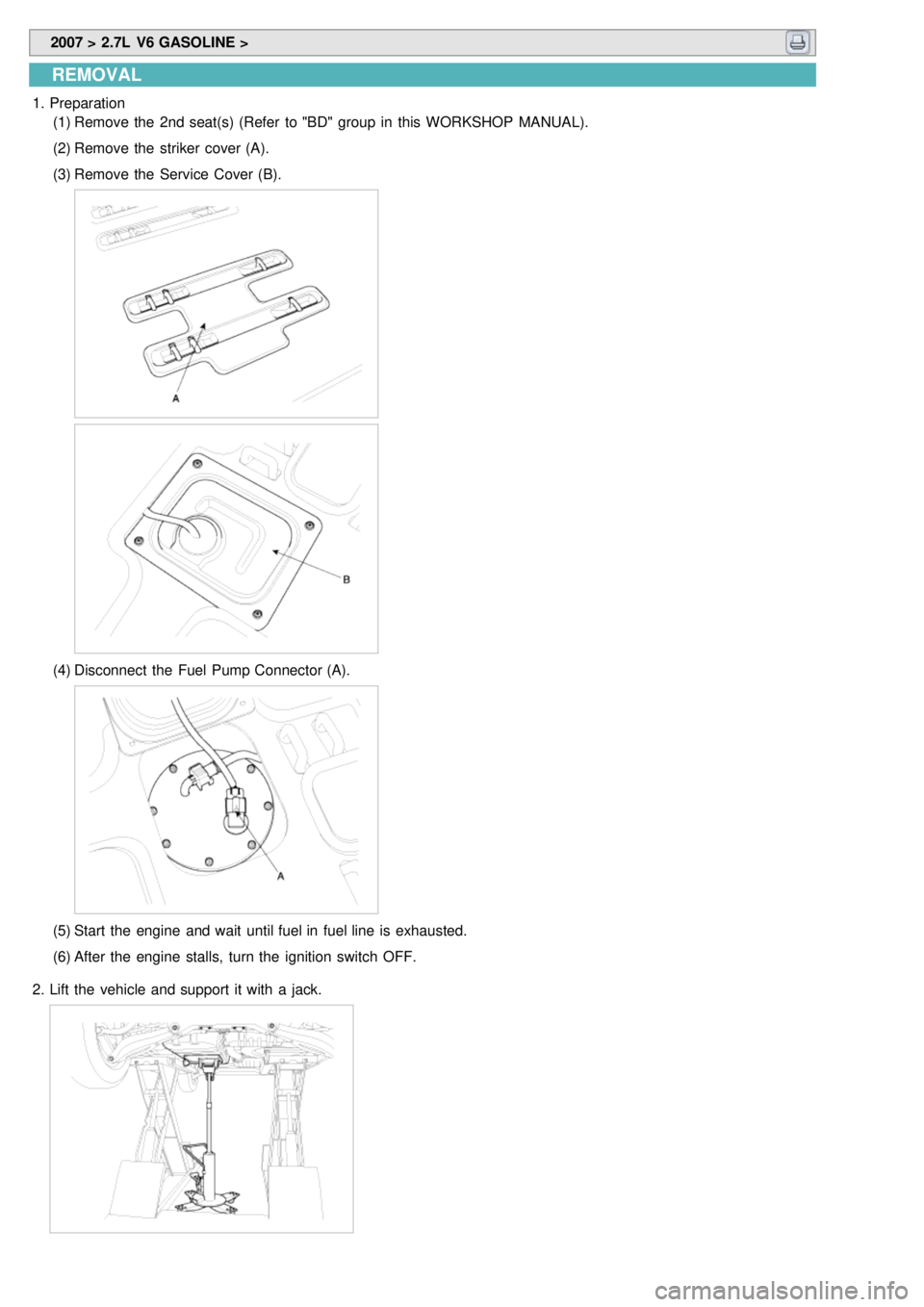
1.Preparation
(1) Remove the 2nd seat(s) (Refer to "BD" group in this WORKSHOP MANUAL).
(2) Remove the striker cover (A).
(3) Remove the Service Cover (B).
(4)Disconnect the Fuel Pump Connector (A).
(5)Start the engine and wait until fuel in fuel line is exhausted.
(6) After the engine stalls, turn the ignition switch OFF.
2. Lift the vehicle and support it with a jack.
Page 323 of 1575
2007 > 2.7L V6 GASOLINE >
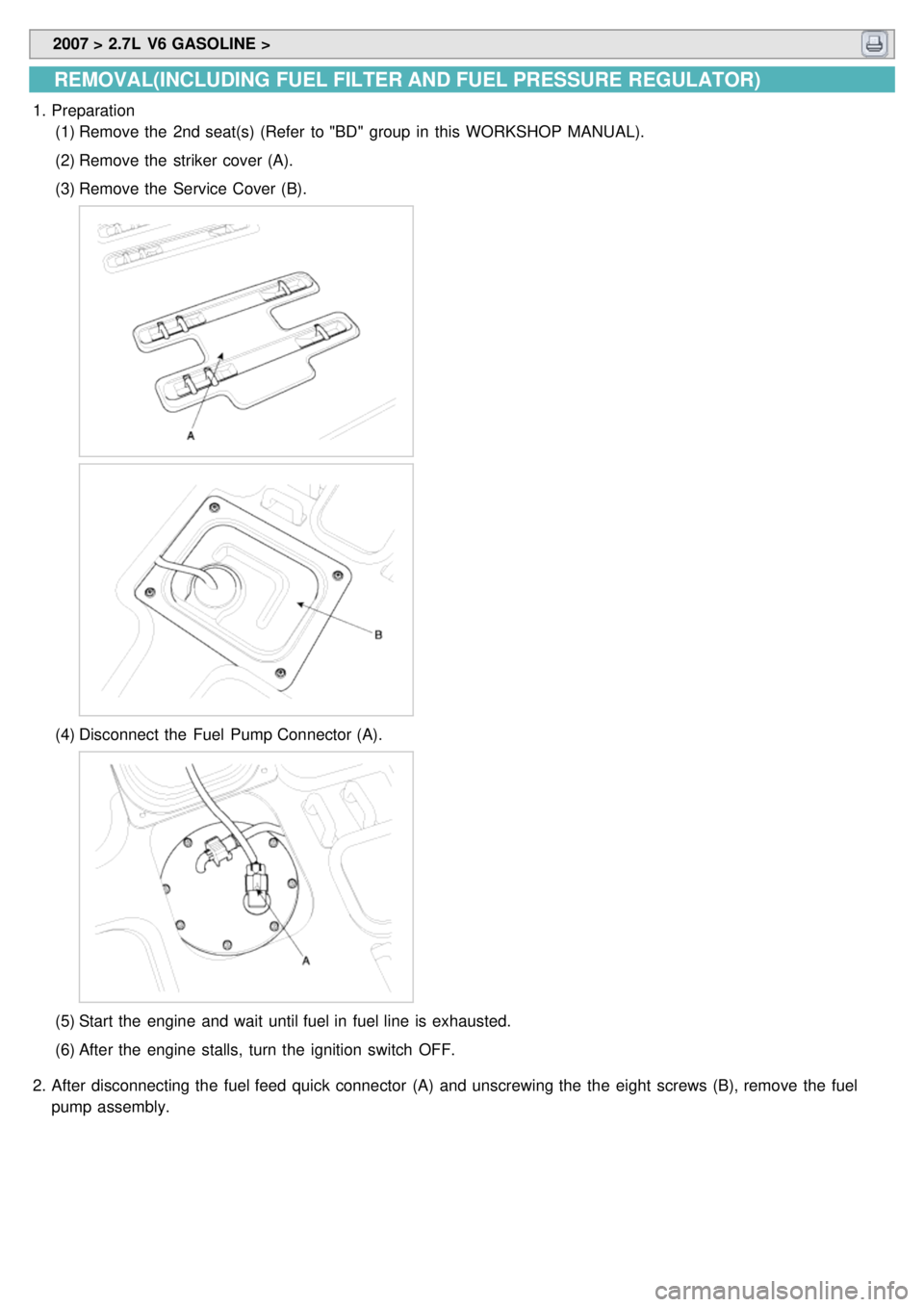
REMOVAL(INCLUDING FUEL FILTER AND FUEL PRESSURE REGULATOR)
1.Preparation
(1) Remove the 2nd seat(s) (Refer to "BD" group in this WORKSHOP MANUAL).
(2) Remove the striker cover (A).
(3) Remove the Service Cover (B).
(4)Disconnect the Fuel Pump Connector (A).
(5)Start the engine and wait until fuel in fuel line is exhausted.
(6) After the engine stalls, turn the ignition switch OFF.
2. After disconnecting the fuel feed quick connector (A) and unscrewing the the eight screws (B), remove the fuel
pump assembly.
Page 361 of 1575
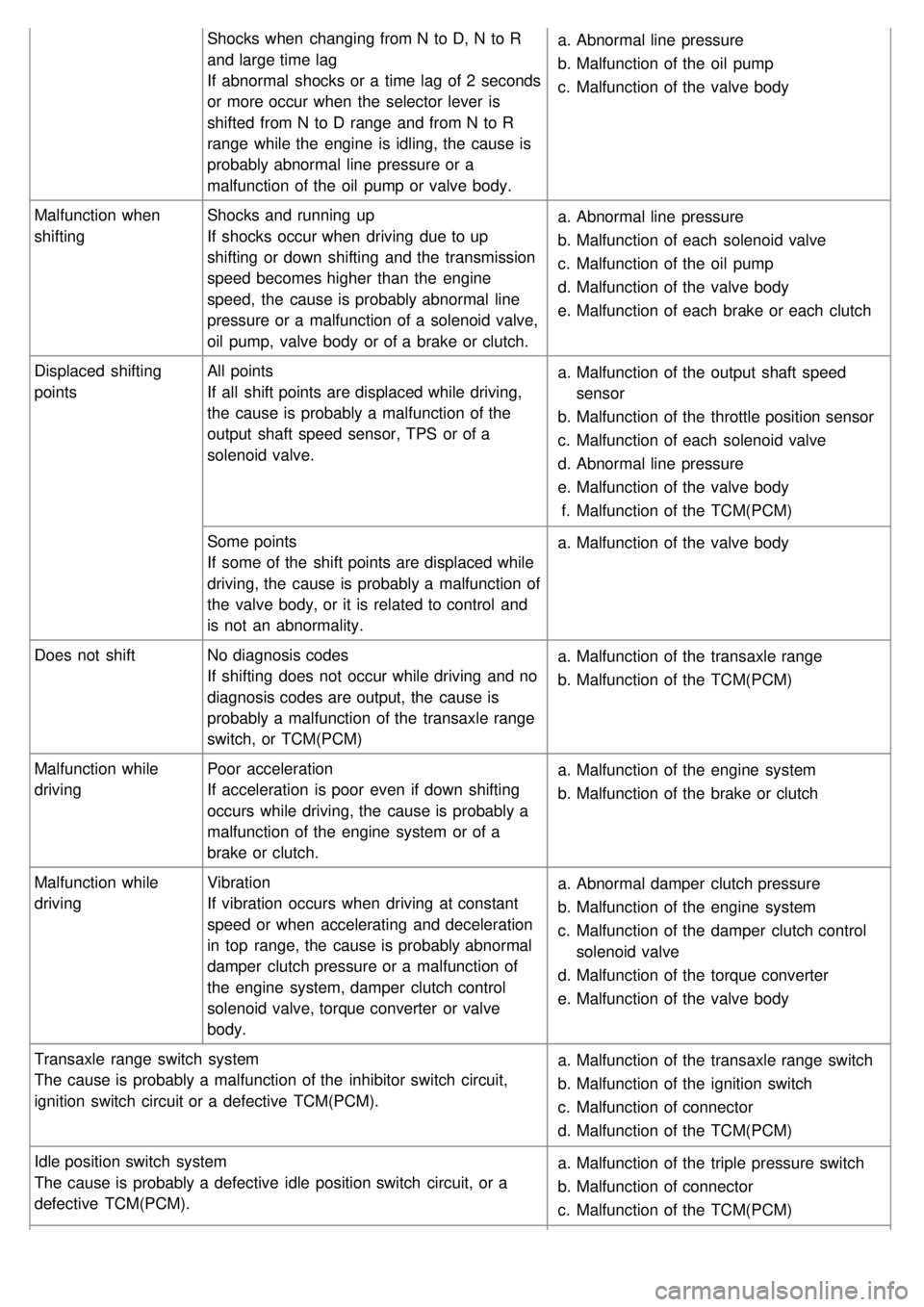
Shocks when changing from N to D, N to R
and large time lag
If abnormal shocks or a time lag of 2 seconds
or more occur when the selector lever is
shifted from N to D range and from N to R
range while the engine is idling, the cause is
probably abnormal line pressure or a
malfunction of the oil pump or valve body.a.
Abnormal line pressure
b. Malfunction of the oil pump
c. Malfunction of the valve body
Malfunction when
shifting Shocks and running up
If shocks occur when driving due to up
shifting or down shifting and the transmission
speed becomes higher than the engine
speed, the cause is probably abnormal line
pressure or a malfunction of a solenoid valve,
oil pump, valve body or of a brake or clutch. a.
Abnormal line pressure
b. Malfunction of each solenoid valve
c. Malfunction of the oil pump
d. Malfunction of the valve body
e. Malfunction of each brake or each clutch
Displaced shifting
points All points
If all shift points are displaced while driving,
the cause is probably a malfunction of the
output shaft speed sensor, TPS or of a
solenoid valve. a.
Malfunction of the output shaft speed
sensor
b. Malfunction of the throttle position sensor
c. Malfunction of each solenoid valve
d. Abnormal line pressure
e. Malfunction of the valve body
f. Malfunction of the TCM(PCM)
Some points
If some of the shift points are displaced while
driving, the cause is probably a malfunction of
the valve body, or it is related to control and
is not an abnormality. a.
Malfunction of the valve body
Does not shift No diagnosis codes
If shifting does not occur while driving and no
diagnosis codes are output, the cause is
probably a malfunction of the transaxle range
switch, or TCM(PCM) a.
Malfunction of the transaxle range
b. Malfunction of the TCM(PCM)
Malfunction while
driving Poor acceleration
If acceleration is poor even if down shifting
occurs while driving, the cause is probably a
malfunction of the engine system or of a
brake or clutch. a.
Malfunction of the engine system
b. Malfunction of the brake or clutch
Malfunction while
driving Vibration
If vibration occurs when driving at constant
speed or when accelerating and deceleration
in top range, the cause is probably abnormal
damper clutch pressure or a malfunction of
the engine system, damper clutch control
solenoid valve, torque converter or valve
body. a.
Abnormal damper clutch pressure
b. Malfunction of the engine system
c. Malfunction of the damper clutch control
solenoid valve
d. Malfunction of the torque converter
e. Malfunction of the valve body
Transaxle range switch system
The cause is probably a malfunction of the inhibitor switch circuit,
ignition switch circuit or a defective TCM(PCM). a.
Malfunction of the transaxle range switch
b. Malfunction of the ignition switch
c. Malfunction of connector
d. Malfunction of the TCM(PCM)
Idle position switch system
The cause is probably a defective idle position switch circuit, or a
defective TCM(PCM). a.
Malfunction of the triple pressure switch
b. Malfunction of connector
c. Malfunction of the TCM(PCM)
Page 362 of 1575

Triple pressure switch system
The cause is probably a defective dual pressure switch circuit or a
defective TCM(PCM).a.
Malfunction of the triple pressure switch
b. Malfunction of connector
c. Malfunction of A/C system
d. Malfunction of the TCM(PCM)
Vehicle speed sensor system
The cause is probably a defective vehicle speed sensor circuit or a
defective TCM(PCM). a.
Malfunction of the vehicle speed sensor
b. Malfunction of connector
c. Malfunction of the TCM(PCM)
DTC TROUBLESHOOTING INDEX
No. Code ItemMILRemark
1 P0707 TRANSAXLE RANGE SWITCH CIRCUIT LOW INPUT ON
2 P0708 TRANSAXLE RANGE SWITCH CIRCUIT HIGH INPUT ON
3 P0711 TRANSAXLE FLUID TEMPERATURE SENSOR RATIONALITY ON
4 P0712 TRANSAXLE FLUID TEMPERATURE SENSOR CIRCUIT LOW INPUT ON
5 P0713 TRANSAXLE FLUID TEMPERATURE SENSOR CIRCUIT HIGH INPUT ON
6 P0717 A/T INPUT SPEED SENSOR CIRCUIT - OPEN or SHORT(GND) ON
7 P0722 AT OUTPUT SPEED SENSOR CIRCUIT - OPEN or SHORT(GND) ON
8 P0731 GEAR 1 INCORRECT RATIO ON
9 P0732 GEAR 2 INCORRECT RATIO ON
10 P0733 GEAR 3 INCORRECT RATIO ON
11 P0734 GEAR 4 INCORRECT RATIO ON
12 P0741 TORQUE CONVERTER CLUTCH STUCK OFF ON
13 P0742 TORQUE CONVERTER CLUTCH STUCK ON ON
14 P0743 TORQUE CONVERTER CLUTCH CONTROL SOLENOID VALVE - OPEN or
SHORT(GND) ON
15 P0748 VFS SOLENOID OFF
16 P0750 LOW and REVERSE SOLENOID VALVE CIRCUIT - OPEN or SHORT(GND) ON
17 P0755 UNDER DRIVE SOLENOID VALVE CIRCUIT - OPEN or SHORT(GND) ON
18 P0760 SECOND SOLENOID VALVE CIRCUIT - OPEN or SHORT(GND) ON
19 P0765 OVERDRIVE SOLENOID VALVE CIRCUIT - OPEN or SHORT(GND) ON
20 P0885 A/T CONTROL RELAY - OPEN or SHORT(GND) ON
21 P0890 TCM power Relay sense circuit low ON
22 P0891 TCM power Relay sense circuit High ON
Failsafe
Activation and deactivation of error failsafe is coordinated Error failsafe Management.
Once Error failsafe is activated, it will be kept until ignition key OFF.
In every new TCM start, TCM start with No Error failsafe and No Error present.
0. Mechanical Limp Home Mode
a. Switch off A/T relay
1. Electrical Limp Home Mode a. Keep 2nd / 3rd gear
2. Prohibit Intelligent Shift a. Fuzzy SAT(Siements Adaptive Transmission) shift pattern (Medium Driver, Sporty Driver) will not be used
Page 366 of 1575
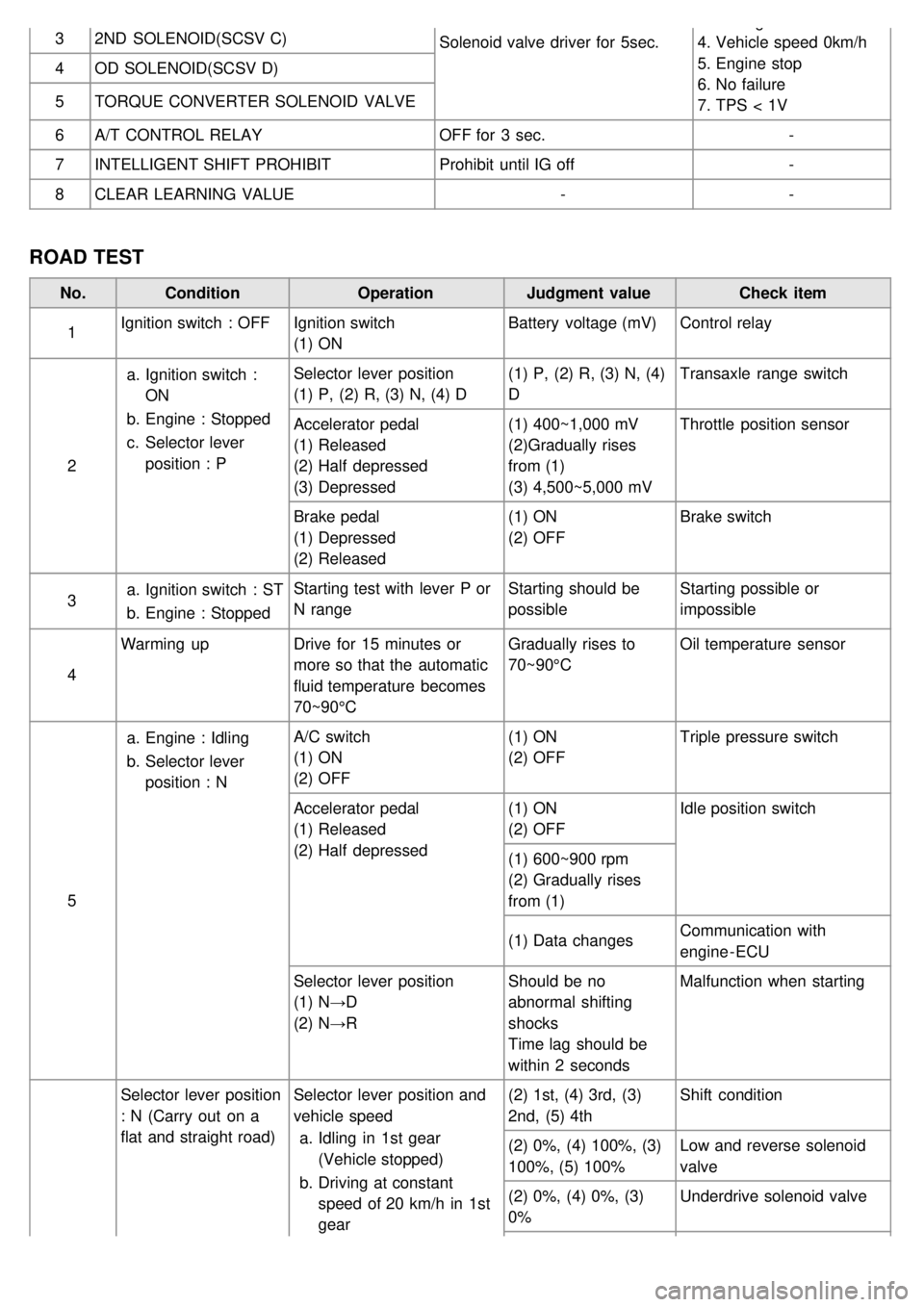
32ND SOLENOID(SCSV C)
Solenoid valve driver for 5sec.3. P range
4. Vehicle speed 0km/h
5. Engine stop
6. No failure
7. TPS < 1V
4
OD SOLENOID(SCSV D)
5 TORQUE CONVERTER SOLENOID VALVE
6 A/T CONTROL RELAY OFF for 3 sec. -
7 INTELLIGENT SHIFT PROHIBIT Prohibit until IG off -
8 CLEAR LEARNING VALUE --
ROAD TEST
No.Condition OperationJudgment value Check item
1 Ignition switch : OFF
Ignition switch
(1) ON Battery voltage (mV)
Control relay
2 a.
Ignition switch :
ON
b. Engine : Stopped
c. Selector lever
position : P Selector lever position
(1) P, (2) R, (3) N, (4) D
(1) P, (2) R, (3) N, (4)
DTransaxle range switch
Accelerator pedal
(1) Released
(2) Half depressed
(3) Depressed (1) 400~1,000 mV
(2)Gradually rises
from (1)
(3) 4,500~5,000 mVThrottle position sensor
Brake pedal
(1) Depressed
(2) Released (1) ON
(2) OFF
Brake switch
3 a.
Ignition switch : ST
b. Engine : Stopped Starting test with lever P or
N range
Starting should be
possibleStarting possible or
impossible
4 Warming up
Drive for 15 minutes or
more so that the automatic
fluid temperature becomes
70~90°C Gradually rises to
70~90°C
Oil temperature sensor
5 a.
Engine : Idling
b. Selector lever
position : N A/C switch
(1) ON
(2) OFF
(1) ON
(2) OFF
Triple pressure switch
Accelerator pedal
(1) Released
(2) Half depressed (1) ON
(2) OFF
Idle position switch
(1) 600~900 rpm
(2) Gradually rises
from (1)
(1) Data changes Communication with
engine - ECU
Selector lever position
(1) N→D
(2) N→R Should be no
abnormal shifting
shocks
Time lag should be
within 2 secondsMalfunction when starting
Selector lever position
: N (Carry out on a
flat and straight road) Selector lever position and
vehicle speed
a. Idling in 1st gear
(Vehicle stopped)
b. Driving at constant
speed of 20 km/h in 1st
gear (2) 1st, (4) 3rd, (3)
2nd, (5) 4th
Shift condition
(2) 0%, (4) 100%, (3)
100%, (5) 100% Low and reverse solenoid
valve
(2) 0%, (4) 0%, (3)
0% Underdrive solenoid valve
Page 391 of 1575

30.Install the engine cover. (see 'EM' group)
When replacing the automatic transaxle, reset the automatic transaxle's values by using the High- Scan Pro.
a. Connect the Hi - Scan Pro connector to the data link connector under the crash pad and power cable to the cigar
jack under the center facia.
b. Turn the ignition switch on and power on the Hi - Scan Pro.
c. Select the vehicle's name.
d. Select 'AUTOMATIC TRANSAXLE'.
e.Select 'RESETTING AUTO T/A VALUES' and perform the procedure.
f.Perform the procedure by pressing F1 (REST).