steering KIA CARNIVAL 2007 Manual PDF
[x] Cancel search | Manufacturer: KIA, Model Year: 2007, Model line: CARNIVAL, Model: KIA CARNIVAL 2007Pages: 1575, PDF Size: 44.86 MB
Page 867 of 1575

PartItemStandard ValueRemark
HECU(Hydraulic and
Electronic Control
Unit) System
4 channel 4
sensor(Solenoid)
·Total control(ABS,
EBD, TCS, ESP)
Type
Motor, valve relay
intergrated type
Operating voltage 8 V ~ 16 V(DC)
Operating temperature - 40 ~ 120 °C(- 40 ~
248 °F)
Warning lamp Operating voltage
12 V
·ESP Operating Lamp
·ESP Warning Lamp
Current consumption 80 mA
Active wheel speed
sensor Supply voltage
DC 4.5 ~ 20V
Operating temperature - 40 ~ 150 °C
Output current low 5.9 ~ 8.4 mA
Output current high 11.8 ~ 16.8 mA
Tone wheel 48 teeth
Frequency range 1 ~ 2500 HZ
Airgap Front
0.15 ~ 1.5 mm Typ. 0.7 mm
Rear 0.2 ~ 1.2 mm Typ. 0.7 mm
Steering Wheel Angle
Sensor Operating Voltage
8V ~ 16 V
Current Consumption Max 150 mA
Operating Angular velocity Max ± 780 °/sec
Yaw - rate & Lateral G
sensor Operating Voltage
8 V ~ 16 V
Current Consumption Max. 120 mA
Output Voltage high 4.35 V~ 4.65 VTyp. 4.5 V
Output Voltage low 0.35 ~ 0.65 VTyp. 0.5 V
Yaw Sensor Operating Range ±100 ° /s
G Sensor Operating Range ±1.8 G
Reference voltage output 2.464 ~ 2.536 VTyp. 2.5 V
LUBRICANT
Item Recommended lubricantQuantity
Brake fluid DOT 3 or DOT 4As required
Brake pedal bushing and brake pedal bolt Chassis greaseAs required
Parking brake shoe and backing plate contact surfaces Bearing greaseAs required
Caliper guide rod and boot RX - 2 grease0.8 ~ 1.3 g
Rear caliper guide rod and boot Rubber grease0.8 ~ 1.3g
Page 928 of 1575

2007 > 2.7L V6 GASOLINE >
DESCRIPTION
This specification applies to HCU(Hydraulic Control Unit) and ECU(Electronic Control Unit) of the HECU.(Hydraulic and
Electronic Control Unit)
This specification is for the wiring design and installation of ABS/TCS/ESC ECU.
This unit has the functions as follows.
a. Input of signal from Pressure sensor, Steering angle sensor, Yaw & Lateral G sensor, the wheel speed sensors
attached to each wheel.
b. Control of braking force / traction force/ yaw moment.
c. Failsafe function.
d. Self diagnosis function.
e. Interface with the external diagnosis tester.
Installation position : engine compartment a. Brake tube length from Master cylinder port to HECU inlet port should be max. 1m
b. The position should not be close to the engine block and not lower than the wheel.
OPERATION
The ECU shall be put into operation by switching on the operating voltage (IGN).
On completion of the initialization phase, the ECU shall be ready for operation.
In the operating condition, the ECU shall be ready, within the specified limits (voltage and temperature), to process the
signals offered by the various sensors and switches in accordance with the control algorithm defined by the software
and to control the hydraulic and electrical actuators.
Wheel Sensor signal processing
The ECU shall receive wheel speed signal from the four active wheel sensors.
The wheel signals are converted to voltage signal by the signal conditioning circuit after receiving current signal from
active wheel sensors and given as input to the MCU.
Solenoid Valve Control
When one side of the valve coil is connected to the positive voltage that is provided through the valve relay and the
other side is connected to the ground by the semiconductor circuit, the solenoid valve goes into operation.
The electrical function of the coils are always monitored by the valve test pulse under normal operation conditions.
Voltage limits
a.Overvoltage
When overvoltage is detected(above 16.8 V), the ECU switches off the valve relay and shuts down the system.
When voltage is returned to operating range, the system goes back to the normal condition after the initialization
phase.
b. Undervoltage
In the event of undervoltage(below 9.3 V), ABS control shall be inhibited and the warning lamp shall be turned on.
When voltage is returned to operating range, the warning lamp is switched off and ECU returns to normal operating
mode.
Pump Motor Checking
The ECU performs a pump motor test at a speed of 15km/h once after IGN is switched on.
Diagnostic Interface
Failures detected by the ECU are encoded on the ECU, stored in a EEPROM and read out by diagnostic equipment
when the ignition switch is turned on.
The diagnosis interface can also be used for testing the ECU during production of the ECU and for actuating the HCU
(Air - bleeding line or Roll and Brake Test line).
Warning Lamp module
Page 946 of 1575

DTCDESCRIPTION WARNING LAMP
REMARK
ABS EBDESC
C1101 BATTERY VOLTAGE HIGH ООО
C1102 BATTERY VOLTAGE LOW ОО
C1200 FL WHEEL SPEED SENSOR- OPEN/SHORT ОО
C1201 FL WHEEL SENSOR- RANGE/ PERFORMANCE ОО
C1202 FL WHEEL WHEEL SPEED SENSOR- NO SIGNAL ОО
C1203 FR WHEEL SPEED SENSOR- OPEN/SHORT ОО
C1204 FR WHEEL SENSOR- RANGE/ PERFORMANCE ОО
C1205 FR WHEEL SPEED SENSOR- NO SIGNAL ОО
C1206 RL WHEEL SPEED SENSOR- OPEN/SHORT ОО
C1207 RL WHEEL SENSOR- RANGE/ PERFORMANCE ОО
C1208 RL WHEEL SPEED SENSOR- NO SIGNAL ОО
C1209 RR WHEEL SPEED SENSOR- OPEN/SHORT ОО
C1210 RR WHEEL SENSOR- RANGE/ PERFORMANCE ОО
C1211 RR WHEEL SPEED SENSOR- NO SIGNAL ОО
C1213 WHEEL SPEED FREQUENCY ERROR ОО
C1235 PRESSURE SENSOR- ELECTRICAL ОESP
C1237 PRESSURE SENSOR- SIGNAL FAULT ОESP
C1260 STEERING ANGLE SENSOR- SIGNAL ОESP
C1261 STEERING ANGLE SENSOR NOT CALIBRATED ОESP
C1282 YAW RATE & LATERAL G SENSOR- ELECTRICAL ОESP
C1283 YAW RATE & LATERAL G SENSOR- SIGNAL ОESP
C1503 ESP SWITCH ERROR ОESP
C1513 BRAKE LIGHT SWITCH MALFUNCTION О
C1604 ECU HARDWARE ERROR ООО
C1605 CAN CONTROL HARDWARE ERROR ОESP
C1611 CAN TIME OUT- PCM(ECM) ОESP
C1612 CAN TIME OUT- PCM(TCM) ОESP
C1616 CAN BUS OFF ОESP
C1623 CAN TIMEOUT STEERING ANGLE SENSOR ОESP
C1625 CAN TIME OUT- ESP ОESP
C1626 IMPLAUSIBLE CONTROL ООESP
C1702 VARIANT CODING ООО ESP
C2112 VALVE RELAY MALFUNCTION ООО
C2308 FL INLET VALVE MALFUNCTION ООО
C2312 FL OUTLET VALVE MALFUNCTION ООО
C2316 FR INLET VALVE MALFUNCTION ООО
C2320 FR OUTLET VALVE MALFUNCTION ООО
C2324 RL INLET VALVE MALFUNCTION ООО
C2328 RL OUTLET VALVE MALFUNCTION ООО
Page 967 of 1575

2007 > 2.7L V6 GASOLINE >
description of ESP
Optimum driving safety now has a name : ESP, the Electronic Stability Control.
ESP recognizes critical driving conditions, such as panic reactions in dangerous situations, and stabilizes the vehicle
by wheel- individual braking and engine control intervention with no needfor actuating the brake or the gas pedal.
ESP adds a further function known as Active Yaw Control (AYC) to the ABS, TCS, EBD and ESP functions. Whereas
the ABS/TCS function controls wheel slip during braking and acceleration and, thus, mainly intervenes in the
longitudinal dynamics of the vehicle, active yaw control stabilizes the vehicle about its vertical axis.
This is achieved by wheel individual brake intervention and adaptation of the momentary engine torque with no need
for any action to be taken by the driver.
ESC essentially consists of three assemblies : the sensors, the electronic control unit and the actuators.
Of course, the stability control feature works under all driving and operating conditions. Under certain driving
conditions, the ABS/TCS function can be activated simultaneously with the ESP function in response to a command
by the driver.
In the event of a failure of the stability control function, the basic safety function, ABS, is still maintained.
DESCRIPTION OF ESP CONTROL
ESP system includes ABS/EBD, TCS and AYC (Active yaw control) function.
ABS/EBD function : The ECU changes the active sensor signal (current shift) coming from the four wheel sensors to
the square waveform.By using the input of above signals, the ECU calculates the vehicle speed and the acceleration
& deceleration of the four wheels.And, the ECU judges whether the ABS/EBD should be actuated or not.
TCS function prevents the wheel slip of drive direction by adding the brake pressure and engine torque reduction via
CAN communication.TCS function uses the wheel speed sensor signal to determine the wheel slip as far as ABS
function.
AYC function prevents unstable maneuver of the vehicle. To determine the vehicle maneuver, AYC function uses the
maneuver sensor signals(Yaw Rate Sensor, Lateral Acceleration Sensor, Steering Wheel Angle Sensor).If vehicle
maneuver is unstable (Over Steer or Under Steer), AYC function applies the brake pressure on certain wheel, and
send engine torque reduction signal by CAN.
After the key - on, the ECU continually diagnoses the system failure. (self- diagnosis)If the system failure is detected,
the ECU informs driver of the system failure through the BRAKE/ABS/ESP warning lamp. (fail- safe warning)
Page 978 of 1575

Steering Angle Sensor
Page 985 of 1575

Steering Angle Sensor
Page 986 of 1575
2007 > 2.7L V6 GASOLINE >
DESCRIPTION
GENERAL DATA
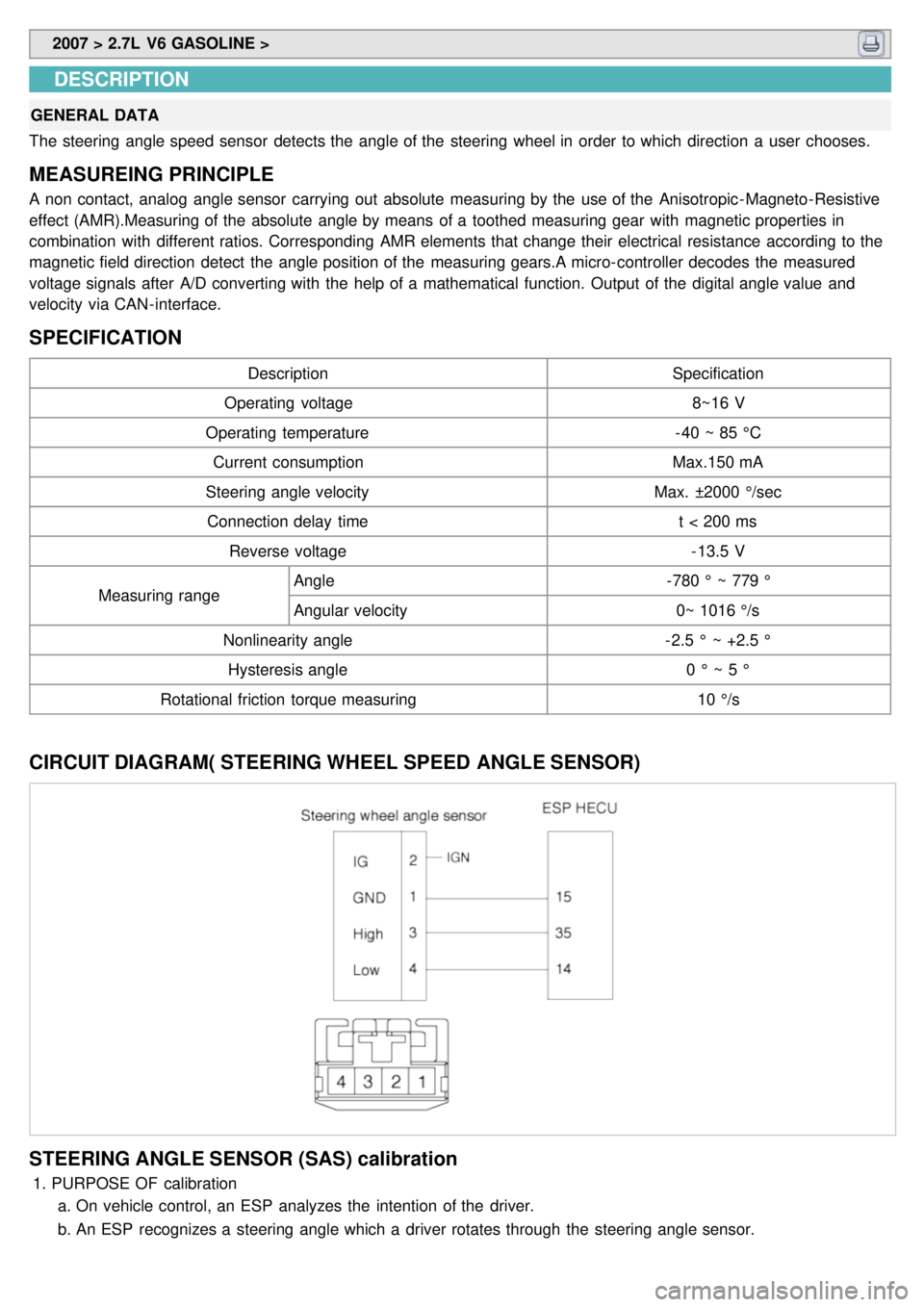
The steering angle speed sensor detects the angle of the steering wheel in order to which direction a user chooses.
MEASUREING PRINCIPLE
A non contact, analog angle sensor carrying out absolute measuring by the use of the Anisotropic - Magneto- Resistive
effect (AMR).Measuring of the absolute angle by means of a toothed measuring gear with magnetic properties in
combination with different ratios. Corresponding AMR elements that change their electrical resistance according to the
magnetic field direction detect the angle position of the measuring gears.A micro- controller decodes the measured
voltage signals after A/D converting with the help of a mathematical function. Output of the digital angle value and
velocity via CAN- interface.
SPECIFICATION
Description Specification
Operating voltage 8~16 V
Operating temperature - 40 ~ 85 °C
Current consumption Max.150 mA
Steering angle velocity Max. ±2000 °/sec
Connection delay time t < 200 ms
Reverse voltage - 13.5 V
Measuring range Angle
- 780 ° ~ 779 °
Angular velocity 0~ 1016 °/s
Nonlinearity angle - 2.5 ° ~ +2.5 °
Hysteresis angle 0 ° ~ 5 °
Rotational friction torque measuring 10 °/s
CIRCUIT DIAGRAM( STEERING WHEEL SPEED ANGLE SENSOR)
STEERING ANGLE SENSOR (SAS) calibration
1.PURPOSE OF calibration
a. On vehicle control, an ESP analyzes the intention of the driver.
b. An ESP recognizes a steering angle which a driver rotates through the steering angle sensor.
Page 987 of 1575

c.A steering angle sensor used in ESP adjusts 0° setting of steering wheel through K- line or CAN
communication.
2. STEERING ANGLE SENSOR (SAS) CALIBRATION METHOD
(1) Align the wheel to the straight line. (steering wheel < ± 5° )
ex) Perform the wheel alignment first.
Align the wheel to the straight line.
A driver moves the vehicle to the front and back about 5 meters twice or three times.
(2) Connect Scan tool to the vehicle.
(3) Select Brake system.
(4) Select Steering angle sensor(SAS) calibration.
(5)Perform the Steering angle sensor(SAS) calibration.
(6)Perform the procedure continuously.
Page 988 of 1575

(7)The procedure is finished. Push the "ESC" key.
(8)Scanner OFF.
(9) Remove the scanner from the vehicle.
(10) Confirm the Steering angle sensor(SAS) calibration as driving the vehicle.(turn left once, turn right once)
Page 1064 of 1575
2007 > 2.7L V6 GASOLINE >
REPLACEMENT
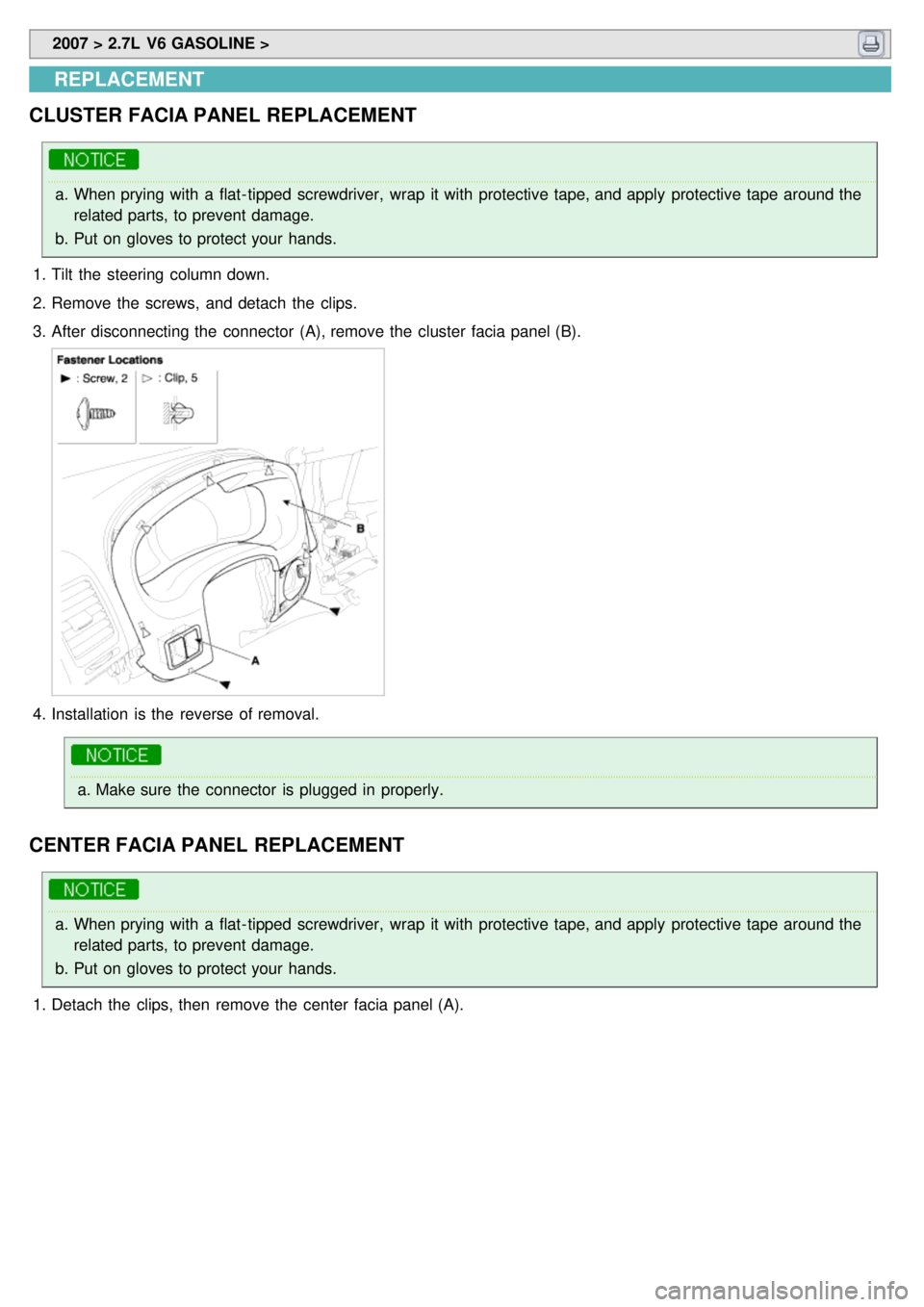
CLUSTER FACIA PANEL REPLACEMENT
a. When prying with a flat- tipped screwdriver, wrap it with protective tape, and apply protective tape around the
related parts, to prevent damage.
b. Put on gloves to protect your hands.
1. Tilt the steering column down.
2. Remove the screws, and detach the clips.
3. After disconnecting the connector (A), remove the cluster facia panel (B).
4.Installation is the reverse of removal.
a.Make sure the connector is plugged in properly.
CENTER FACIA PANEL REPLACEMENT
a.When prying with a flat- tipped screwdriver, wrap it with protective tape, and apply protective tape around the
related parts, to prevent damage.
b. Put on gloves to protect your hands.
1. Detach the clips, then remove the center facia panel (A).