brake light KIA Optima 2006 2.G Owner's Guide
[x] Cancel search | Manufacturer: KIA, Model Year: 2006, Model line: Optima, Model: KIA Optima 2006 2.GPages: 225, PDF Size: 3.77 MB
Page 145 of 225
5-9
If you believe you may have gottenyour brakes wet, apply them lightly
while driving until normal braking
operation returns.WINTER DRIVING We recommend that you carryemergency equipment. Some things
you might include are tire chains, a
window scraper, windshield de-icer,
a bag of sand or salt, flares, a small
shovel and jumper cables.
Make sure you have sufficient ethylene glycol coolant in the
radiator.
Check the battery condition and cables. Cold temperatures reduce the
capacity of any battery, so it must be
in top shape to provide enough
winter starting power.
Make sure the engine oil viscosity is suitable for cold weather.
Check the ignition system for loose connections and damage. Use antifreeze-formulated windshield
washer fluid and make sure you have
sufficient fluid for your trip. (Do not
use engine coolant antifreeze.)
Do not use the parking brake if it might freeze. This is most likely to
happen after driving in slushy or wet
conditions and temperatures drop into
the freezing range. When parking,
shift to P (Park) with automatic
transaxle, or to 1 (First) or R
(Reverse) with a manual transaxle
and block the rear wheels.
SNOW TIRESWhen snow tires are used, select the size
and construction specified on the Tire
Pressure Label. It is strongly
recommended that snow tires be used on
all four wheels, or poor handling may
result. Snow tires should not be operated
at speeds exceeding 120 km/h (75 mph).
These tires should be inflated 4 psi (28
kPa, 0.3 kg/cm
2) above the recommended pressures shown on the Tire
Specification/Pressure Label, but inflation
should never exceed the maximum cold-
tire pressure shown on the tire sidewalls.
Do not install studded tires without first
checking local, provincial and municipal
regulations for possible restrictions
against their use.
WARNING - Snow Tire
Size
Snow tires should be
equivalent in size and type to
the vehicle’s standard tires.
Otherwise, the safety and
handling of your vehicle may be
adversely affected.
MS-CNA-Eng 5 New.qxd 7/25/2005 5:21 PM Page 9
Page 153 of 225
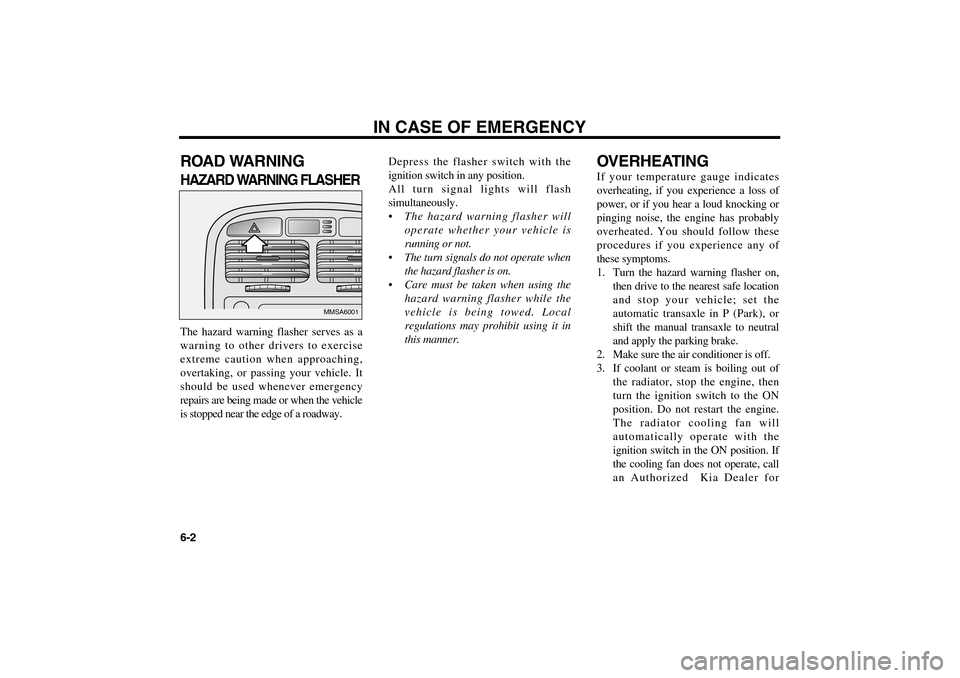
ROAD WARNINGHAZARD WARNING FLASHERThe hazard warning flasher serves as a
warning to other drivers to exercise
extreme caution when approaching,
overtaking, or passing your vehicle. It
should be used whenever emergency
repairs are being made or when the vehicle
is stopped near the edge of a roadway.Depress the flasher switch with the
ignition switch in any position.
All turn signal lights will flash
simultaneously.
• The hazard warning flasher will
operate whether your vehicle is
running or not.
The turn signals do not operate when
the hazard flasher is on.
Care must be taken when using the
hazard warning flasher while the
vehicle is being towed. Local
regulations may prohibit using it in
this manner.
OVERHEATINGIf your temperature gauge indicates
overheating, if you experience a loss of
power, or if you hear a loud knocking or
pinging noise, the engine has probably
overheated. You should follow these
procedures if you experience any of
these symptoms.
1. Turn the hazard warning flasher on,
then drive to the nearest safe location
and stop your vehicle; set the
automatic transaxle in P (Park), or
shift the manual transaxle to neutral
and apply the parking brake.
2. Make sure the air conditioner is off.
3. If coolant or steam is boiling out of
the radiator, stop the engine, then
turn the ignition switch to the ON
position. Do not restart the engine.
The radiator cooling fan will
automatically operate with the
ignition switch in the ON position. If
the cooling fan does not operate, call
an Authorized Kia Dealer for
IN CASE OF EMERGENCY
6-2
MMSA6001
MS-CNA-Eng 6.QXD 7/25/2005 5:13 PM Page 2
Page 177 of 225
MAINTENANCE
7-1
MAINTENANCEMaintenance Services . . . . . . . . . . . . . . . . . . . . . . . . . . .7-2
Maintenance Schedule . . . . . . . . . . . . . . . . . . . . . . . . . .7-3
Owner Maintenance . . . . . . . . . . . . . . . . . . . . . . . . . . . . .7-8
Engine Compartment . . . . . . . . . . . . . . . . . . . . . . . . . .7-10
Engine Oil and Oil Filter . . . . . . . . . . . . . . . . . . . . . . . .7-12
Engine Cooling System . . . . . . . . . . . . . . . . . . . . . . . . .7-14
Brakes and Clutch . . . . . . . . . . . . . . . . . . . . . . . . . . . . .7-17
Parking Brake . . . . . . . . . . . . . . . . . . . . . . . . . . . . . . . . .7-18
Power Steering . . . . . . . . . . . . . . . . . . . . . . . . . . . . . . . .7-18
Automatic Transaxle . . . . . . . . . . . . . . . . . . . . . . . . . . .7-19
Lubricants and Fluids . . . . . . . . . . . . . . . . . . . . . . . . . .7-20
Air Cleaner . . . . . . . . . . . . . . . . . . . . . . . . . . . . . . . . . . .7-21
Wiper Blades . . . . . . . . . . . . . . . . . . . . . . . . . . . . . . . . .7-22
Battery . . . . . . . . . . . . . . . . . . . . . . . . . . . . . . . . . . . . . .7-23
Tires and Wheels . . . . . . . . . . . . . . . . . . . . . . . . . . . . . .7-25
Bulb Replacement . . . . . . . . . . . . . . . . . . . . . . . . . . . . .7-32
Lubricant Specifications . . . . . . . . . . . . . . . . . . . . . . . .7-36
Exterior Care . . . . . . . . . . . . . . . . . . . . . . . . . . . . . . . . .7-38
Interior Care . . . . . . . . . . . . . . . . . . . . . . . . . . . . . . . . . .7-40
Headlight Aiming Adjustment . . . . . . . . . . . . . . . . . . .7-42
7
MS-CNA-Eng 7.QXD 7/25/2005 5:09 PM Page 1
Page 214 of 225
MAINTENANCE
7-38When choosing an oil, consider the range
of temperature your vehicle will be
operated in before the next oil change.
Then select the recommended oil
viscosity from the chart.EXTERIOR CAREEXTERIOR GENERAL
CAUTIONIt is very important to follow the
manufacturer’s directions when using
any chemical cleaner or polish. Read all
warning and caution statements that
appear on the label.FINISH MAINTENANCE
WASHINGTo help protect your vehicle’s finish from
rust and deterioration, wash it thoroughly
and frequently at least once a month with
special attention to the removal of any
accumulation of salt, dirt, mud, or other
foreign materials. Make sure the drainholes in the lower edges of the doors and
rocker panels are kept clear and clean.
Insects, tar, tree sap, bird droppings,
industrial fallout and similar deposits can
damage your vehicle’s finish if not
removed immediately.
Even prompt washing with plain water
may not completely remove all these
deposits. A mild soap, safe for use on
painted surfaces, can be used.
After washing, rinse the vehicle
thoroughly with lukewarm or cold water.
Do not allow soap to dry on the finish.
WAXINGWax the vehicle when water will no
longer bead on the paint.
Always wash and dry the vehicle before
waxing. Use a good quality liquid or
paste wax, and follow the manufacturer’s
instructions. Wax all metal trim as well,
to protect it and to maintain its luster.
Removing oil, tar, and similar materials
with a spot remover will usually strip the
wax from the finish. Be sure to re-wax
these areas even if the rest of the vehicle
does not yet need waxing.
✻
NOTICE
Do not use strong soap, chemical
detergents or hot water, and do not
wash the vehicle in direct sunlight
or when the body of the vehicle is
warm.
CAUTION
After washing the vehicle, test the
brakes while driving slowly to see if
they have been affected by water. If
braking performance is impaired,
dry the brakes by applying them
lightly while maintaining a slow
forward speed.
MS-CNA-Eng 7.QXD 7/25/2005 5:09 PM Page 38
Page 224 of 225
9
INDEX
9-1
A
ir Bag - Supplemental Restraint System ................................3-42
Air Cleaner ..................................................................................7-21
Antenna .......................................................................................3-68
Automatic Heating and Cooling Control System .......................4-47
Automatic Transaxle ............................................................4-7, 7-19
B
attery.......................................................................................7-23
Before Driving ..............................................................................5-4
Brake System ..............................................................................4-12
Brakes and Clutch .......................................................................7-17
Bulb Replacement .......................................................................7-32
C
hanging tires ..........................................................................6-22
Climate Control System ..............................................................4-42
Cruise Control .............................................................................4-37
Cup Holders and Console Storage Compartment .......................3-63
D
oor Locks .................................................................................3-9
E
lectrical Circuit Protection .......................................................6-7
Emergency Starting .......................................................................6-3
Emission Control System ..............................................................5-3
Engine Compartment ..................................................................7-10
Engine Cooling System...............................................................7-14
Engine Oil and Oil Filter .............................................................7-12
Exterior Care ...............................................................................7-38
F
uel Filler Lid ...........................................................................3-55
Fuel Requirements ........................................................................5-2
G
auges ......................................................................................4-20
H
eadlight Aiming Adjustment .................................................7-42
Homelink® Wireless Control System.........................................5-12
Hood ............................................................................................3-54
How To Use This Manual .............................................................1-2
If You Have a Flat Tire .............................................................6-19
Ignition Switch ..............................................................................4-2
Immobilizer System ......................................................................3-6
Instrument Cluster .......................................................................4-19
Instrument Panel Overview ...........................................................2-3
Interior and Exterior Overview .....................................................2-2
Interior Care ................................................................................7-40
Interior Features ..........................................................................4-33
Interior Lights .............................................................................3-62K
eyless entry system .................................................................3-4
Keys ..............................................................................................3-3
L
abel Information .....................................................................5-11
Lightings .....................................................................................4-27
Lubricant Specifications .............................................................7-36
Lubricants and Fluids ..................................................................7-20
Luggage Net ................................................................................3-69
Ms-CNA-Eng-INDEX.qxd 7/25/2005 5:07 PM Page 1