lock KIA Optima 2006 2.G Owner's Guide
[x] Cancel search | Manufacturer: KIA, Model Year: 2006, Model line: Optima, Model: KIA Optima 2006 2.GPages: 225, PDF Size: 3.77 MB
Page 34 of 225
SAFETY BELT RESTRAINT
SYSTEMWe strongly recommend that the driver
and all passengers be properly restrained
at all times by using the safety belts
provided with the vehicle. Proper use of
the safety belts decreases the risk of
severe injury or death in accidents or
sudden stops.Safety belts provide the best restraint
when:
• The seatback is upright.
• The occupant is sitting upright (not
slouched).
• The lap belt portion of the safety belt
is snug and low on the hips.
• The shoulder belt portion of the
safety belt is snug against the chest.
• The knees are straight forward.
To help you remember to fasten your
safety belt, a warning light will flash and
a chime will sound.
See safety belt warning on page 4-22.
All seats have lap/shoulder belts.
The center rear seat has a lap/shoulder
belt.
Inertial locks in the safety belt retractors
allow all of the lap/shoulder safety belts
to remain unlocked during normal
vehicle operation.This allows the
occupants some freedom of movement
and increased comfort while using the
safety belts. If a force is applied to thevehicle, such as a strong stop, a sharp
turn, or a collision, the safety belt
retractors will automatically lock the
safety belts.
Since the inertial locks do not require a
collision in order to lock up, you may
become aware of the safety belts locking
while braking or going around sharp
corners.
The center rear seat safety belt does not
have an inertial lock so it is always in a
locked condition.
Whenever possible, use the center rear
seat position to install your child
restraint. The center rear seat is the best
position to install your child restraint.
3-25
WARNING
The driver and all passengers
should always use the safety
belts provided in order to
minimize the risk of severe
bodily injury.
MS-CNA-Eng 3.QXD 7/25/2005 5:17 PM Page 25
Page 38 of 225
PLACEMENT OF A CHILD
RESTRAINT SYSTEMWe recommend that, whenever possible,
you put the child restraint in the center
position of the rear seat.
If the center rear seat is not available, or
you are using more than one child
restraint system in the vehicle at the
same time, the rear safety belts have
been designed to allow a child restraint
to be used in these positions. Since those
safety belts normally lock only under
extreme or emergency conditions
(emergency lock mode) you must
manually adjust those belts to the auto
lock mode.
3-29
WARNING
When a child restraint is not in
use, make sure that it is
secured by a safety belt. In a
sudden stop or accident, a
loose child restraint could be
thrown forward and injure
someone.
WARNING - Restraint
Instructions
Failure to observe this manuals
instructions regarding child
restraint systems and the
instructions provided with the
child restraint system could
increase the chance and/or
severity of injury in an accident.✻
NOTICE
The driver’s safety belt
incorporates the emergency lock
mode only.
MS-CNA-Eng 3.QXD 7/25/2005 5:17 PM Page 29
Page 39 of 225
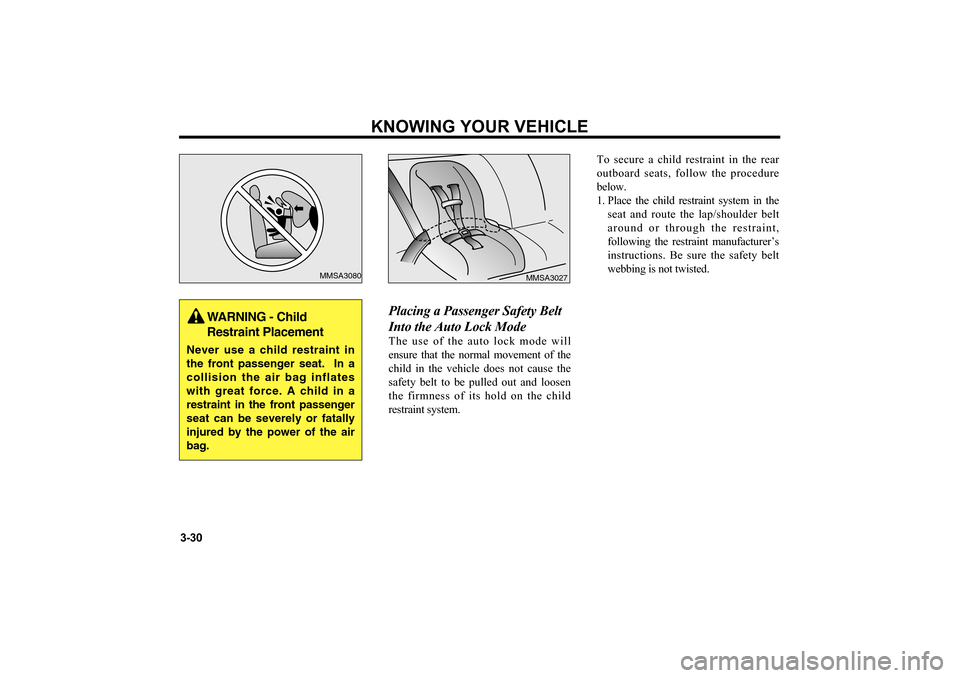
Placing a Passenger Safety Belt
Into the Auto Lock ModeThe use of the auto lock mode will
ensure that the normal movement of the
child in the vehicle does not cause the
safety belt to be pulled out and loosen
the firmness of its hold on the child
restraint system.To secure a child restraint in the rear
outboard seats, follow the procedure
below.
1. Place the child restraint system in the
seat and route the lap/shoulder belt
around or through the restraint,
following the restraint manufacturer’s
instructions. Be sure the safety belt
webbing is not twisted.
KNOWING YOUR VEHICLE
3-30
MMSA3080
MMSA3027
WARNING - Child
Restraint Placement
Never use a child restraint in
the front passenger seat. In a
collision the air bag inflates
with great force. A child in a
restraint in the front passenger
seat can be severely or fatally
injured by the power of the air
bag.
MS-CNA-Eng 3.QXD 7/25/2005 5:17 PM Page 30
Page 40 of 225
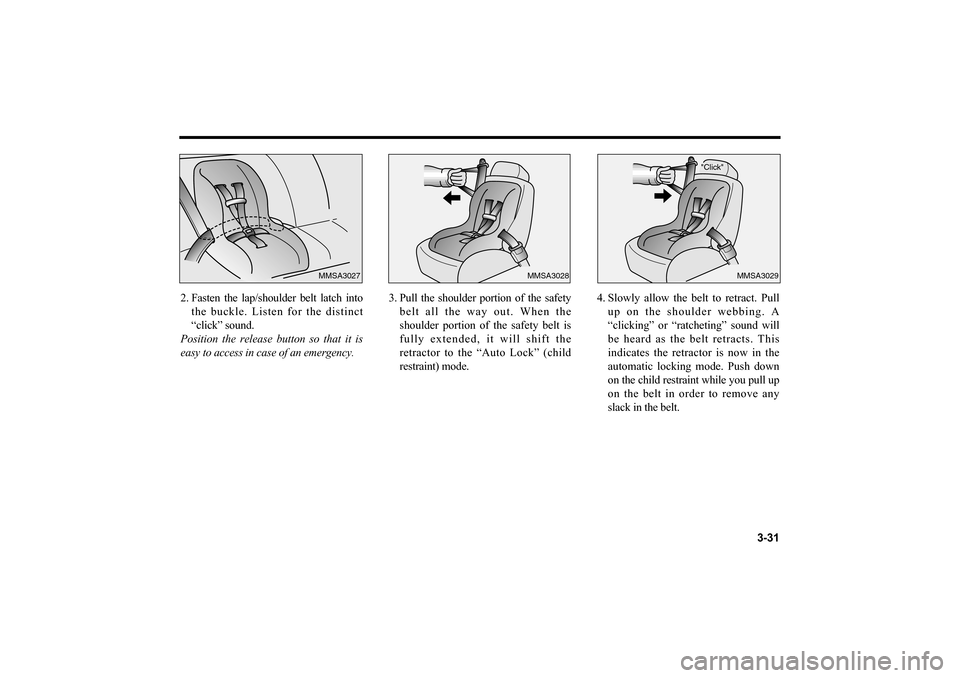
2. Fasten the lap/shoulder belt latch into
the buckle. Listen for the distinct
“click” sound.
Position the release button so that it is
easy to access in case of an emergency.3. Pull the shoulder portion of the safety
belt all the way out. When the
shoulder portion of the safety belt is
fully extended, it will shift the
retractor to the “Auto Lock” (child
restraint) mode.4. Slowly allow the belt to retract. Pull
up on the shoulder webbing. A
“clicking” or “ratcheting” sound will
be heard as the belt retracts. This
indicates the retractor is now in the
automatic locking mode. Push down
on the child restraint while you pull up
on the belt in order to remove any
slack in the belt.
3-31
MMSA3028
MMSA3027
"Click"
MMSA3029
MS-CNA-Eng 3.QXD 7/25/2005 5:17 PM Page 31
Page 41 of 225
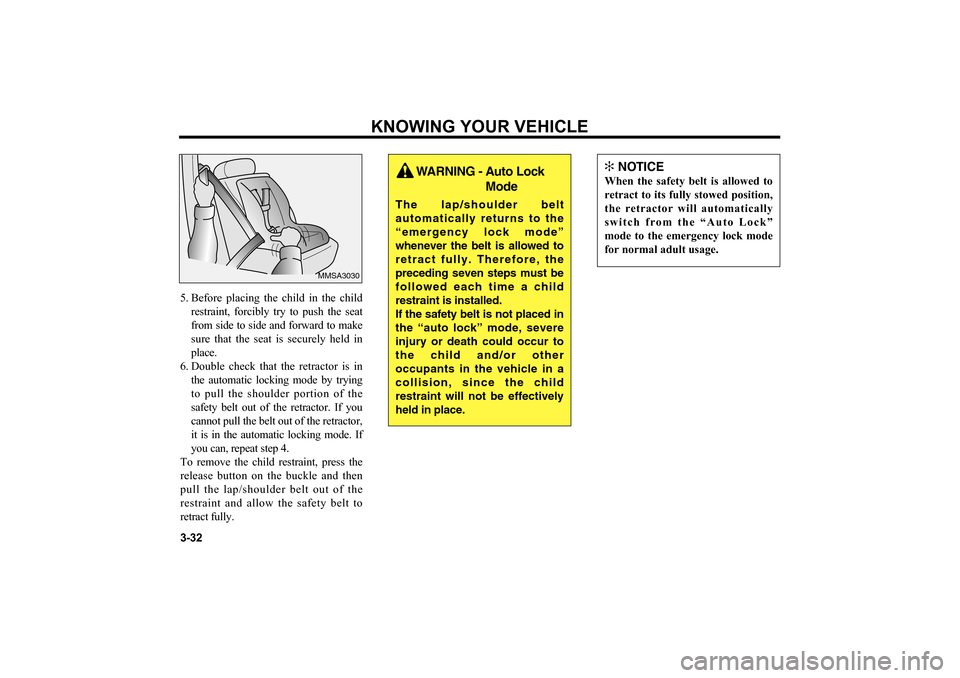
5. Before placing the child in the child
restraint, forcibly try to push the seat
from side to side and forward to make
sure that the seat is securely held in
place.
6. Double check that the retractor is in
the automatic locking mode by trying
to pull the shoulder portion of the
safety belt out of the retractor. If you
cannot pull the belt out of the retractor,
it is in the automatic locking mode. If
you can, repeat step 4.
To remove the child restraint, press the
release button on the buckle and then
pull the lap/shoulder belt out of the
restraint and allow the safety belt to
retract fully.
KNOWING YOUR VEHICLE
3-32
MMSA3030
✻
NOTICE
When the safety belt is allowed to
retract to its fully stowed position,
the retractor will automatically
switch from the “Auto Lock”
mode to the emergency lock mode
for normal adult usage.
WARNING - Auto Lock
Mode
The lap/shoulder belt
automatically returns to the
“emergency lock mode”
whenever the belt is allowed to
retract fully. Therefore, the
preceding seven steps must be
followed each time a child
restraint is installed.
If the safety belt is not placed in
the “auto lock” mode, severe
injury or death could occur to
the child and/or other
occupants in the vehicle in a
collision, since the child
restraint will not be effectively
held in place.
MS-CNA-Eng 3.QXD 7/25/2005 5:17 PM Page 32
Page 46 of 225
3-37
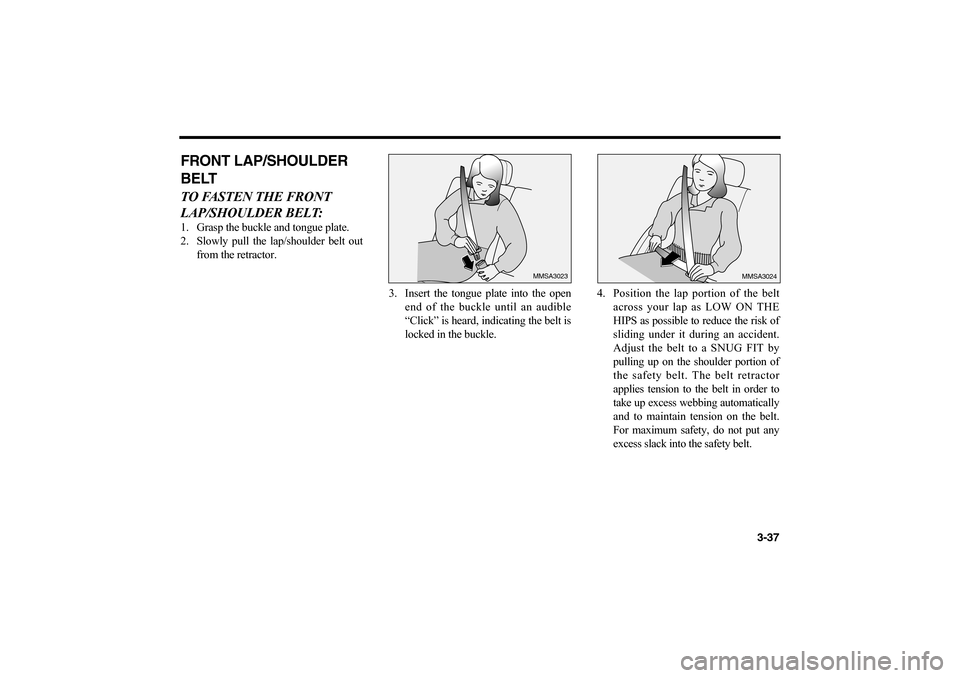
FRONT LAP/SHOULDER
BELTTO FASTEN THE FRONT
LAP/SHOULDER BELT:1. Grasp the buckle and tongue plate.
2. Slowly pull the lap/shoulder belt out
from the retractor.
3. Insert the tongue plate into the open
end of the buckle until an audible
“Click” is heard, indicating the belt is
locked in the buckle.4. Position the lap portion of the belt
across your lap as LOW ON THE
HIPS as possible to reduce the risk of
sliding under it during an accident.
Adjust the belt to a SNUG FIT by
pulling up on the shoulder portion of
the safety belt. The belt retractor
applies tension to the belt in order to
take up excess webbing automatically
and to maintain tension on the belt.
For maximum safety, do not put any
excess slack into the safety belt.
MMSA3024
MMSA3023
MS-CNA-Eng 3.QXD 7/25/2005 5:17 PM Page 37
Page 47 of 225
KNOWING YOUR VEHICLE
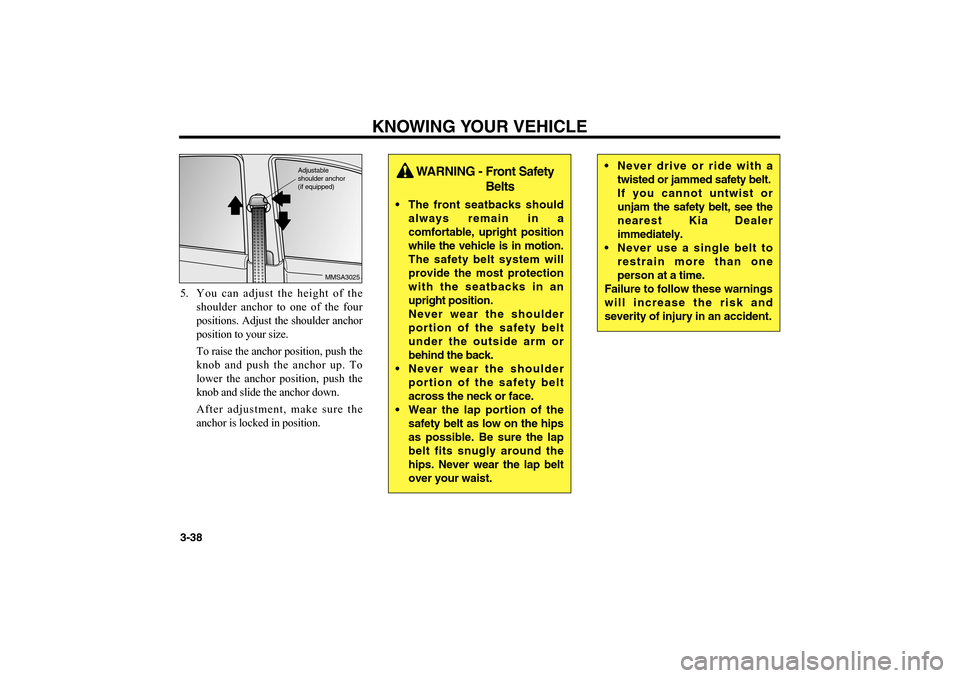
3-38 5. You can adjust the height of the
shoulder anchor to one of the four
positions. Adjust the shoulder anchor
position to your size.
To raise the anchor position, push the
knob and push the anchor up. To
lower the anchor position, push the
knob and slide the anchor down.
After adjustment, make sure the
anchor is locked in position.
MMSA3025 Adjustable
shoulder anchor
(if equipped)
WARNING - Front Safety
Belts
The front seatbacks should
always remain in a
comfortable, upright position
while the vehicle is in motion.
The safety belt system will
provide the most protection
with the seatbacks in an
upright position.
Never wear the shoulder
portion of the safety belt
under the outside arm or
behind the back.
Never wear the shoulder
portion of the safety belt
across the neck or face.
Wear the lap portion of the
safety belt as low on the hips
as possible. Be sure the lap
belt fits snugly around the
hips. Never wear the lap belt
over your waist.
Never drive or ride with a
twisted or jammed safety belt.
If you cannot untwist or
unjam the safety belt, see the
nearest Kia Dealer
immediately.
Never use a single belt to
restrain more than one
person at a time.
Failure to follow these warnings
will increase the risk and
severity of injury in an accident.
MS-CNA-Eng 3.QXD 7/25/2005 5:17 PM Page 38
Page 48 of 225
3-39
TO UNFASTEN THE FRONT
LAP/SHOULDER BELT:Press the release button on the buckle.
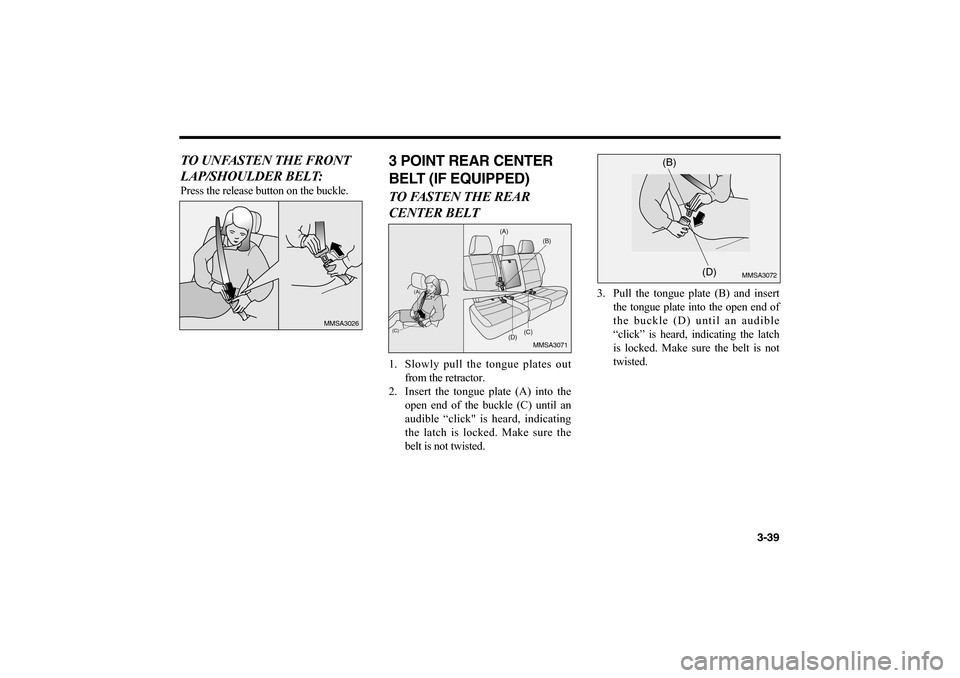
3 POINT REAR CENTER
BELT (IF EQUIPPED) TO FASTEN THE REAR
CENTER BELT1. Slowly pull the tongue plates out
from the retractor.
2. Insert the tongue plate (A) into the
open end of the buckle (C) until an
audible “click" is heard, indicating
the latch is locked. Make sure the
belt is not twisted.3. Pull the tongue plate (B) and insert
the tongue plate into the open end of
the buckle (D) until an audible
“click” is heard, indicating the latch
is locked. Make sure the belt is not
twisted.
(C)(B)
(D) (A)
(C)(A)
MMSA3071
(B)
(D)
MMSA3072
MMSA3026
MS-CNA-Eng 3.QXD 7/25/2005 5:17 PM Page 39
Page 49 of 225
There will be an audible “click” when
the tab locks in the buckle. The seat belt
automatically adjusts to the proper length
only after the lap belt is adjusted
manually so that it fits snugly around
your hips, if you lean forward in a slow,
easy motion, the belt will extend and let
you move around. If there is a sudden
stop or impact, the belt will lock into
position. It will also lock if you try to
lean forward too quickly.
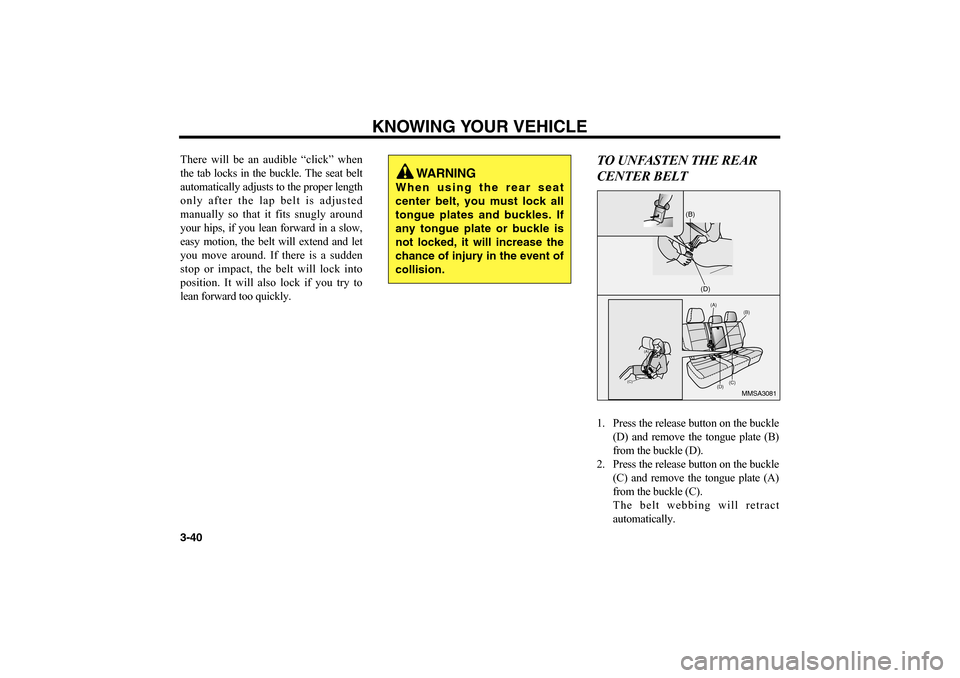
TO UNFASTEN THE REAR
CENTER BELT1. Press the release button on the buckle
(D) and remove the tongue plate (B)
from the buckle (D).
2. Press the release button on the buckle
(C) and remove the tongue plate (A)
from the buckle (C).
The belt webbing will retract
automatically.
KNOWING YOUR VEHICLE
3-40
(B)
(D)
(C)(B)
(D) (A)
(C)(A)
MMSA3081
WARNING
When using the rear seat
center belt, you must lock all
tongue plates and buckles. If
any tongue plate or buckle is
not locked, it will increase the
chance of injury in the event of
collision.
MS-CNA-Eng 3.QXD 7/25/2005 5:17 PM Page 40
Page 58 of 225
3-49
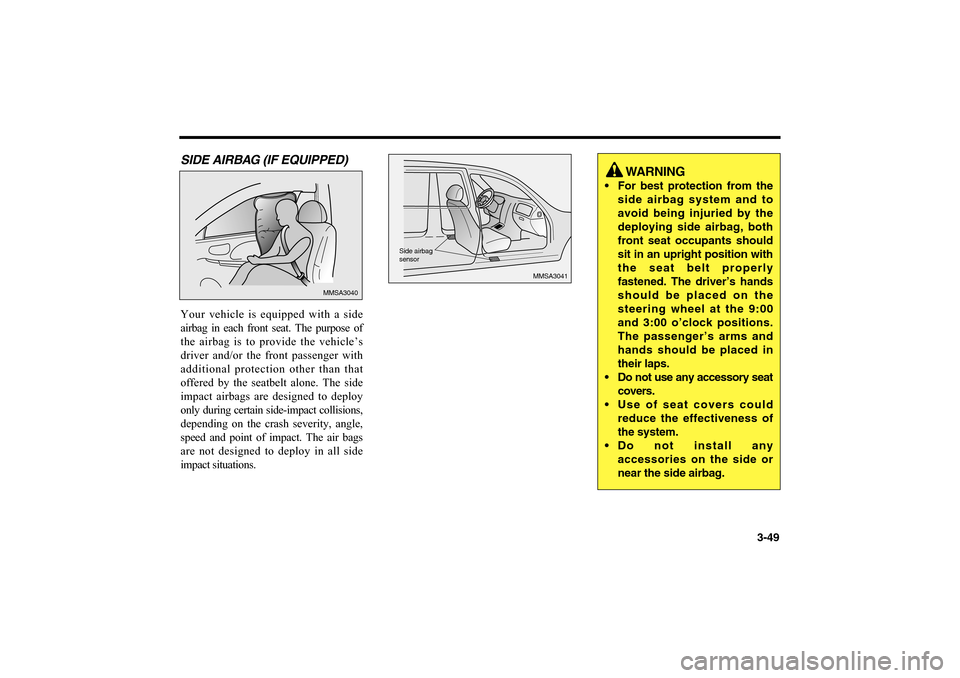
SIDE AIRBAG (IF EQUIPPED)Your vehicle is equipped with a side
airbag in each front seat. The purpose of
the airbag is to provide the vehicle’s
driver and/or the front passenger with
additional protection other than that
offered by the seatbelt alone. The side
impact airbags are designed to deploy
only during certain side-impact collisions,
depending on the crash severity, angle,
speed and point of impact. The air bags
are not designed to deploy in all side
impact situations.
MMSA3041 Side airbag
sensor
MMSA3040
WARNING
For best protection from the
side airbag system and to
avoid being injuried by the
deploying side airbag, both
front seat occupants should
sit in an upright position with
the seat belt properly
fastened. The driver’s hands
should be placed on the
steering wheel at the 9:00
and 3:00 o’clock positions.
The passenger’s arms and
hands should be placed in
their laps.
Do not use any accessory seat
covers.
Use of seat covers could
reduce the effectiveness of
the system.
Do not install any
accessories on the side or
near the side airbag.
MS-CNA-Eng 3.QXD 7/25/2005 5:17 PM Page 49